Click on graphic above to navigate the 165+ web files on this website, a regularly updated Gazetteer, an in-depth description of our island's internally self-governing British Overseas Territory 900 miles north of the Caribbean, 600 miles east of North Carolina, USA. With accommodation options, airlines, airport, actors, actresses, aviation, banks, beaches, Bermuda Dollar, Bermuda Government, Bermuda-incorporated businesses and companies including insurers and reinsurers, Bermudians, books and publications, bridges and causeway, charities, churches, citizenship by Status, City of Hamilton, commerce, communities, credit cards, cruise ships, cuisine, currency, disability accessibility, Devonshire Parish, districts, Dockyard, economy, education, employers, employment, environment, executorships, fauna, ferries, flora, former military bases, forts, gardens, geography, getting around, golf, guest houses, highways, history, historic properties, Hamilton, House of Assembly, housing, hotels, immigration, import duties, internet access, islands, laws, legal system and legislators, main roads, marriages, media, members of parliament, money, motor vehicles, municipalities, music and musicians, newcomers, newspaper, media, organizations, parks, parishes, Paget, Pembroke, performing artists, residents, pensions, political parties, postage stamps, public holidays, public transportation, railway trail, real estate, registries of aircraft and ships, religions, Royal Naval Dockyard, Sandys, senior citizens, Smith's, Somerset Village, Southampton, St. David's Island, St George's, Spanish Point, Spittal Pond, sports, taxes, telecommunications, time zone, traditions, tourism, Town of St. George, Tucker's Town, utilities, water sports, Warwick, weather, wildlife, work permits.



By Keith Archibald Forbes (see About Us).
While Bermuda is certainly an offshore international business and insurance center, it is not an international banking center. International banks, which in other offshore locations and also in many onshore jurisdictions, are allowed to register as banks and can operate in those countries, are not allowed in Bermuda to register or operate as banks.
2020. April 9. All of Bermuda’s banks decided to waive ATM fees for Bermuda dollar cash withdrawals for the period of “shelter in place” conditions. This means that customers of one bank will be able to withdraw cash from the ATM of other banks without financial penalty during the lockdown period. The news came in a statement from the Bermuda Bankers Association this afternoon. The BBA added: “Our members will each evaluate the need to continue this practice after the expiration of the current SIP mandate.” Banks were given special permission by Curtis Dickinson, the finance minister, to open for limited hours on one day per week during the lockdown period.
2020. April 9. Banks are to open their doors for one day a week to offer limited retail banking services. The initiative is designed primarily to assist seniors and other vulnerable members of society. The Bermuda Bankers Association has obtained approval from Curtis Dickinson, Minister of Finance, for the banks to have the limited opening opportunities to support “vulnerable” customers under the Shelter in Place, state of emergency conditions due to Covid-19. Services available are cheque cashing, cheque deposits, cash deposits through No-Wait Deposit depository, card collection, and statement production. Services available will be emergency cash withdrawal for deserving cases, debit card pick up, collections of tokens, wire and local bank to bank transfers for customers who have do not have Clarien iBank access or problems with tokens, and any other emergency needs.
2020. March 16. HSBC Bermuda, Butterfield Bank and Clarien Bank are all lowering their base lending rates for business and retail customers. All three banks said they were making their moves to help customers with the likely negative economic impact from the Covid-19 crisis. Yesterday, the US central bank, the Federal Reserve dropped its influential federal funds rate by one percentage point in an emergency measure, less than two weeks after a half-point cut for similar reasons. HSBC Bermuda’s base lending rate for business clients will be reduced from 4.75 per cent to 4.25 per cent, while the base lending rate for retail customers will be reduced from 3.75 per cent to 3.5 per cent. The rate reductions are effective May 1, HSBC said. Butterfield’s base rate for Bermuda dollar residential mortgages and consumer loans will decrease half a percentage point to 4.75 per cent. The rate decrease on personal loans is effective today while the rate decrease on Bermuda residential mortgages “will become effective as soon as practically possible”, the bank said. Clarien Bank said its Bermuda dollar personal base lending rate will be reduced by half a percentage point to 4 per cent and its Bermuda dollar commercial base rate by half a percentage point to 4.25 per cent. Borrowers will be notified of the effective dates in accordance with the terms of their facility. HSBC Bermuda added: “Additionally, the bank would like to remind its customers to proactively contact their banking relationship manager or make an appointment with the retail team if they are experiencing financial difficulties due to the pandemic. The bank will review each case on an individual basis to determine the most appropriate way to support customers that are facing particular challenges.” Michael Neff, Butterfield’s managing director in Bermuda, said: “It is our intention, with this significant decrease in rates, to help ease the financial burden on personal banking and business customers whose income may be impacted by the potential decrease in local economic activity associated with the health crisis. The bank is additionally reviewing the fee schedules and payment terms of select other products and may make changes to provide additional relief to customers during this challenging period, including providing extensions on repayment of credit card balances. We want our customers to know that we are here to support them, and those who may find themselves in financial difficulty should not hesitate to reach out to us to discuss their situations. Doing our part to help protect the health of our community and keep our economy functioning is our priority.” Clarien Bank explained in a statement: “Governments and financial institutions around the globe are implementing measures to reduce the negative economic impact resulting from Covid-19 and to create financial stimulus where possible. As a result, we will be making adjustments to our personal and commercial base lending rates.” Clarien added that it was enacting its business continuity plans to ensure minimal disruption to its day-to-day business.
2019. May 17. Bank customers with Bermuda dollar accounts will have up to $25,000 of their money protected should their local bank collapse. In such circumstances, they will receive compensation through the Bermuda Deposit Insurance Corporation, providing they fulfil the eligibility criteria. HSBC Bank Bermuda, Butterfield Bank, Clarien Bank and Bermuda Commercial Bank, are members of the scheme, and they are paying in to the pre-funded deposit insurance fund. The scheme provides a safety net for depositors, insomuch that if their bank fails they will get some or all of their deposited money returned, up to a maximum of $25,000 per depositor, per bank. The island is now among 143 countries and jurisdictions around the world that have deposit insurance schemes. Since the financial crisis of 2008, such schemes have become increasingly widespread as a way to give some protection to bank customers. They aim to give public confidence in the banking system and reduce the likelihood that depositors would panic and withdraw funds if there was sudden concern about the stability of a bank. In Bermuda, the idea of an insurance deposit fund was first proposed in 2010, with legislation the following year and more in 2016. The scheme has been working in the background for a few years, and was announced today. However, Bermuda’s insurance deposit fund is still in its early days of building up its reserves from premiums paid by the banks, and it is anticipated it could take another 15 to 20 years for it to have sufficient funds to cover its potential financial obligations. When asked what will happen if a bank fails in the meantime, Stephen Todd, chairman of the BDIC, said: “We would not wish to see such an event transpire. We would need to ensure that there is some framework in place, some contingencies to at least avoid such an eventuality. It is a process that really is a work in progress. It is not something that we can necessarily safeguard against, but we wish to ensure we take all the necessary steps to prevent it as best we can.” An information brochure that explains how the scheme works, mentions that the Bermuda Government is providing liquidity support to the scheme while the deposit insurance fund is being built up. The Royal Gazette is seeking clarity on what this would mean in terms of depositors being compensated up to the maximum level. The brochure also provides scenarios to show how the scheme works in different circumstances. A simple example would be if an individual has $20,000 in a Bermuda dollar account. If that customer’s bank failed, they would be eligible for $20,000 in compensation through the fund. On the other hand, if they had $50,000 in Bermuda dollar deposits, regardless of whether it was split across more than one account at the bank, they would be eligible for a maximum of $25,000 in compensation. The scheme covers accounts of individual and joint account holders, sole partnerships, partnerships, unincorporated associations, registered charitable organisations and corporate small businesses registered with the Bermuda Economic Development Corporation. It only applies to Bermuda dollar accounts, and there are no immediate plans to change that. Mr Todd said Bermuda dollar accounts are the primary and largest concentration of deposits held with local banks. “We feel it is first and foremost our responsibility to look after the Bermuda dollar deposits and then proceed accordingly,” he said. Curtis Dickinson, the finance minister, and Thomas O’Rourke, of the Bermuda Bankers Association, also spoke at the press conference where the BDIC and the deposit insurance scheme were announced. In prepared remarks, Mr O’Rourke said: “Public confidence reduces the likelihood that depositors of an individual financial institution will panic and withdraw funds suddenly if concerns arise about the condition of that institution. We have seen examples outside of Bermuda where concerns about one financial institution have at times led to concerns about others, resulting in so-called “contagion runs”. Thus, deposit insurance supports the stability and smooth operation of the entire financial system by providing insured depositors with prompt reimbursement or access to insured depositors’ funds. Delays in reimbursement can also cause financial hardship for depositors, who may need funds for everyday living expenses. A scheme that provides prompt reimbursement aids in enhancing public confidence in Bermuda’s financial sector and economy.” He said the Bermuda Bankers Association fully endorsed the scheme, which is mandatory for all licensed banks. The deposit insurance fund is being built up from premiums paid by the banks, currently calculated on qualifying insured deposits at the rate of 0.25 per cent, per annum, and also from earned investment income. In addition to the banks, the Bermuda Industrial Union Members’ Credit Union is being integrated into the deposit insurance scheme.
2020. March 12. Bermuda’s banks say they will work with customers who struggle financially in the event of coronavirus-related economic disruption. The Bermuda Bankers Association said last night that its members had been “very active in preparing for the potential public health actions that may be implemented in Bermuda” as a result of a potential Covid-19 outbreak. We are also aware of the potential economic consequences for our customers, if there are significant disruptions to our daily activities. BBA member banks will undertake good faith measures to work with customers who are struggling financially to ensure that they are made aware of the options available to them. We emphasize that customers who may be facing income dislocation due to this potential health-related emergency, should contact their respective bank at the earliest opportunity to explain the economic difficulties that they may be experiencing so that responsible options can be discussed.” The statement follows a call from the Bermuda Government for the island’s banks to cut their lending rates after the US Federal Reserve dropped its influential “fed funds” rate by half a percentage point last week. The island’s four banks — HSBC Bank Bermuda, Butterfield Bank, Clarien Bank and Bermuda Commercial Bank — are the members of the BBA and employ a combined total of about 1,200 people in Bermuda. All the banks have business continuity plans to respond to potential emergency situations, the BBA said, and all will be closely following announcements from the Emergency Measures Organisation. Italy, the country with the biggest outbreak of Covid-19 outside China, this week announced a freeze on mortgage payments after a nationwide lockdown. In the UK, the UK-wide Royal Bank of Scotland has offered similar relief to its customers.
2019. April 26. Bank workers need union protection, a labour leader said yesterday. Chris Furbert, head of the Bermuda Industrial Union, said the Butterfield Bank decision to shed staff and close the Rosebank branch underlined the case for trade union representation. Mr Furbert said: “I encourage all workers to get organized — I’m not saying they should join the BIU. There are other unions you should join that would give you some protection.” He told workers: “Become organized. That will hopefully give you protection against employers that are going to behave like the Bank of Butterfield.” He was speaking after the bank announced last Wednesday it had made 11 staff across two departments redundant and that 30 staff had opted for early retirement. Mr Furbert said: “I’m not sure where Butterfield has any kind of compassion.” He added that workers were not given “reasonable notice”. Mr Furbert said: “That has to be a cold feeling. I don’t envy the position those workers found themselves in. Bear in mind, in 2009 the Progressive Labour Party government gave Butterfield Bank a $200 million guarantee.” The Government bailed out the bank with a guaranteed preference share issue in the wake of the 2008 financial crash.
2019. April 17. Premier David Burt said this afternoon that the Bermuda Government was “disappointed at the loss of Bermudian jobs announced today by Butterfield Bank” — and would prioritise the diversifying the island’s banking sector. The Premier’s remarks came after 11 staff were axed, and 30 more have accepted early retirement packages. The cuts were announced by the bank in a statement this morning issued by the Bermuda Stock Exchange. Mr Burt voiced regret at the news, “especially in light of their recently announced record profits for 2018”. He added: “We are also concerned about the impact that these redundancies and early retirements have had on the affected employees. It is clear that Bermuda requires greater diversification in the banking sector to create more employment opportunities for Bermudians and more banking choices for Bermudian consumers. Consequently, the Government will increase our efforts to diversify our banking sector as a matter of national priority. In 2009 the Government of Bermuda stepped in to assist Butterfield Bank when its future, the security of depositors deposits and Bermudian jobs were in jeopardy. For the Bermudian workers who have been made redundant today, the Government intends to be there for you, just as we were for Butterfield Bank in 2009. I have asked the minister responsible for Workforce Development to make available the full array of services at her disposal to ensure that the affected employees are aware of and where applicable, paired with suitable employment opportunities, training or retraining needed to get them back to work. As Butterfield Bank has obligations to their shareholders, the Bermudians who now find themselves out of work have obligations to their families. We will do everything in our power to ensure that those former employees of Butterfield have the support needed to get through this difficult period.”
2019. March 7. A New York investment firm that is in the process of buying Bermuda Commercial Bank has “no plans with regard to gaming”, one of its principals insisted yesterday. Lewis Katz, managing partner of Permanent Capital, was asked by The Royal Gazette to comment on a statement made in Parliament on Friday by finance minister Curtis Dickinson, who said the Bermuda Casino Gaming Commission had “engaged in discussions” with BCB and two other local banks about accepting the proceeds of casino gaming. Mr Katz said: “We are still in the process of obtaining governmental and regulatory approvals to purchase BCB, we do not yet own the bank and have no plans with regards to gaming. We respect BCB, their board and management, and otherwise defer to them.” BCB CEO Hubert Esperon said: “In 2018, Bermuda Commercial Bank Limited met with the gaming commission. This meeting was mainly to explore the opportunity and challenges of the potential introduction of gaming to the island. As mentioned before, Bermuda Commercial Bank Limited has no plans at this time to bank the gaming industry in Bermuda.” The securing of a local bank with a US correspondent bank willing to accept the proceeds of casino gambling has long been viewed as a major hurdle for the Government and the commission as they attempt to get the island’s fledgling casino industry off the ground. Mr Dickinson told the House of Assembly last week: “As a high priority, the commission has engaged in discussions with three local banks, namely the Bank of NT Butterfield, Clarien Bank and the Bermuda Commercial Bank to secure a local bank with a US correspondent bank relationship that would accept the proceeds of the casino gaming operations. Further discussion will be carried out with the BMA (Bermuda Monetary Authority) as banking regulator and the US correspondent banks.” HSBC took a global decision to limit its involvement with the gambling sector, while Clarien and Butterfield have yet to commit to any involvement. A Butterfield spokesman told The Royal Gazette: “We can confirm we are engaged in ongoing dialogue with the commission but have no additional comment at this time.” A spokesman for Clarien Bank said: “We continue to work with all of the various stakeholder groups in order to inform our risk appetite for this sector.” The Royal Gazette asked New York-based Signature Bank, which is to offer banking services to Bermuda’s fintech start-ups, if it had plans to handle the proceeds of casino gaming on the island. Spokeswoman Susan Turkell said today: “We are not banking gaming companies.” It was announced last month that Permanent Capital had struck a deal to buy BCB from parent company Somers Ltd, with plans to grow the business and expand its services. Mark Pettingill, Permanent’s lead counsel in Bermuda, said then that providing banking services to the gaming industry was “unequivocally not part of the business plan”. However, he added: “The bank is open to banking any industry, as long as it meets all Bermuda regulatory requirements.” Bermudian businessmen John Tartaglia and Michael Moniz have been named on a notice to incorporate Permanent Capital Holdings Ltd, a local affiliate company of Permanent Capital. The pair own MM&I Holdings, a company that was poised to make tens of millions of dollars from a controversial casinos deal with the Government. They attempted to land a lucrative contract to provide a cashless gaming system to any casinos that opened in Bermuda, as outlined in a special report in The Royal Gazette in October 2017. Mr Moniz and Mr Tartaglia were listed on the notice of incorporation alongside Mr Pettingill and Grant Spurling, both lawyers from Chancery Legal law firm, and Mr Katz and Logan Sugarman, of Permanent Capital. A spokesman for Permanent Capital said Mr Tartaglia and Mr Moniz were directors of a local holding company that was being used to enable the merger agreement to go ahead, and neither they, Mr Pettingill nor Mr Spurling would be the ultimate owners of BCB once the transaction was completed. The ultimate owners, it was stated, would be Mr Katz, Mr Sugarman and Bermudian-based businessman Chris Maybury. Mr Sugarman’s involvement in the purchase was nixed by Permanent Capital, after the Florida-based Offshore Alert website revealed details of US lawsuits and judgments relating to him.
2019. March 2. The Bermuda Casino Gaming Commission is in talks with three locals banks as it attempts to get the island’s fledgling casino industry off the ground, finance minister Curtis Dickinson said yesterday. Mr Dickinson told Parliament the commission is trying to secure a local bank with an American correspondent bank relationship which could accept the proceeds from gaming. He said the commission had engaged in discussions with Butterfield Bank, Clarien Bank and the Bermuda Commercial Bank as a “high priority”. The securing of a bank has long been regarded as a major stumbling block for the casino industry. Clarien told The Royal Gazette a year ago it would make a “risk-based decision” on whether to have further discussions with its stakeholders, including its overseas correspondent banks, once it had a better understanding of the island’s casino legislation and regulations. Butterfield declined to comment when approached by the Gazette at that time. Bermuda Commercial Bank is being sold to New York investment firm Permanent Capital, whose lead counsel in Bermuda is Mark Pettingill, the former One Bermuda Alliance MP. Mr Pettingill told the Gazette last month that providing banking services to the gaming industry was “absolutely not a focus” and did not form part of BCB’s business plan. Mr Dickinson added further discussion will be carried out with the Bermuda Monetary Authority as banking regulator and the US correspondent banks. In an extensive Ministerial Statement on gaming, Mr Dickinson also told the House of Assembly responsibility for betting shops would move from the betting licensing authority to the commission, and that the industry’s legislative framework would be revised. David Burt, the Premier, previously noted that the Bahamas had been faulted in 2016 over money-laundering issues with its betting shops. Former executive director Richard Schuetz, in his resignation letter, pointed to “glaring deficiencies in the anti-money-laundering regime of this island’s betting sector”. Mr Dickinson said yesterday: “In order to ensure this sector is regulated thoroughly and to a level or standard equivalent to mature regulatory jurisdictions, the current legislative framework will need to be revised. The commission is poised to complete the legislative framework including AML/ATF controls for licensing and supervision of betting and other non-casino gaming activities in 2019. Consultation with the betting operators regarding the legislative changes and the pending compliance requirements is ongoing. This consultation has involved educating them on the introduction of a new AML/ATF regime and the subsequent impact this may have on resources and their operations. The commission will assist them in understanding the importance of adopting policies that create robust internal controls that will meet the new legislative requirements. The commission is also drafting a Licensing Conditions and Code of Practice document which will be introduced in tandem with the legislation governing the betting sector.” Mr Dickinson also pointed to the struggles to find a new executive director to replace Mr Schuetz, who left the post in December 2017. He said: “It has been decided to engage the services of an executive recruiter to assist with securing a suitably qualified leader for the commission’s team as soon as possible.”
2019. January 25. A fintech-friendly bank is to set up on the island and David Burt will be revealing details next week, according to a media report out of Switzerland. The Premier made the revelation in an interview today with the BBC’s Priya Patel at the Consensys Lounge in Davos, Switzerland, where he is heading the Bermuda delegation at the World Economic Forum. “I’m proud to say that next week we’ll be making an announcement revealing that a bank will be set up in the country that will start accepting crypto and blockchain companies,” Mr Burt said in the interview, according to a report on the CCN website. The discussion featured on the importance of focusing on quality over quantity when accepting businesses, CCN reported, adding that this was an issue which Mr Burt said was the main focus for Bermuda looking at crypto and blockchain companies. The island’s banks have shied away from fintech start-ups, proving an obstacle for the fledgling industry. In July, the Bermuda Government made amendments to the Banks and Deposit Companies Act 1999 to create a new type of restricted licence for banks catering to the fintech industry. At the time, Mr Burt said: “Despite the robust regulations put in place, to date our four local banks have been unwilling to offer services to newly incorporated fintech and distributed-ledger technology companies. “This is a problem that we must fix or else Bermuda will not be able to realize the possibility of economic growth that can come from a fintech industry on our shores.” Last October, Mr Burt said he had met in New York with “a number of banks that we’re looking to entice into the Bermuda market, who might have an appetite for this type of asset”.
2018. July 28. MPs approved a new type of banking licence to cater to Bermuda’s fintech industry last night. David Burt, the Premier and Minister of Finance, told the House of Assembly that the restricted licence would allow fintech companies access to a Bermuda bank account and the chance to be part of the island economy. He said: “Despite the robust regulations put in place, to date our four local banks have been unwilling to offer services to newly incorporated fintech and distributed ledger technology companies. This is a problem that we must fix or else Bermuda will not be able to realize the possibility of economic growth that can come from a fintech industry on our shores.” Mr Burt added: “This Government believes that fintech companies that are licensed to participate in legal business ventures in Bermuda should not be treated differently and should not be shut out from participating fully in the local economy. It was therefore incumbent on this Progressive Labour Party government to find a solution to this problem.” Mr Burt said the amendments to the Banks and Deposit Companies Act 1999 would solve the problem. Jeanne Atherden, the Leader of the Opposition, the One Bermuda Alliance, asked how many banks would be set up under the restricted licence. Mr Burt said the number of banks would be driven by market demand. Cole Simons, the Shadow Minister of Education, backed the Bill but emphasized the need for it to be implemented in a manner that is “measured, intentional and acceptable by the regulators and industry so that our banking fraternity is not compromised and that we can still go to the international markets knowing that our banking industry is first-class, reputable and functional”. Mr Simons said he was also concerned “that we may be traveling too quickly in that we are over-promising and under-delivering”. He added some interested parties said the concept was right but were not satisfied that all the regulations and safety precautions were in place. But Wayne Caines, the Minister of National Security said: “Yes, we are moving at a rapid pace but the steps are deliberate. The steps are consultative and they are in keeping with global best practices.” Kim Swan, a PLP backbencher, spoke in support of the Bill and encouraged opponents of a fintech industry to look at the opportunities it presented. Chris Famous, also a PLP backbencher, said innovation was important. He added that Bermuda’s strides in the fintech industry had been praised by finance ministers from across the Caribbean at the recent Caricom conference in Jamaica.
2018. June 29. The Bermuda Government’s fintech plans have met “understandable resistance” from banking, David Burt told the House of Assembly today. The Premier spoke of the need to resolve the issue surrounding the new fintech which has been attracted to the island in recent weeks. He said legislation to create a “new class of bank” will be brought to the House to provide banking services to Bermuda-based fintech companies. Restrictive banking licenses will be introduced, and consultation has begun on expanding the types of banks that can operate in Bermuda to serve the public. “Bermuda must be nimble, or we will be left behind,” Mr Burt said, calling the proposals “critical”. The Premier said: “Yesterday afternoon, because this Government believes in consultation, I convened a meeting with the Bermuda Banking Association at the Ministry of Finance and I have their support.” He added: “The fact is that local banks do not currently have the risk appetite to accept persons in the digital asset space.”
2017. June 26. Home-grown Bank of Butterfield has outstripped global giant HSBC to become Bermuda’s biggest bank. Butterfield was listed as having assets of $11.1 billion last year, compared to $8.7 billion for HSBC Bermuda, overtaking its rival by a sizeable margin. A KPMG report into the state of the island’s banking industry said: “The change in position arose as Butterfield completed their acquisition of HSBC’s private banking operations in April 2016.” But the banking sector as a whole in Bermuda shrunk by around $1.49 billion last year, a 6 per cent drop. Clarien Bank had more than $1.1 billion in assets in the same period, while Bermuda Commercial Bank’s assets totaled a little over $649 million. Net profits across the industry went up by $26 million, some 15 per cent compared to 2015.The details were revealed in the latest Bermuda Banking survey carried out for KPMG’s Insights magazine. Craig Bridgewater, head of banking at KPMG in Bermuda, said: “Six per cent is not a big number and what’s happened is there have been some movements in the industry.“ HSBC sold its private banking to Butterfield and Butterfield is restructuring its business." He added: “From time to time, customers may move funds around in the nature of their business — large reinsurance claims could see funds leave banks. ”Mr Bridgewater said that since the Insights survey was first produced six years ago, regulation of the sector had increased. He said that the impact of stricter regulation had been a major topic in the Insights round table featuring the heads of the four island banks. “Customer experience remains of paramount importance and investment in technology enablement has the potential to benefit the business, employees and customers.” According to the survey, despite the drop in assets the banking sector remained stable. "The cost-to-income ratio, a key performance indicator for the productivity and efficiency of banks, has remained in line with the five-year average." Mr Bridgewater said: “Clearly, there is the regulatory environment and that continuously becomes more of a challenge. I don’t see any weakness in there so far — they have been able to absorb these challenges.” He added: “It has been an eventful year for Bermuda’s banking sector. Butterfield listed on the New York Stock Exchange, HSBC sold their private banking operations, BCB moved into its new premises and Clarien received a significant capital injection.” HSBC reported $117 million in profits for 2016, up $34 million, or 34 per cent, compared to the previous year. Butterfield made $116 million profits over the same period up $37.8 million, or 48 per cent, compared to 2015.Clarien Bank ended the year with $1.2 million in net profits, more than double the 2015 figure, while BCB had a net loss $6.63 million, put down to poor performance of investments, as well as currency depreciations as result of the fall in sterling after the UK voted to leave the European Union.
Bermuda banks are below listed by size, not in alphabetical order.

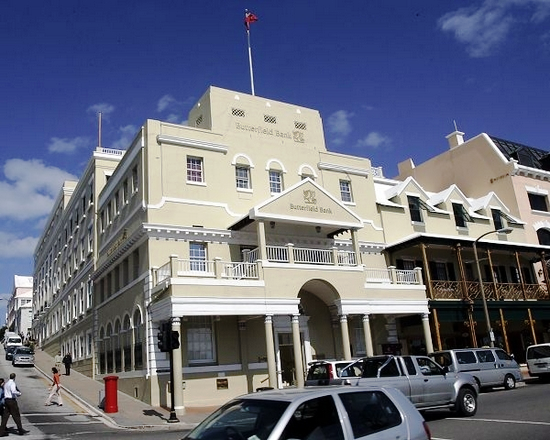
65 Front & Reid Streets, Hamilton HM 12. Phone 295-1111. Like all local banks, charges a monthly checking account fee.
2020. February 12. Butterfield Bank has reported a profit of $43.9 million, or 82 cents per share, for the fourth quarter. That’s down from the $46.2 million, or 87 cents per share, it made in the same quarter of 2018. For the full year, the bank’s net income was $177.1 million, or $3.30 per share, down from $195.2 million, or $3.50 per share, year-on-year. However, core net income was almost $1 million higher at $197.9 million. During the past year, Butterfield acquired the ABN Amro (Channel Islands) banking business. “With a relatively small market share in the Channel Islands, we are now pursuing growth to complement and balance our profitable and well-established banking franchises in Bermuda and Cayman,” Michael Collins, Butterfield’s chairman and chief executive officer, said. “With the acquisition, we now have a larger and more diversified balance sheet supported by investment grade credit ratings from S&P, Moody’s and KBRA.” He said the US dollar interest rate environment had been challenging in the latter half of 2019, and the bank had achieved “strong and stable” core net income. During the quarter, the bank completed its 2.5 million common share repurchase programme, and authorized a new programme for the repurchasing of up to 3.5 million shares. Mr Collins said: “Continued share repurchases helped achieve a core net income per diluted share improvement of 5 per cent and core return on average tangible common equity remained at industry-leading levels. Throughout the year, we continued to emphasize cost management initiatives and furthered our plans to leverage Group service centres, which helped us achieve a core efficiency ratio1 of 62.2 per cent in 2019.” Mr Collins also congratulated the bank’s team in Cayman for opening the Camana Bay Banking Centre, in Grand Cayman, this week. “Camana Bay is a fantastic location and a great start to the roll out of our updated Butterfield brand. We are confident that this investment will solidify and grow our retail and imaret corporate banking market share in the Cayman Islands for years to come. Our investment in this new branch signals our confidence in Cayman and the desire to further enhance our offerings in this important market.” Fourth quarter highlights included a return on average common equity of 18 per cent, and a net interest margin of 2.59 per cent. Non-interest income for the quarter was $49.7 million, up from $45.7 million a year ago, however non-interest expenses were higher at $93.9 million from $83.5 million in the same period during 2018. The non-performing loans ratio for the year was 1 per cent, down from 1.2 per cent in 2018. Looking ahead, Mr Collins said: “As we enter 2020, Butterfield’s strong balance sheet, capital efficient fee businesses, thoughtful capital management, and selective acquisition strategy should continue to provide long-term value for our shareholders. Finally, I would also like to thank our existing and new customers for their business and partnership with Butterfield during 2019 and to all Butterfield Group employees for their commitment to excellent customer service.” The bank has declared a 44 cents quarterly dividend to be paid on March 11. Before the release of the earnings statement, the bank’s shares closed at $34.51, up 0.58 per cent, on the New York Stock Exchange, and unchanged at $34.25 on Bermuda Stock Exchange.
2019. December 3. Butterfield Bank’s board of directors has approved a new $125 million share repurchase programme. The programme, which was announced in a filing with the Bermuda Stock Exchange, will enable the bank to buy back up to 3.5 million of its own common shares through February 28, 2021. Michael Collins, Butterfield’s chairman and chief executive officer said: “Having the flexibility to repurchase shares is an important aspect of our capital management strategy, complementing our quarterly cash dividend payments and maintaining the ability to support organic growth and make strategic acquisitions in our core markets. “We see significant value in repurchasing Butterfield shares and appreciate the confidence and support of the board with this new authorization.” The timing and amount of any share repurchases will be determined by bank management based on its evaluation of market conditions and other factors that include Butterfield’s share price and the availability of alternative capital investments. Repurchases under the new share repurchase programme may be made in the open market or through privately negotiated transactions. The new programme will come into effect following the completion of the existing 2.5 million share repurchase authorization that was announced on December 6, 2018, which currently has approximately 225,000 shares remaining. Butterfield also said that during November it spent around $12.9 million buying back 383,600 of its own shares at an average price of $33.79 per share.
2019. December 2. Butterfield Bank has been named Bank of the Year in Bermuda for the seventh consecutive year. The award for 2019 was bestowed upon Butterfield by UK-based international banking industry periodical The Banker, a publication of The Financial Times, which annually selects banks in more than 100 countries to receive its Bank of the Year awards. In making their selections, Butterfield said, The Banker’s global editorial team considers not only a bank’s financial performance, but also strategic initiatives, innovative use of technology and service delivery channels, and efforts to extend banking services to all parts of the community. Michael Neff, Butterfield’s managing director in Bermuda, said: “Having earned the Bank of the Year distinction for seven straight years in Bermuda is a point of pride for all of us at Butterfield. The last few years have been a period of strategic growth and change for Butterfield Group, during which we’ve expanded our ownership base and extended our geographic reach. But our focus on serving the needs of our clients in Bermuda has been unwavering, and our international growth has enabled us to enhance the financial solutions we’re able to offer here. This award reflects our commitment to Bermuda, and the efforts of our dedicated team of banking, trust and investment professionals who strive to exceed clients’ expectations every day, at every point of service. I would like to take this opportunity to thank them, and also thank our clients for their ongoing loyalty to the bank.” Earlier this year, Butterfield was named Best Private Bank in Bermuda by PWM/ The Banker, the company said. Butterfield also received the Bank of the Year 2019 award for the Cayman Islands, the fifth time it has received the award during the last seven years, the company said. A full listing of winners will be published in the December edition of The Banker.
2019. July 24. Butterfield Bank’s second-quarter net income declined by more than $11 million year over year due to a number of restructuring initiatives. Net income for the quarter was $38.6 million, compared to $49.7 million in the second quarter of 2018, and $52.1 million for the first quarter of 2019. The $13.5 million decrease in net income in the second quarter over the previous quarter was attributed to a number of factors, the bank said. There was a $9.3 million increase in staff-related costs due to cost restructuring initiatives in Bermuda and the Channel Islands and costs associated with the departure of a senior executive. Interest expense on deposits increased by $1.1 million due principally to higher volumes and rates of term deposits, while there was a $1.7 million decrease in interest income on deposits with banks due principally to lower US dollar market rates and underlying currency mix of customer deposits. There was a $1.6 million decrease in total gain/losses due principally to gains realised on the liquidation settlement from a former investment in a SIV [structured investment vehicle] in the first quarter of 2019, and a $900,000 decrease in provision for credit losses, due principally to a larger release in the current quarter when compared to the prior quarter. In addition, there was a $900,000 increase in banking fees due to both higher transactional volumes of credit card transactions and improved interchange rates, and a $1.5 million increase in the remaining non-interest expense items, due principally to higher technology, property, and professional services expenses related to the timing of projects and acquisition-related costs, the bank said. Return on average common equity was 17.1 per cent and the core return on average tangible common equity was 24.6 per cent. Butterfield’s board declared a dividend of 44 cents per share to be paid on August 16 to shareholders of record on August 5. The bank’s previously announced acquisition of ABN AMRO (Channel Islands) Ltd closed on July 15. “Butterfield delivered strong financial results in the second quarter of 2019, with increasing non-interest income, growth in investments and continued expense management,” said Michael Collins, Butterfield’s chairman and chief executive officer. “We continue to focus on maintaining industry leading profitability throughout the interest rate cycle and have taken demonstrable actions with improving operating leverage, capital management and growth through acquisitions. Last week we announced the closing of the ABN AMRO (Channel Islands) acquisition and are very pleased with the closing process and the quality of new employees and customers to Butterfield in Guernsey. We expect the full operational integration of banking platforms to take up to 12 months. Importantly, this acquisition will elevate Butterfield’s stature and growth prospects in the Channel Islands and, as a consequence of our larger presence, we expect to achieve market synergies and consolidation benefits. We remain committed to disciplined and balanced capital management and believe the combined dividend and share-buyback represent an attractive and sustainable return profile for our shareholders.” Net interest income for the second quarter was $85.2 million, a decrease of $2.8 million compared with $88 million in the previous quarter and $87.4 million in the second quarter of 2018. The decrease in the second quarter of 2019 compared to the prior quarter was due primarily to lower short-term and reinvestment market rates, while customer deposit levels remained stable. Non-interest income was $44.2 million for the second quarter, compared with $43.4 million in the previous quarter and $41.9 million in the second quarter of 2018. The increase over the prior quarter was attributable primarily to higher banking revenue due to increased credit card fee income and improved asset management, trust and custody services fees. Non-interest expenses of $91.7 million were elevated in the second quarter of 2019 due to the closure of the Rosebank branch in Bermuda, a voluntary early retirement programme and the costs associated with the departure of a former senior group executive, the bank said. The current total regulatory capital ratio as at June 30, 2019 was 22.7 per cent as calculated under Basel III, compared to 22.4 per cent as at December 31, 2018. During the second quarter, Butterfield repurchased 340,000 common shares at an average price of $36.92. Butterfield has 800,000 shares remaining for repurchase under the bank’s current share repurchase plan authorization. Following the announcement of the ABN AMRO (Channel Islands) Ltd acquisition on April 25, the bank paused its share buyback activity and intends to resume common share repurchases later in the year, subject to market conditions, it said.
2019. July 15. Butterfield Bank announced completion of the acquisition of ABN AMRO (Channel Islands) Ltd, the Channel Islands-based banking subsidiary of ABN AMRO Bank NV, following receipt of all regulatory approvals. Effective today, ABN AMRO CI has been renamed Butterfield Bank (Channel Islands) Ltd, the company announced. Over the next 12 months, Butterfield said it anticipates that BBCI will be fully integrated with Butterfield Bank (Guernsey) Limited, which has operated in the Channel Islands for more than 45 years, and all of Butterfield’s Guernsey banking clients will be served by the combined bank. Michael Collins, Butterfield’s chairman and chief executive officer, said: “We are excited to close the acquisition of ABN AMRO’s banking business in the Channel Islands, which is progressing generally as planned and consistent with our expectations announced on April 25, 2019. Butterfield’s combined and expanded banking presence in Guernsey and Jersey now represents a substantial part of our group’s banking business and supports our view of the Channel Islands as a leading international financial centre and a growth market for Butterfield.” He added: “I am particularly pleased to welcome our new colleagues in the Channel Islands to Butterfield. The team has a well-earned reputation for innovation and excellent client service, which we intend to continue in our goal to deliver superior products and service to our customers. As we initiate our integration plans and bring together our teams and systems, we remain focused on delivering a seamless transition to employees and customers. We are committed to communicating with stakeholders our integration progress in a transparent and timely manner. We look forward to growing Butterfield in the Channel Islands together.” The statement said that BBCI will operate within the Butterfield group as integration plans for clients and personnel within a combined Butterfield Guernsey bank are being rolled out. Consequently, the company said, there are no immediate changes to relationship management contacts, products or services.
2018. February 15. Butterfield Bank agreed to buy Deutsche Bank’s banking businesses in the Cayman Islands, Jersey and Guernsey — a deal that could increase its deposit base by about one fifth. The news came as the Bermudian-based bank declared net income of $40.3 million for the fourth quarter of last year, which completed a year of record profits of $153.3 million for the bank, up from $115.9 million in 2016. Further good news for shareholders came with a 19 per cent hike in the quarterly dividend payment to 38 cents per share and the announcement of Butterfield’s plans to buy back up to one million of its own shares. “I am pleased to report that Butterfield achieved record profits in 2017,” said Michael Collins, Butterfield’s chairman and chief executive officer. “These strong results were driven by our specialized banking and wealth management businesses that generate consistent fee income and an expanding net interest margin that benefited from our efficient deposit franchise and a rising rate environment. We delivered core net income of $158.9 million, up $20.3 million or 14.6 per cent year-on-year, and a core return on average common equity of 19.7 per cent, driven by strong performances in our core banking markets, as well as strong growth in our UK mortgage business.” The deal with Deutsche Bank is the second acquisition Butterfield has made from the German financial-services giant after it agreed last October to buy the company’s Global Trust Solutions business. “The GTS integration process is well under way and anticipated to close early in the second quarter of 2018, ahead of plan,” Mr Collins said. “We are pleased that over 90 per cent of the staff have now accepted employment agreements with Butterfield. This morning we announced that we have reached a second agreement with Deutsche Bank to acquire their banking businesses in the Cayman Islands, Guernsey and Jersey. We are very excited about this acquisition as it could increase our deposit base by about 20 per cent once integrated. It will help us establish a foothold in Jersey, an attractive banking market, as well as increasing our scale and market share in Cayman and Guernsey. The customer base has a very similar profile to our existing banking business and we look forward to welcoming the new relationship teams and their clients to the Butterfield Group.” Results for the fourth quarter of 2017 included lower credit costs with a release of provision for credit losses of $5.4 million compared with a release of provision for credit losses of $0.9 million in the fourth quarter of 2016. In the fourth quarter of 2017 the provision release was partially offset by $2.5 million of valuation loss adjustment on a foreclosed property included in other real estate owned.
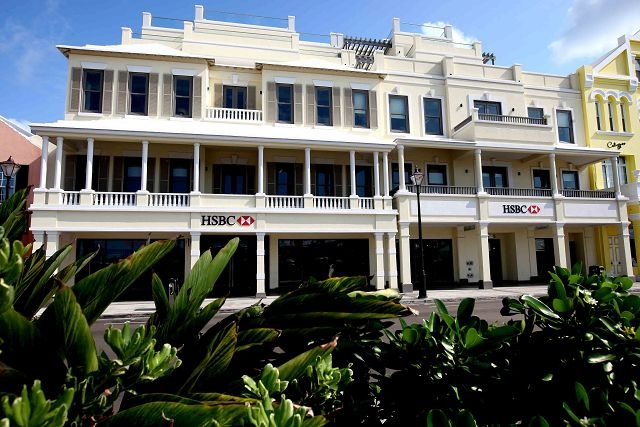
HSBC, Bermuda, Royal Gazette photo
Harbourview Centre, Front and Reid Streets, Hamilton. Phone 295-4000. Fax 295-7093. Since 1889. Formerly the Bank of Bermuda Limited. The largest by a considerable margin and most profitable Bermuda bank, especially since February 2004 under HSBC ownership when acquired for US$1.3 billion. At HSBC acquisition the bank employed 1,050 people but reduced this to about 730 in 2012. About 47% of the local banking market. Charges a monthly checking account fee.
2020. April 7. HSBC Bermuda pledged to donate $180,000 to support those impacted by Covid-19. An allocation of $140,000 will be divided among six local charities that support seniors, children and education, single-parent homes, vulnerable individuals and the food insecure population in Bermuda. And a further $40,000 has been pledged to support two local charities that will be nominated by HSBC staff in the coming weeks. The bank said it was adopting “a broad-based, community-support approach” in recognition of the increasing pressures facing the charitable sector, as they work to assist people impacted by the pandemic. Steve Banner, HSBC Bermuda CEO, said: “There is a large cross-section of our community that is confronting, or soon will, extremely difficult challenges directly attributed to this global pandemic. As a corporate donor, HSBC seeks to be both strategic and considerate when providing support to local charities. We recognise that, in addition to the six local charities already selected, there will be more needing support. A further $40,000 has been pledged to support two local charities that will be nominated by HSBC staff in the coming weeks to directly address Covid-19 related challenges.” HSBC Bermuda contributes approximately $1 million in funding through its charitable giving, donations and sponsorships activities, the bank said.
2020. March 2. HSBC Bermuda’s net profit rose 3 per cent to $143 million last year. Total operating income before expected credit losses was $281 million, in line with the prior year. The bank said decreases in net interest income were offset by higher net fee income, dealing profits, and gains on financial investments. Change in expected credit losses for 2019 was a $9 million charge, compared to a $3 million release in 2018. The charge was mainly incurred on residential mortgage lending, the bank said. The overall level of impaired loans remained consistent at around $360 million. Total operating expenses decreased by $14 million, or 10 per cent, to $129 million, as a result of lower litigation expenses and prudent cost controls, the bank said. The cost efficiency ratio improved in 2019 to 46 per cent from 51 per cent in 2018. Steve Banner, chief executive officer and director, HSBC Bermuda, said: “The level of expected credit losses for the year was higher than last year but within expectations. Our balance sheet remains conservatively positioned from a capital and liquidity perspective.” He added: “The results for the 2019 financial year demonstrate the resilience of our business in Bermuda. Our revenues remained stable, despite some headwinds, and we managed our costs prudently. During the year we helped many Bermudian companies gain access to international capital and continued to fulfil our objective of providing international connectivity for Bermuda.” Total assets increased by 4 per cent over the year to $8.38 billion as of December 31, 2019. Total loans and advances to customers were $2.17 billion the end of last year, a fall of 1 per cent from 12 months earlier. Total allowance for expected credit losses as a percentage of total gross loans and advances to customers decreased marginally to 5.6 per cent at December 31, 2019, compared with 5.7 per cent at the prior year end. Total capital adequacy ratio was 24 per cent at year end, a decrease from 26 per cent a year earlier. Mr Banner added: “I was proud to see HSBC’s continued support for the local community. In 2019 our staff contributed over 1,300 hours of volunteering for worthy local causes during company time. On behalf of the board, I would like to thank all our customers for placing their trust in HSBC and our hard-working employees for their dedication in serving our customers and our community.”
2020. February 19. HSBC Holdings plans to shed about 35,000 jobs — 15 per cent of its global workforce — over the next three years, the bank said yesterday. Any potential impact on HSBC Bermuda is not yet clear. “There is no geographical breakdown regarding potential job losses,” an HSBC spokes- person said yesterday. We refer to the global announcement on hsbc.com.” The job cuts announcement came as HSBC announced a pretax profit of $13.35 billion for 2019, down by one third from the year before. HSBC said it planned to merge its private banking and wealth businesses, and axe European stock trading. In the United States, it intends to cut about a third of its 224 US retail branches and target only international and wealthier clients. Noel Quinn, the group’s interim chief executive, told Reuters: “The totality of this programme is that our headcount is likely to go from 235,000 to closer to 200,000 over the next three years.” HSBC Bermuda’s profitability may count in its favour when decisions are made on where cuts are to be made. Although its 2019 results have not yet been released by the group, the local branch generated adjusted net income of $140 million for 2017 and $139 million in 2018. Mark Watkinson, then chief executive officer of HSBC Bermuda, told The Royal Gazette two years ago: “If you look at our record, we remain an important part of the group. Our adjusted return on equity is 17 per cent, which is above the 10 per cent target for the group.” He added: “For us, Bermuda is a good market.”
2019. February 22. HSBC Bermuda posted net profit of $139 million for last year — down by $1 million from 2017, after one-off items were stripped out. The bank said that total operating income before loan impairment charges was $280 million, consistent with 2017. Increases in net interest income and fee income were offset by lower investment portfolio gains. Operating expenses increased by $4 million, or 3 per cent, to $143 million. The increase was due to investment in systems and regulatory programmes, as well as the non-recurrence of an insurance recovery in 2017, the bank said. The cost efficiency ratio in 2018 remained comparable to 2017 at around 51 per cent. HSBC Bermuda added that the change in expected credit losses for 2018 of a $3 million release was due to a number of recoveries on previously written-down loans. The overall level of impaired loans remained consistent at around $360 million. Total loans and advances to customers were $2.19 billion at 31 December 2018, down 4 per cent from the end of 2017. The bank said its total allowance for expected credit losses as a percentage of total gross loans and advances to customers decreased to 5.7 per cent at the end of 2018, compared to 6.4 per cent a year earlier. Total assets of $8.08 billion at the end of 2018 were down 11 per cent compared with the prior year end. HSBC Bermuda’s capital adequacy ratio was 26 per cent at December 31, 2018, an increase from 22 per cent at the prior year-end. Steve Banner, chief executive officer and director of HSBC Bermuda, said: “These financial results demonstrate the ongoing strength of the business here in Bermuda. Our revenues were stable, our balance sheet remains conservatively positioned and our capital and liquidity metrics continue to provide capacity for growth. HSBC seeks to help local customers achieve their goals and aspirations, and connects the Bermudian economy to the rest of the world. We invest in our people, and during the past year more than 250 overseas trips were undertaken by employees so they could attend training, participate in events and/or gain valuable work experience in other HSBC locations. We also invest in our community, through various volunteering and charitable initiatives, and through the sponsorship of community events such as the Agricultural Show, the Christmas Boat Parade and, of course, Cup Match. On behalf of the HSBC Bermuda Board and Executive team, I thank our customers for their ongoing loyalty and commitment and our employees for their continued dedication in what has been a successful year.”
2018. March 3. HSBC Bermuda made a profit of $162 million last year, an increase of $45 million, or 38 per cent, year-on-year. Once the impact of notable and one-off items were deducted, the adjusted net income was $140 million, up 22 per cent for the year. Adjusted total operating income, before loan impairment charges, was $280 million, a rise of $8 million due to higher net interest income. Loan impairment charges fell from $19 million to $1 million, and this was attributed to an improved economic environment and a number of recoveries. Non-performing loans decreased from 17.8 per cent to 14.7 per cent of the bank’s total portfolio. Consolidated operating expenses were $139 million, consistent with 2016. Mark Watkinson, chief executive officer and director, said: “All our core businesses delivered revenue and profitability ahead of the prior year and the bank’s capital and liquidity potions remain robust.” He added the strong US economy was likely to have a positive spillover effect for Bermuda’s economy. Mr Watkinson said: “The recent tax changes in the US have caused some initial uncertainty in the international business sector and this is going to need close monitoring.” Mr Watkinson added the fight against financial crime remained a top priority for the financial sector in Bermuda. He said: “While banks across the local market have sought to mitigate the customer impact, the importance of a strong review by the Caribbean Financial Action Task Force later this year to cement Bermuda’s reputation as a top-quality financial centre cannot be over-emphasized.” HSBC Bermuda’s total assets at the end of 2017 were $9,027 million, a drop of 7 per cent year-on-year, while total loans and advances to customers were in line with the previous year at $2,281 million. One-off and notable items last year, which the bank said were not reflective of its underlying performance, included a $22 million gain on sale of an equity shareholding to another member of the HSBC Group, a $55 million increase in legal provisions recorded in operating expenses for last year and $23 million from four months of contribution and the gain on sale of its private banking operations, included in the profit for 2016.
Bermuda Commercial Bank Ltd (BCB)
 L
P. Gutteridge Building, Hamilton, PO Box HM1748, Hamilton HM GX, Telephone:
441.295.5678 Fax:
441.295.4759
L
P. Gutteridge Building, Hamilton, PO Box HM1748, Hamilton HM GX, Telephone:
441.295.5678 Fax:
441.295.4759
Owned by Somers Ltd. A listed Bermuda-incorporated international financial services investment holding company whose major assets include its 100 percent owned subsidiary, Bermuda Commercial Bank Limited, one of Bermuda’s four licensed banks and a 62.5 percent holding in Waverton Investment Management Limited, a UK wealth manager with over US$8.7 billion assets under management. The Group’s other investments include an approximate 68 percent economic interest in the London Stock Exchange listed Private & Commercial Finance Group PLC, a UK asset financing company, an 84.6 percent stake in Westhouse Holdings PLC, a corporate and institutional stock broking group, a 30 percent economic interest in Ascot Lloyd Holdings Limited, a UK independent financial adviser and a 21 percent economic interest in Merrion Capital Holdings Limited, an Irish financial services group.
2020. May 12. Somers Ltd remains hopeful that it can complete the agreed sale of Bermuda Commercial Bank after the deal was stalled by the Covid-19 crisis. The financial-services holding company agreed last year to sell BCB to Permanent Capital Holdings Ltd and in February this year the deal received necessary approvals from regulators. In March, Somers announced the deal had been delayed amid extreme volatility on financial markets. In its first-quarter earnings statement today, filed with the Bermuda Stock Exchange, Somers said: “Disappointingly, during the quarter, we were not able to complete the sale of BCB due to the uncertainty caused by Covid-19 and the impact this uncertainty had on investor confidence. “We remain in discussions with the proposed buyer and are hopeful that we will be able to complete the sale later in 2020.” Somers values its investment in BCB at $70 million. The company which has interests in the UK and Australia, as well as Bermuda, reported a net loss of $22 million for the six months ended March 31, the first half of its financial year. Somers said its net asset value dipped with the markets in the first three months of the year, but has since rebounded. “During the quarter the company’s investments experienced significant stock market and currency volatility as a result of the impact of the Covid-19 pandemic and the actions taken by governments worldwide,” Warren McLeland, chairman of Somers, said. “The impact of sharply reduced valuations combined with the decrease of sterling and the Australian dollar against the US dollar caused the company’s NAV to decrease to $15.73 as at March 31, 2020. It is positive to note that since the quarter end the company’s NAV has moved higher and is now back above the company’s NAV at the start of the financial year.” The NAV was $17.10 per share at the end of September last year. During the first three months of this year, Somers recorded a $78.3 million unrealized loss on its investment portfolio, mainly due to decreased valuations of its holdings in PCF, Waverton, BCB and Thorn Group.
“While we anticipate valuations to be impacted by Covid-19 in the short term, particularly in those businesses, such as PCF, which is focused on asset financing and whose customers will be impacted by the pandemic, we do expect that over the longer term these investments will generate significant value to Somers shareholders,” Somers stated. Shareholders’ equity was $331.3 million as at March 31, 2020 down from $353.6 million six months earlier. Somers’ board of directors declared an interim dividend of 21 cents per share. Of the companies Somers invests in, Australian firm Resimac Ltd reported normalized profit after tax of A$26.9 million for the six months ended December 31, 2019, up 85 per cent from the same period a year earlier, and assets under management of over A$14 billion. UK-based Waverton Investment Management’s assets under management at March 31 were £5.6 billion, down from £6.2 billion at the end of 2019. PCF Group increased its lending portfolio by 45 per cent to £400 million as of the end of March. Total assets were $403.2 million at the end of March, down from $423.1 million six months earlier.
2020. March. The completion of the deal to buy out Bermuda Commercial Bank will be delayed, probably into the summer. Somers Ltd, a financial-services investment holding company, agreed last year to sell BCB to Permanent Capital Holdings Ltd and last month the deal received necessary approvals from regulators. Somers said in a filing with the Bermuda Stock Exchange today: “With the recent extreme market volatility in global markets caused by the Covid-19 virus, Somers and Permanent have agreed that anticipated completion of the sale of BCB should be delayed until as soon as practicable, which could extend into the summer, when it is hoped that the global outlook will have improved and markets are more stable. Permanent has confirmed to Somers that they remain committed to completing the acquisition of BCB. Somers will update shareholders once there is further clarity on an anticipated date of completion of the transaction.”
2020. February 28. Increases in valuation and a stronger British pound and Australian dollar helped Somers Limited to a $74.6 million profit in its first quarter, which ended on December 31. The financial services investment holding company has reported its results, only days after it was announced that regulatory and government approvals have been received for the sale of Bermuda Commercial Bank Ltd, which it owns. Alisdair Younie, director of ICM Ltd, Somers’ investment advisor, said: “Post the quarter end we were delighted to announce that all material regulatory and government approvals had been received for the sale of BCB. We expect the sale to complete shortly and will advise shareholders of the anticipated use of the proceeds upon completion.” Somers’ net income of $74.6 million, or $3.61 per share, compares to a loss of $16.8 million for the same period in 2018. The company said the improvement was primarily due to valuation increases at Resimac and PCF, and the strengthening of sterling and the Australian dollar against the US dollar. About 80 per cent of Somers’ investment portfolio is exposed to foreign currencies, mostly British and Australian. Warren McLeland, chairman of Somers, said: “The first quarter of the year included buoyant global stock markets, clarity on Brexit and an agreement on phase one of the US/China trade war. This had a positive impact on Somers’ two main foreign currency exposures, sterling and the Australian Dollar. On top of this, Resimac announced strong financial results during the quarter providing a significant increase to the valuation. This gain at Resimac, the positive move in the global markets and stronger foreign currencies enabled Somers to announce a record profit for the quarter of $74.6 million and an increase in the company’s net asset value to $20.41. Importantly, our underlying investments continue to perform strongly with their core fundamentals continuing to provide excellent growth.” Resimac Group Holdings is Somers’ largest investment with a value of $227.8 million and assets under management of A$14.2 billion ($9.3 million) at the end of December. Other investment highlights for Somers during its first quarter was Waverton Investment Management Ltd completing the acquisition of Timothy James & Partners, and MJ Hudson Group plc completing its initial public offering on the London Alternative Investment Market, raising $30 million and valuing Somers; investment at $10.4 million. Somers’ total borrowings at December 31 were $73.6 million, up from $67.9 million three months earlier due to increased shareholder loans to fund investments.
2019. December 27. Weaknesses in the British pound and Australian dollar contributed to Somers Limited recording a $9.7 million loss for the year 2019. It has a concentrated portfolio of investments in companies principally in Australia, Bermuda and the UK, and it wholly owns Bermuda Commercial Bank Limited. The company entered into an agreement in February to sell BCB to Permanent Capital Holdings Ltd. Somers is awaiting the necessary approvals from the Bermuda Monetary Authority and the Bermuda Government in order to proceed with the sale. Warren McLeland, chairman of Somers, said: “Whilst the delay is frustrating, we remain positive that the transaction will complete and thereby release significant capital to enable Somers to reduce its debt and to male investments in new and existing businesses.” He made the comment as part of Somers’ annual report. The company’s financial year ended on September 30. While it is waiting for clearance to sell BCB, it has had a busy year, and one which produced strong earnings in some of the companies it is invested, according to Mr McLeland. Somers increased its level of borrowing during the year. It entered into a new loan facility to fund its investment in PCF Group Plc, a bank listed on the London Stock Exchange, in February. Somers invested £5.3 million ($6.9 million) as part of a PCF fundraising. It has a majority shareholdings in the bank. Regarding the increased borrowing, Mr McLeland said: “Given the quality, diverse nature and size of Somers’ asset base, an external gearing level of 12 per cent remains relatively low and within the company’s risk tolerance. Whilst the company’s focus remains on delivering strong returns for our shareholders, we recognise that the global economy is facing numerous challenges and as such we will look to repay the company’s related party debt and reduce bank debt as a result of the sale of BCB.” Macro-economic factors, including Brexit, resulted in a negative impact on foreign exchange movements from Somers’ investment perspective. Mr McLeland said that while the financial performance of many of its investments was strong, foreign currency movements in Sterling and the Australian dollar “which reduced in value due to the weakening global economy” impacted the valuation of several of Somers’ larger investments. Sterling and the Australian dollar weakened against the US dollar by 5.7 per cent and 6.6 per cent, respectively, during the year. Somers has about 41 per cent of its investments in Australia, 28 per cent in the UK, and almost 27 per cent in Bermuda. It has controlling stakes in Resimac Group Ltd, an Australian and New Zealand mortgage securitisation business; Waverton Investment Management Ltd, a UK private wealth management business; and West Hamilton Holdings Ltd, a Bermuda property holding and management company. It also has stakes in UK brokerage organisation AK Jensen; Australian financial services organisation Thorn Group Ltd; and UK law firm MJ Hudson. Somers’ net asset value per share decreased from $18.15 to $17.10. Its shares trade on The Royal Gazette/BSX Index, currently at $15 per share. Its total assets increased during the year from $407.3 million to $423.1 million. At the end of September it had $17.3 billion of assets under management. Looking ahead to the new year, Mr McLeland noted the historically low levels of interest rates around the world, and the weakening of global growth in the face of geopolitical events such as the US-China trade war, Brexit, and protests in Hong Kong. He said: “We remain cautious going into 2020. Whilst we may be entering the end stages of the current economic cycle, we believe our investments are well placed and expect to be able to take advantage of opportunities that might arise.”
2019. December 13. Somers Ltd has reported a net loss for the year of $9.7 million while it awaits government and regulatory approvals for the sale of Bermuda Commercial Bank, which it expects to receive “shortly”. Year-end results for the financial services investment holding company were filed with the Bermuda Stock Exchange, which released them today. Permanent Capital Holdings Ltd, a private New York-based investor in financial services companies, announced on February 5 that it was buying BCB from parent Somers, subject to regulatory approvals, including from the Bermuda Monetary Authority. Somers’ year-end financials valued BCB at $82.9 million, compared with $94.9 million at the end of fiscal 2018. The net loss for the financial year ending September 30 was despite Somers recording a net profit of $4.9 million in the fourth quarter. The loss compares to a profit of $4.2 million at year-end in 2018. Somers said the net loss was primarily due to net foreign exchange losses of $15.6 million for the year. At year-end, Somers said, 72.1 per cent of its net assets were exposed to foreign currencies, primarily sterling and the Australian dollar, and over the course of the year these currencies decreased in value versus the US dollar by 5.7 per cent and 6.6 per cent, respectively. The exchange losses were primarily unrealized, the company said. Warren McLeland, chairman of Somers said: “2019 was a busy year for Somers with a number of corporate transactions and positive financial performances at several of the company’s investee companies, particularly Resimac and PCF. Unfortunately, this did not flow through to the company’s net asset value primarily due to weaknesses in Sterling and the Australian dollar which meant that the company recorded a loss for the year. Since the year end the rebound in the value of sterling, the continued strong financial performance at Resimac and an increase in the share price at PCF have had a material positive impact on the company’s net asset value. We are still waiting regulatory and Government approvals for the sale of BCB but remain confident that the transaction will complete shortly. 2019 has been a year of geopolitical events which have impacted global markets and global economic growth which in turn has led to lower interest rates, often negative rates, and the reintroduction of central bank liquidity. The extreme volatility that the markets experienced in the last quarter of 2018 may not have been repeated in 2019 but until some of these events are removed global growth will continue to be anemic and the threat of further volatility remains. However, our investments are well placed with strong financials, and with increased liquidity when the sale of BCB completes Somers will be able to take advantage of the opportunities that are likely to be present over the next 12 months.” Somers’ total assets increased during the year to $423.1 million, up from $407.3 million a year previous. The company had a net asset value per share of $17.10, and shareholders’ equity of $353.6 million as at September 30, the company reported. Shareholders’ equity a year ago was $364.1 million. Somers’ share price ended the period at $15, down from $16 at September 30, 2018. Investment highlights for the year included completion of the sale of Somers’ holdings in Merrion Capital, Stockdale Securities and Street Capital Group, the company said. Resimac Group Ltd remains Somers’ largest investment with a value of $157.9 million and reported assets under management in excess of $13 billion Australian and recently announced a significant increase in forecast profits for the first half of the current financial year, Somers said. Somers recorded a $4.3 million gain on its investment portfolio for 2019. Total borrowings increased to $67.9 million from $41.5 million a year earlier. The directors of Somers have resolved to pay a final dividend of 30 cents per share bringing the total dividend for the year to 51 cents..
2019. March 9. A New York investment firm that is in the process of buying Bermuda Commercial Bank has “no plans with regard to gaming”, one of its principals insisted yesterday. Lewis Katz, managing partner of Permanent Capital, was asked by The Royal Gazette to comment on a statement made in Parliament on Friday by finance minister Curtis Dickinson, who said the Bermuda Casino Gaming Commission had “engaged in discussions” with BCB and two other local banks about accepting the proceeds of casino gaming. Mr Katz said: “We are still in the process of obtaining governmental and regulatory approvals to purchase BCB, we do not yet own the bank and have no plans with regards to gaming. We respect BCB, their board and management, and otherwise defer to them.” BCB CEO Hubert Esperon said: “In 2018, Bermuda Commercial Bank Limited met with the gaming commission. This meeting was mainly to explore the opportunity and challenges of the potential introduction of gaming to the island. As mentioned before, Bermuda Commercial Bank Limited has no plans at this time to bank the gaming industry in Bermuda.” The securing of a local bank with a US correspondent bank willing to accept the proceeds of casino gambling has long been viewed as a major hurdle for the Government and the commission as they attempt to get the island’s fledgling casino industry off the ground. Mr Dickinson told the House of Assembly last week: “As a high priority, the commission has engaged in discussions with three local banks, namely the Bank of NT Butterfield, Clarien Bank and the Bermuda Commercial Bank to secure a local bank with a US correspondent bank relationship that would accept the proceeds of the casino gaming operations. Further discussion will be carried out with the BMA (Bermuda Monetary Authority) as banking regulator and the US correspondent banks.” HSBC took a global decision to limit its involvement with the gambling sector, while Clarien and Butterfield have yet to commit to any involvement. A Butterfield spokesman told The Royal Gazette: “We can confirm we are engaged in ongoing dialogue with the commission but have no additional comment at this time.” A spokesman for Clarien Bank said: “We continue to work with all of the various stakeholder groups in order to inform our risk appetite for this sector.” The Royal Gazette asked New York-based Signature Bank, which is to offer banking services to Bermuda’s fintech start-ups, if it had plans to handle the proceeds of casino gaming on the island. Spokeswoman Susan Turkell said today: “We are not banking gaming companies.” It was announced last month that Permanent Capital had struck a deal to buy BCB from parent company Somers Ltd, with plans to grow the business and expand its services. Mark Pettingill, Permanent’s lead counsel in Bermuda, said then that providing banking services to the gaming industry was “unequivocally not part of the business plan”. However, he added: “The bank is open to banking any industry, as long as it meets all Bermuda regulatory requirements.” Bermudian businessmen John Tartaglia and Michael Moniz have been named on a notice to incorporate Permanent Capital Holdings Ltd, a local affiliate company of Permanent Capital. The pair own MM&I Holdings, a company that was poised to make tens of millions of dollars from a controversial casinos deal with the Government. They attempted to land a lucrative contract to provide a cashless gaming system to any casinos that opened in Bermuda, as outlined in a special report in The Royal Gazette in October 2017. Mr Moniz and Mr Tartaglia were listed on the notice of incorporation alongside Mr Pettingill and Grant Spurling, both lawyers from Chancery Legal law firm, and Mr Katz and Logan Sugarman, of Permanent Capital. A spokesman for Permanent Capital said Mr Tartaglia and Mr Moniz were directors of a local holding company that was being used to enable the merger agreement to go ahead, and neither they, Mr Pettingill nor Mr Spurling would be the ultimate owners of BCB once the transaction was completed. The ultimate owners, it was stated, would be Mr Katz, Mr Sugarman and Bermudian-based businessman Chris Maybury. Mr Sugarman’s involvement in the purchase was nixed by Permanent Capital, after the Florida-based Offshore Alert website revealed details of US lawsuits and judgments relating to him.
2019. February 7. The owners of a company that was poised to make tens of millions of dollars from a controversial casinos deal with the Government are now involved in buying a Bermuda bank. Bermudian businessmen John Tartaglia and Michael Moniz, owners of MM&I Holdings, were named last week on a notice to incorporate Permanent Capital Holdings Ltd, a local affiliate company of a private American investment firm, which announced yesterday that it was purchasing Bermuda Commercial Bank. The pair were listed in the legal notice alongside lawyers Mark Pettingill and Grant Spurling, of Chancery Legal law firm, and Logan Sugarman and Lewis Katz, managing partners of New York-based Permanent Capital. Mr Pettingill, a former politician who is Permanent Capital’s lead counsel in Bermuda, told The Royal Gazette the intention was to “maintain the status quo” and “grow” the bank with its existing team. He said providing banking services to the gaming industry was “absolutely not a focus” and did not form part of BCB’s business plan. Mr Pettingill added: “There is no gaming industry on island to bank.” A spokesman for Permanent Capital said Mr Tartaglia and Mr Moniz were directors of a local holding company that was being used to enable the merger agreement to go ahead, and neither they, Mr Pettingill nor Mr Spurling would be the ultimate owners of BCB once the transaction was completed. Mr Sugarman added in a statement today: “It is unfortunate that in using a local law firm and its recommended interim legal structure, Permanent Capital was linked to another local business with which it otherwise has no association. The sole owners of Permanent Capital Ltd and the sole owners of BCB post-close, are and will be Lewis Katz, Logan Sugarman and Chris Maybury.” Mr Tartaglia and Mr Moniz were behind an attempt to land a lucrative government contract to provide a cashless gaming system to any casinos that opened in Bermuda, as outlined in a special report in The Royal Gazette in October 2017. MM&I entered a non-binding memorandum of understanding with the Government a year before casino gaming on the island was approved in Parliament — while Mr Pettingill sat in Cabinet as Attorney-General, along with the late Shawn Crockwell, who was the tourism development minister and responsible for gaming. The ten-year deal, with the option for another ten years, would have allowed MM&I to reap 40 per cent of gross gaming revenue from all electronic gaming devices on the island, as well as an 8 per cent transaction fee on money exchanged for chips on dealer-operated tables. The rewards were expected to be substantial, based on projections in a 2010 green paper on gaming. The government-commissioned report estimated that casino gambling could generate potential revenues of between $84 million and $146 million a year, with electronic gaming accounting for about three quarters of that. The potential cashless gaming deal was flagged up as a cause for concern by the Bermuda Casino Gaming Commission, which warned that individuals associated with MM&I’s partner firm, Florida-based Banyan Gaming, had previously surrendered their gaming licences in two major US gambling jurisdictions. The MOU was terminated by the Government in July 2016. Banyan representatives appeared as “expert” panellists at a Progressive Labour Party forum ten months later and told the audience that a cashless system for casinos should be mandated by law. Present at the forum were Mr Pettingill and Mr Crockwell, who set up a private law firm after leaving Cabinet, which went on to represent MM&I. In response to The Royal Gazette’s special report, MM&I said in a statement issued by Mr Pettingill that it would give the majority of any profits it made from a casinos deal to “churches, community clubs, vulnerable citizens’ programmes, etc”. Mr Tartaglia said in July last year that MM&I no longer had “any interest in participating in the gaming industry in Bermuda”. Banyan’s chief executive, Ken Jarvis, said the company had “no intention of becoming involved in the Bermuda gaming industry”. No casinos have opened in Bermuda since the law to allow them was passed in December 2014. Regulators said one of the key stumbling blocks has been the unwillingness of local banks to be involved in the industry. The Royal Gazette asked the island’s three largest local banks a year ago if they had decided whether to conduct financial transactions for any casinos that open here. HSBC said it had taken a global decision to limit its involvement with the gambling sector. Clarien said it would make a “risk-based decision” on whether to have further discussions with its stakeholders, including its overseas correspondent banks, once it had a better understanding of the island’s casino legislation and regulations. Butterfield Bank declined to comment.
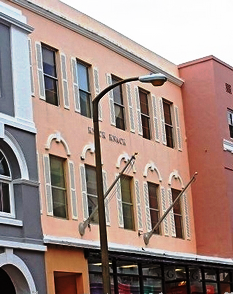 19 Reid Street, Hamilton HM 11. P. O. Box HM
1194, Hamilton HM EX. Phone (441) 296-6969. Fax (441) 296-7701. On January
7, 2014 it amalgamated with and on April 22, 2014 changed its name. Formerly
Capital G Bank Ltd.
19 Reid Street, Hamilton HM 11. P. O. Box HM
1194, Hamilton HM EX. Phone (441) 296-6969. Fax (441) 296-7701. On January
7, 2014 it amalgamated with and on April 22, 2014 changed its name. Formerly
Capital G Bank Ltd.
2020. February 3. NCB Financial Group Ltd, the controlling shareholder of Bermudian-based Clarien Bank, has reported net profit attributable to stockholders of $5.9 billion Jamaican, or $42.37 million Bermudian, for the fourth quarter of 2019. The figure is a 21 per cent, or J$1.5 billion ($10.77 million), decline from prior-year results, which included a one-off gain of J$3.3 billion ($23.7 million) from the disposal of NCB’s interest in an associate company, the organisation said. Excluding that gain, net profit for the quarter would have increased by J$1.7 billion ($12.2 million), or 42 per cent, over the prior year, NCB said. Operating profit increased to J$9.9 billion ($71.1 million) for the quarter, the company’s best-performing quarter to date. That was an increase of J$5.1 billion ($36.6 million), or 105 per cent, over the December 2018 fourth quarter. Operating income was J$33.3 billion ($239.1 million). The company reported a 16 per cent return on equity, and a 1.93 per cent return on assets.
2019. March 25. Clarien Bank’s plan to charge account holders $5 for withdrawing Bermuda dollars with the assistance of a teller has left at least one long-time customer unhappy. “They’re always coming up with new rates, but everyone I have talked to about this new charge thinks it’s terrible and is upset,” says Eric Pengelly, who says he has been a customer with Clarien and its predecessor banks for some 30 years. “Everyone I have talked to is shocked. They say ‘that can’t be’ and think the teller gave me the wrong information. I find it offensive. I am sure there is a good reason but I think it’s exploitive. They are getting away with it because there’s nobody putting pressure on them. It’s a pattern of keeping hitting the consumer constantly. Everyone hates the banks now. I am sure they will say it’s due to the cost of compliance, all their costs are going up and so they are passing them on to the small customer. Some of the charges are just outrageous. There is a pattern of overcharging for all sorts of things that is upsetting the customer. The local populace is outraged.” Mr Pengelly, a 58-year-old painting contractor, describes himself as “old school”. He says he prefers dealing with a teller to using an automated teller machine, and does not use online banking. “With an ATM you can only take out about $1,000 at a time,” he says. “When I go to the teller, I get $7,000 to $8,000 at the end of the month and pay my bills. I don’t want to go back to a machine over and over. I know you can do it online, but I don’t do anything online because you can get hacked. If I can’t get my money out of an ATM in an efficient manner, it becomes inefficient. It’s almost cheaper to pay the $5 because I work by the hour. I’m old school. I like the personal interaction with a teller. Everything is done by machine these days, nobody talks to each other any more.” The new rate becomes effective March 31. A three-month grace period “to allow clients time to consider alternate transaction options” will make July 1 the effective date for the new charge, according to a flyer displayed at the Reid Street bank. Simon Van de Weg, executive vice-president, chief banking officer, responded on behalf of Clarien. “Clarien Bank recently announced fee adjustments to reflect the cost of service provision as we refine our business model in a rapidly evolving digital banking environment,” he said. “Fees have been adjusted or introduced based on a number of factors including the cost of the service, risks and regulation associated with the service and the alternative channels available to receive the same service in a more efficient, free and convenient manner. Equally, while reviewing fees we have also recently adjusted deposit rates to offer premium rates on longer term CDs to support the savings and financial growth goals of the broader community. We are committed to the continuous evaluation of our service offerings to accommodate the demands and expectations of our clients, offering a more thorough financial solutions approach with diversified digital and online channels such as Clarien iBank, iBank mobile and digital authentication tokens available today and intelligent ATMs with an expanded footprint and enhanced capabilities that will launch later this year. Our commitment to channel diversification provides clients with alternative transaction solutions in addition to in-person financial solution support that will help reduce and eliminate many traditional banking fees while allowing clients to interact with the bank faster, safer and smarter through diversified channels. The Bermuda dollar in-branch cash withdrawal fee and other select fees as published on our fee schedule available on clarienbank.com are waived for seniors (65 and older), Iron Kids (youth accounts) and registered charities.”
2019. January 3. NCB Financial Group, the company that owns a majority stake in Clarien Bank, has made a bid to take a controlling interest in Caribbean region insurer Guardian Holdings Ltd. Controlled by Michael Lee-Chin, the Jamaican-born billionaire, NCB has a 50.1 per cent stake in the Bermudian bank. Mr Lee-Chin’s Portland Private Equity owns an additional 17.9 per cent stake in Clarien. On Monday, NCB’s subsidiary NCB Global Holdings, made an offer to all Guardian shareholders to buy up to 32.01 per cent of the company. The $2.79 per share offer is worth more than $207 million in aggregate. NCB already owns 29.99 per cent of Guardian, which is based in Trinidad and Tobago and offers life, health, property and casualty insurance, as well as pensions and asset management in 21 countries across the English and Dutch Caribbean. If the bid is successful, NCB would own a 62 per cent controlling interest in Guardian. The offer is conditional upon Guardian shareholders tendering sufficient shares to give NCB a more than 50.01 per cent stake and on regulatory approvals for the deal. The offer period is scheduled to close on February 7, 2019.
2017. December 19. Billionaire investor Michael Lee-Chin sees a bright future for Bermuda — a view he has backed with hard cash in the form of his purchase of a controlling interest in Clarien Bank. The charismatic Jamaican-born chairman of Canadian firm Portland Holdings is not troubled by the growing pressure being applied on the island by major countries looking to clamp down on tax avoidance. In an interview, he said he saw opportunity amid the uncertainty, guided by his long-term confidence in both the island and its wealth-management industry. And he spoke of his penchant for wealth-building opportunities at times of crisis, of moving in when other investors are moving out. On December 1, Clarien Group announced agreement on a deal that would give companies controlled by Mr Lee-Chin’s Portland group of companies a 68 per cent stake in the Bermuda company. Portland Private Equity, which initially invested in Clarien in April 2016, will hold a 17.9 per cent interest in Clarien under the terms of the deal, while NCB Financial Group will own 50.1 per cent. Edmund Gibbons Ltd owns the remainder. Speaking from Canada, Mr Lee-Chin explained the thinking behind this substantial investment. “I’m very bullish on Bermuda, because Bermuda has a phenomenal global reputation, and because its current situation has given us an opportunity to enter the market. Also, wealthy people from around the world still want to protect their assets, so there will be an opportunity to service their needs.” He said the attention focused on offshore financial centres like Bermuda from tax-hungry major countries had created an improved investment opportunity. “We are firm believers in the Chinese definition of the word crisis,” Mr Lee-Chin said. “Crisis = danger + opportunity. We can’t get the opportunity unless there is a crisis. When there is a crisis, most people focus on the ‘danger’ component, but those with long-term thinking recognize the opportunity.” Global financial institutions were pulling out of offshore centres, he said, something he described as a “kneejerk reaction” to today’s circumstances. “In five or ten years from now, the global players will want to return,” he said. “With the benefit of time they will realize that there is still a strong demand from clients to protect their assets and Bermuda has developed a reputation as a safe place to do that. The rising demand for asset protection is a long-term, secular trend and I always want to invest in a business with a rising tide that will lift all boats and will lift ours.” The island’s advantages included its British legal system, the fact that it is English speaking, has a great mid-Atlantic location, and also that it has a strong reputation for stability, he added. An example of how Mr Lee-Chin’s opportunity-from-crisis investment philosophy has worked for him came with Portland’s purchase of National Commercial Bank Jamaica Ltd in 2002. At the time, NCB had 24 per cent market share in Jamaica, where Canadian banks, one of which had a 54 per cent market share, were dominating. He recalled: “At the time we bought the bank, staff morale was low because they couldn’t compete against the Canadian banks, their IT infrastructure was outdated, inflation was about 30 per cent and the currency was depreciating. The year before we bought it, NCB made a profit of US$6 million — in the year through September 2017, it made US$150 million and now it has a 44 per cent market share. Over the 14 years, it has made about US$1.5 billion in profits and paid about US$475 million in corporate taxes.” The fact he highlighted taxes paid highlights another aspect of Mr Lee-Chin’s approach to doing business. The Portland mantra is prosperitas cum caritate, or prosper with care for people, which speaks to his desire for his businesses to “not only do well, but also do good. I want every staff member to come to work believing there is a direct connection between their efforts and the well-being of the next generation,” Mr Lee-Chin said. He personally works on developing such a community-minded culture in his businesses, he added, striving to lead by example through his own personal life and values. Mr Lee-Chin was born in Port Antonio, Jamaica in 1951 and moved to Canada in 1970 to study civil engineering at McMaster University in Hamilton, Ontario. He went into the mutual fund industry and became a financial adviser at 26. Having achieved some success, at the age of 32, he borrowed money to buy $500,000 of Mackenzie Financial stock, which appreciated sevenfold over the next four years. He then bought a small Ontario investment firm called AIC Ltd with $800,000 of assets under management — 20 years later it was managing more than $15 billion. In 2009, he sold it to Manulife. Now he is chairman and CEO of Portland, which has invested heavily in the Caribbean region, owning stakes in wealth management companies, insurers, banks, telecommunications groups and the Wallenford Coffee Company, the largest cultivator of Jamaica Blue Mountain and Jamaica High Mountain coffee.
All four Bermuda banks charge at least $8 a month for current accounts and levy other banking fees and charges considerably higher than their USA, Canadian and UK counterparts. In services, facilities and competence the local banks benefit the economy generally and enjoy many advantages, especially to visitors and newcomers who, in their own home countries will not find any of their High Street banks with the same national and international range of easy Foreign Exchange and other facilities and services. But the Bermuda Government charges them some of the highest banking fees in the world. Plus, they pay millions of dollars in Payroll Tax for their labor-intensive staff. Thus their interest rates are lower, interest bearing checking accounts do not exist and bank service fees to consumers are the highest in the world.
In July 2011 Bermuda's House of Assembly parliament ( finally) enacted an insurance scheme to partially protect individuals, charities and small businesses, with the Deposit Insurance Act. Membership of Bermuda's Deposit Insurance Scheme [DIS] - see Bermuda Deposit Insurance Corporation (BDIC) below - is mandatory for all four commercial banks, the one deposit company licensed under the Banks and Deposit Companies Act 1999 and the sole credit union. The maximum threshold for compensation is, compared to the USA's $250,000 a mere $25,000, although that amount “could grow over time.” The legislation put the Bermuda Deposit Insurance Corporation [BDIC] in place to administer the scheme. In Bermuda, which has no lender of the last resort and no central bank, the safety net relies heavily on prudential regulation and supervision by the Bermuda Monetary Authority (BMA) which overall administers and regulates the scheme. Deposit insurance is a guarantee to depositors in a bank that they will be compensated up to a maximum specified amount of their deposits upon failure of that institution. This legislation came many years after The USA, UK, Canada and elsewhere enacted the FDIC and equivalents, and for significantly larger amounts than Bermuda's $25,000 where the BMA is the only banking-relevant regulatory authority and the relevant pieces of legislation are The Banks & Deposit Companies Act 1999 and The Banking Appeal Tribunal Regulations 2001. The BMA is responsible for the licensing, supervision and regulation of all financial institutions in Bermuda (including those conducting deposit taking, insurance, investment and trust business). Since 2009, the BMA has required all Bermuda banks to ensure they have a "capital buffer" which would keep them on a solid footing even in the case of a dramatic worsening of economic conditions. The BDIC deposit insurance of $25,000 per depositor is the result of a collaborative effort between financial regulator the Bermuda Monetary Authority (BMA), the Ministry of Finance and the Bermuda Bankers Association (BBA). Technical advice was provided by the International Monetary Fund. Deposit insurance is a guarantee to depositors in a bank that they will be compensated up to a maximum specified amount of their deposits upon failure of that institution. It has three main objectives, to protect small depositors; promote stability in Bermuda's financial system and economy by providing prompt reimbursement or access to insured depositors' funds; and promote competition between financial institutions in Bermuda. Under the legislation, membership of the scheme is compulsory for all relevant financial institutions. The premiums are paid by the banks as a fixed percentage of insurable deposits. The Bermuda Deposit Insurance Corporation has an appointed board of directors to run the scheme. The legislation also entails elements on protection from personal liability and preservation of confidentiality.
Bank deposits in Bermuda banks or trust companies by US or other non-Bermudians are not covered by the US Government's Federal Deposit Insurance Commission (FDIC) which insures deposits of all kinds in all USA licensed banks up to $250,000 per depositor for all deposits, savings and individual retirement accounts.Bermuda bank deposits are not covered by the UK Government's Financial Services Compensation Scheme (FSCS) - http://www.fscs.org.uk/ - under the UK Financial Services and Markets Act, 2000. It too offers a hugely more generous financial compensation than Bermuda, but significantly less than in the USA. Currently, individual UK-based bank clients are insured up to £75,000 pounds sterling. However, from July 2015 this will be upped to £1 million for those who have large sums in their accounts arising from the sale of their homes. (There is no such similar plan for Bermuda, where most houses sell for well over Bda $1.5 million and some for as much as $20 million and the average condominium sells for over $800,000). Also, in the UK, the FSCS pays compensation usually within 7 days of a bank, building society or a credit union failing, except for more complex claims that might take 20 days. Most recently, the FSCS declared it may not even be necessary to claim from it even when a financial organization fails because it ensures customers will have continuous access to their funds via another FSCS mechanism whereby accounts are transferred to another financial organization in the event of a bank or similar going bust. However, continuous access applies only to sums within the £85,000 threshold, not to temporary large balances of up to £ 1 million caused by the sale of a property. No such provisions in any of these categories are made in Bermuda.
In addition, they are not licensed to conduct banking business in the United States or Canada.
Nor are they covered by any Canadian or European or any other country whose nationals live and/or work in Bermuda.
Investment vehicles and services of Bermuda banks have not been registered or licensed under any United States securities legislation and are not being offered, directly or indirectly, in the United States or in any of its territories or possessions or areas subject to its jurisdiction or to its citizens or persons thereof.

The Bermuda Government has not approved any local bank as the depository of public funds. Instead, it awarded this to the Bank of New York.
| Laws of Bermuda | Acts, Regulations and Statutory Instruments |
Bank of N. T. Butterfield & Son Ltd and HSBC Bank of Bermuda Ltd have ATMs scattered throughout Bermuda. Other banks do not. Most American, Canadian & other visitors will find that if they need cash in Bermuda, local ATMs may be able to service them. But the dollar notes they dispense will be in Bermuda dollars only (which cannot be cashed overseas).
Bermuda banks charge between 4 and 5 points more for foreign currency purchase transactions than US, Canadian, British, etc banks do. (In addition, via the banks the Bermuda Government charges customers a fee of 1.25-1.5% of the value of the purchase on every foreign currency purchase). Also see Foreign Currency Purchase Tax below.
See Bank Deposit Protections, above. The 2011 Bermuda legislation to provide deposit insurance of up to $25,000 per depositor (compared to 375,000 in the UK and the equivalent in the USA and Canada) is the result of a collaborative effort between financial regulator the Bermuda Monetary Authority (BMA), the Ministry of Finance and the Bermuda Bankers Association (BBA). In addition, technical advice was provided by the International Monetary Fund. Deposit insurance is a guarantee to depositors in a bank that they will be compensated up to a maximum specified amount of $25,000 of their deposits upon failure of that institution. It has three main objectives, to protect small depositors; promote stability in Bermuda's financial system and economy by providing prompt reimbursement or access to insured depositors' funds; and promote competition between financial institutions in Bermuda. Under the legislation, membership of the scheme is compulsory for all relevant financial institutions. The premiums are paid by the banks as a fixed percentage of insurable deposits and are recouped from customers by bank charges on current and other accounts. The Bermuda Deposit Insurance Corporation has a Bermuda Government/ Ministry of Finance-appointed board of directors to run the scheme. The legislation also entails elements on protection from personal liability and preservation of confidentiality.

The local-only Bermuda Dollar is not exportable. It is not used by traders world-wide. It is not cashable or exchangeable by any foreign banks. It is used only by local citizens and residents - not by international companies based in Bermuda (all of which use US dollars). But for all non-Bermudian visitors the US Dollar - on which the Bermuda Dollar is based and in Bermuda is worth the same - is accepted everywhere in Bermuda despite the fact that Bermuda is not part of the USA politically. Until 1970 but not thereafter, Bermuda had its own local pound sterling notes, based on UK sterling. All visitors from the UK, Canada, Europe and elsewhere should bring US dollars only. If visitors who purchase goods and services in Bermuda get their change offered in Bermuda dollars they should ask if it can be exchanged for US dollars.
Founded in 1994. The organization that in Bermuda represents the trust and related industry. BALT is a forum for the interests of its stakeholders and acts as a representative body for all 30 companies licensed by the Bermuda Monetary Authority to carry on trust and related business in Bermuda. BALT makes representations to Government and is often invited to deliver submissions and reports on trust legislation, fiduciary ethics, good practice and regulation of the industry. The Association is a key contributor to the Bermuda Business Development Agency's strategic plan to promote existing international business and actively develop new business in Bermuda.
Since November 2007. Funded by its members. Created its own (voluntary) code of conduct for its member-banks. Serves as the main representative body for banks and deposit taking/lending firms on the Island. Similar to banker's associations in other financial jurisdictions, an industry think tank, lobby group and a forum for increased cooperation on non-competitive issues among the Island's banks. Stated mission is to be a leading contributor in the development of public policy on the financial services sector and ensure the legal and regulatory framework governing banks operates in an efficient, effective and fair manner. All the Island's chartered banks and lending/deposit taking institutions are eligible for membership and currently all banks doing business in Bermuda are members. The Bermuda Monetary Authority, responsible for the licensing, supervision and regulation of all financial institutions in Bermuda (including those conducting deposit taking, insurance, investment and trust business), is an ex officio observer of the BBA.
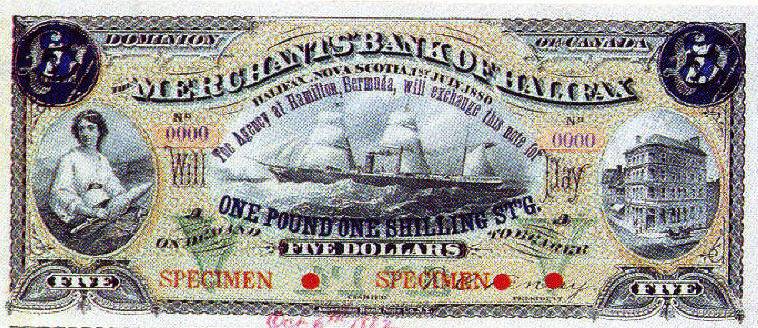
First Bermuda Banknote, 1883. A Canadian $5 note printed for the Merchant Bank of Halifax and converted to a £1 1 shilling (one guinea) note for use in Bermuda.
The Merchants' Bank of Halifax (later, the Royal Bank of Canada), established in Halifax in 1864, opened an agency in Bermuda in 1882 via the local Butterfield's Bank. On October 6, 1883, it issued its own money for use in Bermuda. It began circulating a $5 Canadian note printed by the American Bank Note Company in Ottawa for its bank in Halifax and converted to a one pound, one shilling (guinea) note for use in Bermuda. This Canadian/Bermudian note has considerable historical value as the first "Bermudian" paper money to arrive in Bermuda; some 31 years before Bermuda got its own official currency notes. Later, the Merchants' Bank of Halifax divorced itself from Butterfield's Bank in Bermuda and ran its own branch bank in Bermuda for four years. Thus it also became the first (and only) non-Bermudian bank in Bermuda. Later yet, the Merchants' Bank of Halifax's Bermuda operation was bought out by banking newcomers in Bermuda who established from it the present day Bank of Bermuda Ltd.
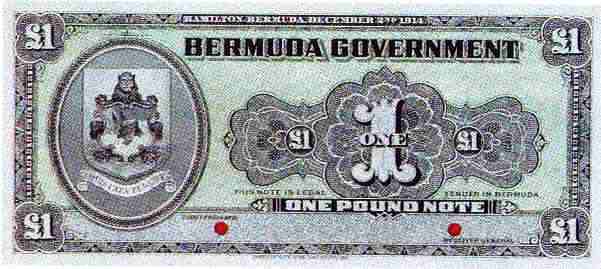
First Bermuda Government £ sterling note of 1914, also printed by the American Bank Note Company in Ottawa.
BMA House, 43 Victoria Street, Hamilton. P O Box 2447, Hamilton HM JX. Tel: (441) 295-5278. Since 1969. A Bermuda Government quango and regulatory agency. It processes applications and recommends to the Ministry of Finance when prudent to establish companies, partnerships, collective insurance schemes, trust companies and issue permits. It conducts background checks of applicants for incorporated business entities and regulates the banking and financial services industries. Game-changers BMA has dealt with during its 50-year history. The first came soon after the authority was formed in 1969 when, the following year, the UK ended its sterling area-based exchange control laws. It was a surprise move that left Bermuda out on its own and excluded from sterling area. Bermuda was no longer part of a club that was thought, in those days, to be the source of its economic stability. The BMA introduced the Bermuda dollar, effectively replacing the British pound as the island’s currency. Its second job was to assume responsibility for supervising the banks, while the third was taking over responsibility for vetting company licence applications, and the fourth job was exchange control. Its responsibilities increased over the years, and it took responsibility for the island’s insurance industry in 2002. The second major game-changer was the global financial crisis of the late 2000s. From the early days of captive insurance companies, to the arrival of the large commercial reinsurers, and more recently to fintech and alternative capital, the BMA has refereed a game in which the goalposts were constantly being moved. Since 2005 — the year of hurricanes Katrina, Rita and Wilma, and the introduction of insurance sidecars — the BMA’s function has become more complex and challenging. The island has had, in the BMA, an integrated supervisory architecture; one regulator for all financial services.
What that meant was the left hand knew what the right was doing. Elsewhere in the world, separate supervision for banking, insurance, and regulation for other financial services has generally applied and still applies but is a situation which many authorities today no longer favour. When Bermuda set its sights on full equivalence to the EU’s Solvency II standards for its commercial insurance regime, it was a tough challenge but the aim was achieved in 2016, and it included a negotiated carve out for the captive sector. Solvency II served as a major rallying point, bringing private industry and the markets regulatory teams together on common ground like never before. Today, Bermuda and other jurisdictions are getting to grips with EU concerns about economic substance. Only time will tell whether meeting the challenge of economic substance will have the same unifying effect as Solvency II. Regarding the regulations now in effect Bermuda companies engaged in relevant activities, such as banking, insurance, fund management and other financial services activities, are required to meet an economic substance test. In March 2019, the island was placed on the EU’s list of non-cooperative jurisdictions for tax purposes as a result of a typographical error in economic substance regulations submitted by the Bermuda Government to the EU. The island was removed from the list in May 2019. The damage Bermuda sustained on March 12, when it was temporarily placed on the EU blacklist, is not irreparable. But it served as a warning that, despite the close relationships we’ve developed with the world’s financial authorities, Bermuda is not immune to reputational setbacks. It cannot afford to become complacent. The EU has forced every offshore financial centre in the world to change its game. Bermuda has to respond by showing it can apply an appropriate level of vetting. It has to show that even though our technical analysis may cost in lost clients here and there, Bermuda will not accept business that even remotely resembles a sham.
2018. December 11. New, wide-ranging fee increases by the Bermuda Monetary Authority were approved by the Bermuda Government. However, the changes will be phased in over a three-year period rather than two years as had originally been proposed. A review this year concluded that the BMA will require up to 39 additional full-time staff by 2020 to continue effectively discharging its duties, while its annual operating costs have been projected to rise to $61 million by 2020, up $11.7 million on last year. Against this backdrop, Curtis Dickinson, Minister of Finance, passed an order in the House of Assembly on Friday that provides for amendments to the fees charged by the BMA. Insurance and reinsurance companies, banks, corporate service providers, trusts and credit unions will be among those affected by the changes. Mr Dickinson made reference to the review conduced by the BMA with assistance from an international consulting firm, that resulted in fee change proposals. The authority recorded a budget deficit of $1.63 million last year, its fifth annual shortfall in the last decade. It expects to record a further operating loss this year. It has previously covered budget shortfalls from its general reserve account. Last year its reserves shrank by $2.1 million. As a regulator, the BMA works to protect and enhance Bermuda’s reputation and position as a leading international financial-services centre. It has said it is enhancing its risk-based supervision approach, coverage and service levels; meeting evolving international standards, but to do so it needs to further enhance its operations and add to its supervisory resources. One way this can be achieved is by raising fees. Mr Dickinson said the BMA recognized market conditions remain challenging in a number of regulated sectors, and this had been taken into account when the proposed revised fees were assessed. During the global financial crisis that started around 2008, and continuing in recent years, fee increases by the BMA were moderated to reduce the impact on the financial-services industry. Mr Dickinson said: “This has, however, contributed to the authority operating at a deficit, with resultant budget shortfalls being covered from existing reserves.” He added: “Consequently, certain existing fees will be adjusted and/or new fees be introduced to reflect the authority’s resource utilization for these ongoing supervisory activities. Also, the basis on which fees are charged will be simplified so that entities will find it easier to determine what fees they need to pay.” One of the four guiding principles that will inform the revised fees is the need for the island to maintain its competitiveness and “account for pricing relative to peer regulatory bodies to ensure Bermuda remains competitive”. Mr Dickinson said that during the consultation process and subsequent meetings between the BMA and industry stakeholder groups, the most prevalent comment was the need for the fee changes to be phased in over a longer period of time, which has resulted in the proposed timescale being altered from two years to three. He added: “The insurance industry’s request that the authority have greater flexibility regarding fees to be applied in specific circumstances, such as where affiliated insurers have similar risk profiles and in cases where combined application fees would otherwise be payable, has also been addressed via separate creation [in the Insurance Act] of a power to exempt or reduce fees.”
2014. November 8. Bermuda’s financial watchdog is to get new powers to police banks. The Bermuda Monetary Authority (BMA) would be able to intervene in case of “a troubled bank.” The move is in line with International Monetary Fund recommendations made in 2008. To address this recommendation, the Government has brought legislation to establish a special resolution regime for banks licensed in Bermuda. The purpose of this resolution is to address the situation where all or part of the business of a bank has encountered, or is likely to encounter, financial difficulties that cannot be resolved by any other means. The Banking Special Resolution Regime Act 2014 established a comprehensive bank insolvency framework that meets international standards and operates independently of general insolvency law. Amendments to legislation have been made to allow the BMA to license money-service businesses. In the past, the BMA has been unable to license these businesses because the money service business regulations do not provide sufficient details for appropriate oversight.. However, changes to 2007 legislation allow the BMA to license and regulate the industry. Legislation governing the insurance and reinsurance sectors, also policed by the BMA, are being updated in line with global developments. Bermuda banks can address the Island-wide need to increase the flow of credit to help re-flate the economy, providing Bermudians with the support they need for their business ventures, their educational ambitions and their dreams of home ownership. Government was also examining a “reverse mortgage” scheme and talking to the Bermuda Bankers’ Association in an attempt to allow seniors to access money locked up in their homes. There are many elderly people in Bermuda who own their own homes, many valued at more than a million dollars, but who do not have the cash flow to maintain an adequate lifestyle or to pay for rising healthcare costs. Reverse mortgages can be an option for people who want to turn substantial home equity into cash in order to ease these challenges. Banking remained an important earner of foreign exchange for the Island. The Government is concerned about shrinkage in the banking sector, in terms of its lending policies and employee numbers. The Ministry of Finance, as a result, is examining policy reforms to expand and diversify the banking sector and, by extension, Bermuda’s foreign exchange earnings and the capacity for job creation. The Government is in talks with the banks and other interested parties with a view to changing bank and deposit company law. Accountancy firms could also offer community support by donating time for audits and reviews of community clubs required under the Charities Act. Accounting firms can adopt a club in this regard, freeing up precious dollars to support their worthy operations.
See http://www.bma.bm. Paid by the banks to the BMA.
Bermuda banks and their advisors and clients are involved. As a result of the enactment of the USA PATRIOT Act (Public Law No. 107-56 - October 26, 2001), the U.S. Department of the Treasury has issued regulations requiring U.S. financial institutions to obtain certain information relating to foreign banks including all those in Bermuda that maintain relationships at U.S. financial institutions using a certification form. This certification is needed to comply with provisions of the USA Patriot Act. Bermuda banks are involved when they, as foreign banks, maintain relationships at US financial institutions, using a certification form. This certification is needed to comply with provisions of the USA Patriot Act, and a relevant Patriot Act Certificate is available for inspection at the Bermuda banks concerned.

Incoming visitors from Europe should note that the Euro is not accepted anywhere in Bermuda as a trading currency. They should use US dollars. But some Bermuda banks may offer the Euro - € - to visitors and business executives or representatives heading for Ireland and other EU countries of Europe.
The Foreign Account Tax Compliance Act is an 18 March 2010 United States federal law requiring all non-U.S. foreign financial institutions to search their records for customers with indicia of a connection to the USA.
In Bermuda, those affected by FATCA include US citizens and green card holders living here who have Bermuda financial bank accounts, financial interests and other holdings; US residents for income tax purposes (those who do not have a US passport or citizenship but have resided in the US long enough to meet the substantial presence test), and others with US connections such US owned foreign entities. Also liable are US-classified foreign financial institutions and non-financial foreign entities including all those with US proprietary investments, US account holders, or other US financial dealings. FATCA cooperation is both encouraged and enforceable in Bermuda because Bermuda has signed Tax Information Exchange Agreements (TIEAs) in the last few years with the United States and other countries. TIEAs, tax treaties, and Intergovernmental Agreements all aid in mutual information exchange cooperation. In cases where tax evasion, etc, is suspected or determined, the US Internal Revenue Service has profound regulatory powers (agreed on by the TIEAs and tax treaties) to request detailed significant confidential information on specified US individuals and related parties.
2014. August 19. Bermuda, like many other areas in the world, became a signatory to the USA's Foreign Account Tax Compliant Act (FATCA). It was enacted in 2010 by Congress to target non-compliance by U.S. taxpayers using foreign accounts. FATCA requires foreign financial institutions (FFIs) to report to the IRS information about financial accounts held by U.S. taxpayers, or by foreign entities in which U.S. taxpayers hold a substantial ownership interest. FFIs are encouraged to either directly register with the IRS to comply with the FATCA regulations (and FFI agreement, if applicable) or comply with the FATCA Intergovernmental Agreements (IGA) treated as in effect in their jurisdictions.
All who work in or have business dealings in Bermuda or who visit there on vacation should note that Bermuda has a Foreign Currency Purchase Tax (FCPT). Presently 1.25% to 1.5% of value money purchased or sent, per transaction. It applies to the purchase of all non-local currencies including the US Dollar. In theory the Bermuda Dollar is on a par with the US Dollar but in in fact it is worth less. Why? Mostly on account of the FCPT, also because of Bermuda bank currency processing charges, in addition to the FCPT applied on every transaction. This includes all purchases of foreign currencies for travel and business purposes and all telegraphic (wire) transfers of monies from Bermuda to individuals and businesses abroad. There is no Government Receipt given for this FCPT charge.
Banner.jpg)
Authored,
researched, compiled and website-managed by Keith A. Forbes.
Multi-national © 2020. All Rights Reserved