
Click on graphic above to navigate the 165+ web files on this website, a regularly updated Gazetteer, an in-depth description of our island's internally self-governing British Overseas Territory 900 miles north of the Caribbean, 600 miles east of North Carolina, USA. With accommodation options, airlines, airport, actors, actresses, aviation, banks, beaches, Bermuda Dollar, Bermuda Government, Bermuda-incorporated businesses and companies including insurers and reinsurers, Bermudians, books and publications, bridges and causeway, charities, churches, citizenship by Status, City of Hamilton, commerce, communities, credit cards, cruise ships, cuisine, currency, disability accessibility, Devonshire Parish, districts, Dockyard, economy, education, employers, employment, environment, executorships, fauna, ferries, flora, former military bases, forts, gardens, geography, getting around, golf, guest houses, highways, history, historic properties, Hamilton, House of Assembly, housing, hotels, immigration, import duties, internet access, islands, laws, legal system and legislators, main roads, marriages, media, members of parliament, money, motor vehicles, municipalities, music and musicians, newcomers, newspaper, media, organizations, parks, parishes, Paget, Pembroke, performing artists, residents, pensions, political parties, postage stamps, public holidays, public transportation, railway trail, real estate, registries of aircraft and ships, religions, Royal Naval Dockyard, Sandys, senior citizens, Smith's, Somerset Village, Southampton, St. David's Island, St George's, Spanish Point, Spittal Pond, sports, taxes, telecommunications, time zone, traditions, tourism, Town of St. George, Tucker's Town, utilities, water sports, Warwick, weather, wildlife, work permits.

By Keith Archibald Forbes (see About Us)


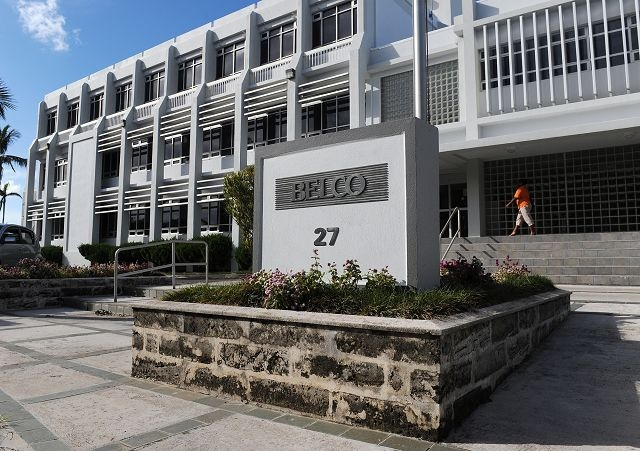

In 1904, through the vision of George Marshall Allen of New Jersey and several prominent Bermudians, the Bermuda Electric Light, Power & Traction Company (B.E.L.P.&T.) was incorporated, but did not become active until the first meeting of shareholders, which took place on September 29, 1906. The first Chairman of the Board to be elected was Dr. E.C. Wilkinson, who served until 1926. Operating from a converted saw mill on East Broadway in Hamilton, the Company installed its first generating unit, a 50 kilowatt (kW) suction gas engine, in 1907. Demand for electricity was almost nonexistent. In fact, during that first year of business, B.E.L.P.&T.'s electricity was used only by the Company itself to light an advertising sign on the premises. On April 21, 1908 an advertisement in The Royal Gazette announced B.E.L.P.&T. would be ready to proceed with the supply of electric current from May 1, 1908. The advertisement read, "which it (The Company) will run daily for the furnishing of lights to whosoever may desire them. As soon as the demand for fans or other daily power arises, it will be provided." The same year, the Company purchased its present site on Serpentine Road and moved its operations there. Later in the year, the Company began advertising its wiring services, fans, irons and tea kettles for sale. Demand began to rise dramatically. By 1909, second and third generating units were purchased and installed and electricity was provided on a 24-hour basis. By 1920, a 300 kW peak load was being achieved, but gas engines were not proving the ideal way to generate electricity, so in 1921, the first oil engine was installed. Demand continued to increase rapidly. By 1938, 12,000,000 kW hours per annum were being generated and oil was transported from the Hamilton docks by pipeline.
Over the decades, scheduling tankers into Hamilton became increasingly difficult. Cruise ships and cargo ships were competing for dock space. In addition, the draft limitation of 26 feet for Hamilton Harbour severely limited the amount of fuel that could be brought in on a single vessel. As a result, BELCO required supply direct from the East End fuel facility. In 1972, Esso built a nine-mile pipeline from their St. George's terminal to the power plant storage facilities in Pembroke. The pipeline remains in use today. In 1965, exchange control regulations banning the importation of air conditioners were lifted and demand increased dramatically. By 1968, generating capacity had increased to 51,750 kW with 13 diesel units and an all-time peak 15-minute load of 34,700 kWs. Kilowatt hours (kWh) sold were 166.5 million. Demand for electricity continued to increase in the 1970s, although world awareness of oil as a finite resource and the growing expectations of producing countries led to several oil crises, notably in 1974 when fuel prices increased by 150%. Major emphasis in operations and planning was placed on fuel conservation.
Through the 1980s and into the early 2000s, the Company grew to keep pace with Bermuda's growing demand for electricity. Significant building and expansion took place in 1999, including development of the East Power Station, the Cemetery Road Transport Facility and the new Administration Building. In 2002, BELCO upgraded its Training Centre and in 2003, brought the state-of-the-art C. Eugene Cox Operations Centre online. The building phase has been accompanied by increased emphasis on efficiency in all of the Company's operations.
The voltage system is 120 volts, 60 cycles - same as in North America. Some larger appliances use 220/240 volts, smaller ones and lights use 110 volts. No UK-produced consumer appliances will work in Bermuda. Electricity for residential - mostly at 120V - heating, lighting, cooking and cooling is provided exclusively in Bermuda by the Bermuda Electric Light Company Limited (BELCO) at 27 Serpentine Road, Pembroke HM 07, Bermuda. Telephone (441) 295 5111. Fax (441) 292 8975. The Ascendant Group has seven operating companies: Belco, Bermuda Gas & Utility, iFM Ltd, iEPC Ltd, Air Care Ltd, Purenergy Renewables Ltd, and Ascendant Properties Ltd. Belco began in 1904, commenced selling electricity in 1908 and was originally called the Bermuda Electric Light, Power and Traction Company. It has a Bermuda Government legislated monopoly on the supply of electricity locally, is the sole supplier to the government at a preferred rate and is a local commercial joint stock company majority owned by Bermudian shareholders.
New electricity laws in 2017. Electricity (Regulatory Authority Fees) Regulations 2017. Electricity users will pay a slight increase to fund regulation of the industry. Electronic Communications (Regulatory Authority Fees) Regulations 2017. The general regulatory authority fee is increased from 1.5 per cent of turnover to 1.75 per cent.
US Electricity costs in 2018 for comparative purposes. The average price nation-wide people in the U.S. pay for electricity is about 12 cents per kilowatt-hour, with a typical U.S. household of three persons using about 908 kWh a month of electricity
Bermuda's mere 20 square miles - more than 600 miles away from the USA in the North Atlantic - resident population of only 68,500 and obvious inability to have no economies of scale makes local costs very high.
The demand for electricity has continued to increase and is always greater in the summer than in the winter. Belco is presently capable of generating up to 152 megawatts of electricity. Large commercial organizations use about 40 percent of all local electrical output.
Belco does not have off-peak rates.
In Bermuda, the architecture, closeness to others and small land size of most Bermuda homes, plus the complete lack of any rivers, nuclear plants, etc. don't allow alternatives - often, less expensive - such as wind farms or solar panels or ground source systems, so imported fuel oil is used exclusively. It is piped directly into the central electricity generating plant owned by the utility on Serpentine Road in Pembroke Parish, west of the City of Hamilton, via a 9-mile 6 inch underground pipe from the oil docks terminal at Ferry Reach, St. George's Parish.

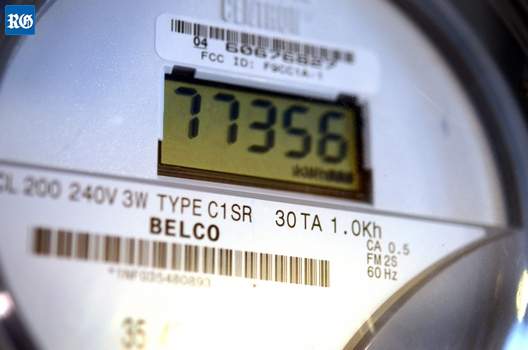
Belco staff monitoring electricity usage. Royal Gazette photo
Solar and other renewable energy sources may be cleaner and cost-effective elsewhere, but in Bermuda they are still considerably more expensive than oil. Unfortunately in Bermuda, when world oil prices went down sharply in 2015 and part of 2016, the Bermuda Government did not allow consumers to benefit for very long. Instead, by April 2016 it increased sharply both the cost and rates of duty on oils and gasoline, to one of the highest if not the single highest in the world. Government import duties on oil and almost all imported consumer goods presently mean government duties alone cost consumers well over 30% of the cost of electricity. Additionally, from June 2016 oil and gas prices have begun to rise again at a steady rate. But any hopes that in Bermuda solar and other renewable energy can result in overall cheaper costs to consumers than oil-produced electricity are dashed until the government reduces sharply the high import duties on imported privately owned solar and renewable energy sources. Recently, during a Bermuda visit, former CIA director James Woolsey urged Bermuda to go solar, saying the Island needed to end its nearly 100-percent dependence on imported oil because the cost of petroleum had become increasingly volatile and unpredictable. However, Belco is exploring importing natural gas, which could be a “promising alternative” to oil. Belco supports reducing reliance on imported fossil fuel (oil), noting that its “Energy Equation” for Bermuda called for renewable energy sources, including solar. Belco’s own target is 20 percent of energy produced from renewable sources by 2020. That said, renewable energy resources, such as solar and wind, provide only intermittent power; that is, only when the sun is shining or the wind is blowing. Belco alone is responsible for providing secure, reliable power, meeting the Island’s base load and this is likely to continue with conventional fossil fuel generation, although it is exploring the liquefied natural gas as a cleaner alternative. Currently, there is no commercially available wave or tidal power generation equipment.
Liquefied natural gas has been converted temporarily to liquid form for ease of storage or transport. (It’s estimated 23 percent of America’s energy comes from natural gas). Belco believes significant infrastructure would be needed to offload and store imported natural gas, and there would be costs associated with conversion of the generating plant. Belco supports the introduction of large- and small-scale renewable energy installations, however it does not have responsibility for encouraging solar or other alternative energy use in Bermuda. That responsibility lies with the Bermuda Government, in particular with the Ministry of Environment, Planning and Infrastructure Strategy, as well as the Energy Commission, which regulates Belco. The Bermuda Government also has authority over where such installations would be located, and Bermuda’s limited land mass makes location of large solar installations challenging.
Belco has established an Interconnection Policy for any residential and commercial renewable energy installations. The Interconnection Policy is for those interconnecting their commercial or residential alternative energy installations with Belco’s transmission and distribution system. They must meet certain technical specifications to ensure that they are operating safely, and that they don’t compromise the overall system.
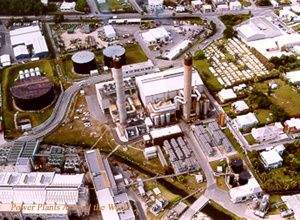 Presently,
there are two generating stations on
23 acres of property on Serpentine Road in Pembroke
Parish. The East and West Power Stations contain a total of 12 diesel
engines and 9 gas turbines. The type of fuel used depends on which engines are
in operation. Heavy fuel, used by 82% of the entire system, powers four newest diesel engines which
carry the basic load of power used on a daily basis. They are slower to start up
than the gas turbines but are more efficient to operate. A very light diesel
fuel called Cetane runs the six smallest gas turbines.
Both types of engines generate a maximum of
168 megawatts of electricity at a frequency of 60 Hz. A generator (alternator)
produces alternating current. Voltage is about 18,500 volts. A generation
transformer increases voltage to 22,000 volts to transfer electricity more
efficiently over long distances. Transmission cables are made from copper or
aluminum because they have low resistance.
Presently,
there are two generating stations on
23 acres of property on Serpentine Road in Pembroke
Parish. The East and West Power Stations contain a total of 12 diesel
engines and 9 gas turbines. The type of fuel used depends on which engines are
in operation. Heavy fuel, used by 82% of the entire system, powers four newest diesel engines which
carry the basic load of power used on a daily basis. They are slower to start up
than the gas turbines but are more efficient to operate. A very light diesel
fuel called Cetane runs the six smallest gas turbines.
Both types of engines generate a maximum of
168 megawatts of electricity at a frequency of 60 Hz. A generator (alternator)
produces alternating current. Voltage is about 18,500 volts. A generation
transformer increases voltage to 22,000 volts to transfer electricity more
efficiently over long distances. Transmission cables are made from copper or
aluminum because they have low resistance.
Belco's central plant needs to be redeveloped. It wants a new North Station, located between Cemetery Road and St John's Road. It will initially feature several 18MW diesel engines along with a 65m (213ft) smoke stack, storage tanks and external radiators. Once the new facilities are in place, Belco plans to decommission its oldest power station, located to the north of the Belco offices. Belco has said that the new site needs to be in place by 2013 in order to guarantee reliable power delivery throughout the Island as several of the plant's generators are already working beyond their normal service life. According to the company's long-term plan, new diesel generators will be built within the site's existing footprint as older generators are decommissioned. While Belco believes that fossil fuels will continue to make up the backbone of the Island's electricity system, it has set a goal of having 20 percent of Bermuda's energy coming from renewable sources by 2020. The company believes that Bermuda could see the construction of a large-scale solar farm by 2015, and an offshore wind farm by 2018.
Underground cables are not as vulnerable to wind damage but cost more to repair than overhead cables. In most rural and urban areas, the cables are overhead, not underground. But BELCO funded underground cabling in the Town of St. George to help improve the look of the town as it went for and got World Heritage Site status. All electrical cabling for new developments such as office buildings and hotels, both in the City of Hamilton and elsewhere are located underground. Otherwise, this is done only when customers request it and pay for it themselves.
There is a major step down sub station where electricity is routed for commercial or domestic use. 30 substations transform high voltage to low voltage. For commercial use, transformers in large buildings and some other buildings transform low voltage electricity even lower to 120 or 220 volts. For domestic use, the electricity passes along high voltage poles to pole-mounted transformers to low-voltage poles to households.
In Bermuda, for domestic premises, the average per kilowatt hour (KwH) cost before tax (Fuel Adjustment Rate, FAR) is high by international standards, higher than any of the countries named in the International Energy Agency's key world statistics report. The cost to Bermuda consumers is per KwH, plus the Fuel Adjustment Rate. The two combined mean that the overall cost of electricity to Bermuda consumers now exceeds 57 cents US/Bermuda per kilowatt hour.
2020. May 11. Opinion. By Ian Robertson is the chief executive of Algonquin Power&Utilities Corporation, the entity that has contracted to buy the Bermuda Electric Light Company Ltd. Renewables is something we at Algonquin Power&Utilities Corporation are passionate about. It is how our company started. From our inception in 1988, we have approached business growth with a long-term commitment to creating value for our customers and communities through investment in long-lived, sustainable assets that are built for the future. Through our two companies, Liberty Utilities and Liberty Power, we own more than 70 power-generation facilities and utilities throughout Canada and the United States, supported by more than 2,500 skilled and motivated employees who play a vital role in our success. Liberty Power holds direct or indirect equity interests in more than 35 clean-energy facilities with more than two gigawatts of installed capacity. This includes hydroelectric facilities with a combined generating capacity of 135MW and solar-energy facilities with 164MW of installed generating capacity. Our company also operates wind-powered generating stations in Canada and the US with a combined generating capacity of 1GW, which is ten times Belco’s peak demand. Wind is a technology with which we have much experience and we are looking forward to exploring the possibilities of introducing this technology in Bermuda. Our portfolio of development projects will add more than 1.4GW of incremental renewable capacity from wind and solar-powered generating stations by 2023.
Our mantra at Algonquin is that sustainability is not something we do; it’s something we are, and our purpose is simply stated as “Sustaining Energy and Water for Life”. Our strategy includes a focus on high-quality, renewable-generation projects that benefit from low operating costs using proven technology and can offer a high rate of return on invested capital. That is why we have committed to investing $300 million in Bermuda’s renewable-energy future. This investment will help Bermuda to achieve the renewables goal outlined in the Integrated Resource Plan — to generate 85 per cent of the island’s electricity supply from renewable sources by 2035. The island is already making inroads to achieving this goal with the new solar project at the “airport finger”, which is projected to generate 6MW, and already-installed rooftop solar generating another 5MW. Empowering home and business owners to install generating capacity and energy storage is something we strongly believe in and have moved towards with initiatives in other jurisdictions in which we operate. For example, in New Hampshire, we recently commenced the first phase of a programme that has received approval from the local regulator to purchase and install Tesla Powerwalls in 500 homes. The programme is intended to lower costs for ratepayers overall, while saving money for the host customers based on a time-of-use rate. This new model provides an avenue to leverage private investment in distributed energy to reduce overall grid-system costs.
We also look to replace fossil-fuel generation with renewables in the markets in which we operate — like our 600MW Missouri wind project, as well as solar generation and storage. Last November, we broke ground on our Maverick Creek Wind Farm in Texas, which will, when operational this year, have the capacity to power 200,000 homes. Our energy purchasers for Maverick — Kimberly-Clarke and General Mills — will use that clean energy to offset significant portions of their operations’ power needs, helping them to achieve their sustainability goals. So we’re not just helping the local economies, we’re helping the planet. If our application relating to the change of control of Belco is approved by the Regulatory Authority and the Government of Bermuda, we are committed to making similar investments on island — a $300 million commitment to steadily increase the amount of renewable energy to ultimately replace fossil-fuel generation. Our proven track record will enable Bermuda to move to more renewable energy sources while also lowering energy prices for customers. We are excited by the possibility of becoming part of a cleaner, greener Bermuda."
2020. April 27. A preliminary report on the possible future of the electricity sector was released by the industry watchdog tonight. The Regulatory Authority published the document on its website and asked for public views to be submitted by June 2. The authority said that the report was prepared after “a comprehensive review to identify ways to improve the efficiency of the regulatory framework that governs the sector”. The report said that the RA received 18 responses to a consultation document last year. Members of the public were asked questions such as whether or not there should be charging points for electric vehicles across Bermuda that consumers could pay to use. They were also asked to consider if community energy projects would be beneficial. Proposals from the RA included that its functions should “explicitly include the promotion of clean energy”. The authority said its main objectives for the sector were to:
The preliminary report is available at the RA’s website at ra.bm.
2020. April 14. Some upcoming Belco bills will be based on estimates, because restrictions on movement mean meter readers are unable to visit properties. The utility said today that customers will be able to alert Belco to discrepancies between what they are billed for and what they used. Belco also urged customers to ignore messages concerning meter readings that have been circulating on social media. A Whatsapp message on the topic was being shared today. A Belco spokesman said: “Since the Government implemented sheltering in place on April 4, our meter readers have been unable to visit residential and small commercial properties to complete meter reads as normal. As a result, system-generated estimate bills have been issued. Customers will know if their bill is an estimate as it will say ‘this is an estimated bill’ on the right-hand side. It is important to note that customers with AMI meters [also known as smart meters] will have an accurate bill.” Customers are advised that, once they have received their bill and confirmed it is an estimate, they can check the usage reading on the bill against their meter. If there is a large discrepancy, a clear photo of the meter can be taken and e-mailed to info@belco.bm and a new bill will be issued. Customers are urged to only check for a discrepancy once they have received their bill and it indicates that it is an estimate. If there is a minor discrepancy, any underestimation or overestimation will be corrected in the next reading cycle after the shelter in place is lifted. The spokesman added: “Belco will only use accredited media sources to send official information about company operations and information for customers. If information is not published by local media or posted on our website then it should be ignored.”
2020. April 1. Belco’s new multimillion dollar North Power Station has powered up. The station went online at midnight on Tuesday after “many years of planning and construction”. Dennis Pimentel, Belco’s president, said: “The commissioning of the North Power Station marks an important milestone for our company and Bermuda — one that has been more than ten years in the making. Our new plant will be much cleaner, quieter and more efficient than the old engines — and this will benefit everyone in Bermuda.” Construction of the North Power Station, between St John’s Road and Cemetery Road in Pembroke, started in 2018 and is estimated to have cost $120 million. The station has four 14 megawatt dual-fuel generators designed to pump out 56 megawatts of power. The new station will allow Belco to decommission generators that have been in operation for between 40 and 50 years. A Belco spokesman said the older engines were more expensive to operate and maintain and had become unreliable. Mr Pimentel added that the new station will also help provide the “bridge” as Bermuda moves towards renewable energy as outlined in the Government’s integrated resource plan. The plan proposed that 85 per cent of the island’s energy should be generated from renewable sources by 2035. Mr Pimentel said Belco had invested in training for its staff as part of the new station project. He added: “I would also like to thank all those involved in bringing this large and complex project to fruition on time and on budget. That includes the Government and Regulatory Authority, our team at iEPC who worked on the design, our project management team and all the staff at Belco, contractors BWSC, numerous local subcontractors and shipping agents who arranged for the delivery of the engines and equipment. We would also like to thank our neighbours and the community for their patience and understanding during the construction of the new plant. This project provided a much-needed boost to our economy and jobs for Bermudians to build a plant that will be fully operated by Belco staff. Our ultimate goal is to bring down electricity rates for our customers and move to a more renewable energy future and the North Power Station will assist in achieving that goal.” Mr Pimentel said some work still needed to carried out at the site, including removal of construction equipment and landscaping.
2020. March 31. A big fall in restructuring charges helped Ascendant Group Limited, the parent company of Belco, achieve a 129 per cent improvement in its full year profit, reporting net income of $12.4 million, or $1.27 per share, for 2019. That was up on the $5.4 million reported in 2018, when the company shouldered restructuring charges of $9.12 million in 2018. Last year those charges fell by 68 per cent to $2.88 million. Ascendant’s core earnings were $15.3 million in 2019, about $800,000 higher than the previous year. Sean Durfy, Ascendant CEO, said: “2019 was a very busy year for the company. We made great progress with our $250 million capital plan having built and commissioned Bermuda’s first battery energy storage system and completed construction of the NPS [North Power Station]. “These are significant investments that will ensure a safe, reliable and cost-effective energy future for Bermuda.” He said shareholders had also approved the sale of the company to Algonquin. “Algonquin is an established renewable energy and utility group with North American assets in excess of $10 billion and they currently own and operate 54 energy facilities, of which 90 per cent are renewable. As part of their proposal, Algonquin has committed to continue to run all Ascendant companies locally with current Bermudian management and to support Belco as it works alongside the [Regulatory] Authority to implement the Integrated Resource Plan for Bermuda and introduce modern energy technologies to accelerate the introduction of renewables, conservation and battery storage for the island.” He said the increased net income was due to “solid operating results”. Dennis Pimentel, Belco president, said: “Belco has made great progress on the $120 million NPS replacement generation project which is currently being commissioned. In addition, we have begun our $50 million-plus upgrade to our transmission and distribution system which will ensure a much more resilient grid and the ability to add large and small scale renewables. We were also pleased to complete our rate case and deliver lower rates to our customers beginning in January 2020.” He added: “Even though electricity sales continue to decline, our cost savings measures have allowed us to lower rates for customers. We are confident that the NPS and ongoing cost saving initiatives and efficiency measures will enable us to continue to provide safe, cost-effective electricity for our valued customers.” During the year, Belco’s earnings were $19 million, up $1.35 million, or 8 per cent, on 2018. The company said the 5 per cent increase in core earnings was due to increased results at Belco and continued growth in non-utility earnings at AG Holdings Limited, partially offset by higher group expenses. Ascendant continued its share repurchase programme until 1 April last year, when it was discontinued in light of the proposed sale of the company. Share repurchases during the year totaled 139,395 at an average price of $18.26 per share. The company’s earnings and cash flow enabled its board to maintain the annual dividend rate at 45 cents per share.
2020. March 6. Bermuda should consider all options, including offshore wind turbines, as it looks at future energy sources. There are strong reasons for this, according to Jens Alers, who touched on these as he spoke about a new style of ship being used to maintain offshore wind farms. The US is looking at the possibility of wind farm operations off its east coast, and the technology is increasingly being used in other places, including Europe. Mr Alers sees such developments opening up possibilities for Bermuda. He is group director of Bernhard Schulte Shipmanagement (Bermuda), which has offices in Par-la-Ville Road. Bernhard Schulte Offshore, part of the Schulte Group, won a tender to provide a new service operation vessel to give maintenance support for a wind farm off the coast of Germany. The Bernhard Schulte group all ready has two ships servicing wind farms in the North Sea. The new vessel will accommodate about 80 technicians and crew. The technicians will be able to use a “walk to work” bridge on the ship to access the wind turbines and carry out repairs and maintenance from within the structures. The vessel will be put to work at a offshore installation where each of the 66 wind turbines generates up to six megawatts. Such large expanses of turbines would not be needed to cover the energy demands of Bermuda. Mr Alers believes that 15 similar turbines would likely be sufficient. He acknowledges there are challenges, but said solutions are also available. Bermuda is seeking a new energy plan for the future. The Integrated Resource Plan has placed a focus renewable energy sources, such as solar, wind and biomass technology. Mr Alers said Bermuda should consider all options. “Wind is one, solar — given where we are — is the strongest. LNG (liquefied natural gas) is not the strongest because it is very expensive to create the infrastructure for it. But propane, which is already imported into the island and has an existing distribution network, belongs in the mix,” he said. When it comes to offshore wind turbines, he said Bermuda could, technically, have its energy needs met by about 15 of the six-megawatt turbines, although in practice it would likely install fewer. “We would not want to just rely on wind. Plus, the Sargasso Sea, where we are, is not the windiest of areas. Efficiency of turbines would be less near Bermuda than in the North Sea.” There are other challenges. Mr Alers said: “We really have to look at an environmental feasibility study, because these things have a foundation. You would need to ram them into the reef. They are basically built into the ocean floor. I’m sure there would be quite a few people who would have something to say about embedding these things into our reefs, and I totally understand that.” He mentioned research off the coast of Portugal into floating turbines that are anchored to the sea floor, something that could be less environmentally intrusive. As for the issue of hurricanes. Mr Alers said: “Well, you can stop these things. A winter storm in the North Sea is no different to a hurricane. Companies have been operating wind farms in the North Sea for quite a few years.” If Bermuda did have a small scale installation of offshore wind turbines, it would need to find a way to carry out maintenance, but not necessarily with a dedicated service operation vessel. Mr Alers said six or ten turbines would not require the full-time deployment of a support ship. “It would be very expensive for Bermuda to operate a ship like that, so other solutions would need to be found. But it can be done.” He said US states from Maine to South Carolina are keen on developing offshore wind farms. “The US will build a massive number of offshore wind farms. The aim is to be at about 20 gigawatts in just ten years from now,” Mr Alers said. “Because those wind farms require maintenance and support ships and we are not very far from that in Bermuda, our endeavours to develop wind technology could benefit. Of course it’s not something to rely on 100 per cent. It has never been good to rely on one source.”
2020. February 10. A deadline for a decision on the change of control of Belco to Canada’s Algonquin Power and Utilities Corporation has been extended to October. The Regulatory Authority will issue a final decision on the change of control application. A Bermuda government notice states that Walter Roban, Minister of Home Affairs, has concluded that there is “good cause to waive the deadline” due to the complexity of the statutory process to access the application, and the national significance of the proposed transaction. The new deadline to assess the application is October 4. In August, shareholders of Ascendant Group approved a takeover by Algonquin. Algonquin offered $365 million for the shares in Ascendant, which includes electricity supplier Belco Ltd, AirCare Ltd, iEPC Ltd, IFM Ltd and Ascendant Properties Ltd. In a statement about the deadline decision change, Ascendant said: “In light of this substantial extension, the company will continue to work with the minister and the RA to ensure that final consideration of the application is completed as expeditiously as possible. The Ascendant board of directors is confident that the sale will ensure Bermuda and Belco’s customers are well served with reliable electricity that will be cleaner, more efficient and more cost-effective. Algonquin has committed to reducing Belco’s operating costs by $5 million, with no company-initiated job reductions in connection with the sale, to benefit the customer, investing $5 million to launch the Sustainable Bermuda Foundation with the purpose of advancing and promoting renewable energy, conservation and sustainability in Bermuda, and investing $300 million into renewable energy in Bermuda through a competitive process. These commitments are in addition to Belco’s pre-existing $250 million investment in capital infrastructure upgrades. These commitments are expected to benefit all our stakeholders — our employees, customers and the Bermuda community.”
 2020.
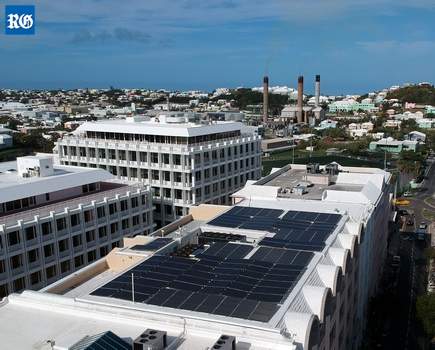
January 17. It is hailed as the biggest solar panel installation in Hamilton,
and it will generate estimated annual savings of up to 140,471 kilowatt hours
each year for the operators of Richmond House. The projected electricity
bill savings from the 276 photovoltaic modules are about $52,000 a year.
“Every company in Bermuda that has a large electricity bill should be looking
at this,” Nick Duffy, divisional manager of Bermuda Alternative Energy, said.
His company was chosen to do the installation, which covers about 6,000 sq ft on
the roof of the Par-la-Ville Road office building. The photovoltaic modules are
bifacial, which means they collect solar energy from direct sunlight and any
that is reflected from the roof onto the underside of the panels. They are
expected to last at least 25 years, and to recoup their purchase and
installation costs within the first six years. The electricity generated will be
used as a power source for the building, with any shortfall in requirements
being made up from the Belco supply. The project was 2½ years in the making.
Anthony Alves, of JPM Ltd, and project manager for Richmond Holdings Ltd, said:
“We’ve always talked about our carbon footprint and reducing that and
showing other building owners that it is a worthwhile investment. We all need to
be conscious of our environment and the use of fossil fuel, and by implementing
solar we are chipping away at that. I congratulate the directors of Richmond
Holdings for having the vision for moving forward on this exciting project. BAE
have done an amazing job. Some due diligence had to be done first by the
building owners on the roof. We had a group of engineers come up to test the
integrity of our concrete slab.” He said Kaissa removed the old roof covering
and replaced it with a new TPO [thermoplastic membrane] that enhanced the final
project. Charles Dunstan, of Kaissa, said the new roof covering has a 20 to
25-year life span, as opposed to the old covering that had to be re-coated every
five years. He said: “With the lack of space up there now, re-coating that
roof would have been difficult. So now we have a life span that matches the
solar panels, so when the owners come to redo things, they can do everything at
one time.” Mr Duffy, of BAE, which is part of the BAC Group, said the
Panasonic modules in the installation are guaranteed to still be producing 90
per cent of their installed maximum wattage after 25 years. When asked if other
companies in Bermuda should look at what has been done at Richmond House, and
maybe follow suit, he said: “Every company in Bermuda that has a large
electricity bill should be looking at this.” He said sunshine is a free,
renewable energy. “It makes total sense, and I compliment the owners of the
building who are being very progressive. It is currently the largest PV system
in Hamilton. It has now jumped to pole position. It’s very good that Richmond
Holdings are setting the trend for others to follow.” Among the companies that
have a home in Richmond House is Conyers. Paul Naylor, its chief operating
officer, said: “We’re delighted to be part of an exciting project. It
enhances our sustainability and our green credentials — something that we are
very conscious of. There are lots of other benefits, such as cost-saving over
the long-term.” Jens Alers, a director of Richmond Holdings, poured
Gosling’s Black Seal Rum in a “roof and solar panel wetting” ceremony to
mark the competition of the project.
2020.
January 17. It is hailed as the biggest solar panel installation in Hamilton,
and it will generate estimated annual savings of up to 140,471 kilowatt hours
each year for the operators of Richmond House. The projected electricity
bill savings from the 276 photovoltaic modules are about $52,000 a year.
“Every company in Bermuda that has a large electricity bill should be looking
at this,” Nick Duffy, divisional manager of Bermuda Alternative Energy, said.
His company was chosen to do the installation, which covers about 6,000 sq ft on
the roof of the Par-la-Ville Road office building. The photovoltaic modules are
bifacial, which means they collect solar energy from direct sunlight and any
that is reflected from the roof onto the underside of the panels. They are
expected to last at least 25 years, and to recoup their purchase and
installation costs within the first six years. The electricity generated will be
used as a power source for the building, with any shortfall in requirements
being made up from the Belco supply. The project was 2½ years in the making.
Anthony Alves, of JPM Ltd, and project manager for Richmond Holdings Ltd, said:
“We’ve always talked about our carbon footprint and reducing that and
showing other building owners that it is a worthwhile investment. We all need to
be conscious of our environment and the use of fossil fuel, and by implementing
solar we are chipping away at that. I congratulate the directors of Richmond
Holdings for having the vision for moving forward on this exciting project. BAE
have done an amazing job. Some due diligence had to be done first by the
building owners on the roof. We had a group of engineers come up to test the
integrity of our concrete slab.” He said Kaissa removed the old roof covering
and replaced it with a new TPO [thermoplastic membrane] that enhanced the final
project. Charles Dunstan, of Kaissa, said the new roof covering has a 20 to
25-year life span, as opposed to the old covering that had to be re-coated every
five years. He said: “With the lack of space up there now, re-coating that
roof would have been difficult. So now we have a life span that matches the
solar panels, so when the owners come to redo things, they can do everything at
one time.” Mr Duffy, of BAE, which is part of the BAC Group, said the
Panasonic modules in the installation are guaranteed to still be producing 90
per cent of their installed maximum wattage after 25 years. When asked if other
companies in Bermuda should look at what has been done at Richmond House, and
maybe follow suit, he said: “Every company in Bermuda that has a large
electricity bill should be looking at this.” He said sunshine is a free,
renewable energy. “It makes total sense, and I compliment the owners of the
building who are being very progressive. It is currently the largest PV system
in Hamilton. It has now jumped to pole position. It’s very good that Richmond
Holdings are setting the trend for others to follow.” Among the companies that
have a home in Richmond House is Conyers. Paul Naylor, its chief operating
officer, said: “We’re delighted to be part of an exciting project. It
enhances our sustainability and our green credentials — something that we are
very conscious of. There are lots of other benefits, such as cost-saving over
the long-term.” Jens Alers, a director of Richmond Holdings, poured
Gosling’s Black Seal Rum in a “roof and solar panel wetting” ceremony to
mark the competition of the project.
2019. December 31. Beginning in January 2020, 95% of Bermudian families will see a reduction in their energy bills. This has been welcomed by the Progressive Labour Party. “This holiday season, we are committed to focusing on the sure and steady progress we’re making for Bermudian policies,” said Acting Leader Walter Roban. “Over the last few years, we’ve been working to bring down electricity prices and I’m happy that as of January 2020, those reductions will be realized. We expect reductions of at least 5% on energy over 2020 and we expect the vast majority of Bermudians to receive reductions. Across the region, electricity rates are going up, but, we are fortunate to be able to see them come down here in Bermuda. Bermudian families will see decreases in their bills. The reduction will reflect on your January 2020 BELCO bill. In the new year, we will continue to focus on reducing the cost of living for Bermudians,” Roban concluded.
 2019. December 18. Electricity
rates are going down in the new year, resulting in the average residential
customer seeing an expected 2.3 per cent reduction in their monthly bill.
Before any figures were released a Bermuda Government minister had said there
would be a “slashing” of the electricity retail tariffs, while Belco
referred to the changes as a “modest reduction”. The Regulatory Authority,
and the Government released statements yesterday about the reductions, with
Belco doing so today. However, initially there were no figures mentioned. Belco
has now released a table illustrating bill impacts when the new rates are
applied to meters on January 1. The table shows that a residential user using
300 kWh per month would see their bill go from $105.81 this month to $102.29 in
January, a 3.33 per cent reduction. A user consuming 600 kWh, referred to as the
average residential customer, would see their bill reduce by just over $5, or
2.31 per cent. Meanwhile, a residential user of 1,500 kWh per month will benefit
from $4.50 reduction, or 0.69 per cent. In addition, there are illustrations of
the impact on bills for commercial users, ranging from a 0.44 per cent reduction
on a bill for 500 kWh, to a 0.64 per cent reduction on a 1,500 kWh bill. A user
with a 5,500 kWh bill would see a 0.02 per cent reduction in their bill. The new
rates have been developed by Belco and the RA to implement a retail tariff
methodology issued by the RA last year. The RA was the first to announce the
imminent reductions when, in a statement yesterday, it said retail tariffs for
Bermuda’s electricity sector will be decreased across all customer groups.
This was followed a few hours later by a statement from Walter Roban, Minister
of Home Affairs, who said: “As a government elected with a mandate to improve
the quality of Bermudians’ lives and to drive down the cost of living, we are
pleased that the Regulatory Authority has today assisted in the delivery of one
aspect of our agenda; driving down the cost of electricity via the slashing of
electricity retail tariffs. From day one, the Government has refused to support
a raise of Belco retail rates and sought ways to drive power costs down. Now,
relief is on the way.” Belco was the last to confirm new rates are on the way,
issuing a statement this afternoon. Dennis Pimental, president of Belco, said:
“Belco remains committed to keeping rates as low as possible and we welcome
the new rate reduction. Although we have encountered significant cost pressures
during recent years, including inflation and decreased demand for electricity
resulting from population decreases, Belco has continued to invest approximately
$250 million in our infrastructure. These upgrades will allow us to import
renewables onto the grid, ensuring reliable and sustainable electricity for
Bermuda. Despite these pressures and investments, we have not raised
customers’ electricity rates. Instead, we have focused on efficiencies and
savings. For example, the North Power Station and Battery Storage System are
expected to save $20 million per year on fuel costs. We are projected to save
more than $30 million in expenditures compared to 2015 through efficiencies and
material savings.” Mr Pimental said the company will continue working with the
RA on reducing rates for Belco customers and providing a safe and secure energy
future for Bermuda.
2019. December 18. Electricity
rates are going down in the new year, resulting in the average residential
customer seeing an expected 2.3 per cent reduction in their monthly bill.
Before any figures were released a Bermuda Government minister had said there
would be a “slashing” of the electricity retail tariffs, while Belco
referred to the changes as a “modest reduction”. The Regulatory Authority,
and the Government released statements yesterday about the reductions, with
Belco doing so today. However, initially there were no figures mentioned. Belco
has now released a table illustrating bill impacts when the new rates are
applied to meters on January 1. The table shows that a residential user using
300 kWh per month would see their bill go from $105.81 this month to $102.29 in
January, a 3.33 per cent reduction. A user consuming 600 kWh, referred to as the
average residential customer, would see their bill reduce by just over $5, or
2.31 per cent. Meanwhile, a residential user of 1,500 kWh per month will benefit
from $4.50 reduction, or 0.69 per cent. In addition, there are illustrations of
the impact on bills for commercial users, ranging from a 0.44 per cent reduction
on a bill for 500 kWh, to a 0.64 per cent reduction on a 1,500 kWh bill. A user
with a 5,500 kWh bill would see a 0.02 per cent reduction in their bill. The new
rates have been developed by Belco and the RA to implement a retail tariff
methodology issued by the RA last year. The RA was the first to announce the
imminent reductions when, in a statement yesterday, it said retail tariffs for
Bermuda’s electricity sector will be decreased across all customer groups.
This was followed a few hours later by a statement from Walter Roban, Minister
of Home Affairs, who said: “As a government elected with a mandate to improve
the quality of Bermudians’ lives and to drive down the cost of living, we are
pleased that the Regulatory Authority has today assisted in the delivery of one
aspect of our agenda; driving down the cost of electricity via the slashing of
electricity retail tariffs. From day one, the Government has refused to support
a raise of Belco retail rates and sought ways to drive power costs down. Now,
relief is on the way.” Belco was the last to confirm new rates are on the way,
issuing a statement this afternoon. Dennis Pimental, president of Belco, said:
“Belco remains committed to keeping rates as low as possible and we welcome
the new rate reduction. Although we have encountered significant cost pressures
during recent years, including inflation and decreased demand for electricity
resulting from population decreases, Belco has continued to invest approximately
$250 million in our infrastructure. These upgrades will allow us to import
renewables onto the grid, ensuring reliable and sustainable electricity for
Bermuda. Despite these pressures and investments, we have not raised
customers’ electricity rates. Instead, we have focused on efficiencies and
savings. For example, the North Power Station and Battery Storage System are
expected to save $20 million per year on fuel costs. We are projected to save
more than $30 million in expenditures compared to 2015 through efficiencies and
material savings.” Mr Pimental said the company will continue working with the
RA on reducing rates for Belco customers and providing a safe and secure energy
future for Bermuda.
2019. November 19. Opinion. By Sir John Swan, a businessman, Premier of Bermuda between 1982 and 1995, and a former Belco board member and Michael Murphy, a former attorney for American International Group who was the chairman of the Association of Bermuda Insurers and Reinsurers between 1985 and 2005. "More than five months have passed since the announcement of a potential sale of Ascendant to Algonquin Power & Utilities Company. Since that time there has been no effort by the potential Canadian buyer to clearly state what benefits it may offer to the Bermudian ratepayers, the public or the future role it may play in the development of a distribution system in conjunction with the island’s developing local renewable sector. We estimate that 44 to 50 local Bermuda jobs exist in the solar installation and maintenance business. These small businesses have installed about one megawatt of generation capacity in the past year, with the ability to develop exponentially more jobs as a result of the Regulatory Authority’s long-term commitment to have 75 per cent renewables in place by 2035 to satisfy our total electric power needs. The combination of non-transparent events in the thinly traded stock of Ascendant, which lifted the acquisition price by Algonquin to a substantial premium, can lead only to higher prices for Bermuda’s ratepayers. In addition, our research indicates that Algonquin as the potential foreign buyer:
Algonquin may present itself as a renewable-energy company, but does not appear to offer Bermuda the renewable resources it needs to develop that are unique to this small-island country. The recent discussions with home affairs minister Walter Roban, during which interest was expressed by Legal & General Re of Bermuda to explore local investment in renewables, opens a door that could both boost our local solar labour force and finance the renewables Bermuda needs at cost-effective prices without the control of Ascendant changing hands to a foreign-owned company. The parent company of Legal & General Re is a socially responsible British-based insurer that has made more than $1 billion of investments in renewable energy and its technology. This development may increase the interest of others to invest in Bermuda’s renewable-energy future. In addition, the RA recently improved the economics for solar panel owners by approving a significant increase in the return that Belco must pay solar-energy providers for kilowatt hours purchased from them from 17.36 cents to 22.65 cents per kWh. The increase more accurately shares the marginal saving Belco receives by not having to purchase fossil fuel to produce the equivalent amount of power. The new generators Belco has can satisfy the island’s power-generation needs for the transitional years while phasing out the use of fossil fuels. Bermuda has the opportunity to implement its renewables Integrated Resource Plan in response to climate change and become self-sufficient and freed of foreign control of a resource fundamental to its future economic survival.
2019. November 6. Opinion and statement about our announced purchase of BELCO. By Ian Robertson, chief executive officer of Algonquin Power & Utilities Corporation. "When Algonquin Power & Utilities Corporation was founded in 1988 to develop and own generating stations in mostly remote regions of Canada, it was imperative to build and maintain strong relationships with the communities in which we operate — primarily through job creation, excellent customer service and contributing to the communities where we live. This commitment to communities is a huge part of the reason why, over the course of 30 years, Algonquin has grown to become a diversified generation, transmission and distribution utility with more than $10 billion in assets. Through our operating subsidiaries, we provide safe, reliable and affordable rate-regulated natural gas, water and electricity generation, transmission and distribution utility services to nearly 800,000 customers in Canada and the United States, via more than 54 generation and distribution facilities. From our inception, we have approached business growth with a long-term view to creating value for our customers and communities through investment in long-lived, sustainable assets that are built for the future. Our ability to build a portfolio of close to 1,500MW of wind, solar and hydroelectric generating capacity speaks to that commitment, as well as a drive to be leaders in the renewable energy space. With the power of more than 2,300 talented employees, we are well on our way to our goal.
2019. October 24. A new battery storage system that can instantly provide 10 megawatts of electricity to the grid in the event of a generation plant failure, has won an award for Belco. The Nolan Smith Battery Energy Storage System is a standby facility for Belco. If there is a system fault it kicks in and delivers electricity to the grid to fill the gap. It does this three times faster than can be achieved by a standard engine powering up to generate the additional electricity. It won the Best Energy Storage Project award at the Caribbean Renewable Energy Forum, which is the largest annual gathering of the Caribbean clean energy market. Dennis Pimentel, Belco president, praised the working group team involved, and said: “The BESS is an exciting project that is just a part of the foundation we are building for a better energy future for Bermuda, our $200 million-plus capital plan that has one overriding objective, to better serve our customers with safe, efficient and cost-effective electricity.” The reserve capacity storage system covers an area of 2,000 sq ft, with ISO containers and transformers. The containers hold the battery cells and other equipment involved in the system, which has a 20-year operating life. When the battery cells reach the end of their life, they will be shipped back to the US to be recycled. The storage system has been dedicated to the late Nolan Smith, a Bermudian who worked for Belco for more than 30 years and specialized in transmission and distribution system analysis.
2019. October 7. Customers selling excess electricity generated from their renewable energy systems to the Bermuda Electric Light Company, will be paid at a higher rate from today. The 30.4 per cent increase means customers will now receive 22.65 cents per kilowatt hour they sell to Belco. Previously they received 17.36 cents per kWh. The announcement was made by the Regulatory Authority of Bermuda. The feed-in-tariff for Bermuda’s solar PV distributed generators is the predetermined rate that Belco pays to residential or commercial solar distributed generators for the excess electricity they generate and feed into the grid. In Bermuda, distributed generators are primarily small-scale solar customers with renewable energy systems below 500kw, but may also include wind or other renewables generation sources. The RA said the feed-in-tariff will be reviewed again before 2022.
2019. October 3. The Regulatory Authority is seeking to increase fees on electricity providers and telecommunications companies to fund a $1 million-plus increase in its budget for the next financial year. In its work plan consultation document for 2020-21, the RA estimates total expenditure at $7.43 million, up from $6.29 million in 2019-20. Special projects in both electronic communications and electricity — the two industries the RA oversees — are the main drivers of the 18 per cent jump in expenditure. These include the first phase of a pre-feasibility study of an offshore wind farm, as detailed in the Integrated Resource Plan, the RA’s blueprint for the future of Bermuda’s electricity supply. The study will be commissioned by the RA “to determine the level of offshore wind resource available together with the business case and the environmental impacts”. A radio frequency study will feature on the electronic communications side, to determine whether cutting-edge technology, such as a 5G network, would be appropriate for Bermuda. The independent regulator is funded by the fees its levies on the two industries and receives no funding from the Government. To fund the increased budget, the RA proposes an increase in the Electronic Communications Regulatory Authority fee, to 1.9 per cent from 1.75 per cent. On the electricity side, the RA suggests that the regulatory fee of $0.00475 per kilowatt hour that appears on Belco customers’ bills remain unchanged. However, the regulator wants to increase levies on bulk electricity generators at varying levels depending on their scale and how the power is generated. Utility-scale electricity generation providers like Belco, with more than 25 megawatts of installed capacity, would face an increase of $5,500 per megawatt — up to $6,500 from $1,000. Renewable and waste-to-energy suppliers, with 0.5MW to 25MW of installed capacity would deal with a $500 increase to $2,000 per MW. The plan adds: “The RA also recommends to the Minister of Home Affairs that there be no increase in the current level of Government authorization fees imposed on the electronic communications and electricity industries under the Government Fees Act 1965, until the RA has completed a taxation review.” The RA’s proposed budget for the electronic communications segment of its work is $3.76 million for 2020-21, up 8 per cent on 2019-20, while $3.75 million will be needed for the electricity budget, up 31 per cent. In its work plan, the RA says it has 18 employees, led by Denton Williams, its chief executive officer, with three additional positions open. The RA has submitted its work plan to the Ministry of Finance, seeking approval of its budget for the year. The regulator is seeking public feedback on the work plan. The consultation period is open until October 31
2019. October 1. Legal and financial advisory fees related to the sale of the Ascendant Group Ltd totaled $4.62 million in the first half of the year, contributing to a net loss of $1.9 million for the six-month period, the company reported. The loss compared to a profit of $3.1 million for the same period in 2018. The details were included in a filing with the Bermuda Stock Exchange. Ascendant announced on June 3 that it had signed an agreement with Algonquin Power & Utilities Corp for the sale of the company for $36 per share, subject to shareholder and regulatory approval. Shareholders gave the two-thirds approval of the total issued and outstanding shares of the company at a special general meeting on August 9. The company is now awaiting approval from the Regulatory Authority and the Ministry of Finance. In a letter to shareholders that accompanied the six-month earnings report, chairman Peter Durhager said those approvals “may take several months”. Ascendant’s year-to-date core earnings from operations before corporate expenses were $7.5 million for the first half of 2019, compared with $11.1 million for the same period a year ago. The company said that was due in part to Belco’s base rate electricity sales falling by $3.9 million. Belco’s total expenses increased, the company said, with depreciation associated with new assets higher by $600,000 and service allocations from Ascendant increasing by $700,000. Those expenses were offset by salary savings of $800,000 compared to the same period in 2018. Ascendant said the company’s non-utility businesses continued to grow, with core earnings increasing $500,000 over the prior year. The group’s core earnings year-to-date in 2019 were $2.7 million, compared to $4.1 million a year ago. Corporate expenses dropped by $2.2 million in the first six months of the year, Ascendant said, as cost saving measures led to reduced personnel, directors’ costs and consultants’ fees. Cost recoveries from affiliates increased by $800,000 during the period. Cash flow from operations, excluding the effect of working capital charges, totaled $9.8 million for the first half of 2019, compared to $14.1 million for the same period a year ago. Capital expenditures for the first half of 2019 were $73.1 million, compared with $36.5 million for the same period of 2018. The company said this increase reflected spending associated with Ascendant’s capital plan. Construction of the 10-megawatt battery storage system was completed, and construction of 56MW of replacement generation continues, the company reported. Ascendant said a rate case was submitted in April 2019 to the Regulatory Authority in respect of the retail tariff methodology released by the RA in October 2018, which provided clarity on future rate-setting methods and timing. “With these accomplishments, the company has laid the groundwork for Bermuda’s energy future,” the statement said.
2019. September 25. Former employees and overseas workers have helped to return power to Bermuda after Hurricane Humberto, a Belco representative said yesterday. The spokesman said: “Thankfully, with the assistance of our retirees, as well as extra linemen from Algonquin Power & Utilities Corp, we have 75 per cent more linesmen working to restore electricity.” He thanked all workers who had been “instrumental in getting the work done efficiently and safely” and said that the power provider “continues to make good progress in restoring power to our customers”. The spokesman said that work continued on main branch lines and smaller pockets of outages across the island. He added: “However, overgrown vegetation that was broken, uprooted and hitting power lines during the storm is making the restoration process much more time consuming, as it takes a few hours to reconnect small pockets of customers. In some cases, customers who have had their power restored will have it switched off temporarily so that other lines can be safely repaired.” The spokesman said crews had also faced other setbacks. He explained: “On Monday evening, there were a number of pole fires due to salt that had been deposited by Humberto, combined with a light rain, which knocked out power to a number of areas that had been restored. Dealing with these priority emergencies has slowed progress in planned restorations.” The spokesman said that crews would continue to work from 8am to midnight to get power restored across the island. As Tropical Storm Jerry approaches, Belco crews will work until the weather makes it unsafe to continue. Crews will be back out as soon as the storm passes and it is safe to recommence restoration.” He said that preparations had been made for Jerry. The spokesman explained: “Belco are replenishing supplies and equipment in staging areas across the island to prepare for any further damage to the grid.”
2019. September 5. Belco is ready to send teams to help the Bahamas in the wake of the devastation caused by Hurricane Dorian. The storm struck the island nation on Sunday as a Category 5 hurricane and lingered there for almost two days, causing extensive damage. A Belco spokesman said the company reached out to partners in the Caribbean Electric Services Corporation to offer help when it became clear the Bahamas would be hit. Dennis Pimentel, the Belco president, said: “Our first thoughts are for the safety of all the residents of the Bahamas. “It’s clear that this powerful Category 5 hurricane, the second most powerful ever recorded in the Atlantic, has caused several deaths and extensive damage to property and infrastructure on the Abaco Islands and on Grand Bahama. Our team is on standby as assessments need to be carried out and a plan of action put into place by the Bahamian disaster management team. We are in regular communication with our Cariclec counterparts, and are ready to assist, once our crews have the necessary accommodations and other considerations, to effectively help with restoration efforts.” Mr Pimentel added that Algonquin Power and Utilities, a Canadian energy company which has offered to purchase Belco’s parent company Ascendant, would be able to assist Bermuda, if the island faced a similar disaster. The sale has been approved by stakeholders, but the deal is still subject to regulatory approval. He said: “One of the major benefits of being acquired by Algonquin is having a mutual aid agreement in place. Through Algonquin’s Utility Division which employs over 130 linesmen, Belco will have access to a number of these resources, which can be deployed to Bermuda, in the event that we are impacted by a hurricane, greatly improving our ability to rapidly restore power throughout the island.”
2019. September 4. More than 20,000 customers across the island lost power after a major transmission fault at Belco this morning. Residents reported outages in every parish from about 10am. A Belco spokesman said at about noon that service had been fully restored. He added that at the height of the outages 20,269 customers were without power. The spokesman said that the outages were linked to a switchboard fault and not the result of ongoing work taking place at Belco. He added: “It was an isolated incident.” Warwick Academy was among the buildings to lose power for about 45 minutes on the first day of the school term, as did the new building at Somersfield Academy. Bermuda High School for Girls and Mount St Agnes for Girls experienced a brief glitch, while Saltus Grammar School reported business as usual because it has back-up generators. Lights in the west end of Hamilton remained on. The spokesman said shortly before 11am that a “major transmission fault” was to blame. He added: “We know that outages are inconvenient and we thank everyone in advance for their patience.”
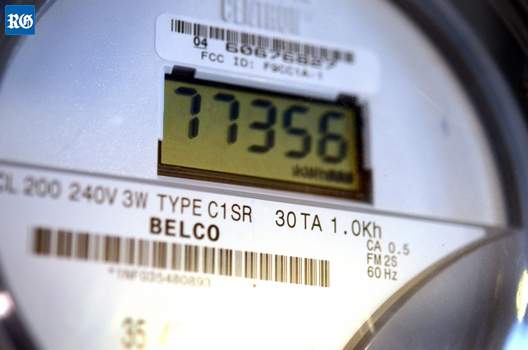 2019.
August 30. You’re not seeing things when your monthly Belco bill charges for
more than a month’s worth of usage. In some instances, those additional
days can tip a customer deeper into a higher rate tier. Belco is in the process
of installing meters fitted with a small computer chip and radio that transmit
information about a customer’s electricity usage to the company. This will
overcome the problem of monthly readings exceeding 30 or 31 days. As an example
of the problem currently encountered, a resident found their bill jumped
significantly from June to July even though their energy consumption barely
altered, with one month’s bill covering fewer days than the next. When they
queried this with Belco, they were told “excess days” had been charged at
the top kilowatt hour rate. However, when contacted by The Royal Gazette, a
Belco spokesman said there is no “excess days” charge applied to monthly
bills. He explained that while the company endeavors to keep the monthly
meter-reading cycle to approximately 30 days, sometimes the period is extended
by a few days. This happens as a result of delays, such as public holidays when
meter readers are not out-and-about gathering readings. “Belco’s billing
cycles are determined by meter reading cycles. The company’s meter readers
start in the eastern end of the island at the beginning of each month and work
their way westward, finishing in Dockyard at the end of the month,” the
spokesman said. “Normal meter reading cycles are between 25 and 35 days,
however every effort is made to complete reading cycles of approximately 30
days.” He said that between March and the end of September there are
“significant challenges” in the meter reading cycle due to public holidays
and staff vacations. “Meter readers work Monday through Friday, and on
occasion, may work on Saturdays in an effort to balance out any challenges
presented by the public holiday schedule. This means that some reading cycles
are shorter and others are longer based on when routes are read.” He gave an
example of what can occur to a customer who uses 20 kWh per day.
2019.
August 30. You’re not seeing things when your monthly Belco bill charges for
more than a month’s worth of usage. In some instances, those additional
days can tip a customer deeper into a higher rate tier. Belco is in the process
of installing meters fitted with a small computer chip and radio that transmit
information about a customer’s electricity usage to the company. This will
overcome the problem of monthly readings exceeding 30 or 31 days. As an example
of the problem currently encountered, a resident found their bill jumped
significantly from June to July even though their energy consumption barely
altered, with one month’s bill covering fewer days than the next. When they
queried this with Belco, they were told “excess days” had been charged at
the top kilowatt hour rate. However, when contacted by The Royal Gazette, a
Belco spokesman said there is no “excess days” charge applied to monthly
bills. He explained that while the company endeavors to keep the monthly
meter-reading cycle to approximately 30 days, sometimes the period is extended
by a few days. This happens as a result of delays, such as public holidays when
meter readers are not out-and-about gathering readings. “Belco’s billing
cycles are determined by meter reading cycles. The company’s meter readers
start in the eastern end of the island at the beginning of each month and work
their way westward, finishing in Dockyard at the end of the month,” the
spokesman said. “Normal meter reading cycles are between 25 and 35 days,
however every effort is made to complete reading cycles of approximately 30
days.” He said that between March and the end of September there are
“significant challenges” in the meter reading cycle due to public holidays
and staff vacations. “Meter readers work Monday through Friday, and on
occasion, may work on Saturdays in an effort to balance out any challenges
presented by the public holiday schedule. This means that some reading cycles
are shorter and others are longer based on when routes are read.” He gave an
example of what can occur to a customer who uses 20 kWh per day.
Belco’s energy charges are split into tiers: the first 250 kWhs at 15.75 cents per kWh, the next 450 kWhs at 24 cents per kWh, and the remaining kWhs at 33.62 cents per kWh. The spokesman pointed out that during the months of July and August energy usage tends to increase as air conditioning units work harder to cool rooms compared to the months either side. He added: “We are currently in the midst of an AMI meter deployment programme which will facilitate remote readings of our meters. Once full deployment has been achieved, Belco will be able to offer different reading cycles which will not require movement of our meter readers from one end of the island to the other.”
2019. August 14. A renewable energy company has predicted it will exceed expectations with a new solar farm on a disused airport runway. Saturn Solar Bermuda 1 explained its objectives in a string of documents submitted as part of a licence application posted on the Regulatory Authority website. The firm, part of Canadian-based Saturn Power, said it aimed to develop a six-megawatt power plant on the unused “finger” at the airport. It said in a Bulk Generation Licence application: “The goal of the project is to produce clean, emission-free, and sustainable power through the conversion of sunlight into electricity therefore reducing Bermuda’s dependence on dirty diesel power generation. This project provides the island of Bermuda with a price-stable and cost-efficient source of electricity with predictable supply. Saturn Power’s mission is to ensure the safe, efficient and timely installation of the project and long-term operation of the project to exceed the expectations of the Government of Bermuda, the citizens of Bermuda and local agencies.” The application showed the ownership structure of the company. It added: “At Saturn Power Inc, this same team has been responsible for the development, permitting, engineering, financing, and construction of over 70MWs of solar facilities in Canada and internationally. The company was founded over ten years ago and has seen great success with renewable energy development.” Walter Roban, the home affairs minister, said: “I am pleased that the project has progressed from a proposal phase towards becoming a reality.” He explained in June 2018, when he was the Minister of Transport and Regulatory Affairs, that Saturn Power had submitted the lowest bid out of nine proposals, six of which were Bermudian, and offered a rate of 10.3 cents per kilowatt hour. The Bermuda Government will collect rent for the site, although the licence application said that the lease was “in the process of being amended between the parties”. Portions of the company’s submission were removed from the documents released to the public, including the expected capital cost for the installation as well as anticipated annual expenses, which were predicted to rise in line with inflation each year. The application said that a local contractor would be used to build the solar power station with imported equipment for specialized parts such as “solar modules, inverters, racking, transformers and other electrical equipment”. Mr Roban said last year that the deal included an agreement that all bidders “were required to have Bermudian content in regards to labour during construction and operations, and maintenance personnel post-construction”. He explained then that the project will “create an opportunity for sustainable and sensible competition in the electricity sector”. Mr Roban added that it would stabilize a portion of ratepayers’ electricity bills for the next 20 years. He said that the replacement of oil fuel costs with solar power would keep an estimated $20 million or more in the island’s economy over the project’s lifetime. The Government’s Official Gazette said that comments on the proposed development could be submitted up to 21 days from the date of the application notice, which was on Monday.
2019. August 12. The Canadian company that intends to take over Ascendant Group sees an opportunity in Bermuda to replace fossil fuel energy generation with renewables, as it is doing elsewhere. That was among the comments made by Ian Robertson, chief executive officer of Algonquin Power & Utilities Corporation during a second-quarter earnings conference call on Friday. He spoke a few hours after Ascendant Group shareholders met and voted overwhelmingly to accept Algonquin’s $365 million offer for the group, which includes energy provider Belco. The amalgamation transaction is expected to close later this year, subject to the granting of regulatory approvals. Algonquin has reported adjusted net earnings of $55 million for the second quarter, or 11 cents per share, up from $50.9 million for the same period in 2018. Revenue fell six per cent, year-on-year, to $343.6 million. During Friday’s conference call, Mr Robertson responded to a question about the Ascendant transaction and said that while Belco is “a great utility in a highly stable and fairly well-off socioeconomic service territory, what really enthused us about it is the fact that, believe it or not, that the utility supplies almost 100 per cent of its energy from fossil fuel resources.” He said there are two consequences of that. “Obviously, I don’t think Bermuda is achieving its objectives from an ESG [environment, social and governance] perspective. And second of all, maybe where the real opportunity comes in, energy is very expensive in Bermuda, like 40 cents a kilowatt-hour with almost 20 cents of that being attributed to fuel. The company sees an opportunity to do in Bermuda what it is doing in the US Midwest in terms of replacing fossil fuel energy generation with renewables. And gosh, when you’re paying 20 cents for the energy alone — there’s a value proposition there.” He also mentioned the Regulatory Authority’s preference for renewable energy projects, as laid out in its Integrated Resource Plan, published last month. Mr Robertson said: “You can imagine that was the underpinning of our interest in Bermuda and music to our ears. From our perspective it has advanced the timing of our expectations of continued investment to replace fossil with renewables. So I think it’s great news.” Regarding debt within Belco, Mr Robertson said it is a “relatively low levered utility”.
2019. August 9. Shareholders of Ascendant Group Ltd have approved a takeover bid by a Canadian utilities group. They gave overwhelming backing to the bid from Algonquin Power and Utilities Corp, in a meeting at the Hamilton Princess Hotel and Beach Club this morning. Peter Durhager, the chairman of Ascendant’s board of directors, told shareholders in attendance that of those who voted 99 per cent had supported the transaction. Ian Robinson, the chief executive of Algonquin, said the company was “very pleased” by the strong support for the acquisition. He added: “We look forward to developing deep relationships with employees, customers, and the Bermuda community and look forward to being a part of the exciting future for Bermuda Electric Light Company Limited and Ascendant’s non-regulated businesses.” Algonquin had offered $365 million for the shares in Ascendant, which includes electricity supplier Belco, AirCare Ltd, iEPC Limited, IFM Limited and Ascendant Properties Ltd. Shareholders will receive $36 per share, a premium of 20 per cent over yesterday’s closing share price of $30 per share. Ascendant’s board of directors previously voted unanimously in favour of accepting the bid. Mr Durhager told attendees prior to the vote that Algonquin “have the capital resources, the operational knowledge and the experience in renewable innovation necessary to advance the company’s efforts to provide cleaner and more cost-effective electricity to our community”. The company currently operates 54 energy facilities, about 90 per cent of which are renewable. They operate in 13 states in the United States and one province in Canada with 2,300 employees. He said that there would be expectations on Algonquin to reinvest profits in Bermuda. He added: “A smart owner will both invest in the infrastructure that they own, and also in the community in which they are operating.” But Mr Durhager said: “At the end of the day, it is their prerogative what they do with their profits.” He said that the issue of the 60/40 rule would be examined after the takeover was backed. Mr Durhager added: “The Government regulators, in this case the Ministry of Finance, the Bermuda Monetary Authority and the Regulatory Authority, will have to get involved. Certainly the BMA and the Ministry of Finance will be making a determination to issue a licence to any non-Bermudian owner that would own more than the relevant portion. So there’s no difference in this transaction than any other business in Bermuda.” The bid by Algonquin will require regulatory approval before going ahead.
2019. August 7. Ascendant Group Ltd, which is the subject of a takeover bid by a Canadian utilities company, has reported a loss of $1.9 million for the first six months of the year. That compares to reported earnings of $3.1 million for the same period in 2018. The company said earnings were impacted by the changes to core earnings from operations, as well as $4.6 million in restructuring charges related to the sale of the company. Shareholders of the company will meet on Friday to consider a $365 million offer by Algonquin Power and Utilities Corp for the shares in Ascendant, which includes Belco. Shareholders would receive $36 per share under the proposed deal, which is backed by the company’s board of directors. In its financial statement, Ascendant said its core earnings from operations during the first six months were $2.7 million, compared with $4.1 million a year ago. It said the decrease was largely the result of lower electricity demand at Belco, in addition to a small increase in depreciation expense. This was partially offset by 21 per cent growth in Ascendant’s non-utility businesses and $2.2 million lower corporate expenses. Cash flow provided by operations, before changes in non-cash working capital balances, decreased $4.3 million, to $9.8 million for the six- month period that ended on June 30. The decrease was primarily driven by decreased Belco revenues and restructuring charges, offset by cost savings at Belco and Ascendant. Capital expenditures for the six-month period were $73.1 million compared to $36.5 million for the same period of 2018, reflecting execution of the company’s capital plan including Belco’s replacement generation, battery storage and transmission and distribution modernisation projects, the company said. The company’s share repurchase programme was suspended on April 1 as a result of the invitation for proposals for the purchase of the company. Trading was suspended on June 3 in anticipation of the announcement that the company had signed an agreement for the sale of the company, pending shareholder and regulatory approvals, and resumed on June 4. The company’s board of directors has declared a quarterly dividend of 11.25 cents per common share. Year-to-date, the company has declared dividends totaling 22.50 cents per common share. Ascendant said its capital plan progress continued in the first half of the year with engines delivered for the North Power Station and ongoing upgrades to transmission and distribution infrastructure. The company said continued cost reductions were made through operational efficiencies and implementation of an early retirement programme. Sean Durfy, chief executive officer, said: “The company has identified a prospective buyer, Algonquin Power and Utilities Corp, that has a long track record of renewable energy generation in the North American market and has the capital resources, operational knowledge and experience in technological innovation to bring more renewable energy to Bermuda. The board is in support of Algonquin purchasing the company and is asking shareholders to approve the sale.” Dennis Pimentel, president of Belco, said: “Belco is continuing the construction of the $120 million replacement generation and commissioned the battery storage project at the North Power Station. We also continue to invest in upgrades to the transmission and distribution grid to ensure reliability of the system but also to allow the integration of more renewables as per the release of the much anticipated Integrated Resources Plan by the Regulatory Authority on July 25. The company supports the IRP and all efforts to improve Bermuda’s environment and reduce greenhouse emissions wherever possible. Belco is currently in the review process to determine how it can work with the Authority to implement this aspirational plan and ensure a continued supply of safe, reliable and cost-effective power for our customers.” Mr Durfy added: “In addition, the company’s efforts to reduce costs are bearing fruit. Considering declining sales, these costs savings are critical to keeping rates in check. Our non-regulated businesses continue to perform well and experienced healthy growth of 21 per cent compared to the first six months of 2018.” Should Ascendant shareholders approve the deal on Friday, the bid by Algonquin would require regulatory approval before going ahead.
2019. August 6. Opinion. By Sir John Swan, a businessman, former Premier of Bermuda between 1982 and 1995, and a former Belco board member and Michael Murphy, a former attorney for American International Group. He was the chairman of the Association of Bermuda Insurers and Reinsurers between 1985 and 2005. "We would like to endorse and commend the Regulatory Authority of Bermuda for its decision in the recently released first Bermuda integrated resource plan to reject liquefied natural gas as an option and for committing Bermuda’s electricity generation programme to using at least 75 per cent renewables to be put in place by 2035. The RA’s foresight and courage in making this decision, if properly developed, could lead to the creation of brand new industries, many new jobs in Bermuda for Bermudians, local investment opportunities, huge foreign exchange savings leading to fossil fuel independence, and no longer being held hostage to the whims of the global oil market. Even Belco now supports the IRP in principle. In light of the IRP’s high commitment to the specific kinds of renewables that fit Bermuda’s unique topography, Bermudian Ascendant shareholders should be questioning if this opaque, proposed, one-time payout to shareholders for their stock really makes sense for the future of our country. This is a proposed sale to foreign owners, a loss of cyclical revenue and a potential exodus of significant assets that Bermuda will never get back. This is also our chance to lead ourselves in the right direction for the many and not the few. Let’s establish Bermuda as a leader in technology, policy and innovation to attract new talent and competition, rather than give up our right to choose our own destiny. The revolution happening now in the electric car market, the increased excess capacity to store rooftop solar or other electricity in their battery packs and either sell it to Belco’s grid or use it in our homes in the evenings through the use of a two-way charging system could rapidly make the recently acquired Belco generators at the North Power Station a partially redundant asset. Moreover, if properly and intelligently set by the RA, customer costs of purchasing electricity would be reduced and the Bermuda people could see the details of how they may participate in this cost reduction directly on their bills. The Renault project in Porto Santo, in the Madeira islands, is an example that shows how the benefits of the electric car with large battery packs could satisfy most of Bermuda’s power needs in the near future. With this IRP decision, Bermuda has now entered a new paradigm where the best path to lower electricity costs has been chosen to be an aggressive pursuit of new clean-energy sources where we must all play our part to attain the result. The “build more, profit more” model of the arcane power monopolies such as Belco is now bankrupt — a dead duck. This defunct model is the basis for their proposed sale at a very high premium price and can only lead to significant increases to customers’ costs of electricity. Instead, the right incentives to align utility, distribution and customer needs must be carefully chosen by the RA and the Bermuda Government so that the Bermudian people committed to the future of the island are all pulling in the right direction. Does Bermuda now even need to consider a foreign buyer for Belco at this strategic moment of change in energy source direction? The IRP decision should also force a complete detailed analysis by the RA and by the Bermuda Department of Energy of Ascendant’s proposed sale to Algonquin Power & Utilities Corporation, especially since the entire process since early 2019, which eliminated many prospective bidders, has been fatally flawed. No one, not even Belco knew six months ago of the IRP decision to commit to at least 75 per cent renewables and to eliminate LNG as an option. How could bidders intelligently make a fair estimate of the value of Belco before the IRP was issued? Many of the more careful, potential quality bidders were surely left behind by the flawed process of putting the cart before the horse. The Ascendant shareholders who vote on whether to accept the APUC offer on Friday, along with the RA and the Bermuda Government, who have the ultimate say on whether the proposed foreign buyer is acceptable, must carefully consider what if anything APUC offers Bermuda to meet its renewable objectives as provided in the IRP. The bottom line is that Bermuda needs to reduce the cost of electricity for Bermudians and ultimately the cost of living on the island. There are recent precedents of regulatory authorities in Hawaii and other locations of rejecting bids from power-generating companies at premium payout prices to shareholders for a variety of reasons — many of which appear to exist in the APUC-proposed purchase. We have recently reviewed most of the public information available surrounding the proposed purchase of Belco by APUC, including the public announcements of the proposal, Securities and Exchange Commission fact sheets, investment expert analysis of the APUC transaction and its impact on APUC, and the recent financial statements of both APUC and Ascendant/Belco. We have concluded that the proposed purchase by APUC offers little if anything to satisfy Bermuda’s long-range electricity objectives and reduction in customer electricity costs, as recently expressed in the IRP. Bermuda may be better off if Ascendant, with the right management attitude and its new vision embracing the IRP, continued without a foreign takeover bid being considered until it is determined what can be delivered by Belco and other Bermudian investors to meet the IRP objectives. It would be the most inopportune time for Ascendant insiders, senior management and foreign shareholders — collectively at least 22 per cent of the company ownership — to be permitted by the RA/Bermuda Government to bail out, take more hard currency out of Bermuda or realise large incentive payouts to senior management at a time when management focus on the future of renewables is most needed. In the interest of brevity, we have summarised our reasoning in arriving at these conclusions, but are prepared to provide details to any interested or concerned parties. Papers prepared for the shareholders meeting on Friday provide some vague statements expressed by the outgoing board about long-term savings to ratepayers evolving over time in moving towards renewables and lots of legalese on why two-thirds voting shareholder approval by an amalgamation mechanism to eliminate minority shareholders objecting to the transaction was the way to go. Ascendant directors emphasised the many ways that the $36-per-share cash offer was a wonderfully high premium price for the shareholders to receive from APUC. Algonquin eventually must recoup the premium it proposes to pay, most likely from customer ratepayers’ increases, part of which Belco already applied for with the RA in March this year, just before any sale or bidding process to sell Belco was announced by management. A proposed $420 million rate base was submitted by Belco in its request for a rate increase. No details were laid out by APUC as to how, when and in what amounts the customer ratepayers would have savings on their bills, only a statement that the transaction itself would not increase rates. Is APUC the right potential purchaser to be considered to meet the IRP renewables’ 75 per cent minimum objective? While APUC and Ascendant management are presenting the potential buyer as a state-of-the-art renewable conglomerate, almost all of the renewables APUC owns are in hydro-electrical power, concentrated solar power, land-based wind generation and large, land-use solar fields for utility production — none of which would apply to Bermuda’s topographically unique power-production renewable needs. No specific information has been provided about who will own Ascendant within APUC, other than “an affiliate of APUC” or the corporate-governance chain of command or decision-making process affecting Ascendant within an extremely large and complex buyer such as Algonquin. The press releases state that the Ascendant head office would remain in Bermuda, which could be a self-serving tax position. It appears that the ”affiliate” will be AAGES itself, a joint venture between APUC and telecommunications company Abengoa, where each of Algonquin and Abengoa have only minority interests. We do not know Abengoa’s objectives, but do know it almost went bankrupt in 2016. Are these risks of possible economic instability, complex ownership and partially defined corporate governance acceptable to ratepayers, the RA and the Bermuda Government? According to our research:
Electricity is a fundamental need, publicly regulated, and is required to maintain lives, cost-effective businesses and the comforts of all Bermudians, and should be treated as such. The days of an old-line monopoly and foreign profiteers dictating exorbitant rates to the Bermuda people are over."
2019. August 6. British workers contracted for Belco’s North Power Station downed tools on Saturday after a delay in their pay cheques. Last night a spokesman for Belco’s parent company Ascendant Group said that the contractors’ payroll was delayed through their UK-based employment agency. The industrial action involved an unknown number of staff at the project in Pembroke. The spokesman added: “The issue was resolved within 24 hours and staff returned to work.”
2019. July 31. Local and international investors will be invited to bid on the new renewable energy projects laid out in Bermuda’s 20-year electricity plan. This will open the way to competition in the business of generating electricity. The Integrated Resource Plan, published last week by the Regulatory Authority, maps out a future that would have 85 per cent of the island’s electricity supply generated from renewable sources by 2035. The plans include a 60-megawatt offshore wind farm, and more solar power, from both utility-scale solar farm projects and distributed solar, that is solar panels on homes and businesses feeding power into the grid. Monique Lister, senior legal adviser for the RA, said: “It started with requesting the IRP proposal from Belco, then going through the alternative proposals and more than 800 submissions from the public, which were strongly pro-renewables. The RA has listened and the IRP is Bermuda’s 20-year electricity plan. We completed this process in less than two years, ahead of schedule.” Ms Lister and other technical staff on the RA staff who have worked on the IRP for some 20 months said in an interview yesterday said that people would continue to pay Belco for their electricity as the owner and operator of the distribution grid. Ms Lister said: “As the transmission, distribution and retail licence holder, Belco will be the sole distributor of electricity and will be responsible for the sale of electricity. Belco will also continue to provide the base load power.” Despite the growing focus on renewables, the $108 million North Power Station, featuring four new liquid fuel-burning engines, will have an essential role to play in providing that base load. Simon Clinton, junior technical engineer at the RA, said: “We will still need the engines to maintain the electricity supply when the wind doesn’t blow and the sun doesn’t shine.” The IRP describes how the engines will generate a decreasing proportion of the total electricity supply as the big renewable projects come online, particularly after 2026. Under the plan, Belco’s engines will be decommissioned at their scheduled retirement dates. According to Nigel Burgess, the RA’s senior manager, that should be approximately 25 years. The next stage of making the IRP reality will be a series of pre-feasibility studies, particularly for the offshore wind, solar and biomass parts of the plan. Biomass generation is scheduled to be added to the island’s energy mix by 2028. The Bermuda Government is undertaking a solar feasibility study, Ms Lister said, and the RA will work on the offshore wind study. One aspect of this is likely to be a probe at sea to monitor wind speeds to estimate the potential for wind power generation. While BE Solar’s “Better Energy Plan Bermuda”, one of the IRP alternative proposals, suggested a site six miles off Dockyard for the wind farm, Mr Clinton said the location was yet to be determined. Factors to be considered would include coral reef and aviation exclusion zones, for example. Environmental impact assessments would also be needed. Jozelle Opoku, head of regulatory finance at the RA, said the IRP would help to boost the economy. “Investment in new generation will come and that will bring construction opportunities to build infrastructure,” Ms Opoku said. “There will be many opportunities for jobs and for training programmes to ensure that people can participate. The significant reductions in pollution would also mean cleaner air for the island. The fact that Belco could soon have new owners, after the utility’s parent company Ascendant Group accepted a $365 million takeover bid from Algonquin Power & Utility Corporation, made no difference to the IRP, Ms Lister said. The deal still has to be approved by the RA. “Belco will be required to comply with the IRP,” Ms Lister said. “This will not change if there is a change of control of Belco.” The IRP road map points to the wind farm being online within six years, as well as 21MW of utility-scale solar capacity and 30MW of distributed solar generation. Mr Burgess warned against describing the plan as “ambitious”. “It’s very realistic,” Mr Burgess said. “Every aspect of this has been fully laid out and thought through. The details are all there in the IRP.” Ms Lister added that the IRP is a “living document” which will be renewed every five years or so, to reflect changing realities.
2019. July 30. Belco has declared its in-principle support for the island’s first Integrated Resource Plan. The IRP, released by the Regulatory Authority of Bermuda on Thursday, outlines the framework for the island’s energy requirements over the next 25 years. Belco submitted its proposals for the IRP, which favored a solution with natural gas being used as a principal fuel. However, Bermuda’s electricity sector regulator has opted in favour of an offshore wind farm and more solar power. Under the plan, within six years the island is scheduled to have a 60-megawatt offshore wind farm, 21MW of utility-scale solar photovoltaic supply and up to 30MW of “distributed generation”, meaning residential and small-scale solar. The IRP’s release came as shareholders of Belco’s parent company Ascendant Group prepare to vote next week on a proposed $365 million takeover by Algonquin Power & Utility Corporation, the Canadian utility group. A Belco spokesman said: “Belco supports the IRP, in principle, and looks forward to continuing to collaborate with the Regulatory Authority to pursue the aspirational renewable targets that have been set. The company currently supports, and will continue to support, efforts to improve Bermuda’s environment and reduce greenhouse emissions wherever possible.” The spokesman added: “One of the reasons Algonquin Power & Utilities Corp was chosen by the board of directors to take the company forward is because it has the capital resources, operational knowledge and experience in technological innovation to introduce renewable energy.” Ian Robertson, chief executive officer of Algonquin, said: “Our commitment to sustainability provides us with the opportunity to leverage our core competencies of responsible utility ownership and renewable energy development; we look forward to working with the Authority and the people of Bermuda to ensure safe, reliable and cost-effective energy for many years to come.” In the IRP, the RA said that “specific engines at the Belco plant that are dependent on fossil fuels will be decommissioned”. Generators that burn liquid fuel “are not expected to operate at full utilization from 2026 onwards, due to the relatively high contribution that is expected from renewable sources”, the report states. However, such generators will still be needed to ensure continuity of supply when renewable sources are not available and during major system faults, the IRP adds. Shareholders of Ascendant are to meet on August 9 to vote on whether to approve the sale of the company to Algonquin. Under the deal, shareholders would receive $36 per share.
2019. July 27. The chief executive of the Regulatory Authority of Bermuda is to play no part in the utilities watchdog’s consideration of the sale of Ascendant Group Ltd, because he has a contingent interest in the company. Denton Williams became chief executive of the RA on January 7, having previously served as senior vice-president of Ascendant and chief operating officer of Belco, which is among Ascendant’s properties. A 74-page “Shareholder’s Circular” on the Ascendant website includes, on page 19, details of Ascendant’s long-term incentive plan, which includes stock awards made to executive officers and other key employees. Under these programmes, the company said, present executive officers as well as two former executive officers are entitled, in the aggregate, to 748,088 shares of the company. The circular said that “to the extent not yet vested, all such awards will vest upon the change of control resulting from the amalgamation”. At the bid price of $36 per share made for Ascendant by Algonquin Power & Utilities Corporation, those shares would be worth a total of nearly $27 million if the transaction receives the necessary shareholder and regulatory approval. A breakdown of each individual’s interests is not provided in the circular. The shareholder’s circular on the Ascendant website adds: “One former officer [of both the company and Bermuda Electric Light Company Limited], is now the current chief executive of the Authority. He, like others, is entitled to a portion of the historic share awards described above. Given these two facts, the former officer has confirmed that he will not have any involvement in the Authority’s consideration of the Amalgamation and the resulting change of control process.” The circular concludes: “The Board of Commissioners of the Authority is aware of the above facts.” A spokesman for the RA said that Mr Williams divested his shares in Ascendant when he took the top job at the RA, adding that any interest that Mr Williams has in the company would only vest when and if a sale of the company goes through. Shareholders of Ascendant are to meet on August 9 to vote whether to approve the sale of the company to Algonquin, the Canadian utility group, which has bid around $365 million for the company. Under the deal, shareholders would receive $36 a share, representing a premium of 20 per cent over yesterday’s closing share price of $30 per share. Ascendant shares traded at $22 on June 3, the day the deal was announced. Ascendant’s board of directors has voted unanimously in favour of accepting the bid. In a letter sent to shareholders, board chairman Peter Durhager has encouraged shareholders to approve the transaction. A two-thirds vote is needed for approval. The shareholders’ circular said the share entitlements in question do not carry the right to vote at the August 9 meeting.
2019. July 26. Bermuda’s electricity sector regulator has opted against natural gas as a principal generation fuel and in favour of an offshore wind farm and more solar power. Details were released yesterday by the Regulatory Authority in the island’s first Integrated Resource Plan, which outlines the framework for Bermuda’s energy requirements over the next 25 years. Under the plan, within six years the island is scheduled to have a 60-megawatt offshore wind farm, 21MW of utility-scale solar photovoltaic supply and up to 30MW of “distributed generation”, meaning residential and small scale solar. The RA said last night that “specific engines at the Belco plant that are dependent on fossil fuels will be decommissioned”. By 2028, biomass generation is scheduled to be added to the island’s energy mix. In a statement, the RA said two distinct options emerged from its analysis: liquefied natural gas as a fuel source with additional renewable energy, or no liquefied natural gas with very high renewable energy penetration. “The RA selected the high renewable option which will yield the lowest long-term cost for a non-natural gas solution, while exceeding Bermuda’s renewable energy policy objective,” the regulator stated. The RA chose from eight energy-mix scenarios. The one selected will result in 85 per cent of the island’s electricity coming from renewables by 2035, well in excess of the 38 per cent target of government energy policy. The capital investment needed to implement the plan is estimated at $273 million. Generators that burn liquid fuel “are not expected to operate at full utilization from 2026 onwards due to the relatively high contribution that is expected from renewable sources”, the report states. However, such generators will still be needed to ensure continuity of supply when renewable sources are not available and during major system faults, the IRP adds. The regulator had gone through a 20-month process, which involved power utility Belco submitting its proposals for the IRP — which favored a solution with natural gas being used as a principal fuel. Eight alternative proposals were then submitted and reviewed by the RA and feedback from more than 800 people considered. One of the proposals, submitted by BE Solar, included plans for a 60MW wind farm located six miles off Dockyard. Angela Berry, the RA’s chairwoman, said: “We know that business as usual is not sustainable. We also know that investing in a natural gas solution would continue our dependency on fossil fuels for up to 50 years and provide fewer diverse investment opportunities. “Therefore, the RA is confident that the energy plan will help to stabilize the cost of electricity, provide jobs to construct and support the new renewables infrastructure, increase investment opportunities for local and international investors, reduce our dependency on fossil fuels and place Bermuda significantly ahead of its renewables target.” The IRP’s release comes as Ascendant Group shareholders prepare to vote next month on a proposed $365 million takeover by Algonquin Power & Utility Corporation. In a letter to shareholders, Peter Durhager, chairman of Ascendant, said that for Bermuda, “Algonquin and Belco will continue to collaborate with the regulator to implement the IRP”. Belco declined to comment on the IRP last night. Ms Berry said the next steps in the IRP implementation include conducting several pre-feasibility studies to quantify the maximum amount of solar capacity available and future requirements, and also to undertake an investment-grade study on the use of wind power. Another study would determine the feasibility of introducing biomass generation into the energy mix. Ms. Berry added: “It is important to note that the IRP is a living document, and as such, the RA will conduct another IRP within the next three to four years to include the results of the pre-feasibility studies, to identify new changes in technology and gauge public sentiment regarding energy.” Walter Roban, the home affairs minister, welcomed the IRP last night. “I am pleased with the announcement and release of Bermuda’s first IRP,” Mr Roban said. “While there are elements of the IRP that reflect the Government’s commitment, the IRP also outlines a number of scenarios that the public should carefully consider as we all decide the course of our energy future moving forward. Bermuda has a long way to go before we can achieve a low-carbon energy future at a lower cost.” Mr Roban added: “We must all do our part to decrease our demand for fossil fuels and non-renewable electricity in Bermuda. This contributes to hundreds of millions of dollars leaving the country and unsustainable high costs of living and doing business.”
2019. July 24. Shareholders of Ascendant Group Ltd are to meet on August 9 to vote whether to approve the sale of the company to Canadian utility group, Algonquin Power & Utilities Corporation. Ascendant, which owns Belco among other interests, has accepted a takeover bid from Algonquin worth around $365 million. The sale is subject to shareholder and regulatory approval. Under the deal, shareholders would receive $36 a share, representing a premium of 20 per cent over yesterday’s closing share price of $30 per share, which was up by $5.99. or 24.9 per cent, on the day. Ascendant shares traded at $22 on June 3, the day the deal was announced. The company’s board of directors has voted unanimously in favour of accepting the bid. In a letter sent to shareholders, board chairman Peter Durhager has encouraged shareholders to approve the transaction. A two-thirds vote is needed for approval. In the letter, Mr Durhager wrote: “The board proposes a sale of the company. The board evaluated all of the strategic alternatives that would achieve the main objective of delivering the greatest positive impact for all our stakeholders. For you, our shareholders, the board sought to deliver an excellent return on your investment in Ascendant. For our customers, the board had to ensure long term stability of electricity prices with a clear path to reducing these prices over time. For our employees, the board’s goal was to enable continuity of employment as well as growth and advanced learning opportunities in their jobs. And, for the community, it meant integrating more renewables, conservation and battery storage into Bermuda’s energy mix.” Algonquin, Mr Durhager wrote, “is positioned to deliver on Bermuda’s energy future. Algonquin is a diversified generation, transmission and distribution utility with approximately US$10 billion of total assets and a market capitalization of US$5.5 billion. Through its two business groups, Algonquin provides rate-regulated natural gas, water, and electricity generation, transmission, and distribution utility services to approximately 800,000 connections in North America and is committed to being a global leader in the generation of clean energy through ownership of or investments in long-term contracted wind, solar and hydroelectric generating facilities representing over two gigawatts of installed capacity. Algonquin delivers continuing growth through an expanding pipeline of renewable energy, electric transmission, and water infrastructure development projects. It also maintains a global focus and aims for organic growth within its rate-regulated generation, distribution and transmission businesses and pursues accretive acquisitions.” The Ascendant website provides information about how the deal would impact employees, customers, and the island generally. For employees, the site says, Ascendant “will introduce advanced training opportunities, both locally and overseas, and are committed to no company-initiated job cuts”. For customers, “Algonquin plans to integrate additional low-cost renewable energy into Belco’s supply mix, which is expected to lower electricity costs”. For Bermuda, “Algonquin and Belco will continue to collaborate with the Regulator to implement the IRP. They are committed to accelerating the introduction of renewables, conservation, and battery storage”, the website says. In the letter to shareholders, Mr Durhager added: “The board unanimously concluded and recommends to the shareholders that the offer of $36 per share is a tremendous opportunity for shareholders to realise the value of their investment. Ascendant’s directors, management and other insiders (as such term is defined in the Bermuda Stock Exchange Listing Regulations) representing a total of 2,055,260 shares (22 per cent of all issued and outstanding shares of the company) have expressed their intention to vote in favour of a sale to Algonquin.” He added: “This is one of the most important decisions the shareholders of Ascendant will ever make.” The meeting will be held at 9.30am in the Harbourview Ballroom at the Fairmont Hamilton Princess Hotel & Beach Club.
2019. July 8. Belco has once again met an international standard for its environmental management systems, the power company announced. The International Organisation for Standardization, based in Switzerland, publishes international standards for industries worldwide. The ISO, which has members from 161 countries, adopted tighter requirements in 2015 for its ISO 14001 standard. In addition to meeting legal obligations, the standard helps Belco to improve resource efficiency, reduce waste, and manage its environmental responsibilities. Belco was able to meet within the three-year transition period. The utility was first certified for the standard in 2010. Jan Locke, Ascendant Group’s occupational health, safety and environment system coordinator, said the company was “extremely proud” to have maintained its certification. She added: “Belco is committed to environmental sustainability and this updated certification demonstrates how our environmental management system has become embedded in our corporate culture. There are many interested parties where Belco is concerned. The 14001:2015 Standard helps us to meet the expectations of our employees, customers, shareholders, and industry stakeholders.”
2019. July 5. Opinion about the proposed buyout of BELCO. By Sir John Swan, a businessman, a former Premier of Bermuda between 1982 and 1995, and a former Belco board member and Michael Murphy, a former attorney for American International Group. He was the chairman of the Association of Bermuda Insurers and Reinsurers between 1985 and 2005. "The sale of Bermuda’s electrical grid to any buyer can only move forward with approval by Bermuda’s independent Regulatory Authority. For that reason, the recent offer from Algonquin Power & Utilities Corporation to pay $360 million to shareholders of Belco’s existing owner, Ascendant, is not a done deal. Non-shareholders, especially Bermuda’s ratepayers and residents, may wonder what is in the deal for them — and, ultimately, that may depend on the integrated resource plan for the utility, which is also subject to regulatory approval. For those who have a stake in Bermuda’s energy future, public statements by APUC, a Canadian company that has formed a joint venture with a Spanish company called AAGES, are worth attention and interpretation. Here is a key passage from their release about the proposed acquisition: “APUC will work closely with the Bermuda Government and the Regulatory Authority to ensure a seamless transition so that the residents and businesses of Bermuda will continue to receive the same safe, reliable and cost-effective utility service that they currently enjoy. APUC is committed to maintaining the existing local management and operations teams. Customers should not expect any impact to rates from the acquisition. AAGES’ project implementation experience is available to support the major generation rehabilitation programme under way at Ascendant and help accelerate Bermuda’s commitment to reducing carbon intensity.” First, APUC implies that Belco customers enjoy existing electricity prices. They are some of the world’s highest rates, yet the company describes them as “cost-effective utility service”. This speaks for itself. Related to rates, it is rational for APUC to seek to extract from Bermuda every dime it pays for Belco — and more. By paying an extraordinarily high per-share premium to buy the Ascendant stock, the price of electricity to the consumer is most likely to increase to eventually pay for the cost of the premium purchase price paid by APUC to Ascendant shareholders. APUC states “customers should not expect any impact to rates from the acquisition”, which would suggest they see enormous profit potential with the present rates and that they expect no relief from high rates even if their cost basis for power declines in the future. Importantly, the Regulatory Authority that oversees Belco rates has not yet disclosed whether it has approved or will approve a rate hike requested in April 2019, which Belco appeared to attribute in part to massive LNG infrastructure investments that have neither been accepted by the RA or hundreds of participants in the regulatory proceeding about that proposal. The LNG investments were proposed in the original Belco Integrated Resource Proposal, which a recent statement from Belco senior management indicates was never being considered by Belco. APUC also states: “AAGES project implementation experience is available to support the major generation rehabilitation programme under way at Ascendant and help accelerate Bermuda’s commitment to reducing carbon intensity.” This vague statement appears to still leave LNG on the table for Belco since it could reduce the carbon footprint of Bermuda. However, it would not be a net benefit to world climate change because of the extreme adverse impact of methane gas released from the production sites all the way to delivery. Efforts by the Bermuda Government since 2011 through the issuance of position papers and other studies to make a major policy commitment to have substantial solar power and wind power in place by 2020 have been ignored to date. We are anxiously awaiting the release of a new plan from the RA for Belco’s energy resource development that will set a course in this direction, and it should make clear for both economic and health reasons that LNG is not a part of Bermuda’s electricity generation future. As an island country, where it is so important now and in the future to demonstrate to our tourists Bermuda’s commitment to protecting our environment, we must be leaders on clean energy and climate change. From the information released to date, APUC has not clearly and simply taken LNG off the table in Bermuda’s future, and without that clarity, our energy sector could drag the entire economy to the wrong side of this vital set of issues. If our commitment were substantially to renewables to produce electricity, we could set another example of smart investment and sustainability for the world like the Hawaiian island of Kauai, instead of becoming a fossil-fuel demon. Is APUC/AAGES the potential buyer Bermuda needs or wants in its electricity future? Bermuda customers, the energy department of Government and the RA, in particular, need to focus in detail on some of the history of the potential buyer and specifically the strengths and weaknesses it brings to Bermuda. It appears from fact-sheet filings required for the New York or Toronto Stock Exchange that APUC expects to buy Belco through a joint venture with Abengoa, a huge international utility company that just three years ago was also the largest Spanish company ever to have nearly gone bankrupt. In fact, Abengoa had at least two Delaware subsidiaries that were given bankruptcy-court protection in Delaware for at least nine months to give them time to reduce debt and find new capital and partners as part of a workaround. APUC appears to be one of the opportunistic new Abengoa partners who set up at least two entities where neither APUC nor Abengoa own a majority controlling interest in AAGES. Nevertheless, it appears that both companies would seek to determine the terms upon which renewable energy resources would be developed in Bermuda, and whether Bermudians themselves would be able to benefit. Bermuda’s best interests may not be a factor in future business decisions made by a potential buyer, and that should be carefully considered by the Bermuda Government now when it decides whether or not to approve APUC’s offer to Ascendant shareholders. What experience qualifies potential buyers of our electric grid to help Bermuda achieve a renewable energy future? We raise the following points in summary format, suggesting the RA and Bermuda Government should explore each at length with APUC and Abengoa as the potential buyer of Belco to seek detailed answers in their due diligence: Neither Abengoa nor APUC has any experience generating or delivering electrical power in hurricane-prone jurisdictions While Abengoa operates wind generators from platforms in the River Plate area between Uruguay and Argentina, these do not appear to be state-of-the-art, nor are they designed to withstand hurricane-force winds for which Bermuda must be prepared. Also, APUC’s experience with wind generation is all land-based, which would be hard to adapt with Bermuda’s limited space. Neither Abengoa nor APUC has experience or expertise with integrating electric vehicles into a distribution grid, which will be a game-changer for our island’s energy economy. Any potential buyer should explain how batteries in some new electric cars equipped with two-way plugs will be integrated into Bermuda’s electricity grid. The car battery can store solar power from residents’ rooftops and feed the excess to the electric company grid. As we gain 3,000 electric vehicles over the next decade, we will soon have more energy stored on board our cars than the entire island needs in its most demanding hour. Neither Abengoa nor APUC is focused on the most recent technological advancements or distribution systems that enable customers to generate solar power that could both reduce their costs and feed the grid. While Abengoa Solar is a world technological leader in developing, owning, and operating vast fields of mirrors that concentrate the Sun’s power, this land-intensive technology is not applicable to Bermuda. In reviewing public information about APUC’s solar renewable activity, it has been hard to find where its past use of solar would meet Bermuda’s space limits and the need to use existing rooftops and already developed areas in creative ways to generate renewable energy. Neither Abengoa nor APUC details how or through what programmes they expect to deliver consumer savings as the cost basis for clean energy continues to decline far below our present rates. Costs are falling rapidly for rooftop solar, offshore wind, high-efficiency heat pumps and electric-vehicle batteries. All of these can add value to Bermuda’s economy by improving the performance of our electricity grid. In short, the proposed acquisition of Bermuda’s monopoly owner of our electrical grid and generating systems should not be approved by the RA and the Bermuda Government unless the investment plan it will follow is compatible with the Integrated Resource Plan developed, debated and accepted by Bermuda itself. The first step will be finishing an IRP consistent with Bermuda policy goals and approved by the RA, and only then, a second step would be considering whether a potential buyer is able to implement that plan on terms that are good for our economy and the people of Bermuda."
2019. June 23. A Government MP claimed Belco should be nationalized during a Parliamentary debate about allowing ministerial approval over the company’s sale. Derrick Burgess, the Deputy Speaker, suggested interest in the power provider could be increased incrementally until the public owned or had control over at least half. His comments came in the House of Assembly on Friday when Members approved the Electricity Amendment Act 2019. The legislation would require the Regulatory Authority to consult and receive approval from the minister responsible for energy if it intended to allow the transfer or assignment of a bulk generation or transmission, distribution and retail licence. Walter Roban, the Deputy Premier and Minister of Home Affairs, highlighted that a proposed takeover of Ascendant Group — Belco’s parent company — could not be finalised until the RA agreed a licence transfer. The Act would also ensure that the authority will not give consent until an integrated resource plan has been approved, published and properly considered in the decision-making. Mr Burgess welcomed any Government’s ability to have “final approval” on a sale of the energy provider. The Progressive Labour Party MP said: “We all know that Belco is a so-called private company, and I say so-called because Belco, their electricity, really should be nationalized. We can’t continue to leave ourselves open to a private company that can do almost what they want. I’m just hoping one day, even if we start now, that the Government should acquire some interest in Belco, with the eventuality down the road of taking it over, or at least having at least 51 per cent of the shares in Belco, some sort of figure where we can have a say.” Mr Roban told the House that he had “every confidence” the regulator will carry out due diligence before it reaches a decision on the licence transfer, which comes after Ascendant Group accepted a takeover offer worth about $365 million from Canadian firm Algonquin Power & Utility Corporation. However, he added: “History has instructed us that in any organisation there should always be adequate checks and balances.” He told the House that Belco was “a strategic asset”, which was “critical to our social and economic wellbeing”. Mr Roban said: “Therefore, it is the duty of this Government to ensure that any proposed sale will promote economic efficiency and sustainability in order to reduce our reliance on fossil fuel, increase the use of renewables and make electricity more affordable for all residents.” Leah Scott, the Shadow Minister of Regulatory Affairs, said she was concerned about the Act’s potential impact on the authority’s independence. The Deputy Opposition Leader told MPs: “It’s concerning when you have people that are devoting their time to contribute to the running of the authority and to make decisions, to essentially then be micromanaged because whatever they do or whatever efforts they expend can then be overturned by the minister.” Rolfe Commissiong, a PLP backbencher, said reducing energy prices had to be “an integral piece” of any prospective sale. He added: “It has to deliver that benefit, primarily to the Bermudian people and consumers but also to Bermudian businesses because the cost of energy is one of the most major headwinds hurting our competitiveness.” Scott Pearman, the One Bermuda Alliance Shadow Minister for Legal Affairs, claimed the move was about ministerial power. He drew comparisons with an earlier Bill that provided for Government policy direction to the Bermuda Casino Gaming Commission, and another that allowed a minister to appoint Bermuda Tourism Authority board members. Mr Pearman said: “The Bill seeks to assert the clunking fist of Government over an independent regulator.” He added: “It would be far better if we let independent institutions remain independent and do the role that they are supposed to do without Government sticking its nose in.” Kim Swan, a PLP backbencher, said: “When it comes to the Progressive Labour Party wanting to put forward legislation, the code words and the code languages that are constantly coming forward are ‘ministerial power’ and ‘misuse of Government power’ when the very Government of the day can be vetoed on any legislation by the Foreign and Commonwealth Office through the Governor. But that’s OK for persons who are quite comfortable with the legacy arrangement that has been handed down to them by their forefathers. I don’t accept that, it’s wrong, and any right-thinking person would know that it’s wrong because the playing field is tilted in one direction — to favour those who inherited the legacy.” Craig Cannonier, the Opposition leader, agreed nationalization of the power company could be an option but said he would give it more thought. David Burt, the Premier, said that prospect left a question over “how exactly does that happen?”. He added: “The only way that actually happens is an amendment to the Electricity Act, which is what we are doing today. Just to be clear, I am not saying that it is the policy of this Government to take private property.”
2019. June 7. The Ascendant Group sale must be approved under ministerial directions, home affairs minister Walter Roban said today. Mr Roban told the House of Assembly the Regulatory Authority must give consent to the licence transfer of the utility group, which is the subject of a takeover bid from Algonquin Power & Utility Corporation of Canada. He continued: “If the RA approves a licence transfer without adhering to ministerial directions, the only remedy to the Government is to appeal to the Supreme Court. “ Mr Roban added that the Government would ensure that any sale would promote “economic efficiency and sustainability” in order to reduce reliance on fossil fuel, increase the use of renewables and make electricity more affordable.
2019. June 7. A petition for the Government to legislate a renewable energy target in Bermuda has been backed by hundreds of people. Stuart Kriendler, the managing director of green energy firm BE Solar, one of the main supporters of the petition, said more than 700 signatures had been collected by yesterday. The petition, launched on May 24, asked the Government to require that 70 per cent of the country’s electricity is produced from renewable energy sources by 2040. Mr Kriendler said: “Bermuda currently spends approximately $80,000,000 per year to purchase fossil fuels for electricity generation. If that money stayed in our economy, likely 1,000 jobs could instead be created with that money. In essence, transitioning to renewable energy is a climate and social justice issue as well as an economic one: a win-win-win.” He said the threat of climate change had forced countries around the world to take steps to help to save the environment, but that Bermuda had lagged behind. Mr Kriendler added the petition was in line with Government’s plans for a greener Bermuda. Less than 2 per cent of Bermuda’s electricity is produced with renewable resources at present. A small amount is produced by incinerating waste and the rest is generated using imported fuel. With Belco to be sold and its Integrated Resource Plan, a 20-year energy plan, expected to be finalised in the next few weeks, BE Solar has partnered with environmental charity Greenrock to launch the petition. BE Solar joined forces with UK-based sustainability engineering firm Etude last year to produce a 56-page report as an alternative to the Integrated Resource Plan. The document set out a proposal for an offshore wind farm six miles west of Dockyard and increased use of solar power. But with the Belco energy plan, which relies mainly on fossil fuels, expected to be accepted, the petition was started to encourage the Government to legislate for the use of renewable energy in Bermuda The petition said that parts of Bermuda were predicted to be underwater within the next 25 years due to rising sea levels caused by climate change. It added that Bermuda had some of the highest electricity costs in the world and a reliance on expensive imported fuel. A supporter of the petition, who asked not to be identified, said that a cut in the use of fossil fuels would also improve health. The supporter said: “Living close to Belco, we suffer the harming effects on a personal level added to our deep concern of the impact on a global level.” They added that a daughter had suffered health problems and had tested as allergic to benzene, a component of oil. Salayah Stange and Katarina Rance, Bermuda High School pupils who have lobbied for environmental changes, said they supported the petition. Salayah said: “For years, Bermuda has been asleep when it comes to the topics of sustainability and renewable energy. We are not nearly invested enough in the conservation of fuels or environmentally friendly production methods. It has been announced by the UN that in 12 years, the effects of climate change will become catastrophic and irreversible. It is my generation, Gen Z, that will ultimately have to bear the consequences of years of pollution and harmful emissions. We cannot leave this for later, as there may be no ‘later.’ Action needs to be taken now. I support this petition because I believe it is our responsibility to our island, our environment and our younger generations to do our part in combating climate change, and it is time Bermuda did this.”
2019. June 4. Ascendant Group has accepted a takeover bid worth around $365 million from a Canadian utility group. Yesterday’s announcement of the intended sale to Algonquin Power & Utility Corporation marks the conclusion of a four-month evaluation of “strategic alternatives” by Ascendant. The deal signed by Ascendant is worth $36 a share to shareholders, representing a premium of more than 63 per cent over last Friday’s closing price of $22 on the Bermuda Stock Exchange. Shareholder and regulatory approval is needed before closure of the deal, which Ascendant expects to happen in the second half of this year. The common shares of Algonquin, which is based in Oakville, Ontario, are listed on both the Toronto Stock Exchange and the New York Stock Exchange under the ticker symbol “AQN”. The company has approximately $10 billion worth of total assets and operates natural gas and water utilities, as well as electricity companies. Algonquin states that it is “committed to being a global leader in the generation of clean energy through ownership of or investments in long-term contracted wind, solar and hydroelectric generating facilities representing over two gigawatts of installed capacity”. An Ascendant spokesman said: “Algonquin has the capital resources, operational knowledge and experience in technological innovation necessary to advance the company’s efforts to introduce renewable energy and meet future challenges that will benefit the community as a whole.” He added: “They currently own and operate 54 energy facilities, of which approximately 90 per cent are renewable.” The spokesman said Algonquin had pledged to run Ascendant’s businesses from Bermuda and retain the Bermudian employee base. Algonquin added it would also introduce advanced training, to be carried out in Bermuda and abroad. The Ascendant spokesman said: “The company will continue initiatives such as the voluntary early retirement programme but is committed to no company-initiated job cuts.” He added that Algonquin’s commitment to renewable energy and power storage development would help the island to achieve a move away from fossil fuels and boost employment in new technologies. Angela Berry, chairwoman of The Regulatory Authority, which oversees the electricity sector, said: “As the RA regulates Belco, we will evaluate the proposed change of control of Belco in accordance with the provisions of applicable legislation and any ministerial directions. The next step in the process, from the RA’s perspective, will be for Belco to submit a formal application for a change of control, so that the RA can make an informed decision.” Walter Roban, the Minister of Home Affairs, whose responsibilities include the Department of Energy, said: “I note the announcement around the sale of Ascendant Group Ltd today. There are considerable steps before this is finalised. I am confident that once an application is made to the Regulatory Authority, there will be a robust review, to determine that Algonquin Power & Utilities Corporation has a strategy that is in line with the IRP and this Government’s commitment to drive down energy costs for the Bermuda public and ensure a more affordable and sustainable energy future for the island.” Mr Roban told the House of Assembly in March that the new owner would be expected to be “transparent, inclusive and collaborative” and referred to labour disputes over the dismissal of several Bermudian staff last year. Asked about other bidders considered by Ascendant, a spokesman for the company replied: “The process was very robust — and there was interest from many reputable international firms. We do not want to comment further for the sake of confidentiality.” Ascendant said that the integration of additional low-cost renewable energy into Belco’s supply mix was “expected to contribute to lower energy costs”. The company added: “For Bermuda, Algonquin has committed to introducing modern energy technologies and will look to accelerate the introduction of renewables, conservation, and battery storage for the island. The current board has provided the strategy that has brought Ascendant this far. We have laid the foundation for reliably powering Bermuda in cleaner, more efficient, and more cost-effective ways. Algonquin will bring the knowledge, the experience and the capital necessary to carry Ascendant into the future. All parties will work diligently to obtain all necessary approvals so the transition can happen in a timely manner to minimise any disruption to our companies, employees and our customers.” Ian Robertson, chief executive officer of Algonquin, said: “The acquisition of Bermuda Electric Light Company builds materially on our international growth programme through the addition of this high-quality utility, an acquisition which will be immediately accretive to earnings. In addition to Ascendant customer and employee benefits coming from the scale of our existing utility operations, we are confident that our demonstrated capability in renewable energy development can help Bermuda realise on its carbon reduction aspirations.”
2019. June 4. A timely trade on the Bermuda Stock Exchange is set to pay off handsomely for whoever bought 37,300 Ascendant Group shares last Friday. The shares, worth $820,600 at Friday’s closing share price of $22, look like a good buy with the news yesterday morning that Ascendant Group had agreed a $36-per-share takeover offer from Algonquin Power & Utility Corp. At that price the same stake would be worth $1.34 million. If the takeover is approved by shareholders, regulators and the Bermuda Government, the gross profit on Friday’s purchases would amount to $522,200, representing a gain of more than 63 per cent. Greg Wojciechowski, chief executive officer of the Bermuda Stock Exchange, said the BSX routinely monitors share trading. He added that insider dealing was a criminal offence and in breach of the BSX’s rules. Under amendments made in 2004 to the Criminal Code Act 1907, penalties for insider dealing include up to seven years’ imprisonment and fines of up to $175,000. “In the course of its normal activity, the BSX monitors market activity and makes inquires when it deems that circumstances require further investigation to ensure compliance to BSX regulations,” Mr Wojciechowski told The Royal Gazette. “In addition to its typical oversight processes, the Exchange has monitored trading in Ascendant shares from January 28, 2019 when the company announced it was ‘evaluating strategic alternatives’.” He said the principal function of the BSX was to provide a fair, orderly and efficient market for the trading of securities issued by both domestic and international issuers. “The BSX operates and oversees activity on the exchange’s electronic market platform to ensure compliance with its regulatory framework,” Mr Wojciechowski added. “The BSX Operations and Compliance Departments are tasked with ensuring that BSX regulatory requirements are met by all users of the exchange.”
2019. June 3. Having benefited from the expertise and history that Bill Jewell’s letter to The Royal Gazette dated May 7 provided on the complex subject of the past and future of Bermuda’s electricity supply and the need for maximizing use of renewables in our rapidly changing world, Sir John Swan and Michael Murphy took advantage of Mr Jewell’s holiday visit to the island to discuss with him further many questions, history and disclosure of facts still needed to provide clear answers to the public on this most important subject. Mr Jewell, a retired former senior managing engineer of Belco with a varied lifetime experience in all aspects of power-generation transmission and delivery prepared the commentary hereinafter, building on the discussions As widely publicised, Belco launched an intensive propaganda campaign in 2013 to promote a transition from fuel oil to liquefied natural gas. This message appeared in its annual reports and press articles. The previous government was seemingly influenced by this initiative, despite no valid justification being provided and a refusal to discuss any aspects of this with the public. Various unanswered challenges were raised, since LNG is generally recognized as being unsuitable for a small and remote island utility such as Bermuda, with similar jurisdictions focusing on energy conservation and renewable-energy solutions to reduce emissions and dependence on fossil fuels. This extreme change of direction resulted in the Government’s 2011 White Paper being ignored, and its ambitious demand side management and renewable energy targets not acted on. The public were assured that they would be given the opportunity to participate in achieving the best energy solution for Bermuda after the Regulatory Authority of Bermuda was established and the Electricity Act 2016 passed. This would be achieved by the requirement for Belco to provide a comprehensive Integrated Resource Plan that would meet the stringent requirements of section 40 of the Electricity Act. These IRP study requirements included consideration of all possible resources, with a range of renewable energy and efficient generation options. The basis of selection is to include least cost solution and environmental impact, with expectation of study being carried out in an unbiased and transparent manner with opportunity for invited feedback from the public and other interested parties after its submission to the RA. So what could go wrong? It was not a promising start when Belco boldly stated in its 2013 annual report that it had commenced preparation of an IRP and it would demonstrate natural gas — LNG — as the favored choice. This gave the appearance of being a biased one-horse race. So Belco appointed its consultant Leidos to prepare the IRP that was eventually submitted to the RA in early 2018. This voluminous report was several hundred pages long and included numerous computer printouts. Its executive summary stated it had made a case in favour of LNG, albeit by a slim margin and with an evaluation process that factored in a very subjective qualitative assessment element. Needless to say this was heralded with press releases claiming LNG was shown to be the way forward for Bermuda’s next 20-year energy-planning scenario. It is unlikely that members of the public were inclined to read the whole of this massive report, and would be tempted to settle for the contents of its executive summary. I was intrigued as to how a case favoring LNG could possibly be made, with its obvious disadvantages of extremely high capital cost, major safety concerns — with particular reference to citing of a very hazardous regasification plant — and supply problems with mismatch of available LNG tanker sizes owing to Bermuda’s relatively small consumption. Sir John Swan was particularly interested to see how it could outrank obvious choices such as renewable solar PV and offshore wind options, together with the fallback of LPG — LPG/propane is already on island and avoids LNG problems. So how can the winning odds be improved? The best method of improving winning odds is to eliminate likely contenders wherever possible. So offshore wind was immediately dismissed, with the excuse of the need for a more detailed study. Similarly no ambitious solar PV and energy efficiency options were considered. Bearing in mind Belco commenced offshore wind studies in 2000, and the Bren Bermuda offshore wind energy study was carried out in 2014 with promising results, there was ample opportunity for Belco to have included the additional offshore wind studies within the IRP study brief, with probable commitment of one year and costs of about $250,000. The IRP was under preparation for five years at a cost of more than $2 million. So this still left LPG (propane) as a very serious contender that we expected to rank above LNG. Sir John Swan said: "While I had reservations that inadequate capital costs were assigned to the LNG case, I conducted a thorough analysis review of the IRP based on the Leidos study data provided. Its quantitative results clearly show the LNG scenario as the most expensive of all options in levellised cost ($/MWh) terms, which was no surprise. I then scrutinized its qualitative scoring assessment against the alternative propane fuel case, and immediately identified extreme bias and fudged results. For example, one of the five factors it evaluated was “logistics” defined as “evaluate the degree to which the asset provides ease of logistics and implementation”. It scored ten for the LNG case and only five for the partial conversion to propane, whereas clearly a transition to LNG is a far more challenging case. Similarly, it scored LNG higher for “economic development” — defined as contribution to the economic development of Bermuda with focus on job creation. The propane case was assigned a lower score, whereas in reality the lower-cost propane option would both focus on local spending and facilitate future investment on renewable options to benefit Bermuda. My reassessment of these qualitative factors dramatically change the scoring from its results favoring LNG over LPG to a clear demonstration that LNG ranks the lowest by a large margin. Since it is vitally important that Bermuda’s 20-year energy development plan is based on the best possible and reliable information, the RA commissioned an independent consultant, Oxera, to carry out a review of the IRP proposals’ compliance with the guidelines. Its report was issued to the RA on May 1, 2018 and was posted for inspection by the public. Its review expressed considerable concerns, with particular reference to a very subjective qualitative assessment having a large influence on selecting the preferred scenario. These concerns were heightened since the qualitative influence on results was magnified by the small dispersions of the quantitative analysis results. It was clearly not convinced by the qualitative scoring procedure and allocations provided by Belco’s consultant, Leidos. Oxera gave an example of the very high capital cost favoring the LNG project by providing more employment. (I would further suggest this would principally consist of overseas specialist labour, whereas the low-cost alternatives would provide a higher percentage of local labour and also allow funding of other projects to benefit Bermuda such as renewables.) Oxera’s reservations in its closing statement: “We recommend that the Authority undertakes further detailed analysis of the IRP proposal in order to determine whether the proposal represents the least cost capacity expansion plan for the electricity market of Bermuda” In response to the RA’s invitation for feedback on the IRP, I submitted a 12-page detailed analysis on May 17, 2018, in my capacity as both a minor Belco shareholder and a professional engineer with extensive international power engineering consultancy experience. This independent analysis clearly demonstrated that the LNG option should be reassigned the lowest, and not highest, ranking. Should further steps be taken such as the apparent need to significantly increase the study capital cost assigned to the LNG case, or introduce new qualitative scoring factors such as “safety implications”, then the LNG case would score even lower in any unbiased analysis. Hence, there is very strong evidence that any reference to LNG being the favored choice should be deleted with immediate effect. The RA has not replied to my independent detailed analysis submission, nor has it provided any evidence of the independent IRP analysis review stated as a requirement by its independent consultant, Oxera. After receipt of more than 900 invited feedback comments on the IRP, the RA is mindful that the vast majority of participants wanted to see far more emphasis on renewables and less use of fossil fuels. Belco has been liaising with the RA over the past few months to finalize a revised IRP by the end of June 2019 that demonstrates more emphasis on renewables. However the RA has already stated it will allow offshore wind to be omitted at this stage since the follow-up detailed offshore wind study has not yet been carried out. Imminent important decisions and actions to be taken by the RA and government ministers will require the provision of full and accurate information in this vital process. Hence, the aforementioned independent IRP analysis review(s), as recommended by RA consultant Oxera will be an absolute requirement. The Electricity Act 2016, Section 40, and RA procedures purport that Bermuda’s energy-planning decisions will be conducted in a transparent manner with opportunities for the public and interested parties to participate with feedback on the IRP. Access to the independent IRP analysis review would be welcomed since full disclosure is considered essential for the public to view. Based on the foregoing comments, the public will have lost confidence in the process, but will still be expecting delivery of a viable and validated IRP that reflects a different and unbiased mindset. This crucial decision-making process that will shape Bermuda’s energy future needs to comply with a plan that is in the absolute best interests of Bermuda as a whole and reflects the feedback already received and reported on. It is crucially important to disregard any unsubstantiated, flawed or erroneously derived claims that support LNG. It is expected that, with the deletion of LNG, Bermuda’s energy plans will thereby revert to resembling the earlier 2011 White Paper on energy. A detailed explanation is required on how it will be possible to select from the bidders a purchaser of Belco in the near future in the absence of a viable IRP. Full transparency is also required on the potential purchaser’s experience in renewable-energy installations and demonstration of a track record of reducing reliance on fossil fuels."
2019. May 21. Belco held an official launch ceremony for its new Battery Energy Storage System, which the company believes will cut fuel and maintenance costs by $2 million a year. The huge lithium batteries at the heart of the Bess provide Belco with reserve capacity and will kick in within 50 milliseconds of a problem with the generated power supply. Walter Roban, the Deputy Premier and Minister of Home Affairs, and Jean Nikolai, the Director of Energy, were on hand to cut the ribbon yesterday. Dennis Pimentel, president of Belco, said Bess was part of the utility’s $200 million-plus capital plan “that has one overriding objective — to better serve our customers with safe, efficient and cost-effective electricity”. Mr Pimentel added: “We have several ongoing projects to achieve that goal, and with the completion of this battery storage system, the company will save approximately $2 million per year. Within a few short years this investment will be paid for and our customers will benefit from reduced operating costs at our plant. We continue to make great progress building the new North Power Station with four new 14-megawatt engines being delivered this week. AMI [advanced metering infrastructure] meters are being installed across the island and we have launched a new and improved website that allows customers to monitor their electricity usage. All these projects are geared towards building the foundation for the next era of Belco which will leverage technology to provide a much-improved service to our customers.” The Bess will provide reserve capacity, in lieu of spinning reserve. Spinning reserve is the reserve capacity that must always be available to feed into the grid to help maintain Belco’s power-generating system stability during emergency operating conditions and unforeseen load swings. Reserve capacity has traditionally been provided by running engines that are not adding power to the grid, but can do so at a moment’s notice. The Bess will store up to ten megawatts of power that can be discharged for up to 30 minutes. The batteries used in the Bess have a 20-year life span and can be recycled at the end of their useful life. Stephanie Simons, Belco mechanical engineer, said: “Having worked on this concept since 2012 and this specific project since 2017, I’m thrilled that the Bess is now up and running. We completed successful commissioning of the system in March and the system has been operating as intended since then. Utilizing battery energy storage systems on a utility scale is still relatively new for power companies. This system is one of the first of its kind in the Caribbean and innovations like the Bess make Bermuda’s entire electrical network more robust and reliable.” Mr Roban said: “We are encouraged by Belco’s Bess initiative that aligns with the ministry’s goal to create a more energy-efficient environment in Bermuda. We are hopeful for the continued strides being made towards cutting costs for consumers and promoting renewable energy on our island.”
2019. May 16. Crowds lined the streets of Hamilton to watch as a giant engine for the new Belco North Power Station was transported through the city. The 280-tonne machine inched its way to the construction site on the back of a remote-controlled transporter, while staff from the electricity company dressed in souvenir T-shirts walked alongside. Members of the public also showed interest and took photographs as a specially imported vehicle crawled along Queen Street to deliver the engine to its destination on Serpentine Road in Pembroke. The trip was expected to take up to 2½ hours. Burmeister & Wain Scandinavian Contractor, the lead contractor on the North Power Station project, chartered the Netherlands-registered MV Jumbo Fairlane to deliver four new engines and their alternators to Bermuda. A spokesman for Ascendant Group, the parent company of Belco, explained that each engine is five metres wide, 6½m high and 11m long. The alternators each weigh 66 tonnes and are five metres long and nearly 4½ metres in width and height. The 109-metre-long ship has two 400-tonne cranes and used moveable ballast tanks to help balance the loading of the cranes as it moved the engines and alternators from the ship’s hold to the dock. He said: “BWSC has taken the opportunity to use the remaining stowage space aboard the ship with other materials for the plant, including large electrical transformers, exhaust silencers, radiator coolers and fans, powerhouse cranes, HV switchgear and air compressors. There will be many further material shipments through the regular Bermuda freight lines, as there have been already, as the project progresses. However, the safe arrival and offloading of this shipment marks a substantial milestone for the NPS which is due to be commissioned in the first quarter of 2020.” The spokesman said that the engines and alternators were “so heavy and large” that a special vehicle, imported temporarily, was used to carry the goods from the dock to the site. The transporter has 112 wheels, is three metres wide, 27 metres long and moves “at walking speed”. It was thought the journey between the dock and the construction site would take between two and 2½ hours. The spokesman added: “The management and staff of Belco appreciate the public’s understanding as we work to build an energy foundation that will be safe, efficient and cost-effective for our customers.” Engines and alternators were scheduled to be delivered to the NPS during evenings until May 27. More information on road closures can be found on the company’s website at belco.bm.
2019. May 15. Giant engines and equipment needed to build the new Belco North Power Station has arrived in Bermuda on a massive cargo ship. The cargo of Jumbo Shipping’s Fairlane, moored at Front Street in Hamilton by the Number One Car Park, included four massive generators, spotted yesterday by The Royal Gazette. The Netherlands-registered ship, classed as a heavy-load carrier, has two 400-tonne cranes. The Fairlane is a little more than 110 metres long and transportation of its massive payload will require a series of traffic disruptions to get the equipment to its destination on Serpentine Road in Pembroke.
2019. May 6. As the Bermuda Electric Light Company (BELCO) prepares to receive new generators for its North Power Station (NPS), the Company today notified the public about traffic delays that will be necessary for the engines’ transportation. Canal Road will be closed from May 8 until May 27, 2019 with no access for the duration of this time period. The closure is essential to allow temporary reinforcement of the railway bridge under Cedar Avenue. There will also be some traffic delays and parking disruptions in the City of Hamilton due to the special slow-moving vehicle needed to transport the engines. These delays will take places from 7:00pm to 11:00pm between May 14 and May 27. The affected roads are Front Street, Queen Street, Dismont Drive, Victoria Street, Washington Street, Elliot Street, Cedar Avenue, and St. John’s Road. Motorists are advised to use alternative routes during these times. Please see belco.bm for the affected route. The NPS is part of the Company’s capital plan with the new power station comprising four 14 Mega Watt (MW) dual-fuel engines that can run on traditional fuel or natural gas and will provide 56 MW of power. Construction on the new plant began in October, 2018 and is expected to be completed later this year with commissioning early in 2020. Other aspects of the capital plan include the 10 MW Battery Energy Storage System (BESS) that was successfully brought online in April, as well as comprehensive upgrades to the transmission and distribution system across the island that are ongoing. BELCO President Dennis Pimentel said: “These new engines represent our commitment to building a foundation for the future and will ensure we can continue to serve the people of Bermuda with safe, reliable and cost-effective electricity for many years to come. The engines that they will replace are between 40 and 50 years old and are becoming increasingly costly to maintain. The ultimate goal is to bring down prices for our customers and these new engines will assist in achieving that goal.” BELCO wishes to apologise for any inconvenience and to thank members of the public for their cooperation.
2019. April 26. The island’s regulator for electricity and electronic communications has extended its call for feedback on new communications licences for one week. The Regulatory Authority consultation period for communication operating licences, as well as integrated communication operating licences, was set to expire today. The deadline has been pushed forward to midnight next Friday, after requests from interested parties, the RA announced. A moratorium on the licences was called off earlier this month by Walter Roban, the home affairs minister, to broaden the island’s telecommunications sector. The authority will pass on policy recommendations to the minister after feedback has been compiled.
2019. April 24. A union leader has warned the owner of power firm Belco not sell the company to Canadian investors. Chris Furbert, president of the Bermuda Industrial Union, highlighted rumors heard “through the grapevine” that Sean Durfy, the Canadian chief executive of Belco’s parent, Ascendant Group, may be “behind the scenes trying to make sure that Belco is sold to a Canadian company”. Mr Durfy’s role with Ascendant in October came under fire from the Electricity Supply Trade Union, which took industrial action over four Bermudian staff removed from Belco. The ESTU demands included the firing of Mr Durfy, but he remained at the helm of Ascendant, although Dennis Pimentel, a Bermudian, was appointed as Belco president. “There are some questions that Government needs to raise in relation to this sale to make sure Mr Durfy is not paddling his own canoe,” Mr Furbert said yesterday at a press conference. He added the Government should block the sale of Belco to a foreign company and make sure it remained “Bermuda owned”. Ascendant announced in January that it was examining options that included a possible sale of the company. The company has not identified any prospective buyers, although possibilities reported this month in The Royal Gazette included the Canadian utilities group Fortis. Mr Furbert highlighted Aecon, a Canadian construction company, which was granted a 30-year concession for the airport terminal in 2017. He said: “It seems like Canada is the place to go.” Walter Roban, the Minister of Home Affairs, has said the Regulatory Authority, was to be told that any potential new owners would be required to stick to the island’s Integrated Resource Plan for electricity supply.
2019. April 23. The use of wind power to generate electricity is off the table until a feasibility study is done, the head of Bermuda’s energy watchdog has said. But Denton Williams, the chief executive of the Regulatory Authority of Bermuda, said that soon-to-be released integrated resource plan on the future of power generation in Bermuda would plan for an increase in the use of solar power. Mr Williams added: “To make wind investments you usually require investment-grade wind studies, which are yearlong and conducted at the installation site. It is an expensive study. Provided the IRP says it is a good candidate, we would start looking at how we would do that and proceed to do a detailed evaluation into feasibility.” Mr Williams added: “Provided there are no issues with licence applications and so on we will have the solar finger at the airport come online plus additional resources. There will be further solar on top of that, I am comfortable saying it will increase beyond that.” Wind power was the main source of generation featured in the proposal by Bermuda Engineering Company, which attracted the most support from a public consultation, The survey also showed that a huge majority of those who took part wanted to see less use of fossil fuels and most power generation to come from renewable sources. Mr Williams said that a balance had to be struck in terms of providing cleaner energy, affordability and reliability. Nine proposals were submitted for consideration as part of the IRP, which included wave energy, a floating ship-based regasification power and water plant, wind and solar energy, multi-fuel power using liquefied natural gas and oil, biomass technology using wood pellet fuel and hydrogen-based steam generation with water recovery. The plan submitted by traditional oil-burning power firm Belco proposed the use of liquefied natural gas, which produces less carbon than oil, for about 80 per cent of its power generation over the next 20 years and a slower move towards renewable sources. The RAB asked Belco to include “significantly more” renewable energy than at first proposed. Mr Williams, a former chief operating officer and senior vice-president at Belco, explained: “The original proposal from Belco, while it was a good traditional IRP, wasn’t a complete match with where the country wants to go. “Certainly, there has been a lot of support for many of the independent submissions so we have considered that. The public at large wants something a little different. We asked Belco to consider additional resources and we asked for the analysis of some very high renewable penetration scenarios so that we could understand how far we can go in the 20-year timeframe that the IRP has laid out. We also looked at different penetrations of renewable — we had 35 per cent, 50 per cent and a 70 per cent by the end of the study period.” Mr Williams said that Bermuda would have to use fossil fuels for the foreseeable future to “keep the lights on”. He said: “Traditional fossil fuel base load, some of which will remain for a while, is essential to keep reliability high. The one thing we can’t compromise on its quality of service so we are looking to maintain that and improve the environmental footprint. It is going to be a hybrid of a bunch of different views on how an IRP can be delivered. This is only based on what we know today — this is an iterative process so later on we will launch another IRP which will be updated based on new pricing and new technologies that come on to the market. Statutorily we have to do that every five years but we could do it sooner.” The IRP is expected to be published at the end of June.
2019. April 15. An energy plan will include a mix of ways to generate power, the Minister for Home Affairs has signaled. Walter Roban said the energy blueprint would take elements from all eight energy generation proposals submitted to the Regulatory Authority of Bermuda to get ideas for an integrated resource plan, expected to be unveiled in the summer. Mr Roban said: “It needs to be appreciated that there is no one plan that has been submitted that is going to be endorsed. It will not be BeSolar’s plan or Belco’s plan, in fact it should look very different. The RAB is going to come up with an IRP that is going to incorporate a number of them — a hybrid incorporating the submissions.” Proposals included the use of wave energy, a ship-based regasification power and water plant, wind and solar energy, multi-fuel power using liquefied natural gas and oil, biomass technology using wood pellet fuel and hydrogen-based steam generation with water recovery. Public views on the submissions showed overwhelming support for a plan drawn up by UK sustainable energy firm Etude on behalf of the Bermuda Engineering Company, the parent firm of BeSolar. The submission proposed that 64 per cent of Bermuda’s electricity should come from wind and solar power by 2038. Monique Lister, senior legal analyst at the RAB, said: “The authority has taken the alternative proposal submissions and public comments into account when performing analysis and developing further scenarios.” Mr Roban added: “Part of the impetus of the RAB is to promote the uptick of renewables. It is a legal objective so we can’t go back towards more fossil fuels. That is not legally the objective or the purpose of the RAB. Part of their remit is to diversify the energy market and also to pursue cleaner, more affordable and more renewable forms of energy for the country as well. Two years from now we could be doing this again, technology changes as advancements come. Perhaps there will be more opportunities to do wind and marine types of generation and it will create an opportunity for us to do a new IRP to see how we incorporate other new energy technologies as well and further move away from fossil fuels.” Mr Roban said that there would still be a need for traditional forms of power generation and Belco staff trained in old technology would also get the chance to retrain in new types of energy production. He added: “It is our desire to expand the energy market so the fact we have been running on one type of energy for the past 100 years doesn’t mean there are no opportunities for diversification for some of the people currently working in the energy business. There will be new jobs but also Belco is not going anywhere. They may not dominate the energy generation market in the way they have in the past, but they are still going to be a necessity until we can go 100 per cent renewable.”
2019. April 4. Ascendant Group Ltd is looking for a buyer among a select group of companies. Who those prospective new owners are and how many they number, Ascendant has declined to say. However, names of potential acquirers have surfaced from a source who spoke to The Royal Gazette and also via a report by broadcaster ZBM, who cited a source inside Ascendant. Among them are US-based Twenty First Century Utilities, Australian investment bank Macquarie Group and Canadian utilities group Fortis. The potential takeover comes at a pivotal time for the future of the Bermuda electricity sector. The Integrated Resource Plan, a blueprint designed to meet the island’s energy needs for the next 20 years, is close to completion. The IRP proposal submitted by Belco as the sole transmission, distribution and retail licensee, favored natural gas as the principal generation fuel with a growing proportion of renewables. A public consultation overseen by the Regulatory Authority produced eight alternative IRP proposals, with a common theme of renewable energy playing a greater role. Public support was greatest for BE Solar’s plan, whose centerpiece was an offshore wind farm. After the public consultation, the RA suggested changes to the IRP to Belco on January 25 and Belco is due to submit a revised IRP this month, which will in turn be analyzed by the RA before the final IRP’s publication on June 30. Against this backdrop, who ends up owning Belco is of great importance to the island. Of the three companies reported to be interested, Washington, DC-based TFC Utilities is probably the most familiar to readers, after its attempt to acquire Ascendant with a $15-per-share bid a year ago. Two months ago, Joe Garcia, a spokesman for TFC, confirmed to The Royal Gazette that the company was still interested. After TFC’s bid for Ascendant was turned down last year, Mr Garcia, a former US congressman who has served on America’s National Association of Regulatory Utility Commissioners, said the firm’s approach was based on investing in energy efficiency and renewables, creating a decentralized grid that was shaped by the preferences of customers. On its website, TFC states: “We transform regulated utilities with a 21st-century model that drives mass adoption of clean, low cost energy producing and energy saving technologies, while optimizing the grid.” Another of those involved with TFC’s bid was Dennis Lister, a strong advocate for green energy and the Speaker of the House of Assembly. TFC also has financial backing from Fortress Investment Group, a New York-based investment house with more than $42 billion of assets under management, as of September 30 last year. Fortress is also manager and general partner of the Bermuda Infrastructure Fund, an entity set up in November 2017 with the target of raising $100 million from Bermudian-based insurance companies to fund island infrastructure projects. Macquarie Group, the Australian investment bank, has large energy and infrastructure interests in Australia and around the world. It is the second largest physical natural gas trader in the US and also has a growing interest in green energy. For example, in 2015, Macquarie Group acquired a stake in Baltic 2 offshore wind park from German electricity supplier EnBW for €720 million. Macquarie also bought Britain’s Green Investment Bank for £2.3 billion. On the group’s website, Anthony Felton, portfolio manager for Macquarie Investment Management’s global listed infrastructure team, says: “Renewables are two-thirds of the way towards solving the energy trilemma, being affordable and clean. The third objective, reliability, is still a work in progress.” Macquarie says it expects large-scale storage system solutions to become sophisticated enough to “manage the intermittency of renewables generation. This has sparked a new wave of innovation in the sector which will revolutionise the global power market and allow consumers to shift from being passive to active participants in their energy networks,” Macquarie adds. Fortis, another of those thought to be interested in acquiring Ascendant, has grown out of its roots in Newfoundland, Canada, to become one of the top 15 utility companies in North America with 3.3 million customers and $53 billion in assets. It owns several utilities in Canada and the US, as well as two in the Caribbean: FortisTCI in the Turks and Caicos Islands, and Caribbean Utilities Company in the Cayman Islands. It also owns a one-third stake in Belize Electricity Ltd in Central America. Cayman utility CUC’s website said it relies on diesel-fuelled generators to supply the islands. Its shares trade on the Toronto Stock Exchange and it has a market capitalization of about $485 million. Fortis makes no secret of its acquisitive ambitions, saying on the homepage of its website that “we seek additional opportunities to diversify our asset base and grow our company both within our existing franchise territories and beyond”. FortisTCI has options for customers to benefit from producing solar energy for the grid. Its “customer-owned” programme gives residential and commercial customers a credit on their monthly bill equivalent to the avoided cost of generation. The “utility-owned” programme involves the customer leasing out roof space to FortisTCI. The utility owns the solar panels and the customer receives a credit on their monthly bill for use of the rooftop space. The political element will inevitably be a factor in the sale. Walter Roban, the Minister of Home Affairs, speaking in the House of Assembly last month, spoke about “policy directions” he is giving to the Regulatory Authority relating to the sale of Belco. These include ensuring the “adequacy, safety, sustainability and reliability of electricity supply in Bermuda”, encouraging energy conservation, promoting cleaner energy sources including renewables, protecting the interests of customers and allowing others with “non-discriminatory interconnection” to the grid. The new owners would be required to adhere to the IRP. Mr Roban added: “While the IRP is being developed by the Regulatory Authority and not this Government, we can state quite emphatically that we look forward to more renewable energy, for example, solar energy which is abundantly available in Bermuda.” A marginal improvement to the status quo “will not be acceptable to this Government, nor can it be acceptable to our people,” Mr Roban added. “We will look forward to in whatever form, a better electric utility that shares the government’s vision of increased adoption of renewables, a fairer electric utility, all for a better and fairer Bermuda.” Whether or not Ascendant’s board accepts one of the offers, Bermuda’s electricity sector is sure to see some fundamental changes in the coming years.
2019. April 2. Ascendant Group is officially seeking a buyer after the company’s board invited a group of prospective new owners to make takeover offers. The news came yesterday afternoon in a statement from Ascendant. In January, the parent company of power utility Belco started a review of its strategic options, including consideration of a potential sale. Trading of Ascendant’s shares was suspended yesterday morning by the Bermuda Stock Exchange at the company’s request ahead of the afternoon announcement. The BSX ended the voluntary suspension, with immediate effect, this morning. Ascendant stated: “The board, with the assistance of its financial adviser Guggenheim Securities LLC, following a robust assessment process, has decided to invite a select group of globally respected firms to each submit a definitive proposal to purchase the company. “The board is impressed with the number and quality of firms that have expressed an interest in Ascendant.” The company did not identify the interested parties, nor say how many firms wanted to enter the bidding. “Through these proposals, the board will seek access to the capital resources, operational knowledge and technological innovation necessary to advance the company’s efforts to reduce the cost of electricity and meet future challenges that will benefit the community as a whole,” Ascendant added. "Whatever strategic option is pursued, the board will fully consider the interests of the company’s customers, employees, shareholders, and the community. Whether the board ultimately recommends the sale of Ascendant will be dependent on the outcome of the process. We will continue to work cooperatively with all stakeholders, including our regulators, throughout this process to ensure the best outcome for Bermuda.” The company added that it had suspended its share repurchase programme. Last year, the company invested more than $10 million on buying back its own shares, as the share price doubled.
2019. March 23. The home affairs minister has imposed conditions on the sale of power firm Belco, the House of Assembly heard yesterday. Ascendant Group, the holding company that owns Belco, announced on January 28 that it was considering the sale of the group with a deadline of Monday for bids. Walter Roban told MPs that he had given direction to the Regulatory Authority that prospective new owners would have to stick to the Integrated Resource Plan for energy supply, which is now under development. Mr Roban added: “Any prospective buyer would have taken note of the events of October 2018, where plant workers were poised and ready to put their feet on the street in support of their Bermudian colleagues who were abruptly dismissed.” The Electricity Supply Union took industrial action last year over the removal of four “qualified, displaced Bermudians” from the company. The ESTU also demanded the removal of Sean Durfy, the Ascendant chief executive, and Robert Schaefer, the chief financial officer. The strike was followed by the appointment of Dennis Pimentel as Belco’s president with operational accountability. Mr Roban told the House that a new owner would be expected to be “transparent, inclusive and collaborative”, and that “matters of national importance, once debated behind the closed doors on Serpentine Road, are decided through open discourse across all strata of our society”. Mr Roban added: “It is our mission, together with the Regulatory Authority, to ensure that the result will be a better Belco for a better Bermuda.” A spokesman for Ascendant said its board of directors welcomed Mr Roban’s statement. He added: “The company will continue its evaluation of all strategic alternatives, which may include the sale of Ascendant and, as previously stated, the board understands that its responsibility is to a broad group of stakeholders, including shareholders, customers, employees, and regulators. Each of these stakeholders brings to bear on the company a wide range of perspectives and expectations. The board is committed to taking action that is in the best interests of all stakeholders. As this process continues, we look forward to working with the Government and regulator to ensure the continuity of safe, reliable and cost-effective energy for all our customers.” Mr Roban also said the Government looked forward to “increased use of renewables and a fairer electric utility”. He added: “You will soon hear more about developments in the electronic communications area, in particular the integrated communications licences.”
2019. March 22. The home affairs minister will today outline the Government’s policy regulations for the sale of power firm Belco in the House of Assembly. Walter Roban’s statement will come less than two months after Ascendant, Belco’s parent company, announced it was looking at a possible sale of the group. Ascendant was the subject of a takeover bid from US firm Twenty First Century Utilities in April last year. The $15-per share bid was about 50 per cent more than the company’s share price at the time. As well as Belco, Ascendant also owns air conditioning firm AirCare, iFM, a facilities management company, and iEPC, an engineering and construction business.
2019. March 10. Discarded equipment from the airport’s days as a US Naval Air Station has been discovered by workers preparing to set up a sun-powered energy plant. Home affairs minister Walter Roban said the disused runway which juts into Castle Harbour, known as “the finger”, contained disused fuel tanks and other “strange equipment” which needed careful handling. The Government has said it wanted to have the solar plant online “well before the end of the upcoming fiscal year”. Mr Roban told the House of Assembly on Friday that future commercial projects would have “Bermudians first as principal investors”. He added: “Even if they are partnered with overseas persons, they should be first in line”. A Canadian based firm, Saturn Power, is spearheading the runway project, which will be Bermuda’s first renewable energy plant. The minister, who was debating the Department of Energy’s budget for 2019-20, said the department would move from annual energy summits to twice a year and more effort would be put into public information. Mr Roban told the House that a satellite, run as a joint venture between the companies SES and EchoStar, operated in the island’s space slot. But he said: “At the moment, Bermuda is not earning any revenue from that.” Mr Roban explained that the US Federal Communications Commission prohibited non-American satellites from transmitting into North America. But he said the space industry had changed and there was now potential for the island to use its satellite slot to provide marine services. Mr Roban added that a rebate to encourage solar thermal and solar photovoltaic power for lower value homes, launched in October 2018, has seen an extra 22 kilowatts installed to date, with another 90 kilowatts due to come on stream. He said the Department of Energy has also taken over responsibility for telecommunications, with its expenditure of $280,000 reflecting an additional $97,000 over last year’s figure to cover the addition of a new member of staff. The department’s operating budget is unchanged, but revenue is to rise with new acquisitions such as the spectrum band fees of $2.48 million. Mr Roban said the Government has decided to take on an in-house energy manager rather than using an overseas consultant. He added putting a manager in place earlier could have resulted in “considerable savings”. The minister told MPs he had heard from Belco customers who were surprised to find a fuel surcharge on their power bill that was bigger than their expenditure on electricity. Mr Roban said: “That’s a real concern, and we are discussing that with the Regulatory Authority.” He also encouraged people to take advantage of the department’s programme of helping exchange old incandescent light bulbs with energy saving LEDs. Mr Roban said LEDs were more expensive but that “you can see their impact within a couple of billing cycles”.
2019. March 8. Ascendant Group Ltd’s core earnings dropped 10 per cent to $18.3 million last year as electricity sales slipped. Net income plunged 73 per cent, to $5.4 million from $20.2 million in 2017, driven by a one-off $12.8 million restructuring charge, related to operational efficiency measures as well as costs for financial and strategic advisers, the company stated. Core earnings broke down to $1.87 per share compared to $2.06 per share in 2017. Ascendant said lower sales at its power utility, Belco, and higher expenses at group level drove the fall in earnings. This was offset by a 30 per cent increase in earnings for Ascendant’s non-utility business. The company spent $10.69 million on buying back 650,745 of its own shares last year at an average price of $16.43. In its earnings statement, released today, Ascendant said the aggressive repurchasing was made “in light of its strong financial position and the material discount to book value of its share price”. Book value, the accounting value of the business’s assets minus its liabilities, was $28.57 per share at the end of 2018. The buybacks benefited earnings per share by about 6.2 per cent, or 12 cents per share, the company added. Ascendant said that it closed new financial facilities totaling $158 million last year to support its capital plan and improve the company’s capital structure. The company’s board also announced a quarterly dividend of 11.5 cents per share, unchanged from the previous quarter. “Our performance in 2018 continued to be very strong from a financial and operational perspective,” Sean Durfy, chief executive officer of Ascendant, said. “We are proud of the company’s efforts to control costs in the face of lower electricity sales in 2018. We continued to work constructively with the Regulatory Authority to ensure an appropriate rate compact.” He added that 2018 had been a year of progress in implementing the company’s capital plan and building a strong foundation for the future, with work at the new North Power Station progressing well. We are currently halfway through the construction phase of the 56 megawatt replacement generation which will replace 50 per cent of our older generators,” Mr Durfy said. “The 10MW battery energy storage system, which will be used for spinning reserve, will be up and running by May 2019. The company also began the $55 million grid modernization programme in 2018. All of these initiatives are in support of a more reliable energy system that will reduce costs for our customers over the long run.” Ascendant announced in January that its board had begun to evaluate strategic options including a potential sale of the company. There was no detail on any progress made, but the company reiterated its reasons for this approach. Ascendant stated: “The company understands that its responsibility is to a broad group of stakeholders, including shareholders, customers, employees, and regulators. Each of these stakeholders brings to bear on the company a wide range of perspectives and expectations. Furthermore, the industry in which the Company operates is facing unprecedented change, and with change, we must have the ability to explore and leverage new opportunities for the betterment of Bermuda. The board remains enthusiastic about the future prospects of Ascendant, to the benefit of all of its stakeholders, and will continue to communicate progress on strategic alternatives for the company as this process continues.” Dennis Pimentel, president of Belco, said 2018 had been a busy year for regulatory matters. “Belco submitted an integrated resource plan in February 2018 as well as the final Grid Code in October 2018,” Mr Pimentel said. Also in October 2018, the Regulatory Authority released the new Retail Tariff Methodology as well as the Feed In Tariff Methodology General Determination. Having certainty around the regulatory process enables us to continue to provide Bermuda with a reliable, cost-effective electricity supply.”
2019. January 30. The Women’s Resource Centre and BELCO recently partnered to host a workshop entitled ‘Use Less, Save More’: How to Reduce your Electricity Bill. The one hour Free Lunch & Learn was sponsored by BELCO. The objective was for women to gain tools to lead energy efficient households and learn new methods to reduce their electricity costs. BELCO delivered a comprehensive understanding, in very understandable terms, of the kinds of electricity that we utilize in our households every day. The presentation included how to dry clothes more efficiently and how to lower your electricity bill by utilizing appliances such as heaters, microwaves, refrigerators, light bulbs and computers more efficiently. Other topics included how to make our homes energy efficient by simply cleaning and checking our appliances regularly. Elaine Butterfield, Executive Director of the Women’s Resource Centre, said, “It was a tremendous workshop. Attendees, including myself, learned how to make sustainable life choices while reducing our electricity bills in a safe and practical way. Considering the high cost of living in Bermuda, every chair should have been filled. This workshop was for everyone. We are excited to be partnering with BELCO and will definitely be repeating this soon.” BELCO’s Energy Efficiency and Conservation Manager, Jamil Rahemtula, remarked, “We are grateful to the Women’s Resource Centre for the opportunity to share energy efficiency tips with its members. BELCO makes a concerted effort to promote energy efficiency throughout the community and one of our favorite ways to do this is by speaking directly to people about how simple changes can lead to big savings. The ladies in attendance were very attentive and asked excellent questions. We look forward to returning to the Women’s Resource Centre in the near future. In the meantime, anyone interested in energy efficiency tips can visit belco.bm or search #BELCOefficiencytips on Facebook.” All attendees were treated with takeaways on tips that were shared and a delicious light lunch compliments of BELCO.
2019. January 29. Ascendant Group Ltd is considering putting itself up for sale — and one potential buyer has already revealed an interest. Twenty First Century Utilities, the US company that had a bid for Ascendant turned down last April, would consider trying again if the company decides to seek a buyer. Joe Garcia, senior adviser on TFC’s management team, told The Royal Gazette last night: “Yes, we are interested. We made a bona fide offer, based on the information that was publicly available. If the information provided in this process adds to that, we will again consider making an offer.” Ascendant, the owner of power utility Belco, said in a statement yesterday morning that its board of directors has “begun a process of evaluating strategic alternatives, including the potential sale of Ascendant Group Ltd”. Trading of Ascendant shares on the Bermuda Stock Exchange had earlier been suspended “pending an announcement” from the company. In a statement, Ascendant said: “Among the range of alternatives we see ahead, the company, with the assistance of its financial adviser Guggenheim Securities LLC, is exploring the potential benefits that a new owner of Ascendant can bring to Bermuda — including greater access to capital for domestic investment and the infrastructure development expertise necessary to accelerate the next phase of Belco’s evolution.” TFC offered $15 per share for Ascendant last April. The offer was flatly rejected by the Ascendant board, which a month later described it as “an unsolicited, highly conditional, expression of interest”. The statement added that “it is in the best interests of Bermuda and Ascendant’s customers, shareholders and employees, to continue to execute on its existing strategy”. Since then, the company has begun construction work on the new North Power Station, a $107 million project to replace some of its ageing fleet of generators. Also, strong public support for greater use of renewable energy sources than is envisaged by Belco emerged, when the Regulatory Authority sought feedback on alternative visions for the future of electricity in Bermuda. Belco favours using liquefied natural gas as a principal fuel for electricity generation. An alternative vision submitted by BE Solar entails a more aggressive shift to renewable energy sources, and received the most support during the RA’s consultation period that ended last November. The plan included an offshore wind farm. Ascendant said yesterday: “With respect to regulation, the mandate is to lower rates through increased competition in electricity generation, as well as to ensure renewables play a larger role in the island’s energy mix. Renewable energy is the future, but there is currently a gap between that future and today’s need for reliable and affordable energy.” After TFC’s bid for Ascendant was turned down last year, Mr Garcia, a former US Congressman who has served on America’s National Association of Regulatory Utility Commissioners, said the firm’s approach was based on investing in energy efficiency and renewables, creating a decentralized grid that was shaped by the preferences of customers. Another of those involved with TFC’s bid was Dennis Lister, a strong advocate for green energy and the Speaker of the House of Assembly. In explaining its decision to “evaluate strategic alternatives”, Ascendant said: “The company understands that its responsibility is to a broad group of stakeholders, including shareholders, customers, employees, and regulators. Each of these stakeholders brings to bear on the company a wide range of perspectives and expectations. Furthermore, the industry in which we operate is facing unprecedented change, and — with change — we must have the ability to explore and leverage new opportunities for the betterment of Bermuda.” The statement added: "Ascendant’s share price had risen from $5 to $17 over the past five years. The company has been aggressively buying back its own shares and last traded last week at $16.75. The market value remains well under book value. We know our Belco customers want lower rates and we are actively focused on reducing these through finding efficiencies in how we operate every aspect of our company. We have laid the groundwork for Bermuda’s energy future with flexibility at the forefront, so the island can pursue any energy mix that is appropriate. Current infrastructure improvements to the electricity system include replacement generators that will ensure a cost effective, reliable supply of energy for the foreseeable future, irrespective of any additional generation sources. Through the commitment and hard work of our employees, we are modernizing the grid and installing advanced metering infrastructure island wide so that Bermuda can pursue the most advanced energy technology in the future. We are also mindful of the needs of our employees. As we strive to become more efficient, we are committed to balancing the needs of employees against the need to reduce electricity prices for our customers. We remain enthusiastic about the future prospects of Ascendant, to the benefit of all of our stakeholders.” As well as Belco, Ascendant owns AirCare, iFM, a facilities management company, and iEPC, an engineering and construction business.
2019. January 28. Ascendant Group Ltd is considering putting itself up for sale. The owner of power utility Belco said in a statement yesterday morning that its board of directors has “begun a process of evaluating strategic alternatives, including the potential sale of Ascendant Group Ltd”. Trading of Ascendant shares on the Bermuda Stock Exchange had earlier been suspended “pending an announcement” from the company. In a statement, Ascendant said: “Among the range of alternatives we see ahead, the company, with the assistance of its financial adviser Guggenheim Securities LLC, is exploring the potential benefits that a new owner of Ascendant can bring to Bermuda — including greater access to capital for domestic investment and the infrastructure development expertise necessary to accelerate the next phase of Belco’s evolution.” The announcement comes as the Regulatory Authority of Bermuda considers proposals for the future of the island’s electricity generation. Belco has put forward plans for using liquefied natural gas as a principal fuel for electricity generation, in the Integrated Resource Plan, a document that will detail the island’s long-term electricity plan. Others have put forward alternative visions. The plan filed with the regulator by BE Solar as an alternative to the IRP, entailing a more aggressive move to renewable energy sources, received the most support during the RA’s consultation period that ended last November. The plan included an offshore wind farm. Ascendant said yesterday: “With respect to regulation, the mandate is to lower rates through increased competition in electricity generation, as well as to ensure renewables play a larger role in the island’s energy mix. Renewable energy is the future, but there is currently a gap between that future and today’s need for reliable and affordable energy.” Belco is building a new power plant in Pembroke to replace some of its fleet of ageing generators, many of which have gone well beyond their expected lifespan. In April last year, Ascendant was the subject of a takeover bid from US firm Twenty First Century Utilities. The $15-per share bid was about 50 per cent more than the company’s share price at the time. Joe Garcia, a senior adviser on TFC’s management team and a former US congressman, said at the time TFC’s approach was based on investing in energy efficiency and renewables, creating a decentralized grid that was shaped by the preferences of customers. An attempt to contact Mr Garcia for comment yesterday was unsuccessful. Ascendant stated: “The company understands that its responsibility is to a broad group of stakeholders, including shareholders, customers, employees, and regulators. Each of these stakeholders brings to bear on the company a wide range of perspectives and expectations. Furthermore, the industry in which we operate is facing unprecedented change, and — with change — we must have the ability to explore and leverage new opportunities for the betterment of Bermuda.” The statement added that Ascendant’s share price had risen from $5 to $17 over the past five years. The company has been aggressively buying back its own shares and last traded last week at $16.75. “The market value remains well under book value,” the statement added. “We know our Belco customers want lower rates and we are actively focused on reducing these through finding efficiencies in how we operate every aspect of our company. We have laid the groundwork for Bermuda’s energy future with flexibility at the forefront, so the island can pursue any energy mix that is appropriate. Current infrastructure improvements to the electricity system include replacement generators that will ensure a cost effective, reliable supply of energy for the foreseeable future, irrespective of any additional generation sources. Through the commitment and hard work of our employees, we are modernizing the grid and installing advanced metering infrastructure island wide so that Bermuda can pursue the most advanced energy technology in the future. We are also mindful of the needs of our employees. As we strive to become more efficient, we are committed to balancing the needs of employees against the need to reduce electricity prices for our customers. We remain enthusiastic about the future prospects of Ascendant, to the benefit of all of our stakeholders.” As well as Belco, Ascendant also owns AirCare, iFM, a facilities management company, and iEPC, an engineering and construction business.
2019. January 18. The company undertaking the largest single-site installation of solar panels in Hamilton, is seeing a significant increase in interest in solar energy from the commercial sector. Bermuda Alternate Energy won the contract to install 210 solar panels on the roof of the City of Hamilton’s works depot on Laffan Street. The panels will cover an area of approximately 3,785 sq ft. Roof fittings have been put in place, and the panels are expected to be attached during the coming weeks. It is expected the City of Hamilton will save $37,000 per year on its energy costs. Speaking to The Royal Gazette, Nick Duffy, divisional manager of Bermuda Alternate Energy, said the company has seen an uptick in interest for solar panels from the commercial sector. Advances in technology, and the declining cost of solar panels have made them more attractive as a cost-effective, environmentally friendly option. Mr Duffy estimates that since about 2012 when commercial installations were first rolled out in Bermuda, the power of the solar panels has increased from about 225 watts of power, to 330 watts today. “That’s about a 50 per cent increase in power in the same footprint and a very significant, exponential drop in cost.” In terms of a system paying back its initial capital costs, that is usually achieved with 5½ to seven years. “That is the benchmark. In some cases we beat that. A lot varies with type of roof and how much remediation needs to be done, things like that,” said Mr Duffy. The installation for the City of Hamilton will generate 103,846 kilowatt hours of electricity each year, which will be consumed by the works depot. Mr Duffy said: “In most of the commercial sites, they more or less will self-consume everything they make. These buildings have a significant energy base load, with things like air conditioning running 24/7, and pumping systems.” While storage options for commercial customers are not generally available, residential users can save the energy from their household solar system panels to use later in the day after the sun has gone down. This is done by using lithium storage batteries. “We are doing lithium-ion storage for residential and we are doing that with LG Chem batteries.” Looking to the future, Mr Duffy said battery storage will be the big trend. “The price of storage is rapidly coming down, internationally that is loud and clear. It is going to be the norm before too long that the majority of PV (photovoltaic) systems are going to have storage. The price for battery storage is exponentially coming down, exactly the same it did for PV modules.” The solar panel installation at the City of Hamilton’s works depot is being managed on behalf of the authority by ABM, and it is due to be completed by mid-May.
2018. December 24. A local firm that was part of the construction of a new power station at Belco has left the job, a spokesman for the power company said. But the departure of Somers Construction is not expected to impact the building of the North Power Station’s buildings, tanks and underground utilities. The $107.5 million deal, settled in July, had Somers subcontracted by the general contractor, Burmeister & Wain Scandinavian Contractor A/S to perform the civil works portion of the job. The Royal Gazette understands that Somers staff stopped work on the project after a meeting last Thursday. The spokesman said: “It was by mutual agreement that BWSC and Somers Construction Limited decided not to continue working together. All of the local subcontractors that were working on the site when this agreement was made have agreed to continue to work directly with BWSC. The spokesman added: “Work on the NPS will continue as scheduled during the holidays and into the New Year.”
2018. December 3. The Regulatory Authority of Bermuda got about 800 responses from a public consultation on Bermuda’s blueprint for power generation in the future. The six-month consultation period on the Integrated Resource Plan ended on November 30. A spokeswoman for the authority said tonight that the majority of submissions were “copies of a template response provided to the public by one of the eight commercial entities that submitted a proposal for alternative generation technologies, BE Solar”. The energy industry watchdog has posted many of the responses on its website, including drawings submitted by children. The rest will be added this week. The spokeswoman said the RA has started to analyse all the proposals and the public on their technical, economic, environmental and social merits.
2018. November 29. A vision for a majority renewable energy supply in Bermuda has received overwhelming support in a six-month public consultation. An extended deadline for submissions is tomorrow. The submission by BE Solar’s parent company, Bermuda Engineering Company, authored by British sustainability group Etude, proposes that 64 per cent of Bermuda’s energy be made up of wind and solar by 2038. It comes after a marketing campaign by BE Solar and environmental charity Greenrock promoting the proposal that included template responses for the public to submit. BE Solar managing director Stuart Kriendler told The Royal Gazette: “Costs have come so far down for renewables in the past few years. Last year, $103 billion was spent on fossil fuel generation while $265 billion was spent on renewable. The new status quo is renewable energy, while the alternative is fossil fuel because of the price.” Eight proposals were submitted, including technologies of wave energy, a floating ship-based regasification power and water plant, wind and solar energy, multi-fuel power using liquefied natural gas and oil, biomass technology using wood pellet fuel and hydrogen-based steam generation with water recovery. Belco’s plan proposes Bermuda rely on LNG, which produces less carbon than oil, for about 80 per cent of its power generation for the next 20 years with a more tempered move towards renewable energy. Dennis Pimentel, president of Belco, said in an opinion piece in The Royal Gazette that more renewable energy capacity could be added to the mix of its plan. He added: “We have put together a plan that is achievable, cost effective and goes a long way towards reducing our emissions. By switching to natural gas as a fuel, we can cut our carbon emissions by more than 30 per cent.” Mr Kriendler said that costs for renewable alternatives are forecast to reduce, while the costs of fuel oil and LNG are expected to rise and remain volatile. BE Solar’s Bermuda Better Energy Plan promotes reducing carbon emissions by more than 60 per cent while stabilizing electricity prices and eventually reducing the cost to the consumer. The Regulatory Authority of Bermuda confirmed that about 350 responses were submitted for the future energy plan, also known as the Integrated Resource Plan. The RAB did not give a breakdown of the numbers but confirmed the BBEP received overwhelming support. Public outreach began in May with town hall meetings, radio interviews and an informational flyer delivered to every household in July. The authority said that the island’s IRP would be determined based on “public interest, together with technical, economic, environmental and social merits of each technology, aligned with ministerial direction”. Independent consultant Ricardo Energy and Environment provided a report for the RAB on how well each of the proposal submissions met the criteria set by the authority but does not necessarily determine the effectiveness of the proposal itself. The BBEP was described in the report as effectively providing another version of an IRP for Bermuda. Ricardo’s preferred option from its plan was a 60-megawatt offshore wind farm proposed to be operational by 2023. The report listed eight checkboxes for each proposal for alignment with the purposes of the Electricity Act and ministerial directions, associated costs, sensitivity, fuel prices and examples of commercial use overseas. Both the Enviva and Albioma’s plan based on biomass technology, and the BBEP performed the highest, satisfying seven of the eight criteria. Bermuda’s IRP is to be published next year and will be reviewed up to every five years. The RAB said that a tender process “may be initiated” for the suggested technology and interested parties “may be invited to submit” through a competitive bidding procedure, as set by the RAB.
What the experts have said
Energy experts and community leaders have weighed in on the future energy debate this month. Here’s what they had to say about Bermuda’s energy future in the run-up to integrated resource plan submission deadline tomorrow:
2018. November 28. A planning application for a solar farm at LF Wade International Airport has been submitted to the Department of Planning. The proposed farm would cover 20.3 acres — more than the 18 acres at first envisaged. The application said the “current design requires a slightly wider area to accommodate the most efficient table layout with four 27.5-metre tables across the sight width for the majority of the site”. It added: “The prior design had anticipated more numerous and smaller tables across the width. As a result of the redesign, the site size requirement increased.” The application added the Government was aware of the changes and an updated land lease will be finalized while the application goes through the planning process. The farm is proposed for a peninsula known as “The Finger”, a piece of land that used to house a runway, a munitions storage area, a strategic air command refueling base and a fuel delivery point. The project will consist of six “blocks” of solar panels, each capable of generating one megawatt of energy. About 432 solar panels will be erected on the site. The solar farm would be connected to the Belco system through a substation on Kindley Field Road. The Government signed an agreement to allow the project in June and the planning application said developer Saturn Solar Bermuda has signed power purchase and connection agreements with Belco. The Government has announced that it will carry out clean-up work in the area in advance of the project’s construction. The next clean-up is set to start at 9am today and last throughout the afternoon. A government spokeswoman said residents in the area should expect increased truck traffic on Cooper’s Island Road, Southside Road, St David’s Road, Kindley Field Road and Cahow Way as a result of the work.
2018. November 19. Household investments in simple power-saving measures will help the island to grapple with overall electricity costs, according to home affairs minister Walter Roban. Mr Roban retained control of the Department of Energy along with telecommunications broadcasting from his previous ministerial portfolio, after David Burt shifted Cabinet positions on November 1. After The Royal Gazette reported a call from the renewable energy firm BE Solar for ambitious investments in renewable energy projects such as an offshore wind farm, Mr Roban said the Government’s focus, “no matter what projects are out there, is on taking down the cost. It’s fine to talk about wind farms and solar, but what we have to look at is how this is going to reduce cost.” Capital expenses for a significant wind-farming project were estimated at $300 million, but Mr Roban said: “If that doesn’t bring affordability, that’s not a good investment.” As cited last week in the Throne Speech, the minister noted that “our spending is one of the highest kilowatt hours in this hemisphere, perhaps the globe. We have to bring down the cost of electricity as a top priority. Whatever investments go forward, we will focus on efficiency and conservation.” Mr Roban said that investing in photovoltaic power or solar water heating remained expensive at the household level. “Timers on hot-water heaters, or switching from incandescent light bulbs to LED, are investments that can assist the average person with affordable electricity and getting a better handle on their bills. There are different phases to this — there are big sexy projects such as wind farms and little incremental steps individuals can take. We can’t just work on the solar project at the Finger [at LF Wade International Airport in St David’s].” The Government offered increased rebates last month to households in solar electricity, and customs duty breaks have been in place since the previous One Bermuda Alliance administration on renewable energy and electric vehicles. Mr Roban pointed out a scheme last month by Clarien Bank in tandem with Greenrock, in which the bank offered the public a chance to switch incandescent light bulbs for energy-efficient LED lighting. “We encourage all local institutions to do the same thing and the public to get involved,” Mr Roban said — adding that the Department of Energy was marking Energy Month for November by sharing power-saving tips on its Facebook page.
2018. November 14. A “call to action” has been made by the team behind an alternative energy plan that would mean nearly two thirds of Bermuda’s power comes from renewable sources within 20 years. BE Solar claimed the island is failing to keep up with the international drive to develop schemes that will cut down on harmful gases and tackle climate change. It joined forces with British-based sustainability engineering firm Etude to produce a 56-page report as an alternative to the Integrated Resource Plan already put forward by utility company Belco. The document sets out a proposal for an offshore wind farm with turbines set up six miles west of Dockyard and a rise in the amount of solar projects. It is one of eight alternative schemes that use a range of technologies — including liquefied natural gas and wave energy — filed with the Regulatory Authority of Bermuda, which is seeking responses from the public before consultation closes at the end of this month. Alan Burland, the BE Solar president, said: “What’s critically important is that the people of Bermuda clock in on this subject and that they respond to the Regulatory Authority. If they have a view, and they feel that Bermuda can and should do better, they should write in and voice their opinion, they’re open to do that but they only have until November 30 so it is a call to action. This is just too important for future generations to be casual and lackadaisical on. It’s critical to our economy, it’s critical to our social fabric. I can’t think of a more important issue on the table at the moment.” Mr Burland described the measures in his company’s report as “tried and tested ... proven technology”. He said uptake of solar and wind energy elsewhere has been “exponential” and added: “Bermuda is seriously getting left behind, we must get up and get cracking.” Stuart Kriendler, the BE Solar managing director, said the company came up with the Bermuda Better Energy Plan, as it was concerned that very few island residents were aware of the IRP and that the Belco proposal “locks us into volatile foreign fossil fuels and high electricity rates”. He also believed potential businesses were increasingly turning away from Bermuda as operation on the island would not work within their “environmental charters”. Mr Kriendler said millennials and “cultural creatives” prefer places such as the Cayman Islands, which is perceived to be “a cleaner destination” that better fits their values. The report’s “optimum renewables” scenario suggests an offshore wind farm online in the next five years would “significantly reduce” fossil fuel use in a single project. Capital costs for this were estimated at $300 million although the team pointed out that future projections were favourable as the “fuel is free”. Several thousand electric vehicles would feature and by 2038, the proposal states, wind and solar would provide 64 per cent of the island’s energy “for a stable cost”. The report said about $100 million a year would remain in the local economy that “historically would have been spent importing fuel”. Chris Worboys, a Bermudian who works for Etude, said: “We get a 62 per cent reduction in CO² emissions — a big improvement in terms of climate change — and a significant reduction in other air emissions which are harmful to human health.” He continued: “Ten years ago, when all this conversation started and the department of energy was formed, back at that time the UK had pretty much no renewable energy. Last week, there was a day when about 47 per cent of the UK’s total electricity supply came from wind. When I return to Bermuda and look at the progress, on a sunny day maybe two per cent of the electricity is coming from solar, that really shows the lack of progress.” Along with colleagues Dora Ma and Thomas Lefevre, Mr Worboys travelled to Bermuda to deliver a presentation last week at a public meeting hosted by BE Solar and environmental charity Greenrock in Hamilton. Dr Ma pointed out that BE Solar did not request for solar energy to be included in the final proposal and the team “genuinely went on a journey to find out the best thing for Bermuda”. Eugene Dean, a Greenrock director, described the Bermuda Better Energy Plan as a “no-brainer”. He believed the IRP had a “huge reliance on fossil fuels” and failed to include innovation and new technologies. Mr Dean added: “It seemed like nothing that has been happening in the last ten to 15 years has been incorporated in this, it just looks like more of the same.” Other alternatives to the IRP have been made by BCM McAlpine and Bouygues Energies and Services; Bermuda Environment Energy Solutions Group, Louis Berger Power and Corcon; Bermuda General Agency; Brad Sorenson and Arpheion; Enviva and Albioma; Offshore Utilities and Sol Petroleum Bermuda Limited.
2018. November 6. Greenrock and BE Solar will be hosting a public meeting on Bermuda’s energy future this Thursday, the 8th of November, at St Paul’s AME in Hamilton, corner of Victoria and Court St. People are encouraged to join from 5:30pm for discussion, with presentations and questions to follow at 6pm, refreshments will be provided and door prizes are available. The meeting will feature presentations from Etude, a UK based Sustainability Engineering Firm who were commissioned by BE Solar to develop the Bermuda Better Energy Plan, and the Chamber of Commerce’s Kendaree Burgess who will share the findings of a recent university study into Bermuda’s economy as it relates to energy. Presentations will be followed by a question and answer session. Eugene Dean, Director of Greenrock said “the Energy IRP Process was created to develop a plan that will govern energy generation and distribution in Bermuda for the next 20 years. BELCO was required to write the plan and Etude have produced an alternative, the Bermuda Better Energy Plan. What does the outcome of the IRP mean for our children? Is the IRP process something we all need to learn about? What do the proposed plans entail? How can Bermuda residents have an influence on the final decision? As an organization, Greenrock aims to raise awareness and educate the broader community on critical issues relevant to sustainability and as a result we are hosting the meeting this Thursday night. If you need answers to any of the aforementioned questions please be sure to join us. We fully endorse the plan submitted by Etude and having them on the island to present is an opportunity that we cannot afford to miss. This is about our future Bermuda, and if we have learned anything from our recent history, we would know just how important it is for us all to get involved, before it’s too late.”
2018. October 30. The cost of electricity in Bermuda is to be reviewed by Belco following an instruction from the Regulatory Authority. The retail rate review will result in an updated usage charge on bills, based on rate per kilowatt hour. In addition, the facilities charge that is shown on Belco bills will also be assessed in the review. The review will analyze the cost of generating, transmitting and distributing electricity, and using what has been termed “retail tariff methodology” will cap Belco’s allowed revenue. This is a change from the current situation, where it is Belco’s return, or profit, that is capped, not its revenue. Currently Belco’s return is capped at a maximum of 8 per cent. Aaron Smith, interim chief executive officer of the Regulatory Authority, said: “The retail tariff methodology has set the path for a future of certainty and accountability for Bermuda’s electricity rates and the process is now under way to determine what is a reasonable rate. Bermuda’s electricity rates are frequently criticized by the public as being too high. While we know that delivery and operating expenses for many services in Bermuda are high, this review will allow the Authority to determine a fair and just rate while maintaining high quality service standards with safe and reliable electricity to all.” In a statement, Belco said it welcomed the announcement by the Regulatory Authority that it has commenced its electricity retail tariff review. Dennis Pimentel, Belco president, said: “Belco is pleased to provide the Authority with the information it requires to conduct its review as this will assist with Belco’s efforts to reduce electricity rates for all its customers. Belco is in full support of the Authority and looks forward to working with the Authority to assess all costs associated with producing and distributing electricity.” Belco’s per kWh rate was last updated two years ago, before the Electricity Act 2016 regulated the industry. The updated tariff will be published by mid-2019. The review does not include the cost of fuel, which is identified separately on Belco bills as the fuel adjustment rate.
2018. October 23. Dennis Pimentel, a former apprentice at power firm Belco has been appointed as its new president with operational accountability. Sean Durfy, who has been under fire over his management style, which led to a strike, will remain as president and chief executive of parent company Ascendant, although Mr Pimental has assumed control of Belco. Mr Pimentel, who was vice-president of grid operations, took over his new role with immediate effect, it was announced yesterday. He started at the company as an apprentice in 1989. Mr Pimentel has also served in positions including specialist electrical fitter, operations and maintenance foreman and capital projects foreman. The move came after two weeks of industrial action by the Electricity Supply Trade Union, which called for Mr Durfy and Robert Schaefer, the chief financial officer, to be fired. David Burt, the Premier, announced on Sunday that the ESTU and Ascendant had settled on “a way forward” after the union imposed a work-to-rule over the departure of four Bermudian staff and grievances over Mr Durfy’s management. The stand-off worsened on Friday as unionized staff went on strike, but the work stoppage was called off that evening after Ascendant obtained an injunction from the Supreme Court.
2018. October 23. A range of alternative energy proposals are under consideration as part of a consultation on Bermuda’s long-term power generation plan. Now the public and the power industry have been given extra time to submit comments and ideas on the integrated resource plan to the Regulatory Authority, which already has eight proposals submitted. One plan by green energy company BeSolar focused on energy efficiency and an offshore wind farm which could be operational by 2023. Bermuda General Agency proposed a wave energy farm and Bermuda Environment Energy Solutions Group Consortium detailed a bulk generation plant to be located at Ship’s Wharf. A steam powered generation plant based on biomass technology was also proposed for Ship’s Wharf by Enviva and Albioma and Offshore Utilities detailed a ship-based power-plant anchored off shore. Brad Sorensen and Arpheion Inc’s submission outlined a plan for clean energy from hydrogen-based steam generation. The submission said: “A new underground electricity network and a new water supply system are also proposed for the electricity and water production.” Other proposals included a bulk generation plant based on heavy fuel oil/liquefied natural gas from Sol Petroleum and three options from BCM McAlpine and Bouygues Energies and Services — liquefied oil products, liquefied gas and biomass. The original deadline of November 13 has been extended to November 30 at the request of the power industry and the public. Aaron Smith, the Regulatory Authority’s interim CEO, said public consultation was important for effective regulation. He added: “The authority is pleased to see a high level of interest in Bermuda’s future electricity plan. The more information, public discussion and feedback there is, the better the final plan will be. The integrated resource plan is an important document that will set the long-term plan for Bermuda’s electricity generation. We urge interested parties to engage in the process by November 30." The full proposals, a summary sheet and all of the consultation documents can be viewed on the authority’s website.
2018. October 22. Belco workers ended their industrial action after David Burt called a meeting with union officials and the Ascendant Group. The Premier announced Bermuda’s electricity supply would continue uninterrupted after both sides agreed “a way forward” on Saturday night. However, it remained unclear whether Ascendant, the parent company of Belco, would accept the Electricity Supply Trade Union’s demands to remove chief executive Sean Durfy and chief financial officer Robert Schaefer, and reinstate four non-unionized Bermudian managers who lost their jobs last month. Mr Burt said: “The remaining issues will be for the board to address in due course.” ESTU president Donald Lottimore declined to comment yesterday and the Ascendant Group refused to say whether it had agreed to the union’s demands, or whether the demands had been dropped. The union imposed a work-to-rule at the company more than two weeks ago amid anger over the departure of the Bermudians and the management style of Mr Durfy. Tensions escalated on Friday when Belco staff went on strike, which the ESTU and Ascendant both said could lead to power cuts. But staff were ordered back to work on Friday night after Ascendant obtained a legal order against the action from the Supreme Court. The Premier, deputy premier Walter Roban and home affairs minister Walton Brown met Ascendant board members and union leaders at the Cabinet Office on Saturday. Mr Burt said yesterday: “Our meeting was productive and a way forward has been agreed. Both sides came prepared to talk and I wish to thank them for their willingness to work towards some form of resolution. Most importantly, I am satisfied that the supply of electricity for Bermuda will continue uninterrupted.” He said the group spent several hours “trying to repair a damaged working relationship. Unions do not take strike action lightly and in this case it was important to engage in a critical examination of the issues they outlined. Both sides accept that dialogue must continue and that communication must be open and constructive. The ‘work-to-rule’ has ended and the ESTU executive made it clear that their aim is to provide electricity to the island safely and reliably. In the meantime, the remaining issues will be for the board to address in due course. The Government responded to a need to bring the parties together for the good of the country. Disputes like this can be concerning but we are a mature democracy that has and will continue to manage issues responsibly, mindful of the wider impact on the community. Discussions will continue over the next few days and I am confident that electricity supply will be delivered uninterrupted as both sides are now clearer on what needs to be done to continue the progress achieved last night.” The Ascendant Group said in a statement that those at Saturday’s meeting had “agreed a way forward which brings to an end the industrial action by Belco staff of the last two weeks. For Belco customers this means that all regular services will resume effective immediately. Belco’s head office on Serpentine Road will be open during regular office hours on Monday to accept all customer inquiries and payments. We appreciate the input of all parties who have endeavored to bring resolution to this situation and would especially like to thank our customers for their patience and understanding during this challenging time.”
2018. October 20. Workers at power firm Belco were last night ordered back to work after a strike was called over a stand-off with the company’s management. Electricity Supply Trade Union members were given a legal warning to end their industrial action after a court ruling. A spokesman for Ascendant, the parent company of Belco, said: “Ascendant Group Limited this afternoon obtained an order from the Supreme Court directing members of the Electricity Supply Trade Union to return to their full employment effective immediately. The order states that the ESTU ‘shall be restrained from contravening the Labour Relations Act 1975 by means of a strike or withdrawal of labour or any irregular industrial action short of strike which shall include picketing or any work-to-rule. It is expected that ESTU members will comply with the order and return to work with immediate effect and normal operations will resume.” Donald Lottimore, the ESTU president, last night declined to comment until union members had discussed the legal ruling. Staff downed tools yesterday after talks with management on Thursday night failed to end a deadlock sparked by the departure of four non-unionized Bermudian management staff and anger about the management style of Sean Durfy, Ascendant’s chief executive officer. The union imposed a work-to-rule at the company over the row two weeks ago. The court move came after the union stuck to demands made on October 4 to Ascendant, which also included the removal of Mr Durfy, as well as Robert Schaefer, the company’s chief financial officer. The union also wanted the reinstatement of four Bermudian management staff who had earlier left the company. Mr Lottimore said that after a meeting at the Bermuda Industrial Union headquarters yesterday, members had agreed to halt their two-week work-to-rule and voted for “withdrawing our labour to make sure our membership’s demands are heard”. He confirmed that the action was a strike and workers picketed Belco’s Pembroke headquarters until 5pm. Mr Lottimore said that the strike could mean power cuts and added: “There is a potential for things to be affected as long as we are at an impasse.” Ascendant warned earlier that the lack of manpower had made “an immediate impact” and the company could not guarantee an uninterrupted electricity supply. But the firm added that power for essential services would be maintained in the event of outages. A spokesman explained: “As the industrial action continues throughout the day, our ability to maintain a reliable electricity supply is diminished and there is an increased likelihood of widespread outages. Medical priority customers should consider attending the King Edward VII Memorial Hospital to ensure they have access to the required care and resources.” David Burt, the Premier, said the statement was “unhelpful, considering the need for both sides to work together in the best interests of Bermuda”. Walton Brown, the Minister of Home Affairs, said discussions to break the deadlock were continuing. He added: “This dispute has emphasized the importance of the issues at stake and where possible, this ministry will work to bring the parties together to achieve some resolution.” Mr Lottimore did not rule out the possibility of arbitration in a bid to end the deadlock. He added: “The key part of the dispute is the respect of the employees that we feel this particular CEO does not have.” Mr Lottimore said the union had made “considerable sacrifices” over the past ten years and accused Ascendant of using cost-cutting as a justification for the erosion of staff benefits. He was speaking after more than 100 unionized workers marched to the BIU for a four-hour closed doors meeting. The stepped-up industrial action came two weeks after the power union locked horns with management. Passers-by sounded their horns yesterday afternoon in a show of support for the picket line outside Belco. One power worker said that the industrial action was designed to get rid of Mr Durfy. He added: “He’s not listening, we want him out.” Signs at the Belco customer care office on Serpentine Road said it was closed and that the company “sincerely apologized for the inconvenience”. One elderly customer waiting at the closed office to pay her electricity bill said: “I just want to pay my bill — it’s an inconvenience for me. It doesn’t look like anyone is coming. Christmas is coming but it doesn’t look like any staff are.”
2018. October 19. Unionized Belco workers gathered outside the utility this morning for a sidewalk march to the Bermuda Industrial Union for a closed-door meeting. About 100 staff were advised to set off by Donald Lottimore, the president of the Electricity Supply Trade Union, and set off from Serpentine Road at approximately 8.15am. The latest developments come two weeks after the ESTU gave Ascendant Group, the parent company of the utility, 14 days to reinstate four Bermudian members of staff, among other demands. Walton Brown, the Minister of Home Affairs, said yesterday that talks had been continuing this week between the ESTU and Ascendant. ESTU workers have headed into the BIU building for unspecified talks after Mr Lottimore called for unity in a brief address to workers from the steps of the Ascendant offices. Workers have headed into the main room and shut the doors. Ascendant knows of the meeting and says there will be no impact on operations at the main plant.
2018. October 13. Unionized Belco workers headed to the Bermuda Industrial Union headquarters yesterday for a meeting — a week after they backed a work-to-rule at the power firm. Electricity Supply Trade Union members were called to the meeting a day after the union is understood to have communicated with Ascendant Group, Belco’s parent company. The ESTU started the work-to-rule as a protest over the removal of four “qualified, displaced Bermudians” from the company. But the dispute also involved senior management. Donald Lottimore, the president of the ESTU, demanded the removal of Sean Durfy, the Ascendant chief executive, and Robert Schaefer, the chief financial officer. A work-to-rule means Belco staff will work basic hours, but overtime and emergency jobs are banned. Ascendant warned last week that the industrial action could stretch its resources and lead to power cuts for customers.
2018. October 12. The island’s power supplier is now halfway through a 14-day union ultimatum to reinstate four management staff, but neither side in the dispute would say if talks have taken place. Unionized Belco workers adopted a work-to-rule last Friday in the wake of an emergency meeting the day before. Ascendant, the parent company of Belco, warned that the industrial action could lead to blackouts. The company has tackled minor outages this week, but union staff have refused to work emergency shifts or overtime. Donald Lottimore, the head of the Electricity Supply Trade Union, gave the firm two weeks from last Friday to reinstate four “qualified, displaced Bermudians”. The union also demanded the removal of Sean Durfy, the Ascendant chief executive, and Robert Schaefer, the company’s chief financial officer. The standoff came after an announcement from Ascendant Group that four senior executives had been made redundant or resigned. Denton Williams, senior vice-president of Ascendant and CEO of Belco, and Zehena Davis, Ascendant’s vice-president of human resources, both quit. Michael Daniel, Ascendant’s senior vice-president and chief strategic development officer, and Carol Ross-Desilva, Ascendant vice president of organizational excellence, were made redundant. The controversy sparked concern from David Burt, the Premier, and Walton Brown, the home affairs minister. Ascendant’s board of directors said last Friday they were “reaching out” to the ESTU and the Government to begin talks. However, the company’s last public statement was a warning from Ascendant last weekend that the work-to-rule would leave the company short staffed, which could lead to “prolonged outages”. Belco reported an outage on Wednesday that left five customers without power in the Tucker’s Point area until early afternoon yesterday. Another seven customers near Gates Bay, St George’s, lost electricity yesterday, but power was restored by 5pm. ESTU’s restrictions mean outages that fall outside normal working hours could leave customers in the dark. The Collective Bargaining Agreement between the ESTU and Belco rules that emergency overtime is “required from time to time” because of “the nature of the electricity supply industry”. Industrial relations rules say that any “lockout, strike or irregular industrial action short of a strike” is illegal without at least 21 days’ notice. It is understood that the ESTU replied to a letter from Ascendant last night, but that no meeting date was arranged. The Royal Gazette asked Ascendant, the ESTU and the Ministry of Home Affairs if talks had been arranged or if arbitration was under consideration. None of them responded.
2018. October 10. A vision for the future of Bermuda’s electricity sector — involving nearly two-thirds of the island’s power supply coming from renewable sources within 20 years — has been put forward by BE Solar. The centerpiece of the plan is a proposal for an offshore wind farm, with turbines set up six miles west of Dockyard, and a growth in the amount of rooftop and utility-scale solar projects. BE Solar produced the 56-page report in conjunction with sustainability engineering firm Etude as an alternative to the Integrated Resource Plan already proposed by electricity utility Belco. The plan, which offers several different scenarios, is one of eight IRP alternative proposals that have been filed with the Regulatory Authority of Bermuda. A consultation period on the IRP alternatives is open, with the public being given until November 13 to submit their views to the regulator. Describing the preferred “optimum renewables” scenario, in The Bermuda Better Energy Plan, BE Solar’s report states: “Mid 2023 is a pivotal year for Bermuda’s energy history as a 60MW offshore wind farm comes online, significantly reducing the island’s use of fossil fuels in a single project. By the late 2030s several thousand electric vehicles, with a total battery capacity exceeding 145MWh, play an important role in providing demand response. By the end of 2038, wind and solar provide 64 per cent of the island’s energy for a stable cost. Around $100 million a year stays within the local economy that historically would have been spent importing fuel.” A 60-megawatt offshore wind farm could be established less than six miles offshore and would likely consist of 12 larger 5MW turbines or 20 smaller 3MW turbines, the report states. Capital costs for the wind farm would amount to about $300 million, based on the proposal’s estimated cost of about $5,000 per kilowatt. The estimate “reflects substantial cost reductions that have recently taken place in the industry, which would be expected to continue through to 2022”, the reports states, adding that weighted cost of capital was assumed to be 7.5 per cent. Fixed operational and maintenance costs were assumed to be $21 per kilowatt, amounting to $1.26 million per year. The report sees a massive role for energy efficiency measures in reducing overall demand for electricity on the island, with lighting, water heating and cooling offering the greatest opportunities for reductions of more than one third in power consumption, using existing technologies. Commercial and office buildings have great scope for cutting costs, particularly with lighting and cooling, the report adds. It cites case studies featuring recent building improvements. The Cumberland House office building, for example, achieved a more than 40 per cent reduction in energy consumption, by modernizing its lighting, sub metering and installing a building management system. The report states: “The cost of these works was $600,000 with retrofit measures completed in 15 months. The electricity consumption was nearly halved, and the project completely paid for itself in 33 months.” The optimum resources plan anticipates up to 84MW of solar capacity by 2038. It highlights several potential sites for bulk solar production, including the airport, St David’s and Cooper’s Island water catchment areas, Tudor Hill and the rooftops of some large buildings. The report concludes that electricity costs vary little between its cheapest and most expensive scenarios. The lowest cost, 22.56 cents per kilowatt hour, would come from Belco continuing to use oil fuel, combined with efficiency measures. The highest cost, 23.87 cents per kilowatt hour, is the optimum renewables option. However, maximizing renewables, with Belco burning LNG, has a huge environmental advantage, with carbon emissions 62 per cent lower. BE Solar calculated a lifetime average, or levelised, cost for renewable energy sources based on factors including capital cost, weighted average cost of capital, maintenance costs, system lifetime and capacity factor. The report sets out an “action plan” that starts out the building of consensus around an energy plan that Bermuda supports. The building of the offshore wind facility could be completed by 2023, the report states. It argues that liquefied petroleum gas could be a better bet for the island than LNG as it offers similar benefits in terms of cost and carbon, while providing greater flexibility for the island in an environment of declining fossil fuel use. As a result, it sees plans for an LNG regasification terminal being scrapped.
2018. October 6. Directors at under-fire power firm Belco are prepared to meet union and government representatives to try to end industrial action at the firm. A spokesman for Ascendant Group, Belco’s parent company, said the board wanted talks to end a work-to-rule imposed by the Electricity Supply Trade Union after the departure of four members of the management team. He added: “The board will be reaching out to the ESTU and the Government shortly to agree a mutually convenient time to meet.” Union workers at Ascendant-owned energy provider Belco imposed a work-to-rule yesterday after four senior staff were either made redundant or resigned. Michael Daniel, Ascendant’s chief strategic development officer, and Carol Ross-DeSilva, vice-president for organizational excellence, were made redundant and Denton Williams, chief operating officer, and Zehena Davis, vice-president of human resources, quit. The union has demanded the return of the four Bermudian non-unionized staff and the removal of two top managers. Jason Hayward, the president of the Bermuda Trade Union Congress, accused Ascendant of a “ploy” to remove qualified Bermudians. Walton Brown, the Minister of Home Affairs, added that he had “grave concern” about the situation. David Burt, the Premier, said that the ESTU was “justifiably concerned” by management actions that were “simply not in keeping with the community responsibility we expect from the company”.
2018. October 6, Industrial action at Belco could leave customers in the dark, the utility warned this morning. In a statement, the company said customers “may experience power outages” as a result of industrial action. Workers downed tools at the power company this week, culminating in the imposition of work-to-rule by the Electrical Supply Trade Union, after the departure of four members of the management team. Work-to-rule impacts overtime and emergency work. The ESTU has called for the reinstatement of the staff. The statement added: “The safety of our staff is our primary concern at Belco. There are always staff at the plant to monitor the engines and, if necessary, perform emergency shut downs. However, due to the current work to rule action, and starting this weekend, the company will not have adequate resources to both operate the plant and respond to issues on the network and our customers might experience prolonged outages. The company will continue to provide updates through local media channels as well as on social media on the Belco Facebook page. Belco management and staff thank customers for their understanding and patience at this time.”
2018. October 5. Union workers at power firm Belco imposed a work-to-rule yesterday in the wake of controversial management departures. Jason Hayward, president of the Bermuda Trade Union Congress, demanded the return of the four Bermudian non-unionized staff, and the removal of two top managers at the utility. Union members at Belco, owned by the Ascendant Group, downed tools yesterday morning in protest at the Bermudian job losses, with about 100 ESTU staff gathered outside Belco’s human resources department on Pembroke’s Serpentine Road. Pausing after speaking to workers, Donald Lottimore, the ESTU leader, told The Royal Gazette: “We are at a critical stage right now.” The industrial action kick-started a day of talks between workers and Ascendant Group directors, including chief executive and president Sean Durfy. It was the ESTU’s second emergency meeting since September 14, when staff launched a protest over the loss of three marketing and communications staff. The dispute, which Mr Lottimore said had harmed morale at the company, included the dismissal of non-unionized staff. Walton Brown, the Minister of Home Affairs, voiced “grave concern”. Mr Brown added: “While it is the right of any private company to manage its resources and staff as it sees fit, it is disappointing that a company such as Belco, under the Ascendant Group, who has had such a longstanding history of investing in Bermuda, have chosen to act in this way.” Ascendant Group announced on Wednesday that Michael Daniel, Ascendant’s chief strategic development officer, and Carol Ross-DeSilva, vice-president for organizational excellence, had been made redundant. The firm added that Denton Williams, chief operating officer, and Zehena Davis, vice-president of human resources had resigned. Mr Durfy said that management was prepared to work with the union. He added: “My door is always open and I welcome further discussions.” A company statement said Ascendant management had met the ESTU executive over “challenges that the company is facing with respect to costs and reducing customers’ rates”. Mr Hayward accused Ascendant of a “ploy” to remove qualified Bermudians. Mr Hayward said this week’s dismissals were “extremely alarming”. He claimed: “These cuts come on the back of retaliatory redundancies that were made less than three weeks ago as a result of the CEO not being able to obtain work permits for expatriate workers to displace qualified Bermudians.” He said both Mr Daniel and Mr Williams, who had started as apprentices, had worked at the company for 29 years. Mr Hayward said the BTUC believed that the company’s management had targeted the four because they disagreed with the management of the company and the treatment of workers. He added that “approximately 20 qualified Bermudians” had been let go over the past three years. Mr Hayward said the union was “extremely shocked” at the departures of Ms Davis and Mr Williams, who had headed the last round of industrial negotiations. He added: “These departures come at a very peculiar time as their alleged resignations occurred in the midst of talks which were scheduled for this week.” Mr Hayward also demanded the removal of both Mr Durfy and Robert Schaefer, the chief financial officer, who was appointed in February. The BTUC also wants assurances on succession planning for Bermudians, an end to the “systematic outsourcing” of jobs, better training for staff and information on what savings from cuts in wages and benefits had been used for. The congress also said it wanted to know if the North Power Station would be operated and maintained by Belco employees. David Burt, the Premier, said last night that the ESTU was “justifiably concerned” by management actions that were “simply not in keeping with the community responsibility we expect from the company”. Mr Burt admitted the company’s management had a responsibility to shareholders. But he said: “Even a monopoly must act right.”
2018. October 4. The Electrical Supply Trade Union is imposing work to rule, and demanding the “immediate reinstatement” of four Bermudian workers “displaced” at Ascendant Group, according to a statement issued by Jason Hayward, president of the Bermuda Trade Union Congress. The announcement came as David Burt, the Premier, tweeted: “As Belco staff raise issues of concern with recent redundancies, I sat down with ESTU members about the @bdagovernment’s concern for the loss of #Bermudian jobs. We will not simply ignore practices that do not meet the highest standard of corporate community responsibility.” In a statement Mr Burt said he had met with the ESTU today, along with transport minister Walter Roban and home affairs minister Walton Brown, after the departure of four senior Bermudian Belco executives. Mr Burt said: “It was important to meet directly with the workers’ representatives who are justifiably concerned at a pattern of action by the CEO and the board which is simply not in keeping with the community responsibility we expect from the company. The membership’s reaction to this growing and seemingly deliberate culture of uncertainty that has only affected Bermudians is not something this Government will ignore. The management and Board of Ascendant have a responsibility to their shareholders first; but my responsibility and the responsibility of the Government is to the people. As the union and its members work through these issues, the Government is committed to supporting fair business practices that meet the highest standard of corporate community responsibility. Even a monopoly must act right.” This afternoon, Mr Hayward said the BTUC, which has met today with the ESTU, was “gravely concerned with the manner in which Bermudian workers are being treated within the company”. It came after talks between workers and the directors and CEO of Ascendant Group, Sean Durfy. The BTUC accused Ascendant of a “ploy” to oust qualified Bermudians after four senior Bermudian staff were said to have been dismissed. Calling the move “extremely alarming”, Mr Hayward’s statement added: “These cuts come on the back of retaliatory redundancies that were made less than three weeks ago, as a result of the CEO not being able to obtain work permits for expatriate workers to displace qualified Bermudians. In particular, the workers are angered that Michael Daniel and Denton Williams, who both have served the company for 29 years respectively and had worked their from apprentice positions to senior management, were forced to leave. It is our understanding the board and the CEO targeted this particular group of senior Bermudians, which included Zehena Davis and Carol Ross-Desilva, because they did not agree with the manner in which the Board and the CEO were handling the affairs of the company and, in particular, the treatment of workers.” The group said it marked the second time in the past three weeks that the ESTU had to call an emergency meeting. Mr Hayward said that over the past three years there had been “approximately 20 qualified Bermudians” let go. He called the actions of the board and CEO “the straw that broke the camel’s back” and accused them of failing to value long-serving Bermudian staff. Workers are genuinely concerned about their job security and want clarity on the company’s direction moving forward. The ESTU is extremely shocked at the departures of Zehena Davis and Denton Williams as they were primarily responsible for heading the current round of industrial bargaining negotiations. These departures come at a very peculiar time as their alleged resignations occurred in the midst of talks which were scheduled for this week.” Along with working to rule and calling for the reinstatement of the four, Mr Hayward’s statement demanded the removal of both the CEO and CFO Robert Schaefer. The BTUC also called for clarity from Ascendant management on six points:
The statement closed: “It is the BTUC’s desire that the board of directors meet with the ESTU to bring a speedy resolve to this current impasse.”
2018. September 15. The head of under-fire power company Ascendant said yesterday controversy over redundant staff was “the most mentally draining” experience of his professional career. Sean Durfy was speaking after three marketing staff lost their jobs at the parent company of electricity company Belco last week. Their roles were outsourced to design and marketing firm Cosmic. Mr Durfy wrote a letter to staff just before 1am yesterday morning that said: “I can’t sleep.” He added: “I have read stories, quotes, innuendo, conspiracy theories and outright lies in all forms of media. I have lived both my personal and professional life as an open book, sharing all parts of me and my thoughts — both the good and the bad — with whomever asked. I have made and will make decisions about how we run this company to the best of my ability. Some of those decisions will be very difficult. I will always make sure that I have the interest of all stakeholders in mind — and that is our customers, our employees, and our shareholders.” Mr Durfy said his staff were “the most important stakeholder I report to” and told them he would be available to speak to any employee who wanted to share concerns or ask questions. He added: “I know you may have questions and concerns about what has been reported in the media. You may also have questions about the company’s future given what you are hearing from all other sources.”
2018. September 15. The home affairs ministry stepped into a row last night about three redundancies at power firm Ascendant. The move came after three Bermudian marketing staff lost their jobs last week at Ascendant, parent company of Belco, and their roles were outsourced to the design and marketing firm Cosmic. A post on Facebook claimed later that Belco had fired the staff after a work permit for the chosen overseas candidate for senior vice-president of marketing and corporate communications, Laurie Feser, was refused because there were Bermudians qualified for the job who were not considered. The post further alleged that an appeal against the decision was rejected by immigration officials, but that Ms Feser was working as a “marketing consultant” for Belco. A spokeswoman for the home affairs ministry said: “Earlier today a message was circulated on social media that alleges that senior management had retaliated to the refusal of a work permit by dismissing Bermudians. When the Department of Immigration learnt about the redundancies last week, inquiries commenced into the actions of the company. The department cannot speak to specific allegations until they have been completely investigated, however, the department will inform the public what action, if any, will be taken following the completion of its investigation. However, the Department would like to clarify that the person named in the message was not issued a work permit and does not have permission to work in Bermuda. Our records indicate that this individual is not in Bermuda and if any member of the public has information about actions that contravene our immigration laws, they are encouraged to call the immigration department.” Walton Brown, the Minister of Home Affairs, said: “I am dismayed at the egregious actions of this company. I must add that this government has zero tolerance for such actions.” Mr Brown added: “In addition, there are other sanctions that have been imposed on the company that I will communicate to them directly tomorrow morning. I must also warn all companies that hold work permits and may be considering such action, that they must first inform the Ministry of Home Affairs and/or the Department of Immigration, prior to taking such action, to inform us on the number of jobs being made redundant and what plans are being made for Bermudians.” Mr Brown warned: “While there are a number of companies that have met with me when there are loss of jobs, it appears that others seem to take a cavalier attitude. This will not be tolerated and sanctions will be imposed.” Ascendant announced yesterday that, in addition to the three redundancies, two vacant positions at the firm had been axed. An Ascendant spokesman confirmed: “The marketing and communications department for the Ascendant Group Ltd has been outsourced, which will result in substantial cost savings to the company. The marketing and communications functions have been outsourced to Cosmic Ltd, a local, Bermudian-owned and managed company.” Cosmic, founded 16 years ago, merged in 2016 with The Foundation, a specialist in web design, development, print and online marketing services.
2016. September 15. Union members staged a protest outside the headquarters of Belco yesterday after three staff were made redundant. The action came after three marketing and communications staff lost their jobs at parent company Ascendant last week, when their roles were outsourced to Bermudian design and marketing firm Cosmic. About 100 workers gathered outside Belco’s offices in Pembroke to hear Donald Lottimore, president of the Electrical Supply Trade Union, talk about downsizing and outsourcing. Mr Lottimore said: “We are keeping a close eye to make sure Bermudians’ rights are being protected. Regardless of the intent of dismissing non-unionized employees, this has affected morale and the term ‘good faith’ doesn’t seem like it is being honored. We need to make sure that our membership knew that those things are being discussed and that they don’t get the next call that you are no longer working at Belco. What you find in this parking lot is literally decades of service to this company. Anybody who has an idea about generating electricity is standing here today.” Mr Lottimore added: “We are not making a threat of industrial action; we are opening the lines of communication. I don’t want to predict anything. We understand that the cost of our island is high and the cost of our particular utility is high — we have not done anything to increase that, so the opportunities for us to help need to be an open and frank discussion.” Mr Lottimore said there was a possibility the redundant workers could get their jobs back. He added: “I am sure there are options but at this moment I’m not sure where management would stand.” One Belco employee told The Royal Gazette: “I’ve seen a lot of changes around here over the years.” Another staff member said: “When you have a turnout like this, it’s because everybody sees the writing on the wall. If we don’t stand up for them today, it’s going to be you tomorrow. It is an ongoing pattern — there have been 27 people let go in two years. The marketing department went from being necessary to unnecessary in two months. Every company has the right to ensure the bottom line but you are jeopardizing people’s livelihood to enrich the pockets of a few shareholders. You let go of ten people, you might save $1 million but now those ten people are facing foreclosure on their mortgages.” A post on Facebook under the name Hales Nicole, who appeared to be a Belco employee, claimed that the firm fired the staff after a work permit for Laurie Feser, the chosen overseas candidate for senior vice-president of marketing and corporate communications, was refused because there were Bermudians qualified for the job who were not considered. The post also alleged that an appeal against the decision was rejected by immigration officials, but that Ms Feser was working as a “marketing consultant” for Belco. Ms Feser no longer works for the company. Walton Brown, the home affairs minister, said on Thursday he was “dismayed at the egregious actions of this company” and that Government had “zero tolerance for such actions”. Ascendant said that, in addition to the three redundancies, two vacant positions at the firm had been axed. An Ascendant spokesman added: “The marketing and communications department for the Ascendant Group Ltd has been outsourced, which will result in substantial cost savings to the company.”
2018. September 4. The Regulatory Authority has asked the public for input on what should be the service standard for energy providers. Drafts of the Service Standards have been published online to help the public have a “meaningful role” in the process. Aaron Smith, RA interim chief executive, said: “The Authority is primarily concerned with ensuring that consumers receive safe and reliable services at just and reasonable rates.” He added: “This work by the Authority contributes to a robust regulatory framework for the electricity sector and establishes clear guidelines for the public when dealing with BELCO and other providers. The Service Standards are a requirement of the Electricity Act 2016.” Mr Smith said stakeholders, including Belco, the Tyne’s Bay Waste-to-Energy facility and other potential energy suppliers have also been asked to provide input. The authority said the standards, when complete, will identify:
The authority will also consider monitoring the performance of licensees, comparing energy generation companies against each other and establishing performance incentives. Mr Smith said: “Performance Standards will need to be met while ensuring that end-user tariffs are reasonable, without significant increases year to year.”
2018. August 20. Power firm Belco said today it was pleased regulation changes will allow it to sign up more people to sell excess energy back into the grid. Sean Durfy, Belco CEO, added the company was happy to see “legislative deficiencies” tackled and welcomed an order from the Regulatory Authority that required the company to pay back people who have already put electricity from alternative sources like solar power into the grid. Mr Durfy said: “We are very pleased to be able to compensate all our distributed generation customers with an amount that is rightfully owed to them after a lengthy impasse during which Belco was legally unable to compensate certain distributed generation customers.” He added: “For over a year Belco had been in discussions with the Regulatory Authority and the Government with respect to amending legislative deficiencies within the Electricity Act 2016, including to enable Belco to legally enter into the standard contracts required under the Act and to compensate all customers wishing to engage in distributed generation.” He said: “At one point, because we were unable to compensate certain customers without contravening the Act, Belco proposed to the Authority that it would comply with any instructions from the Authority to remit payment to uncompensated customers after the legislative deficiencies were resolved.” In 2016 legislation was amended to state contracts to put energy into the grid could only be put in place if they were consistent with the Integrated Resource Plan. But IRP is still going through the consultation process, which Belco said meant it could not sign additional contracts. New amendments to address the problem were approved by the House of Assembly this summer and came into effect three weeks ago. The Regulatory Authority announced at the weekend that it would require Belco to enter purchase agreements with any energy generators that meet the requirements. Belco said it will today issue 30-day notices of amendments for those with existing contracts and then contact those without contracts. Mr Durfy said: “Having received the order, we are now in the process of reaching out to the impacted customers. Once signed contracts are in place with those who do not currently have them the outstanding compensation — which totals approximately $11,000 overall based on the Authority’s defined feed-in-tariff rate of 17.36 cents per kWh — will be made as soon as possible.”
2018. August 20. The Bermuda Electric Light Company Ltd (Belco) has been ordered to pay for all energy put into its system by those with solar panels. The Regulatory Authority said that those who have been putting electricity into the energy grid without being reimbursed will receive backdated payments. A spokeswoman said the order requires Belco to enter into purchase agreements with all energy generators that meet the requirements. The company must also compensate them for any electricity supplied to Belco within 30 days of the parties signing a standard contract. A spokeswoman said: “Until now, some consumers who feed-in their excess power from distributed generation to Belco’s grid have not yet been paid. Payment requires a standard contract between Belco and the distributed generator. Belco said its interpretation of the law was that it was not allowed to enter into a standard contract with customers until after Bermuda’s electricity plan, the Integrated Resource Plan or ‘IRP’, was in place.” The spokeswoman added that amendments to the Electricity Act 2016 came into effect on July 30 to allow parties to enter a contract with Belco before the IRP comes into effect. She said: “This means that all distributed generation producers can be legally connected to the grid and receive payment for their electricity provided to Belco. Households with solar power generators who have been feeding electricity to Belco without compensation, will also receive backdated payment for any energy they have provided to the grid in the past.” The standard contract applies to all renewable energy generators, although the spokeswoman said 99 per cent of such systems in Bermuda are solar. She added: “Some distributed generation providers do already receive payment for their energy feed-in, as they were party to Belco’s Small Scale Renewable Generator Interconnection Agreement, to which Belco has since stopped accepting new entrants.” Belco has also been ordered to transition anyone signed up to the legacy agreement to the new standard contract within 45 days.
2018. July 24. Electricity Amendment Act 2018 was enacted. Re-opens the door for those with solar panels to sell their excess electricity, putting it back into the grid. A 2016 Amendment had meant that contracts to put energy into the grid could only be put in place if they were consistent with the Integrated Resource Plan (IRP). Belco had taken the legal position it could not sign additional contracts until it was in place. These amendments will allow contracts to be signed before the IRP was in place. He added that both Belco and the Regulatory Authority had been consulted about the amendments.
2018. July 13. The solar energy industry has seen a 70 per cent decrease in installations over the last year — a fall that supporters of renewables put down a slashing of the rate that Belco is required to pay to solar producers for what they supply to the grid.
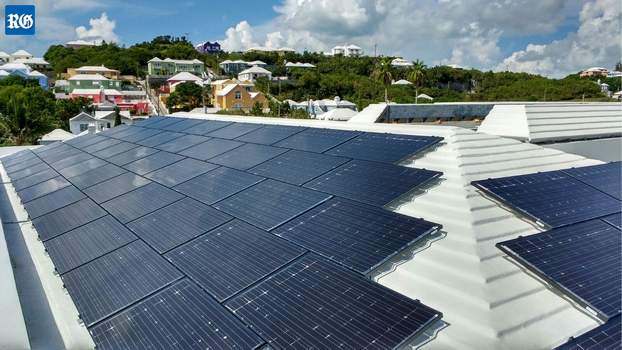
In response, the Solar Energy Association has been formed to promote the case for producing more of the island’s electricity from sunshine. The SEA, which argues that plans for the future of Bermuda’s electricity supply are leading towards a long-term reliance on fossil fuels, will hold its first general meeting at St Paul’s Church Hall in Paget this evening at 6.30pm. The meeting is open to the public. In response to questions, the advocacy group said the timing of the launch of the SEA was in response to the Regulatory Authority reducing the amount power utility Belco has to pay for electricity purchased from solar producers by 61 per cent, from 44 cents per kilowatt hour to 17.36 cents/kWh. The reduction means existing solar photovoltaic customers have seen their expected payback period of between seven and ten years doubled, a scenario that has also deterred potential new customers. “Recent rafts of regulatory orders enacted by the recently formed Regulatory Authority of Bermuda have had a disastrous impact on the growth of residential solar installations in Bermuda such that there has been an almost 70 per cent reduction in the growth of new installations,” the SEA stated. “This, coupled with a utility energy plan that seems to be aggressively steering Bermuda towards a long-term reliance on traditional fossil fuels, and in particular LNG, to the detriment of growing our base of renewable energy generation. The trend in Bermuda, away from the growth of renewable energy, is in complete contrast to worldwide trends where renewable and in particular solar energy has seen rapid and continuous growth and deployment. It is essential to Bermuda’s long-term interests to have an organisation that recognizes the importance and necessity of developing an energy policy that is both sustainable and environmentally responsible rather than simply serving the protectionist and economic interests of a monopolistic utility framework that is not in step with modern trends in energy generation and deployment.” The SEA was set up with four main aims: to promote renewable energy as a cost-effective and clean energy option; to conduct research and lobby policymakers; to champion the use of renewable energy through advocacy and education; and to be a source of information, influence and interconnection for businesses involved in the industry. The SEA sees enormous untapped potential for the industry. “At present, the total deployment of solar PV in Bermuda, including the few commercial installations, represents only around 3 per cent to 4 per cent of our total peak demand, which by the standards of other developed and developing nations is minuscule, and by no means can it be regarded as a mature generation technology,” the SEA stated. “Despite this extremely low penetration, the future deployment is being regulated, via the latest Feed in Tariff, as if the total penetration was similar to nations where PV installations are widespread and offset a ‘significant’ portion of peak demand. For these reasons, there is huge potential for the future growth of solar energy in Bermuda, but that growth is totally dependent on a properly structured regulatory framework and clearly defined energy policy, neither of which currently exist.” The SEA has more than 100 signed-up members and this evening’s public meeting is a first step towards growing public participation. The SEA said it would follow up with a series of informational broadcasts to support the organization's objectives. Walter Roban, the regulatory affairs minister, last month signaled that the Bermuda Government intends to re-establish rebates for solar installations. The previous programme ended four years ago and Mr Roban said the new scheme would seek to provide the most support to lower-income homes, for energy efficiency installations, as well as solar systems. The SEA said this was “certainly a positive sign but it needs to be coupled with the streamlining of the so called ‘soft costs’ associated with solar installations, which are typically the planning and permitting procedures and costs”. The SEA added: “At present, smaller residential installations are unnecessarily expensive, when compared to larger installations, due to the high administrative costs of the permitting process. It is essential that any rebate is targeted directly at those who would otherwise not be able to afford the initial investment that is needed to reduce their energy costs in the longer term.” According to the SEA’s website, its executive committee members include chairman George Masters, deputy chairman Peter Parker, treasurer Kevin Gunther, secretary Liam McKittrick. Other committee members include Damion Wilson, BAE Solar, AES Solar and BE Solar. For more information, visit the SEA website at SEA.bm.
2018. July 22. The public will now have until the middle of August to weigh in on a proposal for the future of the island’s electricity supply. The Regulatory Authority of Bermuda has received approval from the Minister of Transport and Regulatory Affairs to extend the deadline for public consultation on the integrated resource plan for power until August 17. Aaron Smith, the authority’s interim chief executive, said: “We are keen for as many stakeholders as possible to participate in this public consultation process. “We believe that this extension will permit further public review and comment as well as an opportunity for other interested parties to submit alternative proposals for bulk generation or demand side resources for potential inclusion in the IRP.” The IRP consultation was published on May 3 and requested views and alternative proposals for bulk generation or demand-side resources by July 2. But the RA asked for the deadline to be extended after members of the public and interested groups asked for more time. The RA will set out the strategy and lay the foundation for the future of Bermuda’s electricity sector using the public consultation process.
2018. June 29. Hundreds of families have signed up to an energy-saving programme, regulatory minister Walter Roban revealed today. Mr Roban said 220 homes have connected to the grid and 65 are using solar water heating, as a result of rebates to encourage residential solar power. The rebate is to be amended to install energy saving steps, including water heater timers and LED lights, for seniors and low income households. Mr Roban told the House of Assembly a sliding scale rebate will be introduced for properties to install solar photovoltaic power generators. It intends to create business and retain cash otherwise spent on fuel from overseas.
2018. June 29. The Danish power plant specialist Burmeister & Wain Scandinavian Contractor A/S (BWSC), in consortium with MAN Energy Solutions (MAN ES), has been awarded a USD 100 million contract to build a new 56 MW power plant in Bermuda for the Bermuda Electric Light Company Ltd (BELCO), one of BWSC’s longstanding customers with the first contract dating back to 1982. The project will see the construction of replacement generation that will consist of four new MAN dual-fuel engines, totaling 56 MW, and all associated infrastructure. The replacement generation will be located on BELCO’s existing Pembroke facility and it is anticipated that construction will take 18 months. The new engines are designed to provide a reliable and fuel-efficient power supply, while complying with all the latest and most stringent environmental regulations. They will replace the 9 (out of 17) aged engines that BELCO will be retiring between now and 2020. The new engines will have the capacity to run on both fuel oil and natural gas; however, BELCO will continue to use fuel oil until a National Fuel Policy has been developed and implemented for Bermuda. The new plant, together with the power plants delivered by BWSC in 2000 and 2005 with constitute the foundation for the future power supply for Bermuda's 62,000 plus inhabitants. The project is financed by loans from HSBC Bank of Bermuda with export credit guarantee from EKF, a strong partner in the competition to obtain international contracts such as this. This is an important moment in the history of our Company”, stated BELCO CEO, Sean Durfy. “Having just closed on the necessary financing, we can finally proceed with the construction of this critical infrastructure. We are very pleased to have partnered with BWSC-MAN as they are a leader in their discipline. Given the importance of the Project to the stability and reliability of Bermuda’s electricity supply, it is critical that we have vendors who have a proven track record and who can provide us with long-term cost benefits beyond that of initial construction and commissioning costs." The project will see the construction of replacement generation that will consist of four new MAN dual-fuel engines, totaling 56 MW, and all associated infrastructure. The replacement generation will be located on BELCO’s existing Pembroke facility and it is anticipated that construction will take 18 months. "BELCO has been a valued BWSC customer since the first contract in 1982 with new turnkey contracts and services along the way. A contract such as this with an established customer underlines BWSC’s strength as a leading EPC supplier and provider of the most efficient energy technology available in the market today. It marks the culmination of close collaboration between the customer and BWSC and demonstrates our ability to work anywhere in the world based on our experience and skills from the energy industry, our global presence, and the know-how of our approx. 700 employees" comments Anders Heine Jensen, CEO, BWSC. Burmeister & Wain Scandinavian Contractor A/S (BWSC) is a Danish engineering and contracting company that develops, builds, operates and owns high-performance engine-based and boiler-based power plants. The majority of the projects are supplied as turnkey plants, and BWSC has delivered more than 180 power plants to 53 countries worldwide with a total capacity of more than 3,500 MW. Currently, BWSC has on-going activities in the UK, Faroe Islands, Japan, Lebanon, Sri Lanka, Kenya, Benin, Mali and now also Bermuda. In 2017, BWSC had a turnover of EURm 395, and the order backlog amounted to EURm 956 at end-2017. In February 2017, BWSC acquired the Danish boiler manufacturer Burmeister & Wain Energy (BWE) and thus secured its position as a leading energy company on the global market for small and medium-sized biomass power plants. BWSC originates from the stationary engine division of Burmeister & Wain (B&W), which has built and installed diesel engines since 1904. BWSC was established as a separate specialist company in 1980 and was acquired by Japanese Mitsui E&S Holdings Co., Ltd. in 1990.
2018. June 21. Belco has signed a $107.5 million financing deal to fund the construction of the new North Power Station. The utility’s parent company Ascendant Group Ltd said in a statement issued by the Bermuda Stock Exchange that both loans had been arranged by HSBC Bank Bermuda Ltd and HSBC Securities (USA), Inc. The financing includes a US$91.4 million, 12-year export finance loan, guaranteed by EKF, Denmark’s Export Credit Agency, paying floating interest based on six-month Libor, together with a US$16.1 million, five-year commercial loan paying floating interest based on three-month Libor. Libor, the London Interbank Offered Rate, is a widely used interest rate index. Ascendant said Belco will also use an interest rate swap, fixing the above floating rates for these loans. “Due to EKF’s support, the finance package yields extremely competitive terms for Belco, whilst extending Belco’s debt profile for this important capital investment in Bermuda,” Ascendant added. Belco has contracted a consortium of Burmeister and Wain Scandinavian Contractor A/S and MAN Diesel and Turbo SE for the construction of the replacement generation and Saft America, Inc, for the battery energy storage at the site. “We are very pleased to announce the completion of Belco’s financing of its replacement generation and battery energy storage, and can now proceed with the construction phase,” Sean Durfy, Ascendant’s chief executive officer, said. “Once completed, a number of advantages will benefit our customers and Bermuda, in general. As Belco decommissions and disposes of nine older engines, and commissions four new, more efficient engines — the cost for maintenance and fuel will be less. The replacement generation will also lead to better system reliability, cleaner operations for the environment and a significant decrease in the vibration and noise levels currently experienced by nearby residents.”
2018. June 14. Plans to install new generators at Belco have been given the go ahead. The application proposed four new 14 megawatt dual-fuel diesel engines, to be installed in a new powerhouse with a 65-metre chimney on the Belco site between Cemetery Road and St John’s Road in Pembroke. A report to the Department of Planning said: “Given the compliance with current planning policies and an addendum to the original environmental impact study that adequately demonstrated the revised scheme results in lower level impacts than the previous approval, the application is supportable.” The installation of the new generators would allow Belco to decommission three engines that are beyond their service life. The report said: “The size and scale of the project, particularly the exhaust stack and power plant structure, have long-term and potentially significant visual impact implications for the broader surrounding area. It must be acknowledged, however, that this is an industrial site already containing a nationally critical industrial use. Any expansion for diesel engine facilities will require the scale and scope of the type of facilities proposed to the North Power Station, and the associated emissions stacks are large and inevitably unattractive structures.” In a meeting of the Development Applications Board on May 30, the technical officer recommended the application for approval. He told the board the new engines would have an operational life of 30 years. Belco gained permission in 2011 to build the North Power Station. At the time, the company sought to install four 18 megawatt engines. The application was revised the following year to propose five 14.3 megawatt engines. The revised application, submitted in March, would include a smaller powerhouse and an updated design. Construction on the project is expected to take 18 months and involve about 100 workers.
2018. June 8. The company behind plans for a solar plant at the airport has met with the Ministry of Finance to explore avenues for Bermudians to invest, Walter Roban told MPs. The transport minister said Canadian-based Saturn Solar Bermuda 1 will build the project under a build-own-operate model. He told the House of Assembly the project, which was formally agreed to this week, “will not be the last of its kind”. Mr Roban said the solar farm idea for the “finger” runway had been introduced in 2010 by the previous Progressive Labour Party administration, when it was separated from the airport to ensure it would remain in the portfolio of government lands. Mr Roban also sought to allay public concerns over the wireless “smart meters” being installed by Belco as part of its infrastructural improvements, which he said had been contemplated as early as the 2011 energy White Paper. Assuring MPs that the devices presented no threat to public health, Mr Roban said a report by the Regulatory Authority would be released within the next ten days.
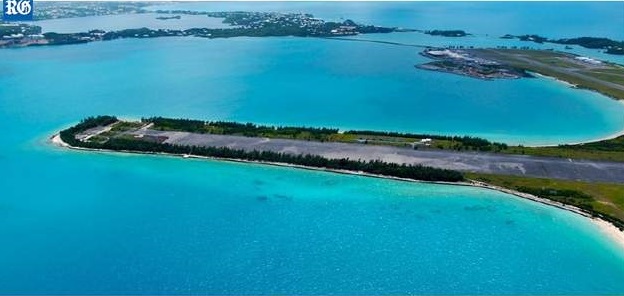
Airport finger for solar power
2018. June 6. Belco has just completed electric vehicle training for its fleet team as it moves towards a 100 per cent electric fleet. The five-day training was carried out by Craig Van Batenburg of Massachusetts-based Automotive Career Development Centre. Jason Simons, Anton Daniels, Nigel Lewis, Aesop Smith and Andrew Cabral completed the training session and Belco hopes to move to City and Guilds qualifications for all Belco participants. Mr Simons, fleet manager, said: “Ultimately, our goal is to be Bermuda’s number one service provider for electric vehicles. Already, our technicians have gained valuable insight from this training. While this will obviously help our fleet, we also aim to be the example of what is possible for the transition of corporate fleets to electric vehicles in Bermuda.” Belco began the electric conversion of its fleet in 2016, when it replaced 12 diesel vans with Renault Kangoo Maxi ZE vans. To date, 13 internal-combustion engine vehicles have been replaced with full electric vans. By June 2018, all of Belco’s bucket truck fleet will comprise hybrid vehicles, and 78 per cent of the van fleet will be electric by the end of the year. Mr Simons said: “We are on track to realize our goal of a 100 per cent electric fleet by 2025. In the near future, five of the remaining gasoline vans will be replaced by the Peugeot Partner Electric and we have begun receiving our hybrid bucket trucks. The bucket trucks will allow the aerial device to operate with electric power while the truck engine shuts off.”
2018. June 1. The Regulatory Authority has backed hi-tech smart meters installed by power firm Belco. The authority said yesterday that the meters comply with safety standards set by the United States Federal Communications Commission. The authority will carry out tests because of “public concern” this month to ensure that the meters used in Bermuda are in line with approved standards. The devices are being installed by Belco as part of its modernization plans. About 2,700 meters are now in place at homes and businesses around the island. The Royal Gazette reported this week that some people have challenged the move on the grounds that electronic emissions from the meters are harmful to health. The authority confirmed yesterday that it had authorized the use of the radio frequency or RF bandwidth used for metering. It added: “The smart meters use RF only to transmit data from the meters. The RF feature is not used to monitor electricity usage. The smart meters used in Bermuda homes transmit meter data once every four hours, which equates to a total transmission time of less than one second per day.” The Authority pledged to test the meters’ maximum permissible exposure standards this month and report on its findings.
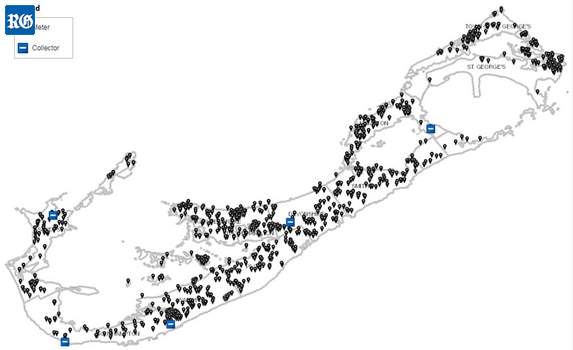
2018 Belco smart meter map
2018. May 30. Belco is to run an education campaign on wireless devices at the forefront of the company’s modernization plans. “Smart meters”, which record electricity consumption in detail and beam readings straight to the power company, are set to replace traditional meters across the island. About 2,700 advanced meters have been installed in homes across Bermuda, according to the power firm and its parent company Ascendant Group. Belco also moved to ease concerns raised by the activist group Move Bermuda, which has met twice with company officials over fears that the devices are a risk to health. Move Bermuda has asked for the programme to be halted and the meters removed from homes. Sean Durfy, chief executive of Ascendant, said that claimed threats from the technology were “a non-issue — and the benefits are outstanding. If we thought for any moment that we were doing something outside the norm, there’s no way that this company would do that.” Smart meters were approved by the Regulatory Authority, which issued a provisional licence to install them. Mr Durfy said the meters used in Bermuda met the standards of the United States’ Federal Communications Commission. However he admitted the company’s communication with the public about the change last summer had been inadequate. A spokeswoman for Belco said smart meter installation started in the summer of 2015 with employees of the company. Staff were asked to volunteer to have their home meters augmented with the digital devices. The spokeswoman added that letters and brochures were sent out to the public but “the process didn’t work” for 1500 homes, which left residents unaware of the change. She said the company had met Move Bermuda twice and had fielded several questions, but was now set to step up a “robust marketing campaign”. Mr Durfy added that the deployment of “advanced metering infrastructure” formed part of the $250 million capital plan to modernize the utility’s operations. He added the pilot devices had “worked very well in testing”. The smart meters measure and record electricity use about once an hour and beam the data to both the utility and the utility customer at least once a day. They also report outages, and allow the company to spot homes left in the dark after other residences have electricity restored in the wake of power cuts. Mr Durfy said Belco planned to connect the advanced meters to its online portal, so consumers can view their electricity consumption in detail — information that will help them cut their bills. He added that advanced metering would also help Belco improve its own infrastructure. Mr Durfy pointed out that smart meters are common in the United States and many other countries. He added that customers will be able to opt out from the new meters, although a charge would be imposed for manual meter reading. Peggy Burns, who had a smart meter removed from her St David’s home in January, insisted all the devices should be recalled. Ms Burns said she was “in the midst of more than 40 smart meters” because of her neighbors and had developed symptoms ranging from a dry cough to sleeplessness. She added: “I have begged the present government to please order their removal, and to no avail.” Ms Burns claimed the “pulse” signals sent out by the meters were harmful but were said to be safe “on face-value” in Bermuda by the Department of Consumer Affairs, the Department of Health and the Regulatory Authority. Ms Burns contacted Arthur Firstenberg, an American activist who has campaigned against wireless technology for more than 20 years. Mr Firstenberg claimed that the radio emissions were “much more harmful than anybody knows”. He said: “People can hear it — they get these piercing, high-pitched sounds in their heads.” Mr Firstenberg, who heads a pressure group the Cellular Phone Task Force, added: “It’s not a matter of belief. They affect everybody whether you know it or not.” He said the devices were the cause of chronic disease and added to a growing backdrop of “ambient radiation from all different sources that are doing damage to the environment as well as people”. Ms Burns has filed complaints with several agencies about the smart meters. The Department of Consumer Affairs said earlier this month that the devices “are approved by the US FCC and have met the radio frequency safety requirements which the Bermuda Regulatory Authority recognizes”. Belco added the meters are well below the regulatory limit for RF transmitting devices and that devices like video games, baby monitors and mobile telephones all had higher radio emission rates.
2018. May 24. The best fuel option for power plants and ship propulsion during the next 25 to 40 years is liquefied natural gas, according to Jens Alers. The wind of change for power production is becoming evident in Bermuda. In its Integrated Resource Plan Proposal, Belco evaluated natural gas as the top principal fuel option for the island’s power generation in the future. If that choice becomes a reality it is possible a ship similar to one now joining the Bernhard Schulte Shipmanagement fleet could be used to transport LNG to the island. Mr Alers is group director of Bernhard Schulte Shipmanagement (Bermuda), which has offices in Par-la-Ville Road. He spoke on the topic of LNG as a major fuel choice for the next 40 years following news that Bernhard Schulte is about to take delivery of its first gas fuel supply vessel, Kairos, which has been built in South Korea. The ship can carry 7,500 cubic metres of liquefied natural gas and will deliver cargoes to power companies in the Baltic, and to other ships that use LNG for propulsion fuel. Mr Alers has a twofold interest in the growth of LNG as a mainstream fuel. One is the potential for it to become a significant cargo for maritime transportation, the other is its role in providing a less environmentally damaging propulsion fuel for ships. Discussing the latter point, he said the shipping world is facing stringent regulations aimed at cutting the level of pollutants and harmful emissions caused by the burning of propulsion fuel — which today is primarily heavy fuel oil. In 2020, stricter global fuel sulphur content regulations take effect. The International Maritime Organisation regulations will make it no longer acceptable for ships to continue burning heavy fuel oil that contains sulphur content above 0.5 per cent m/m [mass by mass] without taking measures to reduce the resulting sulphur oxide emissions. In Mr Alers’s view, ship owners and operators have three choices. If they continue to use the traditional heavy fuel oils with sulphur content above the prescribed level they must install exhaust gas cleaning systems, also known as “scrubbers”, an investment that could cost many millions of dollars per ship, depending on the size of the vessel. Alternatively, shipowners can have their vessels switch to burning low sulphur fuel oil, which is more expensive than the traditional heavy fuel oils, or they can opt to introduce new ships to their fleet that use fuels that have low or zero sulphur, such as LNG. Retro-fitting a ship to run on LNG is prohibitively expensive, while fitting scrubbers is a more feasible option and is likely to be the choice of some shipowners. Mr Alers believes using low sulphur content fuel oil will also be the choice of many, with the price of the fuel likely to come down as supply increases to meet demand. However, the third option of introducing new LNG-powered ships into their fleets is being pursued by some of the world’s largest shipping companies, such as Maersk Line and Hapag-Lloyd. French shipping company CMA CGM has ordered nine 22,000 container TEU ships that will be powered by LNG. The shift to liquefied natural gas as propulsion fuel for ships makes sense to Mr Alers. With gas there is no sulphur oxide and minimal nitrate oxide emissions, and a reduction in particulate matter — tiny particles that pollute the air as a byproduct of burning oil fuel. Gas supply ships like Kairos cost between $30 million and $55 million to build depending on the equipment they have fitted. Bernhard Schulte Shipmanagement went ahead with its new ship only once it had ensured it had a secured charter for the vessel. Mr Alers said: “In my view LNG is the best ship fuel and power plant fuel for the next 25 to 40 years. After that we will be in the hydrogen fuel and renewable energy economy. “We call LNG a bridge fuel to the hydrogen and renewable energy economy.” When asked for his opinion on the future of power generation in Bermuda, in light of Belco’s Integrated Resource Plan Proposal that evaluated four scenarios for the future of Bermuda’s electricity supply, Mr Alers said: “Belco needs to act. We do need a solution to what stands in the halls of Belco — those old engines.” He believes that one way or another LNG power production will come to Bermuda, while also acknowledging that the infrastructure needed for a LNG power plant is not cheap. A number of island communities have engaged in LNG-generated power production, such as Jamaica, Dominican Republic and Sardinia. Mr Alers said he would not want to see Bermuda rely solely on natural gas, but instead have renewable energy, such as solar, as part of the overall energy generation solution. If Bermuda heads down the LNG power generation route, he believes it could be gas supply ships like Kairos that will provide the maritime transportation for LNG from the US East Coast to the island.
2018. May 11. A mix of energy resources using natural gas as the principal generating fuel came out on top in an evaluation of the options for the future of Bermuda’s electricity supply. This is revealed in the Integrated Resource Plan Proposal, which compares four different energy mixes to achieve the estimated power needs of the island over the next 20 years. The natural gas scenario proved most expensive over the two-decade period as a whole, because of necessary investments in new infrastructure and engine conversions — but from 2031 it was the option producing the lowest-cost electricity because of its lower fuel costs. However, the study does not specify what the different scenarios would mean in practice for customer rates. Belco submitted the IRP Proposal to the Regulatory Authority in February, as the utility is required to do by law. Last week the RA published the 59-page document on its website and launched a consultation, which gives the public an opportunity to give feedback with a submissions deadline of July 2. The RA staged the second of two town-hall meetings this week in Hamilton last night, to explain the importance of the plan for Bermuda’s energy sector and how the consultation process will work. The proposal, produced by Belco in conjunction with US engineering consultants Leidos, compares four scenarios — pared down from seven in a 2016 initial study — and grades them economically and by a range of qualitative factors including supply quality, environmental sustainability, security and cost resilience, logistics and economic development. The first scenario is the status quo, with fuel oil remaining the principal generating fuel. The other three scenarios all feature cost-effective utility-scale renewables as well as increased energy efficiency measures and increased adoption of electric vehicles, while each features a different principal fuel — fuel oil, natural gas or liquefied petroleum gas. The natural gas scenario had a score of 96.9 per cent, edging out fuel oil plus renewables at 96.4 per cent, LPG at 95.5 per cent and the status quo at 94.8 per cent. The proposal states: “Based on the overall scoring from the production cost dispatch analysis and the qualitative evaluation of base cases for the four scenarios, the full conversion to NG (Scenario 3) ranked highest. Additionally, the scores for all four base cases were tightly grouped, falling within 2.1 per cent of each other.” The IRP Proposal adds that the preferred plan “will address key objectives related to cost of power, reliability of supply, exposure to high fuel cost, increased renewable resources, capability to burn diverse fuels and reduced carbon footprint”. The report states: “While the NG scenario is more capital intensive than the other scenarios, it is less sensitive to increasing fuel commodity prices when compared to LPG or fuel oil scenarios. In addition, the NG scenario introduces the potential for NG to serve other uses in Bermuda via a piped distribution network.” The proposal builds in many assumptions for the 20-year study period, such as fairly flat electricity demand, seen as closely correlated to economic growth, and average inflation of 2 per cent. Analysis of the natural gas option assumes that liquefied natural gas would be shipped from the US, and that offloading, storage and regasification facilities would be built in St George’s, near existing fuel storage depots. A gas pipeline would also need to be built along the route of the existing fuel pipeline to Belco’s Pembroke plant. The new infrastructure would take about 3½ years to build, from the start of engineering and design work. The LPG option would involve shipping in bulk ocean tankers from the US and the building of offloading and storage infrastructure, but transport to the Pembroke plant would be by road tanker. Also mentioned in the IRP Proposal is the assumption of a new power plant at Marginal Wharf, as has been proposed by the Bermuda Land Development Company, to be operated by an independent power producer. Belco has included in the IRP Proposal a 1.5-mile pipeline for fuel delivery to the new power station, although the BLDC’s request for quotation for the new power station does not specify a type of fuel, nor a pipeline. Renewables are expected to make up more than 18 per cent of the island’s energy supply mix within five years, by which time the new solar farm to be built on land near LF Wade International Airport, is expected to have come online. Continued growth in private solar installations is also taken into account. Energy efficiency measures are expected to ease both peak and total energy demand over time. An expected increase in electric vehicle use is not expected to measurably impact peak demand, because of anticipated “charging and usage behaviors”. After the consultation, the RA will analyze and take account of submissions, which may include proposals from alternative prospective power producers, as it finalizes and approves a long-term energy plan for the island — something the regulator hopes to finalize before the end of this year. The IRP is designed to be a living document to be revisited every few years to take account of new technologies and changing circumstances. A new IRP Proposal will be requested from the Transmission, Distribution and Retail licensee — which is Belco — every five years or less, with timing determined by the RA, in compliance with the Electricity Act 2016. The process is currently at the IRP Proposal stage. Following this 60-day public consultation stage and submission of additional generation proposals, the RA will then review and analyze submissions before drafting Bermuda’s Electricity Plan (the IRP). The IRP will be drafted and published by the RA.
2018. May 4. A US company yesterday confirmed that it and a group of investors had made an offer to buy Ascendant Group Ltd, the parent company of power utility Belco. Twenty First Century Utilities, which is based in Washington DC, was previously linked with interest in Ascendant in an article in The Royal Gazette last November. A source, who asked not to be named, said this week that a $15-per-share bid for Ascendant had been tabled. Joe Garcia, senior adviser on TFC’s management team, confirmed the bid yesterday, but not the amount. “I can confirm that a fully funded consortium, led by Twenty First Century Utilities, did make an offer to the board of Ascendant Group Ltd,” Mr Garcia said. Mr Garcia, a former US Congressman who has served on the National Association of Regulatory Utility Commissioners, declined to elaborate. Last night, Ascendant confirmed that it had received correspondence from TFC. “Ascendant Group Limited has received an unsolicited, highly conditional, expression of interest from Twenty First Century Utilities LLC (the Letter),” the company told The Royal Gazette in an e-mailed statement. "Ascendant’s board of directors considered the Letter and, having taken appropriate legal and financial advice, unanimously determined not to pursue the Letter further, and that it is in the best interests of Bermuda and Ascendant’s customers, shareholders and employees, to continue to execute on its existing strategy.” Ascendant’s plans include the building of the new North Power Station, which will replace ageing generators with new ones, reducing the cost of electricity for customers, and to secure debt financing to modernize its generating plant and distribution grid. Ascendant’s closing share price on the Bermuda Stock Exchange yesterday was $10.75. Its book value, an accounting measure of the company’s assets minus its liabilities, was $27.37 per share at the end of last year, according to Ascendant’s 2017 annual report. The source who told of the TFC offer said: “Unfortunately the offer was flat out rejected by the Ascendant board. Shareholders were not informed about this purchase offer, nor were they consulted about the opportunities presented by Twenty First Century Utilities.” TFC is “proposing to revolutionise energy production and generation in Bermuda”, the source added. “Their model is based on taking capital and investing in energy efficiency and renewable energy, as opposed to fossil fuel-based energy production.” It is understood that the bid was made about four weeks ago and that TFC has been researching Ascendant and the Bermuda power sector over the past two years. According to its website, TFC owns and operates moderate-sized regulated utilities “in a manner that produces the lowest practical cost and highest levels of customer service. What clearly sets us apart is that our approach proactively embraces customer-facing clean energy resources and energy-saving technologies, incorporating and balancing them with utility-scale grid resources for optimal value,” the website adds. Larry Kellerman, a former partner at investment bank Goldman Sachs, is a founder and managing partner at TFC Utilities, and has a background of investing in the energy sector. He has spoken before of his mission to transform regulated utilities, by driving the adoption of clean energy, and “to evolve the grid in a manner that is shaped not by our will but by the will of our customers”. November’s article cited sources saying that local investors were teaming up with TFC in the Ascendant bid. It also quoted a spokeswoman for Ascendant, who said the company was aware that TFC had met with representatives of the Bermuda Government, the Regulatory Authority and the executive of the Electricity Supply Trade Union.
 2018. April 25. This rotten and
damaged electricity cable dates back to 1951, the year when the Royal Naval
Dockyard officially closed as a British military facility and Earl Cameron made
his big-screen debut in Pool of London. After 67 years of service within the
island’s electricity distribution grid, it has finally given up the ghost. The
burnt-out cable is representative of an ageing grid not designed to meet
today’s electricity demands. As Belco publicly stated last year, about 25 per
cent of its underground cables are more than 60 years old. An additional 15 per
cent are more than 50 years old. However, much needed upgrades are now under
way. Over the next five years, Belco will carry out a $125 million project to modernize
the transmission and distribution network, including cables, substations and the
installation of advanced meters. The work will help to improve the reliability
and efficiency of electricity delivery, something that Belco is responsible for
under its Transmission, Distribution and Retail licence granted by the
Regulatory Authority. The work will help to improve the reliability and
efficiency of electricity delivery, something that Belco is responsible for
under its Transmission, Distribution and Retail licence granted by the
Regulatory Authority. The ongoing grid improvements, coupled with new generating
equipment and a proposed switch to natural gas as a principal fuel — all part
of Belco’s $250 million capital plan — are expected to yield great
efficiencies. Sean Durfy, chief executive officer of Belco and its parent
company Ascendant Group, said: “The whole aim of the exercise for us is to get
the cost of electricity down and we believe we can do that over the next five
years. We know we have some of the highest rates in the Caribbean region and we
know we have to get the cost of electricity down. We know the high cost of
electricity has an impact on our customers and on the Bermuda economy. We have
been running the company in a certain way for 100 years and you can’t just
stop that — it’s going to be a step-by-step process. But within five years,
we believe we will be able to manage our costs down to the point that our rates
will be comparable with other islands.” In March, the Regulatory Authority
gave Belco the go-ahead to build the North Power Station and to retire some of
its ageing and inefficient generators. Mr Durfy said the project would provide
work for about 100 people over two years. He said the project was “fully
wrapped”, meaning that any cost overruns would be borne by the contractor,
rather than Belco. The main contractor for the project is BWSC, a Danish company
that has built 180 power plants in 53 countries over the past three decades.
Belco will decommission 80 megawatts of generating capacity and replace it with
56 megawatts of new capacity from the four new engines, supplemented by a
battery energy saving system, known as BESS. The massive batteries, with an
output capacity of 10 megawatts, will be housed in the new power station on land
off Cemetery Road. BESS will contribute to efficiency as well as reliability of
the supply. “When a unit goes down you have to have other engines ready to
ramp up quickly. The batteries will give us more time to do that,” Mr Durfy
said. The new engines will run on the light and heavy oil fuels Belco burns
today, but will be easily convertible to natural gas — should the island
decide to opt for that fuel in future. They will use a single chimney stack,
while one of the two chimneys in Belco’s existing plant will be removed. It
will adhere to modern noise and vibration standards and although it’s an
industrial site, it’s built to ensure the best aesthetics,” Mr Durfy said.
The project will allow Belco to reduce the number of engines at its Pembroke
plant from 17 to 12. Also, a pilot programme is under way with advanced meters
that will give both the customer and Belco more information about electricity
consumption. The aim is that eventually, customers will be able to access meter
information online through Belco’s portal. For the company, the meters will
provide valuable data about fluctuating demand that will help it to better
manage supply to different parts of the island. Belco submitted its Integrated
Resource Plan — comprising proposals for the future of electricity supply in
Bermuda — to the RA in February this year. Next comes a consultation period,
giving the public the chance to have their say. The plan incorporates an
increase in the role of renewable energy, which will gain a significant boost
from a six-megawatt capacity solar farm scheduled to be built within months at
the munitions pier of LF Wade International Airport, land also known as “the
finger”. Mr Durfy said while solar energy from rooftop installations and the
utility-scale facility in the East End would make a significant contribution to
supply, it could not replace the island’s need for baseload capacity from
engines burning oil or gas. “To replace the 60 megawatts of capacity, you’d
need about 175 acres for the necessary solar panels — about three or four
times the size of Hamilton,” Mr Durfy said. Wind turbines constructed at
platforms out at sea are another option. But Mr Durfy, who has in the past been
involved in projects to build vast 150-turbine wind farms in the North Sea, said
the five or six 10-megawatt turbines Bermuda would need, would not be
economically efficient. He added that the wind tended to drop at the times of
year when electricity demand was at its highest. Successive governments have
advocated more competition in the electricity sector, something Mr Durfy
believes will not achieve the desired result of a better deal for consumers in a
market the size of Bermuda. “I believe that opening up this market to
competition will not necessarily lead to reduced pricing — I stand by that
view and several studies support that,” Mr Durfy said. Because Belco is a
monopoly supplier of electricity, it was the regulator’s role to replicate the
competition, Mr Durfy said. That was why Belco had to adhere to service
standards and a grid code and needed to justify and get approval for any rate
increases. Belco aims to have an entirely electric fleet of vehicles by 2022. Mr
Durfy hopes to see the popularity of electric vehicles continue to grow on the
island and not only because it will boost electricity sales. “It just makes
sense for the island,” Mr Durfy said. “Electric vehicles have about 65 per
cent of the operating costs of internal combustion vehicles, because there are
fewer moving parts.” The cost of charging an electric car was as little as one
fifth what it costs to fuel a conventional vehicle, he estimated. A mass move to
electric vehicles would boost electricity demand, allowing Belco to spread its
fixed costs wider, leading to lower electricity costs per kilowatt hour, Mr
Durfy argued. “Electricity demand is falling about 1 per cent a year, but if
the island’s vehicles were 100 per cent electric, we estimated it would add 10
to 12 percentage points to demand,” he added.
2018. April 25. This rotten and
damaged electricity cable dates back to 1951, the year when the Royal Naval
Dockyard officially closed as a British military facility and Earl Cameron made
his big-screen debut in Pool of London. After 67 years of service within the
island’s electricity distribution grid, it has finally given up the ghost. The
burnt-out cable is representative of an ageing grid not designed to meet
today’s electricity demands. As Belco publicly stated last year, about 25 per
cent of its underground cables are more than 60 years old. An additional 15 per
cent are more than 50 years old. However, much needed upgrades are now under
way. Over the next five years, Belco will carry out a $125 million project to modernize
the transmission and distribution network, including cables, substations and the
installation of advanced meters. The work will help to improve the reliability
and efficiency of electricity delivery, something that Belco is responsible for
under its Transmission, Distribution and Retail licence granted by the
Regulatory Authority. The work will help to improve the reliability and
efficiency of electricity delivery, something that Belco is responsible for
under its Transmission, Distribution and Retail licence granted by the
Regulatory Authority. The ongoing grid improvements, coupled with new generating
equipment and a proposed switch to natural gas as a principal fuel — all part
of Belco’s $250 million capital plan — are expected to yield great
efficiencies. Sean Durfy, chief executive officer of Belco and its parent
company Ascendant Group, said: “The whole aim of the exercise for us is to get
the cost of electricity down and we believe we can do that over the next five
years. We know we have some of the highest rates in the Caribbean region and we
know we have to get the cost of electricity down. We know the high cost of
electricity has an impact on our customers and on the Bermuda economy. We have
been running the company in a certain way for 100 years and you can’t just
stop that — it’s going to be a step-by-step process. But within five years,
we believe we will be able to manage our costs down to the point that our rates
will be comparable with other islands.” In March, the Regulatory Authority
gave Belco the go-ahead to build the North Power Station and to retire some of
its ageing and inefficient generators. Mr Durfy said the project would provide
work for about 100 people over two years. He said the project was “fully
wrapped”, meaning that any cost overruns would be borne by the contractor,
rather than Belco. The main contractor for the project is BWSC, a Danish company
that has built 180 power plants in 53 countries over the past three decades.
Belco will decommission 80 megawatts of generating capacity and replace it with
56 megawatts of new capacity from the four new engines, supplemented by a
battery energy saving system, known as BESS. The massive batteries, with an
output capacity of 10 megawatts, will be housed in the new power station on land
off Cemetery Road. BESS will contribute to efficiency as well as reliability of
the supply. “When a unit goes down you have to have other engines ready to
ramp up quickly. The batteries will give us more time to do that,” Mr Durfy
said. The new engines will run on the light and heavy oil fuels Belco burns
today, but will be easily convertible to natural gas — should the island
decide to opt for that fuel in future. They will use a single chimney stack,
while one of the two chimneys in Belco’s existing plant will be removed. It
will adhere to modern noise and vibration standards and although it’s an
industrial site, it’s built to ensure the best aesthetics,” Mr Durfy said.
The project will allow Belco to reduce the number of engines at its Pembroke
plant from 17 to 12. Also, a pilot programme is under way with advanced meters
that will give both the customer and Belco more information about electricity
consumption. The aim is that eventually, customers will be able to access meter
information online through Belco’s portal. For the company, the meters will
provide valuable data about fluctuating demand that will help it to better
manage supply to different parts of the island. Belco submitted its Integrated
Resource Plan — comprising proposals for the future of electricity supply in
Bermuda — to the RA in February this year. Next comes a consultation period,
giving the public the chance to have their say. The plan incorporates an
increase in the role of renewable energy, which will gain a significant boost
from a six-megawatt capacity solar farm scheduled to be built within months at
the munitions pier of LF Wade International Airport, land also known as “the
finger”. Mr Durfy said while solar energy from rooftop installations and the
utility-scale facility in the East End would make a significant contribution to
supply, it could not replace the island’s need for baseload capacity from
engines burning oil or gas. “To replace the 60 megawatts of capacity, you’d
need about 175 acres for the necessary solar panels — about three or four
times the size of Hamilton,” Mr Durfy said. Wind turbines constructed at
platforms out at sea are another option. But Mr Durfy, who has in the past been
involved in projects to build vast 150-turbine wind farms in the North Sea, said
the five or six 10-megawatt turbines Bermuda would need, would not be
economically efficient. He added that the wind tended to drop at the times of
year when electricity demand was at its highest. Successive governments have
advocated more competition in the electricity sector, something Mr Durfy
believes will not achieve the desired result of a better deal for consumers in a
market the size of Bermuda. “I believe that opening up this market to
competition will not necessarily lead to reduced pricing — I stand by that
view and several studies support that,” Mr Durfy said. Because Belco is a
monopoly supplier of electricity, it was the regulator’s role to replicate the
competition, Mr Durfy said. That was why Belco had to adhere to service
standards and a grid code and needed to justify and get approval for any rate
increases. Belco aims to have an entirely electric fleet of vehicles by 2022. Mr
Durfy hopes to see the popularity of electric vehicles continue to grow on the
island and not only because it will boost electricity sales. “It just makes
sense for the island,” Mr Durfy said. “Electric vehicles have about 65 per
cent of the operating costs of internal combustion vehicles, because there are
fewer moving parts.” The cost of charging an electric car was as little as one
fifth what it costs to fuel a conventional vehicle, he estimated. A mass move to
electric vehicles would boost electricity demand, allowing Belco to spread its
fixed costs wider, leading to lower electricity costs per kilowatt hour, Mr
Durfy argued. “Electricity demand is falling about 1 per cent a year, but if
the island’s vehicles were 100 per cent electric, we estimated it would add 10
to 12 percentage points to demand,” he added.
2018. March 15. A decision to allow Belco to replace ageing generators was necessary for safety and the security of electricity supply for Bermuda, the Regulatory Authority of Bermuda has said. Last week it was announced that the Authority had issued an order for the replacement of aged generation assets permitting Belco to start installation of four new dual-fuel generators, capable of a combined output of 56 megawatts. The Authority also gave approval to a system for battery energy storage. Aaron Smith, interim chief executive of the RA, said: “Much of Belco’s current generation capacity has gone beyond its normal life expectancy and this had become a critical issue in terms of safety as well as the security of supply for Bermuda, which were major factors in our decision to approve this replacement generation.” The RA is currently in the process of developing an Integrated Resource Plan — a wide-ranging plan for the future of electricity supply in Bermuda. The IRP will be ready for approval later this year. Mr Smith said: “The decision to allow the new generators does not in any way pre-empt the IRP, which will take a comprehensive view of Bermuda’s energy system taking into account its needs and requirements. We expect a final plan to be ready later this year, after public consultation.” The Authority has just embarked on consultation on the methodology used to decide the retail tariff for electricity — the formula for determining the rate that the consumer pays. Mr Smith added: “Until we finalize the methodology, which must take into account issues such as economic efficiency and affordable prices to end users, it would be inappropriate to speculate on what the future tariff may be. The approval of the replacement of assets was not an approval for an increase in rates. Despite our approval for the new generators, there will be no decision on what the tariff will be until the methodology is set and a retail tariff review using that methodology has been completed." The retail tariff consultation document is available on the Authority’s website. Responses may be submitted by going to the “Consultations” drop down menu and selecting “Submit Your Response”. Comments should be submitted before 5pm on March 29.
2018. April 18. Revised plans for a North Power Station at Belco have claimed that work could be completed next autumn — and pave the way to a potential move to natural gas as a fuel source. Planning documents estimate that the construction project will involve around 100 construction workers and last 18 months. Work is hoped to begin as soon as this month with generators ready to start in October 2019. Belco sought approval for the installation of five new diesel engines capable of generating a combined 72 megawatts of energy in 2012. But last month the application was changed to four dual-fuel diesel engines generating 56 megawatts. Each of the four generators would be installed in a single new powerhouse, located on the Belco site between Cemetery Road and St John’s Road. The generators would use a single 65-metre concrete chimney stack. The new station would be capable of burning a combination of light fuel oil and heavy fuel oil. The planning documents said: “The dual-fuel component will enable cost-effective conversion to natural gas, should such become available in Bermuda in the future. It’s noted that substantial detailed engineering has been completed on the proposed North Power Station since the previous submission in April 2012.” The documents said the new power plant would allow the retirement of older engines and cut pollution. The application added that the adoption of natural gas as a fuel would lead to further environmental benefits. The Regulatory Authority decided to allow the installation of new generators last month, along with a system for battery engine storage. Aaron Smith, interim chief executive of the RA, said: “Much of Belco’s current generation capacity has gone beyond its normal life expectancy and this had become a critical issue in terms of safety as well as the security of supply for Bermuda, which were major factors in our decision to approve this replacement generation.”
2018. March 9. Belco has been given approval to build four new generators. The Regulatory Authority approved the company’s application to install four dual-fuel engines with a total power output of 56 megawatts. The company will also build a battery energy storage system with a ten megawatt output. The new machines will be built on Belco’s existing site on Pembroke’s Serpentine Road. Sean Durfy, president and chief executive of Belco, said: “I am extremely pleased the authority has recognized the urgency of proceeding with the development of the replacement generation. “Given that 50 per cent of our existing generation capacity will be retired over the next two years, the order will allow Belco to continue to provide Bermuda with a reliable electricity supply.” Mr Durfy added: “In addition to the creation of new jobs during the construction phase of the North Power Station, and the assurance of our employees’ ongoing safety, there are numerous benefits that will be realized by our customers once the replacement generation is commissioned.”
2018. March 9. A solar farm could be up and running at LF Wade International Airport before the end of this financial year. Walter Roban, Minister of Transport and Regulatory Affairs, said work to prepare the site was scheduled to start within weeks. Mr Roban added: “The Department of Energy will work with the Ministry of Public Works to facilitate the development of the six megawatt solar farm at the munitions pier of the LF Wade International Airport. The site clearing and preparation will begin over the next few weeks. This project is targeted for completion in this fiscal year, at which time up to 13 per cent of peak demand will be met by clean solar power.” A ministry spokesman said yesterday he could not identify the potential developer because discussions were still ongoing. He said: “We are in final stages of negotiations with the preferred bidder and cannot announce anything further until final agreements are signed. We will make a press statement at the appropriate time in the process.” Environmental charity Greenrock said that it was delighted to hear the long-discussed project was moving forward. Jonathan Starling, the charity’s executive director, said: “Renewable energy technology, and particularly battery technology, are increasingly changing the dynamic in favour of increased renewable energy integration into our power system. With the impact of human-induced global climate change increasingly affecting us, this development is a great first step for Bermuda in reducing its fossil fuel dependence. Along with switching increasingly to renewable energy sources, which battery technology is increasingly helping to smooth out supply and demand issues, we also need to increase energy efficiency and conservation.” He said the charity looks forward to the project being completed and hopes to see a greater focus on renewable energy as the island works to reduce its dependence on imported fossil fuels. Plans to erect a solar farm on the munitions pier, also known as “the finger”, have been discussed for several years under both the One Bermuda Alliance and Progressive Labour Party administrations. The former OBA government put out a Request For Proposal for the site in December 2016, with the goal of selecting a developer by April, 2017. The RFP proposed the Government should fund site preparation, which would be recovered from the rental income for the estimated 15 acres that will be leased to the developer. There were 29 submissions, of which 19 met the criteria, with potential bidders from Bermuda, Canada, Spain, the United States, Germany, Britain and Australia.
2018. February 23. An upgrade of Belco’s customer self-service portal has left customers temporarily unable to initiate on-demand debit payments. In an e-mail to customers, the power utility said the portal was upgraded at the start of February in an effort to restore customers’ ability to pay bills online using MasterCard. “Unfortunately, during the upgrade, we discovered that the ability of customers to initiate on-demand debit payments had failed,” Belco stated. “We are working on a solution with our billing system vendor and hope to have it available soon.” The message advises customers to e-mail the firm, giving their Belco account number and the payment amount, in order for Belco to generate a direct-debit payment. Alternatively, customers can call a customer experience representative on 298-2800.
2017. December 8. Government will finalize its National Fuels Policy this month, according to Walter Roban. Speaking in the House of Assembly today, the Minister of Transport and Regulatory Affairs said the policy is hoped to be published within the first six weeks of 2018. Mr Roban said: “The purpose of the policy is to direct the island’s fuel sector towards a future that is affordable, sustainable, safe and secure, helping inform the Integrated Resource Plan and Bermudians’ involvement with the IRP process. “All sectors of our economy are dependent on imported fuels, and Bermudians’ concerns over the monetary cost, as well as the environmental and health costs, point to a need to chart a more sustainable course for the energy sector. This involves making a key distinction between conventional fossil fuels and low-carbon fuels, and endorsing actions that shift our use from the first to the second. However, I should point out we have not lost sight of the significance of displacing fuels — whether low carbon or conventional fossil fuels — with clean renewable sources of energy.” Mr Roban said the Government understands the need for reliable energy and is working with Belco to find a “equitable way forward” for both the company and the island. “Any licensed entity in the electricity sector is effectively in the public service, and it has to purchase equipment and pay for personnel to operate that equipment or manage the grid,” he said. “There would be no reason for any utility to ensure that its equipment was modern, efficient, safe, and reliable if it could not make a reasonable profit from it. This is the essence of the regulatory compact. The regulator examines the costs of providing service to the public, and determines what the utility may expect to be compensated for. There is a duty to be fair to the rate payer, but also fair to those providing energy to the grid- both large and small energy producers, and to those providing the infrastructure to get that energy to the customers. This noted, we must simultaneously make certain that Bermudians have their say and have their preferences honored, while ensuring there is healthy and sensible competition.” Mr Roban stated that the Government supports clean energy and energy diversification in general, saying that the adoption of new green technology could be a boost for the economy as well as the environment. “The benefits of keeping more currency in Bermuda, circulating in our economy, as opposed to purchasing foreign oil, are numerous and cannot be ignored,” he said. Air quality improves, just a little both locally and globally, with every solar panel on a roof. A little extra money stays in the local economy with every conservation measure. There is a job for an installer with every PV system purchased. The renewable energy sector will provide jobs for electricians, technicians, computer and software specialists, repair and maintenance specialists, salespersons, marketers, engineers, and design professionals. It all adds up, and these benefits should no longer be considered as vague externalities because there are real and tangible benefits for Bermuda.”
2017. November 17. The Regulatory Authority of Bermuda has issued a notice requesting the Bermuda Electric Light Company Limited submit an Integrated Resource Plan proposal to the Authority by February 15, 2018. Belco was issued with a Transmission, Distribution and Retail license on October 27. A spokesperson for the RA said: “An Integrated Resource Plan, when approved and final, details how electricity demand will be met in the future. “Consistent with Section 40 of the Electricity Act and the TD&R license held by Belco, the Authority has formally commenced this important phase of electricity regulation. It should be noted this is the first part of the IRP planning process. The second part includes public consultation on the IRP proposal and will include the opportunity for third parties seeking to provide electricity to the transmission grid (in competition to Belco generation) to state their views and positions on the IRP proposal and to submit alternative generation proposals. The IRP process, and the outcome, is integral to the development of the electricity sector in Bermuda, both in terms of securing competitive and reliable electricity supply to the transmission grid, as well as driving cost efficiency. Once the public consultation phase begins (following Belco’s submission of an IRP proposal), there will be full opportunity for views and proposals to be provided in relation to the role of both renewable and non-renewable electricity generation within the sector.”
2017. November 10. The island’s energy sector will be under the spotlight at the Bermuda Energy Summit next week. The summit, which will take place next Thursday, will focus on the integrated resource planning process that the Regulatory Authority will carry out in the energy sector. Walter Roban, the Minister of Regulatory Affairs, told the House of Assembly this morning the event would motivate delegates to become more involved in energy matters. He said: “Part 8 of the Electricity Act 2016 requires the initiation of the IRP process by the Regulatory Authority within two years of commencement date, which means that, strictly speaking, the RA has until October 2018 to initiate the IRP, Cognizant of this deadline, the Department established the IRP process as the focal point of the summit in an effort to prepare the public for the commencement of this new and inclusive process.” The summit will feature an electrical vehicle exhibition and five panel discussions looking at various issues including the IRP process and efficiency and conservation in the hospitality industry. The keynote speaker at the event will be Dr. Devon Gardner, programme manager for energy at the Caricom Secretariat.
2017. November 9. Belco has hit back over the Regulatory Authority’s claim that what the utility decides to do about its ageing generators is a “business decision for Belco”. Instead, the utility says it needs to get permission from the regulator before it can dispose of and replace the worn-out engines — and it hopes to get clearance for its plans “in a timely manner”. The difference of opinion arose after the Regulatory Authority announced this morning that it can now start to regulate Belco’s pricing after new laws were put into place and licences awarded to the utility. The regulator also released an independent report on Belco’s plant, which found that “new generation capacity is required as a matter of urgency to replace the Belco generating units that are planned for retirement in the next two to three years”. The report adds: “Without new generation capacity, the security and reliability of Bermuda’s electricity supply could be at risk in periods of high demand.” A spokesman for the RA said: “It is important to note that what Belco decides to do with regards to replacing its ageing turbines is a business decision for Belco. Ultimately, Belco has to be competitive, and prove it can be competitive, in the supply of electricity to the transmission grid, this being consistent with the regulatory and licensing framework.” In response, Belco stated that it had been issued transmission, distribution and retail, and bulk generation licences “and hopes to soon be in a position to implement its plans to replace aged generating assets” that would result in “stabilised or lower cost electricity for Bermuda over time”. Belco added: “What Belco decides to do with respect to replacing its ageing generating assets is, unfortunately, not simply a business decision for Belco. Belco’s bulk licence requires Regulatory Authority consent prior to disposing of, or replacing, generating assets. Belco has notified the Authority of its intention to decommission a portion of its generating assets between the end of 2018 and March 2020 and, as required under Belco’s bulk licence, has sought the Authority’s consent to dispose of such assets following the decommissioning.” Belco added that it would issue a proposal to the RA to replace generators being retired. “As the Authority has publicly stated that it expects Belco to address the significant issues relating to its existing generation, Belco trusts that the Authority will consider the proposal immediately and will act reasonably and in a timely manner, to provide Belco with the consents that are required before Belco will be able to proceed,” the utility added. Improvements are also required in transmission and distribution assets and infrastructure, Belco said. The RA, also the telecommunications regulator, was given the added responsibility for oversight of the electricity sector a year ago. The Electricity Act, which was given Royal Assent on October 27 this year, mandated that companies such as Belco would have to be issued with licences which specify the basis upon which they will be regulated, including assessments of proposed retail tariffs. The Bermuda Government’s Tyne’s Bay power generation facility has also been licensed. A spokesperson for the RA said: “Belco’s licences have now been issued which will allow the Authority to start regulating the company, this includes the assessment of, and decision on, the level of retail prices. One of the Authority’s most important roles is to look after the best interests of the consumer. With the licensing of Belco, we are now able to investigate and regulate prices as necessary. We will also be able to assess and decide the feed-in tariff between Belco’s generation activities and its transmission activities (provided via the TD&R licence). This will be highly relevant to the future level of retail prices, as Belco may be one of various competing generators selling electricity to the transmission grid.” The spokesperson said other licence applications from companies wanting to enter the electricity market had also been received and were in the process of being evaluated. The RA said it had released a report, from June, called Generation Asset Lifestyle Review, commissioned to provide an independent review of the condition of Belco’s generators and the potential generating capacity that could be provided by other generating companies. The review found that new generation capacity was required urgently to replace generating units that are coming due for retirement. The report noted that Belco’s maintenance of the generation units was generally well-managed and that “regular services and overhauls are conducted on the units in accordance with the manufacturers’ recommendations. The review finds that there is limited scope to extend the life of five of the nine units that are planned for retirement, but additional investment would be required to address existing issues,” the report stated. It added that “when units reach a service life of between 20 and 30 years of age, replacement rather than repair tends to be the most cost-effective option”. The RA spokesman added: “Now that Belco is licensed as a bulk generator, the Authority expects the company to address the significant issues that relate to its existing generating plan.”
2017. July 21. Massive changes in the energy industry could be good for Bermuda as the island looks to reduce its reliance on oil-fired electricity generation. And the growth of liquefied natural gas as a fuel, combined with huge reserves in North America, makes it the ideal fuel to replace old oil-burning technology, according to Mary Hemmingsen, global LNG leader at professional services firm KPMG. But Ms Hemmingsen said that efficient energy production depended on a variety of sources — including green generation like solar, wind and sea — being integrated into an overall policy not dependent on one source of power. Ms Hemmingsen, who is based in KPMG’s Calgary office in Canada, said: “There is so much cheap gas in North American reserves — in Canada, they have 350 years beyond their needs and the US has similar reserves, but they have more population, so the years are much less. The other factor is an overall movement to decarbonisation.” She explained that LNG was a cleaner fuel than the heavy oil at present used in Bermuda, while the cost of capital and fuel with LNG was “more evenly balanced — relatively, it’s a small footprint cost to put the capital in and pay for the fuel as you go.” Ms Hemmingsen was speaking on a visit to the firm’s offices in Bermuda as utility company Belco looks to replace ageing oil-burning plant with a new cleaner and cheaper source of power. She said: “In Bermuda, you obviously have wonderful sunshine but it doesn’t shine 24 hours a day. Batteries are still relatively expensive as a back-up for the renewable resource. Our future energy systems are going to need everything we’ve got. It’s going to need renewables, batteries and gas. Gas has a really significant role as an immediate resource and it’s available at an attractive price. This is an evolution — a perfect time for all these factors to come together.” Lori Rockhead, a senior manager in the Bermuda office specialising in public service operations, said there was “a tidal wave of adoption of electric cars around the world. It’s really happening very rapidly and that’s the challenge governments and regulators face in regulating this change — not impeding it, while also preserving their revenues from taxation. It’s really part of a bigger system everybody has to think about. More and more, it’s about partnerships to bring the right capabilities and synergies together in an ideal solution.” Ms Hemmingsen added that the LNG industry in the past was based on bulk, with large liquefaction plants and long-term large-volume contracts. But she said there had been a move away to “break bulk — the capability to offer up smaller volumes on shorter terms”, while the cost of LNG has been declining. “I do think it would work for Bermuda and I think with a partnership around the receiving infrastructure and what’s being offered by the LNG market, it’s evolved into suppliers’ trading portfolios. They can come to Bermuda with a fairly attractive price.” Ms Hemmingsen is a regular author on the LNG industry and speaker, moderator and chairwoman at LNG conferences around the world. She has more than 25 years of experience as an energy business leader, in asset management and related business development, which includes leadership in the development and delivery of policy and strategy, initiatives. In addition, Ms Hemmingsen advises a number of the largest LNG global players on their interests in development, contracting and portfolio management.
2017. June 15. When Belco workers opened up one of the their huge generators — known as E3 — for a routine overhaul last month, they got a nasty surprise. Inside the heavy oil-burning beast, half of the 16 connecting rods that link the pistons to the crankshaft were seriously worn and had to be replaced. Had one of them broken, “catastrophic failure” would have resulted, potentially fatal for the 32-year-old generator, potentially dangerous for staff, hugely expensive and disruptive for the island’s electricity supply. Fortunately E3 was caught before the worst happened, but engine D8 was less fortunate. A bearing shell broke inside the colossal engine, forcing it to be shut down. D8 is housed in what is known as the Old Power Station, the oldest part of the Belco complex, a structure built about 100 years ago. Decades of ingrained industrial grime give the building a distinctly Dickensian look. According to plant manager Elizabeth Davidge, speaking on a media tour of the plant, D8 will be out of action for at least four weeks while the repairs take place. D8 owes Bermuda nothing, having toiled for nearly four decades to generate electricity for the island. It may be many years past its retirement date, but it remains a key part of the energy infrastructure — its eight megawatts represent 5 per cent of Belco’s entire capacity. Two of the other near 40-year-old engines in the Old Power Station have been retired — or rather they retired themselves. One gave up the ghost in 2009, another in 2015. Belco gave the media a glimpse inside its operations at a time when the utility is awaiting approval for its capital plan from the Regulatory Authority and the Bermuda Government that would enable it to replace the ageing generators. It wants to decommission half of its 160-megawatt capacity over the next three years and replace it with new more efficient natural gas-burning generators providing 60 megawatts. Belco describes the need as urgent and has argued that it will need to start work by next month in order to meet its timetable. Working with ageing machinery has become way of life for the Belco workers described as “Herculean” by Sean Durfy, their chief executive officer, for keeping the ageing plant running so the island’s energy supply retains first-world levels of reliability. Danny Johnson, who has worked at the plant for six years, personifies the pride of the Belco workforce. He came from a motorcycle background, but these days enjoys turning his attention to the king-size engines that power Bermuda. He doesn’t mind the noise or the heat — temperatures for workers can reach 130 degrees Fahrenheit in the summer months in some areas of the plant — but he concedes that catastrophic engine failure is a concern and it can be dangerous. “I know of two occurrences here when a connecting rod came out of the engine,” he said. Joshua Simons has worked at Belco for 25 years, having started out as an apprentice and worked his way up to manager of facilities and security. He explained the challenges associated with operating equipment that has exceeded the lifespan it was designed for. “You can replace moving parts, but when the actual housing of the engine becomes worn, then it gets very difficult,” Mr Simons said. “You’re working with tolerances of thousandths of a millimeter and these engines have been running for 8,000 hours a year for decades.” The biggest engines in the plant are those installed in the East Power Plant in 1985. These enormous machines each provide between 10 and 14 megawatts of capacity. The neighboring four engines, installed in 2005, run more efficiently and sit atop a vibration mitigation structure, something that residents living close by would appreciate. These are dual-fuel engines that can be converted to burn natural gas. Fuel to the plant is supplied via a six-inch pipe that runs nine miles from the fuel storage area at Ferry Reach. The utility burns about 900,000 barrels of fuel per year — most of it heavy oil, but also some lighter diesel fuel. On site is a heavy oil tank that can hold 68,000 barrels of heavy oil — about three million gallons — and two 25,000-barrel diesel tanks. Gas turbines, which kick in at times of high demand to provide extra capacity, run on the diesel. Ms Davidge said the 4.5-megawatt turbines are more expensive to run than the bigger engines, because they are less efficient and because the diesel they burn is more expensive than heavy oil. When engines like D8 and E3 break down however, the turbines have to be used more often, driving up the overall cost of electricity production. Belco reckons it can save $26 million on production costs by replacing its old generators. The whole operation is overseen from the C. Eugene Cox Operation Centre, named after the late former Belco vice-president and Bermuda Minister of Finance. Denton Williams, Belco’s chief operating officer, showed off the hi-tech control room, full of monitors facing a large computerized map of Bermuda with Belco’s 32 substations lit up on screen. The technology allows Belco to better enable the balance of supply and demand and to rapidly pinpoint outages and deal with them quickly. “Our aim is to deal with outages within 90 minutes,” Mr Williams said. “The other day a car took out a utility pole and we managed to restore the power supply in 45 minutes. That’s quite impressive. The control centre is the epicentre of operations in a hurricane. After last year’s hurricane, we restored power to everyone within six days. After Hurricane Emily 20 years ago, it took us months, so things have improved.” Asked whether Belco had set funds aside over the years in preparation for the retirement of the generators, CEO Mr Durfy said the company had done better than that by paying off debt. This had left Belco carrying no debt and well positioned to borrow the necessary funds to support its approximately $300 million capital plan. Mr Durfy has previously stated that Belco would request a tariff increase of 3 to 4 cents per kilowatt hour during the construction period in order to ensure an adequate rate of return for shareholders. After that, he predicted the rate would peak and then start to fall as efficiency savings were realized. The alternative — continuing to keep the ageing generators running — would cause costs tens of millions extra and would inevitably result in higher electricity prices, he added. Mr Durfy argued that the Electricity Act, passed last year and which passed oversight of the electricity sector to the Regulatory Authority, in addition to seeking to open up electricity generation to competition, was “flawed legislation”. The law did not give the Regulatory Authority the authority it needed to make decisions, nor the funding to bring in the expertise it needed to regulate the sector effectively, he said. And he argued that studies had shown that competition in a market of less than 1,000 megawatts would not improve things for the consumer — the Bermuda market is only 160 megawatts. “The legislation is flawed,” Mr Durfy said. “It will not work and it will add extra costs to the electricity system. We’re going to decommission 80 megawatts, because we have to for safety and economic reasons. If you want to open it up to competition after that, then I can guarantee that electricity prices would still go up.” He had expressed these concerns and the urgent need to upgrade Belco’s plant in talks with government representatives and with the regulator. “I’m not sure anybody’s listening. They say they get it, but we’ve been saying this for years and nothing has happened.” Without action, the reliability of the electricity supply is at risk, Mr Durfy said — a risk that he felt was not fully appreciated in Bermuda. He said: “If you have a third-world electricity system and you have rolling blackouts, what does that do to your economy?”
2017. June 15. National fuels policy is the subject of a new government discussion paper — and the Department of Energy is now seeking public feedback on it. The policy sets out the government’s aims of achieving a mix of fuels that is cost effective and less polluting. The document, which is available on this webpage under the heading of Related Media, can also be found on the Bermuda Government web portal or in hard copy from the Department of Energy at the Government Administration Building, 3rd floor, 30 Parliament Street. The deadline for written comments on the policy document is close of business on July 7, 2017, submitted via e-mail or by hand at the Department of Energy, Government Administration Building, 3rd floor, 30 Parliament Street. The Department says it will review all information obtained and respond to each submission. Jeane Nikolai, Department of Energy director, said: “Fuels is another essential pillar of the energy sector which directly affects the local community and economy. The New Fuels Sector Policy will mark the beginning of Bermuda’s road towards a fiscally transparent, efficient and environmentally sensitive fuel regime. The Department of Energy is working with stakeholders to develop new policies for the fuels industry, including assessing new fuels and technologies, ensuring fuel security, ensuring public safety, fuel quality as well as ensuring that fuels are at least cost. "The policy proposal is the culmination of months of preliminary consultative work done by the Department of Energy with private sector and government stakeholder groups," a government statement added.
2017. May 11. Belco’s operating earnings surged 36 per cent last year as the power utility benefited from in increase in tariff rates for electricity from June last year. The company earned $24.3 million, according to figures released today by its parent company Ascendant Group Ltd. At the group level, Ascendant said net income climbed 43 per cent to $24.9 million, compared to $17.9 million in 2015, largely due to an $11.7 million gain on the sale of Bermuda Gas to Rubis. Ascendant said its board had decided to increase the quarterly dividend by about 50 per cent to 11.25 cents per share, raising the annual yield for shareholders to 5.3 per cent at today’s closing price of $8.50 on the Bermuda Stock Exchange. AG Holdings Ltd recorded a 5 per cent increase in operating earnings to $543,000, largely due to improved performance at iEPC Ltd, partly offset by reduced earnings at Air Care caused by inventory write downs and relocation costs, as well as decreased rental income at Ascendant Properties Ltd. Unallocated group expenses climbed $6 million, the company said, in part due to “accruals related to the company’s long-term incentive programme” and improved revenues were also partly offset by a proposed death benefit programme for future retirees. Results were also impacted by higher claims at the group’s captive insurance company, Ascendant Bermuda Insurance Ltd related to crankshaft damage on one of Belco’s generators. Over the past year, Ascendant said it had repurchased 822,817 shares, of which 595,000 shares were cancelled. The decision to hike the dividend was based on “underlying earnings performance, strong cash flow and reduced gearing levels”, Ascendant said. Belco’s sales volume decreased 0.8 per cent from 590 million kilowatt hours (kWh) in 2015 to 586 million kWh in 2016 on a meter-read basis. Sales to residential customers were down 0.2 per cent. Large commercial sales decreased 1 per cent and small commercial, street lighting and other sales were down 2 per cent. Fuel consumption fell and overall fuel costs decreased $15.2 million from $92.8 million in 2015 to $77.6 million in 2016. The average cost of a barrel of fuel declined from $101.06 in 2015 to $85.91 in 2016, which includes $31.79 per barrel for customs duty. “This represents an increase of 38 per cent in the duty from 2015. Since 2014, while oil commodity prices have decreased, customs duty on fuel oil has increased 111 per cent,” Ascendant said. The tariff increases approved by the Energy Commission took effect on June 1 last year, which allowed Belco to make a 7 per cent return and will allow for an 8 per cent return for 2017, but the regulator mandated that revenues above the allowed return on capital should be set aside in a Tariff Stabilization Fund, to be used to defer future tariff increases. The balance in this fund at the end of last year was $6.6 million. Sean Durfy, Ascendant’s chief executive officer, said: “2016 marked the beginning of significant changes both within the group and in the external environment in which we operate. We embarked on an invigorating slate of new corporate initiatives intended to enhance our customer’s experience with the company, improve business processes to become more efficient, increase profitability and growth opportunities. Our people are key to our future success and we have begun to focus on building a culture of engagement through new employee programmes that will stimulate empowerment, accountability and pride in all we do. Externally, 2016 saw the shift to a new regulatory environment that will introduce new protocols and procedures for the way Belco generates, distributes and sells electricity in Bermuda. After a decade of discussions and delayed decisions, Belco’s assets are ageing and inefficient; driving up cost to the customer and increasing the risk of Belco not being able to meet Bermuda’s future electricity demand.” Mr Durfy said Belco had scheduled the decommissioning of 80 megawatts of generation that had outlived its useful life by 2019-2020. “Twenty-five per cent of our transmission and distribution cables are more than 60 years old and this will increase to 40 per cent over the next ten years,” the CEO added. “Bermuda deserves a more reliable, safe, cost effective and environmentally friendly electricity supply than our current aged infrastructure can provide. The investment into a new generation plant, upgrading transmission and distribution assets and introducing liquefied natural gas is critical in order to meet that expectation. It represents the most prudent and cost-effective approach in addressing the risks of our ageing infrastructure, while enhancing the island’s environmental profile and minimizing electricity costs. We will need the support of all relevant stakeholders in an expeditious manner to ensure a stable and reliable electricity supply for the future.”
2017. April 7. A new fee to pay for power industry regulation came into force this month. The charge, of $0.00475 per kilowatt-hour sold, amounts to around $34 a year on the bills of middle-tier customers and less than $10 a year for the lowest tier. The money will be used to fund the Regulatory Authority of Bermuda, which took over regulation of the power industry as well as the telecoms industry at the start of the month. Power firm Belco said that bills with meter readings from April 1 had been delayed so the new charge could be incorporated into bills. A spokeswoman for Belco said: “We recognise that our customers depend on receiving bills on a regular schedule and are working diligently to get them sent out as soon as possible. It should be noted that payment discount dates are based on the billing date, not the meter-reading date. Therefore, when bills are ultimately produced and sent out, a new discount date will be assigned.” Customers who have any questions or concerns should contact Belco’s customer experience team on 299-2800.
2017. March 27. The Senate passed the Electricity (Regulatory Authority Fees) Regulations 2017 without objection. Under the Electricity (Regulatory Authority Fees) Regulations 2017, electricity users will pay a slight increase to fund regulation of the industry. The fiscal year which begins on April 1 will be the first that the electricity sector is regulated by the Regulatory Authority. Money for the new regulation responsibility will come through the new transmission, distribution, and retail fee. Bulk generation fees area also included under the new framework.
2017. March 15. The Ascendant Group has announced that ten jobs are to go across the company. The bulk of the job cuts will come from management and supervisory at Belco, air conditioning firm Air Care and at Ascendant. Sean Durfy, president and CEO of Ascendant Group, said: “Over the past six months we have made some significant strides in mapping out our future and identifying how to effectively deliver on our strategic plan. As part of this exercise we have been reviewing all facets of our business and that includes our organizational structure.” He added: “After careful consideration and analysis, today we have made several changes to the organizational structures of Belco, Air Care and Ascendant Group Limited. These adjustments have been made in response to changes in our business environment and our goal of increased synergies and improved efficiencies across our group of companies. These changes are difficult. The majority of the ten redundancies are within the management and supervisory levels. With our electricity customers facing increased bills due to higher tax on fuel, the introduction of new regulatory fees and the cost to maintain ageing infrastructure, we need to operate more efficiently and be nimble to deliver the excellent service Bermudians expect and deserve.”
2017. March 9. The Ascendant Group has grown from its 1908 origins as simply suppliers of electricity to Bermuda. Although Belco remains the most visible, biggest part of Ascendant’s empire, it also includes AG Holdings Ltd, which is made up of Air Care, iFM, iEPC and Ascendant Properties. Belco is facing headwinds familiar to many regulated power utilities around the world as it deals with a worldwide trend towards greener energy, an ageing oil-burning plant, as well as the high cost of introducing alternative fuels like liquid natural gas on the island, which will cost hundreds of millions of dollars to implement. But 109-year-old Belco appears to be aware that the world of power generation is changing — and has put forward its own vision of what the future of the island’s electricity supply could look like in its Integrated Resource Plan, submitted to the Energy Commission last June. In its first-half report for last year, the latest figures available, Ascendant posted operating earnings, excluding the impact of discontinued operations, of $6 million — a $3.5 million jump compared to comparable earnings in of $2.6 million. Ascendant attributed the increase to a $3.1 million or 59.1 per cent increase in Belco’s net earnings because of higher electricity sales revenues and lower operating costs. The operating earnings excluded the financial results of Bermuda Gas, which was sold in April last year to fuel firm Rubis for $17.7 million. A year before, Bermuda Gas exited retail appliance sales and its parts and repair business to focus on propane gas distribution — but, after the Rubis opportunity came up, it “provided an opportunity for the company to reserve capital for anticipated new energy infrastructure investments in Bermuda and other needs”. The company at present has a market capitalisation of more than $77 million and total assets and regulatory deferral account debit balances of more than $379 million. Quarterly dividends have been 7.5 cents per share since March 2014 when they were reduced from 21.25 cents per share. Over the same period, the share price has dropped from $31.20 at the start of March, 2012 to $7.20 at the start of this month. The six-year recession accompanied by a sharp population decrease hit Belco’s electricity sales hard and Ascendant’s profitability, share price and dividend payout suffered as a result. But since bottoming at $4.11 in May last year, the stock has rallied strongly, rising 75 per cent through yesterday. Senior management declined to be interviewed, but then-president and chief executive officer Walter Higgins said in the 2016 half-yearly report that the firm would use some of the cash from the sale of Bermuda Gas to embark on a plan to repurchase up to 1.5 million shares, around 41.1 per cent of outstanding shares. He added: “The primary objective of the share buyback programme is to provide liquidity and to stimulate interest in the company’s shares, which appear to be appreciably undervalued. “The remaining funds will enable Ascendant to invest in new and existing initiatives throughout the group as we evolve to meet Bermuda’s future energy needs.” Mr Higgins’s claim that the shares were undervalued were backed up by the company’s book value, which at the end of 2015 was $23.24 per share — more than three times yesterday’s share price. Mr Higgins said that its integrated resource plan, submitted last June, suggested a move to LNG instead of oil, the implementation of “utility scale” solar energy, battery energy storage for reserves and to support the intermittent nature of renewable generation, as well as “aggressive energy efficiency initiatives and widespread promotion of conservation”. He added: that the future of energy supply “requires a new approach to energy demand, supply, usage and management”. Mr Higgins said: “This is a critical time for developing Bermuda’s energy future and the Ascendant group of companies stand ready, willing and able to play their parts.”
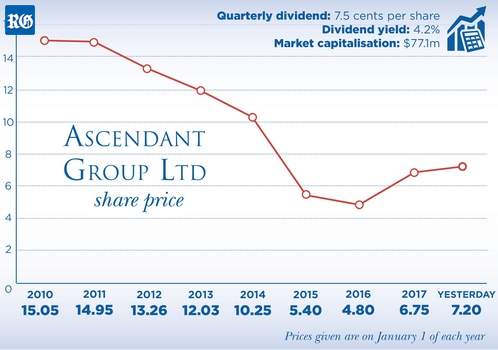
See above story
2017. February 3. A Request for Proposal has been issued for the Solar Photovoltaic Project on the “Finger” at the LF Wade International Airport, Minister of Economic Development Grant Gibbons announced in Parliament this morning. The project is a joint effort between the Ministry of Public Works and the Ministry of Economic Development with help from consulting firm Castalia Strategic Advisors. With the RFP issued on December 2, Dr Gibbons described the project as “well under way” and anticipated that the successful candidate would be selected by early April. Project oversight is being provided by a steering committee, made up of the permanent secretaries of the both ministries as well as the Ministry of Tourism, Transport and Municipalities and the financial secretary. Prior to the RFP, a Request for Qualifications was issued to ensure standards including a “demonstrated financial capacity to build and operate a solar PV facility of this scale, and an established track record of operating efficiency and reliability.” There were 29 submissions of which 19 met the criteria with potential bidders hailing from Bermuda, Canada, Spain, the United States, Germany, Britain and Australia. One of the objectives of this project is to provide pricing stability for a portion of Bermuda’s electricity supply by ensuring that the price remains fixed over time,” Dr Gibbons said. The cost of electricity generated by solar power is not subject to price fluctuations; therefore this cost can be contractually fixed over the 20-year anticipated life of the facility. Other objectives of this project include the diversification of the energy supply and the reduction in Bermuda’s carbon emissions, which could avoid as much as four thousand metric tons of carbon emissions per year of operation.” The Government will fund site preparation which will be recovered from the rental income for the estimated 15 acres that will be leased to the developer.
2017. January 1. The Bermuda Electric Light Company Ltd, Bermuda's sole supplier of electricity put into effect its new island-wide schedule of residential and commercial charges.
2016. December 30. Belco customers will see lower overall electricity rates from January 1. A surcharge that was implemented in June this year will be removed after Saturday. As a result, tariffs applied to energy charges for residential users, small commercial users and demand services, will be scaled back between 3.9 per cent and 18.4 per cent. In June 2015, Belco asked for permission to set its rates at a point where it would “receive a reasonable return on equity in order to fund the ongoing infrastructure investment required to deliver highly reliable electricity to Bermuda”. The rate increases proposed were to provide a return on equity of 7 per cent in 2016, and 8 per cent in 2017. In May, the Energy Commission issued a directive in response to the rate proposals. But as the directive was made five months into the year, a surcharge needed to be applied to base rates for Belco to achieve its required return on equity for the entire year. That additional surcharge will no longer apply after Saturday. Separately, Belco has advised customers that due to a software issue, it is temporarily unable to accept payments with Mastercard credit cards. Should customers have any questions or concerns, they are asked to contact Belco’s customer care department on 299-2800.
2016. November 25. Ascendant Group Limited, the parent company of Belco, has repurchased 710,000 of its own shares. The shares were bought at price of $7 each, and 6.6 per cent of Ascendant’s overall listed securities issued as at the date of the trade. In a statement released through the Bermuda Stock Exchange, Ascendant stated it intends to cancel 595,000 of the listed securities repurchased and retain the remainder as treasury shares to be used for general corporate purposes.
2016. October 28. The Regulatory Authority is to get two new members as it takes over supervision of the power industry. Grant Gibbons, Minister for Economic Development, said the number sitting on the Commission, which already regulates telecommunications, would rise from three to five. Dr Gibbons said in a statement: “We anticipate recruitment for the two new Commissioners will begin shortly.” The Electricity Act 2016 comes into effect today and is designed to modernize the regulation of electricity generation, distribution and sale. The Act transfers responsibility for the regulation of electricity from the Energy Commission to the Regulatory Authority and also establishes a framework by which future investments in the production and sale of electricity will be evaluated and regulated. The new regulatory structure aims to liberalize the electricity market, protect end users and ensure that opportunities exist for businesses to participate in the planning and delivery of Bermuda’s energy future. Dr Gibbons said: “Government’s national electricity sector policy seeks to ensure that electricity is provided at the least-cost and highest-quality; that it is environmentally sustainable; and that it is secure and affordable for individuals and organisations. The bringing into operation of the new Electricity Act is a significant step on the path to achieving these goals — and the new regime represents a major step in the Government’s efforts to modernize Bermuda’s electricity sector.”
2016. October 27. A new lower rate for energy bought from solar power users will take effect from the start of next year. The new feed-in tariff of 17.36 cents per kilowatt hour — about half the previous rate — will start next January. But Grant Gibbons, Minister for Economic Development, said that when the Regulatory Authority takes over policing of energy from the Energy Commission in the near future, it will make drawing up a new policy governing solar power a matter of priority. Dr Gibbons was speaking after the Energy Commission reported on power firm Belco’s proposed termination of its net metering scheme, which compensated solar power producers who fed excess energy into its grid. He said: “The regulation of electricity and the setting of rates in particular is a delicate balance of many factors. We all want to see more renewable used in Bermuda, but we also have a duty to understand any inherent subsidies and ensure that renewable energy comes at a price we can all afford. The Energy Commission’s report highlights that complexity and demonstrates the necessity for the new regulatory regime. I have every confidence that the Regulatory Authority will meet this new challenge with the same due diligence and professionalism they’ve exhibited in regulating the electronic communication sector.” When Belco applied for a rate change to residential net metering and commercial renewable energy in August, it argued that the previous rate was too high and effectively meant average customers subsidized wealthier ones because it did not take account of Belco’s fixed costs like distribution and transmission. The incentive, introduced in 2010, was set for 200 customers, but a total of 325 eventually signed up for the scheme. The scheme allowed residential customers to send excess power to the Belco grid at the full retail rate. The scheme’s existing members will continue to receive the higher rate, but newcomers will get the new, lower “avoided cost” rate. The Energy Commission report also recommended that, until the Regulatory Authority conducts a thorough examination of the solar energy market and economics, Belco should “fully absorb the cost of purchasing that power and allocate it to a recovery account similar to the Commission’s ruling in a recent rate case filing directive”. The report added that Government should also look at establishing a policy on the importation and use of technology used to store power.
2016. October 20. As thousands of old-school sodium street lights across Bermuda get replaced with energy-saving LED fixtures, the island stands to halve its budget for illuminating the roads. But not everybody welcomes the move, with one West End resident complaining that the new lights force him to squint — and goes beyond a threshold set by the American Medical Association after widespread complaints in the United States. Bermuda had its own case in 2011 when Global House was fitted with 1,300 LED lights that were so heavily blue-tinted that the entire system had to be replaced. Under a contract sealed with the Bermuda Government in May 2015, Belco is replacing about 2,000 sodium lights with LED technology, a programme slated to take two years. According to a Belco spokeswoman, the government-financed programme will “contribute greatly to national energy efficiency and conservation goals, including reducing fuel consumption and carbon emissions from street lighting by approximately 57 per cent”. About 1,800 street lights have been switched, covering 95 per cent of the island’s main roads. Calling the public response “positive”, the spokeswoman said that when 98 residents had been polled after the lighting went up around Trimingham Hill, 80 per cent felt that LEDs improved street lighting. However, “I find it much too white, too glaring,” said the anonymous member of the 20 per cent against. “I like to go walking at night, and I find it very hard on my eyes. I have LED lighting in my house, but it’s a yellower kind of light, which doesn’t trouble my eyes. I guess it’s too late to change the lights now, but I have to say I don’t like them.” In the US, where many cities have embraced LED street lighting, the American Medical Association has cautioned against extra bright fixtures. Over the summer, the AMA recommended that communities adopt lighting with a “colour temperature” set at 3,000 Kelvin. Colour temperature refers to the spectrum of light. The higher the CT rating, the greater the content of blue in the light, making it harsher — the same problem that emerged in Global House, where many workers complained of the “cave effect” induced by the lights. Aside from the glare, the bluish light scatters more easily in the eyes, making it more difficult to see — and interfering with the body’s production of melatonin, the hormone that controls sleep. Glaring lights have also proved disturbing to wildlife. The problem was severe enough that some American cities, such as Seattle and New York, ended up taking down their new LED systems, and replaced them with friendlier illumination tailored to the red and yellow end of the spectrum, better suited to human eyes. The Belco spokeswoman said the company was aware of the AMA advisory, which included shielding lights to minimise glare. “Blue light is emitted by many sources aside from LED street lighting, including indoor LED lighting, fluorescent lighting, televisions, mobile phones, tablets and regular incandescent light bulbs,” she said. “And some of the sources provide much higher levels of light in homes than street lights do.” The US Department of Energy has come out in favour of LEDs, she added — in particular, for the ability to dim them where appropriate, which is virtually impossible with conventional street lighting. LEDs also offer a high degree of control over the pattern and evenness of light on the ground. By contrast, conventional lamp-based technologies produce light in all directions, resulting in light spilling in unwanted directions — a waste of energy as well as a form of light pollution. Bermuda’s LED lighting is set to a colour temperature of 4,000, which puts it above the AMA threshold — but the Belco spokeswoman said that it was commensurate with the spacing of the island’s street lighting poles, which limits the intensity of roadway lighting. “LED lights of 4,000 CT were recommended for Bermuda’s road and are being installed. Lowering the CT would not affect visibility, but would reduce clarity and ability to distinguish colours on our roads at night.” Lowering the colour temperature to 3000 would consume more power to attain the same light intensity on the roads. “The street lights are controlled remotely and are dimmable so lighting levels can be reduced at preset times. The street lights have recessed light engines and do not emit light above 90 degrees, reducing glare and light pollution.”
2016. October 20. A series of outages have affected Belco customers today, with the company blaming a build-up of salt. In a statement this afternoon, a Belco spokeswoman said: “Given the weather, crews have been responding to system outages caused by the salt build up on Belco’s distribution system that often happens following a hurricane. “Crews are responding to the outages as they occur.” About 90 per cent of Belco customers lost power during Hurricane Nicole, but power was restored to the majority of homes in a matter of days. Belco had announced last night that service had been returned to the final 33 customers, thanking the public for their patience.
2016. October 15. Belco crews are making fast progress as they attempt to restore electricity across the island after Thursday’s hurricane. The company’s 5.00pm report today stated that engineers from the control room had been switching mainline circuits on and off in order to safely restore power to branch and secondary lines and bring more customers on. “If you were restored as part of the main line circuit restoration you may have temporarily gone off again and will go back on,” explained a Belco spokeswoman. As of this morning, 2,734 customers remained without power. All main lines were restored by 10.30 last night. Throughout today the numbers have been changing as the switching is taking place during this phase of restoration. “Crews are making good progress and we expect to see a good result tonight as more customers come back on line,” she added Crews have been and/or are scheduled to work in the following areas today: East End: Wellington Slip Road (near complete), Cashew City (complete), Ballast Point (complete), Stokes Point (complete); Central: Shawwood Park (complete), Northcote (complete), Blocks Point (half complete), Boss Cove (complete), Travelers Rest (to do), Sunset Pass (complete), Deep Bay Lane (complete), Happy Valley (tonight), Parsons Lane (complete), Devon Spring (went on, back off investigating), Jennings Land (mostly back), Ram Goat Hill (in progress), Shelly Bay (complete); West End: Tamarind Vale (in progress), Heron Bay (complete), Scaur Hill (tonight), Sound View Road (ongoing), Scott’s Hill (in progress), Bob’s Valley (complete). “While these area have been scheduled for restoration today, additional personnel are assessing damage to smaller isolated areas and making repairs where they can,” said the spokeswoman. “We also have crews available to address any emergency situations that arise. “It is during this period of the restoration process that results are slower, as smaller branch lines and secondary lines require similar levels of effort to restore but bring on fewer customer than main line restoration. Main lines have to be restored first, as it is power from the main lines that flows through to the branch and secondary lines and on to homes and businesses. We do not expect that we will get everyone back on today, but do expect to have a better idea late today or tomorrow as to when total restoration may be achieved. When power is returned to your home or business, bring your appliances and sensitive equipment back on-line gradually so that you can be sure the service is stable. If you have partial power, turn off all the switches in your circuit breaker box and contact Belco. Periodically, check one switch that feeds a 120-volt outlet, such as a light or lamp, so you will know when power has been restored. If you have flickering lights, turn your power off at the Breaker Switch which will turn power off to the entire house or facility. We appreciate the patience of those customers who remain without power and continue our focus on getting full restoration complete as quickly and safely as possible.” Sean Durfy, Ascendant Group chief executive officer, said yesterday although Nicole was a Category 3, going on a Category 4 hurricane, “she wasn’t as devastating as she could have been”. While more than 27,000, or about 90 per cent of Belco’s customers, lost power, crews had started the restoration process by 4.30pm on Thursday. And Mr Durfy said they had been working “very, very hard” over the past 24 hours to get Bermuda’s lights back on. “We have an obligation to serve. We’ve had that obligation over 100 years and I’m very proud of the people in the organisation.” Belco chief operating officer Denton Williams praised the “tremendous team” and thanked “every one that enabled us to be here to help out”. According to Dennis Pimentel, vice-president of grid operations, only 11 poles were reported down, compared to the 202 after Hurricane Gonzalo in 2014. Mr Williams added that only two transformers were “substantively down, so much lower than we usually have”. But Mr Pimentel said: “It’s worth noting we haven’t completed our damage assessment, so we do anticipate that we will find a few poles and transformers that will need to be replaced, but nowhere near in the order that we had with Gonzalo and Fay.” Mr Williams said an island-wide tree-trimming exercise in late August would help the island ride out hurricanes “a lot better”. However, regarding laying power cables underground, he said “it’s a constant trade-off between cost and practicality”. He reiterated that it would cause a “significant” cost and disruption and that underground circuit repair could take several days. “You could be facing that as an alternative to having a 90-minute outage on a regular basis on our overhead system.” He said the company’s position remains that extensive undergrounding “is not the best solution. But we are opportunistic where it makes sense and we’re kind of in the area and if we can do it, we’ll do it.”
2016. October 13. 9 pm. Following Hurricane Nicole, Belco had restored electricity to 7,698 customers by 8pm, while some 19,733 remain out of power. “Assessments have indicated a large number of poles down and wires,” said a Belco spokeswoman. “Crews have been limited in what they can do in the immediate aftermath of the storm as in many instances wind gusts were still to high to work safely from a bucket truck and assessments need to be completed to ensure crews’ safety. Restoration tomorrow will proceed with main lines as a priority, as they bring restoration to the largest number of customers quickly and then on to major branch lines. Belco will have a much better assessment of restoration timing once damage is fully assessed. We have crews and equipment in the East End so restoration efforts there have begun despite the extended closure of the Causeway. Safety is the most important consideration at the moment for the public and our crews. Any wires down should be considered live and avoided and reported. Everyone at Belco appreciates all the kind comments and support the community has expressed and looks forward to getting everyone back to normal.” Major outages were being monitored by the utility’s grid operations. As customers lose power, outages are logged at Belco’s operations centre. Belco offices will be closed tomorrow for cash payments and walk-ins. They will honour discounts for discount dates of Wednesday through Friday October 12-14.
2016. October 10. Bermuda's telecommunications sector is stuck in a trend of falling revenues, according to data published by the industry's regulator. The Regulatory Authority, in its 2017-18 work plan document, published on its website last Friday, revealed that the sector's taxable turnover had fallen by more than 12.5 per cent over a two-year period starting in April 2014. The regulator expects the trend to continue and is expecting revenue to fall 7 per cent in the fiscal year 2017-18 to about $177 million. The plunge in telecoms firms' turnover has prompted the RA to request an increase in the rate it charges the industry to fund its own operations, from 1.75 per cent of taxable revenue to 2 per cent from April 2017. The RA's numbers refer to Integrated Communications Operating Licence holders, who between them offer the full range of telecoms services, including wireless network, internet and pay television. The RA states: "The Authority noted a continued downward trend in the actual relevant (taxable) turnover during the financial years 2014-15 and 2015-16 of approximately 4 per cent and 9 per cent respectively and anticipates that this trend will continue during 2017-18." While the document offers no reasons why the sector's revenue has fallen so sharply even at a time when the latest data suggests the economy has stabilized, it is likely that the advance of technology may also be hurting some of the industry's traditional revenue streams. Just as mobile technology hit landline and voice revenues, overseas web-based streaming video services are likely to be taking a bite out of cable and satellite TV operators' income. A survey by research firm GfK in July found that nearly a third of all US households subscribed to a streaming TV service, such as Netflix, Amazon Prime Video or Hulu, and that cord cutting, consumers cancelling their pay TV services was accelerating. Also, liberalization of the Bermuda market in recent years, through the dismantling of a licensing regime that had restricted the services that carriers were allowed to offer, has led to more bundling and greater pricing competition. The RA is also due to take on oversight of the electricity sector, although a date for the handover of this responsibility from the Energy Commission has yet to be announced by the Government. The regulator's proposal for a $6.92 million budget for 2017-18 is based on the assumption that it will be responsible for electricity by the start of the next fiscal year on April 1, 2017. The RA estimates it will need a budget of $3.55 million to fund its telecoms activities, up 5 per cent from the year before, mainly because of the need to buy new radio spectrum equipment costing $230,000. And it estimates it will need a further $3.37 million for electricity-sector regulation. Residents are being urged to have their say on the RA's strategic plans, goals and budgets in a public consultation with an October 28 deadline for submissions. In order to take on electricity oversight, the RA estimates it will increase its payroll from nine employees to 13, and to add two commissioners to the three it has already. Employees' responsibilities include collection of Government and RA fees, strategic analysis, compliance, consumer affairs and enforcement. Among the RA's stated priorities is a quality-of-service investigation aimed at establishing enforceable standards for internet speeds. "The Authority will implement measures to prevent significant disparities between consumers' expectations of broadband performance and their actual experience," the RA stated. A review of billing practices of telecoms firms and efforts to increase consumer awareness of internet and mobile services are also on the RA's agenda. In its electricity-sector work, the RA will look to ensure fair and competitive pricing, carry out consumer perception surveys on quality of electricity services and evaluate the scenarios in the Integrated Resource Plan, a study of the island's future power needs and the mix of sources that could be used, to identify least-cost, high-quality options for Bermuda.
2016. September 2. Plans by Belco to adjust its rates for customers who install solar power are to be reviewed. The utility company made its request to the Energy Commission on August 15 to change its rates for residential net metering and commercially renewable energy. Special rates were adopted in 2010 to encourage the development of solar power, allowing homes and businesses to send their excess electricity into the grid at the same rate paid for power. The incentive, initially set for 200 new customers, ultimately gained 335 participants by last month, when Belco proposed switching to a compensation of “avoided cost” for new installations — mainly covering the cost of fuel. Grant Gibbons, the Minister of Economic Development, has called for a commission inquiry to ensure that a range of perspectives had been considered. Dr Gibbons has requested the inquiry’s findings by the end of this month, and appointed Raj Barua as a special advisor to the commission for the inquiry’s duration. Under the Electricity Act 2016, the regulation of electricity is ultimately to be handed over from the Energy Commission to the Regulatory Authority of Bermuda.
2016. August 19. An open call has been issued to pre-qualify companies seeking to participate in the tender process to build a solar power facility on land adjacent to L.F. Wade International Airport. The Bermuda Government is seeking a six megawatt AC solar power photovoltaic plant on the peninsula known as the “Finger.” The land is owned by the government. In a statement, the government said: “Solar photovoltaic technology is an important component in the future development of Bermuda’s electricity sector. The technical criteria that must be met for companies to be eligible to participate in the tender process include a track record in successful solar project development of at least 10MW of cumulative capacity, with at least one successful installation of 3MW or more on a single site anywhere in the world. The financial qualification criteria include the submission of three years of audited financial statements showing positive net worth and profits for each of the three years.” The tender process, which is scheduled to commence during the autumn, is expected to establish the optimal price of solar power for this project through competitive bidding. Additional details about the project and the RFQ documents themselves can be found on the project website.
2016. July 19. Belco reported that some 6,000 residents were without power shortly after 1pm yesterday but it was restored just after 2.30pm. The outage followed a load shed caused by the shutdown of an engine. It was the second time within 24 hours that homes had suffered power cuts. Those affected were in the areas of Camp Hill, Fort Hamilton, Flatts, Fractious Street, Harrington Sound, Parson’s Lane, St George’s and Tucker’s Town, a Belco spokeswoman said. On Monday night cuts affected about 7,000 residents when three engines shut down. The outages occurred at about 7pm, causing loss of power in some of the mentioned areas. Extra engines were brought online, restoring electricity to the 14 circuits affected by about 8.15pm.
2016. July 13. The Bermuda Energy Summit 2016 has been hailed an “unqualified success”, by Grant Gibbons, the Minister of Economic Development. The event that was held on June 29 at the Hamilton Princess and attracted 110 attendees with over 20 panelists sitting in five panels. Dr Gibbons told the House of Assembly the summit looked at a range of topics including the department’s energy policy, fuel technologies and energy storage. He also confirmed that the selection of a developer for the solar farm facility at The Finger will begin at the end of 2016. “We hope to make this an annual event by continuing to engage public, Belco, fuel suppliers, potential investors, developers and environmental interests — all of which have a major interest in Bermuda’s energy sector,” Dr Gibbons said. The summit also looked at the CETO system that employs a technology that harnesses ocean swell movement to actuate a submerged buoy, which drives a generator to produce electricity. “CETO has potential for use in Bermuda and is anticipated to be tested in a pilot version,” Dr Gibbons added.
2016. July 13. A power cut resulted in a fault at the sewage treatment plant at Grotto Bay Beach Resort and Spa, causing a stench around the area. Smoke was also seen emanating from the air-conditioning unit at the nearby Blue Hole gas station. The outage, caused by a cable that had broken away from the overhead line feeding the circuit, took place at about 7.40pm on Friday and affected Blue Hole Hill and Crystal Cave Road, according to Kerry Judd, Belco’s corporate communications manager. Seventeen customers were affected, some losing power completely and others experiencing one or two outages. Electricity has been restored to the sewage treatment plant at the hotel but a smell remains. JP Martens, the hotel’s general manager, said: “The plant is up and running but it needs to be brought back to life. It is hard to forecast how long that will take. We had no electricity coming into the plant so we could not inject any air into it and it caused the plant to go bad on us. It was immediately fixed but it takes time to recover. The problem was dealt with quickly, the partial power outage was Friday night, the plant failed on Saturday night and it was fixed by 8am on Sunday. We have had no complaints. We have been able to continue our services as normal despite the challenges. We apologies for this but it was beyond our control and we are doing everything to get the plant up as quickly as possible.” Jermaine Simons, the sales manager for Rubis Energy Bermuda, said there was an internal investigation into the smoke caused by the outage at the gas station. Mr Simons told The Royal Gazette: “When one leg [of power] goes down you go from three-phase power to single-phase power, which is what your computer, TV and things like that run on, but if you try to run a heavy duty air-conditioning unit on a single phase the motor is going to overwork. The motor had strained and created smoke, which set off our alarms. Our fuses and trips did activate when the load got too much. The matter is under internal investigation, so we are reviewing the situation and if there are any lessons we can learn from it, we will implement them as quickly as possible.” Ms Judd added: “As a safety precaution, any time customers experience partial or split power, Belco always recommends that power be turned off at the fuse box and to call 955.”
2016. July 4. Belco is asking residents to provide up to date and accurate information as their workers prepare for another hurricane season. And they also want those who are dependent on electricity to run life support systems to make sure they are on the company’s medical priority list. Belco has advised customers to review their most recent electricity bill to ensure that contact information is correct. “During outages, especially those related to storms and hurricanes, customers are often directed to call 955 during the restoration efforts”, states Kerry Judd, Belco’s Corporate Communications Manager. “When they do call, if the phone number keyed in for the property experiencing the outage does not match the phone number already in Belco’s system against the account for that property, the customer may get a response from the system to this regard. As we continue our preparations for the 2016 hurricane season, we want to ensure that all contact information in our system, especially telephone numbers, is accurate and completely up to date.” Mr Judd urged that customers who are dependent on electricity to run life support systems (life support/oxygen systems, body lifts for paralysis, etc) are named on the medical priority list. And they also must provide a letter from their physician confirming the medical condition and the dependency on electricity for care “It should be noted,” continued Ms. Judd, “that in the case of a severe storm/hurricane and a major or extended power outage, Belco may advise medical priority customers to attend the King Edward VII Memorial Hospital due to the severity of the damage to the transmission and distribution system in the affected area. For example, if the customer’s property is fed from a branch line, but there is major damage to the main line upstream from which their branch line feeds, repairs must be completed on the main line first in order for their branch line to then be restored. Customers who need to provide updated telephone numbers or who have questions regarding being placed on the medical priority list should call Belco’s Customer Care Department on 299-2800 or e-mail the firm. Safe and timely power restoration to all of our customers, and especially to our special needs customers will always be a focus for Belco. We remain committed to responding to our customers needs as quickly and as safely as possible.”
2016. June 3. Regulators have ordered Belco to phase out special discounts given to employees and hotels over the next two years, arguing that the public is effectively paying for them. The Energy Commission has also demanded the electricity provider scrap its “convenience fee” on credit card payments. The revelations came in the EC’s 76-page filing, just published on the government website, which shines a light on almost a year of deliberations that ended with Belco being given permission to raise electricity tariffs from this month. The document also reveals that Ascendant Group, parent company of Belco, plans to use a captive insurance company to try to reduce its insurance costs. And the EC is also calling for Ascendant to provide more details on shared services within the group to address concerns that Belco customers might effectively be subsidizing Ascendant’s other businesses. The EC, whose chairman is Michael Leverock, is due to hand over regulatory responsibility for the electricity sector to the Regulatory Authority this year. As a regulated utility, Belco must adhere to the regulator’s directives. In the filing, the EC states on discounts: “The Commission finds that the embedded staff and special hotel discounts are not in the public interest whereby the public pays for these discounts without regulatory approval.” In its final ruling, dated May 13 this year, the EC orders Belco: “All staff, hotel, special groups, or any other discounts applied to both the base and fuel adjustment rates (with the exception of the waiver of the facilities fee to the Bermuda Government’s Social Assistance programme and the quick payment discounts) shall be phased out over a two-year period commencing on the date of this letter.” All customers receive a 5 per cent discount for early payment, but some get additional help, Belco’s submissions reveal. The Bermuda Government, for example, receives an additional 5 per cent discount, which enables it to save more than $1.5 million on its annual bill. Bermuda Hotel Association members also get a 5 per cent discount during the November-to-April shoulder season, due to end when government payroll-tax concessions for the hospitality industry are halted. Two hotels, the Hamilton Princess and the Fairmont Southampton, receive an additional 5 per cent discount, all year round. A submission from Belco in the filing states: “This was originally negotiated in the early 1990s when the hotels were seeking to self-generate and disconnect from the grid. The disconnection would have caused a shift in the costs to the remaining customer base and this was agreed an incentive for them to remain on the system.” Belco employees receive a 25 per cent discount on their electricity bills on top of the early-payment discount, a deal the utility said was “initiated as an agreed alternative to base salary increases during union negotiations. The company pays for this cost and does not recover it as a part of the cost of service to customers,” Belco added. “All non-Belco entities in the group of companies pay Belco for the costs of any employee electricity discounts they have.” On credit-card payments, the EC directed: “The convenience fee charged to customers for the use of credit cards for bill payments shall be discontinued. “Efforts shall be made simultaneously to facilitate the use of all credit and debit cards currently utilised in the market as soon as practically possible.” Belco customers can pay with MasterCard and a fee of 2.04 per cent is applied. The EC argued the fee is a disincentive to using credit cards to pay the bill and that it would be in the public interest to discontinue it. Belco had argued that scrapping the fee would result in many more people using cards to pay bills. And the fees applied by credit-card companies would have be spread across the whole customer base, or “socialized”. This would “unfairly allocate costs” to those paying by other means, Belco said. “Currently the expense to those who use cards to pay their Belco bills is approximately $45,000 per year as a group,” Belco stated. “This could instead exceed a million dollars if costs are socialized.” Ascendant’s plans to insure some of its own risks — initially coverage of plant, property and equipment — through a captive insurer were also outlined in the filing. “Belco is spending in excess of $2 million per annum on this business class with a $750,000 deductible per incident,” Belco stated. “Belco also has currently uninsured lines of business including the distribution system, which incurred unplanned expenses of more than $4 million in 2012, funded from the balance sheet and unrecovered from customers.” Actuarial analysis of Belco’s claims history indicated a forecasted loss of $531,000 per year. “Ascendant agreed to finance the risk at the $500,000 premium level, providing a maximum $750,000 of cover per annum for claims,” the firm stated. “The analysis suggests a 40 per cent chance of no claim within in given year hence any premium payments retained could be accumulated and used to offset the larger and less frequent events that require significant cash to pay for unplanned events and damages.” Ascendant Bermuda Insurance Ltd is licensed by the Bermuda Monetary Authority as a captive insurer and was incorporated in April 2014, according to the Registrar of Companies. “The captive represents a transition from our historic ‘pay as you go’ mode of operating for the first loss/deductible, which requires unexpected financing from our balance sheet, to a vehicle that offers to smooth out some of that volatility,” Belco argued. On shared services, the EC demanded greater transparency from Belco on cost allocation. “The Commission finds the perception remains that Belco substantially subsidies its parent entity. Shared services, loans and insurance risks are examples. Efforts to regularize cost/benefits would be encouraged to place Belco in a more favorable position in this regard.” Ascendant said that some services were shared among the whole group, including finance, IT, human resources and transportation and that this “results in savings for Belco and its customers”. Such services were budgeted and costs allocated to various businesses taking into consideration system usage and budgeted effort, for example. Ascendant director costs were attributed 50 per cent to Belco, while the cost of group executives was charged out on an allocated effort basis. Asked for an update yesterday, a Belco spokeswoman said: “Belco is in the process of developing responses, initiatives and timelines around each of the Energy Commission’s directives and will be getting back to the Commission with proposals to address all of the directives.” The filing is also loaded with technical analysis. The EC approved an allowed return on equity of 7 per cent for 2016 and 8 per cent for 2017. The new rates, which will take effect this month, will result in residential customers paying 8.7 per cent more for the first 250 kilowatt hours used. For the next 550 kWh used, there will be a 5.7 per cent increase and for the top tier — anything over 700 kWh — a 17.7 per cent hike will apply. The graduated facilities charge will also rise by between $5 and $20 per month, depending on the amount of electricity used. Commercial rates will go up between 16.6 per cent and 22.4 per cent.
2016. May 31. Bermuda is continuing to explore and implement renewable and “cleaner” energy options, and is seeking to have renewable sources meet 35 per cent of the island’s electricity needs by 2025. That aspiration was reiterated by Grant Gibbons, the Minister of Economic Development, as he applauded a landmark moment earlier this month when Portugal met its entire electricity needs for four consecutive days using renewable energy. For 107 hours the European country, which has a population of 10 million, met its electricity requirements using a combination of solar, wind and hydro power. Last year renewable sources together provided 48 per cent of the country’s electricity needs. “It’s fantastic that Portugal has been able to change their energy needs from dirty sources to clean sources,” said Dr Gibbons. However, he pointed out that there are some important differences between Portugal and Bermuda, one being the ability for Portugal to connect to the electricity grids of neighboring Spain and nearby France in order to address any shortfall in energy production when renewables sources are not able to meet demand. Dr Gibbons said that was necessary because solar panels could not harness energy at night, and wind power was also dependent on weather conditions. The minister further noted the difference in available land area for solar farms and wind turbines in Portugal, compared to Bermuda’s limited space. However, the island is moving in the direction of renewable sources, as evident from the electricity policy statement last year, which set out inspirational figures. By 2020, the aim is to have 8 per cent of the island’s energy needs provided for by renewable sources, increasing to 35 per cent by 2025. Businesses such as Gorham’s and Lindo’s Group of Companies have been running sizeable solar panel arrays for a number of years, while other businesses have stepped up their use of energy efficient equipment to counter rising energy costs. Meanwhile, Belco and its parent Ascendant Group are looking at alternative sources of electricity generation and have drawn up an Integrated Resource Plan for consideration by the Energy Commission. An increase in the availability of liquefied natural gas, and the possibility of larger scale solar power operations, are among options being mulled. One area of Bermuda that has been earmarked as a potential solar power facility is the peninsula of land known as “The Finger” at LF Wade International Airport. It is anticipated that project will go out to tender later in the summer. “There’s about 80 or 90 acres of land there. Whether we use all of it is still to be seen. It is a nice opportunity for us to use that land for solar and photovoltaic energy production,” Dr Gibbons said. He estimated the project might produce about 25MW of peak load electricity, with peak load referring to daytime electricity use. Dr Gibbons said the solar power would not help with night-time demand, but anticipated changes as things evolved regarding electricity storage options. He added that various models are being looked at with regard to the proposed project before it is put out to tender. As for other alternative energy solutions, he said wind was one possibility, although there is reluctance among many people about placing wind turbines off the island’s coast. And he noted that there is continuing growth in the use of solar panels by householders and businesses, and he said that there was room for that to increase further. Until fairly recently, the Bermuda Government had been providing subsidies totaling about $800,000 to encourage the installation of solar panels by residents and the private sector. “The good news is we do not think we are going to need subsidies as the cost of solar panels is going down and has become quite competitive,” said Dr Gibbons.
May 27. Community groups have taken a cautious approach to Belco rate changes, saying they will look closely at how the move will affect the less fortunate. Starting next month, residential customers will pay 8.7 per cent more on their first 250 kilowatt hours, 5.7 per cent more on the next 450 kWh and 17.7 per cent more on anything over 700 kWh on their monthly bill. Belco said the impact would be softened by the fuel adjustment rate being at a nine-year low of 7.65 cents per kWh, meaning the total bill for small and average residential users will be lower when the new rates take effect next month than it was 12 months earlier. An average user who had a monthly bill of $225.38 in June 2015 will have a bill of $217.45 when the new rates kick in next month, Belco said, representing a decrease of 3.52 per cent. However, bills will also be subject to fluctuation based on the fuel adjustment rate — for a clear look at the relationship between the fuel adjustment rate and global oil prices, see page 11 of today’s Business section. Speaking yesterday, Charles Jeffers of Age Concern said that the main question many in the public had about the rate change was how the move would affect the company’s profit margin. “What we have to look at is what the profit margins are going to be,” he said. “Obviously they have to cover their costs and they have to pull in a reasonable profit but what are the expectations of their shareholders? I also know they are looking for some kind of investment into new equipment because some of their equipment is outdated and has been for a few years. They really need to be clear with the public what they are doing.” Asked about how the changes would affect seniors, Mr Jeffers said a wait-and-see approach might be appropriate, noting that Belco had stated that those who use less electricity might see their bills shrink. If so, that’s nice for the people at the lower end, but it needs to be laid out in a way so everyone understands. I would expect that most seniors would be at the lower energy usage group, and if they are using a small amount of electricity, according to what they are saying, their rates are going to go down. Of course, Age Concern will be looking very closely to see what it means, but until people get one or two bills under the new system you really cannot tell.” Claudette Fleming, the executive director of Age Concern, added: “Moving forward into the summer, we look forward to a corresponding increase in social insurance payouts to assist seniors in meeting the increasing cost of living demands that seniors have to meet on fixed or diminishing incomes. “It seems only fair to our seniors and an appropriate time, as regulators/legislators set the tone and the opportunity for what constitutes a ‘reasonable’ financial investment.” Meanwhile, former parliamentarian Quinton Edness expressed concerns that far more people would see increased energy costs than would see lower. “I bet if you get down to it, you would find out a lot more people are being affected by higher costs than by lower costs. What the Government has to do is find out how to reduce or maintain the cost of energy in Bermuda. One of the largest figures in most families’ monthly bills is the energy costs. It’s particularly stressful for seniors. Their income is static and a great deal of them are suffering in silence because they cannot afford the cost of living in Bermuda.” He called on the Bermuda Government to do more to encourage the adoption of solar energy in Bermuda, making the cost-saving technology more broadly available, as well as pursuing alternative energy sources such as tidal energy and geothermal energy. Martha Dismont, the executive director of Family Centre, said the organisation was taking a close look at the changes and how they would affect the public. “Obviously we are looking into how this will impact people, particularly lower income households,” she said.
2016. May 27. Power charge increases by Belco will force up costs for hotels and grocery stores. Stephen Todd, chief executive of the Bermuda Hotel Association, said that rising power costs would impact his members. He added: “There are concerns — we have just now started to see an increase in occupancy. We’re going to be utilizing more in the way of power and that will equate to additional operating expenses for each of our members.” He was speaking after Belco announced that commercial power rates were set to go up between 16.5 per cent and 22.4 per cent, dependent on the amount of power used, from next month. Mr Todd said: “We are anticipating it will represent an increase in the overall operating expenses to our members. We’re in the process, from an individual property standpoint, evaluating this. We will be working with a relationship manager at Belco to determine how we best manage this and understand the overall cost to our individual members. We’re looking at how it affects us for this year and the projected expenses for 2017.” He added: “We’re getting feedback and intelligence from the members now — I’m expecting that over the next few days we will get a better indication of how it will affect them.” Mr Todd said: “We understand the rationale behind it, but every additional cost increases expenses and that makes it much more expensive to operate.” But he added that hoteliers — keen to stay competitive in a regional and world market — would only raise room rates as a last resort. He said: “That is something we are conscious of on an ongoing basis. We don’t want to increase the cost of rooms. “We have to ensure we are competitive and a destination the visitor will choose to come to.” Fredrick Gorham, head of Hamilton grocery store Supermart, added that supermarkets were also unlikely to mark-up prices to cover extra outlay on power. Mr Gorham said: “My understanding is the base rate is what is going up and fuel adjustment will go up and down.” He added the store was still working out what the increases would mean for the business. Mr Gorham said: “Nobody is happy when their electricity bill goes up. But we have put a lot of time and effort into trying to reduce our electricity costs. If we changed the prices every time something else changed people would be dizzy — the bottom line is we have to absorb this. I would say it will increase our costs, but we are busy trying to figure it out now. It sounds like a lot, but I don’t know if it is. As it stands right now, electricity bills are lower because of the price of oil, but who knows where that’s going to go?” The Energy Commission backed Belco’s bid for increases after hearing that the firm’s return on capital was lower than similar island utilities. The power firm had asked for a rate to bring its return on capital up to 10.5 per cent. The Energy Commission approved increases that will raise the rate of return to 7 per cent this year and 8 per cent in 2017. Belco argued that it needed to increase earnings to maintain necessary investment in plant and infrastructure.
2016. May 27. Belco’s customers will feel the effects of some significant increases in electricity prices when higher tariffs kick in next month. But greater pain is likely in the coming months when the fuel adjustment rate — which has just hit a nine-year low — catches up with the spike in world oil prices that has occurred over the past three months. The fuel adjustment rate reflects the cost of the diesel and heavy oil fuel that Belco burns, including the Bermuda Government duties levied on it. As a “neutral pass through” element of the bill, it has zero impact on Belco’s earnings. There appears to be a lag of around three months between a move in crude oil prices and a corresponding impact on the fuel adjustment rate, as the graph accompanying this story clearly illustrates. Most notably, in mid-2014, when the crude price started to plummet, the fuel adjustment rate continued to rise for three months before it too started to fall. The opposite is happening right now. The May fuel adjustment rate has been set at 7.65 cents per kWh, less than half of what it was just two years ago and the lowest rate charged since 2007. This will have a dampening effect on the tariff increases — for now — and has allowed Belco to state that an average residential customer using 600 kWh would actually see a 3.5 per cent decrease in their total Belco bill from a year ago under the new tariffs. That average customer will pay $45.90 as a fuel adjustment rate at today’s level, down from $69 in May 2015 and $99 in May 2015. But that element of the bill is likely to surge higher again in the coming months. Yesterday afternoon, US crude prices were at around $49.40 a barrel, having topped $50 earlier in the day — up more than 80 per cent from the 13-year low of below $27 barrel just four months ago. Using recent history as a guide, as depicted by the graph, it is likely that a spike of this magnitude will lead to a sharp rise in the fuel adjustment rate in the second half of the year — depending on what Belco actually paid for its fuel. An aggravating factor for consumers is the increasing customs duty charged on fuel. The Government raised the duty last year and again this year. Duty now adds $31.79 onto the cost of a barrel of fuel oil and feeds directly into the fuel adjustment rate. As Belco points out, duty on fuel makes up 5 cents of the fuel adjustment rate — around two thirds of the charge at this month’s level.
2016. May 26. Belco will be conducting a series of small group discussions with its customers in an effort to “improve customer experience”. Total Research Associates, which will carry out the research in June, is creating discussion groups representative of Belco’s customer base, through a recruitment telephone call. In a statement, Belco advised this will involve a series of demographic questions, but that all information will remain confidential.
2016. May 26. Electricity prices are to rise after regulators gave power utility Belco permission to increase its rates for the first time in three years. The new rates, which will take effect next month, will result in residential customers paying 8.7 per cent more on their monthly bill for the first 250 kilowatt hours used. For the next 550 kWh used, there will be a 5.7 per cent increase and for the top tier — anything over 700 kWh — a 17.7 per cent hike will apply. The graduated facilities charge will also rise by between $5 and $20 per month, depending on the amount of electricity used. Commercial rates will go up between 16.6 per cent and 22.4 per cent, depending on the amount of electricity used. Belco pointed out yesterday that the impact will be softened by the fuel adjustment rate being at a nine-year low of 7.65 cents per kWh. The utility said that the net effect means that the total bill for small and average residential users will be lower when the new rates take effect next month than it was 12 months earlier. An average user who had a monthly bill of $225.38 in June 2015 will have a bill of $217.45 when the new rates kick in next month, Belco said, representing a decrease of 3.5 per cent. The decrease is entirely due to the steep fall in the fuel adjustment rate, from 11.5 cents per kWh in June last year to 7.65 cents for next month, as a result of the fall in global oil prices meaning cheaper fuel for Belco’s generators to burn. “The Energy Commission, recognizing that Belco requires a reasonable return on capital in order to make the ongoing infrastructure investments required to deliver the highly reliable electricity system for business and residential customers, has instructed the utility to revise its rates in order to achieve a 7 per cent return on capital in 2016 and 8 per cent in 2017,” Belco said in a statement yesterday. Belco had sought a higher rate increase to bring its return on capital up to 10.5 per cent, which it has argued is in line with utilities in similar jurisdictions. “As part of the filing, Belco had an independent report prepared on the cost of capital, which indicated that a suitable return for Belco, in line with peer island utilities, should be 10.5 per cent, well above the 1.8 per cent realized in 2013, the 3.3 per cent in 2014, and the 6 per cent in 2015,” Belco added. “Over the past several years, despite higher system reliability, Belco’s realized return on capital has been consistently much lower than other island utilities.” Belco has argued that it needs to increase earnings to maintain the necessary level of investment in its plant and infrastructure. The power company said it had invested about $390 million since 2000, even as electricity sales plunged during the recession. “Given the prolonged erosion of sales revenues in a capital-intensive and high fixed-cost regulated business, Belco could not sustain high levels of investment with unreasonably low earnings,” yesterday’s statement added.
2016. May 9. The choices facing Bermuda over how it should generate the electricity supply of the future are becoming increasingly complex, with the rapid changes taking place in the global energy sector. That is the view of Walter Higgins, chief executive officer of Belco and its parent company Ascendant Group, who said the dramatic fall in oil prices in recent years and the fall in the cost of solar power infrastructure had created more options. Belco is to submit an Integrated Resource Plan expressing its views on the future of the electricity sector to the Energy Commission by as early as next month. In an interview, Mr Higgins also explained why he believed the increases in electricity rates that Belco has applied for — which would add about 7 per cent to the bill of a typical household and between 8 per cent and 20 per cent for commercial customers — were justified. The Energy Commission’s response to that request is expected soon. The submission has been delayed over the past year to take account of fuel market and technology changes, as well as the passing into law of the Electricity Act, which outlines government’s vision for the power sector. Mr Higgins said the price of oil had declined dramatically in the few years since Belco started its IRP planning. The analysis initially favored converting to liquefied natural gas as a principal fuel rather than the heavy oil and diesel that Belco’s ageing generators burn today. “The first thing that’s happened is the decline in the price of oil,” Mr Higgins said. “There has been a slight recovery, but it’s still much lower than it was two or three years ago. That’s a factor that needs to be taken into account.” An increase in the availability to Bermuda of LNG was another development. Mr Higgins said Kazakhstan and the Middle East had emerged as potential sources, and the US was preparing to export LNG in quantities suitable for small islands like Bermuda. “We’ve gone from having few choices to many choices,” Mr Higgins said. “It’s a dilemma. If price were the only consideration, then low oil prices suggest staying with oil, even it means replacing some of our engines. But if it’s about meeting policy objectives of using cleaner fuel and reducing carbon emissions, then you would look at natural gas.” The fall in the cost of building a utility-scale solar farm — as the Government wants to see happen on land known as “The Finger” near LF Wade International Airport — had fallen about 80 per cent in the past five years and 50 per cent in the past two years, changing some of the arithmetic in the IRP, Mr Higgins added. He said Belco’s proposals would be a basis for discussion that offered analysis of different options, but that the decision on which way to go was one for the country to make. Ascendant announced profits of $14.5 million for 2015, up more than $7 million from the year before. Belco’s operating profit was $17.8 million, representing a return on the approximately $299.4 million of capital invested of 6 per cent, according to Ascendant’s chief financial officer, Mark Takahashi. Last year marked a large improvement from 2013 and 2014, when Belco’s return was 1.8 per cent and 3.3 per cent respectively. Mr Higgins said these returns were too low for Belco to be able to make the investments that were necessary in maintaining and upgrading the island’s electricity system. The company has invested some $300 million since 2000. A return of around 10.5 per cent would be more appropriate and in line with what peer utilities in comparable jurisdictions were allowed to earn, he argued.
2016. May 4. Ascendant Group Ltd’s operating earnings doubled to $14.5 million last year as electricity sales rose for the first time in six years. The group, which owns Belco, attributed the $7.2 million increase in earnings to improved results at the power utility, driven by higher sales, reduced windstorm expenses and a reduction in bad debt expenses. Walter Higgins, Ascendant’s chief executive officer, said the 2.3 per cent increase in electricity sales suggested that an economic upturn could be under way. He added that the company was preparing its long-awaited proposals for the future of electricity production in Bermuda in its Integrated Resource Plan that it plans to submit to the Government next month. Ascendant added that it expected a decision soon from the Energy Commission on the application made by Belco last year to increase electricity rates. The company argued the increase was necessary because its return on capital was “unacceptably low” when compared to peer utilities and insufficient for Belco to be able to make necessary investments in its infrastructure. “Since 2000, Belco has invested a total of $390 million to provide Bermuda with a first-world electricity system,” Ascendant stated. “Belco cannot sustain these levels of investment with its present earnings. In June 2015, Belco submitted a request to the Energy Commission to increase electricity rates to provide a suitable return on capital consistent with peer utilities as determined by a third-party Cost of Capital Report. It is anticipated that the Energy Commission will make a final determination of Belco’s request shortly.” The rate increases requested by Belco would increase electricity costs by about 7 per cent for the typical household and between 8 and 20 per cent for major commercials users. Last year Belco saw its first increase in electricity sales since 2009. The utility sold 590 million kilowatt hours, up from 577 million in 2014. But it is still a long way from the 2009 peak of 656 million kWh, reflecting the shrinkage in the economy since then. The sales rise was driven by residential sales, which were higher due to temperatures that were warmer than 2014 and historical averages. But sales to commercial customers remained flat, as energy efficiency and conservation measures offset the effect of the warmer weather. Mr Higgins said: “It appears Bermuda may have begun its recovery from eight years of recession. There is renewed interest in energy, infrastructure and tourism related developments and the electricity sector is going through a transformative period.” He added that the Electricity Act, passed in March this year, and the national electricity policy, both of which set out a vision for greater use of renewables and a more efficient electricity system, were “in line with our Integrated Resource Plan”. Belco had planned to submit the IRP last year. Mr Higgins explained: “We delayed submitting our original IRP to the regulator in 2015 in order to better understand the pending policies and processes, as well as thoroughly consider how recent fuel market changes and technology advances have affected the suitability and viability of liquefied natural gas and large-scale deployment of renewable energy systems. We intend to submit the IRP to the regulator in June 2016.” Falling oil prices enabled Belco to buy cheaper fuel last year, a saving reflected on electricity bills by the plunging fuel adjustment rate. The average price Belco paid for a barrel of fuel was $101.06, which includes taxes, shipping and handling, down from $128.60 in 2014. Nearly a quarter of the cost of last year’s fuel, or $23.05 per barrel, was made up of Customs Duty, a figure that has since risen to $31.79 per barrel after duty increases in the Government’s 2016/17 budget. Ascendant Group cut operating expenses by more than 12 per cent to $197.5 million last year. Lower fuel costs were a factor, as well as a significant reduction in bad debt expenses and a decrease in labour overtime costs, as there were fewer storm expenses and fewer unplanned outages. Ascendant’s consolidated net income was $17.4 million, a $0.2 million decrease from 2014. This figure was impacted by a one-off gain of $5 million from amendments to employees’ post-retirement benefits plans and also by costs arising from the restructuring of Bermuda Gas. Last month Ascendant sold Bermuda Gas, a propane distribution and commercial service company, to Rubis for $17.7 million.
2016. April 2. A local businessman has described the move to solar energy as a “double-edged sword.” General manager Andrew Mackay, of Gorham’s True Value Home Centre, which is in the process of completing its final instalment of photovoltaic solar energy, said: “Your initial investment is going to be high, but at the same time you want to do something that’s good for the environment. “You’ve got your moral obligation and your financial obligation. You’ve got to weigh both of them.” Mr Mackay’s comments come after a Government report, investigating the potential of bringing liquefied natural gas to Bermuda as an alternative to diesel, was tabled last month. Grant Gibbons, Minister of Economic Development, said that LNG would be more cost effective and produce less harmful emissions. But he noted concerns had been raised about the manner in which it is extracted, and that it would act as a disincentive to adopting renewable energy due to its lower cost. The report found the deployment of LNG in Bermuda was feasible if the pricing differences between natural gas and oil were sufficiently disparate and that LNG was available on the island. Solar energy advocates have long extolled the virtues of its generous payback. However, Mr Mackay added that with a “considerable drop in oil prices, the payback had changed. Where before you could see a return on your investment in five years, it may take a little longer, seven or eight. From a financial standpoint, I would say that if the government came on board with making it a viable option for people, I think it would be great.” According to Mr Mackay, the company has always aimed for greener solutions, having installed its first solar panels in 2011. And he said they were “ecstatic” with the results of the new system. “We haven’t got the main system online yet because we’re the first company to go this large and again the infrastructure is not in place for it. We’re like the test pilot. Nobody on the island has a system this big — even close to it. Alternative financing solutions could also work, but marketing also needed to improve. If we can find a solution where the banks, Belco and the solar distributor could come up with an agreement and a package they could offer the people, I think it would do wonders for the island — absolute wonders. There are stacks of methods to do it. It’s all about getting the right players in the same room and coming up with a solution. Once finished, Gorham’s would need about 20 per cent of its power from Belco because it would still need battery backups. We’re excited about it and hopefully people will get on board. "
2016. March 22. Cleaner and cheaper liquefied natural gas could be powering Bermuda inside four years, a report has revealed. Consultants Castalia said that electricity generation in Bermuda could be switched over to LNG by 2020 with a price tag of between $258 million and $315 million, depending on the arrangements for supply and delivery to a power plant. The report, tabled in the House of Assembly yesterday, said: “By quickly deciding on the best approach for procuring LNG, the Government can set Bermuda on the path to begin importing LNG by the end of 2019. “Deciding on an approach and awarding contracts to providers will take until early 2017. From that point, it will take about 30 months to build an LNG carrier and other infrastructure necessary to receive LNG and to complete the rest of the needed infrastructure.” The Castalia report came down in favour of making the switch from using fuel oil and diesel to produce electricity. The report said: “Our analysis suggests that Bermuda could procure LNG and use natural gas to generate electricity at a lower cost than continuing to depend on oil products. Our market research suggests that LNG is quickly becoming available for small island markets such as Bermuda soon. Indeed, recent agreements in Jamaica and elsewhere suggest that it could be available immediately for Bermuda, if the right agreement were in place.” The report, however, said that Bermuda would still have to pay a premium for the new fuel, although it would be cheaper than other options or continuing to use oil-based products. It explained: “Current and projected prices for natural gas at Henry Hub, the largest natural gas trading hub in the United States, are easily the cheapest of the fuels shown. However, high transportation costs and competition for globally-traded gas lead to higher prices for imported natural gas, as shown by relatively high prices in Europe and Japan.” Bermuda imported 1.6 million barrels of oil in 2014, with more than half, 54 per cent, used to generate electricity. Using natural gas instead of oil would, depending on power plant specifications, would cut nitrogen oxide emissions by 56 per cent and carbon dioxide by 38 per cent, while sulphur dioxide emissions would be cut to almost zero. The report said: “The cost of the new power plants would make up about half of these investments — since much of Belco’s generating capacity needs to be replaced soon, costs of this magnitude would be incurred regardless of the fuel chosen for electricity generation. The rest of the investment is made up mostly of facilities to store and re-gasify the LNG and conversions of existing oil-fired plants to use natural gas.” But the Castalia consultants said that their estimates showed power generated from LNG could be 16-20 cents per kilowatt hour, a discount of between 15 per cent and 42 per cent compared to oil-fired generation. Tabling the report, Grant Gibbons, the Minister of Economic Development, told the House: “Bermuda has been wholly dependent upon environmentally unsustainable fuel — heavy fuel oil and diesel — for the majority of its electricity generation, leaving residents and businesses vulnerable to price shocks as global oil prices fluctuate. It seems that we are in the eye of a perfect storm of energy generation issues — we know that the utility’s existing generation assets area at or near the end of their useful lives and we watch as the world considers the long-term proposals for oil while monitoring the stability of supply and projected low prices for LNG. Bermuda is at a cross roads. We can either continue as we have for the past 100 years or take advantage of the opportunities before us by investing in lower-cost and more sustainable alternatives to oil-fired generation such as LNG. Any future action to adopt and deploy LNG as the principal source of fuel for the generation of electricity in Bermuda will not be made by the Government but by the private sector. Government’s role in this process will be simple — either we will or will not approve of the development of LNG. The mechanics, specifics and time frame for development will be up to the market and the private sector and contingent upon what is economically feasible for the developer.” Natural gas: what the conversion would entail The consultants’ report said that the size of the Bermuda market dictated that only one liquefied natural gas import point would be needed. Castalia experts said the existing oil terminal at Ferry Reach in St George’s appeared to be the best choice, while using the existing Belco power station in Pembroke would probably be cheaper than building a new plant elsewhere. A new ship of a size suitable for Bermuda and its market, would also have be built, which would cost around $75 million and take around 30 months to construct. The report considered Ferry Reach and Marginal Wharf in St David’s as potential natural gas import points. It said: “There is already a jetty in place at the Ferry Reach terminal that could receive LNG carriers with minimal modifications and the fuel storage site is relatively removed from surrounding residential or commercial areas.” The consultants added that it would cost about $20 million to modify the Ferry Reach terminal for LNG. The report said: “These changes would be relatively minimal, reducing costs and lessening the environmental and social concerns of an additional dock. The jetty is easily accessible by sea for ships of the adequate size, though this may leave ships exposed to extreme weather when docking.” The report added that a re-gasification and storage plant, costing around $57 million, would also have to be built at the chosen import point. It said that the Ferry Reach terminal was zoned as industrial land and large enough to build the new plant. The consultants said: “The terminal is also surrounded by a mound, making it relatively well-protected from the elements and also protecting nearby buildings from the very small possibility of a fire or explosion.” If Ferry Reach and Belco at Pembroke were found to be best option, a new gas pipeline running alongside the existing oil pipeline could be built for around $12 million. The report added that it would cost in the region of $31 million to convert Belco’s existing power station to use gas, with new plants at the site costing an additional $138 million. Options for supply are that a single supplier organizes and manages the process, a single tender for gas-fired generation and tendering out suitable parts of the LNG supply chain that fit with competitive procurement. Government could use its powers “requiring access to the Ferry Reach terminal on the grounds of it being a uniquely favorable asset required for the country’s benefit”. Grant Gibbons, the Minister for Economic Development, told the House of Assembly yesterday that a “Swiss challenge” — where, a process to allow for competition for projects proposed by the private sector — was the most innovative method of procurement. Dr Gibbons explained: “In a Swiss challenge, the Government first approves of the principle of the proposed project, then an open bidding process is conducted in which the project proponent is also invited to participate. This process is used to encourage competition when one bidder controls a uniquely favorable asset and reduces risks associated with other development paths, such as mandatory access. A Swiss challenge also ensures transparency, which is critical with a infrastructure developments of this magnitude.”
2016. February 24. The price of oil may have fallen worldwide, but for local consumers the cost of electricity will soon rise as a knock-on effect of the latest Budget. While motorists will pay a higher fee at the pumps, Belco’s customers will also pay for more for Customs duty paid on fuel. Fuel is to take an extra duty of 5.5 cents per litre, starting in April. According to a spokeswoman for Ascendant Group, this means that a customer using 650 kilowatt hours per month can expect to pay $8.66 more on their monthly bill. The Customs Duty increase contained in the Government’s 2016/2017 budget increases the Customs Duty portion of the total cost of fuel from $23.05 per barrel to $31.79 per barrel. This is slightly up from a similar hike added to the Budget last year. The move will be in keeping with the Government’s continued need to boost its revenues for deficit elimination, as stated by Bob Richards, the Minister of Finance. The spokeswoman explained: “The total Heavy Fuel Oil price delivered to Belco was $77.93 per barrel in January 2016, which is inclusive of: the price of the commodity, supplier margin, shipping, Customs Duty, UNESCO Tax, handling, and Foreign Currency Purchase Tax. Belco does not receive crude oil; it is a refined product, blended to meet operating and environmental specifications.”
2016. January 28. The inflation rate rose to 1.4 per cent in November according to the latest government statistics — but the rise in the cost of living was dampened by the continuing fall in electricity costs. Fuel and power sector costs plunged 11.3 per cent from November 2014, thanks mainly to a plunge in global oil prices that has come with great benefits for the Bermuda consumer. The sector saw a 1.3 per cent fall in costs in November from the previous month alone as the fuel adjustment rate levied on Belco bills fell by 4 per cent to 12 cents per kilowatt hour (kWh). The downward trend has continued since November, as the rate has fallen a further 16.7 per cent to the 10 cents charge applying to January electricity bills. By way of comparison, the fuel adjustment rate averaged 12.22 cents per kWh in 2015 and 16.87 cents in 2014. The electricity bill boost has come from a more than 70 per cent slide in the global price of crude oil — which was yesterday selling at around $33 a barrel — over the past year and a half, which has reduced the cost of the fuel that powers Belco’s generators. The health and personal care sector was the biggest driver of inflation and was 7 per cent higher than in November 2014, according to government statistics. Inflation climbed to 1.4 per cent from October’s 0.6 per cent, which was a six-year low. The basket of goods and services represented by the Consumer Price Index, which cost $100 in April 2015, cost $100.50 in November. Food prices were up 1.6 per cent year over year, while household goods and services costs rose 2.9 per cent. However, food prices fell 0.5 per cent in November from the month before, thanks partly to decreases in the price of fresh ground beef (down 4.3 per cent), fresh carrots (3.8 per cent) and salad dressing (3.4 per cent).
2016. January 4, Bermuda can play a part in tackling climate change with a more progressive approach to energy generation and energy conversation. This is likely to see a decreased dependence on fossil fuels for bulk electricity generation, and a boost in the use of renewable sources, such as solar power. Grant Gibbons, Minister of Economic Development, introduced the New National Electricity Policy in June, and tabled the Electricity Act 2015 in the most recent parliamentary session. He said the two initiatives “set out clearly the Government’s intentions for Bermuda to play its part in alleviating the causes of climate change by providing the legislative and regulatory framework that will facilitate the introduction of more sustainable, renewable energy sources, as well as energy conservation measures in our Island’s future energy mix”. The Island has long been reliant on fossil fuels to generate electricity, but rising costs, greenhouse gas emissions and vulnerability to supply and price shocks has acted as a driving force to find alternatives for the Island. Aims of the Electricity Act include promoting effective and sustainable competition among energy producers, and the adoption of renewable energy and greater energy efficiency. Dr Gibbons said: “Competition will be introduced for utility-scale or ‘bulk’ generation. In addition to renewable energy technologies, independent power producers will be able to propose any means of generation that can yield high-quality, sustainable and affordable electric power. Independent power producers may also provide other services, such as storage, to the grid. Long-term power purchase contracts will be standard, which will give investors the confidence and regulatory certainty that will encourage capital investment, both local and foreign.” Bringing in renewable forms of energy production will decrease the Island’s reliance on fossil fuels for its bulk electricity production. As a result, Bermuda will lower the amount of carbon emissions it produces. Carbon emissions are seen as a major contributing factor to climate change. Dr Gibbons said an example of renewable bulk generation is the proposed “utility-scale photo voltaic generating facility planned for the 80-acre former munitions pier at the airport. A solar power farm on the strip of land, which is widely known as “The Finger”, at LF Wade International Airport, could produce a sizeable portion of the Island’s energy requirements. Although the exact amount of the energy to be supplied will not be known until we go out for competitive tender in 2016, estimates suggest that the area has the potential to supply roughly 20 to 30 megawatts — equivalent to roughly 25 per cent of Bermuda’s peak demand during daylight hours,” said Dr Gibbons. “Issues relating to the design of the facility, the need for storage and interconnection to the grid will all need to be worked out in the RFP process.”
2016. January 4. RG Editorial. For decades, Bermuda has been a hostage to the vagaries of the global oil market. The biggest impact of the price of oil can be seen in our electricity cost, which in turn impacts the running costs of every home and business. The cost of filling up the tank at the gas station, the profit margins of hauliers and taxi drivers and the air fares our valuable visitors must pay to get to Bermuda are other direct impacts. A stunning collapse in the price of oil — the US crude price collapsed from more than $100 a barrel to around $37 a barrel in the space of the past 18 months — has effectively been a tax cut for everyone in Bermuda. The fuel adjustment rate on our Belco bills has come down by about a third, for example. While we are beneficiaries of today’s global energy market, it would be wise to remember that in a more normal environment we play the role of helpless victim, paying up what is required by a market completely out of our control. Our dependency on fossil fuels remains a vulnerability of our economy. With that in mind and looking to the year ahead, it is encouraging to think that 2016 is set to be the year that Bermuda makes its largest step yet in changing this situation. The Electricity Act 2015, which was tabled in the House of Assembly last month by Grant Gibbons, the Economic Development Minister, offers the potential for a much greater role for renewable sources of energy in our future, as well as a more open electricity market with competition and greater energy efficiency. As Dr Gibbons told MPs last June when he released the Government’s electricity policy document: “The share of renewable generation is projected to be 35 per cent by 2025 and 38 per cent in 2035.” Such ambitious targets will require a transformation of the Island’s electricity system, with benefits for the Island that will be economic as well as environmental. A major early move will come this year, when Government invites bids to build a new utility-scale solar farm on an 80-acre site, known as “The Finger” near LF Wade International Airport. In an article in today’s Business section, Dr Gibbons said: “Although the exact amount of the energy to be supplied will not be known until we go out for competitive tender in 2016, estimates suggest that the area has the potential to supply roughly 20 to 30 megawatts — equivalent to roughly 25 per cent of Bermuda’s peak demand during daylight hours.” The weakness of most renewables is their intermittent nature — solar panels do not generate electricity after the sun goes down, for example. For that reason, baseload capacity driven by a fuel like natural gas or diesel-burning generators will continue to be needed. However, if the solar farm can deliver the kind of output suggested by Dr Gibbons, it will be a hugely significant step forward. The perceived high cost of solar panels has put people off installing them, even those who find the idea attractive and economically sensible on this sun-kissed island with relatively high electricity costs. However, it is encouraging that costs are coming down — quite rapidly in some parts of the world — with the enhancement of the technology. As Walter Higgins, the chief executive officer of Belco’s parent company Ascendant Group, said last summer, the cost of building a photovoltaic facility such as that planned for “The Finger” has come down by more than 50 per cent in a short time. “A utility-scale solar facility would have cost about $5,000 per kilowatt in the US a few years ago, now it can cost as little as $2,000,” Mr Higgins told The Bottom Line magazine. For Bermuda, this is exciting news, as are the advances in technology to more effectively store electricity from renewable sources, offering the potential to cut down the demands on the oil- or gas-powered generators when the sun is not shining and the wind is not blowing. Renewables are just one element of the energy policy, which calls for the formulation of an Integrated Resource Plan to decide how our electricity supply will be generated in the years to come. The choice of baseload fuel, which could change from heavy oil to natural gas or perhaps liquefied petroleum gas, and a conservation campaign are also significant pillars of the policy. The process will be overseen by the Regulatory Authority and there will be opportunities for public input along the way. During these tough times for the economy, the Electricity Act offers the exciting prospect of starting out on a road to saving vast amounts of money, with the benefits spread across the community. Dr Gibbons has suggested that if the policy’s targets are achieved, the cost of the electricity supply over a 20-year period could be reduced by as much as 6 per cent — or about $7 billion in total. The prospective combination of economic and environmental advantages should generate the public and political support to drive these plans forward and to encourage broad participation in the debate as alternatives are discussed.
2015. December 16. Legislation opening up the Island’s power generation sector to competition has been tabled in the House of Assembly. The Electricity Bill 2015 will also provide for a new regulatory framework to oversee the Island’s electricity production and distribution. It will transfer control from the Energy Commission to the Regulatory Authority. Using an integrated resource plan, electricity planning will no longer be the domain of the utility company alone, according to Grant Gibbons, the Minister of Economic Development. The new framework categorizes the electricity sector into three sub-sectors: transmission and distribution, generation, and self-supply. Belco, the present incumbent utility, will hold two licences — one for transmission and distribution, which will be the only licence of its kind, and one for bulk or large-scale generation, which will likely be “one of several licences of its kind,” Dr Gibbons said, adding: “Simply stated, the Bill opens up the generation sector to competition.” Dr Gibbons said the plan would require the utility to procure the least costly, most reliable, most sustainable sources of electricity. “Bermuda will have a more diverse energy portfolio as we move into the future,” he said. “Electricity planning will no longer be the domain of the utility alone, but will be open to public input and ultimately owned by the Regulatory Authority. This process is leading edge, and used in parts of Canada, the United States and Europe, and provides a transparent means by which policy is implemented.”
2015. November 26. Belco management has agreed to put on hold its pension plan discussions that yesterday sparked a protest by workers. Scores of Belco employees marched through Hamilton over proposed changes to their pension plans and later gathered outside the utility company’s headquarters on Serpentine Road. “Management has acquiesced to our request,” a representative of the Electrical Supply Trade Union (ESTU) told the crowd at about 6pm. He added that no changes will be made until management has sat down with the union. Union president Ray Bean said: “Management have agreed to put a stay on this. Management should have consulted with the union in good faith rather than making a decision on their own that impacted their members. Protocol starts in the beginning. We shouldn’t have been here tonight.” Both representatives thanked the Belco workers for their support. Mr Bean added that the members of the union work with pride around the clock and will now go back to what they do best with the understanding that the union will not stand down on this matter. At a meeting at Bermuda Industrial Union yesterday afternoon, workers voted to stay off the job until management addresses their concerns. More than 100 staff members walked to the electricity company’s headquarters. At about 4pm, a number of representatives went in to speak with management, while the remaining members stood outside. Mr Bean told The Royal Gazette that management had upset the ranks by making unilateral changes to a number of the workers’ medical benefits. Workers claimed some benefit changes were made as recently as Monday with no consultation. Mr Bean said: “We’re here because Belco desires to cut costs even while making a profit. We’re here now because of benefits they have unilaterally rolled back with no consultation and discussion.” A Belco spokeswoman said yesterday evening: “The matter has been referred to the Department of Workforce Development. Management and the ESTU have agreed to meet to discuss the issue.”
2015. November 16. Electricity in Bermuda may become greener and cheaper in the coming 12 months as part of a regulatory Government overhaul. In Friday’s Throne Speech, the Governor, George Fergusson, outlined plans to introduce the Electricity Act, which is aimed at making services “environmentally sustainable, secure, reliable and affordable.” Belco offered its support to the proposed Act, intended to break the power firm’s longstanding monopoly on the Island by allowing competition from other providers. Meanwhile, Family Centre executive director Martha Dismont called electricity price-reduction measures “critically important” to helping struggling families. “The legislation is part of a strategic plan to allow competition in the generation of electricity,” Mr Fergusson said. He added that the act sought to introduce proper fuel regulation, criticizing the existing model as “minimal and not transparent to the consumer. Better regulation can mean lower prices and help support Bermuda’s goals on greenhouse gas emissions,” said Mr Fergusson, who also announced plans to start the bidding process for a solar plant at the disused peninsula at LF Wade International Airport, known to many as the finger. “The project, which will be launched in 2016, has the potential to produce 20 per cent of Bermuda’s peak demand for electricity during daylight hours,” said Mr Fergusson, reiterating a point made last year’s Throne Speech in which he welcomed proposals for the 56-acre site. A Belco spokeswoman said the company welcomed the Bermuda Government’s efforts to lower costs and improve its carbon footprint. “The comments in the Throne Speech are consistent with the approach that is being taken to transform the industry, as outlined in Government’s Energy Policy and previous statements. Belco shares Government’s objectives of environmental sustainability and a secure, reliable and affordable electricity system which, in order to achieve, does require regulatory transformation.” Mrs Dismont said electricity costs had spiraled in recent times to such an extent that she had witnessed families “having to make a choice between paying the electricity bill or putting food on the table. Our problem isn’t electricity itself, it’s that our families are struggling to meet their basic necessities. Any way in which Government looks at how to reduce the cost of electricity is critically important, so I have to applaud them for doing that.”
2015. October 22. Ascendant Group Ltd, which owns Belco, saw its profits fall 15 per cent, to $970,000, in the first six months of this year. The closure of Bermuda Gas & Utility Company’s residential appliance and service business acted as a major drag on the group’s operating income. For the first six months of the year electricity sales volume was up, driven by an increase in demand for residential use. The 1.4 million kilowatt hour (kWh) sales volume increase, represented a 0.5 per cent rise year-on-year, and has been attributed to higher early summer temperatures, which resulted in greater use of appliances such as air conditioning units. An audit of electricity meters also improved billing, the company said. Although residential sales of electricity improved 2.1 per cent, there was a 2.8 per cent decrease in the volume of commercial sales, which the company said reflected “the continuing decline in certain sectors of the economy, combined with energy efficiency and conservation measures”. Electricity sales volume for the six months totaled 267 million kWh. Excluding the impact of discontinued operations and non-recurring charges associated with the restructuring and closure of Bermuda Gas’ residential appliance and service business, the group reported operating income of $3.2 million, an improvement of $1.5 million on the same period in 2014. This was achieved through higher electricity sales revenue and lower operating costs. Closing the residential appliances and service side of Bermuda Gas resulted in a one-time restructuring charge of $1.4 million. “The decision to close these business lines was difficult, but reflected a realistic recognition that continuing operating losses associated with these segments could not be turned around in a reasonable time frame,” the company stated in its six-month report to shareholders. Excluding the restructuring charges, Bermuda Gas made an operating profit of $656,000 during the first six months of this year, down 16 per cent year on year. However, Ascendant noted: “With a more focused business and the potential for lower propane commodity pricing, Bermuda Gas is much better positioned for the future.” Between the start of the year and June 30, losses from all discontinued operations across the group totaled $2.3 million. Depressed sales in the commercial market, which were noted in the electricity revenue figures, were also a factor in the 38 per cent reduction in net income of Air Care Ltd, which is wholly-owned by Ascendant. Air Care’s net income was $818,000. In its report, Ascendant stated: “The reductions in gross sales and earnings reflect continuing challenges in the commercial sector of the Bermuda economy, resulting in cancellations and/or reductions in scope in Air Care’s maintenance agreements.” The impact of cheaper global oil prices was evident, with Belco’s fuel adjustment sales falling $9.3 million, or 22.8 per cent. Belco paid an average cost of $107.02 for a barrel of fuel in the first half of this year, which included a variety of costs associated with transport, storage, taxes and duty. This compares with the $129.24 per barrel it paid during the corresponding period in 2014. At the start of June, Belco submitted a request for a tariff adjustment to the Energy Commission and is awaiting a determination. The deadline for the response is the end of this month. Ascendant’s operating and administrative expenses decreased $3.7 million, or 8.9 per cent, primarily due to lower operations and maintenance expenses at Belco, according to the report. Belco is currently involved in replacing approximately 4,400 street lights across the Island with LED (light emitting diode) fixtures, which the group said are long-lasting and energy efficient. Belco, in conjunction with LED Roadway Lightning, was awarded the contract in June from the Bermuda Government. The company expects the project to be completed in 2017. In his note to shareholders, Ascendant’s president Walter Higgins, wrote: “We expect to take many innovative steps to enhance Bermuda’s energy future and will do so within the context of the new Electricity Act, which will provide both opportunities and challenges for Ascendant Group, as the industry structure and regulatory environment goes through fundamental change. “At the same time, we will continue to adjust our business model as we address Bermuda’s changing economic landscape, which we are confident will recover with stimulus, including the 35th America’s Cup. Ascendant Group’s ultimate success is directly linked to the Island’s growth, stability and prosperity, and what is good for Bermuda will inevitably be good for our shareholders, employees, consumers and the community at large.” Ascendant Group prepared its 2015 consolidated interim financial statements for the first time in accordance and compliance with International Financial Reporting Standards.
2015. October 2. Government notices published under the Public Access to Information Act listed more than $1.2 million in consultancy contracts. According to one of the notices, $544,905 was paid to Castalia Ltd by the Department of Energy for “policy and legislative consultation” for recent consultancy work. Castalia’s website states that the company assisted the Government create the new National Electricity Sector Policy, which was introduced in June. “To develop the policy, the Castalia team set up a high-level electricity sector generation model, and participated in several rounds of public consultations and workshops to gather feedback on policy proposals. The Castalia team also drafted the policy, in close co-ordination with the department and the ministry. Castalia’s advisory now transitions to helping draft the new electricity sector legislation that will give legal effect to the policies articulated in the policy. Castalia will also help the ministry and the electricity regulator develop a licensing regime for generation.”
2015. September 25. An open discussion about the potential adoption of natural gas in Bermuda is scheduled to take place tomorrow at the Bermuda Aquarium Museum and Zoo. The event, organized by the Bermuda Association of Professional Engineers (BAPE) and the Institution of Engineering and Technology, will feature a presentation by Soren Maloney, a senior project engineer at OSCOMP Holdings LLC in Texas along with a question-and-answer session. According to a spokesman, the presentation will neither be for or against the adoption of LNG as a fuel source in Bermuda and will note the benefits and drawbacks of such a scheme. Spaces at the event are limited and, while admission is free for BAPE members, the entrance fee for non-members is $15. The event runs from 5pm to 6pm, with the presentation beginning at 5.30pm. Light refreshments will be available.
2015. August 29. By Lars G. Josefsson, chairman and chief executive officer of BioElectric Solutions AB, Sweden. "The national electricity sector represents the backbone for any modern society. When Bermuda’s energy system emerges from its continuing transition, oil and diesel will have been replaced by more modern sources of energy. Bermudians will have to live with these new sources for generations to come, for good and for bad. The universal requirements for a forward-looking energy system are affordability, reliability and sustainability. It is imperative for the welfare of present and future generations that any proposal is evaluated against these criteria. Bioenergy is the world’s largest source of renewable energy, constituting about 10 per cent of all energy consumed. About half is modern, efficient use, eg, for transportation fuels, electricity and heating. The other half is traditional, inefficient use for cooking and heating. Unlike wind and solar power, bioenergy has several similarities with fossil fuels: both are chemically bound energy that can be easily stored, transported, processed and used for electricity, heating and transportation. This makes it easier to replace fossil fuels with bioenergy than with solar and wind. When processed into a commoditised form, eg, wood chips or pellets, bioenergy can be transported and traded between markets and countries as in between Europe and North America. It essentially acts as a renewable type of fossil fuel, combining the flexibility and controllability of coal with the sustainability of wind or solar. As such, bioenergy is an ideal source of base-load electricity, even for countries with limited forest or agricultural resources, as is the case for Bermuda. Adding shares of wind and solar power is easy, but with increasing shares come an increasing need to balance the variability, eg, cover demand when wind and solar are scarce or to handle surplus. Rising shares of intermittent, renewable sources such as wind or solar are accompanied by rising total costs and technical difficulties with stabilising the grid. Instead of relying on fossil fuels, biomass can play this balancing role and thereby take us closer to an energy system based on renewable energy only. A modern biomass plant has full controllability and can easily and automatically handle the gap between the actual consumption and the generation from variable and non-controllable sources, such as wind and solar. As noted in the Clean Power Plan, released on August 3 by the Obama Administration, there are different views on the sustainability and carbon neutrality of biomass. Fundamentally, the photosynthesis is “the technology” enabling the existence of bioenergy. Obviously, a tree that is combusted releases carbon dioxide and, unless compensated by a balancing plant growth, the action would mean a net addition of carbon to the atmosphere. Therefore, sustainable forestry and agricultural practices must go hand in hand with bioenergy use. When done properly, high biomass use for energy and carbon neutrality can be truly mutually inclusive, as is the case for Sweden. Since 1990, the use of biomass for energy has doubled and now covers one third of the total energy demand, which is a significant contribution to lowering the country’s carbon footprint. The bioelectricity is delivered by 91 power plants with an average capacity of 30 MW. Bermuda could benefit greatly from the development of a modular biomass power plant. Each module should comprise some 15 to 20 MW, with the total number of modules to be determined by the share of wind or solar in the system. The system could retain some oil/diesel capacity to cover peak-load consumption. Our in-depth analyses of introducing bioelectricity on the Island to replace oil and diesel as base load:
• Show lower end-user prices compared with known alternatives (ie, “affordability”)
• Enable attractive long-term supply contracts for wood pellets from the US (ie, “reliability”)
• Reduce climate gas emissions significantly compared with any other available and adjustable source of energy (ie, “sustainability”)
• Secure competitive returns for investors (ie, “profitability”)
Furthermore, bioelectricity will be on the grid no more than 24 months after the last permit is in place and carries no risks out of the ordinary, neither technical nor commercial.
2015. July 18. Customers may get lower electricity bills as the Bermuda Government warned Belco it could face healthy competition from alternative power suppliers. Under a draft Electricity Bill tabled in Parliament, Belco will retain control of the grid — but Grant Gibbons, the Minister of Economic Development, expressed hope more entities will enter the market. Dr Gibbons told The Royal Gazette a regulatory authority would be tasked with “looking for others out there that could supply our electricity demands”. He said: “This is providing the ability to get independent power producers and bring down customers’ bills.” Dr Gibbons said potential new providers could be a natural gas plant or solar farm on the disused “finger” runway at LF Wade International Airport, or a hotel installing a generator and selling off its excess to the grid. Encouraging renewable energy use by residents and small commercial operators is another feature of the document, tabled for consultation and expected to be formally submitted early in the next parliamentary session. The proposal suggests Belco will integrate a resource plan, which would then be directed by the regulatory authority. The grid itself would remain under Belco’s control, and the utility company would continue to control the billing of customers. Dr Gibbons said: “There is no point from an economic perspective to have someone else putting up new poles and installing new transmission cables. “That remains the responsibility of Belco. If someone else needs to build that, it will simply get passed on to the customer. It’s the generation part that we’re looking to get competition.” He described the move as diversification rather than seeking to break a monopoly, but told the House of Assembly Belco would be “carefully regulated to ensure accountability” in return for its sole provider status. Measures such as the 2013 Customs duty break for energy-saving thermal storage technology stand to continue once the legislation is passed, Dr Gibbons said. The bill also seeks to “facilitate the use of renewables, because they make good economic sense for Bermuda, and not through the extensive subsidies which exist in some other jurisdictions”, Dr Gibbons told the House. Later yesterday, legislators approved a draft order to convert the 80-acre “finger” into public land for use in electricity production. Shawn Crockwell, the Minister of Tourism and Transport, said the area had been identified as the only available land that could accommodate a large scale solar power plant, capable of providing 25 per cent of the Island’s power. Under the Civil Airport Amendment, the airport’s lines would be redrawn, making the finger public land under the control of the Minister of Public Works. Both Lawrence Scott, the Shadow Minister of Transport, and Marc Bean, the Opposition leader, pointed out that the finger is much-used at present. Hazardous materials are stored at the vacant runway and aircraft are diverted there in emergencies, as well as military aircraft, the Opposition said. “That finger is strategically necessary, not just for us but for many foreign militaries,” Mr Bean said, requesting to hear contingency plans. Mr Bean conceded that the south-facing finger alongside Castle Harbour was an ideal site for solar energy, telling MPs that a company had lobbied for its use as such under the Progressive Labour Party administration. However, he said there were no other sites in the Island that could be used as effectively to store hazardous materials. Mr Crockwell replied that it was necessary to split off the finger from airport land because of the negotiations for the redevelopment of an air terminal. “Government does not want this piece of land to be part of that discussion,” Mr Crockwell said. The order was subsequently approved.
2015. June 30. A Bermuda company has a $2 billion plan to lead the Island to energy independence within ten years. The ambitious project, which aims to give the Island an electricity supply fuelled entirely by renewable sources, has been in the works for two years. Urban Maximum Industries (UMI), headed by founder Craig Looby, is spearheading the plan, along with US firm Hydrogen 411 Technology. The group has already showed their ideas, which entail using a mix of wind, solar and hydrogen fuel to power the Island, to Government representatives in preliminary discussions. They believe the project can be funded entirely from private-sector sources and say they have already lined up investors ready to commit about $500 million if Government gives the necessary permissions to realize the project. The pay-off for the Island, they argue, is that Bermuda would eradicate the hefty fossil fuel bill that it foots today in order to power the Island. In a press release yesterday, UMI said: “If you were surrounded with an endless amount of clean fuel would you choose to ignore it and import costly dirty fossil fuel?” The news comes as Belco is putting the finishing touches to its Integrated Resource Plan (IRP), which offers the utility’s vision for the electricity supply of the future, and is expected to be submitted to Government next month. The plan includes Belco converting its Pembroke power plant to burn to burn natural gas instead of heavy oil and diesel. There are also solar and energy conservation components to the IRP. Mr Looby believes Bermuda should have alternatives to consider. He is quick to point out that he has no background in energy or engineering — his professional experience is in media production. But driven by a desire to find a way to wean the Island off its fossil fuel dependency, he has contacted experts in the field of renewable energy, as well as engineers, accountants, financiers and architects, who could help to make it happen. The inspiration for the ideas came after Mr Looby suffered a health scare in 2011. “After I got out of hospital, I was looking at how we could solve the biggest problems facing Bermuda and energy security was one. So I did some research into the options that could be put in place in Bermuda to get the Island on a path to energy independence.” With Government having put forward its proposals for electricity policy last Friday and Belco about to make public its own vision, Mr Looby is well aware that decisions made now will have an impact for generations to come. “We are at a crossroads. This is a once-in-a-lifetime opportunity for Bermuda to free itself from fossil fuels.” During the research, he came across Hydrogen 411 Technology, a consulting firm that specializes in numerous forms of alternative energy. The company’s founder John Ballor, a former professional musician and Emmy award-winning cameraman, has a passion for renewable energy and believes Bermuda’s economy could be transformed by a switch away from hydrocarbons. "There is a basic problem with both solar and wind energy — when the sun isn’t shining or the wind isn’t blowing, there are interruptions in supply. And any electricity system has to have sufficient capacity to meet peak demand — which Belco reported as 107 megawatts (MW) last year, down from 123MW as recently as 2010. The UMI plan could overcome those problems with generator sets powered by hydrogen fuel — derived from seawater through the process of electrolysis. Hydrogen fuel can also be used to fuel cars, buses and trucks equipped with a fuel cell, another aspect of the UMI plan. A group of wind turbines, probably eight, each capable of generating 8MW, would be a major part of the renewable capacity. The turbines would be 20 to 25 miles offshore. They would be off the south shore of the Island, not in the way of shipping lanes. We would look to generate another 50MW from solar power, using panels installed at homes and businesses. Bermuda does not have enough land for large-scale solar farms.” So if such a system were built during several phases at a cost of around $2 billion, what would happen to our electricity bills? “We have projected several amortizations and what we’re looking at is paying about half of what you’re paying now, based on a 20-year amortization,” Mr Ballor said. The plan envisages a future in which the only fuel costs will be the maintenance and costs involved in making hydrogen fuel, freeing the Island from oil and natural gas market volatility, making the economy more competitive by helping energy-guzzling businesses to slash their costs, while residents enjoy lower electricity bills and no pollution from the burning of hydrocarbons. While it may sound like a utopian dream, Mr Looby said UMI has the support of many Island residents who believe it can become reality. “We have been fortunate to have a great cross-section of Bermuda professionals on board with this, the support has been there from the get-go,” Mr Looby said. “Everybody’s very excited.” The group of people working on it had included architects, financial services professionals, those in the power sector and transport sector. UMI says it wants to work with Belco, although it has not yet managed to hold talks with the utility’s representatives. “We welcome Belco shareholders to contact us and work with us,” UMI stated. “Potential local investors, we would be interested in speaking with you, as our model has a much wider deployment scope, that goes beyond Bermuda. We want to let the public know this new plant build is not going to use tax payer funds, will not require electricity rate increases, will create short-, medium- and long-term jobs and let them know the deployment can spur wage increases in tourism and drive increased tourist air arrivals by making Bermuda and hotels more competitive.” UMI intends to add detail to its vision in the coming weeks as part of the upcoming national debate on the future of the Island’s electricity supply.
2015. June 29. Power firm Belco has given Government’s new electricity sector policy its cautious backing. The news came after Government on Friday said it wanted high-quality, low cost power services — as well as methods that were kind to the environment, secure and came from a mix of production methods. Minister of Economic Development Dr Grant Gibbons also told MPs that the existing Regulatory Authority, which at present looks after telecoms, would act as a watchdog as the industry moves away from a Belco monopoly. And Dr Gibbons said that Government was still considering whether liquefied natural gas (LNG) could be used as a cheaper and clearer alternative to fuel oil to generate power. He added that Belco — which owns the national grid — would also become the sole buyer of power from all generators and would have to have a “non-discriminatory” policy towards independent suppliers. A spokeswoman for Belco said: “Government engaged various stakeholders, including Belco, in a consultative process to reform the energy sector when developing the national electricity sector policy. “We look forward to ongoing dialogue with Government about aspects of the policy, including Belco’s role as the owner and operator of the Island’s electric grid and, therefore, the sole purchaser of energy coming into the network from multiple sources. We support Government’s development of clean energy goals and the establishment of a Regulatory Authority to oversee Bermuda’s energy industry, including all independent power producers.” Belco has said that it hoped to make a $170 million switch over from expensive oil-based generation to liquefied natural gas (LNG) by 2019. Dr Gibbons said that LNG deserved “serious consideration” as a replacement for diesel and fuel oil. "But there are still many issues to be considered and we are in the process of securing the necessary expertise to assist with that analysis. Further discussions on LNG would lead to initial findings being published before the end of the year." Belco has 17 generators, of which five are combustion turbines and 12 reciprocating engines, which work like diesel engines. Most could be converted to run on LNG — but the oldest ones, which are around 30 years old and already inefficient by modern standards, could not. The firm has said LNG could be shipped in from the US, stored at a purpose-built terminal where it would be turned back into gas and then piped to Belco’s Pembroke plant. Belco is planning to submit its Integrated Resource Plan (IRP), its own vision of the future of Bermuda’s electricity supply, to Government within weeks.
2015. June 27. Minister of Economic Development, Grant Gibbons, yesterday led a take note debate on the National Electricity Sector Policy of Bermuda in the House of Assembly. Dr Gibbons said the policy “represents a significant milestone in the evolution of Bermuda’s energy policies”. Objectives include the provision of high quality electricity services at the least cost, that are environmentally sustainable, affordable and secure. Other initiatives include the consideration of the viability of introducing LNG (liquefied natural gas) for power generation, opening the energy market to Independent Power Producers, and the transfer of regulatory responsibility to the Regulatory Authority (RA). One Bermuda Alliance MP Glen Smith said that Bermuda must join the rest of the world by providing cleaner and more sustainable energy sources that are more reliable and financially viable and welcomed the transfer of regulatory responsibly to the RA. Mr Smith said that using natural gas would be a lot cleaner, but concluded that Bermuda must step up its energy alternatives. MP Jeff Sousa said the main objective of the policy was to open the market so it can be more competitive and drive down energy costs. Some members of the Opposition, however, raised concerns about the policy. Shadow Minister of Economic Development, Wayne Furbert, called for action to be taken more quickly, stating the policy was not as comprehensive as he had hoped. Mr Furbert questioned if Government would consider introducing a sovereign fund for consumers to fund the installation of solar systems on their property instead of having to take out a bank loan. He also said that Government should consider nationalizing energy distribution because of the “smallness” of Bermuda. Shadow Minister of Public Safety, Walter Roban, said the policy was “very specific” and “much more limited” than the 2011 Energy White Paper. He added that it does not appear to be “pushing aggressively for any targets” and called on Government to provide a progress report on present energy consumption and where the Island is in relation to previous targets. Mr Roban also questioned why solar power was the only alternative energy source mentioned in the report and added, “our goals should be bigger with solar.” He said commercial use of solar could be expanded and suggested placing solar arrays on commercial buildings because some roofs are used “for absolutely nothing.” Mr Roban also said an effort should be made to change the Building Code to include provisions for solar systems, and that consumers should be encouraged to install them when they renovate. Opposition Leader Marc Bean said the report showed a continuation of the work begun by the previous Government, but added that the overriding premise in switching to natural gas, which would be “much cleaner environmentally”, would still be an economic one, not an environmental one. He also called on the Government to ensure that the cost of BELCO transitioning to natural gas would not be shifted to the consumer. Furthermore, Mr Bean called for the energy strategy to be directed towards alleviating the struggles of those who are already having a hard time paying their monthly bills. “As legislators our focus should be on those who can least afford it. The initial cost of solar installations is still off-putting to consumers because it is too much of a cost” for some to pay back the initial expenditure over 2½ to three years. I call on Government to consider other energy options, such as tidal energy and generating electricity from the Pembroke dump."
2015. June 8. Hotel operators are likely to look at alternative ways of power generation, such as installing solar panels, in the wake of electricity price hikes proposed by Belco last week. Commercial users face an average increase of 15 per cent on their monthly electricity bill, with the largest commercial users seeing a rise of between 8 per cent and more than 20 per cent, according to the utility company. For hotels, the cost of electricity accounts for a significant part of operating expenses. And while hotels can reduce electricity usage to some degree, they also have obligations to ensure public areas are well lit and guest facilities, such as heating and air conditioning, are maintained at appropriate levels. Responding to news of the proposed increase in electricity prices, Stephen Todd, vice president of the Bermuda Hotel Association (BHA), said: “The concern that we have is this represents a significant increase to the overall expense that each of our members would incur. “They would have to look to see if they can reduce electricity consumption.” Mr Todd said hotels already have plans and programmes in place to minimize operating costs. He added that hotels would probably look at alternative methods of sourcing electricity, such as solar energy. “That may be a consideration, although it would come at an initial cost.” Mr Todd said the BHA was still in the process of assessing the likely impact of the proposed hike in electricity rates. Belco’s proposed changes to the base rate, which were announced last Wednesday, have been submitted to the Energy Commission, which has the final say on whether or not to permit the new rates. The utility firm also wants to increase facility charges by one fifth. Mr Todd said hotel operators are continuing to work to attract more guests to their properties, and would therefore be cautious about countering additional operating expenses by increasing room rates. Other businesses on the Island with high electricity usage are thought to have similar concerns about the impact of the proposed hike in electricity prices. The MarketPlace supermarket chain, which operates from eight locations across the Island, estimates it would face paying at least an additional half-a-million dollars for electricity each year if the proposed new rates become a reality.
2015. June 5. Grant Gibbons, the Minister for Economic Development, gave a ministerial statement on the new National Electricity Sector Policy that he presented to the House of Assembly this morning. Calling it a “key step” in changing how Bermuda sources and uses electricity, he said: “The principal policy objective is to facilitate a high-quality, secure, affordable and environmentally sustainable electricity service for Bermuda at the lowest possible cost through the creation of a new energy framework.” He pointed to continuing developments in renewable energy, energy efficiency and conventional energy. Dr Gibbons added that it would “give Bermuda the opportunity to significantly change how it sources and uses energy.” The new policy recommends the creation of a new Act which transfers regulatory responsibility from the ministry to a regulatory authority. Answering questions, he said the utility would have the right to have exclusive responsibility for the provision of transmission, distribution and retail services, and in return for that exclusivity, be subject to more rigorous regulatory oversight by the Regulatory Authority of Bermuda, including having its efficiency benchmarked against other jurisdictions. Dr Gibbons added that the implementation of a large-scale, solar-generating facility on the “finger” of the airport will be the subject of a competitive procurement process. “I am hopeful in the middle of this summer that we have an RFP ready to go out,” he said. The minister added that the Department of Energy is also considering the viability of introducing LNG for power generation in Bermuda and a review of the customs tariffs for various energy fuels.
2015. June 4. Belco urgently needs to be allowed to increase its electricity rates in order for Bermuda to continue to enjoy a “first-world” electricity system. That is the view of Walter Higgins, the utility’s chief executive officer, who said a continuation of “abysmally low returns” posted in recent years would deter the investors who provide Belco’s capital base and its ability to make the investments necessary to maintain its creaking infrastructure. “The returns have become so untenably low that at some point you’d have to ask yourself why any rational person would invest in this business. The company must be viewed as a viable investment for either a debt provider — like a bank or a bondholder — or for any investor you might want to attract by issuing new shares. It does not look like a viable investment today with falling sales in a rising cost environment. So we have to do something about that. As much as we would like some magic solution that doesn’t involve increasing the rates, there really isn’t one.” Asked why expenses were rising even when Belco was producing less electricity, Mr Higgins said the rising cost of pensions, healthcare and maintenance were principal drivers. “Many of the engines are already past the age at which they should have been retired,” he said. “Not only are they using 30-year-old technology that burns more oil than more modern engines, but the maintenance costs to keep them running rises every year.” Mr Higgins said he received an alert every time any one of Belco’s 17 engines was not working. Typically this would happen between five and eight times per day. He said the people maintaining the engines — some of whom are younger than the engines themselves — did a “remarkable job” keeping them going. In 2011, Belco had applied for a rate rise that it said would have enabled it to finance a new $70 million North Power Plant to replace the oldest of its generators, which are now more than 30 years old, but the application was turned down by Government. Mr Higgins said the new engines would have paid for themselves in the space of four years through savings on maintenance costs and better fuel efficiency. The company had said at the time that the result of putting off the upgrade would be higher maintenance costs and lower reliability — and that was how things had turned out, he added. Shutting down engines permanently with the drop-off in demand had been considered to further cut costs, but this would increase the risk of supply interruptions — something Belco considered unacceptable, Mr Higgins added. Some transmission lines were more than 50 years old, he added. “Three times last year we had to dig up Cedar Avenue because an underground transmission line failed. Replacing some of that infrastructure would help to bring down those high maintenance costs,” he said. Labour costs, which include employee and retiree benefits, made up 30 per cent of expenses, he said, and had fallen as a percentage of total expenses in recent years. Labour unions had helped by agreeing to a two-year pay freeze. Depreciation made up 15 per cent, maintenance and engine overhauls 12 per cent. A further 25 per cent are fuel costs. Although most fuel costs are accounted for separately in the fuel adjustment revenue, the first $30 a barrel is listed as a Belco expense and is paid for by the customer as part of the base rate tariff. Asked about the scope for further cuts, Mr Higgins said: “You have to make sage decisions about cutting costs in a utility because you do want to meet the load whenever it comes. “If you start cutting back, then when the economy comes back you won’t be ready for it and if we simultaneously have an oil blowout again, we’ll be right back in the soup and asking ourselves, ‘Why didn’t we do something about it when we could have?’”
June 4. Struggling families cannot afford even a modest increase in their Belco rates, according to social activist Sheelagh Cooper. The Coalition for the Protection of Children head gave guarded support to Belco’s announcement that it might raise its rates — but was adamant that residents on the bottom tier were already pushed as far as they could go. Yesterday’s announcement from the utility company also appeared to go against an assurance from Government, made three months ago, that bills would not rise despite a fuel charge in the Budget. “Belco’s initiative to lower rates for people who use less electricity was a good thing,” Ms Cooper said, referring to a proposal presented a year ago that offered a drop in rates for those who consumed the least power. “It would be a good thing if they followed the same line of thinking if they raise the rates — if they hold the line on the smaller users. Those are the consumers who can’t sustain any kind of hike. Nobody likes to see rates increase, but certainly not this portion of the population. We get calls daily from people whose lights have been turned off or are about to be turned off. This portion of the population is finding it harder and harder to make ends meet. Larger users of electricity can certainly afford it.” A year ago, Belco proposed that families who used between zero and 15 kilowatt hours (kWh) per day — about 44 per cent of the company’s residential customers — could expect to save between 5 and 21 per cent from their overall bill under a new pricing regime that would have the largest consumers paying more. However, under the new proposed residential tariffs, those same consumers — with a total monthly bill of about 300 kWh — would get a 7.3 per cent rise in their bills, with their monthly charges jumping from $107 to $115. The bigger consumers of 1,500 kWh would see an increase in their bills of more than double that amount: 15.6 per cent, or from $610 a month to $706, meaning that the biggest hit would go to those using the most power. Grant Gibbons, the Minister for Economic Development, said last night that he was limited in his ability to comment on the proposal, since it lay with the independent Energy Commission to make its recommendation on accepting all or part of Belco’s tariff increases, or turning the plan down. That organization would consider the implications of Belco’s offer and give its verdict on whether they were justified. “Belco have a right of appeal to the minister under the Act,” Dr Gibbons said. “If they’re unhappy with the decision there is an appeal to me. For that reason I would just as soon not comment.” In March Dr Gibbons issued a statement to residents that a new fuel charge added to the 2015-16 Budget would be offset by the fall in oil prices. At that time, Belco said that the cost of electricity could drop even more if fuel prices stayed down. “That was for the fuel adjustment rate, the part that’s directly connected to the price per barrel,” Dr Gibbons said last night. “The fact of the matter is that the fuel adjustment rate has come down, but the Commission is going to have to study this particular submission to see what the overall impact would be.
2015. June 2. To mark the start of hurricane season, the Bermuda Electric Light Company yesterday reminded the public to start preparing well in advance. “Please prepare now for stormy weather, ensuring that you have all necessary supplies and that you have made plans to keep your loved ones safe,” a post on social media advised. It added that trees should be trimmed back at least 10ft away from power lines and that the public should make sure that generators are operational. “At Belco, we start our preparations in the spring; including getting in extra materials and ensuring that everyone is up to speed on emergency procedures. Please don’t wait until a storm is approaching. Be prepared for the 2015 hurricane season,” the post concluded. Hurricane season began yesterday and runs through to November 30. While forecasts suggest a quieter than average season, the Bermuda Weather Service last week also urged the public to stay on their toes." Last season was correctly forecast to be less active than average, however, I don’t think anyone would say it was a quiet season for Bermuda,” James Dodgson, the deputy director of the Bermuda Weather Service, told The Royal Gazette. “Whether the forecast is active or inactive, it only takes one tropical storm or hurricane to make it a busy season for Bermuda.” Mr Dodgson urged the public to keep regular tabs on the forecast and warnings, and when a warning is issued, to carry out their tropical storm/hurricane preparedness plan.
2015. June 2. Ascendant Group Ltd’s chairman Peter Durhager yesterday revealed that the firm had commissioned an independent investigation into whether the company’s chief executive officer had a conflict of interests in also being chairman of a US natural gas company. Mr Durhager, through a spokeswoman, said that the study, which was conducted by former Supreme Court Justice Geoff Bell, concluded that there was no conflict of interests in Walter Higgins’ two roles. The Ascendant chairman made the comment in response to a question from this newspaper, after concerned shareholders suggested that Mr Higgins’ role as chairman of natural gas company South Jersey Industries was a conflict, given Ascendant’s proposal to change its primary fuel to natural gas. Mr Durhager added that the Ascendant board is 100 per cent behind Mr Higgins. Mr Higgins himself responded to other concerns of the group of shareholders, all former Belco managers. Ascendant’s Integrated Resource Plan (IRP) proposes a conversion to natural gas (methane) as a primary generating fuel, but he added that alternatives such as propane, butane and ethane had been explored, as well as renewables which also feature in the IRP. He said the IRP process, mandated by law in many countries, was new to Bermuda, and stressed Belco’s plans could not be acted on before approval by the Energy Commission and consultation with the public. “What we’re trying to do is to come up with the lowest-cost way of providing a reliable electricity supply, while also meeting policy goals, such as more use of renewables. If there are people who think we’re on the wrong path with LNG, they will have the chance to say that and to give their own input. After the public have their input, the Government will decide what is the right path for the community.” Mr Higgins said the lack of “any other business” on the agenda did not mean shareholders at Friday’s AGM would not have a chance to speak. “We will stay there and answer questions as long as shareholders want to ask them,” Mr Higgins said. The reason “any other business” was not on the agenda was in the interest of shareholders not present at the meeting, he said. If a matter not on the agenda was voted upon at the AGM, then that would effectively disenfranchise proxy voters who could only vote on matters that had been listed, Mr Higgins said. “The idea that a shareholder can raise and issue at the meeting and ask for a vote to happen is not good corporate governance and it’s not allowed by our by-laws,” the CEO added. On directors’ remuneration, Mr Higgins said directors were compensated with a combination of cash and shares — so when Ascendant’s dividend was slashed they suffered financially along with other shareholders. Directors had not had a remuneration increase over at least the past two years, Mr Higgins said, adding that no cut was planned. The amount board members received was based on what comparable Bermuda companies paid, with an eye on retaining the best and brightest people possible to oversee the company, he added. As for revealing remuneration to individual directors, Mr Higgins said: “Other companies do not divulge it, it’s not considered best practice and it’s not a requirement of a Bermuda company — so our company is not inclined to do that.”
2015. June 2. A group of Ascendant Group Ltd shareholders intends to raise concerns about the direction in which the company is headed at Friday’s annual general meeting. The five are all former managers at Belco, a subsidiary of Ascendant, and they believe the electricity utility is committing itself to using natural gas as a fuel — at a conversion investment cost in the hundreds of millions of dollars — without properly exploring alternatives. The group claims that Ascendant chairman and chief executive officer Walter Higgins has a conflict of interests in that he is chairman of South Jersey Industries, a Pennsylvania-based group that has interests in the Marcellus shale natural gas fields. And the disgruntled shareholders will also demand information on directors’ remuneration in the belief that board members have not suffered financially, while the shareholders that the directors represent have seen their dividends fall by nearly four-fifths over the past decade. Ascendant responded to these concerns yesterday. Ron Lucas, Belco’s former human resources senior manager and one of the group, said in an interview: “We’re a group of shareholders objecting to the way the company is being run. We’re only interested in seeing the company back in good stead. And we’re more concerned about the future of the Island than Belco, because what’s right for Bermuda will be right for Belco in the end.” Another member of the group, Rod Holloway, Belco’s former manager of common services, said it was critical that a review of the options for the future of the Island’s electricity supply was carried out — especially given the plunge in the global price of crude oil over the past year that had significantly changed the arithmetic around the choice of fuel for the future. “In the past at Belco, we always used to look to use an outside consultant to add perspective,” Mr Holloway said. The group are concerned that the agenda for Friday’s AGM does not include the item “any other business” — something they say has traditionally been included in the past to give shareholders an opportunity to air their opinions. Mr Lucas wrote to Ascendant company secretary Cheryl-Ann Mapp to request that “any other business” and “directors’ remuneration” be included on the agenda. In an e-mail, dated May 21, Mr Lucas warned that if these items were not added he would inform the press that “in my opinion and the opinion of others the Board is deliberately suppressing the voice of shareholders”. Ms Mapp replied that directors’ remuneration was governed by company by-laws and was “not the remit of shareholders”, while “any other business” did not appear because “the Notice should contain all the business to be considered” at the AGM. That the board intended to suppress the voice of shareholders was “wholly untrue and unwarranted”, Ms Mapp added. Mr Lucas wrote back that the AGM was “perhaps the one opportunity each year for individual shareholders to ask questions of the Directors related to company performance and actions which on this occasion the Agenda denies.” Mr Lucas said Mr Higgins had called him personally to reassure him that he would get an opportunity to ask questions at the AGM. Shares of Bermuda Stock Exchange-listed Ascendant have collapsed from $42.50 to $5 over the past ten years. Over the same period the quarterly dividend payout has plunged from 39 cents per share to eight cents. Last year, the Ascendant board decided to slash the quarterly dividend from 21 cents to eight cents, given diminishing sales and profits. Mr Lucas believes the directors’ remuneration should reflect this. “The dividend has been cut in half, so the directors’ remuneration should also be cut in half,” Mr Lucas said. “That is what we wanted to propose.” Ascendant last month announced profits of $5.9 million for 2014, generating a return on equity that the company described as “unacceptably low”, after years of declining electricity sales due to a declining population and a struggling economy. And the company also revealed it will request permission from energy regulators to raise electricity rates. In the coming weeks, Ascendant will also submit its Integrated Resource Plan to Government outlining its views on the future of Bermuda electricity supply, with the centerpiece being a plan to switch from fuel oil to natural gas as a principal fuel. This would involve building a new terminal to receive liquefied natural gas (LNG) shipped in from overseas, where the cooled and pressurized liquid would be regasified before being sent via pipeline to Belco’s Pembroke generating plant. Most of the 17 engines now burning oil to generate electricity would also be converted to burn natural gas. The group, which includes an energy expert and engineer, agrees with Mr Higgins that the need for Belco to replace ageing generators is urgent. But they believe the company is underestimating the cost of conversion to LNG. In an interview with The Royal Gazette last month, Mr Higgins estimated a “ballpark figure” of $170 million to get Belco ready to burn LNG. The group estimates the necessary investment would be more than $250 million. “Who is going to invest that amount of money in a company that is making only about $5 million in profit?” Mr Lucas asked. There were two probable solutions, he said. Either a loan from an LNG supplier in return for a long-term contract of up to 30 years, or a takeover of Belco by an LNG supplier. This theory led them to be concerned about Mr Higgins’ alleged conflict of interests as chairman of South Jersey Industries. “Walter Higgins is now chairman of a huge LNG holding company and so his interests are primarily related to promoting LNG and not looking at the best solutions for Ascendant and Belco,” the group stated. Bermuda needed to be aware of environmental and safety concerns surrounding LNG, they added. These included the potential for “potentially catastrophic” explosions, terrorist attacks and the requirement for exclusion zones around regasification plants that “would not be possible on land in Bermuda”. While they agree that natural gas was “the environmentally cleanest fuel”, they said there was potential for methane leaks more environmentally damaging than carbon dioxide produced from burning fossil fuels. The group added that with fuel development and energy price changes over the past two years, there was a need for a study into the best short- and long-term solutions for the Island by an independent engineering consultant with expertise in electricity generation for smaller communities. Mr Lucas pointed out that the US Virgin Islands had chosen liquid petroleum gas (LPG) after a review. Regardless of the long term, urgent action is needed now to refurbish Belco’s generator fleet, according to the group, which argues that Ascendant needs to make a $20 million annual profit just to replace and refurbish its engines and infrastructure. “If Bermuda’s economy picks up to the extent that electricity demand is where it was a few years ago, then we would be getting brownouts,” Mr Lucas said. “Belco urgently needs two new engines now and two more in the next few years. This will cost about $80 million for four new engines and a new building to house them.”
2015. May 21. Belco could be burning natural gas instead of heavy oil fuel within four years, if energy regulators back the utility’s plans to change its principal electricity-generating fuel. That’s the view of Walter Higgins, the chief executive officer of Ascendant Group Ltd, Belco’s parent company, who is preparing to submit plans for the future of the Island’s electricity supply to the Energy Commission within the coming weeks. Mr Higgins estimated that the infrastructure and plant investment needed to achieve the conversion to natural gas would cost in the region of $170 million. The plan envisions liquefied natural gas being shipped in from the US, delivered to a purpose-built terminal, where it could be stored and regasified, and delivered via a pipeline to Belco’s Pembroke power plant for burning. The details are contained in Belco’s ‘Integrated Resource Plan’ (IRP) which Mr Higgins hoped to have ready to present to regulators by June or July. As well as conversion to natural gas, the plan includes an expanded role for solar energy and an energy conservation programme. Mr Higgins said the company would seek permission to carry out in-depth studies in order to make accurate estimates of the impact on electricity prices. “It’ll take us about eight months of serious, detailed engineering before we can go back to the regulators and say ‘here’s what it’s going to cost and here’s what the effect on the customers’ rates would be. If they say ‘go’, it’s about two years from there to convert to natural gas — so about 2019, probably.” The purpose of the IRP is to propose optimal solutions for delivering a reasonably priced and reliable electricity supply, while also working towards policy goals, such as reducing emissions and increasing use of renewable energy. Mr Higgins said conversion to natural gas would be worth the investment for the Island. "Thanks to advances in gas extraction techniques, notably ‘fracking’ which allows access to gas deposits trapped in subterranean rocks, the US has an abundance of natural gas reserves. While energy markets tend to be volatile, the glut of ‘shale gas’ has created a reliable supply and a relatively stable market for natural gas. The fuel adjustment charge on Belco bills, which fluctuates with fuel prices, would be less prone to violent swings with natural gas. Belco has 17 generators, of which five are combustion turbines and the rest are reciprocating engines that work like diesel engines. Most of these can be converted to burn natural gas, but not the oldest ones — which are close to 30 years old and are already operating inefficiently. Gas also burns more cleanly. “The conversion will solve emission problems — both the things you see coming out of the stacks today and carbon emissions. We can reduce the carbon emissions from our plant by about 30 per cent by converting to natural gas. In the world of the future, cutting carbon emissions won’t be a matter of being good, but rather mandatory. That’s coming, it’s just a matter of when. Solar energy can play a growing role in the electricity supply, the IRP will argue. Bermuda’s a good candidate to deploy solar energy in a couple of ways. One is rooftop solar thermal to heat the hot water in your house. There are about 10,000 good candidate rooftops in Bermuda (out of a total of a bout 36,000 rooftops). They face south and are not shielded by trees or other buildings. One drawback of solar is the difficulty in storing the electricity produced for use when the sun is not shining. In the case of water heaters, however, the heat is stored in the water. There is also the potential for “utility-scale” solar in Bermuda, thanks to a fall in the price of solar panel technology that makes it more economically viable. The third leg of the IRP is energy conservation, an area in which there is much room for improvement. People are still not doing much energy conservation. The building codes are not as strict as they might be, and existing housing stock is generally not built to good energy efficiency standards, even for this mild climate. With utility-sponsored energy conservation, we could go the house, wrap the water heater, tint the windows, insulate the attic — that becomes part of the resource that’s helping everybody’s bill go down, because it means we don’t have to burn as much oil or build as many engines.” Another proposal in the IRP features advanced metering systems that could give both Belco and its customers real-time information on electricity usage.
2015. May 16. The Bermuda Electric Light Company was awarded a $4.5 million government contract to replace the street lights throughout Bermuda with light-emitting diodes, or LED, luminaires. Among the advantages of LEDs are lower energy consumption and a longer lifetime. A government spokesman explained the Island-wide initiative, which was contracted to Belco by the Ministry of Public Works, will replace approximately 4000 high pressure sodium street lights with LED luminaires, which includes all the lights they maintain. The street light replacement project does not include the lights maintained by Wedco. The spokesperson said: “In December 2013 a pilot study of LED lighting was carried out on Trimingham Road between the two roundabouts. This involved 14 LED luminaires which also featured wireless control communication. “This pilot study demonstrated the performance of this technology in the local environment. Basically LEDs offer significantly reduced energy consumption — figures around 50 per cent are realistic — which means reduced energy cost. Also, (they mean) reduced environmental emissions, reduced maintenance costs and improved lighting levels.”
2015. May 12. Belco is preparing to ask energy regulators for permission to raise its electricity prices. The imminent rate filing to the Energy Commission to change basic tariffs comes after Belco’s parent company Ascendant Group Ltd announced a fifth consecutive year of falling electricity sales. This afternoon Ascendant reported full-year earnings of $5.9 million in 2014, up $1 million from 2013. The company said the increase was mainly due to accounting adjustments on certain one-off items occurring in 2013. Ascendant also announced that it will submit plans to Government this year to convert its infrastructure to change Belco’s primary fuel to natural gas instead of fuel oil. The ‘Integrated Resource Plan’ (IRP) also includes proposals for “utility-scale solar renewable energy systems” to help diversify the Island’s energy sources and energy efficiency programmes. Ascendant estimated that implementation of these plans would create 150 jobs for Bermudians. In its earnings statement, Ascendant said Belco’s return on equity was “unacceptably low” because revenues had slumped with declining electricity demand, while cash flows were strained under increasing operating costs and capital outlays needed to maintain its aging generators. “Belco will shortly be submitting a rate filing to Bermuda’s Energy Commission to adjust tariffs in order to achieve an acceptable rate of return that will allow it to continue to provide reliable service and attract investment for needed electricity infrastructure,” Ascendant stated in its earnings commentary. For many electricity bills have fallen in recent months, thanks to a slump in the global price of crude oil which has reduced the cost of the fuel used to power Belco’s generators. This has translated into a sharp fall in the fuel adjustment charge, which this month was cut to 11.5 cents per kWh, 26 per cent lower than it was in January 2014. Ascendant’s 2014 annual report shows that Belco’s electricity sales totaled 577.4 kilowatt hours (kWh) in 2014, after demand fell from residential and commercial customers alike. This marks an 11.25 per cent drop since 2010 when Belco sold 650.6 million kWh. Ascendant Group chief executive officer Walter Higgins said: “Ascendant Group continues to grapple with the effects of Bermuda’s prolonged economic recession, rising health care costs, aging electricity infrastructure and increased competition across all lines of business. “With the exception of the slight increase in net earnings in 2014, due mostly to accounting adjustments, Ascendant Group has experienced eight years of generally declining net earnings since 2005 when the Company reported $28.5 million, compared to the current 2014 net earnings of $5.9 million. “The weakened economy and a declining local population have negatively impacted electricity sales, as well as revenues from the sale of goods and services provided by the company’s other operations during the year.” Ascendant said the decline in electricity consumption was driven primarily by “the departure of both Bermudians and the non-Bermuda workforce as international companies consolidated operations outside of Bermuda or reduced the level of staffing on the Island. “In addition, many customers are voluntarily conserving and reducing their electric energy consumption, adding to the downward pressure on sales.” Last June Ascendant slashed the quarterly dividend it pays to shareholders by more than half to 35 cents per share in order to save capital. The Bermuda Stock Exchange-listed company’s share price fell by almost half last year to close 2014 at $5.40 — less than a fifth of its book value, which was calculated as $30.59 per share. The company was also tested by the visit of hurricanes Fay and Gonzalo in the space of a week last October. Ascendant said it spent $2.9 million restoring the network after the storms. Belco replaced 80 transformers, 228 poles and 4.25 miles of cables as a result of the hurricanes. Ascendant Group’s total operating expenses decreased $4.6 million in 2014 to $238.9 million, thanks to the fall in fuel costs — 49 per cent of the company’s total expenses — and a $1.2 million decrease in the cost of its defined benefit pension plan. Ascendant added: “The company is reviewing a number of options to reduce overall compensation and benefits costs while ensuring an optimal number of skilled, competent staff to meet operational requirements and maximize productivity in a safe, secure working environment.”
2015. March 13. The construction of Bermuda’s first solar farm near the airport is still potentially on the cards, Economic Development Minister Grant Gibbons has revealed. Dr Gibbons told the House of Assembly on Wednesday that the Department of Energy would develop a “request for proposal” for a utility-scale solar photovoltaic development at “the finger” at LF Wade International Airport. The minister also maintained that the regulatory reform project would remain a priority for the department in the upcoming fiscal year. “Developing new energy options requires a new framework of policy, legislation, and regulation. The current framework, developed when liquid fossil fuels were the only viable option, lacks the flexibility to integrate new options. The updated framework must also ensure that the benefits of introducing new technologies into Bermuda are shared by the consumers, the utility and the Government.” Dr Gibbons told the House that the Department of Energy’s budget for the upcoming year would be $988,000. He said the decrease of $52,000 from the previous fiscal year was attributable to several factors, most notably the termination of the Solar Rebate Initiative. “There have been over 200 photovoltaic systems installed, for an installed capacity of approximately one megawatt. There have also been approximately 100 solar thermal systems installed during this time. The department has paid out over $540,000 in rebates for both initiatives over the last two years. It is therefore safe to say that these rebates have achieved their goal of encouraging the uptake of residential-scale renewable energy systems, with the added benefit of creating construction jobs in the economy.” Dr Gibbons said the department was keen to co-host another Energy Summit this year and would focus on creating a transmission and distribution licensing framework, so that the rules of engagement with Belco by independent power producers became more well- defined. In the coming financial year, the department will also attempt to create a licensing framework for utility-scale renewable energy facilities, review the duty rates on fuels to introduce incentives for the use of high-energy, low-carbon emitting technologies, and explore the viability of LNG as an alternative energy source.
2015. February 27. The average electricity bill could rise by as much as $8 a month as a result of Governments hike in fuel duty, according to Belco. The company says the fuel increase of five cents a litre announced in the Budget will mean the customs duty it pays on fuel will rise from $15 a barrel to $23. The power provider says this will add approximately $8 to the average monthly electricity bill for householders on the Island. The increase in fuel duty, which is aimed at tackling Bermuda's growing debt, will take effect from the beginning of April. Finance Minister Bob Richards stated during his Budget speech that the tax hike would raise about $9.6 million in extra revenue for Government. A spokeswoman for Belco told The Royal Gazette: "Once passed by the legislature, the five cent per litre increase in customs duty, announced in the Budget, will increase the customs duty Belco pays on fuel oil from $15.10 per barrel to $23.05 per barrel. This will add approximately $8 to the average monthly electricity bill, based on average usage of 600 kilowatts hours per month." The rise in the cost of fuel has already prompted concerns from taxi drivers who fear that the hike will affect their livelihoods. Family charities are concerned that the rise in electricity bills could also have a major impact on families already struggling in tough economic times. Martha Dismont, executive director of support charity Family Centre, told The Royal Gazette: "If it equates to an $8 increase in electricity costs, that is an added problem for families already struggling to make ends meet. We are at such a critical state in our community that an increase of $8 could make some families having to decide between paying the electricity bill and feeding the family. There is a percentage of our population barely hanging on by a thread as a result of loss of jobs, loss of family support, and/or being in the rear of the line because of having less skills than those more recently made redundant. We have a problem that is not going away any time soon, and we need more creative solutions."
2015. January 5. A series of think tanks aimed at cutting the cost of power is to be held in the New Year, Ascendant has revealed in an end-of-year letter to shareholders. Walter Higgins, CEO of the parent company of electricity firm Belco, announced the moves and said that in the meantime his company continues to develop and refine a comprehensive integrated resource plan (IRP) that proposes a diverse portfolio of energy solutions, initiatives to bring down costs to the consumer and job creation associated with implementing the plan. A variety of approaches designed to cut costs and pollution were being looked at including replacing the current oil-burning plant in Pembroke. The plan recommends reducing costs with energy efficiency and conservation initiatives, extensive renewable energy deployment and a transition to an alternative fuel, likely to be liquefied natural gas (LNG) to achieve lower cost energy. Workshops would follow an energy summit, held in November last year, the first of its kind in Bermuda and which brought together experts from Bermuda and overseas. Mr Higgins quoted Minister of Education and Economic Development Dr Grant Gibbons' opening address, where he said that energy reform was vital to economic recovery and could even accelerate the pace. "This is a statement that is even more profound given what is required to prepare for the America's Cup. Ascendant's success is directly linked to Bermuda's growth, stability and prosperity and we will work closely with all stakeholders to achieve the best outcomes. The Cup, which will see a series of events starting in the fall and climaxing with the finals in 2017, would boost the firm and Bermuda. Ascendant Group Ltd has given its commitment to the Bermuda Government and the America's Cup organizers that we will provide the required energy and infrastructure support to help make the America's Cup a great success. There is much to be done in preparation for the America's Cup, but Bermuda has a tradition of successfully rising to challenges." And he cited the firm's response to two hurricanes, Fay and Gonzalo, which hit the Island in a space of a week last October, including drafting in extra specialists from the Caribbean, and the speed at which normality was restored as an example of the Island's resilience. The letter also told shareholders that a dividend of 7.5 cents per share would be payable at the end of last year. Mr Higgins added that work continued to review its costs and that, starting from this year, the employee health insurance plan was being revised to reduce overall costs, while maintaining benefits and sustainable coverage. "The New Year will bring with it continued challenges, but also many more opportunities. We are looking forward to working with Government, stakeholders and the whole community in doing our part to deliver on our commitments."
2014. December 22. As world oil prices fall, the Island is feeling the benefit with the price of gas now at its lowest since 2010, and power firm Belco also cutting its rates. Rubis last week set its gas price at $1.767 a litre, a 17.1 cent fall compared to November prices, while the price of diesel has gone down 14.8 cents to $1.602 a litre. Businesses and householders will soon feel more of the benefits of the lower oil prices when Belco cuts its fuel adjustment rate to 12 cents next month, which follows a December fall to 13 cents per kilowatt hour, down 4.5 cents compared to the November rate. A Belco spokeswoman said: "Belco endeavors to minimise the cost to the customer by negotiating the best possible prices, purchasing when the market is low, selecting the most economical fuel and maximizing plant efficiency." Rubis said its gas prices were at their lowest since February 2010, while the price of diesel has not been so cheap since Cup Match of the same year. The Belco spokeswoman said that the cost of fuel for the firm was the total of the price paid on the world market, plus tanker transportation to the Island and the standard Bermuda Customs duty of $15.10 a barrel. She added: "As the actual cost of fuel changes on the world market the fuel adjustment cost changes." The fuel adjustment rate is set every month by the Energy Commission, based on a calculation that includes the cost of fuel and projected usage, and starts with a base cost of $30 per barrel of fuel. The moves follow a plunge in the price of oil to below $60 a barrel, its lowest level in five years, although it rallied slightly on Friday, closing at $62.15 per barrel. OPEC, a group of the major oil producers, last month failed to agree on production cuts, largely because Saudi Arabia, OPEC�s biggest oil producer, opposed cuts in its own exports of crude. OPEC controls around 40 per cent of the world market in oil. Saudi petroleum minister Ali Naimi said that "a lack of cooperation by non-OPEC production nations, along with the spread of misinformation and speculators' greed" had contributed to the slump in the price of crude oil. Saudi Arabia, which has massive reserves of cash built up over years, is better able to weather lower prices, unlike non-OPEC nations like Russia and OPEC members Iran, Iraq and Venezuela, who need prices higher than the present levels to meet their budgets. Analysts said the bearish fundamental conditions of massive production and shrinking demand remain in place and are expected to continue in the first half of 2015. Macquarie Bank strategist Vikas Dwivedi said: "We continue to see further downside risk for Brent as the oversupply in the global market continues to grow."
2014. November 8. Bermuda’s power firms are to come under the control of the Regulatory Authority in an attempt to boost competition and promote alternative energy sources. The change was signaled in the Throne Speech, delivered by Governor George Fergusson yesterday. He said: “The Government, in keeping with its strategic goals to ensure a secure supply of energy for the Island and to reduce energy costs, fossil fuel dependency and greenhouse gas emissions, will use the year ahead to achieve regulatory reform and promote alternative energy use.” Mr Fergusson said a new Energy Act would transfer regulation from the Ministry of Education and Economic Development and the Energy Commission to the Regulatory Authority. “This will provide greater clarity and scope to the regulatory decision-making process, an increased level of competition between power producers, equitable interconnection in the grid and the development of a robust licensing regime,” he said, adding that Government will also this year call for proposals to turn the unused airport “finger” into a massive solar panel farm to provide renewable energy for Bermuda. He added that an Energy Summit, to be held next week, would discuss Bermuda’s “energy future, the reform of the energy regulatory environment, the diversification of Bermuda’s energy mix, including the introduction of liquefied natural gas and measures to address energy conservation and efficiency.”
2014. October 31. Lingering and widespread blackouts since Tropical Storm Fay 18 days ago, then a week later Hurricane Gonzalo, both of which caused massive blackouts for days and in some cases over two weeks, have prompted the question of why the Island’s power lines aren’t safely underground. But burying the network of distribution cables comes with its own steep costs, Belco responded — and, contrary to rumor, the utility company never requested a rate increase to put the system underground. The company estimates that the job would take a full decade, at an estimated cost of $375 million, that would force Belco to allocate costs across its customer case at an extra $87 each, per month, for ten years. That is up from the $250 million estimated in 2003, in the aftermath of Hurricane Fabian. A Belco spokeswoman told The Royal Gazette that 100 per cent of the company’s transmission system — the high voltage wires carrying power from the plant to its distribution network — already lie below ground. “Also, approximately half of the distribution system is underground, and new builds are typically done as underground — unless there is some reason that a property owner chooses to forego under grounding, such as cost or logistics,” she said. But for Belco to retroactively embed its above-ground system would present operational challenges along with an exorbitant cost — such as the difficulty of repairs. “Identifying, excavating, repairing and reinstating underground cables can be a time-consuming, labour-intensive process,” she said. “In addition, unless the entire Island is under grounded, a property owner’s under grounding is only going to work up to the first span of overhead lines in the distribution system. If there is a fault anywhere along the overhead spans between the customer and the Central Plant, the under- grounded customer will be without power. In addition, permission to go underground would require the consent of landowners and Government — and some locations on the Island might not be suitable for under- grounding."
2014. June 13. A proposal to drag Belco power generation into the 21st century could eventually cost half a billion dollars, the company said in an interview yesterday. It would include, in one of the first stages, an ambitious multiyear plan to begin mounting solar panels on Bermuda homes for hot water heaters — targeting 1000 a year. It would eventually, perhaps in the fifth year, also include the use of liquefied natural gas (LNG) fuel, removing the need for importing expensive oil. Belco uses a million barrels of oil a year, at an annual cost of $150 million — 55 percent of the total cost of running the utility — including $15 million in government duty. Belco’s parent company, Ascendant Group Limited, has an Integrated Resource Plan (IRP) that they say would generate a host of skilled and unskilled jobs, improve Bermuda’s balance of payments, reduce our carbon footprint, conserve energy, reduce pollution and contain household electricity costs. At present, there is no regulatory framework in Bermuda that would allow Ascendant’s plan to proceed. The current regulatory regime, suitable in the past, will have to be discarded for a far more sophisticated administration. And legislative changes are required before the appropriate framework will be put in place. Ascendant’s President and CEO Walter M Higgins, told Bermuda's The Royal Gazette newspaper, “The government is committed to putting the right regulatory regime in place. They indicated that commitment in the Throne Speech last year. They want a 21st century regime in place that is in line with world standards to regulate the electric utility. Standard regulation today, allowing for our substantial costs to be recovered and accumulated in certain ways, is exactly what lenders will look for when they consider lending money to us to do this work.” While the scheme to replace the current technology is pending, officials concede that they are not just faced with dated technology, but a facility that includes engines that are coming to the end of their useful life — and at least one which should have already been retired. While in an ideal world, the company should have begun upgrading years ago, they know there is no time like the present. Mr Higgins said, “The challenge Bermuda faces today is an ageing generating infrastructure with the engines near the end of their life, on average. Some of them are past the end of life. We have an oil burning infrastructure with all of the things that you can imagine are good and bad about that — highly transportable, highly dense, energy dense fuel. But it’s dirty. There is an issue if it is spilled. There’s sulphur in it, so there is a certain amount of pollution that comes out of those stacks. Soot can be a problem. We have to deal with it very carefully. And carbon dioxide, which is a world problem according to a lot of people, is also emitted in large quantities when you burn diesel or heavy oil like we do. And the third part of this is that every gallon of oil coming into this Island has to be paid for with money which is hard-earned by sending some product or service of value off the island. That must be one of the things that make (Finance Minister) Bob Richard’s life hard. We are about cash-outflow when the Minister is trying to get product outflow and cash inflow.”
2014. March 7. Belco has put forward a change to its facilities charge that would cut electricity bills for nearly half of its residential customers but more than one in four households would end up paying more. Those who consume the least electricity will benefit through a reduction in the facilities charge currently fixed at $33 per month for all customers while the largest consumers will see the charge rise to as much as $75 per month. Meanwhile, Walter Higgins, CEO of Ascendant Group, parent company of Belco, told The Royal Gazette a massive infrastructure project that would convert Bermuda's electricity generation system from using diesel fuel to natural gas would be presented to his company's board within a month. The work, which would cost in the region of $200 million, would enable Belco a subsidiary of Ascendant to use a fuel that is cheaper and cleaner than the diesel oil it currently burns and to lower electricity rates by an estimated 15 percent. Mr Higgins said investors were interested and the project to build a new terminal and pipeline, and to convert generators to burn natural gas would involve two to three years work from the point of gaining all necessary approvals. Belco said yesterday its proposal for a Graduated Facilities Charge based on electricity usage had been sent to the Energy Commission for consideration. The company stated: "The proposal is in response to the call to assist lower-income customers who struggle to meet monthly bills, during these difficult economic times. Those who use between zero and 15 kilowatt hours (kWh) per day around 44 percent of Belco's residential customers could expect to save between five and 21 percent from their overall bill, according to the company. However, the 28 percent of customers who use 25 kWh per day or more can expect to see their bills increase by nearly four percent, while the remaining 28 percent of customers will see no change to the charge. The facilities charge will be calculated according to the customers electricity consumption over the previous 12 months. This will be reassessed monthly, giving consumers the opportunity to fall into a lower bracket for the charge if they use less electricity. Mr Higgins said the proposal meant those who made greatest use of the system would pay more. He added that the burden added to larger, wealthier consumers, would be outweighed by the burden removed from the shoulders of low or fixed-income customers who tended to use the least electricity. Belco received sharp criticism from Finance Minister Bob Richards in his Budget statement last month, when he said claimed the company's inefficiency is eroding Bermuda's competitive position and the high cost of electricity was a great burden for the Bermudian people whose buying power is reduced due to the high cost of just keeping the lights on. But yesterday, Belco's move was welcomed by Education and Economic Development Minister Grant Gibbons whose department has been in talks with Belco on pricing issues. "We believe that if approved, this proposal will provide some helpful cost relief for those residential customers who are low users of electricity and who tend to be seniors, as well as families and individuals in the lower income brackets. It would be premature to comment further because it is the Energy Commission who must consider and rule on the submission by Belco. The goal is to lower the cost of energy for all individuals, businesses and organisations while maintaining the reliability that we have come to expect in our energy supply."
How Belco's proposed Graduated Facilities Charge would impact customers divided by electricity usage levels:
Tier 1: 0-10 kWh per day facilities charge goes from $33 to $15 21.1 percent reduction in overall bill (26% of customers)
Tier 2: 10-15 kWh per day $33 to $25 5 percent reduction (18 percent)
Tier 3: 15-25 kWh per day $33 Unchanged NO CHANGE (28 percent)
Tier 4: 25-50 kWh per day $33 to $49.50 3.8 percent increase (22 percent)
Tier 5: 50+ kWh per day $33 to $75 3.9 percent increase (six percent).2013. December 27. Solar energy firms have called for power company Belco to adopt a Caymans-style agreement to buy back excess power generated by the sun from commercial generators. A source close to the Bermuda Sustainable Energy Association said it was difficult to understand why there has been such intransigence in formulating and agreeing the necessary interconnection and power purchase agreements her in Bermuda, especially considering that there are numerous agreements already in existence all over the world representing all sizes of jurisdictions which can be used as a model. "There is absolutely no requirement for Bermuda to reinvent the wheel we simply need to select the best proven models and get them implemented without any further delay. An agreement between Grand Caymans Caribbean Utilities Co and commercial users had been in place since early 2011, while Bermuda has yet to introduce a policy and a buy-back tariff." Belco does buy back power from domestic solar power plants under an agreement thrashed out in 2010 but a proposed agreement has been with the Department of Energy's Energy Commission since May without a decision on how to implement a buy back scheme from large-scale commercial solar power users. The source said there are many geographic and demographic similarities between Bermuda and Grand Cayman as well as comparable scale in terms of power generation, customer base and pricing per kilowatt hour. Cayman has adopted a feed in tariff model for both residential and commercial customers that has been in place since February 2011. A feed in tariff system defines the rate at which power is purchased by the utility company from the residential or commercial customer and guarantees the term of the agreement, usually 20-25 years, to allow the owner of the solar grid to get an assured return on investment. The Caymans agreement on interconnection and power purchase is only eight pages long, while the domestic buy back agreement in Bermuda runs to more than twice that length. The source added that Government had set a target in the 2011 White Paper on Energy of 20 percent of energy to come from renewable sources by 2020. However, the growth of solar electric photo voltaic systems in Bermuda has been severely hampered by the lack of commercial interconnection and power purchase agreements. The Royal Gazette reported in October that large scale solar systems, including Gorham's hardware store, were already supplying energy to the Belco network, which is then sold on, but not receiving payment for it. The source said obviously, this arrangement is beneficial to Belco but provides no incentive for the investment in commercial solar photo voltaic systems as evidenced by the very low growth in commercial installations. Belco referred requests for comment to the Energy Commission. A spokeswoman for the Ministry of Education and Economic Development said the Ministry recognizes the importance of developing fair and equitable interconnection agreements as a basis for the further expansion of solar and other alternative energy production in Bermuda. The Bermuda Energy Working Group which was established earlier this year has been working diligently for some time and is very near to proposing a recommended interconnection agreement. With regard to the interconnection agreements, the challenges are in the technical requirements and the cost recovery mechanism for any amounts paid. The primary concerns are the purchase price, but it is also the quality of power, intermittency, the safety of the systems, and the fairness of pricing not only in terms of what the utility will pay for power produced, but also how that cost is then absorbed by the rate base. This must be done so that it is sustainable, safe, and equitable to all rate payers, not just to those who are producing power. This must be done in close collaboration with the industry stakeholders, power producers, the Department of Energy and the Energy Commission. The process is complex, and it must be done correctly to avoid risk to the entire grid, or inequitable subsidies.
2013. November 22. A green energy firm is to lease solar panels to homeowners, a first for Bermuda. The offer from Alternative Energy Systems (AES) allows domestic users to get six solar panels installed with no upfront cost. AES CEO Tim Madeiros said: "In the past year, we've seen a phenomenal move to solar power in the residential market in Bermuda. To continue the momentum, AES is introducing this financial mechanism to further encourage the transition to solar technology among Bermuda residents. It is AES's goal to make solar technology accessible to everyone in Bermuda, which in turn will reduce the Islands reliance on expensive imported oil that significantly drives up our cost of living and operating a business. Those who sign up will get six SunPower 240w solar panels and a web-based monitoring kit, fully installed and commissioned, as well as Government and permit fees paid. The kit, which takes up 80 square feet of roof space, 2,200 kilowatt hours of power a year and comes with a 25-year guarantee. The monitoring kit allows uses to keep track of energy production from anywhere in the world using a computer or mobile device. Mr Madeiros declined to comment on leasing costs but he said: "The costs will be less than energy saved so the customer can realise an immediate savings on energy. This leasing programme offers a fresh, modern approach to the energy industry in Bermuda." AES, founded in 2008 by Mr Madeiros, a former Belco employee, has installed more solar panels than any other firm in Bermuda.
2013. November 9. Lower energy costs for consumers could be in the pipeline after Government pledged yesterday to open up the energy market to more competition. And the move could also make the Island more attractive to outside investors by lowering the cost of doing business in Bermuda. But a spokeswoman for BELCO which currently enjoys a monopoly position on electricity power urged caution in opening up the market. She said: "Movements toward competition in the electric utility industry need to be undertaken very thoughtfully to avoid bad outcomes for reliability and price." BELCO intends to continue to work very closely with Government on these matters. Delivering the Governments legislative programme for the new Parliamentary year in the Throne Speech, Governor George Fergusson said: "The high cost of energy is an important factor for residents and business alike and it is an issue that companies and developers consider when looking at the Island as a potential domicile." Following the successful launch of the Regulatory Authority in January of 2013, the Ministry of Economic Development will move the regulation of energy to this independent body. This move will involve changes to the Energy Act 2009 and the Regulatory Authority Act 2011. One of the aims of this initiative is to help lower the cost of energy for consumers. The Bermuda Energy Working Group has been formed and comprises a diverse group of energy professionals, independent engineers, non-governmental organisations and interested members of the public, working in collaboration to provide advice and guidance to the Department of Energy. One of their primary tasks is to develop equitable interconnection agreements for independent power producers to contribute to the production of electricity, a development that can lead to price competition, diversified energy production, increased use of renewable energy sources and the opportunity for lower-cost fuels such as natural gas. The BELCO spokeswoman said: BELCO is aware of all of these matters and is actively participating and working with Government on these topics.
2013. October 31. Commercial users of solar power already export electricity to power firm Belco, but they don't get paid for it, an industry expert said yesterday. Tim Madeiros boss of Alternative Energy Systems (AES) said he had been working for four years to thrash out a payment scheme for commercial solar power with Belco, but with no result. In the meantime, Belco has been free to sell on the power to other customers and it doesn't cost them a cent. Mr Madeiros said: "Not only is the excess energy exported by the businesses to Belco without compensation, but growth in the commercial solar energy industry overall being restricted because businesses that would consider a switch to renewable energy are reluctant to move forward until a final interconnection agreement with Belco has been established. I have been working for four years to try and thrash out an interconnection policy for commercial users with Belco long before the first commercial solar system was installed. Promises made by Belco that an agreement would be in place before the first system came online did not materialize." The Royal Gazette reported on Monday that Gorham's chief Rod Ferguson had asked both the Energy Commission and Belco for an explanation for the delay but had not received a reply. But a spokeswoman for Belco said the firm had kept members of his management up-to-date on progress. She added that solar panel installers had failed to respond to requests for comment on a draft agreement, which was submitted in May to the Energy Commission. AES has since installed 1,592 solar panels at three businesses home goods and building supply store Gorham's, drinks firm Goslings and Lindo's supermarket which produce a total of 392 kilowatts. But Mr Madeiros said: "These three businesses are closed on Sundays and public holidays, which means that for 62 days a year, they are exporting energy to Belco for free, that's two months of electricity a year." Clean energy produced by the renewable solar arrays owned by these businesses is received by Belco and is then onward sold by Belco through its grid to its retail customers. Mr Madeiros added that Belco's current rates are around 46c per kilowatt hour. Gorham's chairman Rod Ferguson, where solar power panels were installed two years ago, said he had been under the impression power generated at his firm had been wasted, not pumped into the Belco grid. He added: "They have been having it all this time and giving us diddly. Maybe what Belco needs to do once this agreement is in place is to look at a retroactive agreement. It means they are not using expensive fossil fuel if they are getting our electricity free." Belco said last week that it had submitted a proposal in May to the Energy Commission, which comes under the Ministry for Economic Development, but had yet to receive a response. Mr Ferguson said: "If Belco said look, we have not heard from you and because we feel an obligation to our larger customers, we want to roll this out now to appease them, then maybe the Energy Commission would be energized to complete its task. That would be a satisfactory result for us." But the Belco spokeswoman said: "In fact, those customers, such as Gorham's, who have installed commercial-sized solar renewable generating systems and connected them to Belco's grid have done so without any consultation, permission or approval from the utility. In every case, the affected commercial customers and the solar installers who built the systems did so in the full prior knowledge that until such time as a commercial interconnection mechanism is in place and approved by the Energy Commission, the customer could not be compensated. A solar system which is not properly installed could cause electrical back feed into Belco's electric system under certain circumstances, possibly endangering the safety of Belco line workers and the public. Similarly, arriving at the proper level of compensation ensures that the commercial customer with a solar installation is receiving fair compensation for the excess power they sell to the utility and, very importantly, is not being subsidized by all other Belco customers. Belco stands ready to implement the commercial solar interconnection agreement upon approval and has stated so many times. Mr Ferguson knows this and it is sad the he chooses now to misrepresent the truth." Government did not respond to requests for comment.
2013. October 4. A new tax on fuel - also see below - landed at the St Georges oil docks will raise funds necessary to protect the towns World Heritage site status, Government has claimed. MPs voted in favour of the Corporation of St George (UNESCO World Heritage Fund and Levy) Act 2013 in the early hours of yesterday morning. The bill puts a one quarter of a cent per litre tax levy on petroleum imports. Noting the historical significance of the town, Public Safety Minister Michael Dunkley said that Bermuda had long struggled to maintain its World heritage site to the standards set out in the criteria of the designation. He said that additional income raised from the tax will go straight to the Corporations coffers to maintain, develop and promote the World Heritage site. This will provide much needed funding to revitalize St George's into a centre that Bermuda can be proud off, Mr Dunkley said, adding that the towns potential as a major tourism attraction had not been exploited fully. The Minister noted that damage inflicted to the towns wharf by Hurricane Fabian ten years ago had still not been repaired. "It is acknowledged that any measure that results in even the slightest increase in cost creates an atmosphere of tension and impacts the consumer," Mr Dunkley said. "But this Government is not about to let the east end or anywhere else on the Island slide any further." Opposition MP Zane DeSilva said he support the bill in principle, but questioned the timing of the increase, claiming that the man on the street was hurting, while Independent MP Terry Lister asked what else the town could do to raise revenues. And Glenn Blakeney raised concerns about the long-term impact of an increase, questioning whether fuel cost increases might eventually result in a rise in public transport fares. But St Georges North MP Kenneth Bascome insisted that the PLP had dropped the ball by allowing the jewel of a town to fall into decline, and said that the funding would have long-term benefits. "It is going to help the Corporation of St Georges to increase their work crews and improve infrastructure, " he said.And Finance Minister Bob Richards concluded that the increase was negligible. "It's important to put this in perspective it is a 0.047 percent increase less than half of one tenth of one percent. It's negligible, it really is. And in terms of jobs, at the very least this measure will save jobs in St Georges."
2013. September 24. A new tax on oil imports will help protect and promote the world heritage site of St George’s. But oil importers yesterday reserved judgment on the one quarter of a cent per litre tax levy proposal until the details — including whether they can pass it on to consumers — are thrashed out with Government. David Rose, CEO of RUBiS, said: “It’s a levy on all fuel imports into Ferry Reach. We were given a heads-up it was coming and there is no date set for its implementation. And there will be further discussions between the oil companies on this. The oil importers and the Finance Ministers have to get together to discuss this. We can’t absorb any more costs in this financial climate. We as oil companies simply cannot pass on a tax. It’s the Ministry of Finance which allows for any new tax being recouped. It’s nothing at all to the consumer — but to the oil companies and BELCO it has an impact. As far as the oil companies and BELCO are concerned it’s an added cost — we’re in the same position as any other company in Bermuda. There has been declining demand for five or six years in a row and operating costs don’t go down.” Mr Rose was speaking after the bill, designed to raise funds on oil importers, including BELCO, was tabled in the House of Assembly. Mark Fields, country manager for ESSO, added: “I can’t comment on it at this point time. I’ll have to have my lawyers review it and see what it’s all about. I just looked at it and I think we can pass it on, but that’s just a cursory reading.” A spokeswoman for BELCO said: “We’re just trying to get some information on it at the moment — we’re trying to get some clarity. We’re looking into it to see what it means and we’re reserving comment until we do.” The cash raised will be used to create the “UNESCO World Heritage Fund”, which will be managed by the Corporation of St George’s. Finance Minister Bob Richards, who tabled the bill, said Government was still in the process of working out how much cash the move might raise. He added his Ministry had been in contact with oil importers. We’re still organizing the particulars and exact arrangements haven’t been finalized yet. We wanted to get the legislation through so we can get things going. They are pretty strapped for cash in St George’s, so I’m sure this will be welcome as far as they are concerned.” St George’s Mayor Garth Rothwell could not be contacted for comment yesterday. But Shadow Finance Minister David Burt said: “We all know that the old town needs help and the PLP supports maintaining the historic jewel of the Town of St. George. But we hope that the Government has thought this new tax hike through. It is likely that this new tax will be passed on to the consumer increasing the cost of living for hardworking families and small businesses at the worst possible time. We have to consider the knock-on effects of this plan. Not only will consumers face higher prices on their BELCO bills and to refuel their vehicles; but companies who will also see their costs rise are likely to increase the price of their goods and services. This can lead to an increase the price for food and essential services. We have learned that the Chamber of Commerce wasn’t consulted on the cruise ship gaming bill so we hope the same mistake hasn’t been made with this new tax. Rubis and Esso have hopefully been consulted and have been asked to hold off passing this new tax on to the consumer. If not this planned new tax is the wrong way forward and we urge the OBA to reconsider.”
2013. July 24. Power demand has been marginally higher so far this summer than it was a year ago. According to Belco figures, the peak load on July 19 was 112.6 megawatts, compared to 108.7 megawatts on the same date last year. However, while demand has been higher, a Belco spokeswoman said the cost of fuel on the world market had been lower. That translates into lower fuel charges this month when compared to the same period last year. The cost per kilowatt hour in July was 18 cents compared to 20.5 cents in July 2012. The spokeswoman encouraged customers to use energy efficiently, particularly during the hot summer season. “In years past, we have had peaks in July, August and in September. It really depends on Mother Nature and how high temperatures go. If temperatures cool down or it gets rainy, then we may already have had our peak for this summer.” Apart from that she said it’s impossible to predict. The company has also published ‘Understanding Your Bill’ advertisements this month following changes to the information that appears on Belco bills. The facilities charge is now listed as a separate item on monthly bills. It was previously embedded in other costs on the bill. “When we listed the facilities charge, some customers called with questions, so we decided to do some advertising to inform all customers of the change,” said the spokeswoman. “We are now adapting the print ad to become a flyer and bill stuffer. Our aim is to communicate clearly with customers about all of the elements of their bill, so they understand what they are paying for.”
2013. May 29. Government is exploring alternative forms of energy. Government's 2011 White Paper on Energy promised a “bright, exciting” future “not bound by fossil fuels” for Bermuda. But, two years on, the Island remains as reliant on them as ever and the cost of electricity keeps rising — a fact not lost on Economic Development Minister Grant Gibbons. “It's an issue that Government is very much looking forward to tackling,” he said. “There are a lot of pieces to addressing this challenge of high energy prices.” Dr Gibbons, whose Ministry includes the Department of Energy, said he understood the frustration felt by many about steep bills from Belco, the Island's only electricity provider. That discontent was voiced by his Cabinet colleague Bob Richards earlier this month, with the Finance Minister accusing Belco of taking advantage of its “monopoly power” by charging too much and reaping in the profits. Dr Gibbons said he appreciated where Mr Richards was coming from, particularly in light of rising prices, with the latest Consumer Price Index showing consumers paid three percent more for their electricity in March than in February. “It's been a long-term trend,” said the Minister, adding that he also appreciated the challenges faced by Belco. “Belco runs on diesel and fossil fuels to generate their electricity. Part of their problem is that a good portion of their pricing structure is based on the price of oil. We need to look at alternative ways. I know Belco is doing this.” The 2011 White Paper detailed how Bermuda became dependent on fossil fuels derived from oil when “they were cheap, easy to transport and could power a wide variety of machines.” It noted: “Unfortunately, as our use of fossil fuels has grown we have become increasingly aware of a range of issues related to their use and now realize our choice was short-sighted and is neither environmentally nor economically sustainable.” Dr Gibbons said the White Paper, which will be revised, was a little dated but contained a “lot of good things ... which we are now moving ahead on. Government is exploring energy production from wind and waves, along with combined heat and power plants (CHP), photovoltaic fuel panels and the real prospect of a solar farm at the old Navy munitions pier at the airport. We'd like to move forward to a point where we have different independent power producers feeding energy into the grid. Such projects involved a good deal of initial cost for the producers and they'd need the ability to sell power back to Belco. One of the areas that we are working on now, and we have got a number of people looking at it, is the whole issue of interconnect ness. At Tyne's Bay right now, some of the power generated by waste to energy is sold back to Belco at a certain rate. The rate is important and is known as a feed-in tariff. There is a need to find a rate that is fair and equitable. Government had to consider: “What are the interconnect ness arrangements? What are the feed-in tariffs? Is the grid capable of handling an intake of megawatts? Part of it, obviously, would be up to the grid [Belco] as to what they are going to require but part of it may be the responsibility of the independent power producer. There are issues there, but I think the point is we would like to be able to move towards a situation where we have other people, whether it be households [or others] generating energy. That's going to require some logistical and infrastructural changes, which we are going to have to work through and which Belco will have to be a key part of. It was highly likely that the new authority tasked with regulating the telecommunications industry, would also take on energy — with its remit to include setting feed-in tariffs. The authority would replace the Energy Commission. The structure is there and it's a full-time professional structure and much better suited to dealing with some of these areas. That's going to require legislation. During the course of this year, we'll be probably moving in that direction. The challenge that I think we have inherent with the Energy Commission is it does not have a lot of power. It doesn't have the teeth required to address the issues. We need a stronger regulatory structure and a lot of co-operative arrangements. Over the course of this summer we are working through policy direction and working with different stakeholders. Belco had many of its own proposals and was “pushing for alternatives as well. The company already has an interconnection policy which allows householders with small-scale renewable energy generation systems to feed excess power to the grid at the same rate they pay for power. And it has put together potential commercial agreements for larger-scale operations. The last Government, meanwhile, put rebates in place for those wanting to import alternative, and greener, means of producing power, such as solar water heating systems and solar photovoltaic electric generating sets. But such systems, which don't come cheap, had not really taken off here yet. The White Paper was very optimistic in terms of the take-up in terms of solar panels and solar thermal [energy] and it's been a much, much slower uptake than I think the writers of the White Paper anticipated. One of the reasons for that is cost. Photovoltaic panels is a very interesting solution for Bermuda, along with solar thermal energy, where the sun is used to generate hot water. CHP plants have been talked about for some time and could potentially prove effective in Bermuda. Instead of using 40 percent of your fuel, you can use 80 to 90 percent of it. You are using that to produce cold water and steam for other purposes. It's a much more efficient method of generating power. Natural gas, and how it could be used here, is also being seriously investigated. The United States, in the last few years, has become an almost independent producer of natural gas. They may be an exporter in the next few years. The price of natural gas has come down dramatically. Natural gas is a much cleaner fuel and has a lower carbon footprint. One of the abridging strategies here is to use possibly a source of liquefied or compressed natural gas as an alternative to bringing in lots of diesel. Belco is looking at it and there are other people looking at it as well. It's going to require a fair degree of investment, capital assets. You have to find a steady source of fuel to get it here. You need to turn it back into compressed natural gas — you have to deliquefy. It requires a certain amount of physical plant. We think at the very least this could provide better stability in terms of the price of fuel here, which is a key piece of the costs of electricity. It would also provide other opportunities. It's a cleaner, greener fuel in that sense. It's not as good as solar or wind but it could be a nice bridging technology, let's say for the next five or 20 years. I agree with Mr Richards that the cost of energy was a factor in Bermuda's ability to attract business here, including hotel projects. They [hotels] are very sensitive to it, because they have a very narrow operating margin. That's been an issue for many of the existing ones and ones considering Bermuda as well. Government was committed to finding cheaper electricity but it had to be sustainable. We can't have a situation where we have power outages because the wind drops for a few days or because we are in heavy cloud. It does require quite a bit of cooperation, working together and sorting through these problems.”
2013. May 22. Belco does not profit from the Fuel Adjustment Rate, and nothing parent company Ascendant Group is doing affects the price of electricity in Bermuda. This from Ascendant president and CEO Walt Higgins. The Fuel Adjustment Rate applies to the price Belco paid above a Price Commission-set $30 per barrel base rate. So, if Belco paid $130 per barrel $100 would be the amount upon which the Fuel Adjustment Rate is set. The cost is collected on a per kilowatt hour usage basis. The cost of fuel for Belco is thus made up of: The actual cost of the fuel purchased on the world market, refinery, plus transport, terminal processing fees and Bermuda Customs duty of $15.10 per barrel, which provides over $15 million in Government revenue, annually. Commenting on Ascendant’s recent steps to diversify, including formations and acquisitions, he said: “Nothing Ascendant is doing is affecting the price of electricity. “What we are doing is taking shareholder money and investing it in other business opportunities to offset the fact Belco is in a fourth year of seeing diminishing sales.” Belco saw electricity sales decrease for a third year in 2012, on fewer customers and reduced consumption; at the end of 2012 Belco had 35,770 customers compared to 35,862 in 2011. Kilowatt hours have declined from a high of 656.1 million in 2009, to 606.3 million in 2012., a drop of 49.8 million, or 7.6 percent. Ascendant noted in its annual report that fuel adjustment revenues increased $12.7 million to $104.1 million from $91.5 million in 2011, primarily due to a 12.6 percent increase in the average price of fuel, which for 2012 was approximately $135 per barrel as compared to $119.88 a barrel in 2011. The remainder of the increase was due to a higher rate paid for more kWh purchased from the Government’s Tynes Bay waste-to-energy incinerator plant as well as drop in overall fuel efficiencies, as aging plant required more time of service for maintenance. Mr Higgins said there will always be a fuel adjustment rate, it will just get bigger or smaller, based on the true cost of oil. As Ascendant explained, Belco applies to the Energy Commission each month to set the monthly Fuel Adjustment Rate, which covers the cost of fuel purchased to supply electricity. The Energy Commission sets the rate based on the price Belco paid for the fuel shipment. The Fuel Adjustment Rate will vary from month-to-month, up and down, dependent upon the price Belco paid for the fuel. The Fuel Adjustment Rates so far this year have been:
January 16.5 cents
February 17.5 cents
March 18 cents
April 18 cents
May 17 cents
Mr Higgins said he welcomes meeting with Finance Minister Bob Richards who has accused Belco of charging too much for electricity and has urged it to give some of its profits back to customers by lowering prices. Mr Richards charged the company was using its “monopoly power” to grow its business and pay dividends to its shareholders, while cash-strapped consumers suffered from its high charges.
2013. May 16. Bermuda could have imported liquefied natural gas as an alternative to costly oil in as little as three to five years if all falls into place. This from Ascendant Group president and CEO Walt Higgins, who says residents could see a savings of at least 15 percent on their electricity bills. “We are making terrific progress in the process of helping to bring the Island to a decision on the importation of natural gas,” said Mr Higgins, a US energy industry veteran. “The current wisdom now in Bermuda is we ought to be moving towards liquefied natural gas as our principal source of fuel for electricity generation in Bermuda.” But he stressed it will take a substantial investment of hundreds of millions of dollars in building infrastructure, facilities and even at least two dedicated LNG tankers to bring the liquefied natural gas to the Island from the US. Mr Higgins sees this being done in partnership with an experienced international company in the LNG industry. And he said hopefully Belco will be refitting and replacing power plant engines one day to burn imported natural gas and not imported oil. Mr Higgins said following a Government agreement of concept and process there are a number of steps that need to be taken including: A detailed feasibility study covering the financial, environmental, engineering, procurement and logistic aspects of the project; and a long-term natural gas purchase agreement including pipeline transport of the natural gas to a liquefaction and export facility, where the gas would be liquefied and loaded onto specially built ships. A liquefied natural gas terminal would need to be built in Bermuda and a pipeline from the terminal to Belco. Much of this work would take place simultaneously, Mr Higgins said. It is expected the initial feasibility study would take approximately 12 months, after which pending approvals development of the terminal would take upwards of 24 months, Mr Higgins said. He cautioned that making deals to import natural gas will be a challenging process, requiring the securing of pipelines and a facility in the US that can liquefy the gas before shipping, which will not be easy because of record demand right now for America’s supply of cheap, clean and abundant natural shale gas. “Everybody in the world wants to tap into the low prices of US shale gas supplies,” he said. The International Energy Agency (IEA) has predicted in a report this week that rising shale oil production will help meet most of the world's new oil demand in the next five years. The agency said that North America “set off a supply shock that is sending ripples throughout the world”. "The good news is that this is helping to ease a market that was relatively tight for several years," the agency said in the report. Oil traded near $103 a barrel this week, well below its peak of $147 back in 2008. Another benefit of natural gas is it emits about 50 percent less carbon dioxide than oil and coal.
2013. May 9. Finance Minister Bob Richards accused Belco of charging too much for electricity and urged it to give some of its profits back to customers by lowering prices. Mr Richards claimed the company was using its “monopoly power” to grow its business and pay dividends to its shareholders, while cash-strapped consumers suffered from its high charges. He said: “They are a private enterprise, they are entitled to make a profit, but when those profits are used to buy other businesses and, of course, they still have money left over to pay dividends, you say to yourself perhaps some of that profit could have been given back to customers Perhaps they shouldn’t be charging us what they are charging us.” Belco’s parent company Ascendant Group hit back at his comments, with a spokeswoman saying the cost of electricity here was primarily driven by the price of fuel oil on the global market. She said "electricity rates in Bermuda did not support diversification by Ascendant and it was using a combination of earnings from across its group of companies, as well as investor funds and debt, to expand. As for dividends, the spokeswoman said: “Investors in any business will only invest if they receive a fair return on their investments.” Economic Development Minister Grant Gibbons, meanwhile, said "my Cabinet colleague was simply voicing the frustration that many people feel about high energy costs” he had seen a willingness on Belco’s part to be involved with efforts to make energy more affordable. I think a lot of people see Belco as the enemy but I think we have to see them as part of the solution and they will need to be part of the solution. Dr Gibbons is responsible for the Department of Energy, as Economic Development Minister. He also stated that reducing energy costs was a priority for Government, with several alternatives to fossil fuel being explored for Bermuda. They include wind, wave, photovoltaic solar panels, solar thermal energy and combined heat and power plants. There is a “real prospect” of a solar farm being built on the old navy munitions pier at the airport — an area jutting into Castle Harbour sometimes referred to as the Finger. “We have a number of proposals where people are interested in putting in a solar farm down there. The idea is to cover that area with solar cells and use that to generate electricity, which is different to what Belco is generating in Pembroke. The issue of high energy costs is right across the board, whether you are an individual householder, a business or, in fact, Government. Our current budget for energy — which is not all Belco — is something in the order of $20 million a year so Government is invested in this as well. I think we all understand, because we are all paying.” Mr Richards said: “I think there is something intrinsically unbalanced about a company that has a monopoly using monopoly power to buy third-party companies. If they have that kind of money left over, and are still able to pay dividends, it says to me that we are paying too much money [for electricity]. “It’s a private enterprise, I understand that [but] because of the nature of it, it strays into public policy. I don’t know anywhere where power costs as much as it costs in Bermuda.” The One Bermuda Alliance MP recalled how the United Bermuda Party Government of the late 1990s “broke the monopoly” in the telecommunications industry, when he was Telecommunications Minister. And while he suggested it wasn’t “necessarily practical to talk about having another Belco in Bermuda”, it was important to have tougher regulation of the company. Their interests are not necessarily, as a company, in sync with the public interest. Our job as government is the public interest.” The Minister admitted he couldn’t “reel off solutions” for driving down energy costs but said there was a will within the new Government to find a way. “I’m just sort of laying down markers here insofar as my job as Finance Minister to oversee the Bermuda economy,” he said. “I believe that this is a critical factor in how we are competitive as a jurisdiction. I really do believe there are a list of reasons why Bermuda has become uncompetitive and has had four, going on five, years of economic contraction. On that list is the cost of doing business and the cost of living and fundamental to those costs is the cost of energy. I won’t stop talking about it and I won’t stop looking at ways to do something about it.” Shadow Economic Development Minister Glenn Blakeney said soaring energy costs were something the Progressive Labour Party Government tried to get to grips with, adding: “I don’t think we did. That was a great disappointment.” But he said he saw a “level of disingenuousness” in the Finance Minister’s comments because “we are in a capitalist market, driven by meeting projections.” No one wants to sacrifice the profit margin. People invest in companies to be paid dividends, so the bottom line is that those that are charged with the corporate well-being of the company are looking to drive the bottom line. They aren’t in business to be socially conscientious. Electricity was an essential need, so to make it affordable the only way you can encourage the free enterprise system to work is to encourage competition.” The Ascendant spokeswoman said the group shared Government’s concern about the high cost of living here and the impact that the cost of electricity had on that and on doing business. She said "any new initiative in the energy industry should focus on a reduction in energy prices and that it was a “strategic imperative” for Ascendant to work with Government and others to increase the efficient use of energy, reduce costs and find alternatives to traditional electricity production. Belco had no influence over the price of fuel oil globally but was always looking to get the best rates and had saved $5.9 million since January 2010 with efforts to hedge its fuel purchases. Electricity rates in Bermuda do not support diversification by the Ascendant Group. Electricity rates and the return on utility investment are regulated by the Energy Commission. The current return on utility investment of less than four percent is now well below average international accepted rates of return, which are closer to ten percent, as well as previously acceptable Bermuda rates of return. Ascendant is using a combination of earnings from across the group of companies, as well as investor funds and debt to expand its service and product offerings beyond the traditional electricity generation and delivery product, to other energy infrastructure solutions which will combine to bring better efficiencies and, in the long term, lower overall prices.”
2012. November 15. Belco proposed to increase base tariff rates over the next three years to finance a planned expansion of its facilities after electricity sales have stagnated. According to the proposal being made to the Energy Commission, base costs for residential customers would increase by 3.5 percent annually in 2012, 2013 and 2014. Facilities fees would increase by $3 in 2012 and 2013 and $2 in 2014. A Belco spokeswoman said that because the rate of electricity increase is based on how much is used by a customer, the rise would be less than 3.5 percent for most. She said the average residential customer uses 700 kilowatt hours (kWh) per month. Based on that usage, a Belco bill would increase from $280.13 to $283.05, or around $2.92 per month between 2011 and 2012. "The present average price per kWh for this customer inclusive of the facilities fee and with an average fuel adjustment rate of 15 percent per kWh is 40.02 cents, as compared with the proposed price of 40.04 cents per kWh for 2012. The recommended rate structures have been designed to encourage customers to use energy efficiently, with higher prices for higher usage.” According to a notice appearing in yesterday’s The Royal Gazette, the company proposes to remove the $40 minimum bill for residential service as of next year. Commercial demand customers would see rates increase by five percent per annum until 2014, while small commercial customers would see a 3.75 percent rate increase annually during the same period. The spokeswoman said: “In the past, Belco was largely able to avoid rate increases and finance operations and capital expansion from income growth that was achieved by kWh sales growth and cost containment efforts. Belco continues to make strides with respect to cost containment. However, stagnant electricity sales have led to the company to submit the application for rate increases to ensure a strong fiscal platform that can support the debt financing costs of the capital replacement programme. Belco had received approval to increase rates this year, but chose not to do so given the current economic climate. The increase in fees will be used to fund a $300 million expansion, replacing ageing equipment that has reached the end of its operational life. Capital work over the next decade is imperative so that Belco may continue to provide a secure, reliable base load electric poser system for Bermuda’s residents and businesses." Along with a recently approved North Power Station, to be built in Pembroke, Belco intends to improve its transmission and distribution, replacing underwater cables and ageing equipment in several substations. “Throughout its 105-year history, Belco has always maintained a core infrastructure that accommodates the growth of power throughout the Island, regardless of whether it is an extension to a single-family home or a major commercial development. Belco’s application to increase rates is necessary to ensure that the people of Bermuda continue benefiting from a secure, reliable and sustainable base load electricity power system that supports the Island’s progress.” Belco also said they are looking at piloting a Time-Of-Use rate next year, which would offer lower electricity costs at times of low usage, and higher rates at high-use periods. Members of the public are also invited to make written submissions to the Energy Commission between now and November 30, delivered either at their headquarters at the Department of Energy in the FB Perry Building.
2012. September 19. Minister of Environment Marc Bean is “bullish” on pursuing natural gas as an alternative energy solution for Bermuda. His comments came as part of his welcoming remarks at the Association of Caribbean Electric Utility Companies, CARILEC, Annual Renewable Energy Forum being held this week at the Fairmont Southampton. “We are working closely with our local utility Belco, to assist them in introducing natural gas as the short to midterm solution for our energy requirements,” he said. “I am extremely bullish on natural gas, and have high expectations for its use in electrical generation.” But according to Belco, the idea is still very much in the theoretical stage. “Belco and Government continue to explore alternative energy options, including liquefied natural gas (LNG). We appreciate Minister Bean's comments and agree that LNG has real potential as a fuel source for the Island. We, too, are enthusiastic about the prospects. That said, discussions about LNG are in very early stages, and there is considerable work to be done to determine the viability of LNG for Bermuda,” the company said in a statement. In late August, new President and CEO of Ascendant Group Walt Higgins, who has been a US energy industry leader and nuclear engineer, said it would cost hundreds of millions of dollars to transport liquid natural gas and build a LNG terminal and infrastructure in Bermuda. While natural gas is the cheapest and cleanest fossil fuel and is available in abundance, the fuel would need to be transported to Bermuda in its liquid form and a LNG terminal would need to be constructed to receive, cryogenically store and re-gasify the LNG for distribution. The construction of the terminal and associated infrastructure, said Belco, have a high capital cost. Mr Higgins, though, said that along with solar thermal heating and commercial scale solar photovoltaic projects, natural gas is the best alternative energy option for Bermuda. During his remarks to more than 30 Caribbean country representatives at the forum, Minister Bean added Government’s “two-pronged approach” to energy security — focusing on natural gas and other renewable energy sources — was on the cusp of great progress. “Combined with the complimentary energy generation via wind, solar, and tidal, I am convinced that our strategy for Bermuda will not only ensure energy security, but also, social and economic stability,” he said. Minister Bean also stressed that the Government was actively looking to the private sector to start the renewable energy process — inclusive of wind, solar, and tidal methods — rather than forcing change via government initiatives. “We must look to the private sector, who use economic calculation as the basis of their decision making, to innovate, develop, and produce technologies that stimulate demand in the market. It is my position that Government’s role is to facilitate the private sector to becoming the lead agent of this change,” he said. “Examples abound of state-led renewable energy initiatives that, ultimately, have led to increasing production cost, misallocation of scarce resources, and even the bankruptcy of some firms. It has been, in my opinion, a road to hell with good intentions.” To help facilitate growth in the industry, the Senate approved the Companies Amendment Act 2012 in July that allows for certain publicly traded companies in certain industries — including energy — to apply for relief from the rule that requires a minimum of 60 percent Bermudian ownership. The move lowers entry barriers for overseas investment in firms like Ascendant Group.
2012. July 1. With the approval of the Bermuda Government's Energy Commission, the fuel adjustment increased to 20.50 cents per kilowatt hour sold for meter readings taken on or after that date and until further notice. BELCO does not profit when the fuel adjustment rate increases. The Energy Commission sets the fuel adjustment rate every month based on a calculation that includes the cost of fuel and projected usage, and starts with a base cost of $30.00 per barrel of fuel. The cost of fuel for BELCO is made up of: the actual cost of the fuel purchased on the world market, plus transportation and a static Bermuda Customs duty of $15.10 per barrel. As the actual cost of fuel changes on the world market, the fuel adjustment rate changes. World market prices fluctuate greatly due to the growing demand for fuel around the world, limited refineries to process crude oil, and the impact of political, economic and other events. The fuel adjustment rate is announced in the media by the first day of each month. The fuel adjustment rate has climbed steadily rising since July 2009, when it stood at 11.5 cents. Now it is nearly 20 cents per kWh. The Bermuda Government's huge import duty on fuel oil is by far and away the highest tax in the world per square mile, both for oil and for the generation of electrical power. These make electricity three times the cost of the product in North America, Britain and most of Europe, plus the latter have no additional Fuel Adjustment Rate.
2012. May 16. Ascendant Group Ltd said last night it has shelved plans to install a new, more fuel-efficient power plant after Environment Minister Marc Bean ruled against the company’s request to raise base electricity rates. The Energy Commission had previously turned down Ascendant subsidiary Belco’s plan to raise rates for residential customers by 3.5 percent for three successive years. Belco appealed against the decision to Minister Bean. Last night, Ascendant revealed that the Minister had rejected its appeal. The revelation came in the company’s earnings statement, which showed Ascendant’s profits plunged by more than 30 percent as one-time charges related to early retirements and weakening energy demand in the slowing economy took their toll. Ascendant said it was now looking at its legal options and in light of the Minister’s decision, work on a the planned new, $70 million North Power Station would not proceed. The company said this left Belco “with no choice but to continue to meet Bermuda’s future energy demand with older, less efficient and less reliable generation plant”. Ascendant, which is also the parent company of Bermuda Gas, recorded net income of $11.12 million last year, down from $16.02 million in 2010. In its earnings statement, Ascendant said one-time charges totaling $3.88 million arose from decisions regarding both the company’s pension plan and employee early retirements. Electricity demand fell significantly last year, resulting in Belco’s net income falling $1.49 million to $14.54 million. Sales of electricity, net of fuel adjustment income, decreased $3.22 million in 2011 to $150.75 million, down from the $153.97 million in 2010. Residential kilowatt hour (kWh) sales decreased 4.2 percent in 2011, following an increase in 2010 of 1.9 percent. Average consumption per customer decreased 4.2 percent during the year to an average monthly consumption of 678.5 kWh. Ascendant stated: “A significant decrease of 11.58 million kWh is directly related to the economic downturn, as the number of active, metered residential units has declined due to a weak economy and increased numbers of non-Bermudian work permit holders leaving the Island, as some businesses either moved operations out of Bermuda or reduced staffing levels.” Electricity sales in the commercial sector also fell 1.3 percent, compared to a decrease of 1.9 percent in 2010. “Primary factors responsible for the reduction are business closures, reduced hours of operation, lower occupancy levels and concerted efforts by many businesses to reduce operating costs through energy conservation, due to the Island’s economic downturn,” Ascendant noted. The diesel fuel which Belco burns to generate electricity was a soaring expense in 2011. Fuel costs increased $14.71 million from $107.34 million in 2010 to $122.05 million. Ascendant saw a 17.7 percent increase in the average cost of fuel or an additional $18.05 per barrel, up from $101.83 per barrel in 2010 to $119.88 per barrel in 2011. Ascendant said Belco’s planned North Power Station project was budgeted to cost around $70 million over four years, involving the design and construction of three 14 megawatt (MW) diesel generating units plus associated work, with the engines scheduled to start operating in July 2013. “The introduction of these engines is essential to meet Bermuda’s future energy demand, as three less efficient existing engines are scheduled for retirement in 2013, as are all East Power Station Phase I engines in 2017. However, in February 2012, Belco received notice from Government’s Energy Commission that its October 2011 submission to increase basic tariff rates with effect from 1 January 2012 had been rejected. The rates increase is essential for Belco to secure financing for the North Power Station project. The Commission’s decision was appealed by Belco to the Minister of Environment, Planning & Infrastructure Strategy and on 9 May 2012, Belco received notification that the appeal had been rejected by the Minister with respect to the basic tariff rates increase. At the time of writing, Belco is considering its legal options. If the Minister’s decision stands, then the North Power Station project will not proceed, leaving Belco with no choice but to continue to meet Bermuda’s future energy demand with older, less efficient and less reliable generation plant. The rejection of the rates increase would also impact other capital projects. For example, in 2011 Belco commenced logistical work in preparation for the Prospect-to-Flatts transmission cable replacement in 2012; however, as a result of the Minister’s decision this project has been deferred. This project is considered extremely important, as it would allow very old, problematic and operationally expensive 22 kV cables on the eastern portion of the Island to be retired, providing a more secure link to the Flatts substation and mitigating possible overloads on Fort Hamilton feeds to Flatts.” Bermuda Gas’s net income fell 26.8 percent to $969,104, compared to $1.32 million in 2010. Two other Ascendant companies, PureNERGY and inVenture, both reported widening net losses. Renewable energy company PureNERGY sustained a loss of $1.39 million in the current year, following a 2010 loss of $405,276. Ascendant stated: “ Although recent announcements regarding financing, tax relief and other incentives for small-scale renewable energy systems are encouraging for PureNERGY, the operation of this company will be assessed during 2012, if these do not result in opportunities.” inVenture, which was formed to pursue new investment opportunities outside of the energy business, reported a net loss of $184,560 in 2011, as compared to a 2010 loss of $72,035. Ascendant added that plans “were well under way” to replace Vincent Ingham, who retired as chief executive officer at the end of last year.
2012. April 17. It was reported that Bermuda's total reliance on fossil fuels is largely to blame for the most recent huge hike in household electricity bills. The average family’s monthly Belco bill has jumped from $185 to $312 in the space of eight years, an increase of nearly 70 percent. Figures provided by Belco show the fuel adjustment rate, a section of the bill based on world oil prices and determined by the Energy Commission, has soared by nearly 400 percent since 2004, from $33 a month to $138 a month. The charge for owning a meter, meanwhile, has tripled from $10 a month to $30. Even though Belco froze its own section of the bill two years ago to help families during the economic crisis, the overall cost of the bill has continued to grow, thanks to the fuel adjustment increase. The fuel adjustment cost - presently nearly 20 cents per kWh. has fluctuated by almost 400 percent since 2004 and at present accounts for over 41 percent of the total average household energy cost.
2010. November. The Bermuda Electric Light Company Ltd (BELCO) began to allow residential customers with small-scale energy production systems to feed excess power to its grid at the same rate they pay for power. But take-up has been limited so far — probably due to heavy initial costs.
2009. November. The Energy Commission, a regulatory body, was empowered by the Energy Act 2009. It does not release its annual reports to the public — nor does it have to. The Energy Act requires only that it provides the relevant Minister with a report on its activities, not taxpayers. Visit www.energy.gov.bm for more information on the Commission and the Department of Energy.
Newcomers to Bermuda should ensure the premises (apartment or flat or condominium or house) they rent or buy has its own electricity meter and should establish an account without delay. There is an upfront deposit payable. If returning to the UK from Bermuda after an employment contract, sell or give away your US-type appliances before you go and give one month's notice in writing to BELCO. On request, it will also give a written reference to a customer who goes abroad and uses an electricity supplier there.
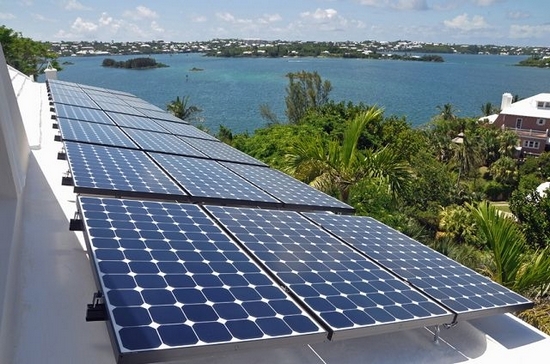 Alternative energy sources,
when practical such as wind turbines and solar panels, are welcomed.
To those with their own Bermuda
homes - not most rented units - solar water heaters are expensive to purchase and
install but may be able to pay for themselves in a few years. Also available are air-sourced heat pumps and geothermal heating/cooling systems.
To encourage their use, Government has a 0% customs duty tariff on relevant
imported items. However, there is not yet any plan, similar to that in the
UK and believed to be in parts of Canada and the USA too, for any kind of
government grant for home-owner-qualified purchase of solar panels or for
surplus energy over and above that used by homes concerned to be sold to local
or regional electricity providers.
Alternative energy sources,
when practical such as wind turbines and solar panels, are welcomed.
To those with their own Bermuda
homes - not most rented units - solar water heaters are expensive to purchase and
install but may be able to pay for themselves in a few years. Also available are air-sourced heat pumps and geothermal heating/cooling systems.
To encourage their use, Government has a 0% customs duty tariff on relevant
imported items. However, there is not yet any plan, similar to that in the
UK and believed to be in parts of Canada and the USA too, for any kind of
government grant for home-owner-qualified purchase of solar panels or for
surplus energy over and above that used by homes concerned to be sold to local
or regional electricity providers.
Recommended to all locals and newcomers are energy-efficient light bulbs and consumer electric appliances such as air conditioners, refrigerators, freezers and washing machines with an Energy Efficiency Recommended logo or North American equivalent.
Air conditioners are essential in Bermuda from May to October to live comfortably at home or in the office. Those who come to work and rent a three bedroom home with say two air conditioners running 24 hours a day to help combat Bermuda's hot and very humid months. At other times - November to April - note there is no central heating in most Bermuda homes and apartments. Some winter days and nights can be damp and chilly for non Bermudians accustomed to seasonal central heating. Some homes have a fireplace, while others may have a ductless split heat pump system with reverse cycle heat during the winter and air conditioning in summer. If not, electric heaters and separate air conditioning units for winter and summer comfort levels are available commercially.
Most residential electricity is from electricity poles placed in the ground. In severe windstorms and hurricanes this can mean outages for days or weeks in extreme cases. Beyond Bermuda, many other places using electricity poles have found a solution or part-solution to this. Unlike in Bermuda, their utility entities do not use a centralized system with its limitations. Instead, they employ distributed generation which allows outages to be isolated with minimal consumer impact. BELCO has long considered the implications and costs of an all-underground system in Bermuda. But it would cost far too much, inconvenience far too many people using Bermuda's crowded small roads; and not be the technical answer.
When power outages occur (as they often do just as frequently beyond Bermuda), far more is lost in Bermuda than just the use of dishwashers, cable and local television, computers, electric can openers, electric clocks & clock radios, electric shavers, electric stoves, freezers, kitchen sinks, refrigerators, shavers, showers, stereo and CD or DVD systems, and other electricity-powered items. Each property in Bermuda then also loses the use of all toilets, bidets, wash basins, showers, baths and kitchen sinks fed from electrical pumps from the private water tanks supplying their home or apartment. There is an almost-complete absence of any central piped-in potable fresh water supply or waste water (sewage) removal. In such dire conditions consumers have to draw water from their water tanks by hand in buckets, haul them inside to pour into toilets to make them flush and clean dirty wash basins and do without a shower or bath. Plus, in the high Bermuda temperature and humidity, when prolonged outages occur, frozen foodstuffs in their freezers perish. To help avoid this and other problems mentioned it is recommended that Bermudian and Bermuda-based home owners buy an emergency back-up system - their own generator - and if a suitable unit is not available locally, to import one privately and pay the applicable customs duty.
Most homes with computers and businesses running computers should have at least one UPS for each computer. You can lease surge protection equipment for appliances, computers, stereo sets and televisions against damage caused by lightning or fluctuations in electricity. Businesses in Bermuda and in North America use a UPS routinely, unlike in the UK where they are much more the exception than the rule.
Log on to the Bermuda Electric Light Company Limited website. Double-click on the icon on the bottom left corner of the page, called "Your account." Follow instructions. Fill out on online registration form and physically take it to where specified. Also see your payment history, account history and more.
 2016.
April 13. Rubis Energy Bermuda is buying Bermuda Gas in a $17.7 million deal.
Almost a year after Bermuda Gas exited its retail appliances business, the
company is set to change hands. There will be no job losses. Rubis is the
island’s leading importer of propane gas. It approached Ascendant Group, the
parent company of Bermuda Gas, and expressed an interest in buying its propane
distribution and commercial service business. The companies have since entered
into a binding agreement, whereby Bermuda Gas and Utility Company will be sold
to Rubis in a deal estimated at about $17.7 million. Ascendant Group, which is
also the parent company of Belco, had not been looking to sell Bermuda Gas, but
decided to do so after an “attractive valuation” of the company by Rubis.
Bermuda Gas achieved an operating profit of $656,000 in the first six months of
2015, according to an earnings report. That figure excluded the impact of
restructuring charges and related expenses from the closure of its retail
appliance and service business lines last June. The closure of those elements of
the business resulted in a one-off restructuring charge of $1.4 million to
Bermuda Gas. Acquiring Bermuda Gas is viewed as a compelling business move by
Rubis, which owns a number of gas stations on the island, together with
petroleum and chemical storage facilities. “The Bermuda Gas acquisition
represents a strategic expansion of Rubis’s existing LPG business in
Bermuda,” said Graham Redford, managing director. “Rubis is currently the
Island’s leading importer of LPG and the integration of the supply and
distribution chains will allow us to expand infrastructure capabilities to
better serve our customers.” Mr Redford said all 18 employees of Bermuda Gas
will remain with the company, and all existing supply agreements and equipment
warranties will be honored. He added: “One of the key advantages of this
acquisition to our staff and customers, is being able to combine the knowledge
and expertise of Rubis’s global LPG operations with a company that understands
the complexities of the local business environment and is 100 per cent staffed
by Bermudians.” Rubis Energy Bermuda is part of the Rubis group, a
French-based international company involved in the storage distribution and sale
of petroleum, LPG, chemical products and fertilisers. It has a market
capitalization of $3 billion. Commenting on the deal, Walter Higgins, Ascendant
Group chief executive officer, said: “While Ascendant was not actively seeking
to exit the propane distribution business, the sale of Bermuda Gas to a
well-respected, experienced local company at an attractive valuation provides an
opportunity for the company to reserve capital for anticipated new energy
infrastructure investment and other corporate needs.” The company said that as
Bermuda Gas transitions to Rubis the business will remain at its location on
Serpentine Road.
2016.
April 13. Rubis Energy Bermuda is buying Bermuda Gas in a $17.7 million deal.
Almost a year after Bermuda Gas exited its retail appliances business, the
company is set to change hands. There will be no job losses. Rubis is the
island’s leading importer of propane gas. It approached Ascendant Group, the
parent company of Bermuda Gas, and expressed an interest in buying its propane
distribution and commercial service business. The companies have since entered
into a binding agreement, whereby Bermuda Gas and Utility Company will be sold
to Rubis in a deal estimated at about $17.7 million. Ascendant Group, which is
also the parent company of Belco, had not been looking to sell Bermuda Gas, but
decided to do so after an “attractive valuation” of the company by Rubis.
Bermuda Gas achieved an operating profit of $656,000 in the first six months of
2015, according to an earnings report. That figure excluded the impact of
restructuring charges and related expenses from the closure of its retail
appliance and service business lines last June. The closure of those elements of
the business resulted in a one-off restructuring charge of $1.4 million to
Bermuda Gas. Acquiring Bermuda Gas is viewed as a compelling business move by
Rubis, which owns a number of gas stations on the island, together with
petroleum and chemical storage facilities. “The Bermuda Gas acquisition
represents a strategic expansion of Rubis’s existing LPG business in
Bermuda,” said Graham Redford, managing director. “Rubis is currently the
Island’s leading importer of LPG and the integration of the supply and
distribution chains will allow us to expand infrastructure capabilities to
better serve our customers.” Mr Redford said all 18 employees of Bermuda Gas
will remain with the company, and all existing supply agreements and equipment
warranties will be honored. He added: “One of the key advantages of this
acquisition to our staff and customers, is being able to combine the knowledge
and expertise of Rubis’s global LPG operations with a company that understands
the complexities of the local business environment and is 100 per cent staffed
by Bermudians.” Rubis Energy Bermuda is part of the Rubis group, a
French-based international company involved in the storage distribution and sale
of petroleum, LPG, chemical products and fertilisers. It has a market
capitalization of $3 billion. Commenting on the deal, Walter Higgins, Ascendant
Group chief executive officer, said: “While Ascendant was not actively seeking
to exit the propane distribution business, the sale of Bermuda Gas to a
well-respected, experienced local company at an attractive valuation provides an
opportunity for the company to reserve capital for anticipated new energy
infrastructure investment and other corporate needs.” The company said that as
Bermuda Gas transitions to Rubis the business will remain at its location on
Serpentine Road.
With no natural gas available in Bermuda, all gas is imported and is very expensive compared to USA. Canada, United Kingdom and Europe. The Bermuda Government levies a very significant import duty on LP gas, the highest anywhere per square mile.
LP gas (liquid propane) is available in Bermuda for cooking, heating, hot water supply, clothes' drying and other commercial purposes as an alternative to electricity, but is not produced in Bermuda. It comes from Argentina, is supplied by an overseas oil company and imported by tanker ships in bulk. It is then distributed by the three wholesale and retail commercial companies shown below - all Bermudian joint stock companies.The gas is not underground piped to homes and businesses on a metered system from a central plant.
Instead, it is brought to premises in cylinders and piped to the relevant appliances.
Many homeowners and owners of commercial premises use imported liquid propane for cooking and other purposes, instead of electricity. For home use, there is a standard 100 lb. household cylinder, delivery included. It fluctuates in price. A cylinder lasts for about three months, depending on usage. Home users are billed immediately on delivery, with established customers having 30 days to settle the account. The cylinders remain the property of the company supplying them to households. When a current cylinder is exhausted, the company concerned will remove it and replace it with a fresh cylinder; and bill you for it.

There are also imported barbecue cylinders. These come in the 20 lb. size - as shown above - and can be purchased or rented by consumers. As well as for outdoor barbecue purposes, they are the source of heat for blow torches, etc. Customers can go to the companies and get them refilled immediately.
Or they can go to the Bermuda Gas BBQ cylinder exchange program at local gasoline stations.
Newcomers will find a selection of new gas operated domestic and commercial stoves and other relevant appliances from reputable manufacturers in showrooms of various companies.
No vehicles in Bermuda use imported propane gas or any imported bio-fuels (unlike vehicles in the UK, Europe, USA. etc).
Bermuda Gas & Utility Company Limited. Wesley Street, Hamilton. Telephone 295-3111. Fax: 295-8311. Sunshine Company Limited, The Famous Building, 57 Victoria Street, Hamilton HM 12, phone 295-6246.
Note that Bermuda, while using British traditions and ways of doing things in many respects, uses the American system, not the British UK one in calculating gasoline prices, yet oddly, prices gasoline in the UK/European way by the litre (liter), not per gallon. There is a significant difference between US gallon and British 1 gallon prices in liters. In the USA and Bermuda, the US gallon is the equivalent of 3.785411784 liters., compared to 1 Imperial (UK) gallon = 4.54609188 liters. In January 2020 unleaded gas in Bermuda was $9.51 per gallon.

2017. March 22. Gasoline and Diesel went up by 5 cents a litre, after the government 2017-2018 budget announcements.
2016. February 24. The price of oil may have fallen worldwide, but for local consumers the cost of electricity will soon rise as a knock-on effect of the latest Budget. While motorists will pay a higher fee at the pumps, Belco’s customers will also pay for more for Customs duty paid on fuel. Fuel is to take an extra duty of 5.5 cents per litre, starting in April. According to a spokeswoman for Ascendant Group, this means that a customer using 650 kilowatt hours per month can expect to pay $8.66 more on their monthly bill. The Customs Duty increase contained in the Government’s 2016/2017 budget increases the Customs Duty portion of the total cost of fuel from $23.05 per barrel to $31.79 per barrel. This is slightly up from a similar hike added to the Budget last year. The move will be in keeping with the Government’s continued need to boost its revenues for deficit elimination, as stated by Bob Richards, the Minister of Finance. The spokeswoman explained: “The total Heavy Fuel Oil price delivered to Belco was $77.93 per barrel in January 2016, which is inclusive of: the price of the commodity, supplier margin, shipping, Customs Duty, UNESCO Tax, handling, and Foreign Currency Purchase Tax. Belco does not receive crude oil; it is a refined product, blended to meet operating and environmental specifications.”
2015. February, to apply from April 1. Gasoline prices increased by 5 cents a litre.
2014. December 22. As world oil prices fall, the Island is feeling the benefit with the price of gas now at its lowest since 2010, and power firm Belco also cutting its rates. Rubis last week set its gas price at $1.767 a litre, a 17.1 cent fall compared to November prices, while the price of diesel has gone down 14.8 cents to $1.602 a litre.
2014. April 27. Gasoline prices rose in April, up 1.6 cents a litre, the Finance Ministry announced. As a result, the maximum gasoline retail price displayed on the pumps is 213.90 cents a litre (liter), or $2.13.90. Diesel declined 0.2 cents a litre. Its maximum price at the pump is now 187.80 cents a litre, or $1.87.80. Kerosene also declined, down 1.6 cents a litre. The maximum cost is now 158.60 cents a litre, or $1.58.60. Thus, in April 2014 the Bermuda price for unleaded gasoline for cars and scooters, mopeds, etc is $8.80 per gallon.
About the same for unleaded gasoline as in London, cheaper for diesel fuel than in London where diesel costs more than for gasoline.
How Bermuda prices affect US and Canadian visitors. Bermuda prices for unleaded gasoline (petrol to newcomers from Britain) will come as a shock to our North American visitors, especially when compared to gasoline prices in the Caribbean. Here, the price of gasoline is higher than most other places anywhere in the world. Only the far North of Scotland, namely Sutherland, Caithness, Orkney, plus in Europe, Norway, Ireland and Iceland are they higher. Fluctuations in the US$ rates with UK Sterling and the Euro must also be taken into account.
In Bermuda, the Ministry of Finance regulates fuel prices in Bermuda based on a pricing formula agreed between Government and the industry. The selling price of fuels changes monthly in sympathy with supply prices. Costs to motorists and consumers of petrol (gasoline) and oils are on average, nearly three times the prices in USA; well over two times the prices in Canada; far more than double the cost of anywhere in the Caribbean. (213 percent more than the cheapest nation in the region, l liter of regular gasoline in the Cayman Islands was $1.69 and in Trinidad and Tobago, only $0.69 a liter).
But when you consider that Bermuda is
only 21 square miles (56 kilometers) in total land area, far smaller than anywhere else mentioned above
not near a mainland but a tiny island 600 miles due east of the nearest mainland, North Carolina, USA
has a total resident population of under 66,000 and a resident plus tourist population of under 69,000
there is far more justification for higher petrol (gasoline) and oil prices in tiny Bermuda than in Britain, despite the latter being a North Sea oil-producing country of 60 million people. Britain is the only oil-producing country in the world - the others are mostly in Saudi Arabia, other countries of the Middle East and Venezuela - that applies gasoline taxes far more heavily than most of the non oil-producing nations.
| Bermuda prices are in liters, not gallons | There are 3.785 liters to 1 US gallon |
In Bermuda, from April 2016, $9.51 per gallon.
In USA see state-by-state prices per gallon at http://www.eia.doe.gov/oil_gas/petroleum/data_publications/wrgp/mogas_home_page.html

Bermuda consumes more oil and gas annually than the combined Caribbean islands - more than 800 miles to the south - of Antigua, Dominica, Grenada, St. Lucia and St. Vincent combined, yet pays so much more for them than those islands do in government duty and retail prices. It is one of the reasons why Bermuda is so expensive. Prices of oil, gasoline and related petroleum products are key factors mostly responsible for not only the cost of transport by air and land but also the prices we pay for accommodation, electricity, air conditioning, food, furniture, heat, household goods and more.
Bermuda prices are fixed and heavily taxed and, with all gasoline and oil imported, has very high Bermuda Government Customs Duties of US$ 0.65.5 per liter. This alone is 44 percent of the price consumers pay at the gasoline service stations, the biggest single reason for - and biggest single beneficiary of - the huge local prices. Government duties mentioned above of 44% plus employment and other taxes and their repercussions amount to about 58% of the total price. Perhaps because Bermuda visitors use mopeds - with gas tanks in liters, not gallons - they don't realize the price differential. Bermuda does not produce any oil or gas, all in imported - and is tiny in land area, only 21 miles in total land area. In contrast, the United Kingdom, which is an oil, petrol and gas producing country and is 58,000 miles in total land area, charges consumers 75% in total taxes.
More than 21,000 automobiles and 30,000 mopeds, trucks, taxis and buses are on the roads of Bermuda.
The Bermuda Government appoints a Price Control Commission under the Price Commission Act 1974, to approve prices of petroleum products. It meets on or about the 16th day of each month to determine local prices. It sets the maximum levels that service stations may charge.
It is wrong to state that because Bermuda is only 21 square miles in total area, less gasoline is used proportionately. Because Bermuda's top legal speed is only 22 miles an hour (33 kilometers per hour), it does not enable motor vehicles to use fuel most efficiently. So the impact of the Bermuda cost is even more noticed, not less. Inefficient use adds to the expense instead of mitigating it.
The only two retailers allowed to offer gasoline and oil in the Bermuda marketplace are USA-owned ExxonMobil (trading in Bermuda as Esso) and the French business of Rubris, SA, see below.
Because of the price the Bermuda Government expects per liter from gasoline service stations, there is no competition between Esso and Shell shown below, the only two gasoline corporations allowed to sell to Bermuda and visiting consumers.
May Bermuda gas (petrol) stations are closed during Bermuda Public Holidays. Visitors on mopeds or scooters should tank up the day before or after. Also, gas (petrol) stations keep different - not standard - hours.
2013. July 10. Exxon Mobil and its affiliates signed an agreement with Barbados-based SOL (Simpson Oil Ltd) for the sale of Esso Bermuda’s downstream (retail) business. The purchase included 170 Esso service stations across the Caribbean, its industrial and wholesale operations as well as marine and aviation refueling. It also includes a 14.5 percent share in SRA Oil Refinery located in Martinique. SOL, led by Barbadian business mogul Sir Kyffin Simpson, several years ago acquired Shell Antilles and Guianas Limited. The acquisition gave the company control over Shell’s retail and commercial fuels business in Barbados, St Lucia, Antigua, Anguilla, Guyana, Suriname, Belize, St Kitts/Nevis, St Vincent, Grenada, British Virgin Islands, Netherlands Antilles and Dominica. Simpson Motors, another of Sir Kyffin's companies, is the holder of the Suzuki franchise in the region.
Esso Bermuda is a division of a Bermuda-based international corporation, Coral Petroleum Company Limited, owned by ExxonMobil. Stretching from the Esso Oil Docks at Ferry Reach in St. George's Parish to the Belco electricity generating plant in the industrial part of Pembroke Parish is the Esso pipeline that feeds Belco with heavy atmospheric gas and heavy oil. It enables Belco to generate 509 million kilowatt hours of electricity annually to businesses, hotels, guest houses, efficiency units and homes.Joint originator of gasoline products imported to Bermuda, for many years based at Ferry Reach, St. George's Parish, GE 01. Telephone (441) 294-5220. Fax (441) 294-5243. An Esso oil tanker arrives in Bermuda about once every six weeks to discharge fuel. Prices are the same as Rubis (see below). About half the 30 gas stations are owned by Esso. It alone pays the Bermuda Government many US$ millions a year in fuel taxes.
Many outlets island-wide. Always call first to ask for opening hours
French oil company RUBiS SA purchased Shell Oil’s operations in Bermuda in 2007. It continued to be marketed under the Shell brand until 2011 after which it switched to RUBiS. Terms of the purchase were not disclosed. Rubis revealed that Shell, which in Bermuda owns two major fuel depots, one liquefied natural gas terminal and 12 gas stations, had sales of $45 million per year in Bermuda and net income of $3.6 million. The agreements signed with Shell provide for a licence to use the Shell brand in the service stations as well as finished goods supply contracts. Rubis already has an extensive network of energy businesses in the Caribbean and French Guiana. The deal was announced in July 2006 at when Phil Burton, country chairman of Royal Dutch/Shell Companies Bermuda said a final decision was subject to the approval of shareholders and the Bermuda regulatory authorities. Shell has had the Bermuda operation on the market since late 2005. Rubis is one of the largest bulk storage operators in France. Through Rubis Gaz, the company distributes liquefied petroleum gas (LPG) to retailers as well as propane and butane to residential and commercial customers.
History: Based at its Ferry Reach head office, Shell House, Ferry Reach, St. George's Parish, GE 02. Telephone (441) 297-1577. Fax (441) 297-8472. In 1947 - a full three years before appropriate legislation officially launched the industry - Bermuda welcomed an organization known worldwide because of its distinctive trademark of a sea shell. With dramatic implications to fuel and light Bermuda's lawyers for future business of equal caliber, the Provident Fund of the combined petroleum companies known in The Netherlands as Voorzieningsfond Der Verbonden Petroleum Maatschappojen was transferred to Bermuda. It had been granted exemption from payment of United Kingdom Income Tax on its investments when it had to quickly transfer its Headquarters from The Hague to London following the fall of Holland in 1940.
Thus Shell arrived in Bermuda, initially as an investment vehicle to protect the pensions of employees of all companies within the Royal Dutch Shell umbrella from unnecessary taxation by Britain. Lawyers Conyers, Dill & Pearman, with bankers Jack Tucker (later, Sir Henry) of the Bank of Bermuda and Hal Butterfield (later, Sir Harry) of the Bank of N. T. Butterfield & Son, assisted in the transfer of Shell's Provident Fund to Bermuda. Three Shell VIPs, Sir George Legh-Jones, Mr. Tim Wilkinson and Mr. Tim Boyle even bought land in exclusive Tuckers Town. They built very expensive homes there, as a visible sign that Shell was here to stay. Its first staff - a group of 20 mostly young ladies - arrived from England on Shell tankers on September 28, 1947. Most have since died. Its first service station - still there - was on May 12 1952 at East Broadway in Pembroke Parish.
Shell was also the first to operate a corporate administrative structure for a collection of affiliated international companies outside the City of Hamilton, at Ferry Reach in St. George's Parish. Now they look after the retirement plan interests of Shell employees worldwide.
About half the 30 gas stations and marinas were until recently owned or operated by Shell. It paid the Bermuda Government more than US$ millions a year in fuel taxes. They have since been taken over by and since 2011 have traded as RUBiS.
Many Rubis outlets island-wide. Always call first to ask for opening hours.
It was the first product brought in by the West Indian Oil Agency (later, Esso) for cooking, lighting and heat. It is still imported, mostly for heating kerosene units in the winter months and as an emergency fuel source during frequent electricity outages. Until the year 2000, this was far less expensive than electricity, although also with a very heavy import duty.
Then naphtha, it was first imported into Bermuda by West Indian Oil Agency (later, Esso) in Bermuda in 1908 to coincide with the introduction by the Bermuda Electric Light Power & Traction Company (later, the Bermuda Electric Light Company Limited or Belco) of electricity in Bermuda. When commercial aircraft first flew between Bermuda and the USA in 1937, Esso Bermuda supplied the fuel.
Banner.jpg)
Authored,
researched, compiled and website-managed by Keith A. Forbes.
Multi-national © 2020. All Rights Reserved