Click on graphic above to navigate the 165+ web files on this website, a regularly updated Gazetteer, an in-depth description of our island's internally self-governing British Overseas Territory 900 miles north of the Caribbean, 600 miles east of North Carolina, USA. With accommodation options, airlines, airport, actors, actresses, aviation, banks, beaches, Bermuda Dollar, Bermuda Government, Bermuda-incorporated businesses and companies including insurers and reinsurers, Bermudians, books and publications, bridges and causeway, charities, churches, citizenship by Status, City of Hamilton, commerce, communities, credit cards, cruise ships, cuisine, currency, disability accessibility, Devonshire Parish, districts, Dockyard, economy, education, employers, employment, environment, executorships, fauna, ferries, flora, former military bases, forts, gardens, geography, getting around, golf, guest houses, highways, history, historic properties, Hamilton, House of Assembly, housing, hotels, immigration, import duties, internet access, islands, laws, legal system and legislators, main roads, marriages, media, members of parliament, money, motor vehicles, municipalities, music and musicians, newcomers, newspaper, media, organizations, parks, parishes, Paget, Pembroke, performing artists, residents, pensions, political parties, postage stamps, public holidays, public transportation, railway trail, real estate, registries of aircraft and ships, religions, Royal Naval Dockyard, Sandys, senior citizens, Smith's, Somerset Village, Southampton, St. David's Island, St George's, Spanish Point, Spittal Pond, sports, taxes, telecommunications, time zone, traditions, tourism, Town of St. George, Tucker's Town, utilities, water sports, Warwick, weather, wildlife, work permits.


By Keith Archibald Forbes (see About Us).
Bermuda Botanical Gardens. Paget. April. See http://www.bdaexhibition.bm. Exhibition Secretary, P. O. Box HM 834, Hamilton HM CX. In 2016, on December 21, The AG Show Ltd signed a Memorandum of Understanding with the Bermuda Government to run the Annual Exhibition for the next three years. And the group has further agreed to help finance the revitalization of buildings at the Botanical Gardens over the coming years using proceeds from the event.
The cultural “institution” has traditionally been hosted by the Government of Bermuda, but was cancelled in 2015 due to financial issues. The Ag Show has been an institution in Bermuda for generations and almost all Bermudians have fond memories of it. It offers an opportunity for people of all ages and backgrounds to get together, share stories and experiences, and participate in friendly competition. Bermuda would not be the same without the Ag Show, and the Green family of Bermuda, owners of the Hamilton Princess and other properties sponsor this 2016 event. The AG Show Ltd is now a registered charity, established in February 2015 for the purposes of holding the annual agricultural exhibition. The annual Ag Show, sponsored by all British counties in the UK where farming is still a major part of the local economies but is no longer the case in Bermuda, nevertheless welcomes as many as 25,000 attendees in Bermuda over three days and features up to 4,000 exhibitors. Participation in the event includes a large portion of the Island’s population, from seniors who have been attending it since the show’s early days, to schoolchildren and toddlers who get an introduction to things they might not see in their everyday lives. For information on donations and sponsorships for the show, e-mail secretary@theagshowbda.com. The show has a rich history. Its roots extend back as far as 1843, when then-Governor Major General Sir William Reid encouraged the adoption of agriculture on the island, where principal occupations included shipbuilding and seafaring. Entrants compete in a broad range of categories including horses, pigs, rabbits, fruit, vegetables, roses, orchids and woodcraft. About 2,000 pictures have been entered for the junior art competition. The Ag Show is probably the biggest cultural event in Bermuda and welcomes people of all ages and from all walks of life. There is an entry cost.
For almost a century it has been as much a herald of the Bermudian spring as returning Longtails kiting across clearing skies or the freesias which shyly begin poking their multicolored heads through the long, rain-saturated winter grass. A combination of county fair, cultural celebration and community jamboree, the exhibit has long-since evolved and transcended its original purpose — to serve as an annual showcase for a once-agrarian Bermuda’s livestock and farm produce. Blue rosettes are awarded for first place in categories encompassing everything from farm animals to floral arrangements to fish sandwiches. Tug-of-war contests, gravity-defying acrobatic performances and more add a carnival-type flavor to the proceedings.
| Source | British |
 Derived from an
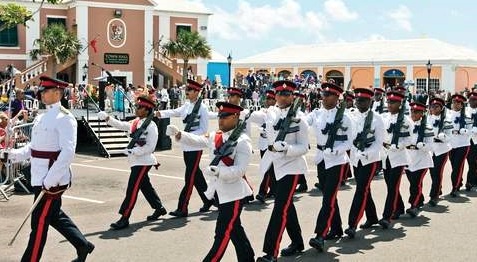
evening British Army
tradition, centuries old. It
became a local custom when full-time regular British Army units was first
based in Bermuda in the late 1700s and always performed Beating Treat on
ceremonial public and garrison duty in St. George's or Fort Prospect occasions.
It is not a sound to retreat but a musical call, under
spotlights in the winter months, to troops to reduce operations for the
night, a military tattoo. The
British Army left Bermuda in 1953, except for short emergency periods later.
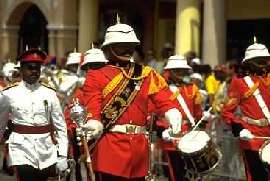
Today, in Bermuda, Beating Retreat is performed frequently - usually, monthly - by the Band of the
Bermuda Regiment which is the local British territorial defence force. The
Band has dress blue and red uniforms and white pith helmets. The Band is
sometimes accompanied by the Bermuda Islands Pipe Band, also originally formed,
like the Bermuda Regiment, from a British Army initiative. It is under the direction
of it's Pipe Major and Drum Major.
Derived from an
evening British Army
tradition, centuries old. It
became a local custom when full-time regular British Army units was first
based in Bermuda in the late 1700s and always performed Beating Treat on
ceremonial public and garrison duty in St. George's or Fort Prospect occasions.
It is not a sound to retreat but a musical call, under
spotlights in the winter months, to troops to reduce operations for the
night, a military tattoo. The
British Army left Bermuda in 1953, except for short emergency periods later.
Today, in Bermuda, Beating Retreat is performed frequently - usually, monthly - by the Band of the
Bermuda Regiment which is the local British territorial defence force. The
Band has dress blue and red uniforms and white pith helmets. The Band is
sometimes accompanied by the Bermuda Islands Pipe Band, also originally formed,
like the Bermuda Regiment, from a British Army initiative. It is under the direction
of it's Pipe Major and Drum Major.
| Source | British |
Performed when a new or refurbished bridge connecting Bermuda's many islands is completed or opened. In December 2014, Margaret Fergusson, wife of then-Governor George Fergusson, carried out a traditional blessing of the new Bailey's Bay Bridge by smashing a coconut on it.
| Source | Bermudian |
No longer celebrated en masse in Bermuda, after years of decline, despite a recent resurrection attempt. Because of the one-time annual Bermuda Floral Pageant, Bermuda's College Weeks were also annual events, occurring at the same time, attracting as tourists thousands of students from colleges and universities throughout the USA and Canada. A 1956 description in the USA's Sports Illustrated describes it thus, see http://sportsillustrated.cnn.com/vault/article/magazine/MAG1069587/index.htm. They were the most numerous by far of Easter-period guests at Bermuda's larger and smaller hotels, cottage colonies and guest houses, most of which offered special prices. Especially noteworthy and quote-worthy were the beach parties at the Elbow Beach Surf Club and the parties at the Bermudiana, Inverurie, and other hotels. Free-spirited and mischievous, the college students often became notorious for their boisterous or unruly behavior, with policeman's helmets, speeding on Bermuda's roads without helmets, swimming en masse across Hamilton Harbour, impromptu beach barbeques, party boats and much more. Many college students were able by special arrangement with the then-USA military bases in Bermuda, to shop there at PX stores and go to the movies.
In those heady days of the 1950s, 1960s and 1970s the Bermuda government's Bermuda News Bureau, or Trade Development Board, later the Department of Tourism, organized and paid for all of the activities scheduled during the College Weeks 28-day period, with courtesy cards that entitled college students free admission to everything from "Get Acquainted" dances at major hotels to beach parties, boat cruises, and steel band concerts. Scores of moped-riding college students took advantage of the island's hospitality. Those mopeds, Mobylettes and Zundapps, mostly, were often photographed in their hundreds, seen at indoor or outdoor events.
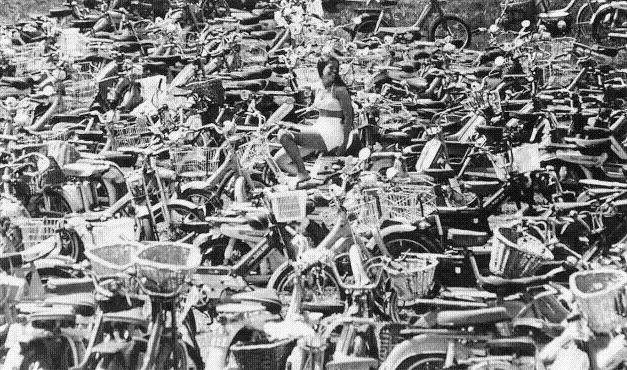
Mobylettes galore, parked at a 1970s Bermuda College Weeks event
As a result, Bermuda became one of the most popular Spring Break destinations, long before places in Florida took over. Major universities such as Harvard and Cornell sent musical and dramatic shows. The Hasty Pudding Theatricals and Harvard Krokodilloes were prominent among them. Female college students were more than welcome, especially for Bermuda's hungry males. Including some famous names, the young college ladies became Bermuda Beauty Queens and were crowned as part of the College Week ceremonies and events. Their Bermuda escorts for those events, always attired in tuxedos in the evening, were, by tradition, drawn from the most handsome or otherwise most eligible Bermuda membership of the Junior Chamber of Commerce. Bermuda wives and girlfriends were left at home when the college girls arrived.

Bermuda College weeks 2012
College Weeks 2012 exceeded expectations, according to the Tourism Department. About 250 visitors were drawn by the event’s re-launch. Tourism Minister Wayne Furbert had earlier expressed hope that as many as 200 students from universities and colleges in North America would attend. In the 1950s and 1960s, Bermuda attracted more than 10,000. College Weeks 2012 ran from February 18 to March 16.
| Source | American |
Every year for many years Bermuda's British Governor and spouse send Bermuda Easter Lilies to the Queen, often grown in the Government House gardens. Government House arranges for Her Majesty’s Easter Lilies to travel on British Airways flights to London, to reach her at Windsor Castle or Buckingham Palace. Her Majesty always writes to the Governor to thank Bermuda.

May 2002 photo by this author
They were introduced to Bermuda from Japan in 1863. They flourished so much that Bermuda once exported blooms to North America and beyond. This was when Bermuda was largely agricultural, before tourism became more important. The export trade is no longer what it was but growing is still a tradition. Bermudians still send Her Majesty the Queen every year at least one choice bouquet of these magnificent flowers. Bermuda is said to have been responsible for America adopting its trumpet-like white lily as the official Easter lily in the 1880s, when an enthusiastic gardener from Philadelphia brought bulbs home with her. Shortly thereafter, they were introduced to spring shows throughout America. Ten years later, sizeable shipments of bulbs were being made from Bermuda to the US and England, and a lively trade soon developed. While the Easter Lily is no longer a major crop in Bermuda, the island still sends some of the flowers to the Queen every year. There is also a perfume made from the essence
| Original Source of lillies | Japan |
| Source | British |
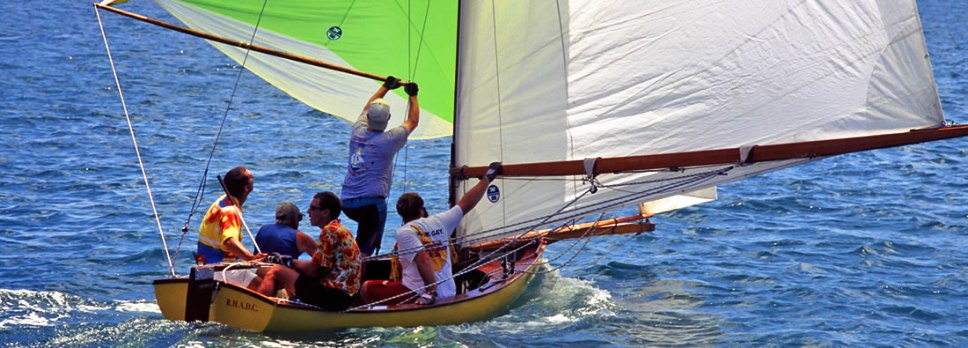
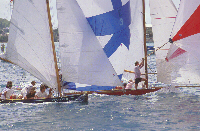
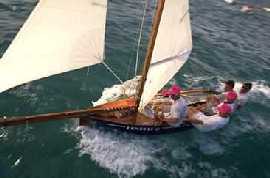
These are a development of the British rowing dinghy or skiff, common in British coastal waters. For many years, skiffs were used as a means of transportation from one part or island of Bermuda to another. British Army and Royal Navy Officers stationed in Bermuda in the late 1800s first designed the boat as seen now. Under their patronage, the first fitted dinghy race was held in the St. George's Regatta in July 1853. The next was at the 1854 Victoria Day Regatta. The third was a St. George's Regatta in 1855 with a 10 shilling entrance fee. Four pounds sterling were added to make up purses for the first two boats to cross the finish line in the handicap event. After several years of informal racing, the sport was organized and measurement rules adopted. It was decided that 14 feet 1 inch long would be the maximum permitted length. No decking is allowed and the keel is limited to 12 feet. All fitted dinghies have a 14-foot bowsprit, 40 foot masts and over 1000 feet of sail - more sail than any other vessel of similar length. Race rules allow the skipper to order as many people as he wishes off the boat, to gain speed. They usually depart from the stern, to give the boat a bonus in speed. There are only eight fitted dinghies. Five race on alternate Sundays from May 24 until September, in various parts of Bermuda. They are Elizabeth, Challenger, Contest, Port Royal and Victory. World-renowned sailor and sail designer Uffa Fox did not believe the vessel would float. But it did. The six people in a crew must improvise for survival and seamanship. They jibe from port to starboard for prevailing winds, try to keep upright, and can take on much water. To keep afloat, they jump or get pushed off. They have high speeds but are often sunk or are dismasted. Luck and talent win. They are always entertaining and often hilarious.
| Source | Bermuda |
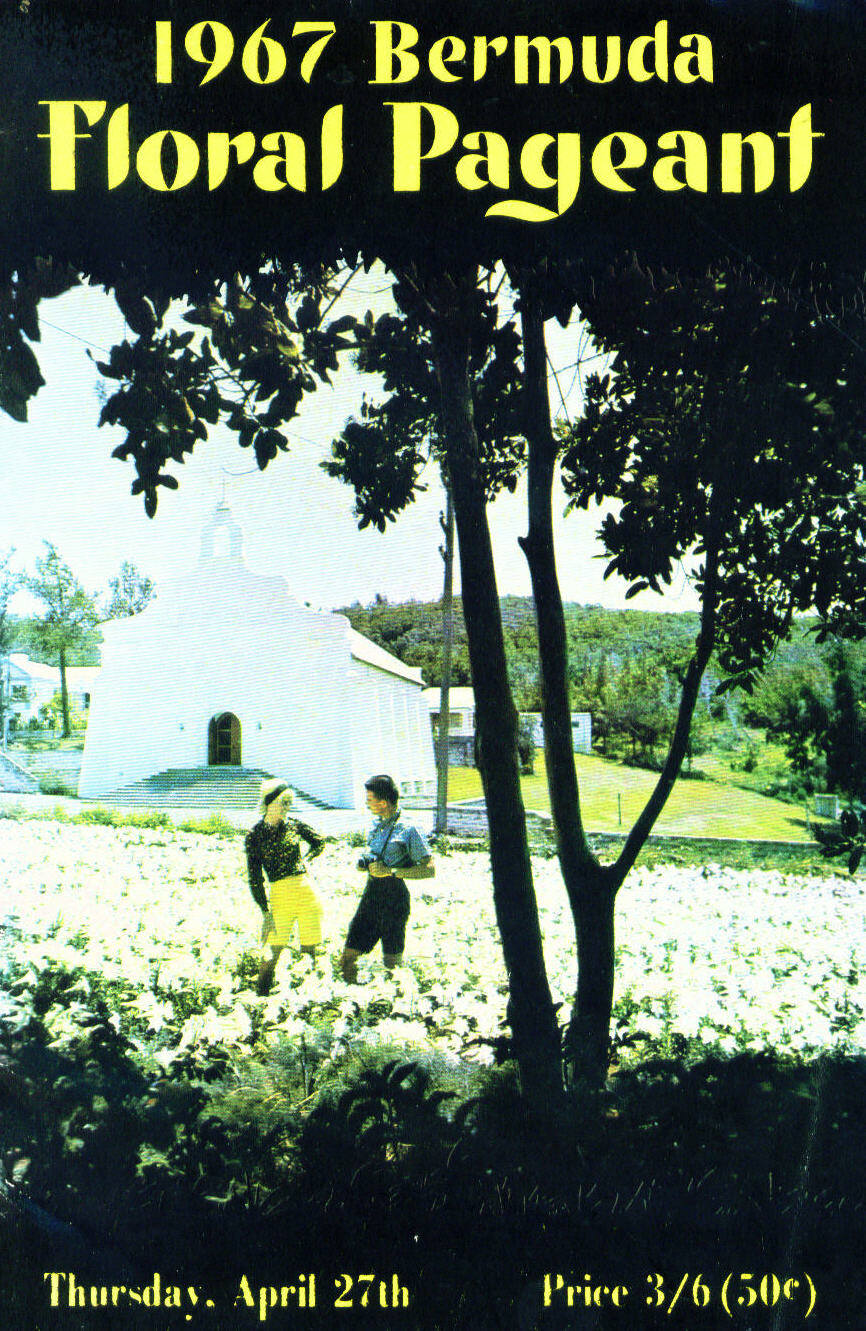
Sadly, no longer offered, last one was in the 1960s, a victim of the hugely-changed social and racial scene. Until then it was by far and away Bermuda's most popular annual event, drawing thousands of visitors mostly from the USA. Because of it, Bermuda's "College Weeks" were a further event by themselves, occurring at the same time, attracting as tourists thousands of students from colleges and universities throughout the USA and Canada.
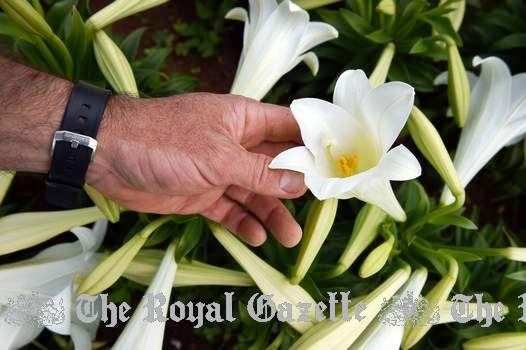
Bermuda Easter Lilies
| Source | Bermudian |
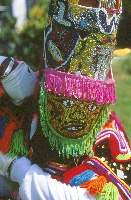
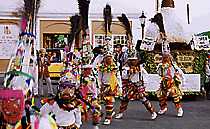
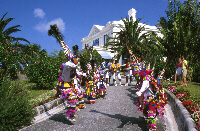
A tradition that began when black slaves were first brought from Africa and the Caribbean. "Gombey" is derived from an African word meaning rhythm. It was originally intended to be performed only on Boxing Day (December 26) and New Year's Day - the two days of the year when slaves were given a rest from their labors. Today, Gombey dance and prance on Boxing Day, New Year's Day, other important events such as football (soccer )matches, at festivals or parades and holidays, also at hotels and guest houses. There is a method of collecting contributions from spectators. The musical accompaniment is usually a kettle drum with two snare drums, covered with goat skin, and a beer bottle fife which produces the sound of a flute crossed with a whistle. Their acrobatic Bermudian members whose routines are based on African, American Indian, Biblical, British "mummers" and West Indian lore and traditions. Each group is a "crowd." The Captain wears the most elaborate costume and is the crowd leader. The Wild Indian and Trapper have a perpetual chase. The Chiefs also carry large tomahawks and shields. Warriors or Choppers include children of families. Under the Captain, the dancers have duets and solos simulating combat. Once, they also re-enacted biblical stories like David's fight with Goliath. Gombey troupes include Warner's Gombeys, Norford's, the Shakey Smith Troupe, Richardson's, and Wilson's Troupe. Books include Gombey Boy and Bermuda Gombey by American born Bermuda author Mrs. Louise Jackson.
1970. The Bermuda Gombeys were recognized as a uniquely local art form at a Unesco Cultural and Conservation Conference. Gombeys have a rich heritage across the Caribbean, where similar traditions emerged on several islands,
| Source | African, West Indian & American Indian, Bermudian |
A fun day, held on Bermuda Day, May 24. With floats, dance groups and majorettes.
| Source | Bermudian |

Partly in honor of The Bermuda Islands Pipe Band and also because of the many Scots and Irish who are resident in Bermuda and Bermudians with Scots and Irish forebears, there are many recordings available in Bermuda of Scots and Irish bagpipe bands and bagpipers, both civilian and military. In the 18th and 19th centuries, an Irish unit of the British Army was here. Scottish regiments were several times in the British Army garrison here until 1953. A Canadian Scottish regiment was based in Bermuda for a while during World War 2. Their bagpipes and drums accompanied the soldiers on Church Parades from Prospect Garrison in Devonshire to the city of Hamilton, waterfront on Pitts Bay Road and back. The idea became a Bermuda civilian tradition.
Once there were two bagpipe bands here. One was the Bermuda Police Pipe Band which began in 1959. It proudly wore the Prince Charles Edward Stuart ("Bonnie Prince Charlie") tartan. Composed at first largely of members of the Bermuda Police and Prison Services, and other local enthusiasts, including some formerly in the Bermuda Cadets Pipe Band, they were soon performing at the Police Passing Out and ceremonial parades, a tradition maintained by the BIPB to this day.
There was also the older Bermuda Cadets Pipe Band, so-called because it originated in 1955 as "A" Company of the Bermuda Cadet Corps when Captain Henry Hallett was the Company Commander. (Paddy Coyle of the Gordon Highlanders, whose idea it was to start the Bermuda Cadets Pipe Band, was in the detachment of the Highland Brigade stationed in Bermuda at the time. In his honor, the band wore the Gordon tartan). Bagpipe celebrities or those who contributed mightily since then include Denis Stuart; Captain Arthur G. Card, Commandant of the Bermuda Cadet Corps; Lillian Hallett; Mary Card Gibbons and Joan Tite. On the disbanding of the Corps in the early 1960's, the Band continued as a body of civilian volunteers under the name of the Bermuda Cadets Pipe Band. Wearing the Regimental Gordon tartan, the Band's first public performance was in the Remembrance Day Parade in 1956 when they began a tradition of leading the war veterans on and off parade.
Both were disbanded in 1992 when the Bermuda Islands Pipe Band was established. The Bermuda Islands Pipe Band is a spectacular sight on ceremonial occasions, often included in Beating Retreat, musical displays and other events. Individual bagpipers go to hotels and weddings. The 17-member contingent still wear the Gordon Highlanders tartan kilt with a white jacket. Experiences include playing at local and international tattoos
Another still
active tradition of the BIPB began in 1963 with the weekly performance by the
Cadets Pipe Band of the "Skirling Ceremony" at Fort Hamilton. Yet
another long-established relationship began in 1965 with both predecessor Bands
and now the BIPB appearing with the Band and Corp of Drums of the Bermuda
Regiment in the Beating Retreat in Hamilton, St. George's and the Royal Naval
Dockyard.
The BIPB has an equally strong tradition of representing and promoting Bermuda
internationally having performed overseas on 18 occasions in the United States,
Canada, Scotland and Germany. In 2003, the Band proudly promoted Bermuda at the
Nova Scotia International Tattoo. The Band, bearing the Bermuda standard before
it, has twice appeared in New York City leading other pipe bands. The Band's
more recent international performance came in January, 2005, at the Musikschau
der Nationen in Bremen, Germany, Norfolk VA, Birmingham UK and Hamburg, Germany.
| Source | British |
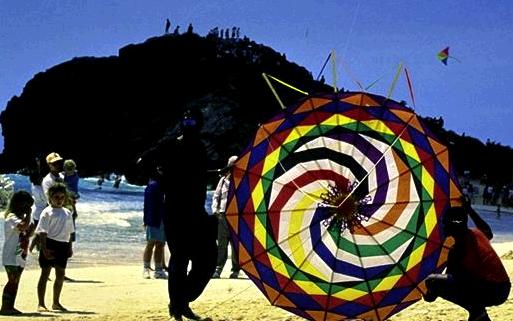
Kite flying at Horseshoe Bay
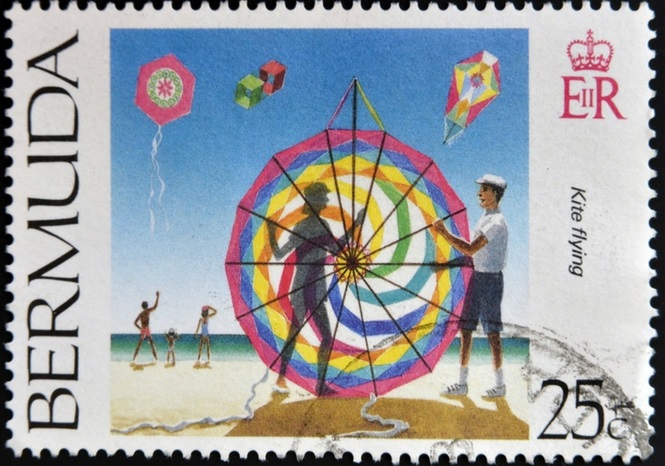 For most Bermudians,
Good Friday traditions mean church, flying Bermuda made kites,
made from thin wood strips and tissue paper, nothing like the cheap plastic
kites used by mostly children beyond Bermuda, and eating codfish cakes -
see below - and English style hot cross buns - also shown below. Flying
kites - although not on Good Friday - originated in Indonesia 3,000 years ago.
There, fishermen used leaf kites to suspend fishing lines out to sea. Indonesian
children still skillfully fly bits of waste paper on strings. Kite-flying
drifted up through Asia and arrived in Europe early in the 16th century. Much
later, it reached Bermuda. British Army troops used them to plan telegraph poles
in Bermuda, the Caribbean and other colonial outposts and they were later used
to good effect by the British Army to plan telegraph poles in South Africa for
the Boer Wars. In Britain, the years 1880 to 1930 were considered the golden age
of British kiting. In the 1880's they became even more useful for UK-wide
military reconnaissance and meteorology. Huge flying frames carrying weighty
cameras were a common sight over trenches in Europe in the First World War. In
California, camera kites were used to photograph the devastation caused by the
1906 San Francisco earthquake. Right: A uniquely made Bermuda kite. Elsewhere
overseas, in India, the kite fighting season can be dangerous. Hundreds of
thousands of people fly their fighting kites from roof tops. They coat their
kite strings with glass and try to cut their opponents' kite strings. In Britain
today, the High Force Kite Festival occurs in August. Kites there require Civil
Aviation Authority to fly at 1,500 feet or higher. Clearly then, they are not
just toys for children. Some are massive, three-dimensional things.
For most Bermudians,
Good Friday traditions mean church, flying Bermuda made kites,
made from thin wood strips and tissue paper, nothing like the cheap plastic
kites used by mostly children beyond Bermuda, and eating codfish cakes -
see below - and English style hot cross buns - also shown below. Flying
kites - although not on Good Friday - originated in Indonesia 3,000 years ago.
There, fishermen used leaf kites to suspend fishing lines out to sea. Indonesian
children still skillfully fly bits of waste paper on strings. Kite-flying
drifted up through Asia and arrived in Europe early in the 16th century. Much
later, it reached Bermuda. British Army troops used them to plan telegraph poles
in Bermuda, the Caribbean and other colonial outposts and they were later used
to good effect by the British Army to plan telegraph poles in South Africa for
the Boer Wars. In Britain, the years 1880 to 1930 were considered the golden age
of British kiting. In the 1880's they became even more useful for UK-wide
military reconnaissance and meteorology. Huge flying frames carrying weighty
cameras were a common sight over trenches in Europe in the First World War. In
California, camera kites were used to photograph the devastation caused by the
1906 San Francisco earthquake. Right: A uniquely made Bermuda kite. Elsewhere
overseas, in India, the kite fighting season can be dangerous. Hundreds of
thousands of people fly their fighting kites from roof tops. They coat their
kite strings with glass and try to cut their opponents' kite strings. In Britain
today, the High Force Kite Festival occurs in August. Kites there require Civil
Aviation Authority to fly at 1,500 feet or higher. Clearly then, they are not
just toys for children. Some are massive, three-dimensional things.
There is uniquely Bermudian both cultural icon and civilian religious significance to kite flying. It started on Good Friday when a local teacher with a British Army connection had difficulty explaining Christ's Ascension to Heaven to his Sunday School class. So he launched a kite with a likeness of Christ. A traditional Bermuda made kite, from different colors of tissue paper, is still in the shape of a cross. A traditional Bermuda kite is a narrow hexagon formed by joining three pine sticks at the center (although there is version where they are joined just below centre). In a slight variation, a round kite, known locally as a Roundy is created with either four or five sticks to produce an octagon or decagon. Roundies tend to be more temperamental and pull exponentially harder than their additional surface area would suggest. Size does not matter, with minuscule toothpick kites admired as much as thirty-foot monsters, the only question being will it fly? Originally, kites were not flown until after 3 pm. Now, they stay up all day. Only if it rains do they come down. Bermuda kites have long cloth tails and are in different colors of paper tissue, wood, metal and string. Some are huge, in exquisite patterns, requiring several men to get aloft. Some are deliberately made to emit a humming or buzzing sound, with a hummer made from glued paper, which spoils their spiritual serenity. The hummer is always made with purple tissue paper because it is said to be louder. Another variation of the Bermuda kite is the traditional Somerset brown paper kite. It is made of cross sticks with a hummer behind the head stick. What makes a Bermuda kite stand out is when the pattern or design, admired from the ground, is even more lustrous in the air. The way it flies can be revealing, especially when the string is positioned, angled, correctly for prevailing conditions. When the kite has enough tail it can be practically motionless in the air. And is the hummer loud enough to be distinctive?
Good Friday Kite flying at Horseshoe Bay often includes a non denominational religious service; live musical entertainment; children's games; kite competition and judging; locals versus tourists tug of war; live entertainment; Warwick Gombey Dancers. Hundreds of people take advantage of the warm but windy weather to head to the beach for Good Friday. Horseshoe Bay was packed with kite flyers as early as 10.30am, and many more beaches, parks across the island are gear up for a busy weekend of Easter celebrations.
Other events include:
| Source of Kites | Indonesian, local tradition, Bermudian |
|
Another legend associated with the Easter holiday - although Easter Sunday itself is not a public holiday - is that of the passion flower, of which there is a Bermuda species. This climbing vine requires a sheltered southern location and a great deal of care, so you will not see it in exposed local gardens. It has five sepals or five identical petals. Spanish missionaries who first discovered the flower in South America made it known how the petals represented the disciples without Peter and Judas. The legend was imported to Bermuda as well. The double row of colored filaments, known as the corona or crown, appear to show to some the halo around the head of Christ and to others the crown of thorns. Bermuda Passion flower, photo by author |
 |
The violet stamens and other parts of the flower appear to show the wounds and nails Christ endured.
| Source of Flower | Spanish |
| Source | British |
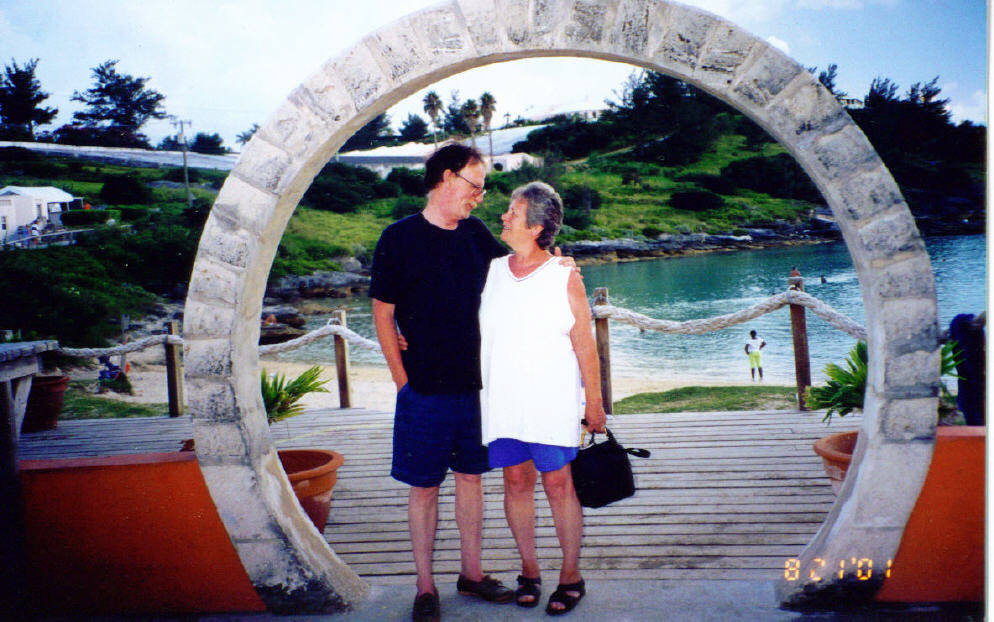
Photo by this author of a Maine couple under the Moongate at Tobacco Bay, St. George's, Bermuda
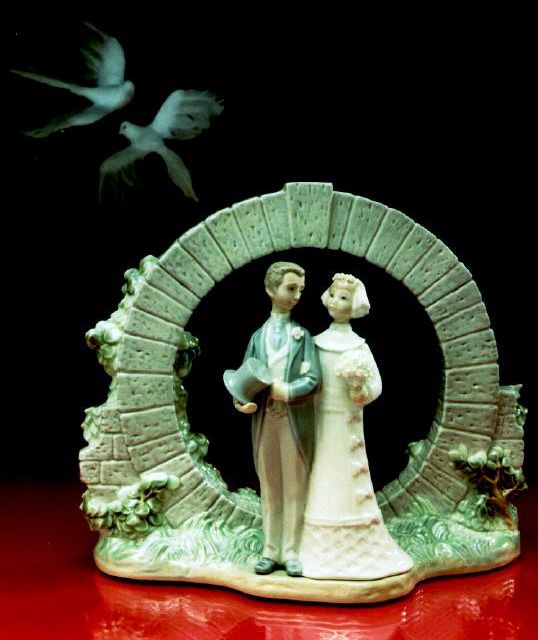
Lladro made this lovely Bermuda Moongate ornament

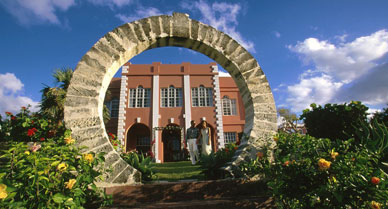
Bermuda Moongate images. On the left, bottom, is an original Chinese one. A New England version is bottom center) and a local one. made from Bermuda limestone, is right
Legend has it that people who walk through a Bermuda Moongate, especially but not solely young lovers and honeymooners, are blessed with good luck. The first plan for one in Bermuda was brought from a Chinese garden in 1860 by a local sea captain. He drew the design of a circular, ornamental wooden gateway to a garden or place of inner repose and, once back in Bermuda, built one of his own. It has since been adopted by Bermuda as a national symbol. The real Chinese origin, many centuries old, of the Moongate was unknown locally until the former gardener of the Duke of Westminster in the United Kingdom was employed to lay out the grounds of the (former) Bermudiana Hotel in the 1920s being built at that time by the Furness Withy shipping group. This was the first of the Bermuda Moongates in hotel properties. (In July 2004, a Japanese garden with a structure almost identical to what in Bermuda is called a moongate, won a Silver Gilt prize at the Royal Horticultural Society show at Tatton Garden in the UK). Some years later, one was seen at the world-famous Chelsea Flower Show, but as an authentic and much-admired Chinese Moongate. About 40 now exist in Bermuda, mostly on private property including in the gardens of several hotels but with public ones at places including the Bermuda Botanical Gardens; Par la Ville Gardens, Hamilton; and Tobacco Bay. Bermuda versions are always built of Bermuda stone and often but not always used as an entrance to a garden. Unfortunately, Bermuda Moongates do not export well as Bermuda stone, local limestone, is very heavy. There is also a New England version, in granite, of the Chinese design, as one of the photographs above shows.
Bermuda Moongate song. Composer Ralph Blane, from the USA, co-wrote the song "Step Though a Moongate." Once there was a 45 rpm record of the song, with Ralph singing. On the flip side of the record is "Bermuda Blue." One of his best known compositions was "Have Yourself a Merry Little Christmas" and other songs of the movie "Meet Me In St. Louis." A local version of Step Through a Moongate, sung years ago by Gene and Pinky Steede, confirms the Oriental origin of the Bermuda Moongate in the words of the song.
| Source | China, Bermuda and American songs |
Annual, since 1992.
2018. March 24. The woman crowned Bermuda’s queen of fishcakes said she was shocked by her win. Valerie Pethen explained: “I consider myself a hit-and-miss cook at everything. Fishcakes are one of the few things that I do, and I enjoy doing.” The 72-year-old Paget resident claimed the title for best fishcakes from a female competitor at the annual Bermuda National Fishcake Competition held at the Leopards Club on Thursday night. Mujib Swan took the title for best entry by a male participant. Ms Pethen said she only cooked the island favorite once a year and that she never followed a recipe. She added: “I’m not one of these people who just get a charge out of cooking. I cook minimally.” Ms Pethen revealed her secret ingredient was sweet potatoes. She said: “It’s just ironic that in today’s paper there were two articles extolling the virtues of sweet potatoes.” She added the idea for the starch substitute was inspired by a friend more than two decades ago as they both began diets based on their blood types. Ms Pethen said: “One Good Friday she called and said ‘Val — we can make our fishcakes with sweet potatoes’.” She added: “I just hope I have started a trend for people to at least try it. The taste is different, but it is so lovely.” Ms Pethen added that almost everything in her fishcakes was Bermudian. She said the sweet potatoes were bought at the farmers market at Botanical Gardens. The parsley, thyme and onion came from her garden and lemon juice came from the tree in her yard. Ms Pethen added: “It’s not Bermuda fish, but it’s in a package called Bermuda’s best.” Nasturtiums from behind her garden and a friend’s loquat chutney were used as part of her plate presentation. Ms Pethen said she was inspired to enter this year’s competition after a chance meeting with Rodney Smith, one of the competition’s organizers, last week. Mr Smith was handing out fishcakes in the Court Street area to promote the competition. She said she admired both Mr Smith and Dale Butler for “trying to keep the tradition alive”. Ms Pethen said she decided to enter “to support the effort, but I never expected to win”. Mr Butler, the founder of the competition, described this year’s event as a smash. He added: “It was very well attended. I would say it was a successful evening.” Mr Butler said there were about a dozen entries in this year’s running. All entries were assessed on criteria including colour, taste and presentation by a panel of five judges. Mr Butler said that crowning two new champions this year was “very important” for the competition. He explained: “We want the legacy to continue.” Mr Butler and Mr Smith had won the National Fishcake Competition since it began in 1992, but both decided to step back from this year’s battle. Mr Butler explained: “If you don’t pass on an opportunity to others, they’ll lose interest.” He said that the island favorite food was something that had “removed barriers” and united the community. Mr Butler added: “If you want to get a group of people together, say you’re having a fishcake party and everyone comes.”
| Source | Bermudian |
This lovely tradition has finished, with the last one held in 2008 and then in only one place, not several in every parish as was earlier the case. It was hugely interesting, culturally and environmentally stimulating and uniquely enjoyable in New York, Virginia, etc. It increased visitors by 30-50% for the months involved. Plus, they led to new friendships, referrals galore, much repeat business, encouragement to home owners to show off their homes and gardens and a recurring source of income to hosting organizations from the charges made to visit all the Open Homes and Gardens on specific days, in sequence. Local homeowners were reluctant to continue opening up their homes and gardens, quoting the need for security, the high crime rate which rendered their properties exposed to attack after publicity and more.
| Source | Bermudian |
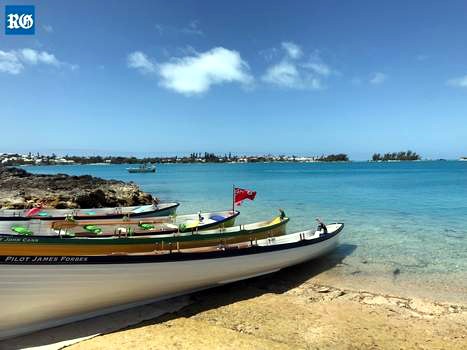
2018. April 13. The Bermuda Pilot Gig Club held its first West End regatta at its new premises on Boaz Island today. The event to commemorate pilot James “Jemmy” Darrell saw six teams compete in a series of races designed to test their piloting skills, speed and agility. Roger Gillett, BPGC chairman, said: “Today we have a series of four races all designed to not only test the crews rowing ability but also the Cox’s ability.” Mr Gillet said each race would challenge the teams in different ways while also emulating “the sorts of things the pilots in past generations had to do”. The traditional gigs guided ships and rescued people in distress. Sarah Burrows, location captain and member of the Sandy Crabs team, explained that the first race involved the teams rescuing “survivors” stranded on Middle Kings Point. The second race saw each gig carry a pilot flag that had to be placed in a buoy — emulating the race to take pilots to incoming vessels. The salvage race involved teams towing an old tyre, and the final race — capture the flag — represented a pilot being brought back to shore. Three teams from Spanish Point took part in the event, along with two teams from St George’s and one home team. The latter took the prize for the best-dressed gig. Ms Burrows said she was excited for the club’s first event at the newly renovated premises. She said they hoped to showcase the history of Bermuda’s gigs as well as the “exercise element”. Ms Burrows added: “The idea is to make this a community club that everyone can celebrate.” Liz Christopher, a descendant of Mr Darrell and pilot Stephen Richardson, the namesake of the gig she raced in, described the new premises as a wonderful event space and a great opportunity for children to get involved. Ms Christopher added: “I think it’s perfect. I suspect any future events will be really well prescribed.” Mr Gillett explained that volunteers had worked hard to renovate the pump house of the disused sewage plant on Boaz Island into its new headquarters. He added: “It’s quite special because it’s ours — it’s dedicated to our activities.” Simon Groves, chairman of the Boaz Island Village Condominium Association, added: “It’s an example of a private initiative, hard work and a co-operative effort to make something happen that will benefit not just this community but everybody involved in rowing. It sets an example for others to follow.”
| Source | Bermudian |
Annually, for the Raines Family Trophy,
On July 29, 2016 Pilot gig James T Griffiths, bearing the Somerset flag, emerged victorious over the pilot gig Jemmy Darrell, bearing the St George’s flag, in the race along Ferry Reach to the Swing Bridge finish line. Both gigs are named after Bermudian pilots. Gigs are a centuries-old Bermudian tradition: the wooden boats once greeted incoming ships and guided them in to port. The Cup Match race, in only its second year, is already a main feature of the gig racing calendar after the sport made a return in popularity in recent times. Long and narrow, gigs were built for speed, and the element of competition is nothing new: the boats once ranged far offshore with the hope of beating others to be the first on board an arriving ship. They were also renowned for rescuing passengers and goods from vessels in distress. Yesterday, James T Griffiths, was coxed by Anson Nash and Jemmy Darrell by Roger Gillett, with crews representing the respective ends of the island. The Somerset gig had a lead of just over a boat length for most of the race and despite their best efforts the St George’s crew could not claw their way back. Somerset takes the trophy of a large cedar thole pin where it will be displayed in the West End of the island until next summer. This makes it one victory apiece since the inaugural race in July 2015. Ronnie Chameau of the St George’s team said: “This can only bode well for the continued friendly rivalry between the teams. I heard one St George’s rower vowing to get their well-trained team together for 2017. I am sure Somerset will be ready to meet them fair and square.” Frank Raines, a regular visitor to Bermuda from Washington for 30 years, and his family donated the trophy and a cash prize to be given to a charity chosen by the victorious team. Somerset: Anson Nash (cox), Mario Thompson, Christiane Bosson, Pamela Mahoney, Lawrence Bird, Christopher Smith and Andrew Morille. St George’s: Roger Gillett (cox), Debbie Jones, Michael Jones, Cammie Simmons, Leeanne Cox, Sende Semos and Ronnie Chameau.
| Source | Bermudian |
 There is a great deal of
misunderstanding about this in the USA, Canada, Britain, Europe and elsewhere.
It is assumed, wrongly, that this area is solely in Bermuda.
There is a great deal of
misunderstanding about this in the USA, Canada, Britain, Europe and elsewhere.
It is assumed, wrongly, that this area is solely in Bermuda.
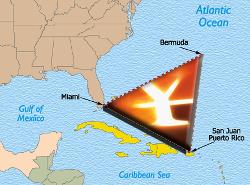
To be entirely accurate, Bermuda is only one point of the three in - and by far the smallest part of - the Bermuda Triangle. 88 percent of all the sinister or unexplained events of the Triangle happened much closer to Florida - especially Miami - or Puerto Rico, the other two points of the Triangle. Technically, Bermuda is near to it but not actually in the Sargasso Sea where the majority of events may have occured. Draw a triangle between Bermuda, Miami and Puerto Rico to get an idea of the Bermuda Triangle and then consider the effect of enormous Florida, large Puerto Rico and tiny (only 21 square miles) of Bermuda. This is the descending order of importance of the three places in the Triangle.
It may disappoint some to know this but there has never been any effect at all of the Bermuda Triangle on any of the customs and culture of Bermuda. This author was told personally by an elderly writer in the USA who studied the Triangle that when the original " Bermuda Triangle" was coined in the USA, it was supposed to have been the "Miami Triangle" but Miami objected as it did not want to lose visitors. The "Puerto Rico Triangle" was the second choice, but it too objected, for the same reason. It is alleged that no one from Bermuda bothered to reply so the name stuck by default. This has never been proven so may be mere speculation. What is known to be true is that there have been quite a few ship and aircraft losses on the Triangle over the years, a few near Bermuda. The most interesting and comprehensive Bermuda Triangle website is done from the USA by an American, given the prominence of Florida and the US Commonwealth of Puerto Rico in the combination of facts and myth. Several books have been written about it. The Chinese, in particular, are said to be sensitive about it, believing it is unlucky to be in any way associated with it, which may help explain why Bermuda, Miami and Puerto Rico are not yet on the list of Chinese government-approved tourism sites.
| Source | American |
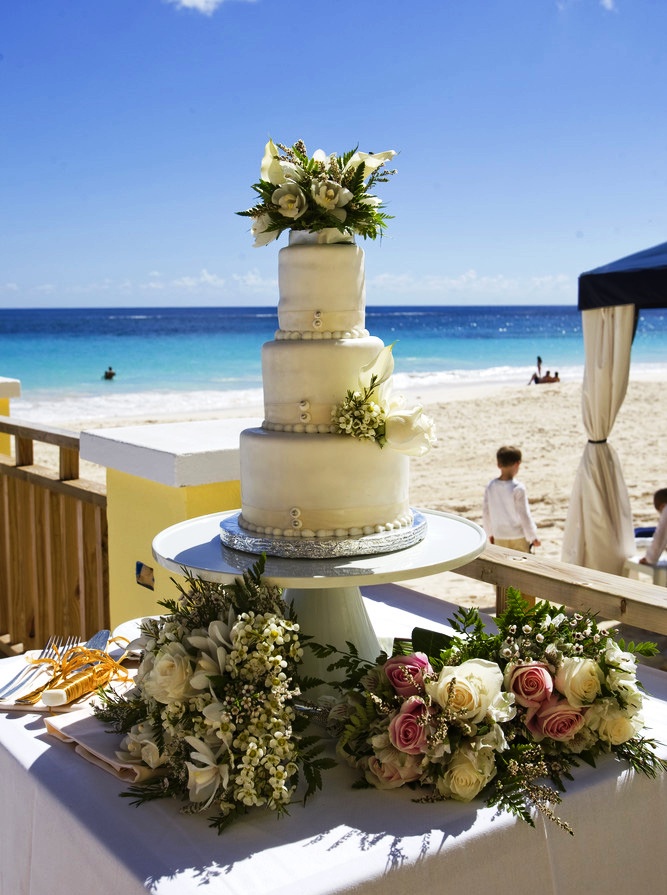
3 layers high, Traditionally made to a wonderful old recipe. In past years, there were two cakes, one for the Bermudian bride, the other for her Bermudian husband, but that custom has weakened now, often to one cake as below serving both and their guests.
| Source | Bermudian |
A tradition dating back to 1849, takes place at the Chapel of Ease dock in St George’s Harbour. In June 2016 The Right Rev Nicholas Dill, Bishop of Bermuda, and the Rev David Raths conducted the blessing after being rowed respectively by the Bermuda Pilot Gig Club in Harry Fox, and by members of the St George’s-based TS Admiral Somers Sea Cadets in Lady Stockton. Parliamentarian Suzann Roberts-Holshouser helped to conduct the service, along with Demi Wight, Dylan Holshouser and Henry Hayward, while music was provided by members of the St George’s Corps of the Salvation Army. The event dates back to the consecration of the Chapel of Ease. With no bridge connecting St George to St David’s, four sons of clergymen volunteered to row the bishop across the harbour. As he passed through, the bishop blessed the boats that had gathered to watch. The tradition is now carried out every year, usually accompanied by a codfish breakfast. Visiting boats are invited to take part in the event, but are asked to first collect a flag from the Visitors Information Centre in St George’s. Each boat in attendance is blessed and receives a Certificate of Blessing saying, “Bless o lord this vessel and all who sail in her; may she be a trustworthy and safe servant.”
| Source | British |
Hamilton Harbour. Last held was in December 2018. Then the Island's top spectator event of the year. A stunning display of Bermuda-based illuminated boats of all sizes, treating 20,000 viewers and ending with a magnificent fireworks display. An after-dark marine spectacle, free to all, on a Saturday evening in December before Christmas, watched mostly from vantage places ashore such as Albouy's Point and Barr's Bay Park. Front Street and Harbour Road also teem with spectators.
It is now an established once-every-two-years Christmas-tide tradition (except for December 2008 when it did not occur). Because of Covid 19 it may not occur in December 2020.
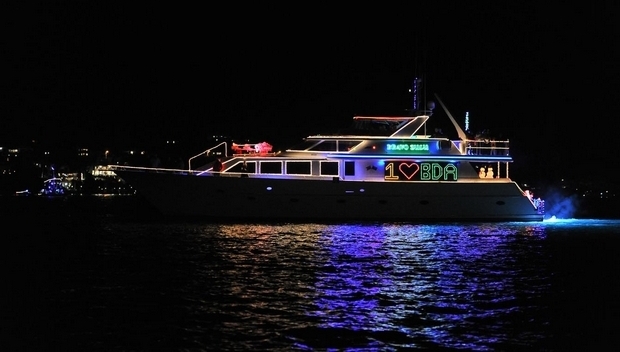
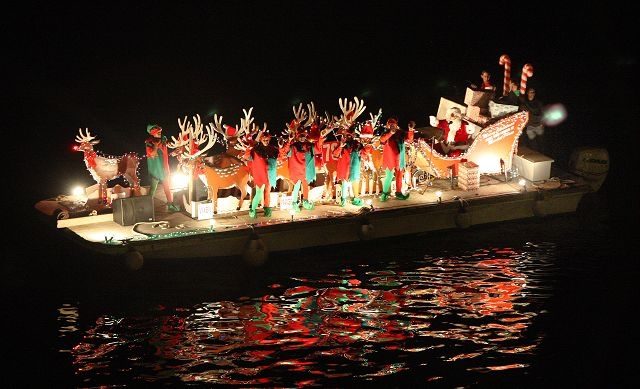
| Source | Bermudian |
| Source | British |
A local gamble particularly noticeable at Cup Match time. Whichever team hosts the annual Cup Match (see below) game accepts tenders for the gambling game of Crown and Anchor, one of the many "concessionary" events, operators of which pay Government a hefty license fee. The odds are always stacked heavily in favour of the operator, not the gambler. Players should first make a point of knowing the basics of the game.
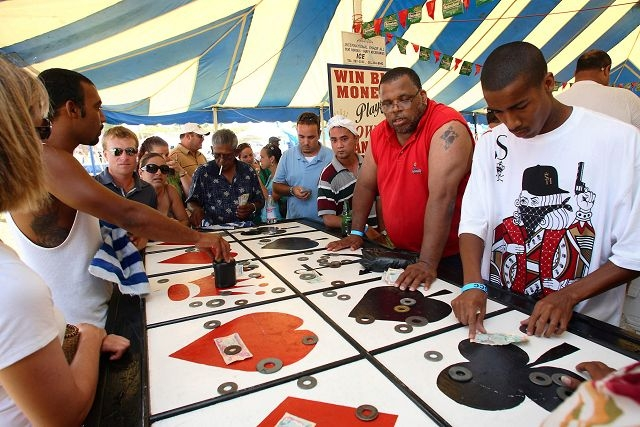
Royal Gazette photo
| Source | Bermudian |
2018. August 3. Somerset enjoy best-ever victory over St. George's. After piling on 378 runs on Thursday, Somerset bowled out St George’s twice. The latter's batsmen scored only 121 in their first innings. In the follow-on, St George’s were able to only add 223. Somerset won by an innings and 35 runs.
This first day of the two-day Thursday and Friday Cup Match holiday in late July or early August is named to commemorate the most important modern events in Bermuda's 400+ year-old history. They are held by tradition on the two consecutive days of (a) Emancipation Day (see below) and Mary Prince Day. These two days are, by Bermuda statute, always on the Thursday preceding the first Monday in August and the Friday preceding the first Monday in August. For many Bermudians, locals and visitors who do not have to work on a Saturday or Sunday this amounts to a 4-day public holiday long weekend. This Public Holiday commemorates the uniquely emotional, cultural, historic and racial day of August 1, 1834 when under British laws that then extended to all British colonies, dominions and islands, with Britons themselves in the UK having been freed since 1772, the Slavery Abolition Act was enacted locally under British legislative pressure, to free the Island's slaves. In Bermuda, 4.000 persons, until then slaves, became free. They and other former slaves who had already been freed from that moment on, gained equal legal status to whites. That momentous day is mostly celebrated with the annual cricket Cup Match classic between St. George's and Somerset, two prominent local cricket teams. It follows a tradition that first started on August 8, 1872. The Bermuda Cricket Club had earlier been founded in St. George's ( in 1845) and played its first cricket game against the-then British Army garrison in Bermuda. Long before cricket became the hugely popular sport it is today, a match played between the fleet team of the resident Royal Navy base and the British Army garrison regimental team was a major event in the social calendar of the Town of St. George. This sport was first brought to Bermuda in the 1840s by British Army soldiers stationed here. Cricket is a British game that originated in England centuries ago. It is not unique to Bermuda. It is popular throughout the British Commonwealth of Nations. Its local season is from late April to late September. In 1872, British cricket thus arrived for local civilians. For many years until 1902, the unofficial festive game was between two fraternal lodges on opposite sides of Bermuda - in Somerset in the west end and St. George's on the east end. The festive game began officially in July 1902 between the Somerset Cricket Club in the west end and the St. George's Cricket Club in the east end. Venues of the game change yearly between both clubs. Most recent (2015) winner is the Somerset Cricket Club. Today, among the cricket-loving nations and territories of the world, only in Bermuda does the whole of Bermuda grind to a complete halt for two days every summer to turn its attention to a cricket game. On Cup Match days, many Bermudians either go physically to the game or listen to it on the radio. Because the popularity of the festive annual game caused continued absences from employment the 2-day public holiday was first introduced in 1947 and has been in effect ever since. Since 1999, a celebration of emancipation is now part of the ritual of the first day of Cup Match, formally renamed Emancipation Day. It is a very busy time for camping and picnicking by Bermudians and locals at public (Government) parks or beaches. The designated campgrounds are Ferry Point, Coney Island and Chaplin Bay but all public parks and beaches can be invaded by persons pitching tents from two days beforehand and until the Sunday evening after Cup Match.
| Source | Bermudian |
| Source | British |
Drystone walls, still found in some parts of Bermuda, are limestone walls made without mortar.
| Source | British |
Discontinued in 2008 as a lovely Christmas-time tradition due to economic conditions and the high price of fuel. Until then it was sponsored for many years by The Bermuda Electric Light Company, the only electricity service, which awarded prizes. Some Bermuda homes were dazzling.
| Source | Local |
Dancers similar to those in Africa and certain parts of the Caribbean, from black families. They dance at certain times of the year and on special days. In 2018 there were 6 Bermudian Gombey troupes. They appeared in the 2003 Edinburgh Tattoo. The word Gombey comes from the African Bantu language and means both rhythm and drum. Noteworthy and quote-worthy are the books "The Bermuda Gombey; Bermuda's Unique Dance Heritage" by Louise A. Jackson and "Bermuda: Traditions and Tastes" by Judith Watson.
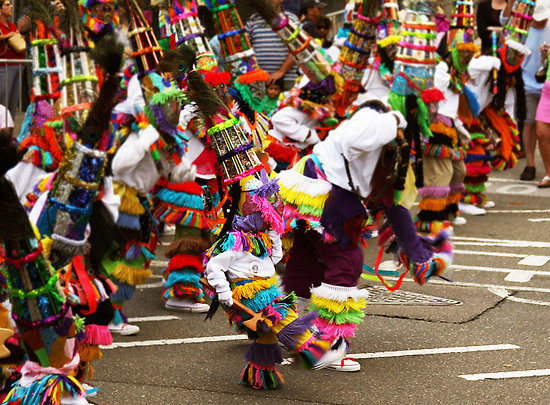
Bermuda Gombey troupe
Annual Gombey Festival. The event is held to celebrate Bermuda’s premier folk dancers, the Gombeys, whose dances celebrate a centuries-old Bermudian folk tradition that blends elements of African and Caribbean performance with North American native music and British military drumming. A tradition of dance passed down through the ages since Bermuda was first populated in part by those of African origin. Each year the festival honors an individual who has cultivated and strengthened the traditions of Gombey music and dance. In 2015 the award was given to Allan Warner of the Warner Gombeys, one of Bermuda's veteran Gombey Captains. He was joined by his family along with members of the Place’s, H & H, Warwick, Gombey Evolution and Gombey Warriors groups. The event was once known as the Gombey Competition, but has evolved into a celebration of a folk tradition that stretches back for centuries. Each troupe has its own distinct history, and the names of drummers and performers who had been influenced by Mr Warner were listed off to drumming, whistles and ecstatic cheers.
2019. October 14. Gombeys “stand for everybody in Bermuda”, a veteran performer proclaimed at a weekend event dedicated to the art form. Shawn Caisey added: “We stand for every ancestor. Gombeys are about honour at its highest. It goes back to slavery, our ancestors. If you are deep into your black culture, you’ll get the gist of what I’m saying. Respect and honour at its highest. That’s the best way I can put it.” The 46-year-old was honoured at the Bermuda International Gombey Festival Showcase on Saturday at Botanical Gardens. Mr Caisey said that his love for Gombeys grew out of his upbringing in the Government Gate area of Pembroke, where he lived just three doors down from the home base for Place’s Gombeys. He added: “It was right there in front of me — it was always there.” Mr Caisey, a member of H&H Gombeys for nearly 30 years, said it was the history behind the art form that had sustained his interest. “What started me was just being curious as a kid. When I became an early teenager, my peers were asking me questions I couldn’t answer. It sort of messed me up because I wanted to answer, but I couldn’t ... I didn’t know.” Ed Christopher, the event emcee, described Mr Caisey as a “keen researcher on the history and origins of Gombey culture”. He added: “He would often be seen at the Bermuda National Library studying up about the Gombeys and other masquerade cultures in the Caribbean and Africa.” Mr Christopher said that Mr Caisey was recognised as an elder in Bermuda’s Gombey community and called him an “expert costume designer, drum-maker, and of course, dancer”. He added: “Throughout his career, he has performed in front of royalty, and represented Bermuda in the Caribbean, North America and Europe.” Wayne Raynor, one of the captains of H&H Gombeys, said that Mr Caines was one of the key figures in Bermuda’s Gombey community. He added: “If you want to know anything about Gombeys, old or new, he can direct you to the right people or he can tell you if he knows. He’s like a Gombey encyclopedia.” Zane Hendrickson, another captain of H&H, said that it meant a lot to have Mr Caisey recognised. He added: “He taught us everything that we know now. Not even just about Gombeys — about life, period.” Lovitta Foggo, the Minister of Labour, Community Affairs and Sport, told the audience that the Gombey had become an “iconic symbol of Bermudian culture”. She added: “Tonight we are honouring our folk art, our history and our connections to the African diaspora.” Five troupes took part in the festival showcase: Gombey Evolution, Gombey Warriors, H&H Gombeys, Place’s New Generation Gombeys and Warwick Gombeys. Ms Foggo thanked the groups for taking part in the event “and more, importantly, for being the strong tradition bearers”. She added: “We all love the Gombeys and we are all here to celebrate with you for our traditional art.” Mr Caisey said that while he didn’t devote his time for accolades, the recognition at the event was appreciated. He added: “It’s nice to know, to feel, to see, that people appreciate what you have been doing over the years.” Mr Caisey, whose 18-year-old son, Chekai, dances with H&H, said that his family’s connection to the Gombeys was generational. “I have a newborn ten months old,” he said. “He loves it.”
| Source | Bermuda |
Always in March - from Harvard University. Annual visit to Bermuda for over 50 years. Sponsored by the Bermuda Government's Department of Tourism which later became the Bermuda Tourism Authority.
For full details of their history and significance see https://en.wikipedia.org/wiki/Hot_cross_bun. The custom was imported to Bermuda from the United Kingdom and is much favored locally. They are available from commercial Bermudian bakeries or as home-made, sold or given away in batches by family matriarchs who love to make them from scratch. They are square-shaped sticky buns about 1.85 inches wide and 1.5 inches deep, with icing sugar applied to them in the shape of a cross. This signifies Christ's agony and death on the cross.
| Source | UK |
Accurately, a half marathon of 13 miles. Dates back to January 1910. It began as a friendly cross-country race began in June 1909 between Bermudian soldiers and those in the British Army then based in Bermuda. It was then hosted by the Somerset Athletic Club, a newly formed black community organization. Earlier, running had become a Bermudianized sport, especially in Somerset. but had not been competed for before then by non-locals. British soldiers witnessed the racing and wanted to join in but they were too late (see 1910). .
1910. January. The friendly cross-country race began in June 1909 between Bermudian soldiers and those in the British Army then based in Bermuda, by then renamed the Marathon Derby. It became an official annual event. It was hosted by the Somerset Athletic Club, a newly formed black community organization. British soldiers issued another challenge, which was accepted, with the locals stating they wanted it run from Somerset to Hamilton. Private Jordan, of the Duke of Cornwall's Light Infantry then stationed in Bermuda, was the first to cross the line, followed by Bermudian local and Somerset favorite John C. Bean. After Stanley Burgess first took part in 1921, when he was 20, and first won it in 1926, then 1927 and 1928 and eventually 10 times, it became famous locally.
See the book Marathon - All the Facts, Winners and Drama. Dale Butler.
| Source | British and Caribbean |
Cancelled in June 2018 after being in existence since 1962, The event was then the brainchild of older brothers of Jill Raine, Eric and Anthony Amos and a group of their friends. The idea behind the event was to poke fun at the disciplined world of yachting. They just wanted to do a spoof on it and that was to show a non-mariners race where everything was wrong. It was silly fun. There was no start and there was no finish. Non-vessels in the early days of the event included an antique bed, a refrigerator and a cello case. A chamber pot was presented as a race prize. Annual Non-Mariners races were first held in Hamilton Harbour. They later moved to St George’s and Ferry Reach before they settled on Mangrove Bay in 1972. Sandys Boat Club, which most recently sponsored the race and charged an admission fee, confirmed the cancellation of the event. A spokesman for the club said fewer entries, a change in the economics of the event, and a shortage of volunteers were behind the decision. The raft-up parties in Mangrove Bay will go ahead as planned earlier, on the Sunday following the annual Cup Match 2-day public. holiday.
| Source | Local |
| Source | Local |
An annual favorite, a different location each year over several miles of flat and hilly areas in places usually barred to the general public, run by the Bermuda National Trust. Walking shoes with non-slip tread are recommended. No dogs or wheeled vehicles (such as mountain bikes and strollers).
| Source | British |
| Source | British |
| Source | Portuguese |
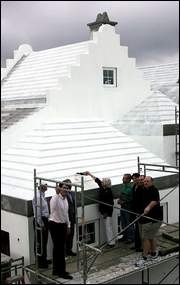

When new houses, apartment blocks and office buildings gave their roofs completed, to seal out the rain, wind and moisture, locals celebrate with a roof wetting on the roof. All who participate on the roof have to be able to go up and get down unaided and must wear hard hats. Usually, an owner and contractor or builder are the key persons and climb the outside of a roof via a ladder. As this picture of a January 2009 roof wetting shows, in winter suits are often worn by the owners while the construction foreman and crew are in working clothes. When the Bermuda Government is the owner, usually the Minister concerned is present. A bottle of black rum is either poured on the roof or is shared, or both.
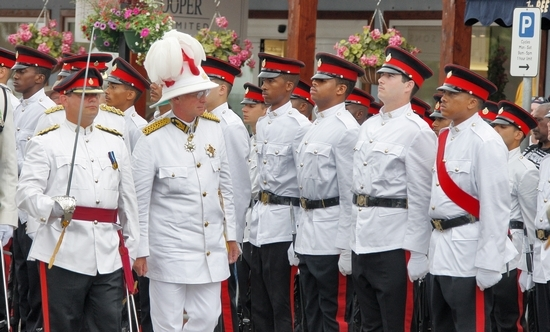
 2018. June 26. A former senior
military officer said yesterday he feared the Government’s decision to end
conscription would weaken the island’s defence force. Lieutenant-Colonel
Allan Rance, leader of the Nine Colonels, a pressure group of former Commanding
Officers of the Royal Bermuda Regiment, said he believed the “vast majority”
of former officers and Non-Commissioned Officers would view the Defence
Amendment Act “with great concern”. Colonel Rance said: “Obviously,
we’re going to hope it succeeds, but we think that there are some pretty big
risks here that it may not.” He said the group would continue to act as a
“friend and advocate” for the Regiment and “hold the minister’s feet to
the fire”. Colonel Rance added: “If we see it failing, we’ll point that
out too, publicly. If at the end of the day it all goes well, wonderful, but if
the strength does fall off, as we think it may, we will ask the hard questions
of the Government of the day. They will have created the problem. They will have
to fix it.” Colonel Rance was speaking after Wayne Caines, the Minister of
National Security, piloted a Bill to end conscription through the House of
Assembly last Friday. The former CO of the Regiment said he felt the decision to
end conscription was based on “false premises”. Colonel Rance dismissed
arguments from anti-conscription campaigner Larry Marshall and group Bermudians
Against the Draft that conscription was a violation of human rights. Colonel
Rance said: “Those claims have all been rejected in the courts when there have
been challenges made to the law, but people have bought into it. In a sense, the
Government’s been duped.” Colonel Rance said the Nine Colonels were also
concerned about the Regiment’s ability to fill its ranks using volunteers
alone. He added the RBR would have to compete with other organisations,
including the Bermuda Police Service and the Bermuda Fire & Rescue Service,
for recruits. Colonel Rance said: “There are only so many people to go around
and we are a small community at the end of the day.” He added that plans to
downsize and restructure the RBR were “implicitly recognizing” the risk.
Colonel Rance explained: “When you downsize, you don’t need as many people
to begin with. You’re trying to solve the equation from the demand side as
much from the supply side in this case.” He said he believed downsizing was
being done to cut operational costs so extra cash could be used to attract
volunteers. Colonel Rance said he thought the move would work in the short term.
He added: “What I think is going to happen in the longer term is the
inducements to make better offers to compete in the job market will have to lead
to higher costs if they want to attract top-class talent.” Colonel Rance said
the group was also concerned about plans for an RBR Coast Guard to assume
responsibility for policing Bermuda’s waters. Mr Caines told the House of
Assembly the Coast Guard was expected to take over Marine Police duties in April
2020. Colonel Rance said: “What we’re concerned about is that it could turn
into a fantasy without adequate funding. The minister knows this, and he will
have to work very hard to make sure the funding is available.”
2018. June 26. A former senior
military officer said yesterday he feared the Government’s decision to end
conscription would weaken the island’s defence force. Lieutenant-Colonel
Allan Rance, leader of the Nine Colonels, a pressure group of former Commanding
Officers of the Royal Bermuda Regiment, said he believed the “vast majority”
of former officers and Non-Commissioned Officers would view the Defence
Amendment Act “with great concern”. Colonel Rance said: “Obviously,
we’re going to hope it succeeds, but we think that there are some pretty big
risks here that it may not.” He said the group would continue to act as a
“friend and advocate” for the Regiment and “hold the minister’s feet to
the fire”. Colonel Rance added: “If we see it failing, we’ll point that
out too, publicly. If at the end of the day it all goes well, wonderful, but if
the strength does fall off, as we think it may, we will ask the hard questions
of the Government of the day. They will have created the problem. They will have
to fix it.” Colonel Rance was speaking after Wayne Caines, the Minister of
National Security, piloted a Bill to end conscription through the House of
Assembly last Friday. The former CO of the Regiment said he felt the decision to
end conscription was based on “false premises”. Colonel Rance dismissed
arguments from anti-conscription campaigner Larry Marshall and group Bermudians
Against the Draft that conscription was a violation of human rights. Colonel
Rance said: “Those claims have all been rejected in the courts when there have
been challenges made to the law, but people have bought into it. In a sense, the
Government’s been duped.” Colonel Rance said the Nine Colonels were also
concerned about the Regiment’s ability to fill its ranks using volunteers
alone. He added the RBR would have to compete with other organisations,
including the Bermuda Police Service and the Bermuda Fire & Rescue Service,
for recruits. Colonel Rance said: “There are only so many people to go around
and we are a small community at the end of the day.” He added that plans to
downsize and restructure the RBR were “implicitly recognizing” the risk.
Colonel Rance explained: “When you downsize, you don’t need as many people
to begin with. You’re trying to solve the equation from the demand side as
much from the supply side in this case.” He said he believed downsizing was
being done to cut operational costs so extra cash could be used to attract
volunteers. Colonel Rance said he thought the move would work in the short term.
He added: “What I think is going to happen in the longer term is the
inducements to make better offers to compete in the job market will have to lead
to higher costs if they want to attract top-class talent.” Colonel Rance said
the group was also concerned about plans for an RBR Coast Guard to assume
responsibility for policing Bermuda’s waters. Mr Caines told the House of
Assembly the Coast Guard was expected to take over Marine Police duties in April
2020. Colonel Rance said: “What we’re concerned about is that it could turn
into a fantasy without adequate funding. The minister knows this, and he will
have to work very hard to make sure the funding is available.”
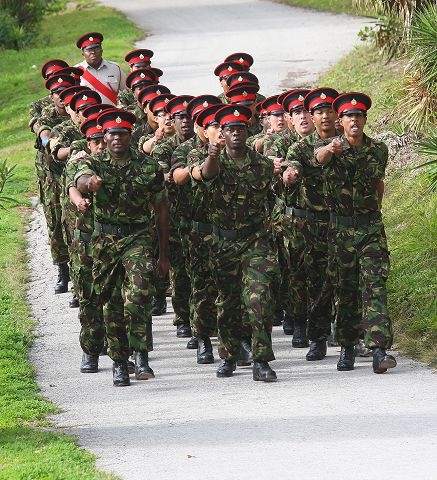 2019. June 23. Legislation to
end conscription into the island’s military was passed in the House of
Assembly last night. Wayne Caines, Minster of National Security, said the
Defence Amendment Act was “a once-in-a-generation chance to transform the
Royal Bermuda Regiment into a bespoke hybrid organisation, which is more
efficient, effective and professional”. Mr Caines, a former officer in the
RBR, said that conscription had “served Bermuda well over the years”. But he
added: “That said, the modern era dictates that the time has come for
conscription into the Royal Bermuda Regiment to end, as is the case in each of
the other Overseas Territories. I am confident that Bermuda will be the better
for ending conscription.” Mr Caines said his ministry had worked with the RBR
to make sure the regiment would be able to sustain its volunteer numbers. He
added: “The RBR will continue its extensive public relations campaigns and
incentive programmes in order to attract men and women to serve.” Mr Caines
said a review by the RBR had been conducted over the past six months. He added
the report found that a total of 327 personnel, 28 officers and 299 soldiers,
could carry out the work of the RBR. The number is down from the 400 soldiers
recommended in a 2014 report. Mr Caines said the review also focused on the
creation of a coast guard. He added: “The plan for the RBR Coast Guard is for
the RBR to commence training now and perform the role alongside the Bermuda
Police Service until the RBR Coast Guard is fully trained and completely take
over the function.” The new Coast Guard is expected to take over maritime
security duties in April 2020. Mr Caines said the RBR would recruit with “a
promise to invest in those officers and soldiers who volunteer to serve
Bermuda”. He added: “Through training partners in Bermuda and overseas, the
regiment will deliver a pathway of education and training that is
second-to-none. In short, this is a very exciting time to be a member of the
Royal Bermuda Regiment.” Mr Caines said that he had met pressure group the
Nine Colonels who “remain steadfast in their belief that conscription should
not end”. But he added that they were “open” to the recommendations of the
latest review. Mr Caines said: “They have made it clear that they would like
to see a clear time continuum and firm undertaking by the Government that shows
a commitment to enacting the key recommendations.” Michael Dunkley, a former
premier and shadow national security minister, said that he had always felt
“very uncomfortable” about conscription. He added: “I am glad that the day
has come where we can deal with it.” But Mr Dunkley added: “At the same
time, we need to make sure that the RBR is in a position to effectively fill out
their mandate.” Lieutenant-Colonel David Burch, the Minister of Public Works
admitted he was a “reluctant member” of the Regiment when he signed up. He
said he had been opposed to the abolition of conscription, but that he could see
the benefits of the Act. Colonel Burch added: “My own view on this has
evolved. I get that times change and situations evolve. In order for this to be
successful in terms of the survival of the Royal Bermuda Regiment, we require
people who are in service to have the ability to convince young people that this
is something they want to do. It must be aggressive and talk to young people
where they are.” Patricia Gordon-Pamplin, a One Bermuda Alliance backbencher,
said: “There are some of our young people who didn’t want to be there but
who will tell you in retrospect that they could not have had a more positive
experience. I’m going to miss hearing the positive experiences from those who
didn’t want to do it.” Jamahl Simmons, the economic development minister,
admitted he had been a “reluctant” conscript, but that the Regiment helped
to “instil basic life skills”.
2019. June 23. Legislation to
end conscription into the island’s military was passed in the House of
Assembly last night. Wayne Caines, Minster of National Security, said the
Defence Amendment Act was “a once-in-a-generation chance to transform the
Royal Bermuda Regiment into a bespoke hybrid organisation, which is more
efficient, effective and professional”. Mr Caines, a former officer in the
RBR, said that conscription had “served Bermuda well over the years”. But he
added: “That said, the modern era dictates that the time has come for
conscription into the Royal Bermuda Regiment to end, as is the case in each of
the other Overseas Territories. I am confident that Bermuda will be the better
for ending conscription.” Mr Caines said his ministry had worked with the RBR
to make sure the regiment would be able to sustain its volunteer numbers. He
added: “The RBR will continue its extensive public relations campaigns and
incentive programmes in order to attract men and women to serve.” Mr Caines
said a review by the RBR had been conducted over the past six months. He added
the report found that a total of 327 personnel, 28 officers and 299 soldiers,
could carry out the work of the RBR. The number is down from the 400 soldiers
recommended in a 2014 report. Mr Caines said the review also focused on the
creation of a coast guard. He added: “The plan for the RBR Coast Guard is for
the RBR to commence training now and perform the role alongside the Bermuda
Police Service until the RBR Coast Guard is fully trained and completely take
over the function.” The new Coast Guard is expected to take over maritime
security duties in April 2020. Mr Caines said the RBR would recruit with “a
promise to invest in those officers and soldiers who volunteer to serve
Bermuda”. He added: “Through training partners in Bermuda and overseas, the
regiment will deliver a pathway of education and training that is
second-to-none. In short, this is a very exciting time to be a member of the
Royal Bermuda Regiment.” Mr Caines said that he had met pressure group the
Nine Colonels who “remain steadfast in their belief that conscription should
not end”. But he added that they were “open” to the recommendations of the
latest review. Mr Caines said: “They have made it clear that they would like
to see a clear time continuum and firm undertaking by the Government that shows
a commitment to enacting the key recommendations.” Michael Dunkley, a former
premier and shadow national security minister, said that he had always felt
“very uncomfortable” about conscription. He added: “I am glad that the day
has come where we can deal with it.” But Mr Dunkley added: “At the same
time, we need to make sure that the RBR is in a position to effectively fill out
their mandate.” Lieutenant-Colonel David Burch, the Minister of Public Works
admitted he was a “reluctant member” of the Regiment when he signed up. He
said he had been opposed to the abolition of conscription, but that he could see
the benefits of the Act. Colonel Burch added: “My own view on this has
evolved. I get that times change and situations evolve. In order for this to be
successful in terms of the survival of the Royal Bermuda Regiment, we require
people who are in service to have the ability to convince young people that this
is something they want to do. It must be aggressive and talk to young people
where they are.” Patricia Gordon-Pamplin, a One Bermuda Alliance backbencher,
said: “There are some of our young people who didn’t want to be there but
who will tell you in retrospect that they could not have had a more positive
experience. I’m going to miss hearing the positive experiences from those who
didn’t want to do it.” Jamahl Simmons, the economic development minister,
admitted he had been a “reluctant” conscript, but that the Regiment helped
to “instil basic life skills”.
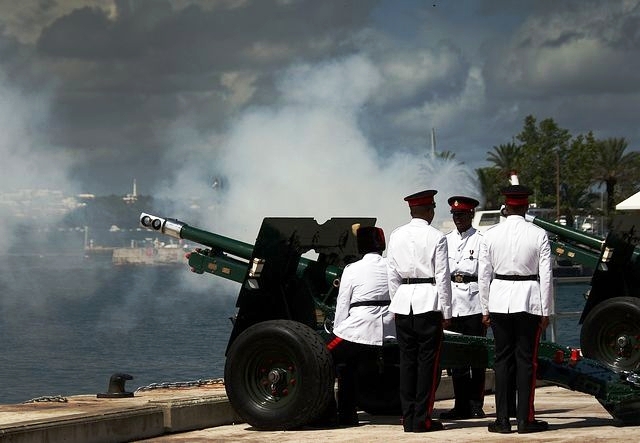
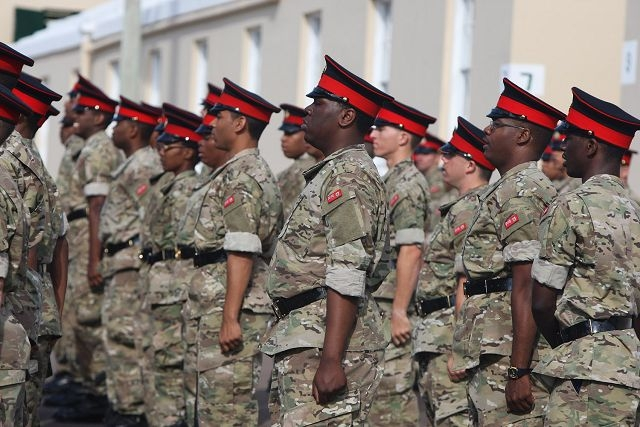
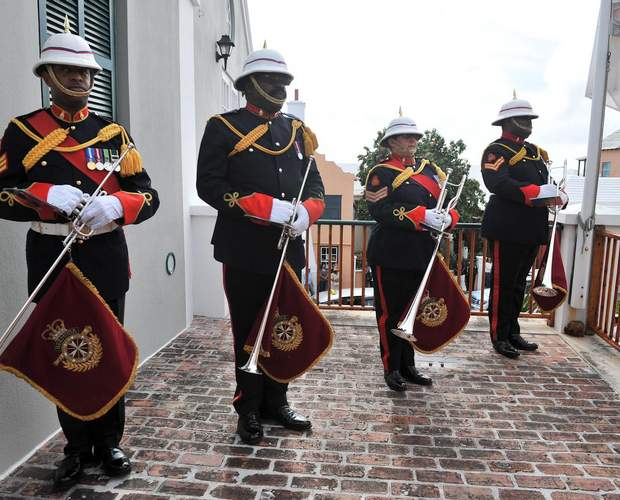
Bermuda Regiment photos by Bermuda's only daily newspaper, The Royal Gazette
| Source | British |
 Bermudians,
especially before the days of electronic weather forecasting, once used to rely heavily on
unique, home-made, soda or wine bottle, shark-oil based "barometers" to predict storms and other severe
weather. Local St.
David's Islanders in particular used to catch and eat shark and, if it met the
conditions and was the species of shark required, cooked it in its own liver oil.
The shark - only a young one, called a puppy shark, will do in this case - has to be caught in certain months when the liver is white in color.
The process must be done in natural sunlight in a non-metallic container. After being melted
down in the hot sun, it was poured into any soda (carbonated beverage) or wine bottle
and hung outside. On a clear day, the shark oil is transparent, like water,
usually with a little sediment at the bottom of the bottle. The appearance of the oil altered,
clouded up, consistently with changes in
the weather. The stirred-up sediment or crystals that formed in the neck of the
bottle often showed peaks and valleys that led to some usually accurate weather
predictions by fishermen in particular. In old Bermuda, bottles of shark oil
appeared on many walls or
terraces. Local practitioners of the art today
say a reliable way of knowing what the weather is going to be like is to secure
the bottle with string, hang it up with the bottle straight, not tilting, then
observe over time how the shark oil settles or remains
cloudy. Some old timers still check shark oil before going out with their
boats into deep waters.
There are dozens of theories on why shark oil changes with the climate and
whether it really is effective. The only one that seems to fit is that
electrical changes in the atmosphere - at least in Bermuda, possibly elsewhere
too - affect the shark's liver and alert the
shark to move out to deeper water before a bad storm. The oil retains this
function when removed, and the change is visible, the oil switching from a clear
golden color like cooking oil to milky white. Shark oil is common in many countries
with sea access and so are soda bottles and shark oil barometers, so there is no
need to export them from Bermuda.
Bermudians,
especially before the days of electronic weather forecasting, once used to rely heavily on
unique, home-made, soda or wine bottle, shark-oil based "barometers" to predict storms and other severe
weather. Local St.
David's Islanders in particular used to catch and eat shark and, if it met the
conditions and was the species of shark required, cooked it in its own liver oil.
The shark - only a young one, called a puppy shark, will do in this case - has to be caught in certain months when the liver is white in color.
The process must be done in natural sunlight in a non-metallic container. After being melted
down in the hot sun, it was poured into any soda (carbonated beverage) or wine bottle
and hung outside. On a clear day, the shark oil is transparent, like water,
usually with a little sediment at the bottom of the bottle. The appearance of the oil altered,
clouded up, consistently with changes in
the weather. The stirred-up sediment or crystals that formed in the neck of the
bottle often showed peaks and valleys that led to some usually accurate weather
predictions by fishermen in particular. In old Bermuda, bottles of shark oil
appeared on many walls or
terraces. Local practitioners of the art today
say a reliable way of knowing what the weather is going to be like is to secure
the bottle with string, hang it up with the bottle straight, not tilting, then
observe over time how the shark oil settles or remains
cloudy. Some old timers still check shark oil before going out with their
boats into deep waters.
There are dozens of theories on why shark oil changes with the climate and
whether it really is effective. The only one that seems to fit is that
electrical changes in the atmosphere - at least in Bermuda, possibly elsewhere
too - affect the shark's liver and alert the
shark to move out to deeper water before a bad storm. The oil retains this
function when removed, and the change is visible, the oil switching from a clear
golden color like cooking oil to milky white. Shark oil is common in many countries
with sea access and so are soda bottles and shark oil barometers, so there is no
need to export them from Bermuda.
| Source | Local |
Given in Bermuda to whose whose courage, selflessness and hard work have changed Bermuda for the better. Their names can be submitted them for consideration in the Queen’s Birthday and/or New Year's Honours List. Honorees include voluntary work, arts, health, sport, education, science, business and politics. The Queen’s Certificate and Badge of Honour is awarded to individuals who have made outstanding contributions to public life or served the community over a sustained period. Nominees should be still active in their chosen area, newly retired or have had a recent significant achievement. The honours are a good way to say thank you. There are many unsung heroes in Bermuda who quietly contribute in all kinds of important ways to improve the lives of Bermudians. It is an opportunity to pay homage to those who work tirelessly for and on behalf of others, and a chance to say thank you for years of hard work and dedication. Nomination forms can be downloaded from the section on the right of www.gov.bm/governor-bermuda, and applicants are cautioned not to discuss the matter with their chosen nominees. Completed forms must be received by the Cabinet Office no later than 5pm on the last working day of April or October.
| Bermuda War Veterans Association | Registered Charity 140 |
| Bermuda War Veterans Commissioners | See Bermuda Government Boards |
See under November in Bermuda Public Holidays
| Source | British |

Banner.jpg)
Authored,
researched, compiled and website-managed by Keith A. Forbes.
Multi-national © 2020. All Rights Reserved