Click on graphic above to navigate the 165+ web files on this website, a regularly updated Gazetteer, an in-depth description of our island's internally self-governing British Overseas Territory 900 miles north of the Caribbean, 600 miles east of North Carolina, USA. With accommodation options, airlines, airport, actors, actresses, aviation, banks, beaches, Bermuda Dollar, Bermuda Government, Bermuda-incorporated businesses and companies including insurers and reinsurers, Bermudians, books and publications, bridges and causeway, charities, churches, citizenship by Status, City of Hamilton, commerce, communities, credit cards, cruise ships, cuisine, currency, disability accessibility, Devonshire Parish, districts, Dockyard, economy, education, employers, employment, environment, executorships, fauna, ferries, flora, former military bases, forts, gardens, geography, getting around, golf, guest houses, highways, history, historic properties, Hamilton, House of Assembly, housing, hotels, immigration, import duties, internet access, islands, laws, legal system and legislators, main roads, marriages, media, members of parliament, money, motor vehicles, municipalities, music and musicians, newcomers, newspaper, media, organizations, parks, parishes, Paget, Pembroke, performing artists, residents, pensions, political parties, postage stamps, public holidays, public transportation, railway trail, real estate, registries of aircraft and ships, religions, Royal Naval Dockyard, Sandys, senior citizens, Smith's, Somerset Village, Southampton, St. David's Island, St George's, Spanish Point, Spittal Pond, sports, taxes, telecommunications, time zone, traditions, tourism, Town of St. George, Tucker's Town, utilities, water sports, Warwick, weather, wildlife, work permits.

By Keith Archibald Forbes (see About Us).
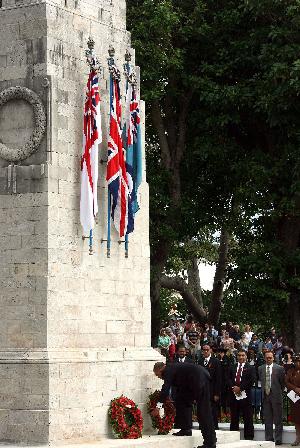
On November 11 each year at 11 am, at the War Memorial and Cenotaph on Front Street in the city of Hamilton, there is a dead silence observed by all present. It marks the 11th hour of the 11th day of the 11th month of 1918 when an Armistice was finally signed by the protagonists, after more than four years of fighting on the battlefields of Europe. Millions of soldiers were dead, dying or mutilated. They included many Bermudians shown below, plus Americans, Australians, Canadians, New Zealanders and more. They died or survived while serving in the British Army or Royal Navy or Royal Flying Corps, later the Royal Air Force, after earlier basic training in the Bermuda Local Forces of the Bermuda Militia Artillery (1894 to 1965) or Bermuda Volunteer Rifle Corps (1894-1946), later Bermuda Rifles (1946-1965). On November 11, 1920, the first such Remembrance Day of veterans to honor their fallen comrades occurred at the then-newly-built Cenotaph in London, attended by Britain's King George V. Since then it has been an annual tradition. In Bermuda, a copy of London's Cenotaph was built on Front Street in the City of Hamilton and for years annual Remembrance Day parades were held there. More than 90 Bermudians died for Britain in the Great War.

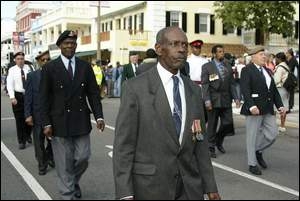
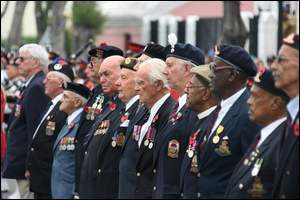
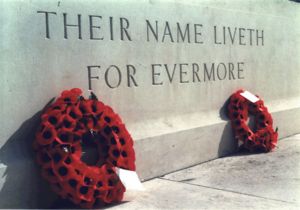
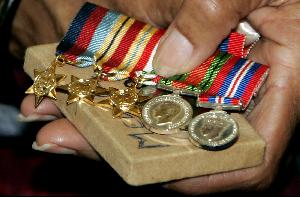
Wreaths to honour the war Veterans dead of Bermuda are laid at the Memorials above by the Governor, Premier, Hamilton Mayor, Opposition Leader, followed by the president of the War Veterans' Association, the Defence Board chairman, the Royal Bermuda Regiment's commanding officer (the regiment was formed in 1965 from the amalgamation of the former Bermuda Militia Artillery and Bermuda Rifles), the Commissioner of Police and the Chief Fire Officer. Parading along Front Street wearing their war medals are the ever-fewer remaining living war veterans of World War 2 well enough to attend, including former members or their representatives of the Bermuda Home Guard and Bermuda Contingent of the Caribbean Regiment. All relatives or descendants of a World War veterans are invited to take part. Participants are welcome to wear the medals or awards of the person they are representing. They wear the decorations on the right arm rather than the left. They are always watched by a large gathering of other residents and visitors. They are accompanied by the Bermuda Regiment Band and Corps of Drums, the Salvation Army, North Village and Somerset Brigade Bands, and the Bermuda Islands Pipe Band. All join in singing hymns, and in participating in a two-minute silence on the 11th hour of the 11th day of the 11th month since the end of the First Word War. An additional parade takes place in St. George's.
Here in the British Overseas Territory of Bermuda, also in Canada, United Kingdom and elsewhere in the British Commonwealth of Nations, Remembrance Day, November 11, occurs annually. It is a solemn and sad Bermuda Public Holiday. It honors and pays tribute to those who who fought and fell as Bermudians and British subjects in units of the British Armed Forces during the 1914-1918 Great War (World War 1) conflict. They gave their lives in defence of freedom In England, on every Sunday before Remembrance Day in London, the Foreign Secretary, on behalf of the Foreign & Commonwealth Office, London, England, which administers Bermuda, lays before the Cenotaph (later copied by Bermuda) in London a wreath to the fallen who died in the wars from the British Overseas Territories which include Bermuda. He is accompanied by the UK's Prime Minister, and leaders of the Opposition - those from the main Conservative and Liberal Democrat parties. The wreath is supplied to the FCO by the Directors and Staff of, and hand-made at, Kew Gardens, Britain's finest gardens, from flowers and botanicals in its collection from all the Overseas Territories including some prized Bermudiana. It always includes sprigs of two endemic Bermuda species, the Juniperus bermudiana (Bermuda Cedar) tree and Chiococca bermudiana (Bermuda snowberry) shrub.
After the end of World War 2, Remembrance Day parades of veterans to honor their fallen comrades were resumed in Bermuda (and all other British Commonwealth Countries), to honor those who fell in both the Great War and World War 2. More than 35 Bermudian men died for Britain in World War 2. Bermuda veterans of World War 2 who died and lived were mostly in the Bermuda Home Guard or serving abroad in the British Army (Mostly Caribbean Regiment or Lincolnshire Regiment), Royal Navy, Royal Marines, Merchant Navy, Royal Air Force, Royal Canadian Air Force, Royal Canadian Navy and, as was the case of a few, the US Armed Forces. Also in the Second World War, 29 Bermudian women served overseas. In Bermuda, as at November 11, 2008, there were 183 living registered veterans and 78 widows of veterans (but numbers have shrunk significantly since then). The Home Guard were joined by Bermudians working in Royal Naval Dockyard. The latter helped keep the Atlantic supply lines open, ensuring Bermudians, American, British and Canadian forces then stationed in Bermuda received essential supplies.
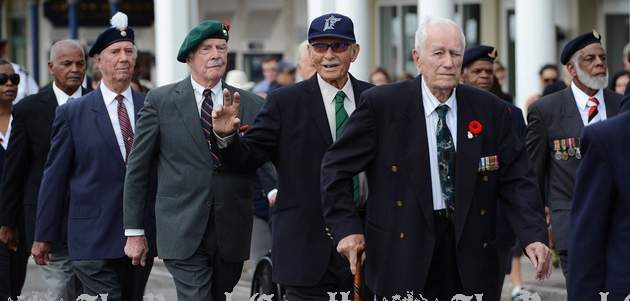
Bermuda War Veterans on parade on Remembrance Day
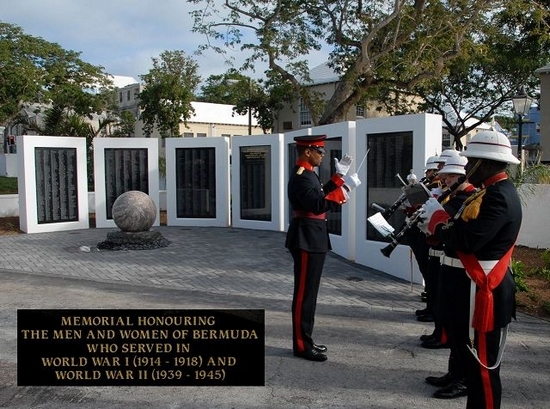
Bermuda's new war memorial (see top photo above) was completed in November 2010. It sits on the Cabinet Grounds just east of the Cenotaph and contains the names of almost 3,000 Bermudian men and women who served in the two World Wars. Names are inscribed on seven highly polished black granite slabs and a diamond emblem in gold leaf beside a name indicates that the serviceman or servicewoman is on the roll of honour and lost their lives in wartime service. A fountain in front of the memorial is made of a granite base and a highly-polished pink granite ball which is the same stone used in the Anglican Cathedral in Hamilton. Seating is provided at the memorial and it is a serene place where surviving War Veterans, their children or grandchildren other other relatives, members of an appreciative public and visitors may gather to reflect upon and pay respect to those who served our Island so heroically during the Great Wars.
2019. July 28. Bermuda’s war veterans and their widows were given a pensions boost by Bermuda's House of Assembly. The Pensions (War Service) Order 2019 raised the monthly payment due to veterans from $800 to $1,000 came with reminders for families to familiarize themselves with the benefits package, which includes a host of medical support. New benefits include coverage for psychiatric services and visits to chiropodists. Veterans and widows are now covered up to $7,000 a month for rest homes. Eye treatment for veterans is free at King Edward VII Memorial Hospital but not if they opt for eye treatment at the GP’s office.
Bermudians also served in the Korean War of the 1950s (but with US Forces). Only one Bermudian (not just born in Bermuda but also of Bermudian parents or parent or elsewhere, again with a Bermudian parent, see Citizenship) is known to have served in later British military conflicts such as Suez, Kenya, Iraq and Afghanistan (also now part of Remembrance Day in the United Kingdom). He is Major General Glyn Gilbert, CB, MC, served in the British Army in post war conflicts in Palestine, Malaya and Cyprus. For details of his life and military successes see http://en.wikipedia.org/wiki/Glyn_Gilbert.
Remembrance Day is the culmination of the annual Bermuda Poppy Appeal conducted by the local branch, Bermuda Legion, of the Royal British Legion (RBL). It is a registered charity that works to assist war veterans and their widows. RBL a worldwide organization that provides a wide range of assistance to veterans. Some include assistance with medical bills, assistance with urgent loans and assistance with Christmas presents. RBL Bermuda call also upon the Royal British Legion's head office in London for larger capital funds and grants. It honors all men and women from the Island's armed forces who lost their lives during the two World Wars. Poppies are available seasonally throughout the Appeal at places including the Cabinet Office, the Corporation of Hamilton and the Bermuda Regiment, as well as churches and participating businesses. Donations are appreciated.
The town of St. George's also remembers the Island's war heroes, at a Remembrance Day Parade in the Town Square opposite the War Memorial. Those present include the Mayor, The Royal Artillery and Ex-Artillerymen's Association, Bermuda Island Pipe Band, The Bermuda Regiment Band & Corp of Drums, Bermuda Sea Cadets, St. George's Girl Guides, Bermuda Fire Service, Bermuda Regiment Wreath Bearers, Bermuda Regiment Gun Troop, and the Boy Scouts all participate in the ceremony.
At the HMS
Jervis Bay memorial at Albouy's Point, The Bermuda Sea Cadets host a Remembrance
Day service. It
is one of a number of memorial events around the world to honour those who
served on the HMS Jervis Bay, a 50,000 ton container ship that visited Bermuda
during the war years before it was sunk as it confronted the superior firepower
of a German warship in 1940 while escorting a convoy from Canada to the UK.
When veterans served with a British unit - as most of them did - they
also get the HM Armed Forces Veterans Badge, and a War Pension from the
United Kingdom. Eligibility to this
prestigious badge was widened following Remembrance Day 2005 to include all
those who served between the end of the Second World War and December, 1954,
thus encompassing the Korean War and military campaigns in Malaya undertaken by
British forces. Another
local veteran, also honored, served in Korea with the US Army. Unlike
in the UK, USA, Canada, etc. there are no retirement homes or hospitals
specifically for World War veterans. However, in Bermuda, registered
veterans and their widows get a Bermuda War Pensions benefit,
plus full coverage on all prescription drugs, medical tests at King Edward VII
Memorial Hospital and partial coverage for medical visits to local medical
general practitioners and specialists.
Bermuda Contingent, Caribbean Regiment.
Bermuda Contingent, Royal Garrison Artillery
Bermuda Home Guard
Bermuda Legion. Bermuda charity 109. E-mail nosoldierleftbehind@hotmail.com or call 293-3975 or 703-6180. The mission is to assist war veterans and their widows. Looks after Bermuda WW1 and 2 and Korean War, etc. war veterans of past, present and future officers and soldiers in units now part of the Bermuda Regiment. Can air-ambulance people, can provide travel costs and cover medical expenses, which the former Royal Bermuda Legion could not. Has helped with air evacuations; has an annual Christmas appeal, taking food hampers and baskets all over the Island. Assists in individual cases of need, helps with healthcare bills, and helps many people find help with the different Government agencies, such as Financial Assistance. Can provide immediate assistance for people without having to go to London for it. Fund raising remains constant for war veteran widows, whose assistance from Government has been cut in recent years. Everything the Legion raises stays in Bermuda. In the ten-day run up to November 11, the Bermuda Legion sets out on its campaign with the signature red poppies.To volunteer or donate to the Bermuda Legion, e-mail nosoldierleftbehind@hotmail.com or call 293-3975. Donations can be also be made to HSBC bank account 010 731 354 001. 2014. May 29. The Bermuda Legion became associated with overseas services after being formally invited to join the Royal Commonwealth Ex-Services League. The Island’s charity for war veterans and their widows has also become affiliated with the Royal Canadian Legion’s Caribbean branch in an effort to boost its advocacy for the veteran community.
Bermuda Militia Artillery (BMA). Black soldiers of Bermuda until 1965, with a proud record of combat in two World Wars. From November 1965 the BMA became part of the Bermuda Regiment, later the Royal Bermuda Regiment. The BMA was the first black unit to serve in the Great War. It distinguished itself on the front and received several battle honours.
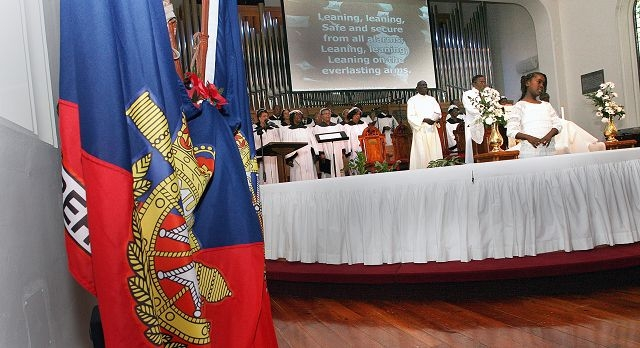
Photo: Royal Gazette
Bermuda Volunteer Rifle Corps Overseas Association (BVRC). P. O. Box HM 2716, Hamilton HM LX, Bermuda. A local charity, RC 140, founded in 1919 by returning servicemen from the Great War to provide assistance to those who went overseas to serve, originally in the First World War and in other wars subsequently. The BVRC were considered to be of such a high standard when they joined the Lincolnshire Regiment in the Great War that they were allowed to fight under their own colours, despite being only a company.
Bermuda War Veterans Association (BWVA). P O Box HM 2716, Hamilton HM LX. It supports Bermudians who volunteered for service overseas during the Second World War and Korean War, assisting veterans and widows in need of help.
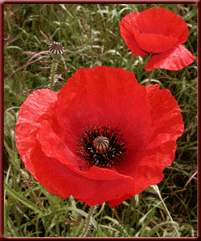 Since
the Great War of 1914-1918 poppies have been since World War 1 the national and international symbol for
British airmen, soldiers, sailors and marines who perished while serving their
country in world wars and the Korean conflict. When we mourn Bermuda's dead in Remembrance
Day ceremonies each November, we think of a flower - a poppy. Why? Because of the following
immortal lines from a poem: "If
ye break faith with us who die, we will not sleep, though poppies grow in
Flander's fields."
Since
the Great War of 1914-1918 poppies have been since World War 1 the national and international symbol for
British airmen, soldiers, sailors and marines who perished while serving their
country in world wars and the Korean conflict. When we mourn Bermuda's dead in Remembrance
Day ceremonies each November, we think of a flower - a poppy. Why? Because of the following
immortal lines from a poem: "If
ye break faith with us who die, we will not sleep, though poppies grow in
Flander's fields."
The author of this famous "poppy" poem was Colonel John McCrae, who was a distinguished professor of Medicine at McGill University after he served in the Boer War. On the outbreak of war in 1914, he at once enlisted in the Canadian Army, 1st Brigade Artillery, which was sent to fight in Belgium.
Soon after landing in Europe, he was made Medical Officer. During the second battle of Ypres in 1915 he was so horrified, appalled and heart-sick over the senseless slaughter of so many hundreds of thousands of men that he penned the following words, used to this day on 11th November.
These verses were sent anonymously to the British magazine Punch, which published them in December 1915 under the title "In Flanders' Fields."
Colonel McCrae died from his battle wounds in 1918.
| "In Flanders' fields the poppies blow. | Take up our quarrel with the foe; |
| Between the crosses, row on row, | To you from failing hands we throw |
| That mark our place; and in the sky | The torch be yours to hold it high |
| The larks still bravely singing fly, | If ye break faith with us who die |
| Scarce heard amid the guns below. | We shall not sleep, though poppies grow |
| We are the dead. Short days ago | In Flanders' fields." |
| We lived, felt dawn, saw sunset glow, | |
| Loved and were loved, and now we lie | |
| in Flanders' fields. |
The poem expressed McCrae's grief over the "row on row" of graves of soldiers who had died on Flanders' battlefields, located in a region of western Belgium and northern France. The poem presented a striking image of the bright red flowers blooming among the rows of white crosses and became a rallying cry to all who fought in the First World War. McCrae's poem had a huge impact on two women, Anna E. Guerin of France and Georgia native Moina Michael. Both worked hard to initiate the sale of artificial poppies to help orphans and others left destitute by the war. By the time Guerin established the first sale in the U.S., in 1920 with the help of The American Legion, the poppy was well known in the allied countries — America, Britain, France, Canada, Australia and New Zealand — as the "Flower of Remembrance." Proceeds from that first sale went to the American and French Children's League. Guerin had difficulty with the distribution of the poppies in early 1922 and sought out Michael for help. Michael had started a smaller-scaled Poppy Day during a YMCA conference she was attending in New York and wanted to use the poppies as a symbol of remembrance of the war. Guerin, called the "Poppy Lady of France" in her homeland, and Michael, later dubbed "The Poppy Princess" by the Georgia legislature, went to the Veterans of Foreign Wars (VFW) for help. Following its first nationwide distribution of poppies in 1922, the VFW adopted the poppy as its official memorial flower. However, a shortage of poppies from French manufacturers led to the idea of using unemployed and disabled veterans to produce the artificial flowers.
Bermuda's Roll of Honour
A total of 544 Bermudians are recorded as serving in World War One, most of them in the Bermuda Militia Artillery and the Bermuda Volunteer Rifle Corps, segregated units that would later came together to form the Royal Bermuda Regiment. Bermuda lost 80 men in overseas service in the Great War. They matched up with foot soldiers of British army regiments, and (c) others who had signed up for the Royal Flying Corps (later, the Royal Air Force) and other units. Some also served in the armed forces of other Allied nations, including Britain and Canada.
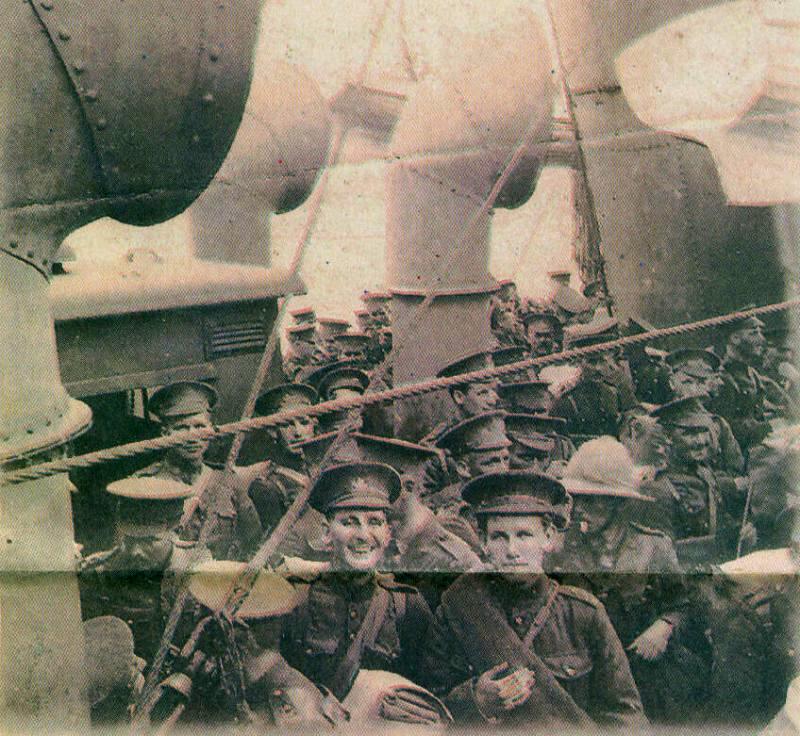
Bermudians en route by troopship to France and Belgium in World War 1.
They died fighting for Bermuda and the UK. For Bermuda soldiers killed in this Great War and buried overseas in a British Commonwealth War Graves-registered plot, they can be researched at http://www.cwgc.org/.
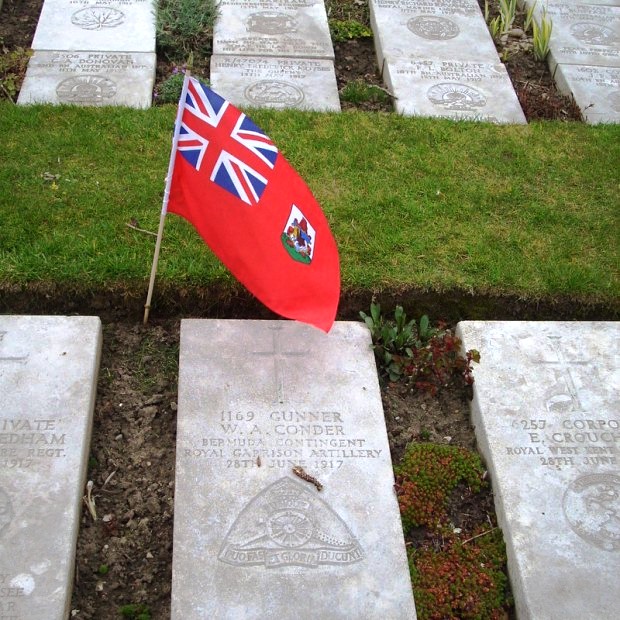
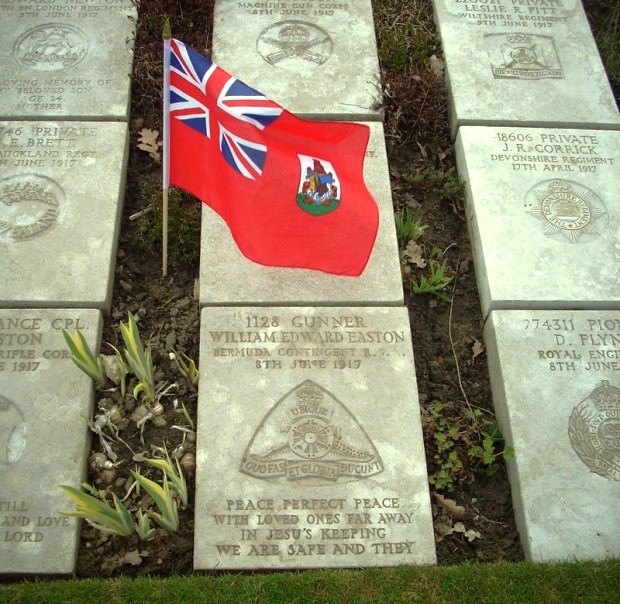
Adcock, Cyril Clarence.
Alick, Richard Thomas Ambrose.
Anderson, W. F.
Arnold, William Henry.
Baker, Henry Arnold.
Baker, Howard Junior.
John Brewer. Died in September 1939 after crashing in German enemy territory while fighting for Britain. He was a flier in the Royal Air Force.
Bridges, Arthur Percy. Brother of Harry Francis Bridges. Died of wounds in Bermuda on February 25th 1918.
Bridges, Harry Francis. Killed at Vermelles, France on November 5th 1916. Lance Corporal, Bermuda Volunteer Rifle Corps attached to 1st Battalion, Lincolnshire Regiment. Service No. 25334. Buried in the British Cemetery in Vermelles. The original wooden cross from his grave hangs on the wall in St. Marks Church, Cherry Orchard, Worcester, England near where he was brought up. His daughter, Eleanor Gibbons-Brown wrote an e-book "War Baby" about her life in Bermuda in the 20th century.
Brown, Ewart Cudmore.
Burrows, John Philip.
Brown, W.
Burgesson, Agnel Eugene.
Cannon, John Arthur.
Conder, Wilfred Augustus. Gunner, Bermuda Militia Artillery. Service number 1169. Died 28th June 1917 at age 25. Grave Memorial IV. A. 17. Buried in Boulogne Eastern Cemetery, France.
Conyers, Walter Neville. Second Lieutenant, 8 Battalion, Royal Berkshire Regiment, son of Emma M. Conyers and James A. Conyers, of Stanmore, Pembroke. Grave Memorial Reference Pier and Face 11 D, Thiepval Memorial. He had enlisted directly into the Royal Berkshire Regiment on March 9 1915 and went to the Western Front on January 13, 1916. He was killed in action at the Battle of the Somme near Bazentin-Le-Petit at the age of 26.
Cooper, John Henry.
Dean, S. G.
Dickinson, Percival Earle. Private, Canadian Army Medical Corps. Service number 2606959. Died 13th October 1918. Grave Memorial Reference 129. Buried at Pembroke Weslyan Cemetery.
Dill, Charles Wentford Alfred.
Doe, Andrew Elliott.
Easton, William Edward. Buried in Boulogne Eastern Cemetery, France.
Farrell, Patrick Joseph.
Fowler, William James. Sergeant, Bermuda Militia Artillery. Son of Julia Caroline Fowler, of Queen Street, St. George's and William James Fowler. Buried at St. George's Military Cemetery, Bermuda. Memorial reference 421.
Frith, Frederick Hervey, Jr. Served in a Canadian Army unit. Possibly with the BVRC earlier. Understood to have been connected with Frith's Hardware, Front Street, Bermuda.
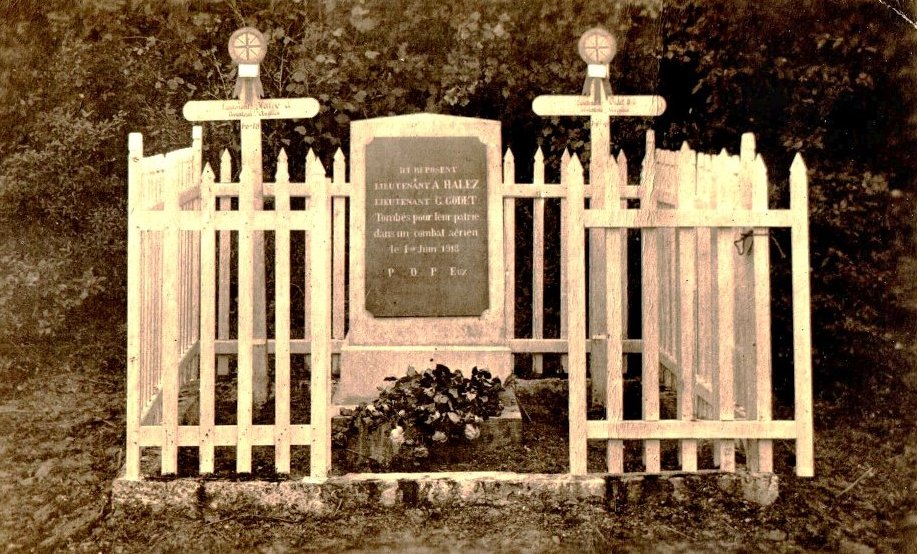
Initial burial place in Antilly, provided by kind-heated locals, of 2nd Lieutenants Leonard Godet and Arthur Haley (spelt wrongly by the locals). They were later reburied, again together.
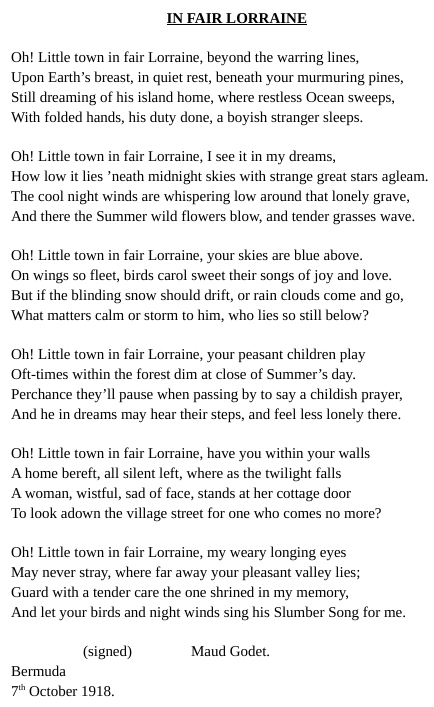
Poem above was discovered by Mrs Janet Bowen (nee Haley), among her father's papers, below, of the poem written by grieving mother Maud Godet of Bermuda about the resting place in Lorraine, France, of her beloved dead son Leonard, buried alongside Arthur Haley. Mr Haley was the great uncle of Janet Bowen, her grandfather's brother. Photos above and additional information and copy of poem above kindly sent in June 2015 to Bermuda Online by Roger Bowen and his wife Janet Bowen, of the UK. Mr and Mrs Bowen also sent a Bermuda Royal Gazette Front Page of October 1, 1918. See 1918-10-01 Bermuda Royal Gazette.pdf. It included (top right) an article entitled "Lt. Godet's Brave End." It credited Mr. F. L. Godet, father of Lt. Godet, for permission to publish an English translation of a statement sent in German by a German major about the death in air combat of Lt Godet. The statement was sent to Mr Godet Senior by a friend residing in Switzerland who was acquainted with the Right Honourable Count Conrad Zeppelin, a well-known and very senior German official and who was appealed to by the friend for assistance in tracing the missing aviator. A courteous reply was promptly given to Count Zeppenin and relayed back via the friend to Lt. Godet's father.
Gorham, Clive William.
Gunn, Archibald D.
Harriott, Nathaniel Benjamin.
Hollis, Edward Kimball. Private, Lincolnshire Regiment ex BVRC. Service number 25343. Died 21st March 1918. Grave Memorial reference Panel 23 and 24. Pozieres Memorial.
Holman, Charles Edward.
Jackson, Cyril Healy.
Joell, Walter. Gunner, Bermuda Garrison Artillery, service number 1035, died 9th December 1918, age 21. Grave Memorial G 27 A. Bois-Gaullaume Communal Cemetery Extension.
Kyme, Walter Robert.
Lamb, Albert Ernest.
Lightbourn, Robert. Killed in action July 26, 1917. Acting Captain, Gloucester Regiment. Born November 2, 1884. 1915 Bermuda Rhodes Scholar.
Marshall, Frederick George.
Martin, William George.
Millett, Henry William.
Morris, Louis William.
Morton, Cyril.
Motyer, Arthur John. Born September 2. 1886, 1905 Rhodes Scholar, killed in action September 15, 1916.
Mussenden, J.
Newton, Walter Ernest. Petty Officer, Royal Navy. Killed on 31 May 1916 during the Battle of Jutland while serving on HMS Fortune. Little is known about Petty Officer Newton’s Bermuda links, although the Commonwealth War Graves Commission states that he was the son of Walter John and Ellen Maria Newton of Bermuda, late of Portsmouth and husband of Ellen Newton, Whitworth Road, Alverstoke, Gosport.
Noble, Herbert Stafford.
O'Connor, James Archibald.
Outerbridge, Benjamin Whitaker.
Pawsey, Frank.
Pitcher, Eldon Liverstone.
Pitman, Byron McWarren.
Place, Charles Wentworth.
Platten, Andrew Richard.
Purdue, Edward Colston.
Richardson, Whitford Stephen.
Robertson, Charles Granville.
Robinson, Cecil Beaumont.
Robinson, Charles Bryan.
Ryder, W. George.
Sheppard, Arthur Leroy.
Simmons, Hayford Douglas.
Smith. A. G.
Smith, Charles Kennelly.
Smith, Donald Gray.
Smith, Frederick Lea.
Smith, Kenneth Nesbit.
Smith, T. Wardell.
William Edmund Smith. The first Bermudian to die in the Great War, on September 22, 1914. He was a black man who had joined the Royal Navy in Bermuda. He was listed by the Royal Navy as "SMITH, William Edmund, L/1874, 1st class cook." He was the son of William Felix Smith and his wife Emma Jane, nee Douglas, of Herman’s Hill, Somerset. Their homestead overlooked the Great Sound on one side and Sound View Road on the other. Mr Smith’s name is on a War Memorial at a churchyard in Kent; St James Parish Church, Somerset and in the Somerset Methodist Church on Long Bay Lane. He was baptized 1893, June 4, at St James Church, Sandys. Smith had joined the Royal Navy in 1912 aboard HMS Sirius which formed part of the Royal Navy’s North America and West Indies Squadron, based in Bermuda. At the end of that tour, he joined HMS Aboukir when the Great War began. Mrs Smith received a letter signed by Mr Winston Churchill, conveying the sympathy of the King and Queen. He was drowned when his ship, HMS Aboukir, an obsolete Cressy Class armored cruiser launched in 1900, was torpedoed in the North Sea off the Hook of Holland. During the early months of World War 1 the Royal Navy maintained a patrol of old Cressy class Armoured cruisers, known as Cruiser Force C, in the area of the North Sea known as the Broad Fourteens. There was opposition to this patrol from many senior officers, including Admiral Jellicoe and Commodores Keyes and Tyrwhitt, on the grounds that the ships were very vulnerable to a raid by modern German surface ships and the patrol was nick named the "live bait squadron". But the Admiralty maintained the patrol on the grounds that destroyers were not able to maintain the patrol in the frequent bad weather and that there were insufficient modern light cruisers available. HMS Aboukir, HMS Cressy, and HMS Hogue of the Seventh Cruiser Squadron were on patrol in the early morning of that day when U-9, a German submarine commanded by Lt Otto Weddigen fired a torpedo at Aboukir, which sank in 20 minutes with the loss of 527 men, including Smith. His name, with 18,000 other service personnel, is on an obelisk at the Royal Naval Memorial in Chatham, south east England and in Bermuda. When two other cruisers, HMS Hogue and HMS Cressy, went to the scene to rescue survivors they too were torpedoed by the same U-boat with a loss of over 1,459 lives. This incident established the U-boat as a major weapon in the conduct of naval warfare. The horrendous loss of life from this early form of submarine warfare had further bleak repercussions. A court of inquiry was set up and found that some blame was attributable to all of the senior officers involved - Captain Drummond for not zigzagging and for not calling for destroyers, Rear Admiral Christian was criticized for not making it clear to Drummond that he could summon the destroyers and Rear Admiral Campbell for not being present and for a very poor performance at the inquiry at which he stated that he did not know what the purpose of his command was. The bulk of the blame was directed at the Admiralty for persisting with a patrol that was dangerous and of limited value against the advice of senior sea going officers.
Steele, Eric Gauntlett.
Stollard, W. Gordon
Stowe, Arthur Granville.
Swan, S. S.
Symons, Joseph Henry Fulton. Gunner, BMA (but he was reported to have returned home on July 1, 1919).
Tatem, Philip Archibald, Bermuda Volunteer Rifle Corps (BVRC). Serving with 1st Bn. Lincolnshire Regiment. Born July 30, 1892, Spanish Point, Pembroke Parish. Killed September 25, 1916 in Battle of the Somme and listed on the Thiepval Memorial (Pier & Face 1C). Oldest son of William Thomas Tatem and Emmie Jessie Miles.
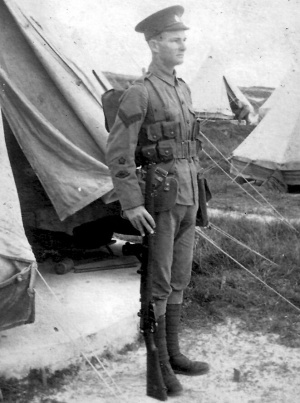
He was the great-uncle of Sherri Panchaud Onorati who kindly sent this photo.
Temple, George. Born in Somerset on December 31, 1879. and later based in Portsmouth, England, Petty Officer, Royal Navy, killed 31 May, on HMS Invincible. His father had also served in the Royal Navy and it is believed that is why Petty Officer Temple was born on the island. He was 37 when he died in the Battle of Jutland.
Thiele, William.
Tiller, William A. Rifleman, service number Z/2722. Died 6th March 1916 at the age of 19. Rifle Brigade ex BVRC. Grave Memorial Reference E. 7. Buried at De Cusine Vavine British Cemetery, Basseux.
Tite, William James. Private, Lincolnshire Regiment ex BVRC. Service number 17156. Died July 16, 1916 at age 21. Grave Memorial Reference Pier and Face 1 C. Thiepval Memorial.
Trimingham, James Joseph Lightbourn, Private, brother of Wentworth Gray. Lincolnshire Regiment ex BVRC. Service number 17160. Died September 15, 1915 at age 21. Grave Memorial Reference I. E. 9. Buried at Brandhoek Military Cemetery.
Trimingham, Wentworth Gray (brother of James Lightbourn Trimingham). 2nd Lieutenant, Lancashire Fusiliers ex BVRC. Died January 4, 1918 at age 27. Grave Memorial Reference VIII. E.16. Buried at Grevillers British Cemetery. A Memorial Death Plaque for him, known as "Dead Man's Penny" (see below) was issued by the British Government to salute him and many others.
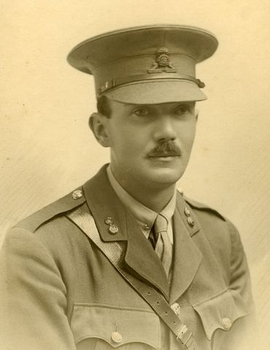
Tucker, Alexander Ewing.
Tucker, Edmund Ernest.
| Tucker, George Frederick S | Tucker, George Samuel | Tucker, St. George Streuli Murray |
| Turini, Basil Louis | Vallis, Alfred Hoare | Wadson, Stanley Parker |
| Ward, Errol Stephen Remsen | Watlington, Henry Joseph | Wears, Rudolph George |
| White, Walter Adrastus | Whitecross, Harold Collins | Wingood, Allan Charles |
Two contingents served as part of the larger Royal Garrison Artillery detachment to the Western Front. The first, 201 officers and men left for France on 31 May 1916. A second contingent, of two officers and sixty other ranks, left Bermuda on 6 May 1917, and was merged with the first contingent in France. The contingent, titled the Bermuda Contingent, Royal Garrison Artillery, served primarily in ammunition supply, at dumps, and in delivering ammunition to batteries in the field. The Contingent served at the Somme from June to December 1916. They were then moved away from the Front, serving on docks until April, 1917, when they were attached to the Canadian Corps, serving in the Battle of Vimy Ridge. They took part in the Battle of Passchendaele (or the Third Battle of Ypres), from 24 June until 22 October, where three men were killed, and several wounded. Two men received the UK's Military Medal. In Bermuda, the BMA was demobilised on 31 December 1918, and when the overseas contingent returned in July, 1919, it was to no unit. Thirty men who chose to remain on temporarily re-enlisted in the RGA, and the rest were demobilised. Field Marshall Sir Douglas Haig commended the contingent. He wrote: "They were employed on heavy ammunition dumps, and great satisfaction was expressed with their work. Though called upon to perform labour of the most arduous and exacting nature at all times of the day and night, they were not only willing and efficient but also conspicuous for their cheeriness under all conditions. On more than one occasion the dumps at which they were employed were ignited by hostile shellfire and much of their work was done under shellfire. Their behaviour on all these occasions was excellent, and commanded the admiration of those with whom they were serving."
They served in France and Belgium in World War 1. Photographed in England prior to their departure to the front. One of those was William (Lanky) Furbert. British Army photo.
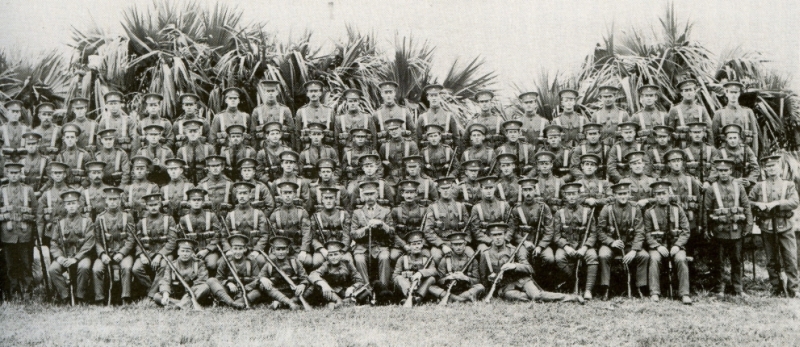
One who enlisted with the BVRC (and lived long enough to write about it) was Allan Livingstone Cooper, one of 16 Bermudians in that unit promoted as an officer during the course of that war. He and his fellow-Bermudians served on the 450-mile long Western Front in France which extended from the Swiss frontier to the English Channel and claimed the lives of an estimated 10 million military personnel and about seven million civilians. He recorded the reaction of troops on the Western Front when the Armistice between the Allies and Germany came into effect at the 11th hour of the 11th day of the 11th month in 1918 in accordance with the Armistice signed by representatives of Germany and the Allied powers between 5.12 and 5.20 that morning.
Cassie B. White. Her wartime actions were so remarkable they prompted General John J. Pershing, Commander-in-Chief of the United States Forces in France, to cite her in 1919 for conspicuous bravery and devotion to duty at great risk under fire.
They died fighting for Bermuda and the Allies. For Bermuda airmen, soldiers, sailors and marines killed in World War 2 and Korean War and buried overseas in a British Commonwealth War Graves-registered plot, they can be researched at http://www.cwgc.org/.
Baxter, Winston C. Died in Italy in September 1944 and was buried at Pompeii. He had volunteered for and was serving in the Bermuda Militia Infantry.
Brennan, Edward Joseph. A stepbrother in Bermuda's Vallis family, he died in June 1945 in action over Germany, having joined the RAF and later transferred to the American Army Air Force. He was awarded the USA's Air Medal, the Distinguished Flying Medal and posthumously, a Purple Heart.
Brewer, John Edward Darrell Carlyle. Of 215 Squadron Royal Air Force, he was killed in action in May 1942 over Singapore, fighting the Japanese.
Burgess, Howard Sinclair. Fireman and trimmer on the Henri Mory, sunk April 26, 1941. Torpedoed by U-110 in the North Atlantic. The U-110 had a very short career of only two sailings and was sunk a few weeks later. It remained afloat long enough for the British to board it and remove an Enigma code machine and many secret documents.
Corbett, Frank Charles. He served with the Royal Navy/Fleet Air Arm on HMS Dipper, not a warship but at Henstridge Airfield, England, built during World War II as a training base for the Fleet Air Arm, who commissioned it as HMS Dipper. He survived the war but died at the age of 47 some months after the war ended, while still in the service.
DeSilva, John. Bermuda Volunteer Rifle Corps, attached to the Lincolnshire Regiment. Killed at Overloon, Holland, October 14, 1944.
Drew, Alfred David Drewsbury. Merchant Navy. On the Bermuda Roll of Honour but neither his date nor place of death are known. At the beginning of the Second World War in 1939, he was a young man of 20 years. He volunteered for convoy service to Britain and was lost when his ship was torpedoed or bombed at Milford Haven while at anchor. His date of death is not known and his name is not recorded on the lists of the Commonwealth War Graves Commission.
John Headley Durham. Royal Navy.
Ede, Herman Francis Grant, Flying Officer, Royal Air Force. 1940. June 8. Killed in action. Following the German invasion of Norway in April 1940, Ede was flying Gloster Gladiators with the RAF's 263 Squadron in Norway protecting the fleet anchorage at Skånland. On 2 June 1940, the squadron was ordered to prepare for evacuation. Along with the remaining members of his squadron and 10 aircraft, Ede embarked on HMS Glorious on 7 June. The next day, Glorious, along her escorts Ardent and Acasta, were sunk by the German battleships Scharnhorst and Gneisenau. Ede was just 23 years old, the son of Ernest Grant Ede and Winifred Louise Ede, of Pembroke, Bermuda. His name is inscribed on the 5th Panel at the Runnymede Memorial, Berkshire, England.
Fowle, Alison William Bluck. Bermuda Volunteer Rifle Corps attached to the Lincolnshire Regiment. He died in late August 1944 at Calvados, France, as his unit was fighting to access Germany.
Frost, Harry Reginald. Bermuda Volunteer Rifle Corps attached to the Lincolnshire Regiment, killed in late April 1945 in Germany.
William Cardy Hollis Hallett, 21 years old, Pilot Officer, Royal Air Force, service number 66559, stationed in Malta where he flew Hurricanes, was killed in action, .He was the son of the Hon.Rupert Carlyle Hollis Hallett DCL.and Jessie Cameron Hollis Hallett, of Juniper Hill, Pembroke, Bermuda. Earlier, he had been Captain of Rossall School, England. 1939-40. Commonwealth War Dead Grave/Memorial Reference: Prot. Sec. (Officers'). Plot E. Coll. grave 19. Cemetery: MALTA (CAPUCCINI) NAVAL CEMETERY,MALTA.
Harris, Elgar Frederick. A British Army parachutist, a Somerset man of the Perinchief family. He died in Tunisia in November 1942, along with all the members of his group who jumped with him from their plane. They were never seen again.
Harris, Warren James. Bermuda Volunteer Rifle Corps attached to the Lincolnshire Regiment, killed in The Netherlands in early October, 1944.
Hennessay, Edward Eugene. Bermuda Volunteer Rifle Corps attached to Lincolnshire regiment, killed March 1945 at Winnekendonk, Germany.
Hughes, Frederick Gerald David. US Army Air Force. Died in an accident in May 1945.
Hutchings, Douglas William Howard. Merchant Navy. Lost on January 16, 1941. An oiler, on one of the two British vessels sunk that day, the Zealandic and the Oropesa.
Hutchings, Harold Edwin.
Linton, James Hugh Arnold. Killed in action in April 1941 in Egypt.
Meyer, Noel Lumley. Was returning to Bermuda via Canada after service with the Royal Air Force, from which he had been invalided out. He was travelling on the Lady Hawkins, one of the "Lady Boats" that had served Bermuda and the West Indies for several decades. The ship was torpedoed on January 19, 1942 south of Boston by U-66, with the loss of 255 souls. Meyer was last seen helping survivors into lifeboats, 71 persons later being rescued.
Monkman, Francis Walter. Bermuda Volunteer Rifle Corps attached to Lincolnshire regiment, killed March 1945 at Winnekendonk, Germany.
Outerbridge, James. Born 5 September 1922. Family lived in Flatts, Bermuda. Educated at Whitney Institute, Bermuda; Rossall School, England. Accepted for Rhodes Scholarship but was interrupted by war. Flying Officer, Royal Air Force. Assigned to 458 Squadron, Royal Australian Air Force (RAAF), then based at Luqa, Malta. He piloted a Vickers Wellington Mark 8 bomber HX 522. It took off from Luqa at about 2020 hours on March 24, 1943 but either had an engine failure or was struck by enemy fire. It ditched off the coast of Sicily. M.E.F. 1941-3. Killed, shot 1 May 1943 while attempting to escape from Allied P.O.W. Camp 21 in Chieti, Italy, while being transported by train by the Germans and Italians to POW prisoner-of-war camp 39 in Palma, Italy, when the train stopped near Rimini. He may have been trying to get to San Marino, then a neutral state 20 kilometres away. During his attempt to escape he was seen and intercepted by a guard who shot and killed him. His body was later identified formally in the mortuary chamber of the Axis military hospital of Rimini. His name is engraved on a tombstone in the military cemetery of Ravenna, Italy, see photo below.
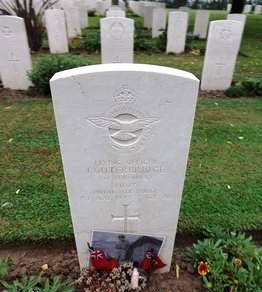
1943 grave of James Outerbridge
Doris Paddock. Her exact role in the Second World War remains undisclosed. She achieved the rank of British Army captain at the age of 19, worked in a special unit that answered to wartime Prime Minister Sir Winston Churchill. She may have worked in espionage or served with Resistance forces in Occupied Europe.
Patterson, Willard. Private, Bermuda Volunteer Rifle Corps, attached to the 2nd Battalion, Lincolnshire Regiment. Killed at Overloon, Holland, October 14, 1944. Service number 18005056. Buried at Overloon with his comrades. British Commonwealth War Dead, Grave Memorial Reference I B. 2, Overloon War Cemetery.
Perenchief, Walter Hewson. Died in action in December 1941 at El Alamein, serving with the British Army.
Scott, Frank. Flying Officer, J/43783, Royal Canadian Air Force. On 1st March 1945 the Wellington bomber in which he was serving crashed into the village of Norton, near Evesham, Worcestershire, England, shortly after taking off from nearby Honeybourne, bound for Germany. He was buried in Norton. He was the son of Arthur Havelock and Rena Scott, Tucker's Town.
Shelton, Stanley Arthur. A member of the Bermuda Volunteer Rifle Corps, he'd been attached to the Lincolnshire Regiment. He died in action in February 1941.
Smith, Major Anthony Frith (Toby). Bermuda Volunteer Rifle Corps, attached to the Lincolnshire Regiment. Killed at Overloon, Holland, October 14, 1944. Major Smith was one of 12 children, five of whom saw active military duties in two world wars. He and the entire first contingent of soldiers of the BVRC and Bermuda Militia Artillery (BMA), survived a U-boat attack in July 1940 and spent several years in the United Kingdom before finally seeing active combat. Meanwhile, his family struggled to make ends meet during the war from their home in the United States and then in Bermuda.
Stephenson, Jay Circott. Bermuda Volunteer Rifle Corps, attached to the Lincolnshire Regiment. Died November 12, 1944 after being wounded by the enemy. He sought shelter in a barn in Holland, which the Germans set fire. His tags and a picture of his girlfriend identified him. He had a brother, Thomas Stephenson, also in the BVRC in Europe, who was not killed but very badly injured, shot twice, in an arm and face, spent years in hospitals in England and and Canada. He later returned to Bermuda, year not known.
Thomas, Alfred John. Royal Air Force, killed in a bombing raid over Germany in July 1943.
Vallis, Daisy Louise W. Died May 5, 1946. Only Bermudian woman killed as the result of WW2. She was killed on her way to be de-mobbed. She was a Leading Aircraftwoman of the Royal Canadian Air Force (Women's Division).
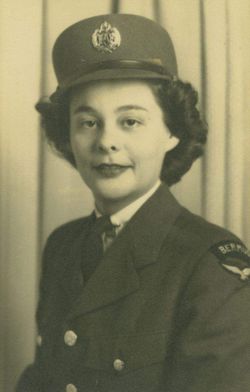
Welch, Geoffrey A. Flying for the Royal Air Force, he was killed in action in early 1943 over Benghazi in Libya during the North African campaign.
West, George Wendell. Died in 1942 at Timor from war wounds.
White, Richard Martin. Bermuda Volunteer Rifle Corps, attached to the Lincolnshire Regiment. Killed at Overloon, Holland, October 14, 1944.
Whitecross, James Standley. He had joined the RAF in November 1940. He was killed when flying over Germany in October 1943.
Williams, Granville Barton. Unlike all other Bermudians, he served in the US Army. On May 2, 1945, he was killed in Europe. Earlier, he had received the Bronze Star, Silver Star and Purple Heart, for valor.
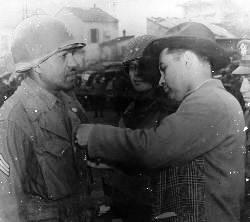
Lieut. Cecil John Greenway Wright, RNVR. Died in action on November 24, 1941. He served in the Royal Navy Volunteer Reserve on HMS Dunedin when it was torpedoed on November 24, 1941, by U-124, halfway between Sierre Leone and Brazil. He was one of the 419 men lost, only 67 of the crew surviving. In 1940, Dunedin had been posted to the America and West Indies Station at Bermuda and thereafter was on the South Atlantic Station, pursuing enemy surface ships in those waters. Wright was a veteran of two World Wars, having served in the Great War in the Canadian Field Artillery and thus was one of the oldest men from Bermuda killed when fighting for the Allies.

1944. The Bermuda Militia force, composed of members of the BMA (Bermuda Militia Artillery) and the BMI (Bermuda Militia Infantry), trained with the BVRC contingent as an infantry force at Prospect Camp. The BVRC contingent was then sent to the Lincolns. The Bermuda Militia contingent, however, proceeded to North Carolina, where it formed the training cadre of a new regiment, the Caribbean Regiment, being formed on a US Army base in North Carolina. Contingents, mostly of new recruits, were sent from various West Indian territories. In North Carolina, they were assessed for fitness, then trained as infantry. The unit was then posted to Italy in 1944. After serving briefly in the field, the Regiment escorted a shipment of Axis prisoners to Egypt, then remained there as prisoner-of-war (POW) camp guards until the end of hostilities. (The Caribbean Regiment was disbanded after the war, and the Bermuda Militia contingent members returned to their original units in Bermuda).
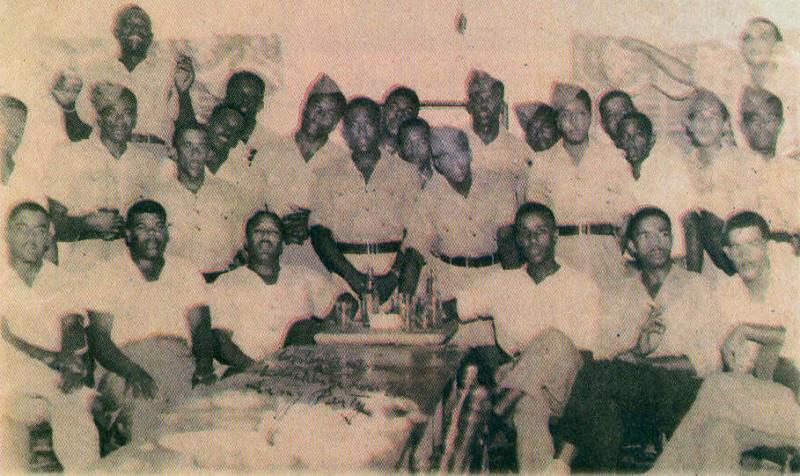
Members of BMA celebrating after the war. They included Sinclair Furbert, with the BMA in Bermuda from 1943 to 1945.
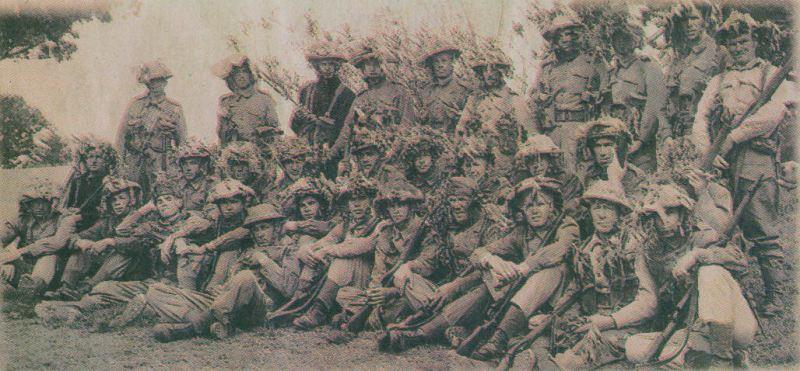
Members of Bermuda Volunteer Rifle Corps sent to Europe in World War 2. They included Herbert Tatem.
Other units included
Other Bermuda women served in England with the Auxiliary Territorial Service.
Home Guard
Bermuda Contingent of the Caribbean Regiment
Some indication of who they were will be welcomed so they can be mentioned here.
This list is not complete by any means. They included
Fred (Red) Adderley, RCAF
Tommy Aitchison (who moved to USA in 2004);
Major Appleby
Robert Ascento
Captain J. Carlton Astwood
Wyndham Barnes
Ernest Benevides (born 1922). Transferred from the Canadian Army to the RCAF. Brother of Lucy Benevides, mentioned below. A Bermudian of Portuguese descent. He attended Saltus Grammar School. He had left Bermuda to attend Queen's University in Kingston, Ontario, Canada at the age of 17, and enlisted in Toronto after receiving his first degree from that university (1943). After WW2 he attended Osgoode Hall Law School in Toronto and became a lawyer and a Queen's Council. He practiced law for decades in Toronto. He was the brother of Lucy Benevides, mentioned elsewhere.
Albert Benjamin (electronic service engineer at HM Dockyard)
Geoffrey Bird (Royal Navy, Fleet Air Arm, later a realtor and a founder member of the Royal Navy Association of Bermuda)
Bobby Burnard, (RAF)
John Brewer, RCAF
Captain N. T. Campbell
John Card
Timothy Joseph Card. Canadian Army. He was among the very first to go off to Canada at the outbreak of the war. It is believed he went to Canada with a group some of whom ended up in the Canadian Air Force. He ended up in the Windsor Regiment (The Essex Scottish) as a Sergeant in the Intelligence Section. They trained near Barrie Ontario and were then stationed near Aldershot in England until they went ashore at Dieppe. He had an enduring friendship with an Officer named Worthington (don’t know the first name). He was wounded on the beach and captured and after convalescence in a POW hospital in France was interned at a Stallag near Dresden. At the end of the war, after several ‘escapes’, he ended up in the then Czechoslovakia (just across the border from Dresden) where he became part of a group running an ‘underground railroad’ assisting escaped and released Allied POW’s who were fleeing toward the west to escape the oncoming Russian forces. The Russians at that time were convinced that once the Nazis were defeated the Allies would turn on them. As a result they had a reputation for executing the internees of POW camps which they over ran - particularly Officers. Many German camp commanders therefore released their internees and told them to make their way to the west. The Czech group was supplying maps, directions, clothing and food to these freed allied troops. My mother, Vera Pokorna-Card, and her family were part of the group. Once the Russians took Czechoslovakia my father made his way to London and worked there to get a war-bride visa for my mother. He was demobilized in Halifax and came back to Bermuda. My mother joined him soon after and they were married at St. Theresa’s." Information kindly supplied by Jan Card, May 2015.
Captain Fred Clipper (US Army). Married into a Bermudian family and made his home here.
Harold Dale, RCAF, later a Bermuda insurance executive
Henry Dallas
Owen Darrell
Lieutenant Colonel Michael Darling
DeFontes
Royston Dodwell, RAF. (His son David became a hotelier and politician in Bermuda)
Eugene Doughty
Jack Exell
Frank Farmer (HMS Ulster);
Benny Ferguson
George Fisher
Ronald Firth
Franklin
Joseph Robert Gibbons, RAF
Major General Glyn Gilbert
Malcolm Gosling
Richard Gorham
Sergeant Grange
Hooper
Arthur (Copper) Jenkins RCAF
Norman Jones RCAF later a Bermuda bank executive
John Keefe (Canadian Army)
Cyril J. Kempe
William Kempe RAF (later a barrister, became one of the founders of Appleby Spurling & Kempe, later Appleby Spurling & Hunter)
David Kopec RCAF
Jim Lang, RAF
Commander Anthony Law RCN
David Lindsay
Joseph Levon. Served with the Bermuda Militia Artillery in WW1 at the Somme and other battles, and then served full-time in the Second World War at the barracks in St David’s. In those days the BMA would march to Warwick Camp with Levon leading the band as a drummer — often with his wife Lillian marching alongside from their home at Bailey’s Bay.
Sergeant John MacDonald
Graham Madeiros
Herbie Marshall
Mello
Teddy Nicholl RAF
Charles Nunn RCAF
Robert Oatway RCAF
Geoff Osborn RAF (awarded the George Medal, see Mid Ocean News story of January 22, 1972. He continued his career in aviation in ATC postwar in Dusseldorf, Germany; Lusaka, Northern Rhodesia (during the Comet runs to Capetown); then at Speke, Stanstead and Heathrow before returning to management in the Bermuda Airport. He retired to Poole, in southern England. His son Michael went into airport management in Bermuda.
John H. (Jack) Osborn, RCAF (brother of Geoff Osborn who served in the RAF); served in Coastal Command of the RCAF in the North Atlantic and the North Pacific (after Japanese invasion of the Aleutians). He later lived in Lumberton, NJ, USA. He kindly supplied this author with some information on himself, his brother and Eldon Williams.
Louis Panchaud
Pete Perenchief RAF
Jack Pitt RAF
Major Patrick L. Purcell (March 16, 1918-February 21, 2002)
Sandy Powell
Arnold Redman RCAF
Richards (first name unknown) RCAF
William Riker
Percy Roach RAF
Anthony Russell
Alfred Simmons, MBE
Slater; A. E
Martin Smith, RAF (later a barrister in Bermuda)
Toby Smith
Francis Stephens, RAF
Norman Sumpter, RCAF, later a Bermuda insurance executive
Squires (first name unknown) RCAF
Jackie Thomas, RAF
Lieutenant J. Brownlow Tucker
Jimmy Vallis, RAF
Stan Walenciak
Wing Commander E. M. "Mo" Ware RAF (after the war when he arrived, he remained in Bermuda and became a Bermudian).
Hubert Fortesque Watlington, RCAF, DFM (died 2003). In September, 1942 he was awarded the Distinguished Flying Medal DFM). He enlisted in the Bermuda Volunteer Engineers on 1 September 1939 and was discharged to enlist in the Royal Canadian Air Force, 12 January 1940. "This officer has displayed exceptional ability and his courage has been an example to his fellow pilots. On this date he was the pilot of an aircraft in the leading flight of a force detailed to attack an enemy convoy with a formidable escort of destroyers and fighter aircraft. Despite the opposition Pilot Officer Watlington pressed home his attack from short range, and although both of his air gunners were wounded during attacks by fighters, this Officer succeeded in evading his attackers and flew his aircraft back to base safely.
Bill Westerfield.
John Hartley Watlington, RCAF. It took him more than a year to escape from France and return home, which he did on 10 July 1944. He authored an account of his adventures published in the Bermuda Historical Quarterly in 1949.
Geoffrey Welch RCAF
Jimmy Whitecross
Eldon Williams, RCAF (older brother of Billy and Charley Williams), RCAF fighter pilot, shot down by friendly fire during D-Day operations. Jack Osborn saw him in hospital in New Westminster, British Columbia in 1945.
Alan (Smokey) Wingood, RAF, DFC, married Peggy from England. Flew Wellington bombers for Bomber Command, later a diver and historian
Herbert (Chummy) Zuill RCAF, later a Bermuda Olympics sportsman and philanthropist.
They included
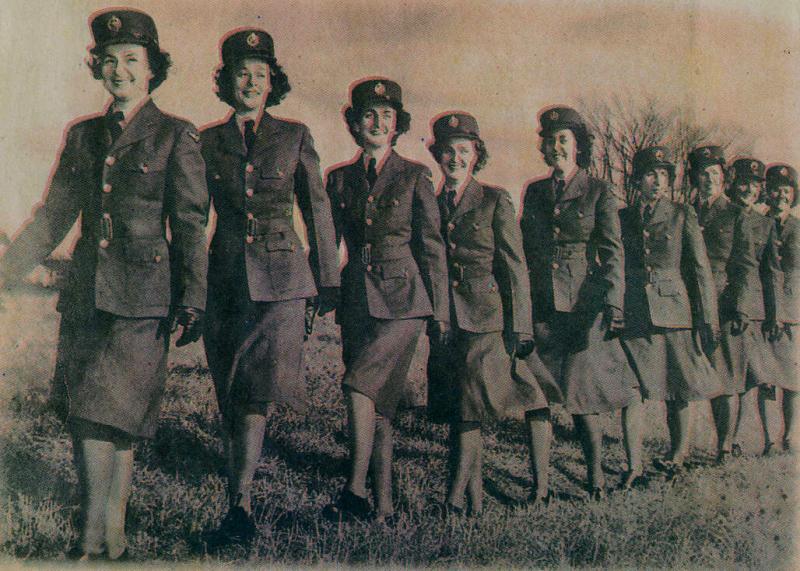
Bermudian women in the Royal Canadian Air Force in World War 2. They included, from left, Lillian Bell, Daisy Vallis, Kathleen Bromby, Iris Jackson, Betty Cousland (later, Leighton), Lucy Benevides, Frida Rigby, Joan Lee and Mary Adams (not shown but present on right). Lucy Benevides stayed in the Royal Canadian Air Force until 1968, eventually as a Captain.
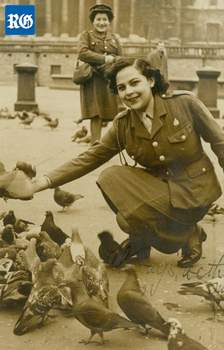 Lobelia Curtis (later
Bubenzer). 2017. October 3. The only enlisted Bermudian woman to
march in the Second World War victory parade in London has died aged 93.
Lobelia Curtis (later
Bubenzer). 2017. October 3. The only enlisted Bermudian woman to
march in the Second World War victory parade in London has died aged 93.
Lobelia “Bella” Bubenzer was just 19 when she traveled to England in 1943 and crossed the U-boat-infested Atlantic in a convoy to enlist in the Auxiliary Territorial Service. She went on to marry a German prisoner of war she met while serving in Oxfordshire before returning home to Bermuda in 1959 with her two sons, Peter and Axel. Son Peter Bubenzer said: “She talked a lot about the victory parade to us as children. She talked about the pride and the camaraderie of all the young women together. She made many friends during the war years that she kept for life.” Mrs Bubenzer was born in July 1924 to James Howard and Doris May Curtis at their home on Middle Road, Paget. One of six children, she attended Paget Glebe School and then Berkeley Institute before pursuing secretarial qualifications. Mrs Bubenzer signed up as a member of the Bermuda Volunteer Rifle Corps and left the island for the first time on December 20, 1943. She paid her own way from Darrell’s Island by flying boat to Baltimore, where she took a train to Halifax before boarding the Pacific Exporter. The old banana boat traveled in a 93 vessel convoy that left on January 23, 1944 and arrived safely in Avonmouth in early February. Mr Bubenzer said: “When she arrived in London she found herself in the middle of an air raid, although to her great surprise everyone was walking around on the street as if nothing was out of the ordinary. She was then assigned to a unit at Bicester in Oxfordshire and served there as a secretary until she was demobbed in 1947. The women slept in huts that could hold 12 and my mother never forgot the spartan accommodation.
While she was in Bicester she was joined by her great friend, Eva Robinson, in the spring of 1944. During periods of leave they decided that they should travel as far away inside the British Isles as they could. They went to Dublin twice, Aberdeen in Scotland and St Ives in Cornwall.” Mrs Bubenzer met August-Wilhelm Bubenzer, a German prisoner of war while stationed in Oxfordshire. The pair struck a friendship and in 1948 they married and moved to Manchester. The couple later settled to London where they had two sons and Mrs Bubenzer got a job working for future newspaper tycoon Robert Maxwell, who had just started a publishing business. But her marriage broke down and Mrs Bubenzer returned to Bermuda with her two sons in 1959. Mr Bubenzer said: “When we first came home we stayed with my mother’s aunt and uncle on Angle Street in Hamilton. I was five and my brother was three and she worked tirelessly to provide for us. Her first concerns were not just providing adequate food and clothing for her sons, but also giving us a good education.” Mrs Bubenzer became the first black woman to serve as secretary to the island’s Magistrates, where she recorded court proceedings. She got a job at American International in 1967 and worked there until she retired in 1989. Mrs Bubenzer continued to travel with Mrs Robinson during her later years and enjoyed an active social life. She decided to move to nursing home Westmeath in 2011, where she remained until her death on Monday, September 25. Mr Bubenzer said: “She was very loving; very protective and wanted to make the best possible life for her children. Above all, my mother loved people, and had friends of all ages and backgrounds over the many years of her life in England and Bermuda, including old Bermuda friends, such as Eva Robinson. We are extremely proud of what she did and the difference she made and also how she struggled when she came back to Bermuda. What she was able to achieve was a minor miracle. She accomplished a huge amount — we were always close and so saying goodbye has been very hard.”
Margaret Ferrar and Eva Robinson, British Army Auxiliary Territorial Services. They endured convoys across the North Atlantic and bombings of cities and towns in England. In May 1945, when World War 2 in Europe ended, Miss Curtis was the only enlisted Bermudian woman to march in the June 1945 Victory Parade in London. Later, she married a German prisoner of war in England.
Altogether there were 29 Bermudian women who served overseas in the Second World War.
Many Bermudian women served in Bermuda during World War 2. Members of the Bermuda Militia Artillery included June Reid Smith and Betty Ingemann.
Civilian women were also employed by local forces. They gave refugee and medical assistance, and supported or operated a host of wartime charity efforts including the Bermuda Women's Auxiliary Force, St. John's Ambulance Brigade, Bermuda Catering Corps and the Bermuda Services Overseas Association.
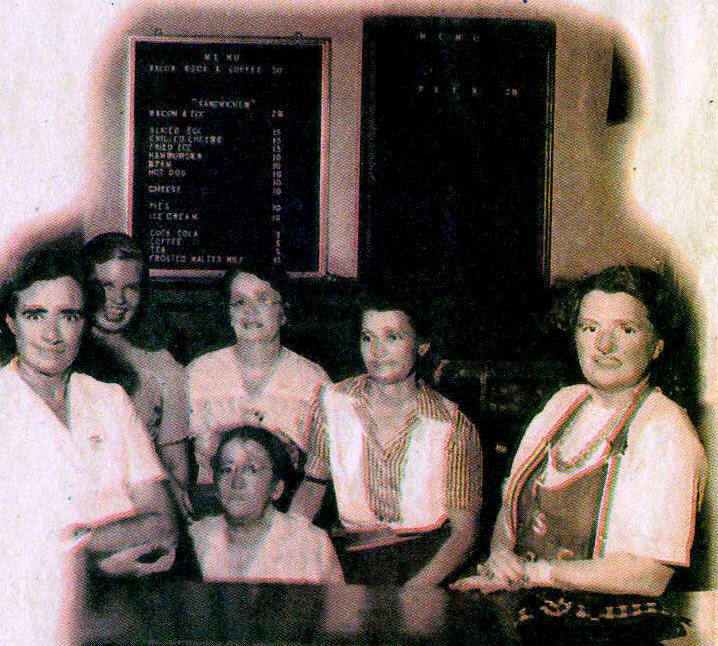
Bermuda Catering Corps war ladies who volunteered their services at the Hamilton Hotel canteen in World War 2. They included, from left to right, Charlotte Ellen Hobbs, Jocelyn Motyer, Mrs Norman Parker, Mrs. Nellie Creelman (seated), Jean Hill Qua and Mrs. William Frith.
Korean War Bermudian
Corporal Henry Eric Dowling, US Army. Killed in action in Korea on December 19, 1950. In US Army records he is listed wrongly as from the US Virgin Islands.
Listed alphabetically. Limited to Bermudians, not those merely born in Bermuda but not Bermudian because they do not or did not have a Bermudian parent or parents. For clarification, see our Bermuda Citizenship.
Elverton A. Mapp, US Army. Son of Mr and Mrs Elverton Mapp of Friswell's Hill. Mr Mapp Jr. lives in Huntsville, Alabama, served as a police officer for a state university. He left Bermuda in 1966 to attend college in Alabama and later enlisted in the US Army in 1971, retiring in 1994. His cousin Lawson Mapp was a Mayor of Hamilton.
R. Luis Villafana. 1st Lt, US Army, Deep Sea Diving officer for 41st PC Company at Phu Cuong, Vietnam. Bermudian mother is related to Petty, Robinson, Gibbons, Chiappa, Card, Adcock, Wainwright, Newman, Watson, etc. Left Bermuda to attend college in USA.
On May 9,
2013 a time capsule filled with soldiers’ memories was laid in place at
Bermuda’s War Memorial. The burial of the safe containing books, documents and
DVDs, marked the completion of the monument on the grounds of Cabinet. The Memorial commemorates
Bermudians who served in the First and Second World Wars. The
Bermuda Archives assisted in acquiring diaries from the First World War,
details of campaigns that Bermudian solders were involved in, and service
records. Veteran Herbert Tatem, who penned the war memoir ‘As You Were’,
stood by as the hole was dug beside the stone slabs bearing the names of
Bermudians who served. Other works included Jennifer Hind’s ‘Defence not Defiance’, a history of
the BVRC, and the military documentaries of Lieutenant Colonel Brendan Hollis. The safe was buried beneath a concrete plinth and a granite
inscription. It will be opened in November 2062 — 50 years after the
Memorial’s dedication.
Banner.jpg)
Authored,
researched, compiled and website-managed by Keith A. Forbes.
Multi-national © 2020. All Rights Reserved