

By Keith Archibald Forbes (see About Us).
|
See at bottom of this page a listing our many History files |
1952. Last visit to Bermuda of the Canadian Ladyboats "Lady Nelson" and "Lady Rodney." They were sold to an Egyptian shipping company.
1952. Then a young and not-yet-internationally famous Canadian actor, Christopher Plummer arrived in Bermuda. He had made his professional debut in 1948 with Ottawa’s Stage Society, performing over 100 roles with its successor, the Canadian Repertory Theatre. He then joined the Bermuda Repertory Theatre — a professional theatre company based out of the old Bermudiana Hotel in Hamilton — for its 1952 season. Performing for visitors and locals at a small theatre at the hotel, the Bermuda Repertory Theatre was for several years a magnet for young, up-and-coming American and Canadian actors. Mr. Plummer performed in half-a-dozen plays during his time in Bermuda, playing Old Mahon, “The Playboy of the Western World,” Anthony Cavendish in “The Royal Family, Bermuda Repertory Theatre”, Ben in “The Little Foxes”, Duke Manti in “The Petrified Forest”, Father in “George and Margaret”, Hector Benbow in “Thark” and Bernard Kersal in “The Constant Wife.” His success in Bermuda caught the attention of a US producer which led to Mr. Plummer being cast in a 1953 American tour of the play “Nina.” In the 1960s he achieved his permanent claim to fame as the lead character in the Austrian-made film The Sound of Music."
1952. Bumping over the old barge bridge became a thing of the past in late 1952 when Kindley AFB's new Long Bird Bridge, built entirely and solely by the US Military at US taxpayers' expense, was officially opened. (Technically, at that time, it was part of what had been since 1941 the leased Kindley Air Force Base of the US Army Air Corps, later the USAF).
1952. Among the Bermudian members of the Kindley Air Force Base Flying Club was Sidney Stallard. He flew a Piper Cub and used his flying jaunts to take many photos of the Island.
1952. 5 June. Death in Bermuda of Louis Leon Arthur Mowbray, the founding curator of the Bermuda Aquarium, Museum and Zoo. He was born in St. George's oon 19 August 1877. In about 1907 the Bermuda Natural History Society asked him to create the aquarium and a marine research centre. He was so successful that he became known to American scientists and later moved to Boston to create a similar facility there. In 1914, he relocated to New York. where he did the same. He was also involved in the Miami aquarium. In 1926 he was induced to return to Bermuda and built the Bermuda Aquarium. A friend, Dr. Charles Townsend, an American zoologist, organised overseas trips, paid for by the prominent American multi-millionaire, philanthropist and sailor Vincent Astor, then a Bermuda resident to collect new fish specimens. Mowbray and Astor sailed to the Galapagos Islands in Astor's luxurious yacht to collect tortoises and penguins. Mowbray became the first person to successfully breed Galapagos tortoises and penguins in captivity, at the Bermuda Aquarium.
1962. June. Queen's Birthday celebration on Front Street, Hamilton.

Bermuda's soldiers and Royal Navy units marched along the route, with the Queen of Bermuda vessel alongside and passengers looking on,
1952. August. Via Cable & Wireless, an office for the acceptance of telegrams within the Customs Area of the Civil Air Terminal was opened by the Bermuda Visitors Service Bureau, in conjunction with the Bermuda Chamber of Commerce.
1952. The Bermuda Public Services Union (BPSU) was established. The founding members were all Heads of Government Departments who included: Mr. Ralph Gauntlett, O.B.E., E.D. Collector of Customs; Mr. Martin Godet, Senior Magistrate: and Mr. Donald J. Williams, Inspector of Schools. A statement issued on behalf of the group said, "Recognizing the importance of its Civil Service establishments to the smooth and efficient operation of any country, and being gravely concerned over the fact that it was becoming increasingly difficult to induce qualified young men and women to enter the Civil Service of Bermuda, and what that portends, a number of civil servants met some months ago to consider the situation."
1952. The Committee of 25 was established by a group of non-Bermudian women. They were led by Canadian-born Edna Watson who in 1948 had become, with Hilda Aitkin, had become the first women in Bermuda's Parliament. Initially, they were appalled by conditions at the Packwood Old Folks Home. One of their major projects was the creation of a children's convalescent hospital at Ireland Island where Lefroy House is today.
1952. December 6. Cubana's "Estrella de Oriente" ("Star of the East") DC-4 registration CU-T397 from Madrid crashed in Bermuda on its way to Havana, shortly (3 miles) after leaving Bermuda. Many died, including Capt. René Ayala, who commanded the aircraft. A dramatic rescue operation was mounted from Kindley AFB Bermuda to save the passengers of the stricken Cubana Airlines - Compañía Cubana de Aviación S.A -.aircraft which took off from the Civil Air Terminal but crashed into the waters of Castle Harbour at the end of the runway at about 4.30 pm. Bermuda had been well prepared for such a rescue operation, due to the previous establishment at Kindley Air Force Base of crash boats imported and operated especially for such an emergency. Two US servicemen on board the 35-foot crash boat that went out to rescue the aircraft's passengers heard faint screams coming from the dark, oil-slicked water. They leapt overboard without lifelines or preservers, in an attempt to rescue the passengers. But despite their heroic efforts, and those of others, in rescuing four people, the balance of the passengers and crew of the stricken aircraft - some thirty seven people in all - perished from wounds incurred in the crash.
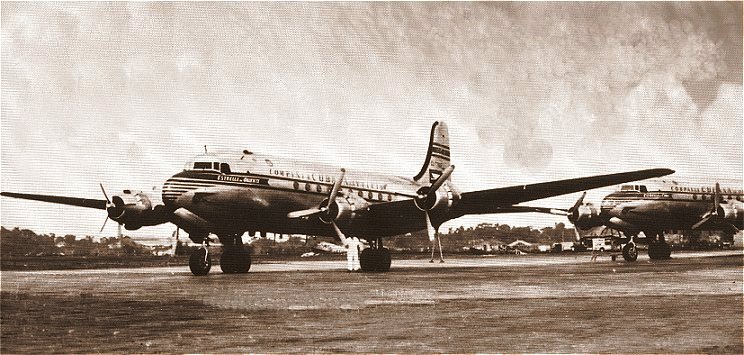
Cubana's Estrella de Oriente DC4 before her crash. Photo courtesy Compañía Cubana de Aviación S.A.1995.
1953. First of three visits of John F. Kennedy to Bermuda, at the age of 36 and about to become a Senator. He stayed at Eventide (now Kennedy House, after the late President) on Burnt House Hill. It was then owned by his friend, wealthy American Oliver Newbury. He fell off his moped on that hill. He was invited by Mr. Brooks, a school friend of Mr. Kennedy who was also friendly with Mr. Newbury.1953. April. A Bermuda Parliamentary Select Committee on Race Relations was appointed and met to consider the race question. The group consisted of black and white Members of the Colonial Parliament. They met on an irregular basis for eight months and reported to the House in late January 1954. Their remit included consideration of occupational opportunities for blacks in government service, institutions subsidized by the government and those in the private sector. They noted segregation in government and aided, non-governmental and unaided organizations, Trade Development Policy toward colored visitors and more. But nothing significant was done.
1953. Lois Browne-Evans became Bermuda’s first female, black lawyer.
1953. Iridomvrmexhumilis (the Argentine ant) was accidentally introduced to Bermuda, in imported nursery plants.
1953. June 2. Coronation of Queen Elizabeth II in Westminster Abbey, London. Bermuda sent a delegation.
1953. July. Edwin McDavid, the black President of the State Council and Minister of State for British Guiana (later, Guyana), arrived in Bermuda with his wife by accident. The BOAC aircraft carrying him (and his wife) to London to be knighted by the Queen had to make an unscheduled atop in Bermuda, owing to engine trouble. As Bermuda's Inn Keepers Act of 1930 did not allow Jews or Negroes or Catholics to enter a white hotel or guesthouse, only at the black Imperial Hotel, they were not allowed entry at the St. George Hotel, like other passengers. McDavid and his wife protested this by returning to the airport where they spent the night sleeping on benches in the airport lounge. The same thing had happened a little earlier to the black Speaker of the Barbados House of Assembly, bound for London for the same reason, who also went from Barbados via Bermuda. The six black Members of Bermuda's Colonial Parliament sent a letter of protest to the Governor, but it did not result in any remedial action.
1953. The Shell Co. of Bermuda purchased a site on East Broadway for the purpose of constructing a modern service station. Holmes, Williams and Purvey (HWP) immediately started negotiating with a view to being appointed as Managers, and with the completion of the station early in 1953 were informed they had been successful. It began HWP's partnership with Shell.
1953. Despite the limited property-based franchise, nine of the black candidates contesting seats in the general election were returned as members of the House of Assembly.
1953. Death in Bermuda at the age of 81 of John J. Bushell, whose Bermuda handbook tourist guide made him a unique local resource.
1953. Acclaimed American actor Charlton Heston (1923 to 2008) performed in Bermuda, in a production of Shakespeare's Macbeth. The superstition surrounding this play may have affected him in more ways than one. Productions of “Macbeth” — which involves witchcraft, the unbridled political ambitions of a Scottish warlord and murder — are said to have been plagued with accidents, some ending in death. According to legend, this dates back to the premiere of the play in the early 17th century: an actor is said to have died because a real dagger was mistakenly used instead of the prop. Academy Award-winning actor Heston played the title role in “Macbeth” in this Bermuda production at Fort St. Catherine directed by Burgess Meredith. During the first performance, when he was riding a horse bareback around the East End fort’s ramparts, Mr. Heston (pictured below) suddenly rushed off stage, pointing at his tights, writhing in pain and yelling: “Get them off me!” According to the actor’s later autobiography, whoever had laundered his tights had dipped them in kerosene and the sweat of the horse and the heat caused serious burns to Mr. Heston’s legs and groin. Later, the wooden facade of Macbeth’s castle came down burning as planned, but the wind blew flames and smoke into the Bermuda audience. Fortunately, nobody was injured. Despite these mishaps, Mr. Heston — who went on to appear in such films as “The Ten Commandments” [1956], “Ben-Hur” [1959] and “Planet of The Apes” [1968] — returned to Bermuda the following year to appear in a production of “Born Yesterday” with original Broadway stars Jan Sterling and Paul Douglas. He said that the worst thing to happen to him on this second visit was getting sunburned at the Coral Beach Club when he was posing for publicity photographs with his co-stars [below].
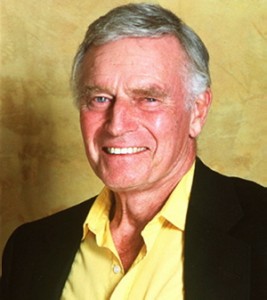
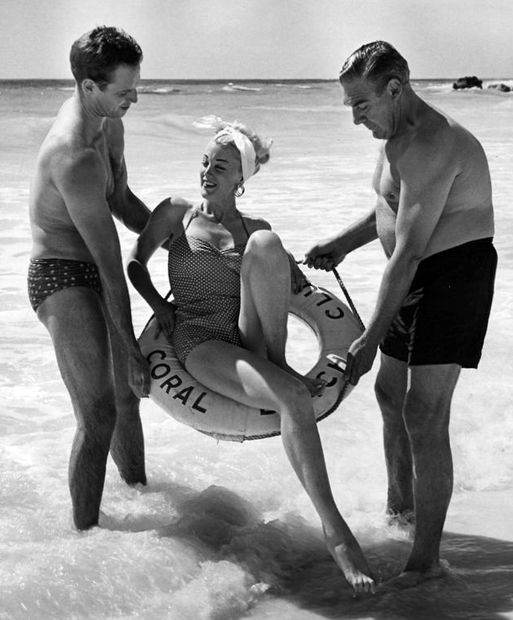
Charlton Heston and colleagues in Bermuda
1953. Bermuda was established as a separate Catholic Church entity, which eventually led to Bermuda becoming its own diocese and to have its own Bishop. Prior to 1953, from 1853, Bermuda was a mission of Halifax, Nova Scotia, the Archdiocese. During those 100 years, the Archdiocese would regularly send down priests and bishops to minister to Catholics on the island.
1953. June 15. The Royal Navy's submarine HMS Andrew became the first submarine to cross the Atlantic entirely underwater, using the "snort" system. She sailed from the Royal Navy Dockyard in Bermuda
1953. Members of the Bermuda Volunteer Rifle Corps had their photograph taken (see below) while at Dockyard, with Seeward S. Toddings, Chairman of the Defence Board, present.
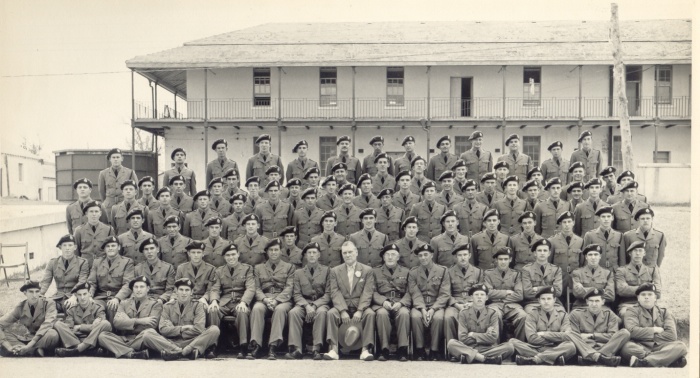
Bermuda Volunteer Rifle Corps (BVRC), Bermuda's then segregated (white) unit of the local armed forces, at Dockyard with Defence Board Chairman Seward S. Toddings. Royal Gazette photo.
1953. September 16. Air/Ground services previously provided by Cable & Wireless (West Indies) Ltd were taken over by the United States Air Force's Kindley Air Force Base.
1953. The last Bermuda-affected British Imperial Defence Plan was published. Bermuda had been given notice two years earlier by the UK of the intention to withdraw within three years all British military units based in Bermuda. From that time, all Bermuda part-time soldiers ceased to have any role or function assigned by the UK's War Office (later, Ministry of Defence or MOD). The Bermuda Government would be purchasing nearly all Imperial Land Forces property on Ireland Island including the Royal Naval Dockyard for £750,000, with £350,000 to be paid in 1954. A Bermuda Government-owned land company, Crown Lands Corporation, was created in which to vest the new lands, buildings and installations that with the establishment of the Dockyard free port was about to begin leasing.
1953. November 1. Via Cable & Wireless (WI) Ltd in Bermuda, a new teleprinter communications center opened at the Civil Air Terminal for overseas civilian aeronautical traffic, operated by the Department of Civil Aviation.
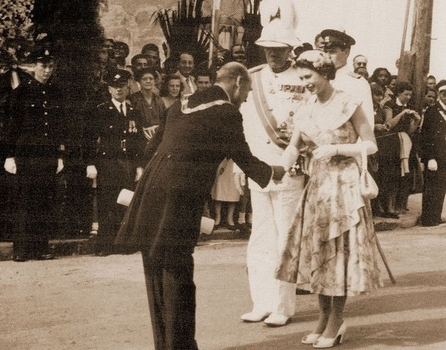 1953.
November 23/24. The young Queen Elizabeth II, and her husband the Greek-born Duke of
Edinburgh, himself with royal blood, arrived in Bermuda after a grueling 16-hour flight with a refueling
stop in Gander, Newfoundland, on board the luxurious and especially
furnished for the flight Canopus,
a Boeing 377 Stratocruiser, then an advanced, propeller-powered commercial
airliner, which was operated by British Overseas Airways Corporation, a
predecessor to British Airways. (The
Canopus would return to the island just a week later with Sir Winston, here for
the Bermuda Conference, with Dwight Eisenhower of the United States and
France’s Prime Minister, Joseph Laniel).. The
Canopus was flown by one of Britain’s most experienced pilots, Anthony C.
Loraine, who was 43 at the time, with a total of 14,300 hours flying time,
including secret missions flying Sir Winston Churchill, the Prime Minister, to
the USA. The
Queen and Duke were accompanied by a royal retinue that included Sir Michael Adeane, her private secretary, Lady Alice
Egerton, the Queen’s lady-in-waiting, and a personal staff member.
1953.
November 23/24. The young Queen Elizabeth II, and her husband the Greek-born Duke of
Edinburgh, himself with royal blood, arrived in Bermuda after a grueling 16-hour flight with a refueling
stop in Gander, Newfoundland, on board the luxurious and especially
furnished for the flight Canopus,
a Boeing 377 Stratocruiser, then an advanced, propeller-powered commercial
airliner, which was operated by British Overseas Airways Corporation, a
predecessor to British Airways. (The
Canopus would return to the island just a week later with Sir Winston, here for
the Bermuda Conference, with Dwight Eisenhower of the United States and
France’s Prime Minister, Joseph Laniel).. The
Canopus was flown by one of Britain’s most experienced pilots, Anthony C.
Loraine, who was 43 at the time, with a total of 14,300 hours flying time,
including secret missions flying Sir Winston Churchill, the Prime Minister, to
the USA. The
Queen and Duke were accompanied by a royal retinue that included Sir Michael Adeane, her private secretary, Lady Alice
Egerton, the Queen’s lady-in-waiting, and a personal staff member.
The Bermuda flight was because the new Royal Yacht Britannia was not quite ready for launching, it happened some weeks later. It was shortly after her accession to the throne after the death of her much-loved father King and last Emperor George VI who had died on February 6, 1952 while she and her husband were on a tour of Kenya, It was then that she first became Queen. Her coronation had been five months earlier, in London. Bermuda was her first stop on a 30,000-mile, six-month world tour to introduce herself to her subjects worldwide The tour saw her attend 223 receptions, give 157 speeches and open seven parliaments. God Save The Queen was sung 508 times. She travelled 18,850 miles by sea, over 173 days,19,650 by air, 9,900 by road and 1,600 by rail. It also saw the maiden voyage of the royal yacht Britannia. In all, the Queen and the Duke of Edinburgh were away from home and their young children for 173 days, including Christmas Day. The Queen’s trip was to take the young monarch round the world to the far-flung corners of the old empire, from Australia and New Zealand to Fiji, Tonga, the Cocos Islands, Ceylon, Aden, Uganda, Malta and Gibraltar.
It all began in Bermuda, England’s third attempt at creating a colony, its second successful one, after Jamestown, Virginia — and with Virginia being the key state in the creation of the United States, Bermuda was then - and still is - Britain’s oldest colony. In what was described at the time as “Bermuda's proudest moment”, a monarch set foot in Bermuda for the first time in 344 years on November 24, 1953. She spent just over 24 hours on island with the Duke. In the past, there had been three visits by future kings, and other visits by royalty, but never since settlement in 1609 had a sitting monarch ventured to the island. Not surprisingly, this was a huge event and was greeted as the “Greatest Royal Occasion of Them All”, according to one headline. Crowds began to gather shortly after dawn at various vantage points on the island. Canopus circled St George’s Island twice a half-hour ahead of its scheduled arrival time of 10am. It was met and saluted in mid-air by five of Hugh Watlington’s seaplanes then based on Hinson's Island in the Great Sound. Mr Watlington was not there himself but had been asked to be among those scheduled to receive awards from the Queen. The royal aircraft landed at Kindley Field, the US Air Force Base, built as part of the lend-lease agreement key to Britain’s survival in the Second World War (now LF Wade International Airport). On their arrival the royal couple were greeted by Governor Lieutenant General Sir Alexander Hood. his wife Lady Evelyn Hood. daughter Miss Rosemary Hood, and local VIPs including Lady Hood, Miss Rosemary Hood, Wing-Commander John Fountain and Wing-Commander E. M. Ware.
The Queen then inspected a joint guard of the Bermuda Rifles and the Bermuda Militia, the segregated antecedent units to today’s Royal Bermuda Regiment, many of whom had seen active service in Europe, North Africa and Palestine. A drive to St George, via Kindley Field Road was lined with thousands of people. The Queen and Duke, flanked by Archdeacon John Stow and the Governor, visited St. Peter's Church in St. George's, the oldest Anglican church in the western hemisphere. The steps of the church were lined by Girl Guides and Brownies. The Queen was greeted by Archdeacon John Stow, rector of St. Peter's, and with him climbed the steps and passed through the portals of the church which has been so closely linked with the history of the Colony. [In 1616 St. Peter's served as the first meeting place of the court of general assize, and within its walls the first General Assembly met in August 1620. The first Crown Governor sent to Bermuda, Sir Robert Robinson, had his first proclamation read in St. Peter's in 1687]. King’s Square, the primary gathering place in the oldest continually occupied English town in the western hemisphere, saw an estimated 2,500 people squeeze in. On their way west from the airport, just after entering Wilkinson Avenue, the Royal Car - the Governor's - passed by the Lyceum building where cub scouts in the group organized and led by Captain F. W. Clipper, a US Army man who met and married a Bermudian and stayed here, all stood to attention in their uniforms. An hour later, on the way to Langton Hill, commonly called Government House, their route was again lined with thousands of well-wishers. A motorcade made its way through Flatts and were greeted by groups of Brownies, their excited hurrahs evoking smiles of pleasure from the royal pair.
Later, the Queen and Prince Philip were driven under a cedar arch erected, fittingly, over Cedar Avenue, to the Sessions House, where she addressed dignitaries in the House of Assembly, the third-oldest parliament in the world after the UK and Iceland. There, finally, after nearly 376 years of settlement, a monarch sat at the Throne Chair: between portraits of King George III and Queen Charlotte, reclaimed by a Bermudian-based British army from the White House in Washington during the War of 1812 and given to Bermuda as a gift. Bermuda’s leadership and their spouses filled the room, including J. T. Gilbert, the chief justice and president of the Legislative Council, the Right Reverend J. A. Jagoe, the Bishop of Bermuda, the Colonial Secretary, Attorney-General, the assemblymen, Councillors and members of the military. In a speech broadcast throughout Bermuda on its two radio stations, and simulcast by the BBC in Britain, she spoke of “the respect and tolerance of the British for the rights of the individual”, and lauded the way in which “in two World Wars, Bermudians have proudly stepped into the position they inherit as the oldest unit of the British Commonwealth”. The entourage then moved to Heyl’s Corner and Albuoy’s Point, where the Queen spoke to a massed gathering of Brownies and Girl Guides, at her request. She later met a decorated veteran of the British West Indies Regiment in the Ashanti Wars, ex-Sergeant Major James “Dick” Richards, still fit enough to wear his Bully Roosters’ distinctive uniform, Colonel B .J. Tucker of the Bermuda Volunteer Rifle Corps, and a sailor, ex-Petty Officer Walter Card, RN. Represented at Albuoy’s Point was the War Veterans Association, the Bermuda Contingents of the Caribbean Regiment 1939-1945 and the Royal Garrison Artillery 1914-1918, ex-servicewomen, and various youth groups, including Sea Scouts, Boy and Cub Scouts, Red Cross committee for the blind and the St John’s Ambulance Brigade. From there, lunch was then taken aboard a local vessel, The Wilhelmina, pressed into service that day as the “royal yacht”. The lunch consisted of cold vichyssoise, Bermuda lobster mayonnaise, breast of chicken Regina en aspic, artichoke bottoms jardiniere, asparagus tips, plum tomatoes, fresh fruit salad, coupe nesselrode and coffee. The vessel cruised the Harbour Islands and the Great Sound before docking at Mangrove Bay, where the Queen and the Duke of Edinburgh went for a brief walkabout before watching yacht racing and meeting officers and enlisted men at the Royal Naval Dockyard on Ireland Island North.
A glitch in the monarch’s tour included the accidental bypassing of war veterans Royal Canadian Air Force Flight Lieutenant Hugh Watlington who earned the Distinguished Flying Medal in action over Malta, Corporal A.W. Flood, BVRC and Royal Lincolnshire Regiment and Sergeant R.C. Butler, Caribbean Regiment, who were due to be presented at Albouys Point. Another was the vetoing of a proposed unofficial gift to the Queen. A miniature of Her Majesty, painted in oils on ivory by Doreen Musson, and set in a silver frame surmounted by a gold St Edward’s crown inset with diamonds, was deemed by Sir Alex as “not coming under the category of gifts Her Majesty is able to accept”. The Queen honoured seven people for their connections to the arrangements of the visit, led by Sir Alex, who received the Knight Commander of the Royal Victorian Order, and O. R. Arthur, the Colonial Secretary, who was awarded the Commander of the Royal Victorian Order. Commissioner of Police R.G. Henderson, received the Member of the Royal Victorian Order, Class 4, and W. James Williams, assistant secretary of the Trade Development Board, and Stanley Trees, of the Colonial Secretariat, received the RVO, Class 5. Royal Victorian Medals were awarded to Charles Whayman, the Government House coachman, and Edwin Heard, the Government House chauffeur, and to Reginald Raymond Dill, who piloted The Wilhelmina.
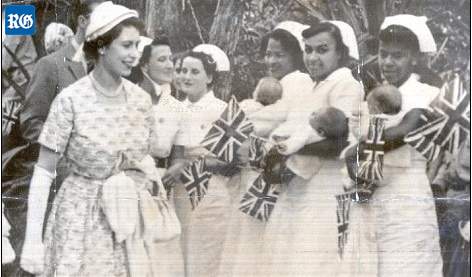 Also visited was
King Edward VII Memorial Hospital where she met and chatted with nurses (see
photo) and the United States Air Force Bermuda-based Kindley Air Force
Base adjacent to the Civil Air Terminal where her aircraft landed Later,
the Queen and Duke went on board the Wilhelmina, which cruised among the
islands of Great Sound while luncheon was served.
Also visited was
King Edward VII Memorial Hospital where she met and chatted with nurses (see
photo) and the United States Air Force Bermuda-based Kindley Air Force
Base adjacent to the Civil Air Terminal where her aircraft landed Later,
the Queen and Duke went on board the Wilhelmina, which cruised among the
islands of Great Sound while luncheon was served.
When she left Bermuda, it was to the sound of a bagpipe played by Tommy Aitchison, official piper to the Caledonian Society. After their brief one day Bermuda visit they flew to Jamaica, their next stop, where they boarded the steamship Gothic to New Zealand. Britannia, built on Clydebank at a cost of £1.8million – and designed to be converted into a hospital ship in times of war – would take them home from Tobruk, Libya, after the tour. For months beforehand, UK newspaper snippets appeared about the schedule, weather and transport. The tone was solicitous, almost anxious, perhaps understandably. Elizabeth was the fourth monarch on the throne in less than 20 years and had two young children she would have to leave behind for six months.
By departure day, November 23, the headlines in the London press had become a blizzard: “Queen off tonight at 8.45, Weather for first stage favorable”, “Final check up on Stratocruiser”, “4,770 miles in 42 hours with day in Bermuda.” A map of the route was printed. Royal Navy ships were stationed all the way across the Atlantic. Hartnell’s the Queen's dressmakers - delivered the Queen’s dresses to the Palace: the only details released, for fear of copying, were the colors – candy pink, pale rose, blue, yellow and white – and that some dresses were cotton print and others contained up to 100 yards of tulle. At a state dinner held the next day in honor of the Queen, 30 persons were invited, but not one of them was black. This was duly noted by the UK's Daily Herald newspaper as a deliberate slur of the British Commonwealth's millions of blacks. The newspaper blamed Bermuda's Governor.
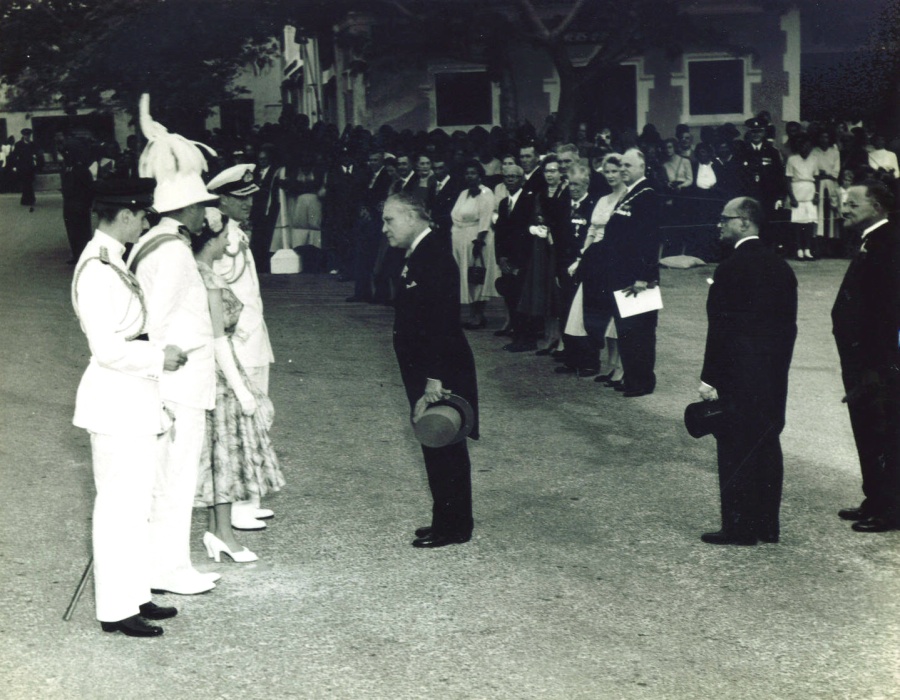

Royal Visit November 1953. S. A. Toddings, MCP is shown greeting the Her Majesty the Queen and His Royal Highness the Duke of Edinburgh. They were accompanied by Bermuda's Governor and his aide-de-camp. To the far right are members of the Bermuda Government. Royal Gazette photo.
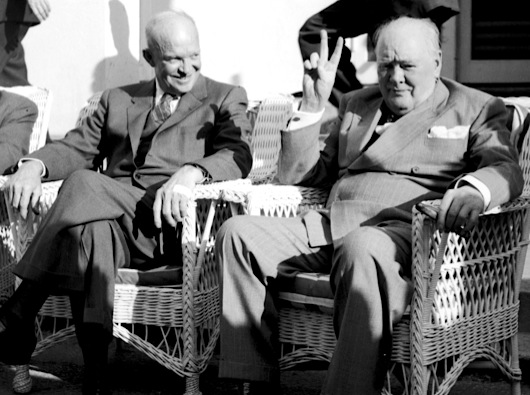
1953. December 4. Bermuda hosted her first Summit Conference when United States President Dwight D. Eisenhower met with British Prime Minister Winston Churchill and French Premier Joseph Laniel. Messrs. Eisenhower and Churchill had visited Bermuda during World War II, but Bermuda had not yet seen any elected leader of France. Churchill wanted the meeting because he felt French interest in the proposal hampered the cause of the post-war Western Alliance. He sought a united British, American and French accord against the idea. On the day of his arrival, Premier Laniel visited some leading tourist attractions including the Aquarium and Natural Zoo, Crystal Caves and St. Peter's Church. He incurred a slight mishap when he slipped on the coconut matting leading into the caves, but was caught and righted before he fell. But during the same excursion he contracted a chill which turned into a bad cold, as the result of which his Foreign Minister, M. Georges Bidault, substituted for him for the rest of the conference. For a formal dinner at Bermuda's Government house involving the three prominent participants, Churchill introduced a goat into the room, a military mascot; and smoked cigars. Several days later at least one prominent French newspaper, published in Paris, reported Monsieur Laniel as being frigidly not amused with Churchill's preoccupation with the goat, to the extent of inviting it to dinner with world leaders - and sick to his stomach from what he described as the "stench of the British Bulldog's cigars polluting the atmosphere in the after dinner conference." President Eisenhower, Churchill and Laniel spent four days in Bermuda. Their geopolitical discussions centered mostly on relations with the USSR as the post-war Cold War began to intensify. Within hours of the commencement of the conference came an official note from Moscow which requested, in somewhat brusque terms, a 4 Power meeting involving the Russian leader. Also on the agenda agreed by Churchill and Laniel was a speech President Eisenhower delivered to the full Assembly of the United Nations in New York a few days later.
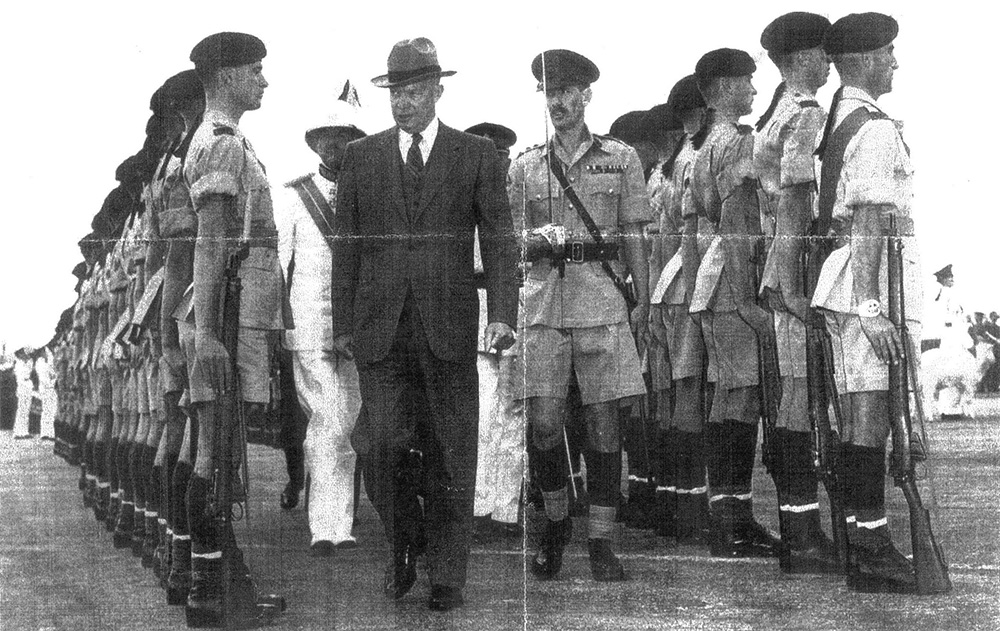
President Eisenhower inspected an Honour Guard of British Troops on his arrival. accompanied by Governor Sir Alexander Hood
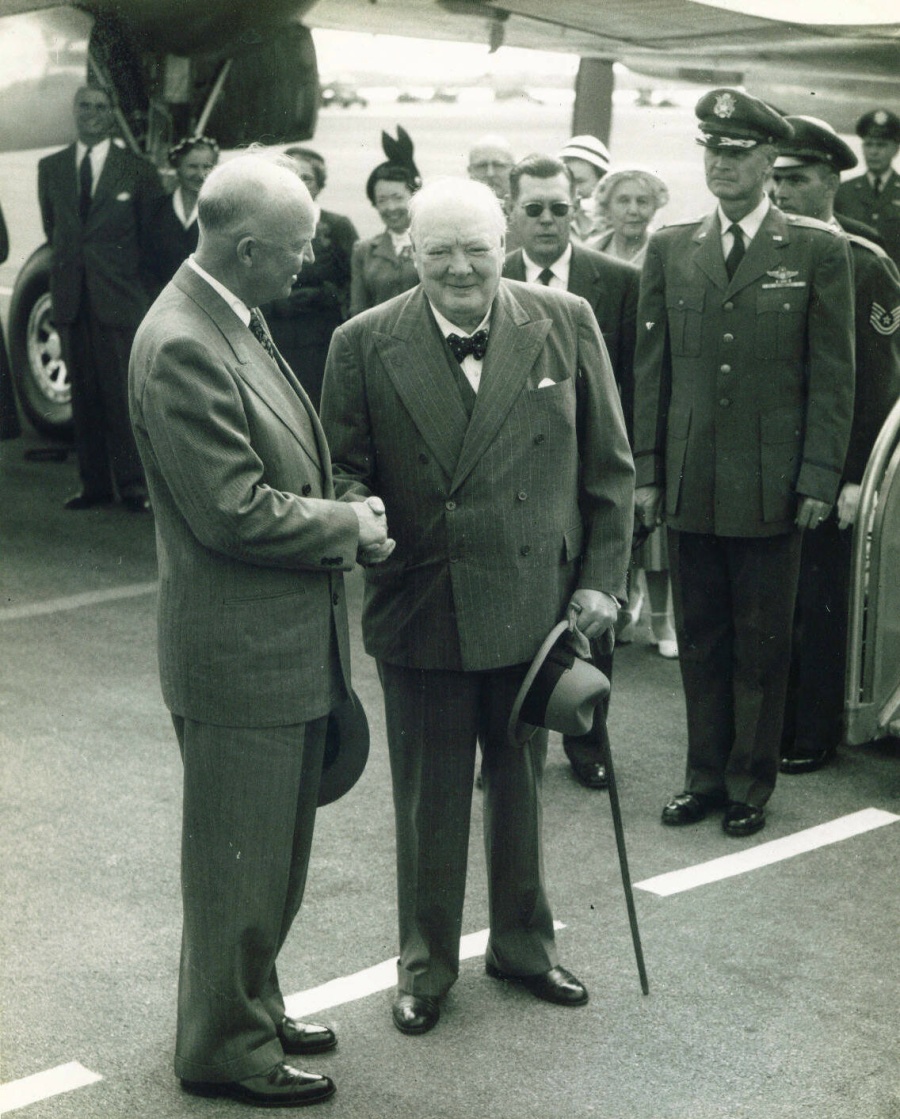
Prime Minister Winston Churchill greeting President Eisenhower at the USA's Kindley Air Force Base, Bermuda. Also shown are the Consul-General of the USA in Bermuda and the commander of Kindley Air Force Base. Royal Gazette photo.
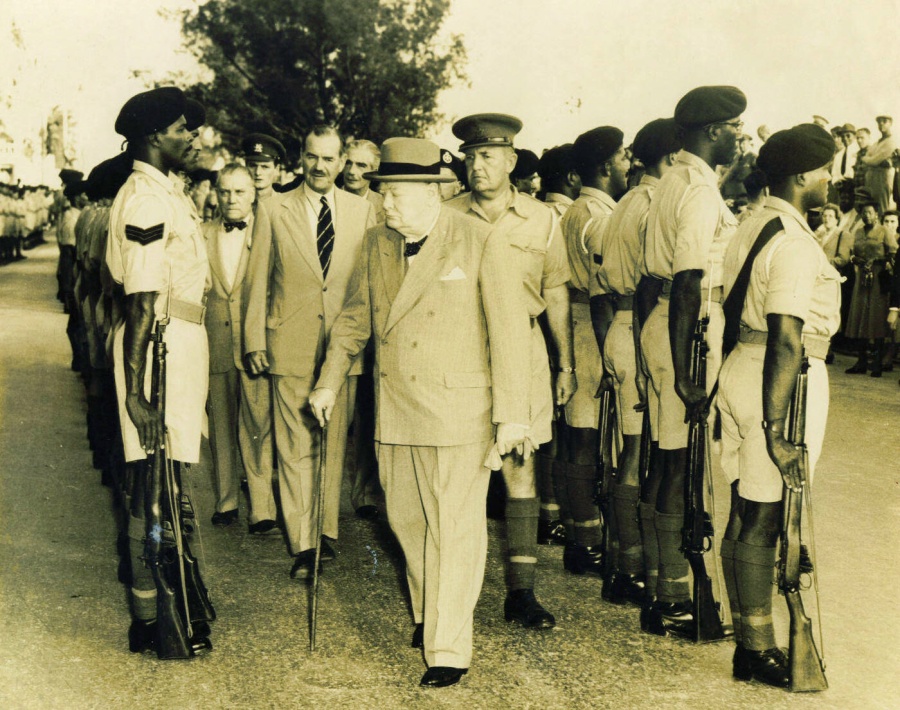
Mr Churchill inspecting the Bermuda Militia Artillery with Governor Lieutenant General Sir Alexander Hood.
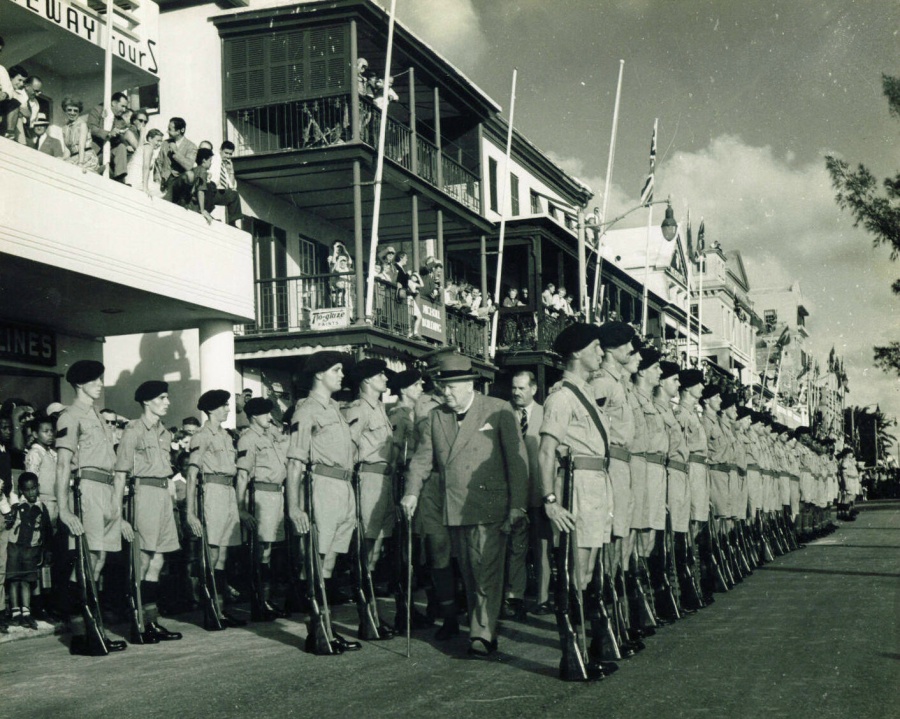
Prime Minister Churchill and his party, including Anthony Eden (later, a Prime Minister himself) inspecting the Bermuda Militia Artillery (top photo) and Bermuda Rifles (BVRC - bottom photo) on Front Street. S. A. Toddings, MCP (shown in top photo between the corporal and Anthony Eden), was then chairman of the Bermuda Defence Forces. Royal Gazette photo.
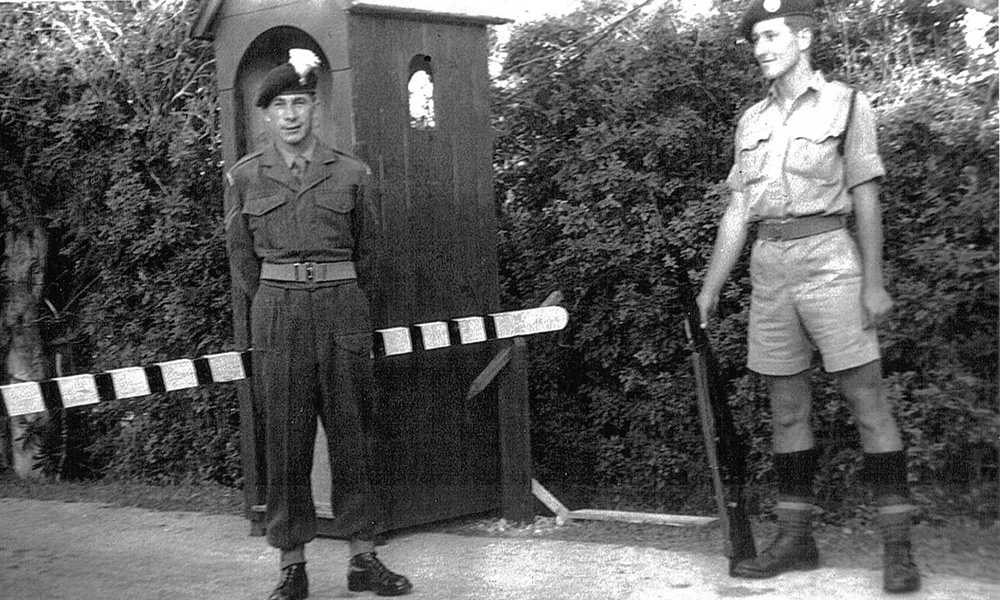
British Army and Bermuda Rifles soldiers providing security at key areas during the 1953 Big 3 conference
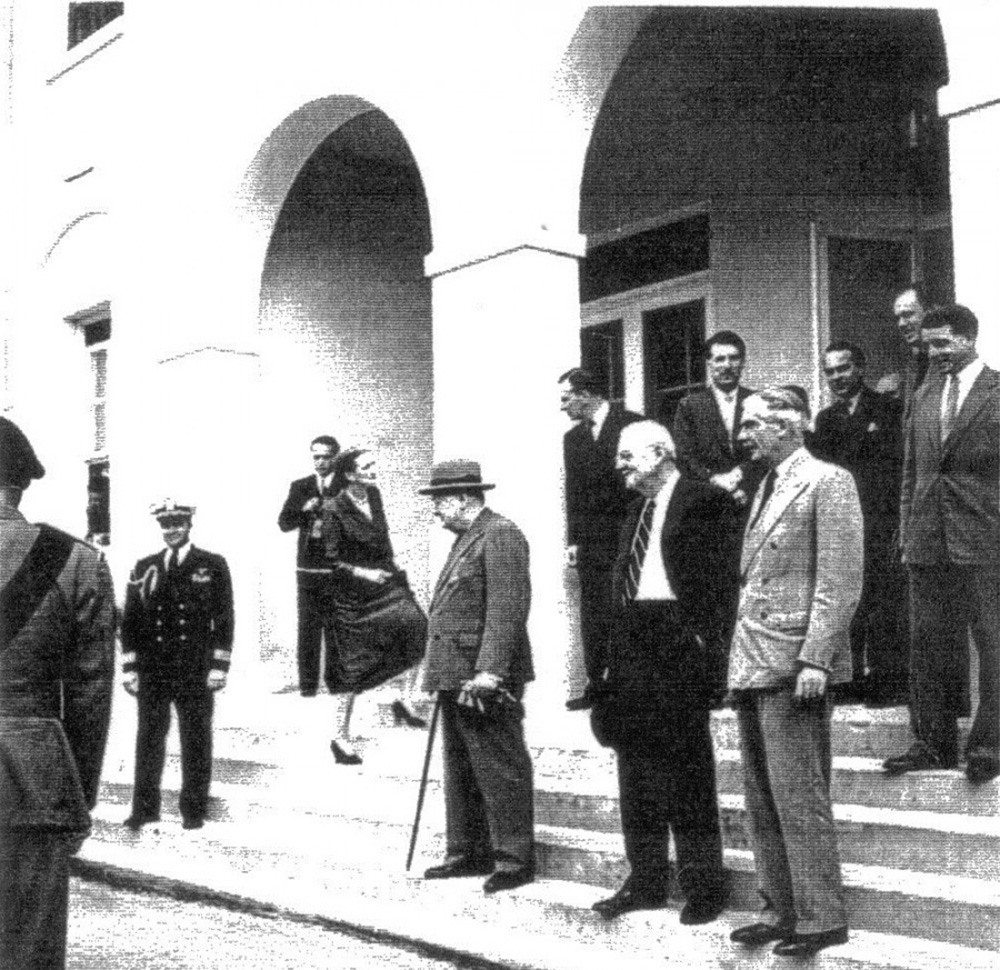
1953. Prime Minister Churchill, US Secretary of State John Foster Dulles, future Prime Minister Anthony Eden and a senior US Navy officer outside City Hall
1954. Bermuda Audubon Society formed in response to marsh dumping.
1954. A Coy Duke of Cornwall's Light Infantry (DCLI) landed in Bermuda for their 1-year stay, from the troopship Empire Clyde. It was reported in the Mid Ocean News, then owned by SS Toddings, Chairman of the Defence Board. It was the last permanent British Army unit in the Bermuda Garrison based at Prospect Camp. See British Army in Bermuda.
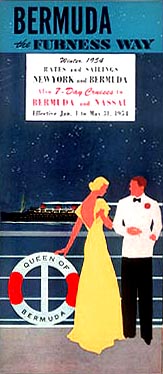
1954. Furness Bermuda issued this poster of its New York to Bermuda service.
1954. Wing Commander E. M. "Mo" Ware, Director of Civil Aviation, bought his 1946 Luscombe 8a Silvaire airplane, originally imported by Hugh Watlington in 1952. Ware, with Jim Babineau and Colin Plant, acquired it from Bermuda Air Tours.
At one time the Luscombe had been fitted with a wheeled undercarriage from a Tiger Moth, for flights at Kindley Field.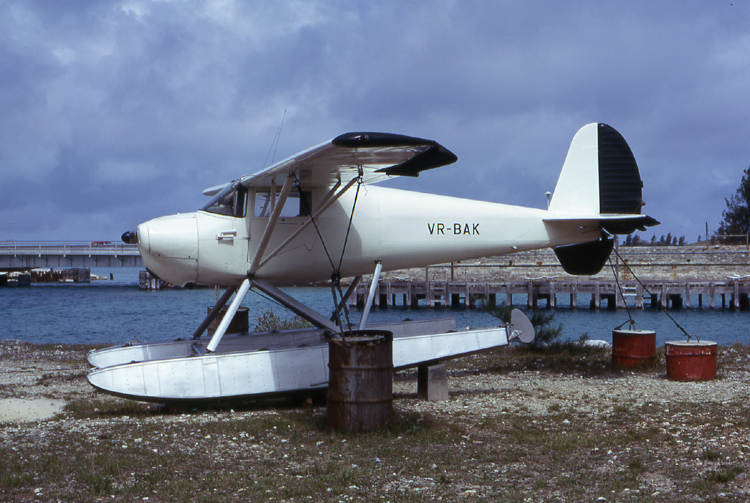
Wing Commander Ware's Bermuda-based aircraft
1954. June. A second British Royal Navy submarine (after HMS Andrew in 1953) sailed completely underwater from Bermuda, establishing a world record. She too used the "snort" system. In this case the vessel was the Royal Navy's HMS Tally Ho, named by Sir Winston Churchill. The object of the operation was to gain experience of the behavior of a ‘T’ class submarine in such conditions and to train personnel in ‘snorting’ techniques and submarine operations generally. The distance is about 2,800 miles, and the submarine started ‘snorting’ a few hours steaming from Bermuda. A similar passage was made by the submarine Andrew last year, but this is the first made by a “T” class craft. The Andrew crossed from Bermuda entirely underwater, and surfaced off the southwest approaches of the English Channel on June 15. It was then stated that there was no record of a previous underwater crossing of the Atlantic. The crew maintained touch with the outside world by radio.”
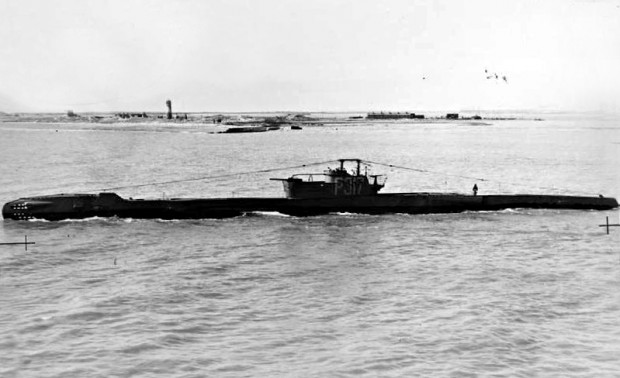
HMS Tally Ho after arriving from Bermuda
1954. July 3. In what became known as the "Bermuda Radar Case" in official reports of the United States Air Force, this report involves official radarscope photos of UFOs off Bermuda, taken that day. Project Blue Book "identified" these as a battleship and six accompanying destroyers but the experienced radar operator stated that the radar returns were definitely unidentified and unlike any ship returns he had ever seen. This report is not listed in the Blue Book "Unknowns." There were radar scope photos of a geometric formation of 7 objects traveling SW [10-50 miles, of 6 disc-shaped objects circled larger disc in the center at low altitude. A B-36 flying over the Atlantic near Bermuda reported receiving peculiar radar returns on an APS-23 radar set. The returns consisted of a clear and well defined circular formation containing 7 and at times 8 objects. The returns were first observed by Capt. Charles C. Spahn, R.O. Spahn had 11 years Air Force service and 3,400 hours flying hours and 1,500 hours as a radar observer. Spahn did not think these returns were ships on the surface. He had tracked a couple of ships just hours before the returns showed up. Spahn said that the shape of the individual returns are not common to ships.
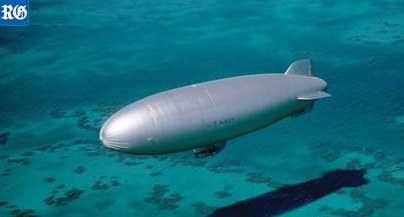
1954. At Kindley Air Force Base, St. David's Island, Bermuda, the USA's Armed Forces Day was celebrated with the arrival of this blimp, US Navy airship ZD-3.
1954. Ariel Sands Beach Club opened (but closed in 2008 and the land has been vacant ever since).
1954-1956. Darrell's Island was transformed into a television village when Atlantic Productions began in Bermuda with local and US capital to produce TV programs for American audiences. The old seaplane terminal was converted to a television studio, dressing and sound rooms and a restaurant, with the Bermuda Government paying a financial contribution for the construction costs. The first company to operate the facility ran out of money in less than a year and sub-leased the buildings to a second production company, but again with no financial success. The 1956 television series of Crunch and Des that starred Forrest Tucker and Sandy Kenyon is the best--known of the Darrell's Island productions.
1954. Formation of a small society of avid Bermuda-based orchid lovers that in previous years after World War 2 had met informally at each other's slat houses. It later became Bermuda's Orchid Society.
1954. The Auxiliary Bicycles Act 1954 Act was passed by the Bermuda legislature, making it is an offence to drive or ride an auxiliary cycle on a highway if either the rider or any passenger is not wearing protective headgear. Legislation requires protective headgear to comply with British, US or UN standard regulations.
1955. Lieutenant General Sir John (Dane) Woodall (1897 to 1985) became Governor and Commander-in-Chief of Bermuda until 1959. In his service biography he was listed as having joined the Royal Artillery 1915 ; World War I 1915-1918; Gallipoli 1915 ; Staff Capt, Royal Artillery, Salonika and Black Sea 1918-1919; Deputy Assistant Adjutant General, Black Sea 1919 ; Staff Capt, Turkey 1919-1922; Deputy Assistant Adjutant General, Turkey 1922-1924; Instructor in Gunnery, Northern Command 1927-1929; Staff Officer, Royal Artillery, Western Command 1932-1934; Brigade Major, Royal Artillery, Malaya 1934-1936; Instructor, RAF Staff College, 1938 ; World War II 1939-1945; General Staff Officer Grade 1, General Headquarters, British Expeditionary Force (BEF) 1939-1940; Brig, General Staff 1940-1943; Regimental Commander, Royal Artillery 1943 ; Senior Air Staff Officer, Army Co-operation Command, RAF 1943-1944; Deputy Director of Staff Duties, War Office 1944-1946; Director of Manpower, War Office 1946-1949; Vice Adjutant General to the Forces 1949-1952; General Officer Commanding Northern Ireland 1952-1955; retired 1955.
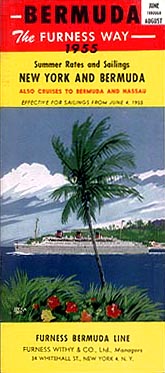
1955. March 8. New York newspapers carried a story of how the Furness Bermuda Line offered the olive branch a day earlier to the 300 seamen, who walked off the luxury liner Queen of Bermuda the previous Saturday, stranding 560 Bermuda-bound vacationers. It had just released the following poster.
1955. 1955. Her Royal Highness Princess Margaret visited Bermuda. A Coy Duke of Cornwall's Light Infantry (DCLI), who arrived in Bermuda in 1954, paraded for her in Hamilton
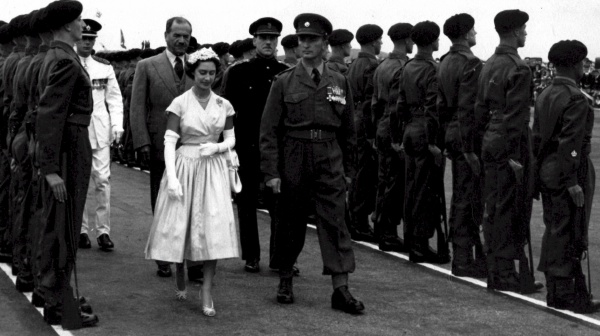
HRH Princess Margaret inspecting an Honour Guard at Prospect Garrison, Devonshire, during her 1955 visit to Bermuda. It was formed by "A" Company, 1 Duke of Cornwall's Light Infantry (DCLI). She was escorted by Commanding Officer, Major J. A. Marsh, DSO and Garrison Commander Brigadier J. A. M Rice-Evans.
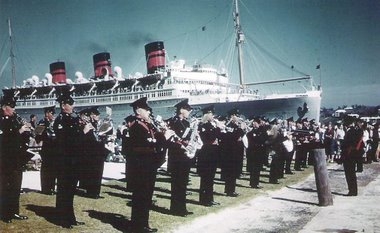
Members of the DCLI also paraded at Albouy's Point, in front of the moored cruise ship Queen of Bermuda
1955. June 1. The Cold War listening post at the U.S. Naval Facility, Bermuda, atop Tudor Hill, Southampton Parish was officially opened, after a year of work by Navy Seabees and Western Electric Company of USA. Circling USN aircraft dropped sonar buoys to locate Soviet submarines heading for Cuba or the east coast of the USA. The buoys were a communications hub in the readiness to launch a nuclear response. It was known as USN Tudor Hill, 1954–1995. The US Navy operated it until the closure of US bases in 1995. This base remotely monitored sensors designed to listen for and played a key role in the constantly successful but top-secret detection of Russian submarines moving through the Atlantic, especially those moving to and from Cuba during the Cuban missile crisis. There was some hope that the base would survive the end of the Cold War, and the base closures of 1995. It was thought that it might be adapted to scientific purposes, for the monitoring of whales, but it was closed, instead, along with NAS Bermuda, and the NAS Annex.
1955. May 1. There was a riot at the Hamilton Prison. In attempting to take one prisoner into custody. the prison officer lost control of the situation. the prisoner then unlocked all the cells and the released prisoners then congregated on the roof. The police station was then next door to the prison and the police were called in. They had to use tear gas to subdue the rioters and get them back to their cells.
1955. June. For several years from this one, the 59th Weather Reconnaissance Squadron (Hurricane Hunters) were based in Bermuda, at the USAF's Kindley Air Force Base.
1955. June 1. The US Navy's Naval Facility (NAVFAC) Bermuda was commissioned. It was located on the west end of Bermuda in Southampton Parish, adjacent to the island’s scenic south shore.
1955. From June to June 1958, James Mathews, stationed in Bermuda for three years at the USA's Kindley Air Force Base, was one of the five technicians who set up and operated the Kindley AFB TV station, ZBK-TV, Bermuda's first. They loaded it at the factory in Michigan City, Indiana, trucked it and then flew it to Bermuda via Dover AFB.
1955. July 4, Independence Day in the USA. American servicemen and their families and friends in Bermuda had a special reason to celebrate. ZBK-TV from Kindley, Bermuda's first television station (no longer in existence) signaled a new era of communications. The audience was officially limited to television receivers in on-base quarters and barracks. But a number of Bermudian families who had equipped themselves with TV sets in hopes of 'catching' the programming were not disappointed in their investment. The signal could be picked up easily in St. George's, Tucker's Town and a few isolated spots even as far away as Harrington Sound, in the vicinity of Flatts. Locals acquired a TV set and could easily receive from their hill-top vantage point the TV signal from Kindley - and periodically invited their neighbors and friends around to watch the American shows, then only in black-and-white, of course. Originally, it had been intended to provide Island-wide TV service and the Bermuda Government had given its permission. But it was discovered that it would not be possible, because the TV footage was then provided by the American TV networks, agencies and unions for transmitting to military forces and their dependents only, not for civilian audiences. TV for the US Navy at Southampton and for all of civilian Bermuda took longer to materialize. American TV engineers who arrived at Kindley were faced with the highly technical problem of trying to restrict transmission to the base area. The USA military audience in Bermuda was exceedingly small, limited to television receivers in on-base quarters and barracks. One of the reasons behind the decision to allow TV to the American military was the fact that the 1,500-plus American service families felt they should not be 'deprived' of TV simply because they were residing in Bermuda, when US bases elsewhere in the world all had TV. The station was one of the last arrivals in Armed Forces Radio and Television Service outlets installed at American military bases overseas.
1955.
Death
of Dr. Edgar Fitzgerald Gordon, the man who had organized the Bermuda
Workers Association in the 1940's as the forerunner of the Bermuda
Industrial Union. Many of
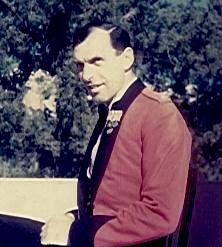 1955. August
13/14. Death in Kenya of
Lieutenant Colonel ("Tupper") Brooke-Smith, King's
Shropshire Light Infantry, when on active service against the Mau Mau in
Kenya. He had specific Bermuda occupational and family connections. He was killed during a
British Army campaign against the Kenyan Mau Mau. With service number 67179, he
was commissioned into the KSLI on 30th January 1936 and served with distinction
during World War II. In 1949/1950 he was posted to Bermuda as GSO II to
the Governor and Commander-in-Chief of Bermuda. He previously served at
Buckingham Palace, London. In Bermuda, he married a Bermudian, Joyce Arnell, the
daughter of Bermudian Mrs. Helen Arnell. His brother-in-law was the late author,
historian and philatelist Jack Arnell. On leaving Bermuda in 1952, Cuthbert and
his wife Joyce, their three children - daughter Philippa and sons Robin and
Bruce - returned to the family home in Church Stretton, Shropshire. His Army
postings from there were with the KSLI, Durham Light Infantry, Wuppertal in Germany with the DCLI - where
he was 2nd in Command of that regiment, then Commanding Officer of his battalion
of the KSLI in Kenya. He walked into an ambush in the Aberdere forests
previously declared a KSLI ambush zone that had been set to lure the Mau Mau. He
was 39 years old. He was shot in error by a Bren gunner member of his own unit,
mortally wounded and died instantly, despite the best efforts of Captain George
Pollock, RAMC) and an RAMC sergeant, both of whom attended the deceased moments
after the event. It was recorded as a tragic accident.
1955. August
13/14. Death in Kenya of
Lieutenant Colonel ("Tupper") Brooke-Smith, King's
Shropshire Light Infantry, when on active service against the Mau Mau in
Kenya. He had specific Bermuda occupational and family connections. He was killed during a
British Army campaign against the Kenyan Mau Mau. With service number 67179, he
was commissioned into the KSLI on 30th January 1936 and served with distinction
during World War II. In 1949/1950 he was posted to Bermuda as GSO II to
the Governor and Commander-in-Chief of Bermuda. He previously served at
Buckingham Palace, London. In Bermuda, he married a Bermudian, Joyce Arnell, the
daughter of Bermudian Mrs. Helen Arnell. His brother-in-law was the late author,
historian and philatelist Jack Arnell. On leaving Bermuda in 1952, Cuthbert and
his wife Joyce, their three children - daughter Philippa and sons Robin and
Bruce - returned to the family home in Church Stretton, Shropshire. His Army
postings from there were with the KSLI, Durham Light Infantry, Wuppertal in Germany with the DCLI - where
he was 2nd in Command of that regiment, then Commanding Officer of his battalion
of the KSLI in Kenya. He walked into an ambush in the Aberdere forests
previously declared a KSLI ambush zone that had been set to lure the Mau Mau. He
was 39 years old. He was shot in error by a Bren gunner member of his own unit,
mortally wounded and died instantly, despite the best efforts of Captain George
Pollock, RAMC) and an RAMC sergeant, both of whom attended the deceased moments
after the event. It was recorded as a tragic accident.
A Ministry of Defence official description of the circumstances of the death later stated: "Lt Col (Brooke) Smith met his death accidentally as a result of shooting by his own troops whilst commanding 1 KSLI in East Africa. The battalion had arrived the previous month. Lt Col (Brooke) Smith had expressed a wish to visit one of his company ambush positions, and a message was sent requesting guides from the ambush position to escort the visiting party. Unfortunately owing to bad wireless operating conditions, the message was incorrectly received by the ambush patrol and as a result no guides arrived. Nevertheless Lt. Col. (Brooke) Smith decided to go part of the journey to the ambush position from a direction other than that usually taken and the patrol commander, hearing movement from an unexpected direction, mistook the two African trackers with Lt. Col. Brooke-Smith's party for terrorists and the ambush patrol opened fire in the belief that a terrorist attack was being made. As soon as firing started an officer in the visiting party called out to identify himself, whereupon firing ceased. Unfortunately Lt. Col. (Brooke) Smith had been wounded and he died of his injuries before he could be evacuated."


He was buried in a civilian cemetery in a church graveyard in Nairobi, Kenya. Repatriation back to the UK of his remains from Nairobi, was believed to have been offered but declined by his family. No photo is available showing his grave. However, his is one of the names commemorated both on the Church Stretton, Shropshire, war memorial and at the more recent National War Memorial in Staffordshire, England, in the latter case not under the name of Brooke-Smith but Smith. He is also remembered on the grave of his brother Lieutenant Commander Francis Haffey Brooke-Smith GC, who won the George Cross. The latter's grave is at Hasketon, St Andrew Churchyard, Suffolk. There was also another brother who was an officer in the Royal Navy and served on HMS Belfast during World War 2. While he was posted in Bermuda, Colonel Brooke Smith’s researches in Bermuda led to the erection and inscriptions of the military monuments at the Prospect Garrison burial ground and the installation at the Prospect Officer’s Mess – later, the Police Club – of a plaque recording briefly what principal British Army units had been based in Bermuda. His name is shown, belatedly, on the War Memorial at Church Stretton, Shropshire where is family then had a home and in 2007 was included on the National Armed Forces Memorial in Staffordshire. One son, Bruce A. Brooke-Smith, lived in Threeburrows, Blackwater, Truro, Cornwall. but has since died. There was also a daughter, Philippa, who died some years ago. Nothing so far is known on the other son, Robin.
1955. Formation of the Bermuda Cadets Pipe Band, so-called because it originated in 1955 as "A" Company of the Bermuda Cadet Corps when Captain Henry Hallett was the Company Commander. (Paddy Coyle of the Gordon Highlanders, whose idea it was to start the Bermuda Cadets Pipe Band, was in the detachment of the Highland Brigade stationed in Bermuda at the time. In his honor, the band wore the Gordon tartan).
1955. Diver and treasure hunter Teddy Tucker found what later became known as the “Tucker Cross” from the San Pedro wreck, believed to have been lost on the reefs in 1594.
1955. The American "Crunch and Des" TV Series - see http://www.imdb.com/title/tt0047725/ was filmed in Bermuda.
1955. August. St. George’s Cricket Club narrowly beat the West Indies - by seven runs. The visiting West Indies XI was captained by cricket legend Everton Weekes. The St. George’s team were D. Steede, G. Dyer, W. Smith, L. James, S. Paynter, C. Simmons, A. Hall, St. C. Smith, L. Richardson, F. Trott and C. Welch. The West Indies team players were C. DePeiza, G. Sobers, C. Smith, E. Weekes, C. Sampath, S. Oliver, E. H. C. Griffith, B. Hardinge, C. Skeete, A. Hadeed and A. Maroj.
1955. December 22/23. Hamilton Hotel was
destroyed by fire. It was built in 1851, during the term of Mayor Henry
James Tucker, the cornerstone of the original Hamilton Hotel was built. On
completion in 1852 it had 36 rooms. It was the first hotel in Bermuda and
pioneered Bermuda's fledgling tourist industry. It was extended hugely and
modernized at the beginning of the 20th century. It stood where the City
Hall Car Park is now located. It was a
landmark in
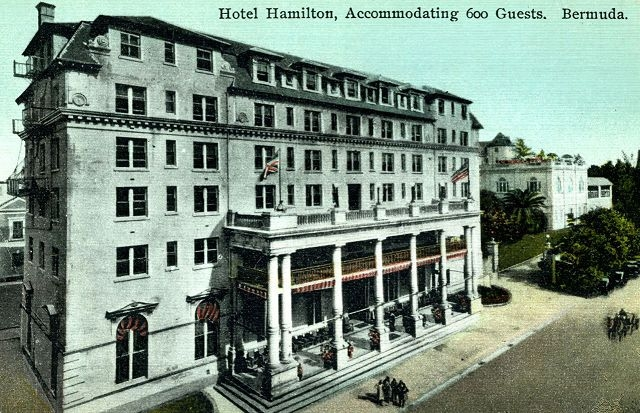
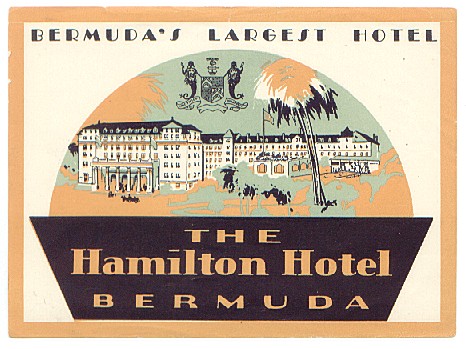
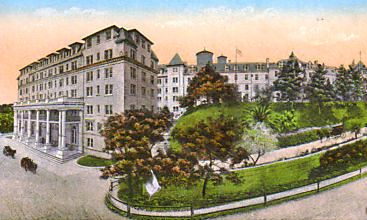
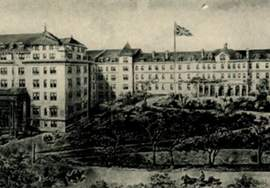
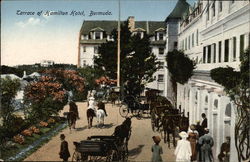
Hamilton Hotel begin in 1851, finished in 1852, destroyed by fire 1955
1956. February. After the revived competition for the King Edward VII Gold Cup1956. Bermuda College Weeks was described thus by USA's Sports Illustrated, see http://sportsillustrated.cnn.com/vault/article/magazine/MAG1069587/index.htm.
1956. The Technical Institute opened as a replacement for the Dockyard Apprentice Training Scheme. It was the first non-segregated school supported by Government. It was a forerunner of the Bermuda College.
1956. George Sousa was the first Bermudian of Portuguese descent to star in local FA Cup soccer. He captained Bermuda from 1956-1959.
1956. Grantley Adams, a Barbadian politician, was denied access to a Bermuda hotel but with the assistance of the Bermuda Governor at the time was able to stay at Government House.
1956. June. Frederick “Penny” Bean joined the Bermuda Police Force at the age of 19. There was then no special training for local recruits, although recruits from England received three months’ training in Mill Meece, Staffordshire. Mr Bean’s basic training included a week reading through law manuals under the direction of Inspector “Tug” Wilson. He was subsequently posted to a watch in Central Division, Hamilton Police Station. Local recruits were often posted there, covering some of the roughest areas in Hamilton at that time — Reid Street East, Court Street and the “back of town”. In March 1959, Mr Bean was posted to CID as a detective constable, and he worked under legendary Inspector “Bo” Swainson. He worked on a team under the command of another excellent detective, Milton Murray Marsh, along with Sinclair Bean, Leon Bean, John Joe Sheehy and other CID officers. In 1962 Mr Bean attended a detective training course in London and was also attached to New Scotland Yard for extra training. On returning from the UK he was promoted to detective sergeant and transferred to the Western Division, where Mr Marsh was the detective inspector. In December 1965 Mr Bean was transferred to the newly formed narcotics department as the officer in charge. He and his team were successful in arresting several major drug dealers, mainly for marijuana offences. Mr Bean rose rapidly through the ranks and was promoted to chief inspector in 1971 and simultaneously transferred to Special Branch. Two years later he was put in charge of that department and promoted to superintendent. During his long career, Mr Bean attended numerous overseas courses including one at Bramshill in the UK. For his outstanding contributions and dedicated service, Mr Bean received an OBE in 1991. Additionally, he was awarded six commissioner’s commendations, one from the Supreme Court; the Long Service and Good Conduct Medal; the Colonial Police Medal for meritorious service and the Queen’s Police Medal. Now formally retired, he remains very active and performs community service working with senior citizens and the sick and shut-in.
1956. August. "Time Out For Teenagers” was a weekly live television program that aired on ZBK-TV, Kindley Air Force Base, Bermuda, until August 1957. Host of the program - a presenter in British BBC and Bermuda terminology - was Lee (Tedford) Grantham. He was joined from time to time as assistant hosts by persons including Barbara Best, John Dudney, Judy Gaddy, Patricia "Trish" McLaughlin, Tucker McClane, Tommy Newkirk, Ellen Ray, Brian Stephenson, John Stith and Jackie Tightman. Lee was the elder son of Major Dick F. Tedford USAF, from the USA, stationed at Kindley Air Force Base, Bermuda from June 1955 to August 1958 with his family including much younger son Scott. The show was produced mostly by Mary Jane Tedford, wife of Major Tedford and mother of Lee and Scott. Lee also wrote to this author: "I began a radio program on ZBM-2 daily, playing top forty music and went on to have daily and weekly music programs on ZBM-1 as well. They were historic years in the history of Broadcasting in Bermuda and those of us fortunate to be a part of that page in Broadcast history." Lee wrote the late website "Bermuda and Beyond."
1956. The movie "Bermuda Affair" was filmed in Bermuda. It starred Kim Hunter, Gary Merrill and Ron Randell and was filmed mostly at Darrell's Island during the latter's short-lived time as a movie studio after it closed as a base for flying boats aircraft. One highlight of the movie was a flight by Wing Commander E. M. "Mo" Ware, Director of Civil Aviation, of his Bermuda-based Luscombe aircraft bought in 1954.
1956. Spithead House in Warwick Parish was lived in by British actor, playwright and composer of popular music Sir Noël Peirce Coward (born 16 December 1899, died 26 March 1973) who later went to live in Jamaica.
1956. Composition by the British-Scottish composer of the choral cantata the Bermudas, Opus 33, by Ian Hamilton, set to a poem by Andrew Marvell who had once written movingly about Bermuda but had never visited.
1956. October 29. The position of Commander-in-Chief of the America and West Indies Station was abolished, leaving the Commodore West Indies as the Senior Royal Navy officer (SNOWI) in the region, reporting directly to the Commander-in-Chief, Home Fleet, in England. SNOWI also served as Island Commander Bermuda (ISCOMBERMUDA) in the NATO chain of command, reporting to Commander-in-Chief, Western Atlantic Area, as part of SACLANT. The ships of the command were reduced to two Station Frigates.
1956. Autumn. The desert island scenes for the British film The Admirable Crichton were filmed in Bermuda.
1956. December 5. Arrival in Bermuda with his Fijian-born wife and two children of the new Colonial Secretary, the Hon J. W. Sykes, who went to live at Montpelier in Devonshire, and the new Bishop of Bermuda, the Rt. Rev Anthony Williams.
1956. Hungarian refugees flying from Europe to the USA following the Russian attacks in Budapest - on British Overseas Airways - planes passed through Bermuda in great numbers. Bermudians provided many gifts and comforts.
1957. January. An 18-month UK-USA-Bermuda wrangle over television ended when the USA's Kindley Air Force Base in St. David's and its Naval Operating Base in Southampton began TV broadcasting in Bermuda. Because the signal had to pass through much of civilian Bermuda, civilians were finally able to watch American television, much to their delight.
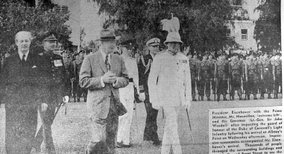 1957. March
20-24. Big Two Conference in
Bermuda between British Prime Minister Harold Macmillan and US President Dwight
Eisenhower, held at the Mid Ocean Club overlooking Bermuda's blue-green waters.
The British Prime Minister arrived by air
1957. March
20-24. Big Two Conference in
Bermuda between British Prime Minister Harold Macmillan and US President Dwight
Eisenhower, held at the Mid Ocean Club overlooking Bermuda's blue-green waters.
The British Prime Minister arrived by air
President Eisenhower arrived in Bermuda, not by air as is often assumed but on the USS Canberra, a battle-scarred, Pacific fleet, heavy cruiser that only a year before had completed a refit as a guided missile cruiser. The Canberra was armed with Terrier missiles, a relatively new weapons system brought into service in June 1956. The Terrier was a medium-range, surface-to-air missile that could carry a nuclear warhead, so it was an important part of the U.S. defence capability. En route, Ike watched the system demonstrated, toured the ship, dined with its officers, watched the film Three Coins in the Fountain, and practised his golf shots. On arrival in Bermuda at the United States Naval Base in Southampton he was then taken by sea to the United States Air Force Base at St. David's where he was greeted by Macmillan, the island's Governor and others in the official party. .
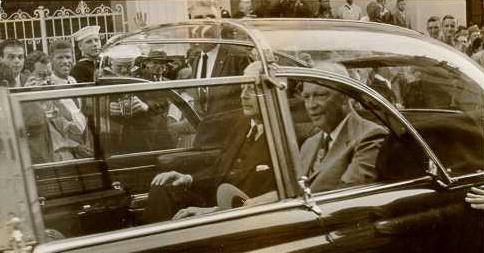
President Eisenhower being greeted by British Prime Minister Harold Macmillan on arrival at Kindley Air Force Base, Bermuda
At the Mid-Ocean Club, President Eisenhower and Prime Minister Macmillan planned to get down to some important business that had concerned both nations. In their 4 day conference they were to eat their meals together, drink together, perhaps golf together. They were not strangers, had met before on quite a few World War 2 occasions. . Newspapers in their respective countries described them as old friends but this may have been an exaggeration. In World War 2 Macmillan was British Resident Minister at Ike’s Algiers headquarters). They had no formal agenda but much on their minds. Their main problem was to re-establish, between two nations, the working relationship that was shaken by Britain’s decision to throw in with France and Israel on Suez.
Restoring the relationship was important, but so were other matters. but it was far from the only important topic of discussion. In fact, the Bermuda meeting was a reordering of the way some things worked in the world, one that would last pretty much for the rest of the Cold War. Former British Prime Minister Anthony Eden’s disastrous Suez blunder and its impact on USA and UK relations had to be rectified but there were other significant political and economic changes caused by World War II and the repercussions they had caused. Changes to mutually acceptable policies had to be made and quickly between allies.
Their agenda included frank discussions on Britain’s acute dislike for the U.N., which Macmillan is reported to have referred to privately as “this Frankenstein which we have created"; Britain’s economic situation; The country was so struggling to manage its economy that it had missed its loan payment to the U.S. in 1956 and would again in 1957; Britain’s then-current defence strategy which was being hampered by the 1946 U.S. ban on sharing nuclear information with its allies: nuclear weapons proliferation, especially in European countries; and U.S. fears of increasing communist influence in Europe, especially in France, Italy and Germany.
Very relevant was the fact that Britain was especially vulnerable. It was no longer one of the most powerful nations of the world.
It's once-mighty empire had been decaying rapidly, with India split unhappily into Pakistan, the old Gold Coast was poised to become an independent Ghana in 1957, and independence movements were at work everywhere. Anti-imperialist voices were rising around the world, given new impetus by a sympathetic and distinctly anti-colonial United Nations.
The meeting was seen against the background of how far Britain had fallen as a result of the war and how difficult its new position was, both practically and psychologically. It had been evident to the British government since the end of the war (if not quite so evident to the British public) that it could no longer be one of the most powerful countries in the world. It couldn’t afford it. Its all-important empire had begun to decay—India had gone, was now blended unhappily with Pakistan, the old Gold Coast was going to become an independent Ghana in 1957, and independence movements were at work everywhere. Anti-imperialist voices were rising around the world, given new impetus by an anti-colonial and sympathetic United Nations.
Suez had been the last fling. With France and Israel, which had admirably fought for and won its independence only recently despite overwhelming opposition from the Arab world in particular, the three countries intended to invade Egypt to stop the nationalization of the Suez Canal by Egyptian dictator Gamal Abdel Nasser, which threatened both their commercial interests and challenged the prestige of Britain and France. Their forces and those of Israel had easily defeated Nasser but were stopped, so shockingly to Britain and France, by the USA from consolidating their victory that they then had to withdraw in humiliating ways with Nasser having the last laugh.
In the aftermath of Suez, France distanced itself from the USA. Britain, despite a feeling (which Macmillan shared) that President Eisenhower had let the side down, decided that unless it could join itself to the U.S. hip, it was going to become just another insignificant European country.
At the Bermuda Conference, Prime Minister Macmillan was persuaded to back away from his inclination to withdraw from the U.N., although he did get a general understanding that efforts should be made to deal with international disputes outside the U.N., either through bilateral negotiations or such security organisations as NATO, SEATO and the Baghdad Pact. Where that was not possible, the two leaders agreed that every effort should be made to deal with disputes through the Security Council, not the General Assembly.
It was agreed that Britain would associate with Europe more closely than it had in the past, to exert, hopefully, a helpful influence on the countries of Europe. The U.S. was particularly concerned that the proposed common market, and free-trade area, would turn into a high-tariff bloc, which might exclude U.S. commercial interests from that market.
The two countries agreed to a policy on nuclear testing that put pressure on the Soviet Union by emphasizing responsible testing, openness about testing schedules and willingness to allow international observers.
The agreement on nuclear weapons was complicated. In essence, the U.S. agreed to share nuclear-weapons information with Great Britain, despite sharp disagreement from some quarters within the U.S. government. In exchange, the British government permitted the U.S. to base Thor medium-range nuclear weapons on British soil and to launch U-2 spy-plane missions over Soviet territory from British bases.
The two countries also addressed what had been an ongoing difference, secret at the time, about the circumstances under which the Americans would use nuclear weapons. Since the early days of the Korean War, when there was a risk of world war, British prime ministers had wanted a voice in any decision by a U.S. president to “go nuclear.” There were verbal agreements with President Truman and a communiqué, written for the Churchill-Truman talks in 1952. Prime Minister Macmillan did get a secret agreement, signed after the 1957 conference, that the Thor missiles in Britain would be under joint U.S./British control, through a two-key system. And work began on another secret agreement that London would be consulted, “to the fullest extent possible,” in any decision to use nuclear weapons.
The missed loan payments by Britain to the USA were forgiven.. British Prime Minister Harold Macmillan to all intents and purposes had succeeded in rejoining Britain to the US hip.
It rained in Bermuda for much of the conference. Despite that, the prime minister went to Kindley Field to see President Eisenhower off for the four-hour flight back to Washington.
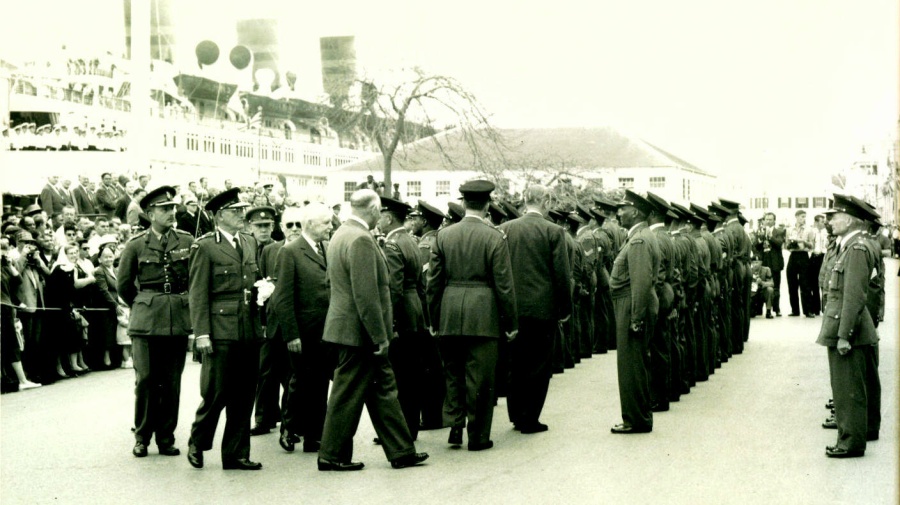
Also present were Canadian Prime Minister Louis St. Laurent for two further days of talks and other British Commonwealth officials. The latter group , with Bermuda's Governor Lt. Gen Sir John Woodall, the Mayor of Hamilton the Wor. E. R. Williams, and Officer Commanding British Troops in Bermuda, Brigadier B. E. Luard. reviewed the island's militia in Hamilton. There were two ships moored prominently alongside Hamilton Harbour that day. One was the Royal Navy frigate HMS Bigbury Bay while the other was the cruise ship Queen of Bermuda. Photo shows British and Canadian Prime Ministers and officials including Captain Ross Winter, MCP, Commandant of of the Bermuda Reserve Constabulary (BRC) reviewing the BRC in Hamilton. Behind them is the cruise ship Queen of Bermuda. Behind Louis St. Laurent is S. S. Toddings, MCP, Chairman of the Defence Board. Photo kindly loaned by his step-daughter Cindy Farnsworth Toddings. Ed Kelly photo.
1957, spring. Guyana-born and black Bermuda politician E. T. Richards MP moved in the House of Assembly that the sections of the Hotel Keepers’ Protection Act that allowed hotels and restaurants to restrict entry based on race be struck from the act. The act, he said, was a “blot on this Colony’s escutcheon.” Such discrimination caused “embarrassment, insult and humiliation” for “Negroes, Jews and other non-Caucasian races.” But the motion was not successful.
1957. April 16. The sudden death in Bermuda of American author Walter Hayward. Born in 1877. He had a notable career as one of the Editors of the New York Times, a fact noted by both that newspaper and the New York Herald-Tribune. After his retirement he moved to Bermuda in 1949. His accomplishments there included, in St. George's, his involvement of the change of the derelict railway yard at Tiger Bay to the Tiger Bay Gardens, his support of the Bermuda Historical Society Quarterly and his book Bermuda Past and Present.
1957-59, Cliff Morris was in the US Navy in Bermuda, based at the Annex in Southampton, pulling duty at the secret Tudor Hill submarine and surface ship detection facility. He also hosted a radio program on ZBM-2 that was sponsored by the Navy1957. Ross Perot, born in 1930, then a 27 year old US Navy officer, visited the island on vacation with his wife, Margot. Later, as an imrnsely rich man, he bought a Tuckers Town property in Bermuda, based his companies here and ran - without success - as a US presidential candidate.
1957. May 16 to 28. The Bermuda Tattoo included the U.S. Marine Band from Washington D.C. It was Bermuda's second such event and held at the British Army's Prospect Garrison parade ground (which later became the National Stadium). The Bermuda Government budgeted £12.935 for it, on a motion passed by the House of Assembly at the request of Mr. S. S. Toddings, MCP, Chairman of the Defence Board. The object was to show the British flag in Bermuda and to provide valuable training and interest for the Local Forces. The Dominion of Canada agreed to assist, by supplying one Naval and four military units and to transport to and from Bermuda at no cost to the colony. Feeding and housing were Bermuda's responsibility.
1957. July 2. Via Cable & Wireless, a special radio leased circuit opened with Aeronautical Radio Inc. for the communications distribution centre at the Civil Air Terminal to feed traffic to local airline offices.
1957. USAF Thunderbirds visited Bermuda for the first time. The team's pilots were: Maj. Robby Robinson - leader, Captains Bill Bartley and Doug Brenner on the wings, Lt. Bill Pogue - slot, Capt. Bob McIntosh - spare, and Capt. Sam Johnson - solo.
1957. The old (and original) Watford Island Bridge, built in 1902 and formally opened in 1903 that lasted for 54 years was rebuilt. But this replacement bridge was destined to last for a mere 23 years. It was built as a post-tensioned concrete structure but within three years began to deteriorate from the inclement and exposed marine environment, so much so that hugely expensive and regular maintenance had to be arranged. It was finally built much more strongly in 1983.
1957. July 8-11. Off Bermuda, the cruise ship Reina del Pacifico, well-known to many Bermudians, ran aground on July 8, while 5.5 nautical miles north of Ireland Island, while on the Liverpool-Valparaiso service which included regular stops at Bermuda. She became famous in Bermuda in 1937 after the former British Labour Prime Minister, Ramsay MacDonald died aboard whilst on a cruise at the age of 71, just two years after leaving government and was conveyed to Bermuda for a military funeral. Early in the Second World War she was requisitioned for service as a troopship, in December 1939 she had taken elements of the First Canadian Division to Britain. Later on in the war she took part in the landings in North Africa, Sicily and Normandy. In January 1947 she returned to her owners, refurbished, and returned to service in 1948. She was successfully refloated three days later, on 11 July.
1957. July 26. Eagle Airways (Bermuda) Ltd was incorporated in Bermuda by Eagle Airways of the UK. It was the first step in this new airline beginning regular scheduled flights to and from New York from 2 May 1958.
1957. July 29. The
Public Library (later, the Bermuda National Library) was transferred to a new
extension to the original Par-la-Ville building, in premises owned by the
Corporation of Hamilton, where it is today in part, except that the Archives and
Youth Library are no longer there. Also as a new tenant in the building, the Bermuda
Historical Society moved to this building from one in East Broadway.
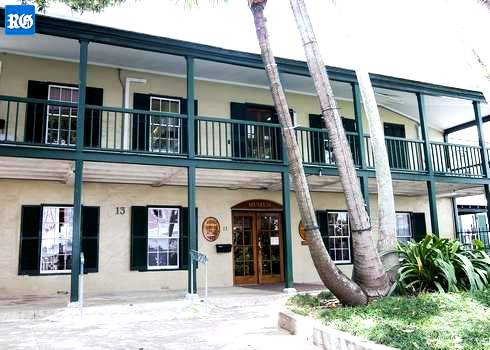
New Bermuda Historical Society tenancy in Par-la-Ville building
1957. Juanita Furbert (Guishard) became the first black nurse at KEMH, Bermuda.
1957. Departure from Bermuda of the last British Army troops regularly stationed here, a company of the Duke of Cornwall's Light Infantry. Prospect Garrison, bought by the British Army in the 1860s, was destined to become Bermuda Government property acquired for £750,000 sterling, earmarked mostly for the Bermuda Police and Ministry of Education.
1957. Closure of the children's convalescent hospital at Ireland Island where Lefroy House is today, after only five years of operation. It had begun in.1952 as the brainchild of the Committee of 25 established by a group of non-Bermudian women. They were led by Canadian-born Edna Watson who in 1948 had become, with Hilda Aitkin, had become the first women in Bermuda's Parliament. In 1818, construction began of the original building on the site, the once-grand Royal Navy Hospital near the Dockyard, with the unusual cast and wrought iron building designed by Edward Holl, Chief Architect for the Royal Navy and Scottish engineer, John Rennie (1761—1821). It was built in the same British colonial overseas-pioneering pre-fabricated manner as the later Commissioner's House, initially as a Quarantine unit, later as an infirmary. In addition to Bermuda-based Royal Navy personnel and their injuries incurred during sea duties or on land, British convicts transported to Bermuda to build HM Dockyard, were treated here, usually for injuries inflicted during their hard prison labor while digging or shaping rock to build the dockyard. When added to substantially later, in addition to more cast iron structural features, such as veranda columns, floor joists, and possibly cast and wrought iron roof trusses, some of the stonework for the building was the hard local limestone. A surgeon, doctors and medical staff were appointed and sent by the Royal Navy. During World War 2, the Royal Naval Hospital, Bermuda, treated and often saved the lives of many brought in from torpedoed ships. The Royal Navy left in the mid 1950s. That hospital itself was formally decommissioned as a Royal Navy Hospital in 1957. The building, not well maintained, deteriorated, became temporarily the children's hospital mentioned earlier, then an egg battery farm, then finally was deliberately burnt to the ground by the Fire Department in November 1972. Later, the site and what was left reusable of the building became Lefroy House, for senior citizens, so-named after the surname of a former Governor.
1957. The Jamestown Exposition celebrated the 350th anniversary of Jamestown.
1957. The movie "Bermuda Cockleshells" - see http://www.imdb.com/title/tt0050183/ was filmed in Bermuda. It was all about Bermuda Fitted Dinghies.
1957. December. Prospect Secondary School for Girls was established at a former British Army barracks building.
1957. At Darrell's Island, the black and white and color 5-star film The Admirable Crichton - see http://en.wikipedia.org/wiki/The_Admirable_Crichton_(film) a comedy, was made. The story, from the well-known book, is of an aristocrat and his family who are shipwrecked. Directed by Lewis Gilbert and 94 minutes long, it was produced by Ian Dalrymple and written by J.M. Barrie (play), Lewis Gilbert (adaptation), Vernon Harris (screenplay). It starred Kenneth More, Diane Cilento, Cecil Parker, Sally Ann Howes, Martita Hunt, Jack Watling, Peter Graves, Gerald Harper, Mercy Haystead, Miranda Connell and Miles Malleson. Music was by Douglas Gamley and Richard Addinsell (waltzes).
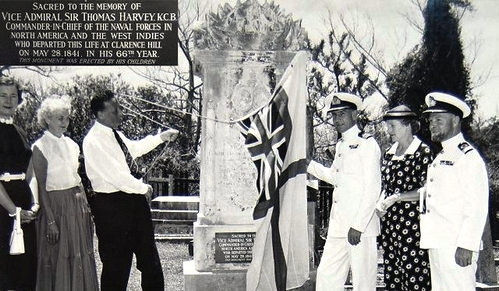
1957. The unveiling of a plaque on the monument to Vice Admiral Sir Thomas Harvey KCB, Royal Navy, who died in Bermuda in 1841 and was buried in the Royal Naval Cemetery, Ireland Island South. Captain G E Hunt, DSO DSC RN is on the far right.
1958. New Year's Day. Harvey Conover, successful businessman and renowned yachtsman, sailed with his family into the Bermuda Triangle and was never heard from again.
1958. January 13. The first local television program went on the air in Bermuda. It was ZBM-TV. ZBM-TV was founded by Bermuda Broadcasting Company as the first local television station in Bermuda. Before then, residents living near Kindley Field at the East End of Bermuda could watch television via unauthorized reception of the also black and white (no color at that time) TV signal on base. Originally, ZBM-TV broadcast on channel 10, but in 1974, Capital Broadcasting Company merged with Bermuda Broadcasting Company and ZBM-TV was moved to channel 9. On that historic-for-Bermuda 1958 January 13 television day Lee L. Telford (see note in 1955) noted: "I worked with former members of the BBC (from London), CBC (Canadian Broadcasting), ABC and the Bermuda Broadcasting company's Radio Centre staff. Quinton Edness, now retired, was a leading local light (and later became a prominent Cabinet Minister). Non-Bermudian staff at the time (nowadays they must by law all be Bermudian or married to one) included Walt Staskow, Canadian, ZBM overall station manager. Other Canadians, formerly of the CBC, were Jack Dodge, Dick Varney and Ken Ludwig. The chief engineer of the TV operation was on loan from the BBC. The prime-time director was Holmes from ABC in New York. Other Americans included Cliff Morris (also in the US military in Bermuda, who joined ZBM-2 after his US Navy tour of duty), Ed Hinson, Jay Lloyd and Jack Dodge (now living in Florida) from the US Bermuda bases but I believe I was the only American doing any on-air announcing. I also wrote a column about TV for the Kindley "Skyliner" for a while. I attended Whitney Institute, where I met Tim Olander. We played basketball together on the Kindley Hawks."
1958. May 2. Eagle Airways first arrived in Bermuda. (See more details in Bermuda Aviation). It was nearly a year after Eagle Airways (Bermuda) Ltd was incorporated in Bermuda on 26 July 1957. The first scheduled flight to and from what was then called Idlewild International Airport in New York (since renamed John F. Kennedy. or JFK). Its first aircraft in Bermuda was the Vickers Viscount 805 VR-BAX. Named "Enterprise," she carried the title "The Bermuda Airline" on her port side. By the end of 1959, she had carried nearly 10,000 passengers on the New York run.
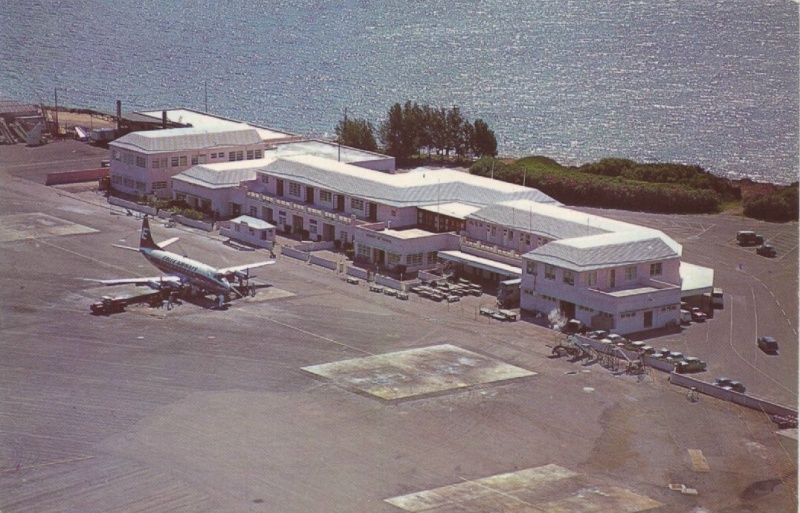
Eagle Airways at Civil Air Terminal
1958. 6th April. HMS Bermuda - see http://www.hmsgangestoterror.org/HMSBermuda.htm - arrived, on its first visit. Built on the Clyde in Scotland in 1939, it saw distinguished service in World War 2. HMS Bermuda (No. 8) was built by John Brown & Company at Clydebank, laid down in November 1938 and commissioned on August 21, 1942. Originally, the ship had 12 six-inch guns, anti-aircraft pieces and six torpedo tubes. During the war, she served in the Mediterranean, the North Atlantic and Arctic and finally in the Pacific theatre. In later years, the vessel was a part of NATO, but was taken out of service in 1962. Some silver objects given to HMS Bermuda by the island are now at the Bermuda Maritime Museum. She visited Bermuda 3 times: 1958, Jul 1959, and Feb 1962.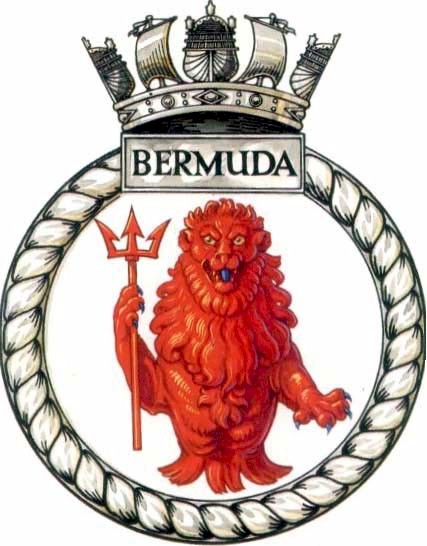
Kindly sent and copyrighted by http://www.hmsgangestoterror.org/HMSBermuda.htm
1958. Bermuda Properties Ltd. purchased the Castle Harbour Hotel from the Bermuda Development Company Ltd.1958. The historic Bel Air mansion at 11 Cobbs Hill Road, Paget Parish, was the residence for some weeks of a famous American theatrical company. It is of several substantial houses built on the hills of Paget in the late 18th and early 19th centuries. A curving drive leads up to the house, imposing in its size a symmetry and surrounded by almost three acres of land. The wide two-storey verandahs are reminiscent of West Indian plantation houses which Francis Albuoy, who built Belair, encountered on his travels south through the islands to Demerara in British Guiana (now Guyana) in South America where he had a trading business in the early 1800s. The front door, beneath an elegant fanlight, is surrounded by stone quoining. Across the threshold, circles of thick glass are embedded in the floor allowing light into the quarters below where slaves once lived. Beyond the house are the old stables and a guest cottage. In 1958 the Helen Hayes Repertory Theatre visited Bermuda and took up residence at this property then owned by Miss Lydia Moncure Robonson. There were more than 20 in the group. Activities included workshops and theatre training. During their visit the members mentioned the property was haunted by a female.
1958. Off Bermuda, the wreck of the 1609 ship "Sea Venture" was discovered by Edmund Downing from Virginia, a direct descendant of George Yeardley who had been the captain of soldiers on the original voyage and later went to Virginia.
1958. Colonial Insurance Company was founded, developed from The Gibbons Company car dealership, as they thought they might as well insure the cars they sold.
1958. July 7. W. L Tucker, MCP for Devonshire, proposed in Bermuda's House of Assembly that the voting system be changed, to enfranchise more Bermudians in accordance with the 1945 Parliamentary Act that had not yet been implemented.
1958. Eight black legislators, Collingwood Burch, Russel Levi Pearman, W. L. Tucker, Hilton G. Hill, E. T. Richards, Walter Robinson, Arnold Francis and Dr. the Hon. Eustace Cann, formed a delegation to meet Alan Lennox-Boyd, Secretary of State for the Colonies, during his visit to Bermuda.
1958. Watford Bridge was rebuilt to provide fishing and pleasure boats a shorter trip to and from the West End.
1958. The movie "Adventures of the Sea Hawk" TV Series - see http://www.imdb.com/title/tt0051250/ was made in Bermuda.
1958. September 4. The ill-fated Bermudiana Hotel, built in 1924 by Furness Withy with much pomp and ceremony and which then could accommodate about 450 guests, caught fire and smoldered for four days before firemen extinguished the blaze. One of the worst hotel fires in Bermuda’s history began with a small whiff of smoke coming from under the eaves of the top floor of the Bermudiana, on a Thursday afternoon when at that time most businesses in Bermuda were closed on Thursday afternoons. One of the hotel managers first discovered a small blaze in a room on the sixth floor at 4.30pm. He tried to use a fire extinguisher but it didn’t work. He found another one but that didn’t work much better. Unable to put out the fire, he called the fire brigade around 5pm and hotel staff started knocking on guests’ doors to get them to evacuate. In those days there were no fire sprinklers in the hotel. The fire got into partitions between the walls and travelled from one room to another. At first it appeared to be moving very slowly from the East to the West side of the building. Guests came into the hotel to pack. Tea and sandwiches were served in the lobby and the bar remained open for some time. One guest even swam in the pool while the fire burned. When the bar finally closed to guests, bartenders calmly packed up large boxes of cigarettes. Everyone seemed resigned to the fact that the hotel would burn to the ground, but there was no sense of urgency to leave. Bermudiana General Manager at that time was Carroll Dooley. His daughter Patricia was swimming in the hotel pool.
The Dooley family were then living at the hotel. Bermuda’s fire department at the time was entirely volunteer. Some firemen arrived from the beach dressed in bathing suits. There was no breathing apparatus or protective fire gear or city fire hydrants in those days. Maids wet down towels for the firemen to wrap around their faces. Fire fighting equipment consisted mostly of two cranes, ladders and fire hoses for several hours they struggled to achieve the water pressure needed to put out the fire. The hotel was supposed to have been coated with a fire retardant paint. But it wasn’t. It was a strange fire and it burned very quickly. The fire left one of Hamilton's premiere resorts and a major Hamilton landmark in a shambles. It caused international concern and interest, especially from New York. All manner of things were thrown from the windows of guests’ personal belongings and furniture. A dentist had an office in the building; a dentist’s chair and boxes of false teeth flew out of that window. The lawn of the hotel was compared to a refugee camp, with items scattered and piled everywhere. Some hotel guests, dazed and uncomprehending, were packing into suitcases, carefully folding clothes and clearing drawers while around them hot yellow-stained water was steadily dripping and from a drip, trickling and running through the cracks which appeared in the ceiling. The ceiling would clearly collapse at any moment. The elevators would not work so the guests tried to hurry down the stairs while water erupted from above them. Meanwhile, crowds of people gathered outside. Some of them tried to help by bringing sandwiches and drinks to the firemen. Some men even joined the volunteer fire service in attempting extinguish the fire. Other onlookers were less than helpful. The curious crowd grew so unmanageable that the Bermuda Militia was called in to control it. The scene became Bermuda’s first experience with live, on-the-spot television reporting. The newly established ZBM studios were just across the street from the Bermudiana. One of the journalists stuck a camera out of the window and filmed the inferno. Those lucky enough to have television sets in 1958 were glued to their sets. All of Bermuda had come to a standstill while the hotel burned. One young policeman, Derek Fletcher, left his bride standing at the altar for over an hour while he helped. The hotel burned to the ground. An electrical fault in the air conditioning system was later named as the cause of the blaze. The fire spurned major changes to Bermuda’s firefighting system a professional service was formed for the first time. The hotel had been a haven for visiting college students on their spring breaks. Some of the rooms would have six girls to a room. The management were pretty strict about who stayed where. Guys and girls were housed on different floors. It was rebuilt within a year, some would say it was rebuilt too quickly and was then owned by Englishman Sir Harold Werhner, of Luton Hoo fame. From about 1964 and for a decade or so, it offered special pool memberships to personnel who worked at the American International Company building then situated below the hotel at the junction with Bermudiana and Pitt's Bay Roads. It also offered membership of the Bermudiana Beach Club in Warwick, where guests could swim on a gorgeous beach, change and eat in comfort and luxury. In later years, the re-built hotel fell into a dilapidated state and was knocked down. In December 1993 the property was sold for $14.5 million and became the site of the Ace and XL insurance buildings.
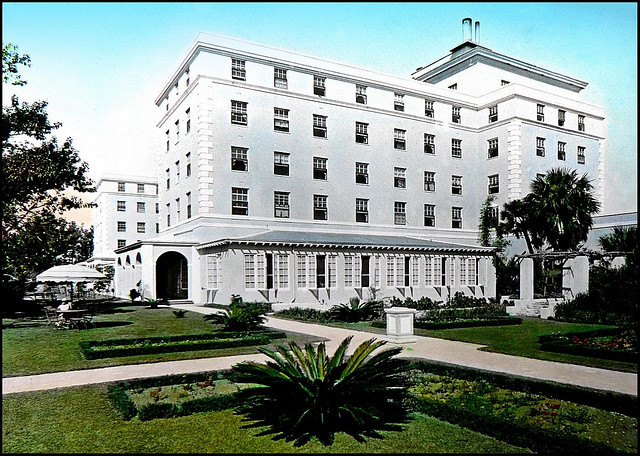
Bermudiana Hotel destroyed by fire
1958. The Adult Education School began, in Hamilton.1958. Princess Soraya — given the title Princess of Iran after the Shah of Persia divorced her because she was unable to produce an heir — visited Bermuda as a tourist. She was an international celebrity at the time, her every move tracked by the paparazzi.
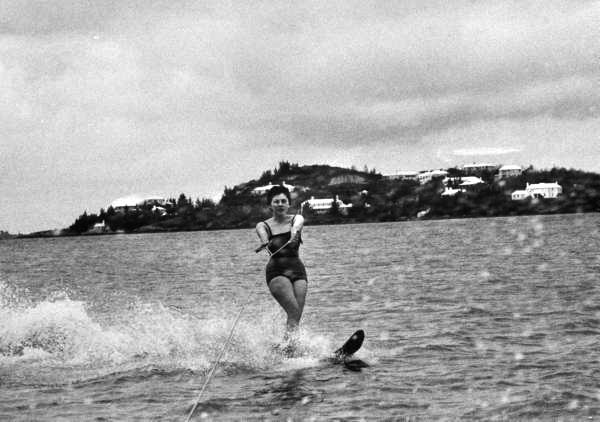
1958. The Royal Navy Base in Bermuda closed almost completely (except for the small area known as HMS Malabar). After the Second World War, with the primary former threat in the region, the USA, having been an ally in both World Wars, and a continuing ally under NATO, the naval base in Bermuda had diminished rapidly in importance to the Admiralty. The US Coast Guard had operated anti-submarine vessels from a base on White's Island, in Hamilton Harbour, in the Great War. During the Second World War, it had built a US Naval Air Station and a US Army airfield in the Colony under 99-year leases. With little remaining interest in policing the World's waterways, and with the American bases to guard Bermuda in any potential war with the Warsaw Bloc, the Royal Navy sold the land to the local government. Earlier, in 1953, the last Bermuda-affected British Imperial Defence Plan was published. Bermuda had been given notice two years earlier by the UK of the intention to withdraw within three years all British military units based in Bermuda. From that time, all Bermuda part-time soldiers ceased to have any role or function assigned by the UK's War Office (later, Ministry of Defence or MOD). The Bermuda Government would be purchasing nearly all Imperial Land Forces property on Ireland Island including the Royal Naval Dockyard for £750,000, with £350,000 to be paid in 1954. A Bermuda Government-owned land company, Crown Lands Corporation, was created in which to vest the new lands, buildings and installations that with the establishment of the Dockyard free port was now leasing.
1959. January. Bermuda, then with a population of 42,000, began its biggest building boom.
1959. March. There was a potentially serious incident involving an aircraft. The pilot of a USAF F-100 fighter aircraft ejected from his plane after his engines flamed out. But he landed in the Atlantic, only 40 miles from Bermuda. A helicopter from Kindley scooped him out.
1959. March. Prince Philip, Duke of Edinburgh, arrived by himself for a 2-day visit relating to the 350th anniversary of the founding of Bermuda by Admiral Sir George Somers in 1609.
1959. In Portsmouth, England and throughout the Island Bermuda celebrated the 350th anniversary of its founding in 1609.
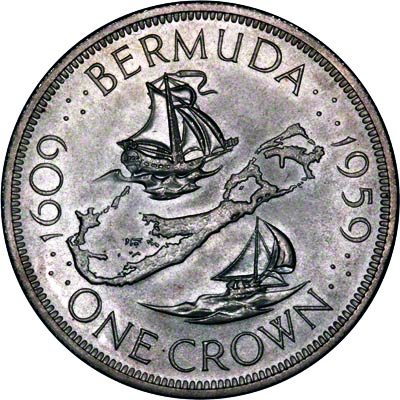
1959. Bermuda earned some free publicity with an event that occurred in London. The prestigious Odeon, in Leicester Square, long the flagship of the Rank Organization's chain of movie theaters nationwide in Britain, featured the world premiere of the film "The Admirable Crichton." The famous British actor Kenneth More, who had portrayed so magnificently the war-time exploits of legless hero Group Captain Douglas Bader, RAF - and the lead in countless other movies - was the star of the hilarious comedy. He and Lewis Gilbert had been, respectively, the star and director of Reach for the Sky, before they journeyed to Bermuda to film The Admirable Crichton. Also playing parts in the movie were the well-known British character actor Cecil Parker and the actresses Diane Cilento (who later became the wife of the film-star Sean Connery) and Sally Ann Howes.
1959. April. The Bermudiana Hotel reopened its doors as a newly rebuilt hotel after earlier having been set on on fire by an arsonist and burnt to the ground. It was rebuilt by Sir Harold Werhner.
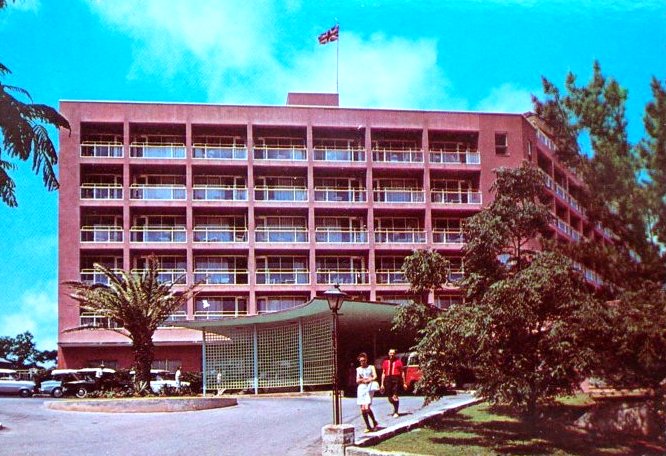
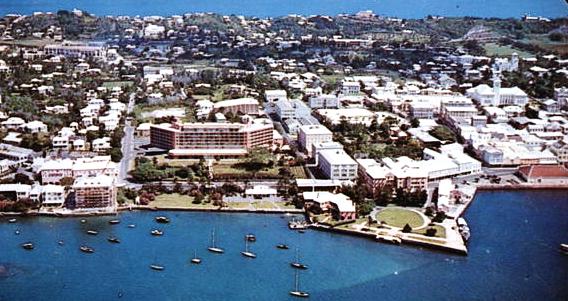
Bermudiana Hotel rebuilt 1959
1959. June 15. A black people's boycott began in Hamilton that later resulted in abolition of segregation in Bermuda hotels and theaters and restaurants. It was organized by "A Progressive Group" to coincide with the 350th anniversary of the founding of Bermuda. Most Bermudians, black and white, recognized the 1959 Theatre Boycott for exactly what it was, a turning point in Bermudian affairs, a genuine watershed event, an exercise in selfless heroism. It ignited flares which erupted spectacularly and illuminated the whole shoddy scene that was segregated Bermuda. It stripped naked at last to the public the everyday indignities, injustices and inequities upon which Bermudian society was then built. It exposed as both preposterous and pernicious the myth this was a racially harmonious little society, a myth perpetuated by those responsible for marketing the image of a cheery, genteel Bermuda to well-heeled vacationers. The boycott organized by the Progressive Group entirely discredited the advertising-driven lies believed by wealthy Americans and also a fair few Bermudians, not all of them white that this was an island where blacks not only knew their place but would do nothing to jeopardize it by engaging in any radical tomfoolery. It also demonstrated the foundations of the racial caste system in Bermuda. It was the beginning of the end of segregated theatres and restaurants and hotels. Not just blacks were victims, Catholics too in some case. Until then, segregation in public places had been a sop to visiting Easterners who, at the time, were only used to encountering blacks in restaurants if they happened to be serving in them. Other miscarriages of justice had occured in everything from housing to education to social mobility. Racial boundaries circumscribed the lives and opportunities of blacks from cradle to grave and caused considerably more distress than seating arrangements in cinemas.
But in the 1950s, the cinema was still the primary source of public entertainment. Thousands of Bermudians and visitors went to the movies every week. The segregated seating, blacks downstairs, white upstairs, vividly literalized old social divisions. So the cinemas became not only the most highly visible target for the Progressive Group's action, a boycott also provided an opportunity for blacks to demonstrate their growing economic clout by disrupting the revenues of a largely white-owned concern. It was a rigidly hierarchical society and while whites may have been the dominant racial group, not all whites were in dominant positions. Far from it. Most were marginalized and filled low-status, low-skilled service positions, disadvantaged in their own way if not actually discriminated against. Interestingly, the USA had already seen major changes for the betterment of blacks. World War 2 and the major role played in the liberation of Europe by black soldiers from the modern slavery of the Nazis had forced black and white Americans alike to contemplate the proscriptions on freedom at home. The emergence of an educated, articulate and increasingly prosperous black middle class during the post-war boom made it increasingly difficult to avoid change. In 1948 President Harry Truman integrated the US armed forces. In 1957 President Eisenhower sent Federal troops into Arkansas to enforce the integration of public schools. The modern Civil Rights era was underway. Yet Bermuda had remained stubbornly resistant to change. The Theatre Boycott ended segregation in public places in a matter of days. More importantly for the island's long-term well-being, it also prompted a decade-long debate on the future direction and character of Bermuda. Members of a generation of forward-looking, liberal-minded whites emerged along with some older power brokers who, for pragmatic rather than idealistic reasons, recognized the old order had to be dismantled. Partnering with the Progressive Group and its supporters, they went on to introduce in trial-and-error but largely peaceful fashion a social system that more broadly conformed to the hopes and expectations of the majority of Bermudians. The Theatre Boycott was the catalyst for profound and irreversible change in the racial power dynamics in this community. It also prompted a radical reorganization of Bermuda's political system and economic pecking order.
1959. July 2. The boycott by black activists of Bermuda's cinemas ended when the management of the white-owned Bermuda General Theatres ended their policy of seat segregation.
1959. Treasure hunter Teddy Tucker, who found the so-called Tucker Cross on a wrecked off Bermuda Spanish ship in 1955, sold the cross to the Bermuda Government. It was put into storage, was to be the showcase of the new Maritime Museum, but by 1975 was stolen, was never recovered and a dummy was found in its place.
1959. During the Newport-to-Bermuda ocean yacht race the yacht Elda was wrecked on the same Bermuda reef that sank the Virginia Company ship the Eagle 300 years earlier. When trying to salvage the Elda a diver noticed the cannons from the Eagle on the ocean floor.
1959. Formation of the Bermuda Police Pipe Band. It proudly wore the Prince Charles Edward Stuart ("Bonnie Prince Charlie") tartan. Composed at first largely of members of the Bermuda Police and Prison Services, and other local enthusiasts, including some formerly in the Bermuda Cadets Pipe Band, they were soon performing at the Police Passing Out and ceremonial parades.
1959. Iran’s former empress, New York’s mayor and the Duke of Edinburgh were among the celebrities filmed against Bermuda backdrops in a 1959 promotional film extolling the island as a dream location for vacationing photographers. “Portrait of Bermuda” was released by the Bermuda Trade Development Board, aimed at the mushrooming market of well-heeled amateur shutterbugs which developed during the post-World War Two consumer boom in the US. The short film featured eye-catching Bermuda scenery ranging from the South Shore beaches to St. Peter’s Church. It also included shots of flower-bedecked floats participating in the island’s old Easter Floral Parade, Prince Philip’s two-day visit to Bermuda in 1959 to take part in events commemorating the 350th anniversary of the “Sea Venture” wreck and diver Teddy Tucker’s fabled emerald cross and other treasures retrieved from shipwrecks. Photographers were even encouraged to frame their shots using Bermuda moon gates in the film, widely distributed to US cinemas and TV stations. Some of the most intriguing footage featured a scrum of international press photographers surrounding Iran’s former empress during a 1958 Bermuda vacation. Soraya — given the title Princess of Iran after the Shah divorced her because she was unable to produce an heir — was an international celebrity at the time, her every move tracked by the paparazzi.
1959. American billionaire Daniel Ludwig purchased the Hamilton Princess hotel with plans to make it a luxury hotel. It had come out of World War 2 in a slightly dilapidated condition, having been used from 1940 to 1944 by British censors.
1959. Death of Wilfred Richmond "Wil" Onions, Bermuda's most famous and influential architect. Born in Bermuda on September 29, 1908, at Melville Cottage in Mangrove Bay, Somerset. He was the only son of Henry “Harry” Onions, a haberdasher who owned a store in Somerset village, and his Scottish wife Mary, and had three sisters Hilda, Edith and Frances. The family moved to Myrtle Cottage in Long Bay Lane, Somerset, and Henry renamed the house Aberfeldy after his wife’s hometown, a small Highland market town on the banks of the River Tay in Perthshire, Scotland. Onions later renovated the house, which had originally been built in 1800, and lived there with his mother until his death. He was instrumental in developing the revivalist Bermudian vernacular style that came to define the island’s architecture and inspire Bermudian architects long after his death. Taking the traditional Bermuda cottage as inspiration, he designed graceful houses with large, well-portioned rooms and bearing his trademark features such as high, graceful chimneys; long flowing rooflines; buttresses; large doors and windows; ‘welcoming arms’ staircases and airy interiors with high tray ceilings. His designs include some of Bermuda’s best-known properties commissioned by prominent families. They included Chelston, the former U.S. Consulate in Paget; Buttonwood and But ‘n’ Ben in Tucker’s Town; Woodstock Cove, Paget; Crow Lane House, Paget; The Quarries, Pembroke; and Socatean Ledge, Somerset. His most famous landmark is City Hall in Hamilton, although he tragically died before it was completed in 1960.
1959. Members of the St. Mary's Church Guild with a passion for flowers and gardening sought to further their interest by applying for membership in the Garden Club of Bermuda. Their applications were not accepted, presumably because they were all 'coloured' women. The Warwick ladies decided they would form their own club. The name 'Hibiscus' was chosen because of the popular flower that adds its beauty to hedges and roadside foliage especially in the spring and summer. The first meeting was at the residence of Mrs. Ruth Simons at Cedar Hill. The 11 people present were Mrs. Simons, who was elected president, Miss Julia Lightbourn and Mesdames Ruth Wainwright, Edna Conyers, Laura Bean, Mildred Smith, Faith Steed, Victor Scott, Horace Davis and Louise Wilson. Also at that meeting was Reginald Ming, Government's first Heritage officer, who according to an excerpt from the minutes of the meeting gave the ladies helpful suggestions and promised to use his office to get them affiliated with an outstanding club in England. At that inaugural meeting Mrs. Simons served her guests cake and champagne. Tea and cake was served at their regular monthly meetings. The Hibiscus Club is not restricted to growing hibiscus, but is interested in all types of plants and vegetation and all forms of floricultures, gardening and landscaping.
1959. A longshoreman's strike in Bermuda crippled imports.
1960. The Committee for Universal Adult Suffrage (CUAS), spearheaded by Roosevelt Brown and others, was organized with the dual objective of extending the franchise for all adults twenty-one years and over and of abolishing the property requirement for voting. The group was so successful in raising public sensitivity to these contentious issues that Government accepted in principle the concept that universal suffrage should be implemented.
1960. At Bermuda's US Kindley Air Force Base, there was a shooting at Air Police headquarters, then manned by the 1604th Air Police Squadron. One of the USAF Air Police members shot several people and killed a couple. The case was handled by the USAF. He was brought back to Bermuda and had trail, was sentenced to 33 years at Leavenworth, Ks.
1960. February 11. City Hall, in the heart of Hamilton, was officially opened on this day, designed by Bermudian architect Will Onions, best remembered for domestic residences. It was on the site of the former Hamilton Hotel. The opening came after 25 years of discussions, delays and construction wrangles . In addition to housing the Corporation of Hamilton, it became the home of the City Hall Theatre, the Bermuda Society of Arts and Bermuda National Gallery. According to Mr. F.J.E. Edwards, executive manager of Post, Andrews, Ltd., contractors, the company lost a whopping £50,000 on the contract for building the new City Hall in Hamilton.
1960. April 5. A 300-foot US Navy dirigible, confronted by unfavorable landing conditions at her home base at Lakehurst, N.J., landed here in Bermuda at Kindley AFB after hovering over the islands for 15 hours.
1960. April 15. The Bermudiana, the new luxury hotel, opened its doors to guests. On the previous day invited guests got a preview of the new establishment.
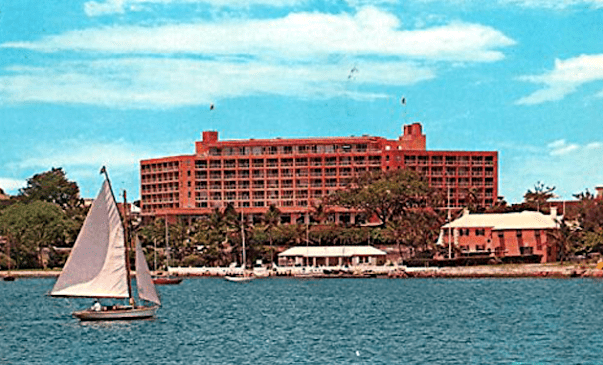
1960. April 15. The St. George Hotel began an extensive face-lifting. Renovations were completed earlier this month. Additions and renovations are also taking place at the Princess Hotel which will increase guest accommodation to 500 . . .
1960. Prince Andrew was born, the third youngest of four children of the Queen and Prince Philip.
1960. August. Non-Mariners Race began by Society of Non-Mariners in Hamilton, Bermuda by amateur non-sailors deliberately launching non-seaworthy and distinctly non-nautical home-made floating in often hilarious un-seaworthy crafts of any type and design as a joke against the well-established and prim sailing clubs of Bermuda and their 1960s sailing correctness. They were not solely men, single women were instigators too, driven by the maleness-only of the more established sailors. Nor were the majority drunk, they were sober, just mischievous, boat-less themselves. Their unorthodox "vessels" were cranked by hand or by pedals or by the wind and were often accompanied by raucous noises, providing much amusement to many residents and visitors at the annual event which became hugely popular. (After one such event had a zany entry almost collide with a cruise ship entering Hamilton Harbor, the Society of Non-Mariners, as the organizers subsequently became, the event was switched to the less-busy but picturesque Mangrove May in Somerset, Sandys Parish, hosted by the Sandys Boat Club. The event now includes family frolics, youngsters jumping off "boats", mock boat battles, some ingenious unorganized surprises. A fun day for residents and visitors.)
1960. Construction of the NASA tracking station in Bermuda was completed (officially opened later, in March 1961, see below), after work began on it in 1959. The NASA station was at the end of Mercury Road on Cooper's Island, St. David's, on the southeast tip of the former base, (adjacent to what is now Clearwater Park). Many airmen and locals were employed to help complete the construction on time. Bermuda became an important part of the NASA worldwide tracking network and initially its primary responsibility was computer monitoring and along with Cape Canaveral could abort a mission on the downrange before going into orbit. The Atlantic Ocean abort landing area was between Bermuda and the Canary Islands. The seven Mercury astronauts, Shepherd, Grisssom, Glenn, Carpenter, Cooper, Slayton and Schirra were frequent visitors to NASA Bermuda in 1960 & 1961. Installation of the Manned Space Flight Network (MSFN) stationed at Bermuda commenced in 1960 and was a dual site in that the control and main body of equipment was located at Coopers Island and all of the spacecraft communications receiving equipment was located at Town Hill, near Flatts, Smith's Parish., some six air miles from Coopers Island. The Town Hill station also included active acquisition aid and receiving antennas on separate towers.
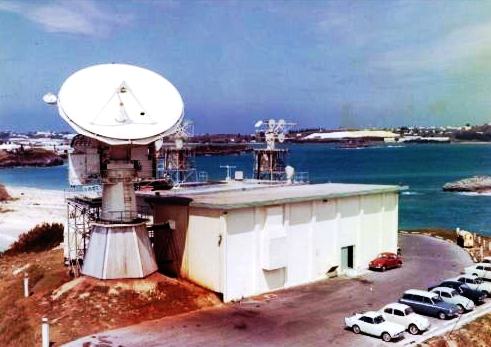
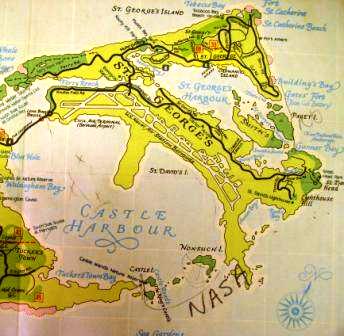
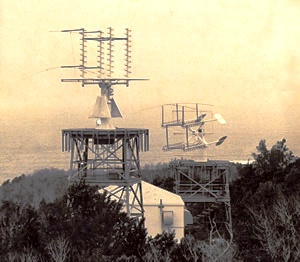
Town Hill antennas
As an integral part of the National Aeronautics and Space Administration's Manned Space Flight Network (MSFN), the Bermuda station played a vital role in the United States' Apollo lunar program and other flight missions. The Cooper's Island station was located on the southeastern tip of Bermuda about 600 miles out in the Atlantic from the U.S. east coast. Radar dishes and helical antennae were used to track anything from spacecraft to sparrows. Because of its location in relation to Cape Kennedy Florida, the Bermuda station had a dual purpose role for the Manned Space Flight Network (MSFN). At the time of launch, the primary mission of the station was to provide trajectory data to the computing facilities at Goddard Space Flight Center (GSFC). Computations based on data obtained during the final portion of powered flight was used to confirm the orbital "Go-No Go" decision. Bermuda normally acquired the spacecraft at approximately T + 3 minutes. The station was usually able to supply a minimum of 60 seconds of valid radar data prior to engine cutoff and orbital insertion. For subsequent passes of the space craft, Bermuda served as a normal tracking station with command capabilities. In addition to supporting manned missions, the Bermuda station commanded, tracked and acquired valuable data from a host of unmanned scientific and application satellites launched from Cape Kennedy and NASA's Wallops Island launch facility in Virginia. In between flight missions, the Bermuda station's sophisticated instrumentation was employed by scientists to conduct research ranging from the migratory habits of birds to astronomy.
1960. May. A dramatic shark attack occurred just off Elbow Beach, with Mickey Caines, then employed at the Elbow Beach Surf Club, credited with killing the nine-foot shark after it had injured a fellow hotel employee. (Later, a hotel restaurant there was named Mickey's, in his honour). The nine-foot long shark attacked fellow Elbow Beach employee, waiter Louis Goiran, aged 24. He was seriously bitten while swimming only about 15 feet from shore. While two men rushed to Mr Goiran's aid, Mr Caines ordered everyone out of the water. The shark was subsequently gaffed with a hand spear and brought by boat to shore alive, where it was killed by forcing an oar down its throat. The shark's victim, Mr Goiran, needed 50 stitches to his hands and feet. Ross Doe was one of those in the boat and leant on the boat's gunwale to keeps his spear implanted in the shark. In the stern was Lucius Stone holding the shark's tail. Bruce Hartnell rowed the boat back to shore with Hans Behringer assisting.
1960. September to September 1961. HMS Rothesay was based Royal Navy Dockyard at Island Island. Crew enjoyed periodic station leave at the-then unused former British Army camp near Horseshoe Beach, in between patrols covering the whole of North and South America. They enjoyed the hospitality of the local people. One crew member spent a few days with a local family over Christmas 1960 (when then was a brief appearance of snow, usually unheard of in Bermuda) and attended Mass with them on Christmas Eve.
1961. January. Cubana's landing rights in Bermuda and Azores were cancelled, at the request of the US Government. This occurred after the severing of relations between the USA and Cuba after the Fidel Castro-led Cuban Revolution. Cubana had first started to fly to Bermuda in 1948 and in 1952 had suffered a major incident in Bermuda. But the service had continued. Now, they stopped. As a result of the stoppage, Cabana had no option but to switch from Bermuda to Gander, Newfoundland and Shannon, Ireland stops on Cubana's Prague route (Gander only on the Madrid route). The Bermuda stop on the outbound and Azores on inbound flights had been essential because Cubana's British-made Britannia aircraft did not have the necessary range to fly nonstop to and from Europe. Fortunately for Cubana, the Canadian and Irish governments provided landing rights and refused to bend to U.S. pressure, especially when Czechoslovak Airlines (CSA) started to operate its own services on the same route (coordinated with Cubana's). The denial of those rights by Canada and Ireland would have forced Cubana to discontinue its transatlantic routes.
1961. The Sea 'Venture" book by F. Van Wyck Mason was published in New York by Doubleday, 349 pages. Illustrated. It is an account of the first British ship and its crew and passengers to colonize Bermuda. The cover for this book, which caused a sensation in Bermuda and became one of his most famous books, was designed by artist John Alan Maxwell
1961. Because of the vision of Sir Gilbert Cooper, a former Mayor of Hamilton, the Bermuda Society of Arts found a permanent home in City Hall, Hamilton.
1961-62. HMS Londonderry was based at the Royal Navy Dockyard at Island Island during her first commission and the ships company have very many happy memories of Bermuda and the hospitality that was afforded them whilst there.
1961. January. In Ottawa, the Cabinet Defence Committee approved the establishment of a High Frequency Direction Finding (HFDF) installation in Bermuda. This was as a direct result of the continued Canadian presence in Bermuda. This decision was noted by the Canadian Cabinet at a meeting in February 1961.
1961. Elliott Extension School opened at Prospect as a special needs school for the physically handicapped, initially with 100 children and four lady teachers.
1961. The American Society of Bermuda was formed by a small group headed by author and writer Col F Van Wyck Mason. It had the encouragement of the American Consulate, which believed that it would be beneficial for United States citizens in Bermuda to get together from time to time. It's objectives were to celebrate certain American national holidays in keeping with the traditions and spirit of the occasion; foster a spirit of friendship, cooperation and mutual understanding and interest among citizens of the United States and Bermudians; promote and foster harmonious relations between United States citizens living in Bermuda and Bermudians; provide aid and comfort to visiting citizens of the United States when aid is requested or necessary; cooperate with the American Consulate in the dissemination of information on legislation or other matters of concern or interest to the membership; and sponsor charitable activities to raise funds to be donated to organisations both within and outside Bermuda. Activities included celebrating the following national holidays with social gatherings: President’s Day, Independence Day, Thanksgiving Day.
1961. March. After The USA and United Kingdom formally agreed to open a US Space Tracking station in Bermuda, NASA opened its Cooper's Island base. It cost the USA $5 million to build. For fiscal and diplomatic reasons, local workers were used as much as possible to build the station, and NASA employed 60 contractors and 20 Bermudians to operate it. Located on a 77-acre rock-coral shelf just off of Saint David's Island on the northern shores, the main station was an eastward extension of Kindley Air Force Base and managed by the US Air Force. Its use dated back to a World War II agreement between President Roosevelt and Prime Minister Churchill. A smaller site was in Town Hill on the main island. I It was part of the NASA Spaceflight Tracking and Data Network at more than 24 locations across five continents. It was used for 37 years as a tracking and communications facility for various space programmes, including the Mercury and Apollo missions and space shuttle flights because of its key geographical position in relation to launch trajectories for space vehicles blasting off from Cape Canaveral in Florida. Alan Shepard was one of the NASA astronauts assigned to Bermuda. The NASA Bermuda station manager was Bill Way, who helped set it up and played a key role in space exploration by tracking shuttle missions. His team's job included monitoring shuttles every 90 minutes as they came around the earth, and receiving scientific data transmitted by units left on the moon following lunar missions. Arriving in Bermuda from California with childhood sweetheart Margie and deciding never to leave, Mr. Way had seven children, two of whom died in tragic circumstances. He had a lifelong interest in science and engineering. He was involved in Apollo programmes. When they were little he would tell his children the stories about them and the children would get to meet the astronauts. He was also well-known on the local tennis circuit for his dedication to the Bermuda Lawn Tennis Association. Bermuda was one of NASA's first stations built on foreign soil and was also one of the most critical. With the exception of Cape Canaveral, it was the most complex and important of the 15 Mercury Space Flight Network (MSFN) ground stations.
The Mercury Atlas flight path was almost directly over the island, which enabled a brief but essential 25-second window to track and make decisions about its status as it ascended into orbit. The vital determination to abort or continue a flight was known as "Go/No Go". During the launch of an Atlas rocket- an Air Force Intercontinental Ballistic Missile used to launch the Mercury astronauts and the NASA's early large satellites, a decision to continue or abort had to be made in only a 30- to 120-second window after the rocket's main engine had cut off. The failure rate of the Atlas booster in those early days was very high - about 50 percent - so aborted missions were common. The Bermuda station was established to keep an eye on every Cape Canaveral launch and the first critical phases of the flight downrange, making it a key station during the launch phase of any mission. The control centre at Bermuda provided reliable communications and controls in the event that it became necessary to make abort decisions. Many mathematical and trajectory experts believed such a "short arc" solution would be impossible, but data analysis, some of it generated by the Bermuda tracking station, determined that, even with such a small timeframe, a spacecraft could be turned around and its retrorockets fired so that it could reenter in the Atlantic recovery area before reaching its point of impact on the African coast. During Project Mercury, NASA's first man-in-space programme, the network was not well-centralized and communication was done by sometimes-unreliable teletype, so flight controllers were dispatched to most of the primary tracking stations in order to maintain immediate contact with the spacecraft from the ground. Astronauts also acted as capsule communicators (known as Capcoms) at various sites. Donald K. (Deke) Slayton, head of Flight Crew Operations at Houston's Manned Spacecraft Center, was said to have assigned astronauts to Bermuda (as well as sites in Hawaii, California, and Australia) as Capcoms to give them some much-needed rest and relaxation in beautiful places. Later, in 1963, to prepare for sending astronauts into space, an ocean floor cable capable of carrying 2,000 bits-per-second of digital information was laid to connect the new station on Bermuda with Cape Canaveral. This link continued to serve the Bermuda Station well into the Space Shuttle era. The Bermuda station was overhauled in preparation for the lunar landing programme. As it had been on Mercury and Gemini, Bermuda would be an essential station immediately after launch. As the first station to electronically see the rocket, operators could observe most of the second and third stage burns at high elevation angles. Bermuda monitored the ascent of the Saturn V into orbit and provided the critical "Go/No Go" data to Mission Control for flight continuation or a decision to abort the mission. In March 1965, a request was submitted for a $1.6 million consolidation and upgrade to the MSFN facility on Bermuda so it could meet the combined requirements for projects Gemini and Apollo.
All of the various telemetry facilities scattered around in pre-fabricated metal structures and trailers on Town Hill and Cooper's Island were to be consolidated. The original facilities also were corroded by years of sea salt and moisture. An air conditioned, 1,100-square meter Operations Building was built and a 300-square meter Generator Building housed the diesel generator. Next to the USB antenna, a small building contained the hydro-mechanical equipment that pointed the massive antenna. Concrete foundations were dug for the dish and the collimation tower. Extensive cabling was installed, and a microwave terminal was relocated. 30 percent more maintenance and administration staff was added as well as 26 additional technicians as the site was ramped up to support Gemini and Apollo missions. When the Cooper's Island upgrade was completed, NASA dismantled the Town Hill telemetry site. Shuttle flights on easterly trajectories went all the way into orbit on their backs. In November 1997, Columbia, the Shuttle program's 88th flight, was the first to roll the entire stack from its usual belly-up to a belly-down position in a 40-second maneuver six minutes after liftoff. Known as a Roll-to-Heads-Up (RTHU) maneuver, it's performed prior to main engine cutoff so that communication with the contemporary space-based Tracking and Data Relay Satellite System (TDRSS) can be established some two and a half minutes sooner. Such a maneuver previously had been used only if Mission Control declared an emergency landing due to a failed main engine or the loss of cabin pressure during the crew's ascent into orbit. This innovation meant that the Bermuda station was no longer necessary for the success of NASA launches. The decision to close the site was ultimately a financial one, as it saved NASA $5 million a year; coincidently the same amount required to build the station in 1961. With Bermuda closed, Merritt Island/Ponce de Leon became the only source of tracking data for the first seven minutes of each Space Shuttle launch. The phase-out of the Bermuda station in 1997 signaled the end of the era of the worldwide network of space flight tracking stations. Bermuda had supported every human spaceflight that NASA had flown, making the critical "Go/No-Go" call on 118 missions.
1961. After enabling legislation finally allowed it, Bermuda's hotels and restaurants eliminated their earlier their front-desk policy of exclusion. Bermuda tourism became open to all. A few pockets of exclusion remained—golf clubs - but race was no longer the driving force.
1961. Universal, but not equal, suffrage was achieved. It was not equal because landowners receive a plus vote.
1961. Formation of the Teachers Rugby Club. Alan Leigh, a schoolteacher from England, an avid rugby fan, was one of the founding members, along with Gabriel Rodrigues, Alwyn McKittrick, Ted Pearson and Carey Maddern, he pulled together a team at first made up of expatriate teachers. Mr Leigh refereed for many years and became a major influence on the sport’s development on the island. He was also a former president and general secretary for the Association of School Principals. Mr Leigh was a strong supporter of parents, especially men, being involved in the education of their children.
1961. The enactment of the Restaurant Act in Bermuda created parity between black and white diners.
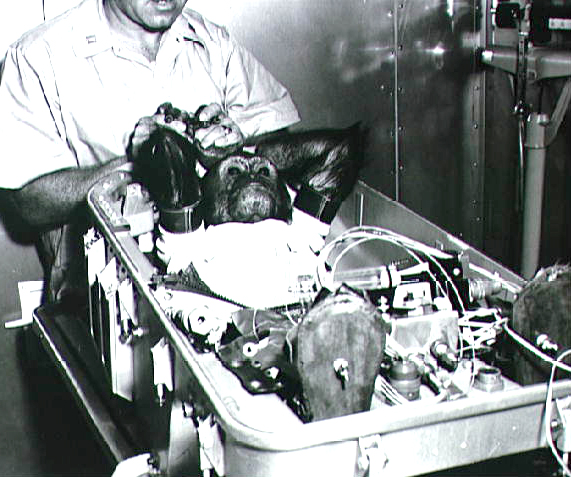 1961. November 29. Enos the
NASA chimp splashed down in the North Atlantic not far from Bermuda,
after having been partly trained here. He pioneered the space launches from
the USA. Enos
was considered the most intelligent of all of the trained chimps, which is
why he was chosen for the mission. Unlike
Ham, his elder "brother." Enos was not cuddly and friendly.
He fought mightily against the veterinarians and operant conditioning, and
was quick to bite so he was kept on tethers when not in training. While he
was highly skilled at his tasks when he did them, early on he might complete
his tasks only to turn on his trainers as soon as he was done. Enos was once
locked in a metal box for a week, living in his own waste, in an effort to
break him. It worked. Enos' mission was to attempt three orbits of the Earth
for the Mercury-Atlas 2 mission. About five hours before the November 29,
1961 launch, the specially constructed primate couch in which Enos was
secured was inserted in the spacecraft. He was relaxed during countdown, and
all of his bodily functions were normal. Then, a series of delays began,
leading some in the control center to joke that Enos was sabotaging the
mission because he had talked to Ham and did not want to go into space. When
the rocket was finally launched, Enos fared well, withstanding a peak of 6.8
g's during booster-engine acceleration and 7.6 g's with the rush of the
sustainer engine. The Atlas rocket delivered 367,000 pounds of thrust,
nearly five times what human astronauts Shepard and Grissom had experienced;
Enos was unfazed.
1961. November 29. Enos the
NASA chimp splashed down in the North Atlantic not far from Bermuda,
after having been partly trained here. He pioneered the space launches from
the USA. Enos
was considered the most intelligent of all of the trained chimps, which is
why he was chosen for the mission. Unlike
Ham, his elder "brother." Enos was not cuddly and friendly.
He fought mightily against the veterinarians and operant conditioning, and
was quick to bite so he was kept on tethers when not in training. While he
was highly skilled at his tasks when he did them, early on he might complete
his tasks only to turn on his trainers as soon as he was done. Enos was once
locked in a metal box for a week, living in his own waste, in an effort to
break him. It worked. Enos' mission was to attempt three orbits of the Earth
for the Mercury-Atlas 2 mission. About five hours before the November 29,
1961 launch, the specially constructed primate couch in which Enos was
secured was inserted in the spacecraft. He was relaxed during countdown, and
all of his bodily functions were normal. Then, a series of delays began,
leading some in the control center to joke that Enos was sabotaging the
mission because he had talked to Ham and did not want to go into space. When
the rocket was finally launched, Enos fared well, withstanding a peak of 6.8
g's during booster-engine acceleration and 7.6 g's with the rush of the
sustainer engine. The Atlas rocket delivered 367,000 pounds of thrust,
nearly five times what human astronauts Shepard and Grissom had experienced;
Enos was unfazed.
At his press conference in Washington, President Kennedy got a round of laughter when he said, "This chimpanzee who is flying in space took off at 10:08. He reports that everything is perfect and working well." During the second orbit, the lever for the motor skills test malfunctioned and Enos was shocked rather than rewarded for each correct answer. Nevertheless, he kept pulling the levers, continuing to perform his required operations as he was trained to do, despite the repeated shocks. His suit overheated and the automatic attitude controls malfunctioned, so the capsule repeatedly rolled forty-five degrees before the thrusters would correct it. Luckily for Enos, given his shocking predicament, mission control decided to end his flight. Three hours and 21 minutes after liftoff - 181 minutes of which he was weightless - Enos re-entered the Earth's atmosphere and landed in the Atlantic, south of Bermuda. Enos and his spacecraft were hauled aboard the Stormes an hour and 15 minutes after landing. Engineers scrutinizing the capsule found that it had held up well. So had Enos, though he'd ripped through the belly panel of his restraint suit, removing or damaging most of the biomedical sensors from his body, including those that were inserted under his skin. He also ripped out a urinary catheter while he waited in the capsule for pick-up. But once aboard the Stormes, he ate two oranges and two apples, his first fresh food since he'd been placed on a low-residue pellet diet.
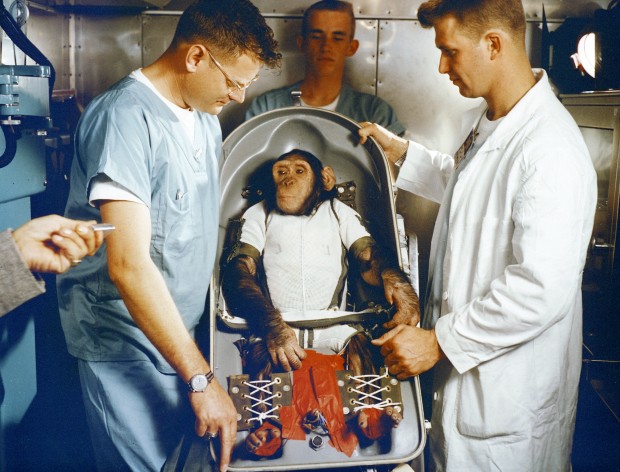
The destroyer dropped the chimpanzee astronaut at the Kindley Air Force Base hospital in Bermuda. The chimp was walked in the corridors and appeared to be in good shape apart from mysteriously high blood pressure, which Woolf speculates arose from Enos stuffing down his rage at his two years of mistreatment at the hands of humans. But, at least for a brief time, Enos was hailed as a hero by NASA and the press. His composure at a press conference surprised reporters. Unlike Ham, Enos was unperturbed by the noise and flashing bulbs, perhaps because of all he'd already endured. On December 1, Enos was sent from Bermuda to Cape Canaveral for another round of physicals, and a week later he departed for his home station at Holloman, set for retirement. Thanks to Enos, mission managers concluded that a human could withstand space travel. An astronaut riding in the MA-5 spacecraft could have made the necessary corrections in flight to complete the three-orbit mission normally. On the date of Enos' flight, it was announced that Lt. Col. John Glenn would make the first manned orbital mission on February 20, 1962. Glenn orbited the earth in the Friendship 7 and became a huge celebrity. In his speech to Congress, he said he was humbled when the president's daughter, Caroline Kennedy, met him and her first question was "Where's the monkey?"
1961. A silver charm of Somerset Bridge, Bermuda, was issued, in time for the annual Christmas gift-giving season.
1961. December 21-22. The beginning of another Summit Conference in Bermuda, at a time of heightened world tension further soured by the erection of the infamous Berlin Wall. It was a two-day event between British Prime Minister Mr. Harold Macmillan and new President of the United States John F. Kennedy (who had been inaugurated only 11 months earlier). It had been arranged to discuss geo-political and nuclear policy. The meeting had nearly been cancelled, owing to a massive stroke suffered by President Kennedy's father, Joseph Kennedy, the pre-war pro-German US Ambassador to Britain.
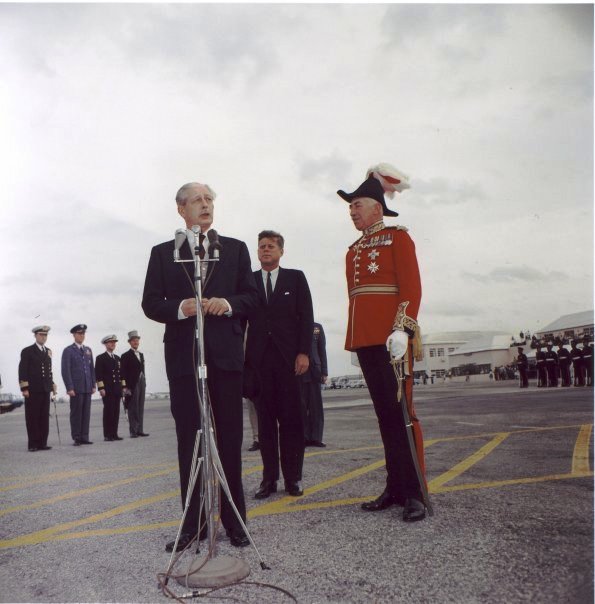
From Bermuda, President Kennedy telephoned his father at the family estate in West Palm Beach, Florida, several times to inquire about his condition - and was ready to fly off at a moment's notice had his father's health deteriorated. President Kennedy arrived in Bermuda on a silver and orange Boeing Jet from Palm Beach Florida at 12.55pm.
He was greeted by Governor Sir Julian Gascoigne and a host of local dignitaries. He was accompanied by US Secretary of State Dean Rusk, National Security advisor McGeorge Bundy, US ambassador to London David Bruce and other high-ranking officials.
Also Included in President Kennedy's entourage were his Press Secretary, Pierre Salinger, later a well-known private-sector broadcaster and author; the President's personal private secretary, Evelyn Lincoln; and Mr. Salinger's assistant Sue Vogelsinger, who wrote for United Press International. Mr Macmillan’s party included Foreign Secretary Alec Douglas-Home, British ambassador to Washington David Ormsby-Gore and nuclear weapons advisor Sir William Penney.
The day was windy, and the president repeatedly brushed the hair out of his face as the combined bands of the Bermuda Rifles, and Bermuda Militia, burst into the national anthems while an honour guard resplendent in scarlet uniforms, snapped to attention.
A small, but enthusiastic, crowd burst into applause, and most of them pointed cameras at the president. He made a brief speech at the airport, telling the people of Bermuda, he was “delighted to be here”. In some remarks at the airport addressed to Macmillan — and the people of Bermuda — President Kennedy said: “I want to express my great pleasure at having an opportunity to talk to you again and to visit you on your territory which has been the scene of most important meetings beneficial to both our countries.
Still remembered today is the motorcade the two men, the Governor and their delegations took from the Civil Air Terminal to Government House, along the North Shore Road. At every junction, parked cars were spilling out their occupants to wave and take photographs. Near Flatts, children held up signs and offered broad smiles of welcome, including one group whose sign welcomed the President on behalf of Bermuda's American residents. At Government Gate leading up to the Governor's residence, a number of children were also assembled.
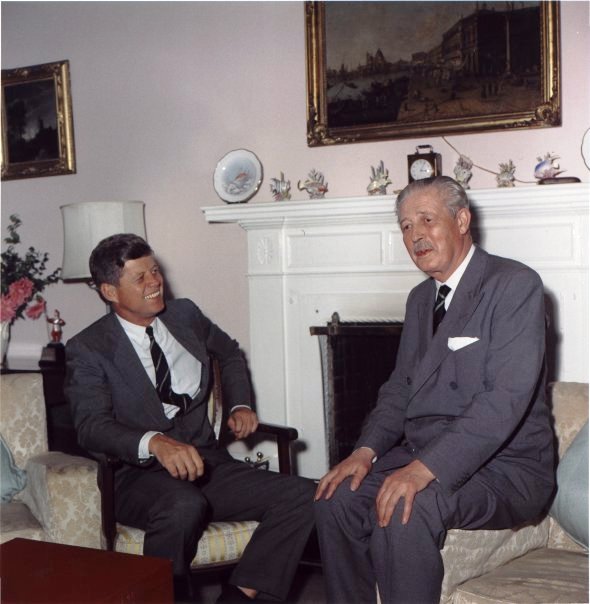
Kennedy and MacMillan held their first solo meeting in a small drawing room at Government House called the West Hall. Apparently they spoke before a roaring fire, which must have made things very hot as apparently it was unseasonably warm in Bermuda for December. Although they sipped gin and tonics and joked with each other, a bit, the topic was very serious — the escalating nuclear arms race which could have resulted in Armageddon.
The Soviets had just resumed atmospheric hydrogen bomb tests in the wake of the June Berlin Wall crisis. At the end of October they had detonated the Tsar Bomba (Emperor Bomb), which remains, to this day, the largest thermonuclear weapon ever exploded — carrying a yield equivalent to 50,000 tons of TNT. Both the president and the Prime Minister were accompanied by their own teams of nuclear experts.
The meeting in Bermuda wasn’t all doom and gloom. While on the Island the president was presented with a Royal Worcester figurine of a hog fish and sergeant major. At the base was a piece of Bermuda Coral. All major dignitaries that visited Bermuda were required to plant a tree at Government House, and Kennedy was no exception.
In a lighter moment during the Summit Conference, President Kennedy initiated some variety into what had by them become an established custom for all world leaders and other very important people who had visited Government House. Because of his well-known and much-publicized bad back, the lingering after-effect of an injury incurred while on his much written about PT-109 boat war-time duty in the Pacific, and the less well-known fact that he was suffering from Addison's Disease, a thyroid condition, he elected to plant his tree - a canary date palm - less painfully than the customary use of a spade dug into earth.
He used merely a pair of scissors to snip a ribbon on the tree that Government House gardeners planted for him. With his unfailing good manners employed so as not to put his distinguished American guest in a bad light, Mr. Macmillan elected to do the same thing with his tree.

President Kennedy was later transported by helicopter from Government House to the airport at the then Kindley Air Force Base following his three days in Bermuda.
The conference was heralded as highly successful. The Canary Island date palm planted by the president is still growing at Government House and is now a fully grown tree. Over a crackling cedar log fire at Government House, the two world leaders discussed at Government House, among other things, the war which was then raging in the newly-liberated territory of the Belgian Congo, which brought forth the ill-fated African patriot Patrice Lumumba who had sought Western help in the civil war tearing his country apart; the crisis of the world escalated further by the erection of the Berlin Wall, completed just days before the conference; and testing of nuclear weaponry, with its acceptable and unacceptable sites and timings.
The two leaders made the decision to renew atmospheric nuclear tests, with a joint statement issued from Bermuda that read: " It is now necessary as a matter of prudent planning for the future, that pending the final decision preparations should be made for atmospheric testing to maintain the effectiveness of the deterrent."
For and during this Summit Conference. the Bermudiana Hotel in Hamilton was used by photographer Dan Lewis and relevant others as a White House Army Signal Agency (WHASA). White House staff set up communications equipment there, for and on behalf of the Department of Defense, Department of the Army, Office of the Chief Signal Officer.
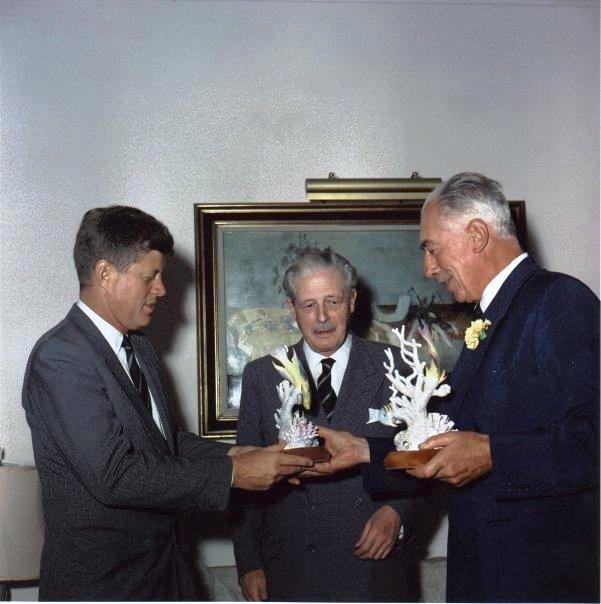
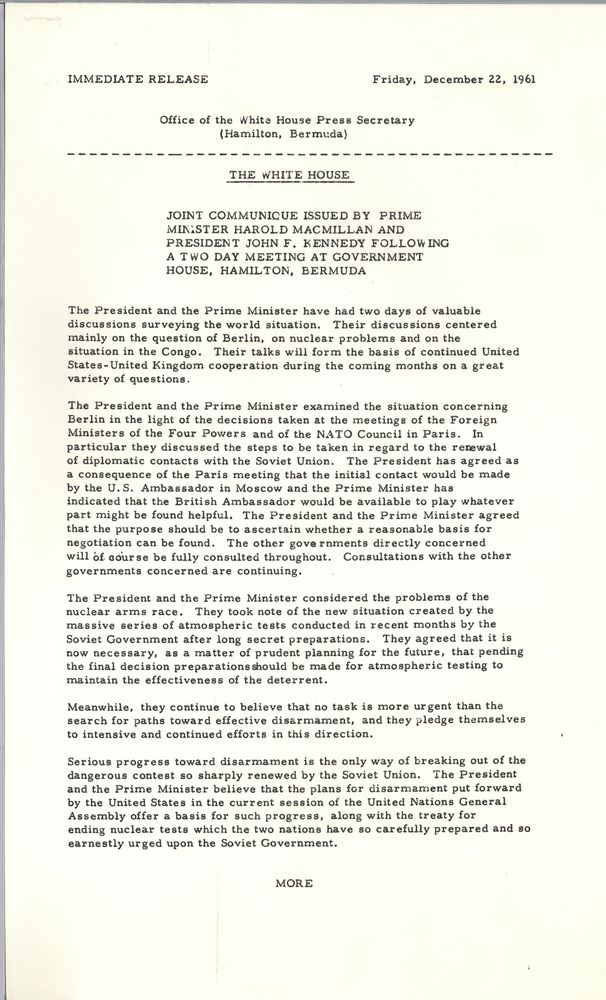
President John F. Kennedy meeting with Prime Minister Harold Macmillan in Bermuda, December 21-22, 1961. Top and bottom photos also show Governor Sir Julian Gascoigne. Photos kindly permitted for Bermuda Online (BOL) publication by J F. Kennedy Library 1995.
1962. January 8. Via Cable & Wireless, a Bermuda/USA 80-channel coaxial cable service opened, in conjunction with AT&T in the USA. One of the principal reasons was the general expansion of the Bermuda economy but in particular the increasing importance to both Bermuda and the USA of Kindley Air Force Base on St. David's Island and strategic NASA activities nearby. From that date and for many years, the Bermuda branch of Cable & Wireless provided links for all American space projects. Bermuda's importance in NASA's global network in support of manned space flight - already high as the first down-range station - increased enormously with the upcoming Apollo program to land a man on the moon by 1970. At that time, only Bermuda was in a position to track the critical moments after the launch of the giant Saturn rocket as it boosted the Apollo spacecraft into orbit. To enhance the program, Cable & Wireless Bermuda ordered and installed five new transmitters and receivers at a cost of £500,000 pounds sterling at the Bermuda relay stations for communication to US Navy instrumentation ships and the Goddard Space Flight Center. The stations were tested with one of the ships in readiness for the Apollo program. One was 4,000 miles away from Bermuda, on Ascension Island on the South Atlantic, where Cable & Wireless completed the construction of a satellite earth station for Apollo.
1962. January. The National Aeronautics & Space Administration (NASA) Space Tracking station on Cooper's Island in Bermuda, part of Kindley US Air Force Base, began the first of a multi-year series of firing weather reconnaissance rockets into the air over the island and beyond. See http://www.astronautix.com/sites/kindley.htm.
1962. In January and again in August, Princess Margaret visited Bermuda.
1962. February 20. US astronaut John Glenn began his historic orbital flight around the earth in the NASA Mercury capsule Friendship 7 at 9:47 am Eastern Standard Time. His Atlas booster, carried aloft on a column of flame, passed directly over Bermuda within minutes of the Florida launch. He became the third American in space but the first to orbit the earth. In 4 hours and 56 minutes Glenn circled the globe three times, reaching speeds of more than 1700 miles an hour. It was due in part to the NASA Bermuda Tracking Station that tracked his movements, despite an earlier brief computer malfunction that if not fixed promptly could have scrubbed the flight. Fellow Mercury astronaut Virgil (Gus) Grissom served as Glenn's capsule communicator in Bermuda throughout the flight. Astronauts had been assigned to various NASA tracking stations around the world because they were best able to understand situations in the spacecraft and relay information or findings. The recovery area south of Bermuda was known as Area Hotel and Grissom guided Glenn to it, to a splash-down 800 miles way from Bermuda, near Grand Turk. Photo below shows Grissom on his Bermuda moped the day before the flight.
1962. Unrestricted access to Britain by Bermudians came to an end with the passage through the British House of Parliament at Westminster of the Commonwealth Immigration Act. It aroused quite a lot of anti-British feeling among some locals - as it does even today. But it is not known and appreciated that long before that legislation came into effect Bermuda had been controlling rigidly, with legislation of its own, the importation of British and other citizens.
1962. A second local commercial radio station organization, Capital Broadcasting Company Limited, using the call letters ZFB, began operating at 910 kHz AM. Everard Davis was its manager and innovator when ZFB Radio hit the airwaves.
1962. FM broadcasting was introduced in Bermuda, with commercial radio stations ZBM-FM on 89.1 MHz and in 1971, ZFB-FM at 94.9 MHz.
1962. Some years after the British Army left Bermuda, the lands at Montpelier, Devonshire, north of the gracious home by that name where the then-named Colonial Secretary lived but part of the same estate, were planted as an arboretum.
1962. April. Prince Philip, Duke of Edinburgh, arrived by himself for a brief Bermuda visit.
1962. First forward planning measures for Bermuda, with the Dwyer Report and its "The Next 20 years."
1962. George Sousa was the first Bermudian of Portuguese descent to become present of a local golf club, the Belmont.
1962. HMS Bermuda was taken out of service as a Royal Navy warship. See http://www.hmsgangestoterror.org/HMSBermuda.htm. She was the Royal Navy warship named after Bermuda This last HMS Bermuda was a light cruiser of the Colony Class, launched in 1941, decommissioned in 1962. HMS Bermuda (No. 8) was built by John Brown & Company at Clydebank, laid down in November 1938 and commissioned on August 21, 1942. Originally, the ship had 12 six-inch guns, anti-aircraft pieces and six torpedo tubes. During the war, she served in the Mediterranean, the North Atlantic and Arctic and finally in the Pacific theatre. In later years, the vessel was a part of NATO until taken out of service. Some silver objects given to HMS Bermuda by the island are now at the Bermuda Maritime Museum. She visited Bermuda 3 times: 1958, Jul 1959, and Feb 1962.
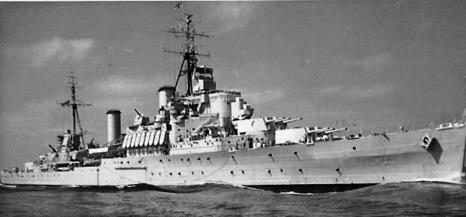
HMS Bermuda, taken out of service 1962
1962. Bermuda's first successful professional black artist, Charles Lloyd Tucker, painted the cruise ship "Queen of Bermuda" in watercolor, sepia and ink.1962. Fred Reiss, who is credited with coining the term "captive," formed a management company in Bermuda, International Risk Management Limited ("IRM"). With the help and support of individuals in the local banking, accounting and legal professions, he persuaded many of his corporate clients to form captives, to free themselves from an insurance market which was perceived to be unresponsive to their needs. Reiss showed his clients how to use the captive mechanism to capture some of the profits from their insurance expenditures. By domiciling the captive in Bermuda, those profits could accumulate free of income tax and, therefore, accelerate the growth of capital in the company. Over time, the captive would be able to retain a larger share of its parent’s risk and, through prudent use of reinsurance, create flexibility and stability in the insurance-buying process in what was a cyclical business. Understandably, this concept was not popular with either traditional insurers or brokers, who viewed it as a movement which would cut them out of a significant portion of business. Consequently, Reiss found it difficult to get broad acceptance of his ideas. The slow rate of captive development continued throughout much of the decade until, disturbed by instability in the Bahamas, several oil companies decided to move their captives to Bermuda. These large multinational corporations were clients of America’s multinational insurance organizations, the most prominent of which were AIG, INA and AFIA. The latter two were later merged into CIGNA, whose general business was, itself, recently merged into ACE. Through their networks of agencies around the world, they provided facilities to allow the captives to reinsure their parent-related business and even provided management services to some of the captives.
1962. The movie "That Touch of Mink" that starred Cary Grant and Doris Day was filmed partly in Bermuda. But they were wrong when they said that only Bermuda has pink peaches (Scotland and the Bahamas have them also).
1962. ZFB began broadcasting in Bermuda.
1962. The Bermuda Ballet Association was formed by Madame Patricia Gray, MBE with the support of Madame Ana Roje.
1962. Fame Magazine began publication in Bermuda.
1962. September 10. Via Cable & Wireless, an international Telex service opened from Bermuda to many parts of the world.
1962. John W Swan Ltd began operating in Hamilton, owned and operated by John W. Swan, later a Premier of Bermuda. He was also one of a small group of forward-thinking individuals, visionaries, who joined the Bermuda Junior Chamber of Commerce and charted their own unique paths and exploits in Bermuda history. John W. Swan Limited went on to become immensely successful in building homes for Bermudians and the company's other members, including Alex Swan, Altimont Roberts, Leon Simmons and Maxwell Furbert, all established their unique claims to fame.
1962. October 27. A USAF Boeing RB-47H Stratojet reconnaissance aircraft operated by the 55th SRW, USAF from Forbes AFB, registration 53-6248, 4501389, crashed on the Astor Estate property at Ferry Reach in St. George's Parish during takeoff from Kindley AFB, Bermuda. All four crew were killed. They were Maj. William A. Britton (Aircraft Commander), 1st Lt. Holt J. Rasmussen (Co-Pilot), Capt. Robert A. Constable (Navigator) and Capt. Robert C. Dennis (observer). It was later determined the cause of the crash was an improper water/alcohol mixture that had been prepared by a civilian contractor in the RATOG (Rocket Assisted Take Off Gear) equipment.
1963. January 1. the Royal Canadian Navy signed a lease to obtain 11 acres of land at Daniel's Head, Sandy's Parish to build a Canadian Naval Radio Station for communications and anti-submarine purposes. It lasted until 1993. It was the only Canadian military base established on non-Canadian soil in the Western Hemisphere. The original lease was for 21 years at a cost of £6000 per annum. It was the beginning of the Canadian Forces Station (CFS) Bermuda. Negotiations had been ongoing for a considerable length of time for a Memo of Understanding on the formal Visiting Forces Agreement between the Bermudian and Canadian governments to finalize the Resolution of Property Acquisition. and Provision of Services and Utilities to support the proposed station. It too was finally signed in January 1963. Delays had been encountered because of Bermudian demands of right of way and defining the status of the Canadian Forces residing on the Island. Canadian demands for Duty Free privileges were reinforced by the US and British Forces status but still had to be ratified by the Home Government in London. On April 24, 1963, the advance party, sans dependants, arrived on site, commanded by Lt (N) Michael A. Ruymer, comprising CPO W.R. Harkness, LS C.A. MacDonald and Leading Storesman Tom Key. They began the task of finding, accounting for and storing the first-fitting material which was pre-shipped and stored in the Bermuda Crown Lands warehouse at Ireland Island. A Communications Technician was later sent to augment the station for the duration of the cryptographic installation phase. All station personnel were rationed and quartered at the US Naval Operations Base, by then known as the US Naval Annex, approximately 3 miles away. Canadian personnel were still not receiving Foreign Service Pay nor duty-free privileges because the Memo of Understanding still had not been approved by the Government in London. The personnel were also not allowed to have their dependants with them. (The ratification of the Visiting Forces Agreement in March 1964 made living in Bermuda a whole lot easier).
1963. Lois Browne-Evans, Bermuda’s first female, black lawyer, who qualified as such in 1953, having previously joined it, announced her intention to seek political office as a candidate for the Progressive Labour Party.
 1963. 10th February. The
Progressive Labour Party was formed by Wilfred Allen, Edward DeJean, Hugh
Richardson, Walter Robinson, Dilton Cann, Austin Wilson and Peter
Smith. Its purpose was to form a political party to either take over the
government of Bermuda or directly address inequities in Bermuda which
included its colonial relationship with Britain. In May, it contested its first General
Election, with six of its nine candidates elected. They were Arnold Francis;
Dorothy Thompson; Russell Dismont; Walter Robinson; Lois Browne-Evans (first
elected black woman member of the Bermuda Parliament and a first-generation
Bermudian with West Indian roots) and Cecil
Clarke. Ann Pindar was an early unsung hero of the PLP. Ms Pindar, a trade
unionist and confidante of Dame Lois Browne-Evans, was selected by the Bermuda
Industrial Union to attend a conference in Barbados because no men were
available. Ms Pindar brought home key documents from the conference, including a
copy of a party constitution, that were used to form the PLP. Dame Lois and Ms
Pindar passed on the documents to male party members to present them to the
founding inner circle.
1963. 10th February. The
Progressive Labour Party was formed by Wilfred Allen, Edward DeJean, Hugh
Richardson, Walter Robinson, Dilton Cann, Austin Wilson and Peter
Smith. Its purpose was to form a political party to either take over the
government of Bermuda or directly address inequities in Bermuda which
included its colonial relationship with Britain. In May, it contested its first General
Election, with six of its nine candidates elected. They were Arnold Francis;
Dorothy Thompson; Russell Dismont; Walter Robinson; Lois Browne-Evans (first
elected black woman member of the Bermuda Parliament and a first-generation
Bermudian with West Indian roots) and Cecil
Clarke. Ann Pindar was an early unsung hero of the PLP. Ms Pindar, a trade
unionist and confidante of Dame Lois Browne-Evans, was selected by the Bermuda
Industrial Union to attend a conference in Barbados because no men were
available. Ms Pindar brought home key documents from the conference, including a
copy of a party constitution, that were used to form the PLP. Dame Lois and Ms
Pindar passed on the documents to male party members to present them to the
founding inner circle.
1963. March 10. Bermuda Airlines was established by Rupert Leatham. He and Martin Smith were directors. The company had one seaplane – a six seater Cessna 185 Skywagon (similar to the one shown in the photograph below). Leatham bought the Cessna new, had floats fitted and flew it from New York to Bermuda on that day. The airline lasted until 1965.
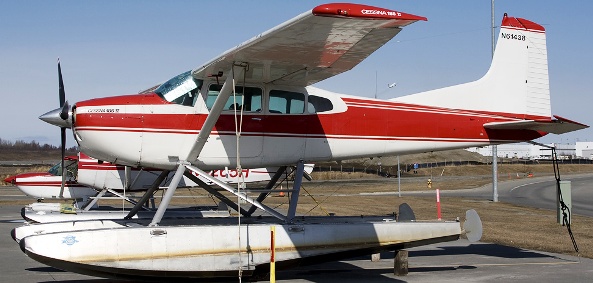
1963. The sites of Forts Victoria and Albert in St. George's were given over to a hotel concession and the adjacent military lands to the west became a golf course
1963. February 10. The Progressive Labour Party (PLP), founded a few weeks earlier by a group led by Wilfred ‘Mose’ Allen, held its first formal meeting. The other members were mainly Hugh ‘Rio’ Richardson, Albert Peter Smith, Edward DeJean, Walter N. H. Robinson, Austin Wilson and Dilton C. Cann. They were part of a group that earlier regularly met at Hugh Richardson's garage in Pembroke. This first formal meeting was held at Walter Robinson's law office in Hamilton. Intended to appeal to the working-class, the first election platform called for equitable taxation, an end to racial discrimination, economic parity and welfare programs, as well as housing, educational and electoral reform.
1963. The Parliamentary Election Act was passed, giving every adult twenty-five years of age and above the right to vote. Universal adult suffrage was declared. This piece of legislation also incorporated the Watlington Amendment, extending the landowners which possessed ratable property anywhere in Bermuda a send or "plus" vote in the constituencies in which they lived. Parishes were retained as electoral districts, but were now divided into two constituencies - i.e. there were 18 in total, each of which returned two Members to the House of Assembly.
1963. Emperor Haillie Selassie of Ethiopia visited Bermuda, with his granddaughter, Princess Ruth Desta. Greeting him at the Civil Air Terminal were Sir Edward Richards, Colonel J. C. Astwood, Sir James Pearman, W. W. Davidson, Sir John Summerfield, American Consul General George Renchard, Sir John Cox, Acting Colonial Secretary Edward Smith, Chief Justice Sir Myles Abbott, Bishop Armstrong, Governor General Sir Julian Gascoigne and Lady Gascoigne.
1963. Modern, high-speed, land-based P-3 Orion aircraft replaced the seaplanes at the US Naval Operating Station, Bermuda.
1963. Casemates Prison was established at the former Royal Navy Casemates Barracks in Bermuda.
1963. The Commonwealth Residential Vote — a measure enacted in this year, allowed Commonwealth citizens who had been resident in Bermuda for three years to vote in Bermuda’s elections.
1963. At the Hamilton Princess Hotel, the Adam Lounge (later, the Fairmont Gold Lounge) was named after the Johnson Brothers who had an 18th century architectural style called ‘Adam.’ They were renowned for their ceilings. There were no more than ten rooms in the world that have a ceiling in this design. Everything was hand made and hand placed. It was very elegantly set with a nice long carpet throughout. The carpet was made by the same company that made the carpet for the Queen’s Coronation at Westminster Abbey.
1963. July 1. The marine direction finding service previously operated by Cable & Wireless closed down.
1963. August 9. Hurricane Arlene scored a direct-hit, winds to 90 mph, much damage to vegetation. She had been threatening the Island for almost a week before she came ashore. In her wake she left hundreds of boats, homes and vast areas of vegetation destroyed or damaged. It was the first time in a decade that a hurricane had not veered its course away from the Island.
1963. The Progressive Labour Party (PLP) contested its first General Election a few months after its formation in February. Nine seats were contested by the Party out of the then thirty-six in the Colonial Parliament. The first successful Members of Colonial Parliament (MCPs) were: Mr. Arnold A. Francis, the first Parliamentary Leader; Mr. Walter N. H. Robinson, the Deputy Leader; Mrs. Lois Browne-Evans (Bermuda's first black elected woman Member of Parliament and first woman lawyer); Mr. Russell Dismont; Mr. Cecil Clarke and Mrs. Dorothy Thompson. In that first General Election the party received 5,827 votes a total of 18.6% of the popular vote.
1963. November. The US Coast Guard detachment in Bermuda transferred from the U.S. Naval Station to Kindley Air Force Base, Bermuda, because greater range could be gotten from its HU-16 Albatross aircraft by land takeoffs rather than water takeoffs.
1963. December 19. One of the last of the US Navy's VP-45 P-5M operational seaplane flights was flown from Bermuda. The PPC was Bob Palumbo, Jake was the co-pilot, Mike Levine manned the Nav table, and the Plane Captain was probably Petty Officer Cox, ADR-1.

1963. December 24. The very last US Navy operational flight by a VP-45 P-5M seaplane was also the very last operational seaplane flight by any Atlantic Fleet squadron, according to Don Hill, the PPC. It was a 7.2 hour patrol from Bermuda.
1964. January 6. The very last seaplane flight of a US Navy Atlantic Fleet squadron. It was a VP-45 4.1 hour ferry flight from Bermuda to Weeksville, North Carolina. The aircraft was a P5M-2, LN-5, BuNo 135489.
1964. January 10. The US Navy's VP-45 officially closed down Bermuda operations, four days after the last flight. Since there were so few P-5 plane commanders left during the last six weeks, they all got a lot of BDA/JAX/BDA flights transferring squadron material.
1964. April 7.14-acre Chelston, one of the most magnificent beachfront estates in the world, built at Grape Bay, Bermuda from 1939 for California oil baron Dobbs, was formally conveyed to the US Government and became the official residence of the US Consul General in Bermuda and his principal staff. In addition to the 10,000 square foot main house, accommodation included three, three-bedroom guest cottages; a two-bedroom staff cottage, as well as a pool house, and a charming beach pavilion, gated entry, a near Olympic-size zero-edge pool, a croquet lawn, acres of rolling lawns for myriad recreational pursuits, and the pink sands of Grape Bay Beach among the many amenities. Guests of the US Consul General later included, over a 30 year period, US President George Bush and Vice President Dan Quayle, Senator John Kerry, Senator Edward Kennedy of Massachusetts, Senator Chris Dodd of Connecticut, General Colin Powell, Secretary of State Henry Kissinger, actor Michael Douglas, and model/actress Brooke Shields.
1964. April. Her Royal Highness the Queen Mother visited Bermuda.
1964.
May. University of Virginia Press released the first edition of the book "A
Voyage to Virginia 1609, Two Narratives." It contained first-hand reports of authors
William Strachey and Sylvester Jourdain who were
traveling from England to Jamestown as secretaries to Admiral Sir George Somers
and Virginia Governor-elect Sir Thomas Gates when they were shipwrecked off the coast of
Bermuda in 1609. It is believed the narrative fell into the hands of William
Shakespeare and he used it as his inspiration for The Tempest.
1964. May 12. The Canadian-born daughter of a Native American chief found and married her husband in Bermuda and since her father was the first chief to visit the island the wedding made the front page of The Royal Gazette. Nancy Nightingale (née Baker) is the daughter of Chief Khot la cha — or Chief Kind Heart — part of the 1,000-member Squamish tribe in North Vancouver, Canada. He visited the island to give his daughter’s hand away to US Navy man Gerald McDonald at St James Church, Somerset on this day. Ms Nightingale was 19 when she traveled by herself across Canada to New York to take a flight to Bermuda and visit her girlfriends. “I loved it so much I stayed and got a job as a secretary to a construction company,” she said. She ended up staying for two years, during which time she met her future husband, Mr McDonald, who was serving in the US Navy. They began planning their wedding, which included the invitation of a rather special guest — her father Chief Khot la cha. It was the first time he had traveled, but after that he loved it so much he was appointed Ambassador for the Native People of Canada through Air Canada. Thanks to Air Canada ,he traveled the world — Europe, New Zealand and Hawaii — promoting his native culture. His daughter later related how her husband served in the Navy and spent two tours going to war in Vietnam. He has since passed away. She has two wonderful daughters and is also blessed with four grandchildren. She now lives in North Vancouver where she grew up and also has been promoting her native culture through her Khot-la-cha Art Gallery, where she sells the artwork of her Squamish Nation.” At the May 12, 1964 time of her wedding in Bermuda, in an interview with The Royal Gazette under the headline “Indian Chief paying visit Here; Daughter’s Wedding”, Chief Khot la cha, born Simon Baker, spoke of a push in the US towards preserving rights for the rights and culture of Native Americans. He said at the time: “At the moment we are fighting the Canadian Government for the confiscation of our land. British Columbia used to belong to us until we were exploited by the French and the British. My grandfather Chief Capilano, petitioned King Edward for full fishing, hunting, educational and land rights.” He also spoke of the history of some of the North Western tribes telling this newspaper: “We have never had wars the way the prairie Indians did with Custer. But the Northern tribes used to raid us and carry off our women and take our men for slaves. And by the way, it was the English who started the idea of scalping, by offering £200 for the head of an enemy during the French and Indian wars.”
1964. June 29. Two United States Air Force aircraft stationed at Kindley Air Force Base (KAFB), Bermuda, collided at sea of Bermuda during a NASA mission from Kindley AFB. 17 US servicemen died. They took off between 11:05 and 11:10 am local time. The first aircraft in the air was a HC-97G (serial number 522773), assigned to the 55th Air Rescue Squadron (55 ARS) at Kindley with 12 crewmen. The other aircraft was a HC-54D (serial number 4272590) assigned to the 57th Air Rescue Squadron (57 ARS) at Lajes Air Force Base in the Azores with 12 crewmen. The mission was for the aircraft to conduct an aerial photography mission to support the NASA Gemini program. It was necessary for the specially-trained para-rescue personnel (jumpers) to exit the aircraft, jump into the waters and install a flotation collar on the Gemini capsule. The planned mission was to have one aircraft with jumpers, while the other photographed the activities. The designated drop zone was about two to four miles south of Bermuda and about four to six miles from Kindley. Both aircraft arrived at the drop zone and because of the clouds, decided to fly the mission at 1,700 feet (below the clouds). Aboard each aircraft were photographers and para-rescue men. On the sea below, there were about three boats, one of which included a photographer, who filmed the aircraft’s operations. During the first run, the HC-97G took photos and the HC-54D was slightly forward and above, began deploying para-rescue men. Right-hand patterns were flown, and photos were shot with the sun behind the cameras and at an angle that would not reveal any land surfaces. After a few passes over the drop area with all four para-rescuemen being deployed from the HC-54D, the aircraft changed positions. This placed the HC-54D slightly ahead and above and to the left of the HC-97G. After flying one dry run, and again in a right-hand pattern, two para-rescue men deployed (jumped) from the HC-97G. Seconds later, the two aircraft collided. The HC-54D suddenly banked to the right, colliding with the HC-97G, hitting the wing or midsection of the HC-97G and sheering both its wing and the tail section, and both aircraft immediately plunged towards the water. A total of 17 Air Force personnel were killed, including Major Martin Nisker, USAF, who was the navigator on the HC-97G that morning. There were 7 survivors, all who jumped prior to the collision. Only five of the 17 killed had remains recovered.
A more personal account and consequence is as follows: Two USAF aircraft, an HC-97 and a C-54 were flying near Bermuda. The HC-97 was assigned to Kindley Air Force Base in Bermuda and the crew included Technical Sergeant (E-6) Lowell (Micky) W. Belter, who was assigned around January 1964, with his family, to the 55th Air Rescue Squadron based at KAFB. He was a radio operator. His aircraft was assigned to NASA to train for the recovery of Gemini spacecraft as the last few Mercury flights had overshot the aircraft carriers by about 90 miles, and NASA was considering reassigning that mission to the US Air Force from the US Navy. The aircraft flew in formation over Castle Harbour and then moved about two miles south of Castle Island. One plane had parachutists to practice jumping into the sea, while the other aircraft was taking pictures. They were flying about 1,000 feet above sea level. The first jumpers left the plane, and the C-54 banked to offset the lost weight. The HC-97, with more powerful engines, did not bank, and the two aircraft collided. This created such a huge fireball that it was seen by many people on the beaches along Tucker's Town and John Smith's Bay. There were 12 men aboard each plane, for a total of 24. 19 of those personnel were killed, and the five who survived where parachutists who had either just jumped or were about to. Rescue craft were only able to recover nine bodies (not including Mickey Belter). Astronaut Scott Carpenter, who was over at the Navy base working on SeaLab, attempted to recover remains, but the two mile depth prevented these efforts. About two weeks later, the family of the late Mickey Belter left Bermuda on a USAF transport, to return to the USA. The next year, the Gemini program began, and was able to accurately land almost next to the aircraft carriers. Thereafter, the USAF never implemented the mission of recovering Gemini spacecraft.
1964. How the Bermuda Triangle mystery began. American author Vincent Gaddis is credited for coining the term "Bermuda Triangle" in an article he wrote for Argosy magazine, "The Deadly Bermuda Triangle", in which he cataloged many of the anomalous events in the area that stretches from the Florida coast to Bermuda to Puerto Rico. Also known as the Deadly Triangle or Devil's Triangle, it has been blamed for hundreds of shipwrecks, plane crashes, mysterious disappearances, craft instrument malfunctions and other unexplained phenomenon. Several other authors, including Charles Berlitz and Ivan Sanderson, have added to their number.
1964. July 1. Via Cable & Wireless, the civil distribution centre at the Civil Air Terminal changed to a fully automatic switching network system brought into use for airline offices between Bermuda and New York and operated by the Department of Civil Aviation.
1964. The Bermuda Cement Company was given a lease by the Bermuda Government to build a cement silo at the Dockyard. (The lease lasted for 43 years).1964. Prince Edward was born, the youngest child of the Queen and Prince Philip. They were congratulated by the Bermuda Government.
1964. August. Prince Philip, Duke of Edinburgh, arrived by himself for a brief visit.
1964. August 21. Formation of the United Bermuda Party (UBP) by 24 members of Bermuda's Parliament. Sir Henry Tucker became its leader It followed the formation of the Progressive Labour Party (PLP) the previous year. The UBP was formally dissolved on 30 June 2011.

1964. September 10. Death in Bermuda of artist Emil Antoine Verpilleux, whose large panoramic landscapes of Bermuda painted in the 1930s, for many years housed in an upper part of the St. George's Town Hall, made him well-known locally. He was born in London on March 3, 1888. His parents were Belgian and probably for that reason, his artistic studies took place in France and at the Académie des Beaux Arts in Antwerp, Belgium. He is believed to have been the first artist to have a woodcut hung in the Royal Academy, London. Today, he is considered one of the finest colored woodcut printmakers in Britain in the first half of the 20th century. Verpilleux served in the First World War and until 1922 as an army officer, attaining the rank of captain. During his war experience he also managed to paint numerous war subjects, especially those of the Royal Flying Corps. Today, many of these paintings are in the collection of the Royal Air Force Museum. Verpilleux moved to Bermuda either in 1927 or early 1930s, mostly as a portrait painter but also did landscapes and was a woodcut printmaker. In 1949/50 he collaborated with ceramicist Andre Bohemelec to produce a series of dioramas, depicting scenes of early Bermuda history. These were, for many years, on exhibit in a special gallery in Fort St Catherine. During the early 1950s Verpilleux was active in establishing the Bermuda Society of Arts and served as president of the society from 1952 to 1956.
1964. September 11. There was an agreement constituted by the Exchange of Notes between the Government of Canada and the Government of the United Kingdom concerning the status of the Canadian Forces in Bermuda.
1964. November. Prince Philip, Duke of Edinburgh, arrived by himself for another brief visit.
1964. November 26. Qantas, the Australian round-the-world airline, inaugurated a route from London to Sidney via Mexico, with one of the stops being at Bermuda.
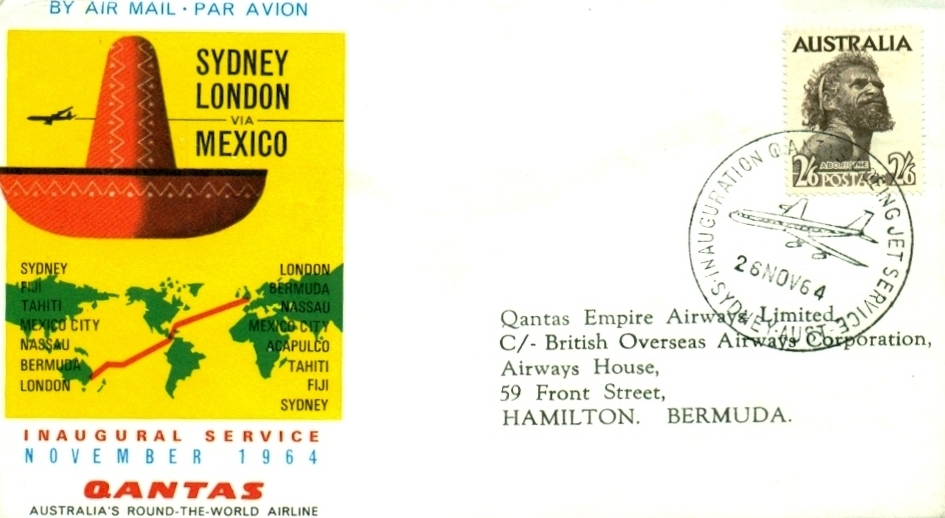
1964. The United Bermuda Party (UBP), composed of twenty six former independent parliamentarians, was established under the leadership of Mr. Henry "Jack" Tucker (later Sir Henry Tucker) and assumed control of legislative affairs in the House of Assembly.
1964. Central Planning Authority was formed.
1964. Keep Bermuda Beautiful was founded.
1964. Bermuda Sun weekly newspaper was founded.
1964. The Hamilton Princess Hotel re-opened, after being bought in 1959 by American billionaire Daniel Ludwig with plans to make it a luxury hotel. It reopened with new rooms and facilities after a $9.5 million investment. Little of the original building from the 1880s remained although some parts dated back to the 1930s and 1940s.
1964. World premiere debut of this classic movie (see below) by Bermudian Arthur Rankin. It became the longest-running Christmas holiday special in world television history. The classic has entertained millions of families since then, with the world-renowned musical score from Johnny Marks and the voice talent of legendary performer Burl Ives (Sam the Snowman). It recounts the tale of a shy, young reindeer whose Christmas spirit is dampened because his shiny red nose made him the laughing stock of all Christmas town. Frustrated by their inability to fit in, Rudolph and his friend Hermey, the Elf who wants to be a dentist, set out on their own. However, they soon find themselves pursued by the Abominable Snowmonster. They flee to the island of Misfit Toys in the Arctic wilderness where Yukon Cornelius, a prospector they meet along the way, comes to their rescue. Returning to Christmastown, they learn that bad weather may cause Christmas to be canceled. But Rudolph's headlight--his illuminated nose--saves Christmas by serving as a beacon to guide Santa's sleigh.
1964. Discovery at the Western Ledge Reef, Bermuda of the wreck of the Spanish ship Santa Lucia, wrecked off Bermuda on 11 January 1584. Captained by Juan Lopez, she had been part of a fleet of ships that had left Spain for the Indies in 1583. She was not carrying any merchandise or treasure and her function was that of a courier ship, carrying government, financial and private documents, as well as gathering information on the progress and condition of the fleet, and of the various port cities visited. Once the fleet reached Vera Cruz in Mexico, she was to return home as soon as possible. However, en route from Vera Cruz, via Havana, to Spain, she ran into a storm and was unable to negotiate Bermuda’s reef-strewn waters.
Rudolph The Red Nosed Reindeer TV classic 1964
1965. January 28. Cable & Wireless (WI) in Bermuda announced that a new coaxial cable would be laid between Bermuda and Tortola in the British Virgin Islands when permission was granted by the governments concerned.1965. February 2. The BELCO strike occurred, with many repercussions. The Bermuda Industrial Union was the main cause. It claimed management would go to any lengths not to recognize the rights of workers. The unrest began after Belco management refused electrical workers the right to hold a secret ballot determining whether or not they would join the Bermuda Industrial Union. Police were called in to break up picket lines. The local military and Bermuda Reserve Constabulary were embodied. Four persons were jailed, one found not guilty, several were made redundant, 14 were fined. The first Police officer injured in the riots was David Garland, born in Leven. East Yorkshire, England. He was working in the police garage that morning when an inspector came running in and ordered him to put on riot gear. The constable had just returned to Bermuda from the UK after being involved in a car accident while on vacation back in Britain, He was healing from two broken ribs. He should not have gone back to work but he did. He and other police went to the entrance at the far end of the Belco property," The inspector said, ‘OK, lock your arms and close off the gate and if anyone wants to come in to work let them in’. Police were outnumbered by the crowd and had very little riot training. One of the protesters walked right up to Garland and punched him in the side, breaking another rib. He was one of 18 people injured. One officer, Ian Davies, received a traumatic brain injury and was never the same again. Mr Garland grew up on a farm and, as a young man, dreamt of becoming a building inspector. Instead, he was called up for national service at 17. After two weeks with the Royal Army Service Corps he switched over to the Royal Military Police when a career officer told him his height of 6ft 1in made him ideal. After doing his required 18 months of service, he started as a civilian officer in Bridlington, on the Yorkshire coast. He applied for a job in Bermuda in 1961 because he “was tired of the cold night shifts in Britain” and convinced a friend, Derek Jenkinson to join him. He left the service. in 1976.
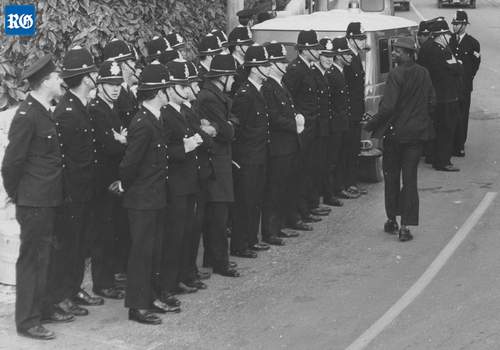
Police awaiting riot instructions
1965. March 17. Via Cable & Wireless, an Extended Range VHF service for civilian aircraft flying to and from Bermuda was brought into operation for the Department of Civil Aviation.
1965. April 2. British Overseas Airways Corporation (BOAC, later British Airways) first flew its new VC-10 aircraft from Bermuda to New York. At that time, BOAC was offering a Bermuda to New York and back service.
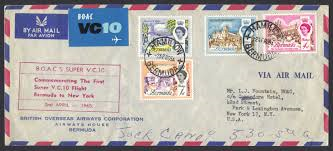
1965. The Bermuda Regiment was formed by the amalgamation of the white Bermuda Rifles and the black Bermuda Militia.
1965. Mrs. Ruth Seaton James became the Registrar General. This made her the first black and woman to head a government department.
1965. Capital Broadcasting Company Ltd, followed up its 1962 success of ZFB Radio by launching ZFB TV, which carried the USA's ABC channel.
1965. Howard Academy had government funding withdrawn and was closed. Government also withdrew funding for racially segregated schools.
1965. First Development and Planning Act for "orderly and progressive development of land and to preserve and improve the amenities thereof..."
1965. The Canima. formerly an Irish ship's tender, sailed to Bermuda to replace the Chauncey M Depew. She was the last vessel to carry the on-board telegraph system and, along with her Irish-built sister ship the Cill Airne, she was said to be Europe’s last rivet-built ship.
1965. Bermuda's exchange control regulations banning the importation of air conditioners were lifted. Demand increased dramatically.
1965. June 1. That part of the Royal Navy Dockyard in Bermuda still required for naval operations remained under Admiralty control under a ninety-nine year lease, and the South Yard Berthing Area was commissioned on this day as HMS Malabar, under the command of the RNO, with the headquarters of SNOWI and the RNO in Moresby House (originally built in the 1899s as the residence of the civilian Officer in Charge, Works.
1965. Summer. The Progressive Labour Party (PLP) dealt with it first major internal crisis. A split occurred due to a disagreement over philosophical direction and how the Party would campaign for equity in Bermuda. It was fundamentally a battle amongst key figures about its direction and principles. In the end all of the member of the Colonial Parliament left the Party, save for lawyer Lois M. Browne-Evans.
1965. HMS Bermuda, the Royal Navy warship named after Bermuda, was scrapped. This last HMS Bermuda was a light cruiser of the Colony Class, launched in 1941, decommissioned in 1962. HMS Bermuda (No. 8) was built by John Brown & Company at Clydebank, laid down in November 1938 and commissioned on August 21, 1942. Originally, the ship had 12 six-inch guns, anti-aircraft pieces and six torpedo tubes. During the war, she served in the Mediterranean, the North Atlantic and Arctic and finally in the Pacific theatre. In later years, the vessel was a part of NATO, but was taken out of service in 1962. Some silver objects given to HMS Bermuda by the island are now at the Bermuda Maritime Museum. She visited Bermuda 3 times: 1958, Jul 1959, and Feb 1962.
HMS Bermuda, scrapped 1965
1965. November 23. Princess Margaret and Lord Snowdon arrived in Bermuda on a British Overseas Airways Corporation (BOAC) VC-10 jet, for a 6-hour whirlwind visit. They came after a vacation in the USA, while en route back to London. It was the Princess's second visit in 10 years, this time mostly to present the Colours of the newly-formed and de-segregated Bermuda Regiment at the National Stadium, Devonshire. 8,000 Bermudians and residents watched. She was given a diamond and platinum brooch, in the colours of the regiment. She and Lord Snowdon also toured the city of Hamilton where they were greeted by mayor Gilbert Cooper and met artist Bill Harrington who created the oil painting of the city given to them in honour of their visit. At Dellwood School, prefects observed Mr. A. E. Nicholl, chairman of the school's board, planting a prize hibiscus to commemorate the visit to Bermuda of the princess. Also present were head boy John Adams and head girl Mary Young.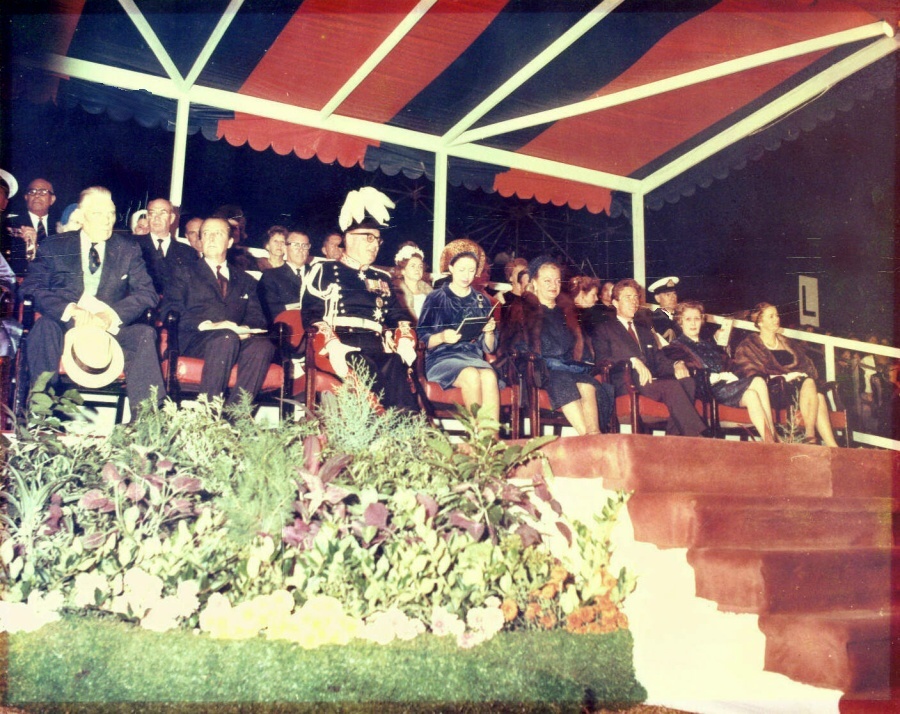
Princess Margaret presented the Colours to the newly-formed Bermuda Regiment. Photo kindly loaned the author by Cindy Farnsworth Toddings, step-daughter of S. A. Toddings, MCP, then chairman of the Bermuda Defence Forces, shown front left. From center, going right, are Governor Lord Martonmere, Princess Margaret, Lady Martonmere, the Earl of Snowdon, Ruth Tucker, Cynthia Toddings.
1965. October 3. Pope Paul VI stopped off briefly in Bermuda on his way to address the UN General Assembly in New York.
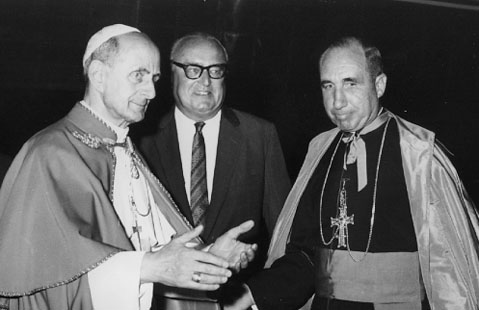
Pope Paul VI in Bermuda, with then-Governor Lord Martonmere and the-then Catholic Bishop of Bermuda
1966. April 16. Promoter Eddie DeMello of Bermuda first discovered The Merrymen of Barbados and brought them to Bermuda for an open-air concert at the Tennis Stadium, as well as gigs at the US military base and the Coral Island Club in Flatts. "I was travelling through Antigua, and they were playing at a big nightclub. They weren't really well known then, but I said, 'This is the type of act that would really, really go well in Bermuda', so I sat and talked with them, we worked things out, and I brought them up here in 1966," Mr. DeMello remembered. They became hugely popular in Bermuda from then on.
1966. June. Via Cable & Wireless, five 30kW transmitters and associated HF receivers and aerial systems were brought into operation for the Apollo Space Communication System between the NASA ship and the Bermuda/USA cable connection to the Goddard Space Flight Centre.
1966. Strike action was taken by the BIU against Bermuda Electric Light Company Limited over union representation. It resulted in unprecedented civil disorder. A State of Emergency was called. There were riots, strikes, malicious damage and Molotov Cocktails thrown. Some policeman were badly injured.
1966. The "plus" vote was abolished and the voting age for every Bermudian (by birth or grant) was lowered to twenty-one (later changed to 18 in 1989). All British subjects satisfying the age requirement and having lived on the island for at least three years were also given the vote, a concession which was later rescinded. In addition, Pembroke Parish because of its large population, was split into four districts with each returning two elected representatives, a change which effectively increased the House of Assembly sears from thirty-six to forty, by 1966 legislation. It had been 36 since 1691.
1966. Representatives of the United Bermuda Party (UBP) and the Progressive Labour Party (PLP), the Legislative Council and independent House of Assembly members, attended a Bermuda Constitutional Conference in London, as a result of which Bermuda's first written Constitution was drawn up and approved.Walter N H Robinson led the PLP delegation to discuss the formation of a constitution. The PLP delegation advocated for the elimination of the plus vote, additional seats in Pembroke, one person one vote of equal value, amongst other changes to advance democracy.
1966. The number of motor vehicles in Bermuda was more than 20,000.
1966. Qantas, the Australian airline, opened another around-the-world route. This was named the Fiesta route and was from Sydney to London via Tahiti, Mexico City, and Bermuda.
1966. The movie "Let's Kill Uncle" was filmed in Bermuda.
1966. Pompano Beach Club opened as the Island's first fishing club that allowed visitors using the fishing lodge to go out for a spot of deep sea fishing and return to enjoy their freshly caught fish in the club's small dining room. Over the years the club grew with additional buildings and by the early 1960s it had developed into a small hotel. Tom Lamb Jr. and his wife Jean were co-founders, bought it outright in 1957 and ran the business until the early 1980s when Mr. Lamb passed away. The couple's daughter Aimee and her soon-to-be husband David Southworth took over in 1982 and were joined four years later by the youngest of the Lamb sons, Larry. Since 1989 Larry and his older brother Tom Lamb III have been the joint management team. The continuity maintained by having one family run the resort and the loyalty of long-serving staff and repeat-visit guests have been the greatest strengths of the hotel, which has since expanded.
1966. The United States Air Force Base in Bermuda, Kindley Air Force Base, ended being a Military Air Transport Service (MATS) base - see http://en.wikipedia.org/wiki/Military_Air_Transport_Service when that entity was discontinued. Instead, it became a Military Airlift Command base - see http://en.wikipedia.org/wiki/Military_Airlift_Command
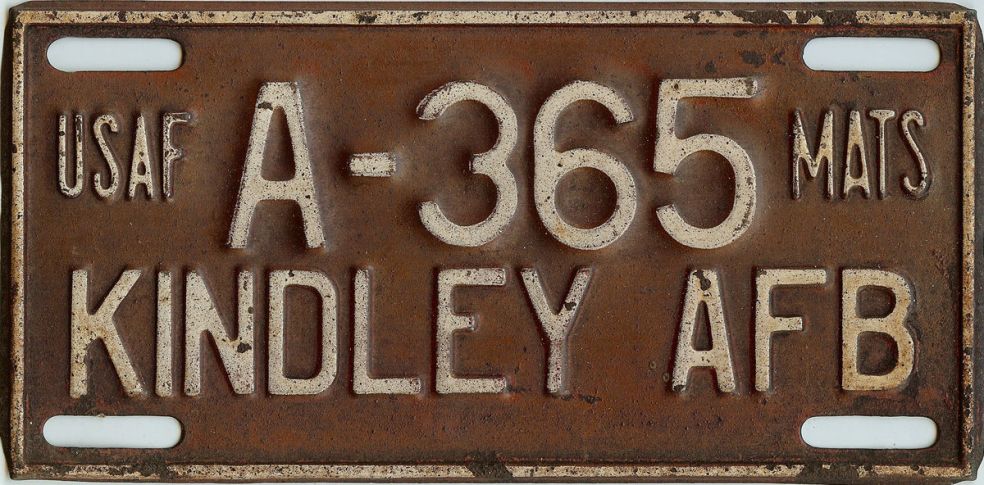
Photo kindly sent by John Cook, who was based at KAFB from 1956-1960.
1966. Ruth James was appointed Registrar General. She became the first black woman to head a Bermuda Government Department.1966. Two former members of the Progressive Labour Party of those who had left the party, Walter N H Robinson and Dorothy Thompson, returned to its ranks. (Mr. Robinson would subsequently become the Party’s second Leader).
1966. The Queen of Bermuda cruise ship made her final weekly call at Bermuda. She had more luxury about her than many transatlantic liners. The service was impeccable and the food top-notch. She was also an immaculate ship. She was first class in every way. She was very, very popular on the 6-day cruise run between New York and Bermuda. In fact, the Bermuda run was a 'gold mine' for her British owners. The 22,500-ton Queen of Bermuda was one of the great liners of the 1930's. She was completed in 1933 at the Vickers-Armstrong Yard at Barrow-in-Furness and, together with her near-sister, Monarch of Bermuda of 1931, added great luxury to the Bermuda cruise trade. Along with splendid public rooms, a large main restaurant, an indoor pool and spa-cious sports and sunning decks, she boasted a great novelty for that era: every cabin had a private bathroom. The fares in the 1930's began at $50, the ideal honeymoon cruise or, as their owners, Furness Bermuda Line dubbed them, the honeymoon ships.. They sailed in regular tandem up to that fateful summer of 1939 when war started in Europe and they were called to more urgent, far less glamorous duties. In August 1939 she went to war. The 19-knot vessel survived the war, returned to the Bermuda run in February 1949 and sailed on it until, when deep into maritime old age, she was sold for scrap in Scotland in late 1966
1967. April. Yeaton Outerbridge introduced his Sherry Peppers Hot Sauce to Bermuda and later world audiences. Over the years, the firm has expanded from Outerbridge’s Original Sherry Peppers Sauce with a full range of sauces, including Royal Full Hot Rum Peppers Sauce, a Bloody Mary Fix, Full Hot Mustard, and Devilishly Hot Barbecue Sauce, as well as Outerbridge’s Rum Swizzle Mix and gourmet rubs for meat and poultry. The initial product was introduced at Robbie Outerbridge’s Harbourfront Restaurant and took off from there. Sherry Peppers sauce originated in the days of sailing ships, where it was used to disguise rotten and poor-quality food before refrigeration helped preserve meat and other basics on long voyages. As a maritime centre, it came to Bermuda and hundreds of years later, it was refined and popularized by Mr Outerbridge.
1967. April 27. Bermuda Floral Pageant. The 17th annual, since the first postwar Pageant was staged in 1950.
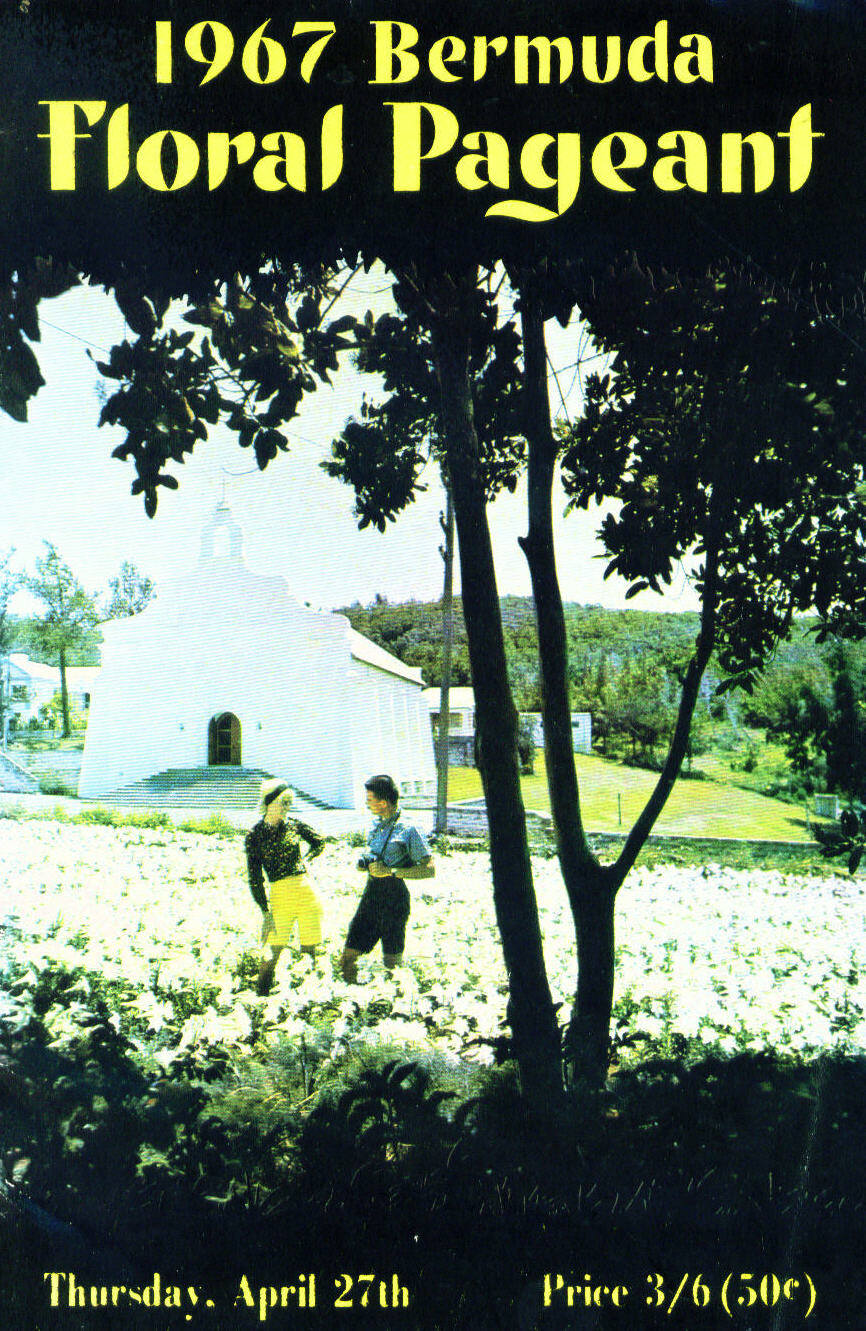
1967 Bermuda Floral Pageant
1967. The Ocean Monarch, sister ship to the Queen of Bermuda but built much later, in 1951, left the Bermuda-New York route. She was sold to Bulgaria and renamed Varna.1967. After the departures of the Queen of Bermuda and Ocean Monarch, the Cunard Line took over the Bermuda Government New York-Bermuda contract for a few years with its Franconia, and the Greek Line joined in with its similarly-sized Olympia.
1967. In London, the UK Parliament approved Bermuda's new Constitution.
1967. The Progressive Labour Party (PLP) moved into what is now its headquarters, Alaska Hall, on Court Street, Hamilton.
1967. The Hotel Keepers’ Protection Act became law.
1967. The Bermuda Post Office issued these stamps to celebrate Cable & Wireless telephone service between Bermuda and Tortola in the British Virgin Islands.
1967. The Duke of Edinburgh award scheme was introduced to Bermuda by the Junior Chamber of Commerce (Jaycees).
1967. Land Tax became a property tax charged on all developed land throughout Bermuda with some exceptions. The tax is charged under the authority of the Land Tax Act 1967 and the Land Valuation and Tax Act 1967.
1967. The James Bond movie "You Only Live Twice" - see http://www.imdb.com/title/tt0062512/ was filmed, a part of it in Bermuda.
1968. Lois Browne-Evans was Bermuda's first female barrister, Bermuda's first female Attorney General, and the first woman to become Opposition Leader in a British Commonwealth country when she became leader of the PLP. She served as leader until 1972 and again from 1976 to 1985.
1968. March. Princess Margaret visited Bermuda for the second time.
1968. April 4. Bermudians were horrified to hear of the assassination of Dr. Martin Luther King Jr. Reverend King was assassinated as he stood on the balcony of his hotel room in Memphis, Tennessee after he had gone to the city to help resolve a strike involving city sanitation workers organized in protest at unequal treatment of black and white employees. At that time, a decade into the open fight against segregation, Bermuda simmered with racial tension. The island was still months away from adopting universal adult suffrage. The Governor, Lord Martonmere, later ordered flags to be lowered to half-mast on the day of Dr King’s funeral, and services were held island-wide as the US observed a day of mourning. Bermuda was affected by riots just weeks after, when young people denied admission to the April 25 Floral Pageant reacted violently.
1968. The Clayhouse Inn became a prime nightspot on the Island, attracting visitors from overseas and revellers from across Bermuda. It hosted an array of international and local talent under the management of concert promoter Choy Aming. Jazz musicians, drag queens, dancers, singers, DJs and other entertainers played to the crowds, while the venue also proved a launching pad for many local bands. It also played for laughs, hosting 'Not the Um Um' shows, and was an assembly point for Mr. Aming's colorful carnival dancers in the Bermuda Day parades. In January 2002 however, fire broke out in the apartments above, signaling the demise of the popular nightspot. Seven people including a two-year-old baby girl had to be rescued by firefighters from their balconies.
1968. April 25 and 26. Floral Pageant Riot. A State of Emergency was called. Black Beret Cadre-led waves on insurrection and rioting followed, that lasted until 1972. They led to an investigation of the underlying causes by a Commission chaired by the Rt. Hon. Sir Hugh Wooding. The Governor declared a state of emergency and a Royal Navy frigate was sent to the Island to maintain the peace. A British Amy unit was also summoned and the 1st Battalion the Inniskilling Fusiliers, about to undergo a name-change, answered the call. The unit was then based at Norton Barracks in Worcester as the 'Spearhead Battalion', tasked with what was to be the final operational move of the Inniskillings before becoming The Royal Irish Rangers. Growing unrest in Bermuda had been little reported in the UK press until, midway through a Ladies Guest Night in the Inniskillings Officers Mess, the order was received to deploy Tactical Headquarters (Tac HQ) and one company to the island where the Governor had declared a State of Emergency. B Company was seen off at 0600 hours the following morning by the remainder of the officers still in their mess kit. The deployment was swift by two RAF VC10s from RAF Brize Norton. B Company arrived at United States Kindley Air Force Base in the north of Bermuda at the same time as HMS Leopard arrived in the South. This was a classic example of the use of minimum force, as immediately the rioters saw that Britain meant business, the rioting and disorder ceased. Tac HQ and B Company were accommodated in the Bermuda Regiment training camp on the south shore of the island just 100 yards from one of the best beaches. Among the early visitors were the Governor, Lord Martonmere, the Senior Naval Officer in the West Indies and British comedian Jimmy Edwards and Marjorie Proops from the Daily Mirror, the latter two having been stranded on the island by the emergency. It was decided that the Inniskillings should remain in Bermuda until after the local elections.
During the six weeks in Bermuda the platoons followed a three-day cycle of training and duties - one day on patrol, a second on guards and duties and the third carrying out tasks in aid of the Bermuda government. This consisted mainly of renovating an overgrown former military cemetery in the old Naval Base. The Commission highlighted that many of the black youths involved were resentful of the predominantly white and expatriate Police force which, many felt, picked on young black men. The underlying causes of the violence were deemed to be racial conflict; limited scope for employment of black Bermudians in a ‘white economy’; the artificiality of the Bermudian society with its emphasis on holiday living and easy money; the heavy dependency upon alcohol and the increasing prevalence of drug use. Although in the years prior to 1968, a series of progressive laws were swiftly introduced, undoing centuries of enforced racism, with racial segregation dismantled, universal suffrage finally gained and a move made to integrate all of Bermuda’s schools, the commission concluded that for many young blacks the changes were too few and were taking too long to really make a difference in Bermuda’s divided society. A frustrated population of young blacks were set to blaze in anger with even the smallest spark of racial injustice, the commission concluded. Those behind the 1968 riots were almost exclusively teenagers, the commissioners wrote. Racial tensions emanated from the deep historical divides between the races. The Wooding Commission “found that virtually everything in Bermudian society was viewed in racial terms”. Race defined all facets of society: relationships between the Police and blacks, the banning of “black” publications, the disputes between political parties and the attitudes of all Bermudians. The Wooding Commission saw a need for a “a new and true understanding, a deep conviction of the essentiality of building a single community, providing common opportunities for all and an unyielding commitment to promoting the democratic values of equality and fraternity in a society that is free in every respect”. The commission put forward a long list of suggestions for the UBP Government of the day to achieve this objective, including: Bermudianisation of local schools, by reducing the proportion of expatriate teachers (which, at that time, had reached 40 percent ). “Government,” the commissioners wrote, “should give urgent attention to the long neglected need for low-cost housing.” The Police Service, which formed a major concern for the commissioners, needed an extensive overhaul to make it more useful in meeting the needs of the society. Court Street, the commissioners wrote, needed a recreational centre for the area youth. “Effective control of the premises should remain with youths of the area,” the commissioners wrote, though Government should advise on its management and fund it.
April 29. The Secretary of State for Commonwealth Affairs Mr. George Thomson made the following statement to the UK's House of Commons in London. "I regret to tell the House that on the night of 25th April there were disturbances in the Colony of Bermuda. The disturbances continued on the night of the 26th, in the course of which several fires were started. Fourteen persons were injured, including five police officers, but, I am glad to say, there was no loss of life. There has been much damage to property. On the 26th a state of emergency was declared, the Bermuda Regiment was embodied and the police reserves were called out. At the request of the Governor, H.M.S. "Leopard" was diverted to Bermuda on the 27th, and a company of the Royal Inniskilling Fusiliers was sent from this country on the 28th. The situation is now quiet. One hundred and four arrests have been made, including a number for breaking the curfew.'
1968. May 21. USS Scorpion, a Skipjack-class nuclear submarine, sank in the Bermuda region, 500 miles southwest of the Azores.
1968. May 22. A General Election was held. In it, the Progressive Labour Party (PLP) was soundly defeated. In the new House of Assembly of 40 seats, using the first-past-the-post system, the PLP won only 10 seats of the 40 available and 33% of the vote. The PLP Leader, Walter Robinson, lost in his constituency. The Party leadership was handed over to Lois Browne-Evans who became the third Party Leader. Along with this position Browne-Evans gained the distinction and worldwide recognition as the first woman political leader in Bermuda, Bermuda’s first Opposition Leader under the new Constitution and the first female Opposition Leader in the British Commonwealth.
It was a historic first General Election
held with the new
constitutional framework that took effect 11 days later, on June 2. It
was the first held under equal universal suffrage, as the additional vote
for property owners used in the 1963 elections was scrapped, and
the voting age lowered from 25 to 21. A total of 107
candidates contested 40 seats in the House of Assembly. The United Bermuda
Party (UBP) had 39 candidates, the Progressive Labour Party (PLP) 38, the
Bermuda Democratic Party (BDP) fielded 21, and there were nine Independents.
The UBP won thirty seats and the PLP won ten. The BDP won 0. Sir Henry
Tucker, leader of the UBP, was appointed Bermuda's first Government Leader.
The General Election effectively took Bermuda from a representative to
responsible form of Government and transferred most of the Governor's former
executive function to the Executive Council, which was now headed by the
person commanding the support of the majority of the elected Members of the
House of Assembly. That individual, referred to as the Government Leader (a
designation which in later years was changed to Premier) chose the other
Members of the Executive Council (subsequently called Ministers) from party
representatives within the Legislature. Thus, the Council (known today as
the Cabinet) assumed responsibility for the administration of the internal
affairs of Bermuda, while the Governor, in a truncated role, retained,
interalia, control of external affairs, defence, internal security and the
Police, matters on which he was and still is, constitutionally obliged to
consult with the Government of the day. A
total of 107 candidates contested 40 seats in the House of Assembly. The
United Bermuda Party (UBP) had 39 candidates, the Progressive Labour Party
(PLP) 38, the Bermuda Democratic Party (BDP) fielded 21, and there were nine
Independents. The UBP won thirty seats and
the PLP won ten. Sir Henry Tucker, leader of the UBP, was
appointed Bermuda's first Government Leader. The General Election effectively
took Bermuda from a representative to responsible form of Government and
transferred most of the Governor's former executive function to the
Executive Council, which was now headed by the person commanding the support
of the majority of the elected Members of the House of Assembly. That
individual, referred to as the Government Leader (a designation which in
later years was changed to Premier) chose the other Members of the Executive
Council (subsequently called Ministers) from party representatives within
the Legislature. Thus, the Council (known today as the Cabinet) assumed
responsibility for the administration of the internal affairs of Bermuda,
while the Governor, in a truncated role, retained, interalia, control of
external affairs, defence, internal security and the Police, matters on
which he was and still is, constitutionally obliged to consult with the
Government of the day.
1968. June 2.
Bermuda took its historic step into responsible government when
the nearly 300 year old unwritten constitution came to an end, and Bermuda's new written
Constitution, a document 98 pages long, approved and enacted by the UK
government and went into force
from midnight in Bermuda after being assented to by the new Bermuda Government.
Agricultural and rural development. No specific provisions regarding this matter.
Constitution structure. The Constitution of Bermuda consists of 8 chapters, divided into 108 sections, and two schedules: Chapter I is entitled: Protection of Fundamental Rights and Freedom of the Individual. In Article 13, the Constitution provides for the protection of private property. The others are: Chapter II The Government; Chapter III The Legislature; Chapter IV The Executive; Chapter V The Judiciary; Chapter VI The Public Service; Chapter VIA Ombudsman; Chapter VII Finance and Chapter VIII Miscellaneous.
Basic institutions of the state and the rule of law. There shall be a Legislature for Bermuda which shall consist of Her Majesty, a Senate and a House of Assembly (Art. 26). Subject to the provisions of this Constitution, the Legislature may make laws for the peace, order and good government of Bermuda (Art. 34). The executive authority of Bermuda is vested in Her Majesty. Subject to the provisions of this Constitution, the executive authority of Bermuda may be exercised on behalf of Her Majesty by the Governor, either directly or through officers subordinate to him. Nothing in this section shall prevent the Legislature from conferring functions on persons or authorities other than the Governor (Art. 56). There shall be a Cabinet for Bermuda which shall consist of the Premier and, subject to the provisions of section 64 of this Constitution, not less than six other Ministers appointed in accordance with section 58 of this Constitution. The Cabinet shall be collectively responsible to the Legislature for any advice given to the Governor by or under the general authority of the Cabinet and for all things done by or under the authority of any Minister in the execution of his office (Art. 57). There shall be an Attorney-General who shall be the principal legal adviser to the Government (Art. 71) There shall be a Supreme Court for Bermuda which shall have such jurisdiction and powers as may be conferred upon it by this Constitution and any other law (Art. 73). Further Chapters VI, VII and VIII provides for the The Court of Appeal and Ombudsman.
Form of government and basic principles of the state. Queen Elizabeth II is head of state and is represented in Bermuda by a Governor, whom she appoints. Internally, Bermuda has a parliamentary system of government. The British Governor has reserved powers in three areas which are External Affairs, Internal Security and the Police. There is a Senate and a House of Assembly exercising the legislative power. The members of the Senate are elected by general elections.
Fundamental Rights and Directive Principles of the State Policy. Chapter I sets forth provisions regarding the rights and freedoms. The Chapter guarantees rights such as right to life and freedom, right to protection of law, freedom of conscience, freedom of expression, freedom of assembly and association, and the freedom of movement. The Chapter further provides for the protection from inhuman treatment, from slavery and forced labor, protection from arbitrary arrest or detention.
Energy. No specific provisions regarding this matter.
Environmental rights and duties. No provisions regarding environmental rights and duties.
Fisheries. No specific provisions regarding this matter.
Forestry. No specific provisions regarding this matter.
Indigenous rights. No provisions regarding indigenous rights.
Land & Property. Article 24 states that ‘subject to the provisions of this Constitution and of any other law, the Governor or any person authorized by him in that behalf, in Her Majesty's name and on Her Majesty's behalf, may, under the Public Seal, make grants and dispositions of lands or other immovable property in Bermuda or interests in such property that are vested in Her Majesty for the purposes of the Government and may exercise in relation to such property or interests any other powers that are lawfully exercisable by Her Majesty (Art. 24). Also see title 6. 3
Livestock. No specific provisions regarding this matter.
Non discrimination and gender equality. Article 1 of the constitution sets forth that whereas every person in Bermuda is entitled to the fundamental rights and freedoms of the individual, that is to say, has the right, whatever his race, place of origin, political opinions, colour, creed or sex, but subject to respect for the rights and freedoms of others and for the public interest. Further Article 12 provides for the protection from discrimination on the grounds of race, place of origin, political opinions, colour or creed whereby persons of disabilities.
Natural resources. No specific provisions regarding this matter.
Property rights. Article 7 provides for the protection for privacy of home and other property. ‘Except with his consent, no person shall be subjected to the search of his person or his property or the entry by others on his premises. Nothing contained in or done under the authority of any law shall be held to be inconsistent with or in contravention of this section to the extent that the law in question makes provision’. Further Article 13 provides for the protection from deprivation of property in detail.
Right to food. No provisions regarding the right to food.
Right to water. No provisions regarding the right to water
Supremacy of international law. No specific provisions regarding this matter.
1968. June 10. Sir Henry Tucker became Bermuda's first Premier.
1968. The Bermuda Government and United Kingdom Government negotiated an entrustment deal that allowed Bermuda's leaders to negotiate with other countries on certain matters without asking for permission from Britain on every occasion. It became a working symbol of Bermuda's senior status with the government of the United Kingdom and a mechanism that helped Bermuda take its place as a responsible member of the international community. It was an essential tool of modern Bermuda. Intrinsic to the exercise of the general entrustment is the trust the United Kingdom has in Bermuda to negotiate arrangements that ultimately require its signature. The papers show that Bermuda was given power to: Negotiate and conclude trade agreements with other countries; Arrange or allow visits of up to 30 days for trade or commercial purposes by representatives or residents of Bermuda to any other country; Negotiate and conclude agreements of purely local concern with any independent member of the Commonwealth or the US or such other authorities that the Bermuda Government may request and the UK Government approve; Negotiate and conclude agreements for technical assistance or of a cultural or scientific nature with any independent member of the Commonwealth or the US or such other authorities that the Bermuda Government may request and the UK Government approve; and Negotiate and conclude agreements with other countries, whether bilateral or multilateral, relating to emigration from Bermuda to those countries and to emigrant labour schemes. The agreement says it is necessary for the Bermuda Government to inform the UK of any such negotiations and keep it informed of progress.
1968. Bermuda had a papal visit by Pope Paul VI. He stopped on these shores briefly following a trip to Bogota, Columbia.
1968. Department of Planning, DAB, established.
1968. October. Bermuda Regiment soldiers went on their first overseas exercise. A 28-man group spent four weeks in Jamaica with 'A' Company of the York and Lancaster Regiment, part of the British regular army, who were there for an introduction to jungle training. The training time was spent working in the rough terrain presented by the thickly forested hills around Berriedale, in Portland. The soldiers lived in a tented camp at Folly Point, just outside Port Antonio, where, during the rainy season in an area that receives more than 100 inches of rain a year, the tented camp soon became a muddy swamp where it was said that only strong discipline and a stronger sense of humor kept the soldiers going. Of this pioneering group of men on the exercise, known by the British Army as Exercise Sane, three went on to make Bermuda Regimental and Bermuda national history; and one went on to high rank in the Church. Lieutenant Eugene Raynor became the first black Commanding Officer of the Bermuda Regiment from 1980 to 1984; Private Alvin Daniels became Captain Alvin Daniels and later the first Bermudian Aide-de-Camp to a Governor from 1973 to 1975, and Sergeant Larry Burchall became the first Bermudian Regimental Sergeant Major from 1978 to 1980. Going on to high rank in the Church was Corporal Calvin 'Skippy' Ball now Bishop Calvin J P Ball, Church of God (Washington State). Coming from Bermuda and working with the platoon was Company Sergeant Major Alan 'Boopsie' Burrows, a Bermuda Regiment pacesetter and trail-breaker in his own right and British Warrant Officer John Selby who later became a red-jacketed pensioner at Royal Chelsea Hospital, but who in October 1968 was on attachment to the Bermuda Regiment as the its Regimental Sergeant Major. Other Bermuda Regiment members in Jamaica were Gerald Bean, Edward Burchall, Allan Caines, Oliver K Darrell, John Deshields, Harold Dowling, Dennis Hassell, Glenn Ingham, J Looby, David Patterson, David Rowntree, Russell Seymour, Averylon Simons, William Todd, Peter Wilson, Creswell Williams.
1968. December. Guards were appointed to protect the Bermuda Cenotaph on Front Street following a series of desecrations and thefts of the memorial flags. The incident resulted in a dramatic move by the Canadian Navy to post a guard
1969. When man walked on the moon for the first time, the NASA station on Cooper's Island, Bermuda, played a key role.
1969. A group of scientists released a colony of gibbons on Hall's Island in Harrington Sound (and followed up on their progress in 1973). The scientists were studying the way the apes swing through trees and also monitored whether they were at play or rest via radios strapped to their backs.
1969. The Canadian Naval Radio
Station Bermuda was officially changed in name to Canadian Forces Station
Bermuda. It was one of the first Canadian stations to be manned by the
"new-look" unified Canadian Forces Personnel.
1969. Bermuda National Trust
founded.
1969. Bermuda's first Black Power conference was held. It brought activists from across the world to Bermuda's shores. The event was organized by the late civil rights campaigner Roosevelt Brown.
1969. Race Relations Act was enacted.
1969. February 20. Since its inception on this date, the Bermuda Monetary Authority was granted responsibility by virtue of Section 9 of the Bermuda Monetary Authority Act 1969 for the issue Bermuda’s national currency – Bermuda dollars and cents. The design of the currency has always reflected traditional Bermuda landscapes, flora and fauna and it is this representation of unique Bermudian features that has made this currency of interest to dealers/numismatists both locally and overseas. Since then, the notes and coins of Bermuda have been featured in the Authority’s Note and Coin Exhibit located at the Authority’s main premises – most recently at BMA House, 43 Victoria Street, Hamilton. This Exhibit is open from 9:00am – 4:00pm daily (Monday – Friday) and is ably supported by a Note Exhibit located at the Commissioner’s House, Bermuda Maritime Museum in Dockyard.
1969. February 20. The Bermuda Monetary Authority was established. On the day it took effect,, a few months later in July it changed the unit of currency from the British pounds, shillings and pence system to the Bermuda dollar. It became locally of equal value to the US dollar. Previously, it had been tied to the Britsh pound sterling.
1969. Death in Bermuda at age 80 of Gladys Morrell, was born in Somerset, daughter of Terrence Misick and Thalia J. D. Misick (née Wells, who had been born in British Guiana to Bermudian parents). She attended Bermuda High School and North London Collegiate School, and went on to receive an honours bachelor's degree from Royal Holloway College, London University, in 1911, becoming one of the first Bermudians to earn a university degree. Her ambition to become a lawyer, however, was unfulfilled because law schools in England did not admit women until 1919. After graduating, she travelled to India to visit her brother John, and on her return to England, she took up working and organising in the women's suffrage movement, and was active in Millicent Fawcett's National Union of Women’s Suffrage Societies until the end of 1913. She returned to Bermuda the following year and began a woman suffrage campaign in Bermuda, holding the first meeting in St. George's in 1914. On the outbreak of World War 1, she travelled back to England with the aim of assisting the war effort. Supporting herself by working in an insurance firm in London, she then volunteered with the Red Cross, and subsequently worked close to the front lines in Verdun, France, serving food to soldiers and tending the wounded, until she fell ill herself and was sent back to England in 1918 – which was also the year that Britain brought in legislation giving the franchise to women over 30 and Morrell was able to vote for the first time. Returning to Bermuda in 1919, she dedicated herself to what would be a long struggle fighting for the right of women to vote. In 1923 the Bermuda Women's Suffrage Society was established, with Morrell as its secretary and effective leader. In 1925, she also co-founded the Bermuda Welfare Society, which established the district nursing service. Rallies and public meetings of the suffrage movement were organized throughout the 1920s, and the campaigning escalated in the 1930s: every year when Morrell refused to pay her taxes because she was not allowed to vote, her furniture was seized and taken away for auction at Somerset Police Station, where suffragettes gathered and bought it back annually. However, it would not be until 1944 that Morrell's efforts succeeded in ensuring voting rights for property-owning women in Bermuda. She married retired British Navy officer John Morrell on 20 April 1926 and their daughter Rachel (later Bromby) was born in 1928. Gladys Morrell died aged 80 in 1969 and was buried in the family tomb at St. James Church, Somerset, Bermuda. The Gladys Morrell Nature Reserve in Bermuda's Sandy's Parish was named in her honour, in recognition of her concern about environmental issues.
1969. In London, England, the The National Insurance and Industrial Injuries (Bermuda) Order 1969 was enacted by the UK Parliament. For what it covers, see http://www.legislation.gov.uk/uksi/1969/1686/made.
1969 October. For a United Press International Conference in Bermuda, delegates included US Attorney General John Mitchell, Governor of New York Nelson Rockefeller, Walter Cronkite. They arrived at Kindley and were met by USAF personnel. Britain sent British Ambassador to the USA, Mr. John Freeman.
1969. The Black Beret Cadre in Bermuda was formed by 22 year old John Hilton Bassett. He was a Bermudian who had spent some time in the United States and who had been inspired by the Panthers’ aggressive style in fighting alleged police racism. His revolutionary name was ‘Dionne’. He adopted as the group’s motto, “Peace if possible, compromise never, freedom by any means necessary.” Bassett quoted Cuba as a good example for revolutionary action and told of how a small band had conditioned the people and eventually taken control of the country.
1970. The Health Insurance Act 1970 was enacted, to come into effect a year later (see April 1, 1971).
1970. March. Princess Margaret visited Bermuda.
1970. Easter Sunday night. There was extensive restoration done to Devonshire Church after a mysterious fire by an arsonist.
1970. July. Bermuda's bowlers including HattieAnn Morrisette became household names in Bermuda when against all odds they defeated bowlers from 20 Western Hemisphere nations in the 8th Annual Invitational Tournament of the Americas in Miami.
1970. July 25. Bermuda's first decimal currency, in dollars and cents, replaced the old British-style currency and the Bermuda dollar was pegged to the US dollar, at par. One the coins then issued is shown below:
1970. July 31. The Royal Navy in the UK and all its ships abroad formally ended its daily issue of a tot of rum, to the huge dismay of crew members on all its ships and shore establishments. For more than 300 years it it been one of the few constants for Royal Navy personnel. Each day, the ship's Purser (known on the ship as the Pusser) had doled it out. Until then, the British Admiralty had its own official rum blending formula and its own exclusive suppliers of them in quantity. No one then had the right to use the insignia of the Royal Navy's White Ensign. It was Black Tot day, the end of the long tradition.
1970. August 8. The Chesley White department store was burnt to the ground. That business, which stood where Washington Mall runs today, threatened to take out a block of Reid Street before being contained.
1970. The Bermuda National Trust was established to preserve natural, architectural and historic treasures and to encourage public appreciation of them. Its forerunner was the Bermuda Historical Monuments Trust, working in conservation from 1937 to 1970. The Trust’s programmes and activities are focused in the key areas of Preservation, Education and Advocacy. Its purpose is to ensure that Bermuda’s unique heritage remains protected for future generations.
1970. Prince Charles visited Bermuda, to open the 350th session of Parliament.
1970. Race Relations Council was appointed.
1970. The Heydon Trust chapel in Sandys
Parish was converted to its present prayerful status, from a modest but
picturesque 19th century farm laborer's cottage that appears to have been
built much earlier.
1970. October. Racial riots resulted in
countless acts of arson, strikes and malicious damage. A
State of Emergency was called.
1970. The United States Air Force handed over its base at Kindley Air Force Base to the US Navy. It became the US Naval Air Station, Bermuda
1970. Captain Horace Gibbons was the first Bermudian to become director of the Bermuda Regiment Band.
1970. The pioneering African-American ballet dancer Arthur Mitchell and his Dance Theatre of Harlem troupe visited Bermuda and became an inspiration to black Bermudian dancers. Black dancers were not dancing classical ballet until the Dance Theatre of Harlem came along. The company performed the George Balanchine ballet Concerto Barocco at the City Hall Theatre during a tour to Bermuda. Mr Mitchell was born in Harlem on March 27, 1934. He was appointed a MacArthur Fellow, received the National Medal of Arts and was awarded a Fletcher Foundation Fellowship over his lifetime.
1970. The Bermuda Gombeys were recognized as a uniquely local art form at a Unesco Cultural and Conservation Conference. Gombeys have a rich heritage across the Caribbean, where similar traditions emerged on several islands,
1970. November 5. Cable & Wireless Bermuda arranged for a special tour of Bermuda's Members of Parliament at the company's Devonshire Communications Terminal. General Manager Pete Waters accompanied by Manager (Admin) Norman Brooks and Manager (Engineering) Bill Dobney hosted parliamentarians who were given a conducted tour of the terminal. They were the Hon. Quinton Edness, Arnold Francis, L. P. Gutteridge, F. Perry, S A. Morton and C. V. Woolridge. After refreshments in the new Canber building, Mr Waters gave the visitors a synopsis of the company's activities and training program aimed at providing better job opportunities in the company for Bermudians at all levels. The tour commenced at the IMC where OIC Colin Collins explained the ease with which incoming and outgoing overseas telephone calls were connected to far-away places over international trunk routes and demonstrated calls to Australia and London. A display featuring the transmission of photo-telegrams managed by TCC technician Kelson Smith aroused much interest, especially after Polaroid shots of the visitors were transmitted to the Receiving Station where they were processed just in time to catch the visitors as they passed through the area. Other aspects shown included a video-scan display of the company's Bermuda activities, an escort around the Coaxial Terminal with emphasis on the existing Bermuda-USA and Tortola coaxial cables and the new Bermuda-Canada link for which terminal equipment was then being installed and the important role played by C&W cable ships and their cable repair work.
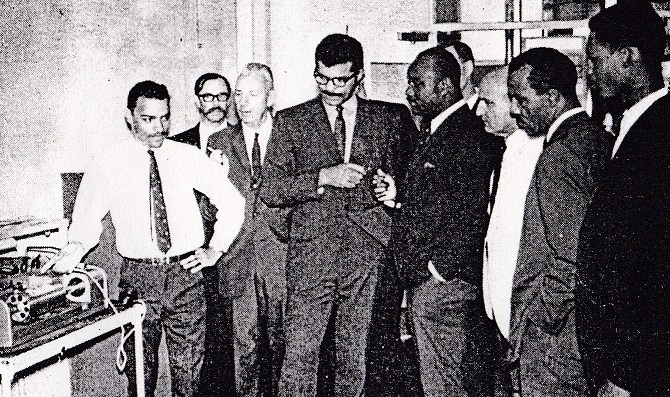
Members of Parliament at Cable & Wireless, Devonshire
1971. January. The year began with a major social development - integration in all Bermuda's public schools. From that moment on, there were no longer officially any black or white schools, but premises infused with the Technicolor of real people.
1971. January 11. Death of celebrated Bermudian artist, organist and pianist Charles Lloyd Tucker, after suffering a massive heart attack. He was born in Bermuda on October 31, 1913. He earned his stature as Bermuda's first black professionally-trained artist, art teacher. He was also a talented pianist. Bermudians black and white expressed their sorrow to his widow, Theresa and two children Hans and Sarah-Anne. His funeral w week later at Bethel Church was attended by hundreds of friends and admirers.

Charles Lloyd Tucker
1971. January. Brenton Roberts was appointed the island's first Organizer of Community Development (OCD). For many years thereafter, Roberts and his staff directed and coordinated the islands sports from east – west providing facilities, sporting events, summer day camps and after school program’s and much more. The first of three locations was above the Spot Restaurant on Burnaby Street for approximately the first 10 years. His staff consisted of Tom Smith, Sports Advisor, Reggie Ming, Youth Advisor and Roselyn Smith, secretary to Mr. Roberts and the Minister of Sport, Mr. Lancelot Swan. During the early 1970′s they broke ground on Bernard Park Softball Diamond, which attracted all walk’s of life, the Rubber Tree, in Warwick which provided a multi – surface complex for netball including various other sports and the former Coney Island race track which provided some the islands best motocross riders.1971. Bermuda's Printed Publication Act 1971 was enacted. It affected every newspaper, book and other publication printed and published on the island.
1971. Bermuda Folk Club formation, by Scottish expatriate Butterfield bank Bank the late accountant Howard Evans, a musician who died in 2019 at the age of 72 at his home in Carnoustie, Angus, Scotland. He created the club with Annabella Fraser and Pat Griffin after a 1971 jam session at his Paget home. He visited Bermuda many times after his Bermuda residency ended in 1988, several months before he would have become entitled to a Bermuda Social Insurance pension at 65.
1971. Senator Edward Kennedy began one of his most significant connection to Bermuda with his relationship with former United Bermuda Party MP John Stubbs. Sen. Kennedy recruited Dr. Stubbs, a surgeon who was familiar with both the UK and US health systems, to spearhead a fact-finding tour of Britain on behalf of the Senate Health subcommittee, which was looking to drastically improve healthcare in the States. The pair struck up a friendship which lasted many years.
Senator Edward Kennedy with Dr. John and Mrs. Stubbs
1971. Sir Edward (ET) Trenton Richards became the first Black leader of the UBP and Bermuda's first Premier.1971. April 1. The Health Insurance Act of 1970 came into affect, making health insurance plans compulsory for all Bermuda businesses. It mandated how health insurance became governed in Bermuda. Before this date, all Bermuda-based employers, whether local or exempted companies, were not required by law to provide any kind of medical healthcare to their employees, although many did so, either via their own self-funded arrangements or via a Bermudian company offering medical and/or health insurance. The Act required every employer to make health insurance available to all employees (full-time and some part-time employees) and their non-employed spouses through a licensed insurer. Self-employed persons were also required to have health insurance. Further, health insurance coverage had to include a minimum of the Standard Hospital Benefit, for the employee, non-working spouse and all their children. However, if a spouse later became employed, the employer was no longer required to provide insurance for that spouse. It was the responsibility of the employee to inform his/her employer when a spouse became employed. An employer was required to pay the insurer the entire cost of the health insurance premium for each employee and their non-employed spouse, but could deduct from an employee’s salary (or wages) up to half the cost of the standard premium. Promptly after an employee is hired, the employer had to provide the employee with the name of the health insurer who is offering the health insurance contract and the insurance number of the health insurance contract.
1971. April. Via Cable & Wireless, the Bermuda-Canada coaxial cable (with 480 channels) was laid.
1971. May 10. Bermuda issued the following stamps commemorating the voyages of the Deliverance:
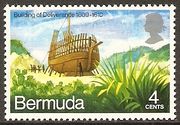
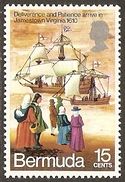
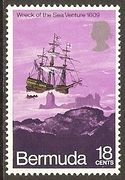
1971. June. Bermuda played a part in supporting the Planetary Atmosphere Experiment tests, which were designed to test equipment which had been developed for further space probes to various planets, especially Mars. The crew at NASA's Cooper's Island installation launched a series of meteorological rockets and balloons to altitudes approximately 400,000 feet to obtain information of atmospheric density and temperature. The spent rocket engines were expected to impact the ocean about 60 miles to the southeast of Bermuda. Not always did everything go according to plan. There was a day when the count down was announced: 10...9...8...7...6...5...4...3...2...1- lift off! But nothing happened. The rocket just sat there and looked passive. An inspection crew was sent out to see what was wrong and just before they got there BOOM! the thing took off. It was a close call.
1971. Initial formation of the Bermuda Stock Exchange.
1971. July 27. Visitor Andrew Sheldon from Toronto, Canada endured in Bermuda one of the most traumatic moments in his life. Then 17 years old, he visiting the island with a Canadian church group and was involved in a desperate but ultimately unsuccessful attempt to save a friend after the pair were pulled out to sea in a rip current. Ronald Andruchow drowned. Andrew Sheldon did everything he could to save his friend Ron. He later said: "Ron was a slight, but lovely guy and his unwillingness to go in the water made him the brunt of some jokes." They were part of a group of about 20 people that travelled to Bermuda with the Pentecostal Church. Mr Andruchow, who came from British Columbia, was just 24 years old when he died. He and his group did work with other churches and also with local children. They were in Bermuda for two weeks and after every day they would all go down to this cove in Warwick called Stonehole Bay to swim. I remember the day of Ron’s drowning very vividly; it was the day before we were supposed to leave. The two of us and another man went down and began to swim. Then, suddenly, Ron and I were sucked out to sea by this huge rip; Ron was trying to grab hold of me and had wrapped his legs and arms around my body, but I managed to get him onto a nearby reef where we could stand. He was hysterical and it was a nightmare situation to be in, but I felt the best chance of us both making it was for me to swim back to shore and get help. I told Ron to stay put and set off. I barely made it back, and had hoped he would just stay where he was. But he didn’t; for some reason he did not stay on the reef and his body was later found underneath the reef. We had to leave the next day but I remember what made me really angry was that the church just thought they could smile and pray it away. That did not work for me.” Next day it was a front page story in the Royal Gazette, The report by Al Seymour provides an account from an 11-year-old eyewitness who describes how Mr Andruchow was knocked off the reef by a large wave.
1971 to 1984. Champion racehorse breeder John Silvertand (who died in 2007) began to live in Bermuda and married a Bermudian with whom he had two daughters. He was the breeder of Afleet Alex who almost managed to win the fabled Triple Crown in 2005. The horse was third in the first leg – the Kentucky Derby – but won both the second and third legs, the Preakness and Belmont Stakes.
1971. Bermuda Building Code began, with application and planning regulations.
1971. September 23. Hurricane Ginger passed south of Bermuda, with heavy waves and gale force winds for 17 hours. But there was no loss of life or damage. The hurricane's passage failed to alleviate persistent drought conditions. However, the threat caused the Royal Navy presence in Bermuda to evacuate a ship, the US military evacuated some aircraft and two visiting cruise ships left early to avoid the threat.
1971. A study on the Bermuda environment by Dr. Idwell Hughes showed significant loss of arable land.
1971. Judge John Keogh of Norwalk, CT, of the New England District of Kiwanis International, visited Bermuda and persuaded locals to become Kiwanis, with the first of what became three local clubs formed.
1971. Freeman Fox study on highway and public transportation.
1971. Skyline Cottage, near the Fairmont Southampton, was bought by billionaire Canadian businessman Kenneth Colin Irving, known as K. C., in 1971 after a row with the Canadian government over taxes and death duties. The Bermuda residence was a vital link in the controversial creation of a island-based trust designed to avoid high taxes in Canada. Mr Irving, later listed as the eleventh wealthiest man in the world, was born in New Brunswick and built a business empire spanning oil and gas, timber and vehicle sales from a single Ford franchise opened in the 1920s. K. C. Irving Ltd owns around 300 private companies, mostly in New Brunswick and Quebec provinces, with interests in oil, timber, mining, shipbuilding, construction, real estate, the media and transportation. The company is a major employer in New Brunswick and a huge landowner. Mr Irving’s wife Winifred was one of the three trustees of the Bermudian-based trust established by Mr Irving’s will, which required the trustees to live outside Canada. Mr and Mrs Irving were forced to move outside Canada to avoid proposed death taxes and duties, which were expected to be as high as 80 per cent. This would have been devastating to the businesses as they would have had to have been sold to pay the anticipated death duties and taxes. Their move to Bermuda allowed the Irving empire to stay in the Maritime region of Canada and “sustained thousands of jobs”. The three-bedroom, two-and-a-half bathroom home bought by the Irving couple was an extension of an original much older two-bedroom cottage on the site and sat in 1.6 acres of land with stunning views over Jew’s Bay and the Great Sound.
1972. Fisheries Act extended Bermuda's jurisdiction to 12 miles and required statistics on each species of fish caught commercially. It required commercial fishermen to be licensed.
1972. Bermuda visit of David Frost, a luminary of British broadcast journalism who once chose Bermuda to fete some of the most eminent celebrities of the day. His impromptu January 1972 Bermuda bash garnered widespread coverage for the Island, from The New York Times to ‘Life’ magazine. The television star was simultaneously hosting talk shows in the UK and US when he chartered a 747 to bring 60 of his closest friends to Bermuda. Guests flown in from New York ranged in celebrity from US Senator Jacob Javits to world-famed economist John Kenneth Galbraith — and actor Richard Roundtree, star of the just-released film “Shaft.” Others included US author James Michener, chess grandmaster Bobby Fischer, journalist Barbara Walters, and film producer Joseph Levine. After treating his guests to a meal at the old Castle Harbour Hotel, followed by a chartered cruise of local waters, Sir David quipped to the British press that he thought “it would be jolly to start the New Year by taking some friends to lunch in Bermuda”. The veteran TV journalist specialised in interviews with leading figures, including eight UK prime ministers and seven US presidents. His most widely known claim to fame was his 1977 series of interviews with disgraced US president Richard Nixon. He died in 2013 of a suspected heart attack aboard the cruise ship Queen Elizabeth, where he had been booked as a speaker.
1972. The Bermuda College was established by the amalgamation of the Sixth Form Centre, Technical Institute and Hotel College.
1972. March. The Bermuda Track and Field Association Half-Marathon was first held on this rainy day, making it a number of years older than any other Island road race except the 102-year-old May 24 Bermuda Day Half-Marathon. German holidaymaker Gerd Mielke was the winner of the inaugural race, beating a field of less than 20 runners in a time of one hour 26 minutes and 23 seconds.
1972. June. Bermuda General Election. Of the 40 seats contested, the United Bermuda Party (UBP) won 30 seats, Progressive Labour Party (PLP) won 10 with 13,018 votes to increase its percentage of the vote to 38.2%. Walter N. H. Robinson successfully returned to active politics. Lois Browne Evans yielded the PLP leadership to him and he becomes the fourth PLP Party Leader.
1972. Cavendish Hall School, in Devonshire Parish, was acquired by Saltus Grammar School as its Preparatory department.
1972. Esso Bermuda built a nine-mile pipeline from its St. George's terminal to the power plant storage facilities in Pembroke. The pipeline remains in use today
1972. Bacardi International, the largest privately held spirits company in the world, established its worldwide headquarters in Bermuda. With operations and offices around the globe, with more than 200 brands and labels operating in more than 100 countries. It went on to build a magnificent office off Pitt's Bay Road, Pembroke.
1972. September 9. Assassination in Bermuda at his home, Bleak House, Devonshire, of Police Commissioner George Duckett, 45 years old, from England - in a planned and premeditated cold blooded murder, after disabling a security light outside the Commissioner's kitchen door – luring him outside and directly into the line of fire. His wife and daughter were intended to be victims too, but his wife escaped by car to call the police. His daughter Marcia was shot at five times, with one shot hitting her, but not seriously. A State of Emergency was called and Scotland Yard detectives were summoned. Confessed murderer Erskine Durrant (Buck) Burrows also attempted to slaughter Duckett's family when he began to spray bullets through the kitchen window, as the declassified Scotland Yard murder log of the investigation has revealed. Burrows fired one shot into the Commissioner's back with his small caliber .22 revolver – a shot that tore through both of Duckett's lungs, his heart and aorta. Duckett managed to stumble back into his house and close the door behind him before collapsing and dying, hemorrhaging blood from his mouth and his nose.
Scotland Yard Detective Chief Superintendent William Wright noted the above in his first full report on the Duckett killing, submitted to then Bermuda Police Commissioner L.M. (Nobby) Clark on February 11, 1973. "From the direction of two of the bullets, which struck a metal tray during flight, it would appear as though the assassin was either trying to hit Mr. Duckett again as he lay on the floor or else was firing at Mrs. Duckett, who was at her husband's side. "The remaining three bullets, however, were deliberately fired in the direction of Mrs. Duckett and her daughter Marcia as they stood in the archway of the kitchen whilst she was attempting to telephone for assistance. Two of the bullets struck the wood paneling whilst the third one struck Marcia in the chest." It was later discovered the killer had cut the telephone wires leading to the house as well as disabling the Police radio in the Commissioner's official car parked outside Bleak House. Detective Chief Superintendent Wright and fellow Scotland Yard murder investigator Detective Sergeant Basil Haddrell arrived in Bermuda on September 11 and worked with the Bermuda Police on the Duckett killing and a series of subsequent violent crimes that rocked Bermuda's placidity in the early 1970s.
In the shocking and bizarre resolution to the Commissioner's murder, Police Headquarters' trusty and one-time Duckett confidante Erskine (Buck) Burrows was arrested and charged with killing the Commissioner in 1973 following a politically-motivated murder and robbery spree that left five people dead including then Governor Sir Richard Sharples. Burrows had frequently worked as a handyman for the Commissioner at Bleak House, knew his habits and the lay-out of the house and property. Following the murder, Burrows had actually been detailed by newly-appointed Commissioner Clark to clean up the blood-stained Bleak House kitchen where Duckett died. Burrrows also attended the Commissioner's September 14 burial at the Military Cemetery in Prospect which overlooks Bleak House. Veteran officers remember him standing by the Police Vault for some 20 minutes, head bowed, paying his respects to the man he murdered. Members of the small militant wing of the Black Beret Cadre (BBC), revolutionaries inspired by the Black Power movement in the US, had met and recruited Burrows when he spent a short stint at the old Casemates prison in the early 1970s for a series of break-ins he almost certainly did not commit. It is believed Burrows' hatred for the rogue police officers who had beaten a false confession out of him for the break-ins resulted in him drifting into the Cadre's orbit.
The Cadre's extremists recognized Burrows' value to them as a spy and agent provocateur at Police Headquarters once he was released from prison – Duckett, aware Burrows had likely been framed, had offered him his position back. Later, the Cadre focused his anti-authoritarian rage and moulded him into a once-removed assassin using indoctrination techniques that were standard in counter-culture para-military cells at the time (for instance, playing on Burrows' ego by always referring to him as "Commander-in-Chief of all Anti-Colonial Forces in Bermuda"). Burrows' grief over the Duckett killing (he considered the Commissioner a friend and something of a father figure) is believed to have led to his conversion to Christianity following his arrest. He provided a written confession to prosecutors during his Supreme Court trial for killing the Police Commissioner in 1975. "I, Erskine Durrant Burrows, being of sound mind and body, wish to reveal and make known the following truths," he wrote. "First of all, I wish to reveal the truth that I, Erskine Durrant Burrows, was the person who shot and killed Mr. George Duckett at his home Bleak House on the night as stated by the prosecution. I shot him in the back. I am also the person who fired other bullets through the kitchen window, one of which wounded his daughter, Marcia Duckett. I wish to state again that what I have written and revealed is all true: it is the truth. I wish to reveal also that I cut the telephone wires beforehand. I also cut the wires to Mr. Duckett's car radio beforehand. I came on foot and left on foot. I was alone. No one else was with me. Finally I wish to reveal that I have made all the revelations of my own free will. No one has forced or pressured me into doing so. I also add my signature willingly and of my own free will. Signed: Erskine Durrant Burrows."
He also admitted his role in the March 1973 murders of Governor Sir Richard Sharples and his Aide-De-Camp Captain Hugh Sayers and was convicted of murdering supermarket executives Victor Rego and Mark Doe during the armed robbery of the Shopping Centre on Victoria Street in April, 1973. At the time of his arrest Burrows was described by then-Governor Sir Edwin Leather as "this tragic young man", saying he and, to a lesser degree, career criminal Larry Tacklyn (tried for collaborating with Burrows in the Government House and Supermarket killings) were puppets manipulated by hard-core elements within the militant Black Beret Cadre. "What I am convinced happened is that, at that moment of time, and probably quite accidentally, the small ring of BBC leaders still meeting together . . . suddenly realized that fate had put a new weapon in their hands in the form of these easily impressed and not very bright young criminals," said Sir Edwin. "They played on them, influenced them, almost certainly inspired some of the violent acts that followed and very probably planned them."
1972. October. Arrival in Bermuda as Governor at Government House of Sir Richard Sharples. He was a former Tory Member of Parliament and Home Office Minister to Bermuda but lost that job in a UK Cabinet reshuffle. He quickly endeared himself to many locals when, as a dog lover and displaying charming British eccentricity he threw a party for his Great Dane and invited all the other Great Danes and their owners to attend. Lady Sharples, his wife, also arrived and grown children visited. He was to have only five months in residence before he and his ADC were assassinated on March 10, 1973 when walking the dog.
1972. A Bermuda Regiment Volunteer Reserves team erected a Bailey Bridge on the Causeway in double quick time to ease traffic snarl-ups while essential maintenance work took place on Longbird Bridge. 30 members of the Volunteer Reserve unit took just two days to complete the bridge-building task which had been expected to take much longer. In October, 1972, Major Brendan Hollis was reported as saying: "The Royal Engineers judged it would take 60 men five days to complete the bridge; we have done it with 30 men in two days." Lt. Col. Michael Darling, commanding officer of the Bermuda Regiment at the time, said: "The enthusiasm of these men was really terrific. They were none of them youngsters, but they proved their worth today."
1972-74, when the Southampton Princess was built as Bermuda's biggest hotel, almost 100% of the construction materials came from Canada.
1973. February 15. Opening date of large new hilltop hotel, the Holiday Inn Bermuda, in St. George's close to Fort St. Catherine and overlooking St. Catherine's Beach, (later, Loews's Inn, later Club Med. It had a sad history and was finally demolished in 2008 in hope of having a new hotel). Present in 1973 were personalities including the Premier, Minister of Tourism and MCPs including Sir Dudley Spurling.
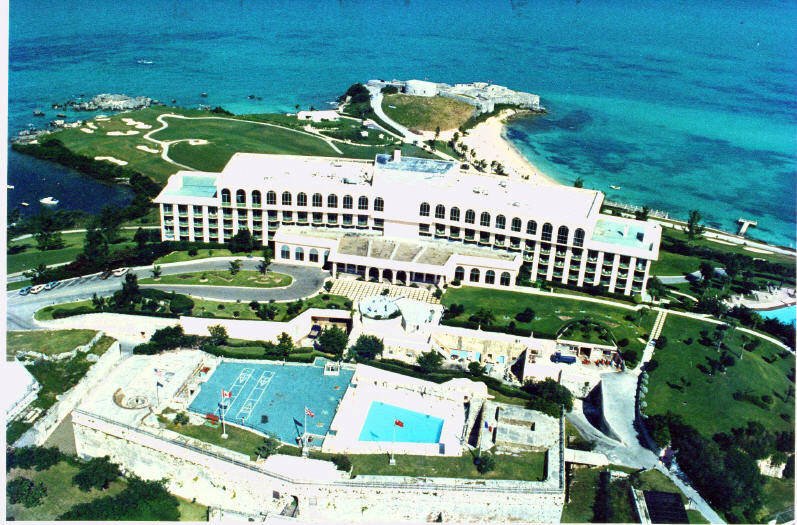
Holiday Inn, Bermuda, opened February 15, 1973
1973. The Bermuda Government's Hotel Occupancy Tax was introduced after being enacted by the House of Assembly. It was charged under the authority of the Miscellaneous Taxes Act l976 and the Miscellaneous Taxes (Rates) Act l980 and their respective Amendments. It was levied on the proprietors of hotels licensed under the Hotels (Licensing and Control) Act l969. It is calculated as a percentage of the rack rate charged to hotel guests. The term ‘rack rate charge’ means the total charge made by an hotel to its guests for accommodation and includes meals where a separate charge has not been made.1973. Prince Charles arrived without pomp and ceremony as a Sub Lieutenant aboard HMS Minerva. He stayed for 4 days and attended a number of social functions but is main duties were on the warship.
1973. The Executive Council was renamed as the Cabinet. Prior to this date, the House of Assembly formulated laws which were reviewed and passed by the Legislative Council which was appointed by the Governor and chaired by the Chief Justice who presided over a panel of senior civil servants and prominent citizens. Final legislative review was the responsibility of the Executive Council which was chaired by the Governor who sat in consultation with the Attorney General and Colonial Treasurer and Members of the Colonial Parliament who ran the various Government portfolios.
1973. When the United Kingdom formally entered the European Union this year, Bermuda, as a British colony, was not included in EU citizenship and other laws and provisions.
1973. City of Hamilton Plan.
1973. March 10. Double assassination in Bermuda of Bermuda Governor Sir Richard Sharples and his aide Captain Hugh Sayers, at Government House while walking a dog. They were buried in the graveyard at St. Peter's Church in St. George's. A State of Emergency was called and Scotland Yard detectives were summoned. Later, the killer was tried and executed. The execution caused mass riots, strikes, malicious damage and injuries to policemen. (Much later, the family came to live in Bermuda, for UK tax avoidance purposes).
1973. The role the Governor of Bermuda plays in public life diminished, in keeping with the principles set by the new Bermuda Constitution. He was once an absolute autocrat in the 17th century. It became a largely ceremonial one but with responsibility for Foreign Affairs, Defence and Internal Security.
1973. Old Devonshire Church was damaged by an explosion on Easter Sunday.
1973. November. Hamilton's container dock # 8, and an extension of container dock # 7, were officially opened.
1973. November. The Bermuda Government gave a tentative go-ahead for plans to create a national lottery and asked the Lottery Committee to draw up details. The Committee's report indicated strong support from residents and visitors. The Committee planned to use the money raised by the Lottery to finance a major sports complex, possibly at Shelly Bay, and other recreational facilities. But this never came to anything.
1974. Princess Cruises bought Flagship Cruises Bermuda Government New York-Bermuda contract and the latter's purpose-built specifically for Bermuda Sea Venture and Island Venture. The Sea Venture became the Pacific Princess, better known as the "Love Boat."
1974. February. A US Navy tug freed the grain ship "Mount Julie" from a reef in Bermuda's main shipping channel.
1974. Sir Henry Vesey voiced his views on international insurance expansion in Bermuda. For the first 35 years of its existence, the Bermuda insurance market pinned its colors to the property and catastrophe sector. But when Bermuda began to move beyond the captive market it had pioneered in the 1960s, one of the early questions it faced was whether to admit life, and annuity business. A hard decision, rather than a vague policy ruling, was required from the Bermuda government when the Harvard University medical malpractice program applied to operate its captive business from Bermuda. Sir Henry Vesey, who had been chairman of the Bermuda Trade Development Board in 1969, famously said: "What we want to avoid is over-expansion," and Harvard was duly turned down. The program went to the Cayman Islands and led to that jurisdiction becoming, over the years, Bermuda's only meaningful offshore competitor in the insurance industry.
1974. The Bermuda Bar Act
1974 - see http://www.bermudabar.org/images/Bermuda%20Bar%20Act%201974.pdf
was legislated.
1974.
"The Bermuda Triangle" first became a household term, through
the publication of The Bermuda Triangle book by Charles Berlitz. Bermuda
gave its name to this mysterious stretch of water largely as a result of the
still unexplained disappearances of ships and planes both military and
civilian including the airliners Star Tiger and Star Ariel in 1948 and 1949.
It is said that when Miami, one of its other points, was asked if it wanted
the Miami Triangle, it promptly and pointedly said no. When Puerto Rico,
another point, was asked, it too immediately declined . When Bermuda was
approached it did not reply, so got the name by default.
1974. The Legislative Council approved regulations allowing American civilians employed at the US bases in Bermuda to have the same on-base customs privileges as members of US Armed Forces.
1974. The dilapidated former Royal Navy Hospital complex mostly burnt down but a surviving building, known earlier as the Isolation Ward, was saved for conversion and change of use, as a senior citizen's retirement home, named Lefroy House. In 1818, the Royal Navy had built a quarantine facility on a small adjacent island later called Hospital Island. It was later extended and served as the Royal Navy hospital until it closed in the 1950s.
1974. The USA and Bermuda established the first commercial pre-clearance agreement whereby passengers leaving Bermuda by air for the USA could be pre-cleared in Bermuda by US Immigration and Customs authorities, instead of having to line up for a long time on arrival in the USA, as do Europeans and others.
1974. September. The Admiralty House Park Association was formed, headed by the late Joyce Hall. Had it not been for the determination of the Association to keep it in pristine condition the Pembroke park could have had a very different name and appearance. It nearly became the site of the Bermuda College, complete with a hotel training school. It was what some members of the then United Bermuda Party Government wanted to see happen. But associations based there, such as The Group (later the Admiralty House Community Centre), the Pembroke Bermuda Scouts Association, the Sea Cadets and the Bermuda Sub Aqua Club, together with Pembroke Parish residents, led by this association, objected very strongly and effectively to the idea and the Bermuda College ended up in Paget. Clarence Cove on the sea side of the park, once an important Royal Navy landing point for the Royal Navy admiral based at the Admiralty House mansion which gave the park its name, had attracted some Government MPs who saw it as an ideal location for a hotel training school. Initial plans showed there would be five buildings around Clarence Cove, taking up 12 of the 17 acres of land. The project was estimated at $8 million dollars over a 10-year period. Had the Government not changed its mind, Pembroke Parish would have lost its only substantial parkland and its only public beaches.
1974. The Bermuda College began, created by the Parliament of Bermuda through the passage of the Bermuda College Act in 1974. Under this Act, a Board of twelve Governors had the responsibility for the direction and management of the College. The members of the Board are appointed annually by the Minister of Education. The Chief Education Officer of the Ministry of Education and the Chairman of the National Training Board are ex officio members of the Board. This provision for the governance of Bermuda's only post-secondary educational institution was patterned after similar governing Acts of state-funded universities in the USA and Canada. The College began with the amalgamation of three flourishing institutions: the Bermuda Hotel and Catering College established in 1965, the Bermuda Technical Institute (1956) and the Academic Sixth Form Centre (1967) Some of these institutions had even earlier antecedents. They had provided opportunities for education and training in the main areas needed by Bermuda in its developing economy.
1974. Development and Planning Act had far wider visions than the 1965 Act. Under Section 30 of the Act, the Minister of Planning had a statutory duty to compile lists of buildings of special architectural and/or historical interest,
1974. Which Way Bermuda? Exhibition at City Hall.
1974. Second Bermuda Development Plan, with 53% zoned as an Environmental Conservation area with reserves for future development.
1974. After the death of the James Bond author Ian Fleming, London's Sunday Telegraph newspaper serialized author John Pearson's book 007-James Bond: The Authorized Biography. It claimed Commander Bond really did exist but was written up as fiction to deceive his enemies. It stated he was based at Bermuda's Hamilton Princess Hotel where he occupied a private suite belonging to his chief, Sir William Stephenson. In Bermuda, tourists at the hotel helped to spread rumors galore about the book, for example that in the hotel's Gazebo Bar the wall of giant fish tank was the model for the attempted death of Bond by Dr. No's sharks. They wanted to see a gold plated Cadillac in which Bond glided.
1974. With the enactment of the Bermuda Archives Act 1974 the Bermuda Archives department of the Bermuda Government was officially established.
1975. The Bermuda Government issued these postage stamps:
1975 Bermuda World Bridge Championship postage stamps
1975: March. Margery Wade, 34, was sexually assaulted inside her Hamilton apartment and killed with a blow to the head from a wooden plank. Her body was found on March 5, still inside the apartment on Laffan Street. Miss Wade was a schoolteacher from England who taught at the Berkeley Institute.
1975. Decline in grouper and snapper catch noted.
1975. February 14. Bermuda endured a General Strike, which lasted 2 days, including for the Royal Visit the next day.
1975. February 16. Second official visit to Bermuda, 22 years after her first, of Her Majesty Queen Elizabeth II and Duke of Edinburgh. She was greeted by Governor Sir Edwin Leather, who presented high-ranking locals.. This time, instead of being saluted by two local military units, one black the other white, as had been the case in November 1953 in her first visit, the combined Bermuda Regiment presented arms. Instead of the Governor's car being used, a specially imported $150,000 pen top Rolls Royce, property of a Philadelphia businessman was used, reputed to have once been owned by Czech Communist Party leader Alexander Dubcek. One of the events she attended was the Speaker's Dinner (which this author also attended), hosted by the Hon. Sir Dudley Spurling. Bermuda was experiencing a massive General Strike at the time with workers from the docks, hotels, transportation and sanitation protesting over poor pay. While here, the Queen visited Gibbs Hill Lighthouse. On this visit, the wife of an air force base commander apparently disgraced herself by getting protocol mixed up, despite having practised it endlessly. Instead of shaking hands then taking three steps back and walking away, she shook hands but became flustered, walked away, then turned around, confused. Prince Phillip laughed at this. Knighthoods were conferred on Sir Gorge Ratteray and the Hon Sir Dudley Spurling at Government House. The Duke, meanwhile, toured Castle Harbour’s Nonsuch Island, to see the Cahow restoration project. A gala dinner at the Southampton Princess Hotel was attended by more than 500 guests, who heard the Queen urge Bermudians to show what could be achieved when people “of different race and ancestry are determined to live together under the rule of law, and in mutual respect and tolerance”. This visit was marred by the disappearance of the famed “Tucker Cross” from the San Pedro wreck, believed to have been lost on the reefs in 1594 and recovered by diver and treasure hunter Teddy Tucker in 1955. Mr Tucker had sold the cross to the Bermuda Government in 1959 and it was to be the showcase of the new Maritime Museum. Just hours before the Queen was to open the museum, it was discovered that the cross had been replaced by a fake, prompting an international investigation. The real cross has never been recovered. Looking at underwater displays of Mr Tucker’s other treasures, the Queen was heard to remark: “Amazing!” The visit concluded the next day with a mini-tour of the East End, and lunch at St George’s Dinghy Club.
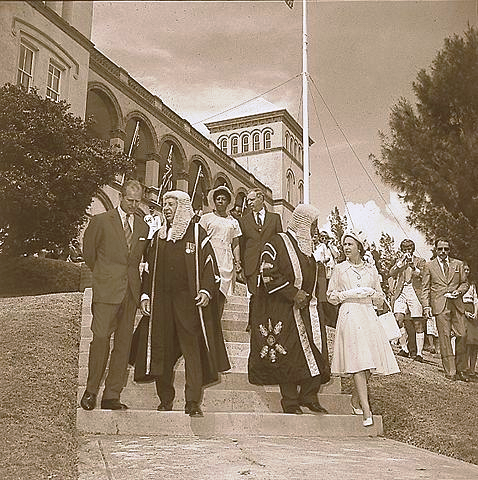
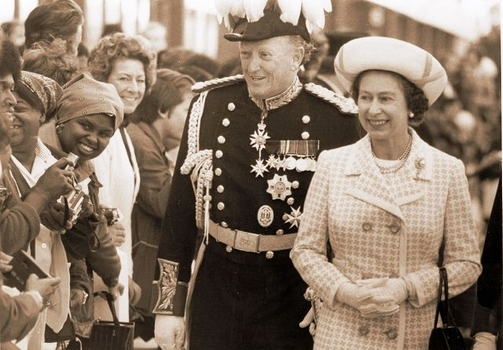
1975. In Bermuda rugby, the Bermuda Athletic Association (BAA) split into two clubs, the Mariners and Renegade Mariners.
1975. W. David Kingery was a member of the Beverly Yacht Club, on the Board of Governors of the Blue Water Sailing Club, and interested in doing a single-handed race from England to Newport. To qualify for the race, David chose to do a single-handed voyage to Bermuda and on this trip was struck with the concept of organizing a race to Bermuda for cruising yachts and family sailors. Having successfully completed the Bermuda trip, he discussed his idea with Dickie Bird of the Royal Hamilton Amateur Dinghy Club and then with Leo Fallon, Commodore of the Blue Water Sailing Club, and with various members of the Beverly Yacht Club. Support was promised from all three clubs; two years later, the 1977 and subsequent every-other-year Marion-Bermuda Cruising Yacht Race began with supporting clubs at each end and an additional staff of enthusiastic volunteers from the Blue Water Sailing Club.
1975. Meals on Wheels began in Bermuda and has been delivering healthy meals to the elderly and the infirm since then.
1975. American foulbrood Paenibacillus larvae was first detected in Bermuda, to the consternation of local beekeepers. As a direct result, an annual inspection programme was initiated by the Department of Agriculture & Fisheries (DAF).
1975. Fred McMurray starred in the movie Beyond the Bermuda Triangle, a made-for-television drama. A retired businessman's obsession with the mysteries of the Bermuda Triangle increased when his lover and her friends become its next victims.
1975. August 14. Bermuda issued s set of stamps to commemorate the 200th anniversary of the 14 August 1775 Bermuda Gunpowder Plot.
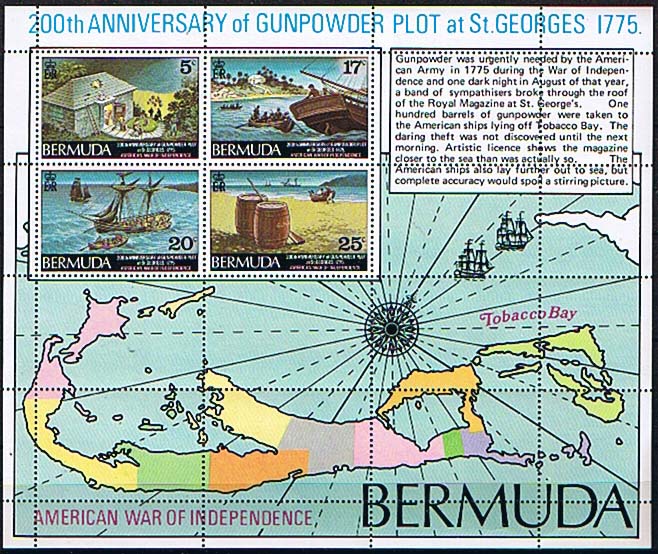
1975. The United Bermuda Party Black Caucus was formed.
1975. Protection of Birds Act 1975 was enacted. But only a limited amount of protection was afforded. It did not address issues such as protection of nesting habitat, in particular seabirds that rely on Bermuda as their sole breeding habitat or announce programs to promote the success of birds.
1975. Closure of the weekly black-owned Bermuda Recorder newspaper. David Augustus was one of the founders. At one time, in about 1973-74, John W. Swan owned it. Before that, Jennifer Smith was the Editor.
1976. January 13. Death in Toronto, Canada, of Bermudian Joseph Robert Gibbons, born 19 May 1929, who survived his service in the Royal Air Force (1940-45) and returned to Bermuda after the war before traveling about the Caribbean islands as an employee of Esso Carribe. In 1956, he was transferred to Canada and settled down in Toronto where he passed away, leaving his wife, Joan Mary (Hawes) and his children, Sharon Joan, Meredith Anne and Bruce William Watson.
1976. March 29. The Bermuda Post Office issued this set of stamps and First Day Cover to mark the 50th anniversary of the Bermuda Biological Station.
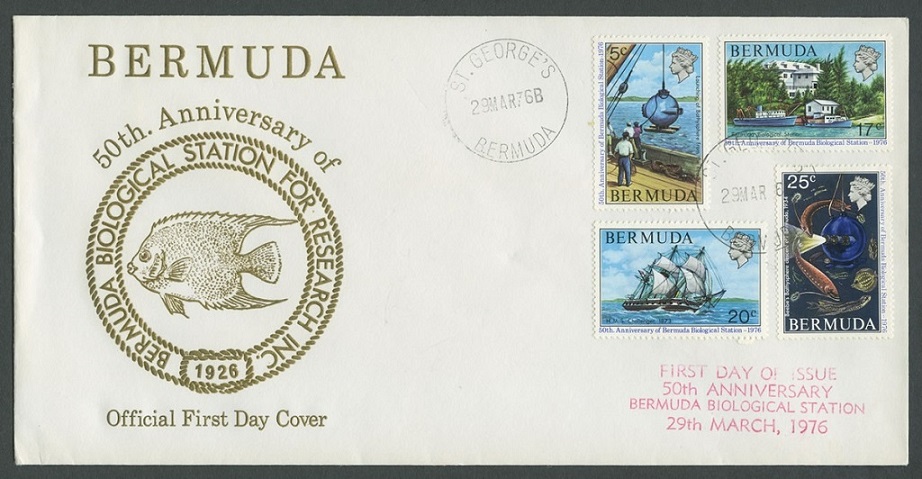
1976. Death in Bermuda of Norman Smith, a World War Two veteran of the Bermuda Militia Artillery. He was the husband of Bernice Smith.
1976. April . Mr. Walter Robinson Progressive Labour Party (PLP) leader, retired from politics and Mrs. Lois Browne Evans once again become Party Leader this time the Party’s fifth.
1976. May 18. A General Election was held. The United Bermuda Party (UBP) was victorious, with 26 seats out of 40. The Progressive Labour Party (PLP). under the leadership of Lois Brown-Evans, ran 36 candidates with 14 seats won and earned 15,246 votes amounting to 44.4% of the popular vote.
1976. July 3. Third visit to Bermuda (first was in 1953, second in 1975) of Her Majesty Queen Elizabeth II and Duke of Edinburgh. This time, it was purely a 4.5 hour stopover.
1976. Tall Ships in Bermuda. In a spectacular showing never before seen in Bermuda in such numbers, 18 Tall Ships from the 14 principal nations of the maritime world congregated in Bermuda as a prelude to their USA Bicentennial celebration in Newport, Rhode Island and New York. Square-rigs filled the sky as the Tall Ships vied for position at the starting line of St. David's Head for their race to New York. Suddenly, what had been a serene 19th century parlor painting turned to glorious chaos. More than half the fleet bunched up at the windward end of the starting line, as this picture to the right shows. There, amid a washday mass of windblown sails and a seemingly impenetrable thicket of masts, the ships both great and small crossed bowsprits, tacked slow-motion through each other's courses, underwent innumerable harrowing near-collisions. Crewmen cursed, spectators shrieked, Bermudian onlookers in the police boat and other small vessels gaped in wide-eyed surprise and shock. The grand green-sailed Libertad of Argentina, all 345 feet of her, glided inexorably through the thickest of the fray, just missing several competitors. Then she and the Spanish Juan Sebastian de Elcano (see below) came together in a bizarre, very gradual crash. Elcano lost 60 feet off the top of her 180-foot foremast and was forced to quit the race, sails tattered and rigging tangled and her skipper furious. Libertad had her mainsail ripped, her mizzen torn, but she went on. In the next exuberant minutes at least five other boats were also in collisions—three tall ships and two of the 70-plus smaller vessels also in the race.By nightfall the melee was far behind and the fleet was stretched over miles of ocean. A day out, the wind died, the sea turned to a glassy calm, the race came to a dead stop. After four windless days, the race was declared over, the Gorch Fock of West Germany was named the winner (though a protest was filed) and the fleet headed for Newport under power. After a week there the tall ships would head toward another memorable scene: New York on the Fourth of July. They were to parade through the Harbor and up the Hudson River, with five million people expected to watch.
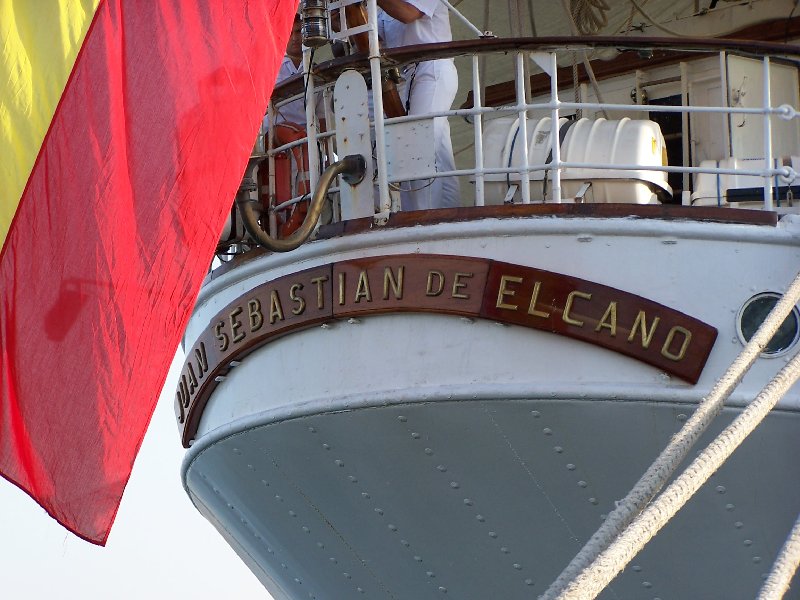
Collision between this vessel and Libertad off Bermuda, 1976
1976. In London, an internal Scotland Yard memorandum was prepared for the Commissioner of London's Metropolitan Police summarizing his Murder Squad's involvement in the politically-motivated assassinations and associated crimes of violence that shook Bermuda in 1972/73. It read as follows: Following the murder of (Police Commissioner George) Duckett on September 9, 1972, the (acting) Governor and Commander-In-Chief of Bermuda (Ian Kinnear) requested the assistance of officers from the Murder Squad, New Scotland Yard. In consequence Detective Chief Superintendent William Wright and Detective Chief Inspector Basil Haddrell (then Detective Sergeant First Class) travelled to Bermuda to lead the investigations. These officers were still engaged in their investigations when on March 10, 1973 the (recently arrived) Governor and Commander-in-Chief Sir Richard Sharples and his Aide-de-Camp Captain Hugh Sayers were murdered in Government House, Bermuda. As there was a definite link between these murders and that of Commissioner of Police Mr. Duckett, Mr. Wright and Detective Chief Inspector Haddrell were deputed to lead the investigations into all three murders. To assist them a further 11 officers were sent from New Scotland Yard (at various times). During the course of the ensuing investigations, two further murders were perpetrated on April 6, 1973 when Mr. Victor Rego and Mr. Mark Doe were found shot at their supermarket in Victoria Street, Hamilton, Bermuda. The hands and feet of both victims had been tied by rope prior to their murders and a total of $21,000 stolen from the premises. At this stage it was clear all five murders were closely linked and, in some cases, the same weapon had been used. Investigations clearly indicated the murders were perpetrated by members of an illegal and militant black organisation known as the "Black Beret Cadre".
This group was affiliated to the "Black Panther Organisation" of the USA and their aims were to end British colonialism in Bermuda and to seize control and power from the white population by removing High Officials from office by any means possible. The earlier activities of the organisation proving futile, they resorted to murder. A "Death List" was published within the organisation bearing the names of nine Senior Officials to be removed, including the Commissioner of Police and the Governor and Commander-in-Chief. Whilst Mr. Rego and Mr. Doe were not included on the "Death List", enquiries revealed they were murdered in the course of a "Fund Raising Mission" conducted by members of the Black Beret Cadre. The object of the mission was to take money from members of the white population for use in the purchase of arms and ammunition by which they might further their cause. Following the series of murders, members of the Black Beret Cadre organisation perpetrated further serious offences, including one attempted murder (of a black Bermudian taxi driver), two armed robberies, one attempted armed robbery and five incidents where revolvers and shotguns were fired at the windows of occupied buildings. Three of these shooting incidents were directed at residences occupied by members of the white community and two at the headquarters complex of the Bermuda Police, the first at the office occupied by the Murder Squad Investigation Team when five rounds from a .38 revolver were fired at the office windows and one other when a shotgun and revolver were fired at the windows of the Single Men's Quarters.
Fortunately no person was injured by these acts of terrorism but the possibility of further attacks occurring and proving fatal could not be ignored. It became clear that the Black Beret Cadre had infiltrated members into Police Headquarters, and so were aware of the offices and accommodation used by the Murder Squad team. In consequence, firearms were made available to Metropolitan Police Officers (serving in Bermuda) to carry at their discretion. The mental and physical stresses experienced in dealing with acts of terrorism in a foreign land added to the strain of investigating five murders at one time were enormous, and the eventual success of these enquiries must present a true reflection of the courage, character and ability of the officers concerned. As a result of extensive enquiries, evidence was adduced to prove Erskine Durrant Burrows was one of the persons responsible for the two armed robberies and the five shooting incidents previously mentioned. At the time of his arrest, Burrows was employed as a janitor at Police Headquarters, Bermuda and was so able to communicate valuable information of police activities to his co-conspirators in the Black Beret Cadre. He was arrested on October 19, 1973 and was eventually convicted of all charges, receiving a total sentence of 25 years imprisonment. Whilst at this stage it was also apparent Erskine Durrant Burrows and another Cadre member, Larry Winfield Tacklyn, were responsible for the five murders under investigation, insufficient evidence was available to justify their prosecution for same. The murder enquiries continued and gradually more evidence was adduced. Following the results of the Coroners Inquests held in 1975, a Voluntary Bill of Indictment was granted indicting Burrows on five counts of murder and Tacklyn on four counts of murder (he was not charged in connection with the Police Commissioner's assassination). Both defendants were arraigned at the Supreme Court of Bermuda and three trials ensued. At the conclusion of the trials, Burrows was found "Guilty" on all five counts of murder and Tacklyn "Guilty" on two counts of murder (he was acquitted of participating in the Government House killings). Much of the success resulting from these difficult, dangerous, arduous and protracted investigations directly emanated from the thorough and exhaustive efforts of the Metropolitan Police personnel during the initial stages.
The importance of correct documentation and thorough investigating was highlighted during the trials some four years (after the various crimes were committed), and their expertise and training of the local members of the Murder Team proved invaluable throughout the duration of the investigation. In fear of reprisals, virtually no public support was afforded the investigators but, despite this, the officers refused to be intimidated or diverted from their duty, and continued to work in a most professional and admirable manner. Bermuda's current transformation from political terrorism to peace and tranquility must be a reflection of the efficiency and ability of these officers.
1976. Two men, Borrows and Tacklyn, referred to in detail above, after being found guilty of the assassinations of the Police Commissioner, Governor and his ADC, were sentenced to death.
1976. Fame Magazine ceased publication in Bermuda
1976. Boxer Clarence Hill won a bronze Olympic medal for Bermuda, the first of any Olympic medal.
1976. August 21-13. Bermuda College mathematics professor Seán O’Connell established a record-setting two-day 43 hours and 27 minutes swim around Bermuda. Mr O’Connell endured months of preparation, a failed attempt, and his grueling but ultimately successful 38-mile swim that raised $11,000 for charity and landed O’Connell in Sports Illustrated and the Guinness Book of Records. Mr O’Connell’s 43-plus-hour feat at the age of 33 — the first known circumnutation of the island — was triggered by a $1,000 bet wagered by a friend at the Robin Hood Pub one Friday evening. “It only happened because of a happy-hour boast that turned into a serious proposition — and it changed my life for ever,” said Mr O’Connell, now 75, who moved to the island in 1974 and spent 29 years teaching at the college. Born in Brooklyn, New York, to a family of Irish heritage, Mr O’Connell, later a Bermudian, trained to become a Jesuit priest after high school until he chose teaching as a career instead. But he says his upbringing as the son of a high-ranking New York City police officer, plus the years of discipline he practiced in the religious order, prepared him well for his long-distance effort years later. Mr O’Connell’s seven months of training in the ocean around Bermuda in 1976 saw him battle weight loss, vomiting and psychological challenges, as well as endure combative tides and close encounters with barracuda, sharks, jellyfish, even a freighter. Through it, he learnt the necessities of marathon swimming — how to fuel his body with high-energy supplements and protect against hours in salt water by coating himself with thick grease and wearing a face mask. A team of volunteers and vessels was organized to support him through two attempts, including the final successful clockwise swim around the island in a time of 43 hours, 27 minutes. He donated a total of $11,000 raised by his swim to the Bermuda Physically Handicapped Association.
1976. Lord Yehudi Menuhin was in Bermuda to perform in the Bermuda Festival. While here, his visit to the string group at Warwick Academy sparked his interest and out of it grew his idea to establish a string quartet in Bermuda that would provide instruction in stringed instruments to all of Bermuda's school children. To take his dream to fruition, the Menuhin Foundation was created.
1976. August. Sean O'Connell swam solo round-the-island for the Bermuda Physically Handicapped Association (BPHA) and raised thousands of dollars for it.
1976.
October. The
British Labour Government in London, pressured by Prime Minister Harold
Wilson, unilaterally terminated the Bermuda I agreement dating back to 1946
and announced that a revised one should be put in place by June 1977. This was
widely criticized in the United States, where it was seen as an attempt to
return to the more restrictive ideas which the British had favoured thirty
years earlier and in Britain, where it was felt that it would upset the
American Government and damage the attempts to obtain landing rights for the
Concorde which British Airways was proposing to fly into New York and
Washington. The timing was certainly poor as it preceded an US Presidential
election and US negotiators might not be in a position to reach any agreements
for several months.
1977. February. Sir John (Jack) Sharpe, who had earlier replaced Sir Edward Richards as leader of the United Bermuda Party, was popular with the electorate but was eventually forced to quit after pressure from his own party members. Seven members of his Government, including members of the Black Caucus, resigned and accused him of bringing the party to a state of "political bankruptcy."
1977. April. Robertson’s Drugstore in St. George's was destroyed in a blaze. Arson was suspected.
1977. First Bermuda chapter of Ikebana International, the Japanese art of flower arranging, was formed by Kitten Ellison.
1977. The Shelly Bay Plaza at Shelly Bay in Hamilton Parish fell victim to an arsonist and was burned to the ground but within a year was rebuilt and back in operation.
1977. June 17. The mystery thriller action adventure movie "The Deep" see http://www.imdb.com/title/tt0075925/ by Peter Benchley (who also wrote "Jaws") was released. Robert Shaw sang the praises of Bermuda-bottled and blended rum.
Set in Bermuda, it also starred Jacqueline Bissett; Nick Nolte; Louis Gossett Jr; Eli Wallach; Dick Anthony Williams; Earl Maynard; Bob Minor; Bermudian Teddy Tucker; Robert Tessier and Lee McClain. A pair of young vacationers on a romantic stay in Bermuda are involved in a dangerous conflict with treasure hunters when they discover a way into a deadly wreck, a WW2 freighter, in Bermuda waters. Near it, they find an ampule of morphine, one of tens of thousands still aboard the wrecked ship. Their discovery leads them to a Haitian drug dealer, Cloche (Louis Gossett), and an old treasure hunter, Romer Treece (Robert Shaw). With Cloche in pursuit, Gail, David and Treece try to recover the sunken treasure. While The Deep was set in Bermuda and the Island featured extensively both above and below the surface, much of the wreck-diving footage was shot on the shipwreck of the RMS Rhone in the British Virgin Islands, while the shark feeding frenzy was actually filmed off the Great Barrier Reef in Australia!
1977. Possible political independence for Bermuda from the UK was first reviewed comprehensively in a Green Paper launched by the Progressive Labour Party (PLP) which favored Independence and stated so in its published Independence Action Plan. It encouraged public debate, television programming and public meetings. It was followed by a White Paper stating Government's view Bermuda was not yet ready.
1977. A new 645 mile yacht race, every other year in uneven years, was devised between members of the Royal Hamilton Amateur Dinghy Club in Bermuda and the Beverly Yacht Club on the coast of Massachusetts at the town of Marion. It became the Marion-Bermuda Cruising Yacht Race and attracts upwards of 80 boats, yachts of a certain type, for its biennial sail from Buzzards Bay to St. David’s Head. It was intended as a contest of non-professionals by founders, Bermudian the late Geoffrey Bird and American the late David Kingery. Sailors may if they wish use celestial navigation methods instead of modern technology. The yachts must be cruising yachts, not racers, require an enclosed cabin and be fitted out for comfortable cruising, including permanent bunks, a permanently installed and enclosed toilet, and permanently installed cooking facilities suitable for use at sea. One of the three sponsors of the Marion to Bermuda Race is the Blue Water Sailing Club, founded in 1959 in Marblehead, Massachusetts, to provide general yacht cruising in areas not exclusive to Bermuda. The other hosts are the Royal Hamilton Amateur Dinghy Club in Bermuda and Beverly Yacht Club, of Marion, Massachusetts. The town of Marion is understood to have been founded on Native American settlements possibly five thousand years old. Located on Sippican Harbor, it was once one of the richest whaling centers in the United States in the nineteenth century. In the first race in 1977, one of the winners was Allan Doughty’s Asteroid.
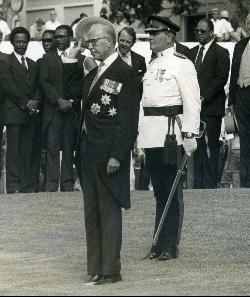 1977.
Arrival of new Governor Sir Peter Ramsbotham, said to be an
architect of modern Bermuda. He not only helped to reduce the racial
inequalities of the island but built its foundations as an international
business jurisdiction.
Faced with some of the most turbulent times in
Bermuda's history, he quelled the riots of December 1977 and went on to pioneer lasting
social change through the Pitt Commission and its findings. As
Governor from 1977 to his retirement in 1980, Sir Peter's is said to have
viewed Bermuda's people as his favorite quality of the Island. He
worked diligently to bring together people of all backgrounds and outlooks on
life towards healing the divisions between the races. Sir Peter governed
during a very turbulent and difficult period in Bermuda's history. He worked
assiduously with his wife Lady (Frances) Ramsbotham, touching all aspects of
the community. Sir Peter made his wife's
dream of opening a home for the physically-handicapped a reality when he
helped to attract funding for 'Summerhaven' in Smith's.
1977.
Arrival of new Governor Sir Peter Ramsbotham, said to be an
architect of modern Bermuda. He not only helped to reduce the racial
inequalities of the island but built its foundations as an international
business jurisdiction.
Faced with some of the most turbulent times in
Bermuda's history, he quelled the riots of December 1977 and went on to pioneer lasting
social change through the Pitt Commission and its findings. As
Governor from 1977 to his retirement in 1980, Sir Peter's is said to have
viewed Bermuda's people as his favorite quality of the Island. He
worked diligently to bring together people of all backgrounds and outlooks on
life towards healing the divisions between the races. Sir Peter governed
during a very turbulent and difficult period in Bermuda's history. He worked
assiduously with his wife Lady (Frances) Ramsbotham, touching all aspects of
the community. Sir Peter made his wife's
dream of opening a home for the physically-handicapped a reality when he
helped to attract funding for 'Summerhaven' in Smith's.
The couple's own daughter was disabled after a riding accident in the 1970s. Educated at Eton College and Magdalen College, Oxford, he joined the Foreign Service in 1950 after serving in the Intelligence Corps of MI5 during the Second World War. In 1945 he was Mentioned in Dispatches. Sir Peter was appointed British Ambassador to Iran in 1971 and then British Ambassador to the US in 1974. In Washington he enjoyed a close relationship with President Jimmy Carter. His appointment to Governor and Commander-in-Chief of Bermuda was not an easy posting. Shortly after his arrival riots erupted in an outburst of anger at racial injustices and the hanging of Erskine Durrant (Buck) Burrows and Larry Tacklyn. Burrows, 33, was executed for the murders of Police Commissioner George Duckett on September 9, 1972, Governor Sir Richard Sharples and his Aide-de-Camp (ADC) Captain Hugh Sayers on March 10, 1973, and supermarket owner Victor Rego and his bookkeeper Mark Doe a month later. Tacklyn, 26, was executed for the supermarket double-murder, which took place during an armed robbery. Despite a petition for clemency by 6,000 people, they were sentenced to death and hanged on December 2, 1977. The verdict sparked three days of rioting and Sir Peter took the decision to call in British troops, the 1st Battalion Royal Regiment of Fusiliers. The Army restored peace to the streets but not the underlying roots of discontent. In a bid to ascertain the causes, Sir Peter called for an inquiry and the Pitt Commission was established. He died in 2010 at the age of 90. Photo above: Sir Peter Ramsbotham's arrival.
1977. July 23. Bermuda II was signed as a Bilateral Air Transport Agreement between the governments of the United Kingdom and the United States of America, as a renegotiation of the original 1946 Bermuda agreement, following events in October 1976. (See above). The Bermuda II agreement was much less liberal than Bermuda 1. Unlike Bermuda I, which was a rigid agreement set for all time, Bermuda II was a framework agreement which would permit changes whenever circumstances changed. Its most significant change was that it replaced the airlines right to set their own fares, subject only to a complex protest procedure by either government with a new system in which fares were agreed by the two governments directly. It restricted the number of airport gateways in the United States to be served directly from London Heathrow. At the same time, it permitted non-scheduled airlines to operate between the two countries, using other airports, particularly the relatively new airport at Gatwick. There was a complicated system of controlling capacity on routes between the UK and the US. The British aim was to provide a system under which airlines from each country could compete on more equal terms.
1977. Sargasso Seafoods projects began.
1977. Death of Mr Len McDonald, chief archivist of the Bermuda (Government) Archives. He left a wife, Anne, and 2 daughters, Rachel and Karen.
1977. The concept of visiting not one but two Bermuda ports first started with the Cunard Princess cruise ship.
1977. November 30. Death in Bermuda, at his home on Knapton Hill, Smith's Parish at the age of 66, of British playwright Sir Terence Rattigan. He was a cultural exile in Bermuda as well as a tax exile. His fall from grace in the 1960s was as much a deciding factor in making the island his home in 1967 as tax savings he could make on fees for the screenplays he turned his hand to once his plays became unfashionable in London’s West End and on Broadway. He lived in Bermuda for the final decade of his life. Once Britain’s most acclaimed and popular playwright with such successes as “French Without Tears”, “The Winslow Boy” and “Separate Tables” Rattigan’s star had started to go into decline with the rise of “Angry Young Men” like John Osborne, Edward Bond and Harold Pinter. Their incendiary plays — labeled “kitchen sink dramas” because they often dealt with the banalities of domestic life — weren’t just attacks on the hypocrisy and cant of the establishment but also damning indictments of traditional British theatre as epitomized by Sir Terence’s elegantly written and constructed body of work. Rattigan told his confidantes he felt so unloved in his own country that he left it to live in Bermuda. Few playwrights in the 20th century were dismissed as cruelly from the warm hearthside of critical approval as Rattigan was in the wake of John Osborne’s ‘Look Back in Anger.’ Sir Terence, who had traveled through here on active service during World War Two and immediately felt an affinity for the island, used to joke he decided to make Bermuda his home because his theatrical and personal nemesis Sir Noel Coward would never set foot here: Coward had lived in Bermuda in the 1950s and dismissed the island as a slice of mid-Atlantic suburbia before decamping for Jamaica. Arriving here in February, 1967, Sir Terence initially rented a house called “Sitting Pretty” located close to the third green of the Mid Ocean golf course in Tucker’s Town. Later he bought “Spanish Grange” on Knapton Hill, filling the house with photographs and mementoes of his parents whose strained gentility, outward respectability and social aspirations cloaked the loneliness, futility and pretense of English upper-middle-class life — a theme running through most of his plays. Battling cancer towards the end of his life, Sir Terence enjoyed a last theatrical success in the West End with “Cause Célèbre” in 1977. Based on the true story of Alma Rattenbury, who went on trial with her 18-year-old lover for the murder of her husband in the 1930s, the play was a valedictory of sorts — a final declaration of ”Rattigan’s passionate hatred of English Puritanism and noble, unwavering affirmation of life” according to critic Bernard Levin. Condemned by the public more for her seduction of a young boy than for any involvement she may have had in her husband’s death, Alma’s fate is left in the hands of the socially and sexually repressed jury forewoman. By then in failing health Sir Terence made the painful journey from Bermuda to London for ”Cause Célèbre’s” opening night. The play enjoyed a successful run in London, was later turned into a popular television production with Helen Mirren and was successfully revived in the West End. During the last months of his life, Sir Terence’s old friend and collaborator Harold French — who had directed his first major hit in 1930s — moved into “Spanish Grange” along with his wife, Peg, to care for the dying man. While in Bermuda, Mr. French was approached by the Bermuda Musical & Dramatic Society to direct a local production of one of Sir Terence’s most acclaimed play, ”The Winslow Boy” – a task the playwright encouraged him to pursue. The playwright died just a short time after his adopted home saluted him with a local production of one of his most enduring dramas.
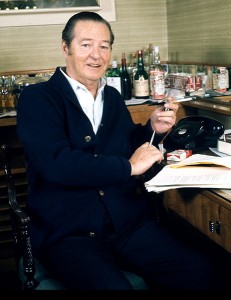
Sir Terence Rattigan
1977. December 1-4. Riots, strikes, malicious damage galore and mass demonstrations protested the sentences of death imposed and thousands of Bermudians petitioned to stop them. The Government, in a last-minute session of the Court of Appeals dismissed the final appeal on behalf of the two men on the night of December and refused to have a last-minute debate on capital punishment. As the two condemned men walked from their cell at Casemates to a holding cell beside the newly constructed gallows the prison went wild. Waiting in a tiny execution chamber was the visiting British hangman and his assistant from Trinidad, since Bermuda had no executioners. The two were old friends: they had performed the same task often enough in the Caribbean.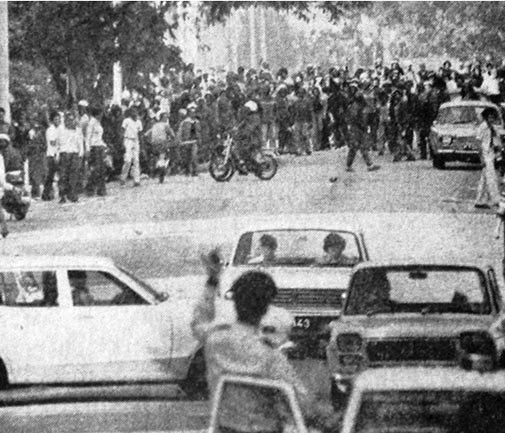
In this excerpt from an official report to London then-Governor Sir Peter Ramsbotham said actions by a handful of “PLP militants” helped to provoke the riots which left three people dead and caused millions of dollars in property damage. Sir Peter wrote a now-declassified report to London’s Foreign & Commonwealth Office in the immediate aftermath of the worst civil disturbances in Bermuda’s history and stated agitators had “set the stage” for rioting which broke out when convicted murderers Erskine (Buck) Burrows and Larry Tacklyn were executed. The former British ambassador to Washington who had taken up his Bermuda post just a few months earlier said the “militants” deliberately undermined the PLP leadership’s call for peaceful and lawful opposition to the hangings. “It was announced on Friday, 25 November, that both men would, in consequence, be executed a week later,” said Sir Peter. “For a time, the PLP remained silent: although the House of Assembly met on the day of the announcement, the subject was never mentioned during its meeting. But the group of PLP militants took swift and energetic action. Over the weekend, they pressured the party’s leaders and some members of the Ministerial Association of the Churches here into sponsoring a protest campaign; they arranged to feed slanted information to left-wing Members of Parliament in the UK and to the press there; they lobbied international bodies opposed to capital punishment, and they formed a local body to oppose it. They thus set the stage for a week of inflammatory activity, throughout which they were themselves never averse to inciting racial hatred – and, I suspect, always hopeful of provoking the riots which eventually erupted. There is no evidence that either the Leader of the Opposition (Dame Lois Browne Evans) or any of her Parliamentary colleagues shared such a hope. Quite the contrary: they blocked several of the , more extreme proposals of the militants, insisting, privately as well as publicly, that all demonstrations must remain peaceful and that nothing unlawful was to be attempted.” Submitted to London in February, 1978, Sir Peter later substantially revised some of the initial opinions he expressed in this report about Bermuda’s socio-economic and political conditions in the wake of the Pitt Commission hearings held that summer into the circumstances which gave rise to the rioting. “We followed that (the Pitt Report) up by having a constitutional conference with a body from the Foreign Office and ourselves, and both parties were there, and we changed … what had been the vexatious point, constitutionally, which was called the Commonwealth vote,” said Sir Peter in a 2001 interview. “Young white people, who’d been in Bermuda for more than three years, had the vote at the elections just because they were Commonwealth and white. This had virtually deprived the black Opposition party of ever really getting enough votes to get power. For 30 years, you’d had a one-party dictatorship there. So we eliminated the Commonwealth vote over a period of time. By doing so we reduced racial tension. Now the black Opposition have become the Government. Whether they will control the racial problems, I cannot tell. But that was the peace.”
1977. December 2. At 4 a.m. on the morning of Friday, December 2, 1977 Burrows, self-styled 'former Commander in Chief of all anti-colonialist forces in the Islands of Bermuda' was hanged. Tacklyn went to meet the hangmen, one of whom was reported overseas as being of the same complexion as the killers, at 4.40 a.m. Some miles away a rumor was rumbling, the hangman was a guest on the top floor of the Southampton Princess. This prompted a hotel worker to jump on an elevator and douse the top floor's carpets with gasoline. Fire swept through the Southampton Princess and three tourists staying there were trapped and killed by the flames. Revenge race riots erupted from the hanging of Buck Burrows and Larry Tacklyn at Casemates Prison. Burrows was convicted of the murders of the former Governor and his ADC in 1973, Police Commissioner Duckett in 1972 and of the Shopping Centre robbery and murder. Tacklyn was hung for the deaths of two Shopping Centre persons. A prolonged State of Emergency was declared, police stations were attacked, many police injuries occurred and publicity overseas for Bermuda was frightful. Five hundred youths took over the Court Street Area, setting fire to the Gosling’s Warehouse and attacking shops in the area. Petrol bombs were thrown throughout the Island and Police responded with tear gas. Millions of dollars in malicious damage was caused by the rioters. The Bermuda Regiment was called up. For the second time, the Governor was forced to declare a state of emergency and request British military assistance. The frustrations of hundreds and anger with Bermuda's perceived racial inequalities were vented. Hundreds of black men aged 16-60 took to the streets within minutes. White people walking on Court Street were attacked and badly injured by the angry mobs. The crowd smashed windows at the Supreme Court and House of Assembly, overturned cars and set fires. Parliament and Victoria streets were a sea of glass after the crowd marched through smashing everything in its way. Molotov cocktails were flying. There was a glow from all the buildings and people running around in masks. Some of the businesses targeted and set alight were Bristol Cellars and Bermuda Air Conditioning. n the course of the day, Gosling Brothers warehouse, Piggly Wiggly supermarket in Shelly Bay and Sunshine Company were gutted. At the Transport Control Department a bus was rammed into the building
1977. Sunday. December 4. New York Times. 260 battle-clad British soldiers landed on this Atlantic resort island tonight, where fresh plywood has been tacked up over pink, blue and yellow storefronts in the wake of three days of racial unrest. The 260 British troops were mostly from the First Battalion Royal Regiment of Fusiliers, some from the jungles of Belize, with orders to shoot to kill, and the streets of Hamilton were finally quiet. British Governors of Bermuda were advised to stop having aides from overseas and instead to have local ones. It is how the tradition started in the Bermuda Regiment. Burrows and Tacklyn were the last to receive the death penalty in Bermuda. The British soldiers provided support for local policemen who clashed with bands of youths since two black men were hanged as murderers here Friday. One of the men was Erskine Burrows, who was convicted of killing Sir Richard Sharples, then the Governor; his aide, Capt. Hugh Sayers, and Police Commissioner George Duckett, and, in a separate incident, two shop-owners during a robbery. The other man, Larry W. Tacklyn, was acquitted of the first crime but convicted of the second.
The first 80 of the British troops arrived at the United States Navy air station from Belize, formerly British Honduras, where they had been stationed since early fall. The rest of the troops, flown here from Britain, were from the Royal Regiment of Fusiliers. Commander David Aldrich of the Royal Navy, the senior British officer on Bermuda, said he did not believe the troops would be put on the streets tonight, but would be held in a camp at Warwick. After the 5:30 P.M. to dawn curfew went into effect that evening, the streets in downtown Hamilton and the winding roads throughout the island seemed deserted except for an occasional police unit, armed with tear-gas guns, patrolling in Land Rovers. Throughout the day, this sun-washed, pastel-colored island was quiet, but the tensions of the last three nights remained. After 5:30 P.M., when the curfew went into effect, no one was supposed to be on the streets accept the police, firemen, the Bermuda Regiment—a militia unit—and now, the British Army.
The hotels scheduled additional “rum swizzle” parties to mollify their guests. Restaurants and theaters are closed. Word of the unrest had already begun to bring canceled reservations and early departures. Many saw a major and prolonged, perhaps indefinite, threat to the tourist industry, the island nation's principal economic backbone after international business. “Enough is enough.” The Royal Gazette said in its weekend editorial. “The bad publicity abroad is probably worse than anything Bermuda ever received,” the editorial said, adding, in reference to a wave of terrorism on another matter, “When tourists start to die, Bermuda could find its tourism wiped out in much the same way as it was in St. Thomas. The timing was somewhat inopportune for the tourist industry since 180 foreign travel agents had just arrived for their annual Bermuda briefing tour, postponed once before because of a hotel strike. Colin Selley, the island's tourism director recalled that tourism had recovered after rioting here in 1968, but added “what you can't measure is the irreversible harm done in terms of Bermuda's image as a quiet place to take a holiday.
The hangings and the rioting came after a week of gathering protest against capital punishment here, led mainly by the opposition, largely black, Progressive Labor Party. A petition containing 13,128 signatures calling for the abolition of capital punishment was submitted to the Government. Lois Browne-Evans, the leader of the opposition party, was the attorney for Mr. Tacklyn, and unsuccessfully argued an appeal for him for four and a half hours on the eve of his hanging. She then filed notice of her intent to appeal to the Privy Council in London, but the execution was not stayed. Mrs. Browne-Evans described the executions as “barbaric” and “a primitive act” to reporters today and contended the unrest of recent days was due to frustration over what she said was the rule of the white minority. “Repeatedly in one form or another, the voice of the Bermudian people has fallen on deaf ears, and, in the Bermudian way, we have swept a back log of sociological, economic and political inequities under a manicured facade to fester,” she said. Even as the judges were turning down the appeal on Thursday night, a group of more than 100 black youths, marching to drums and music, moved on the House of Assembly, the building that houses Parliament and the Supreme Court. The police riot squad, carrying shields and three‐foot nightsticks, clashed with the youths, but several got over a wall and hurled rocks and a traffic light through the windows of the government building. The two convicted men were hanged early Friday morning in Casemates Prison, Mr. Burrows at 4 A.M. and Mr. Tacklyn at 4:30 by a hangman brought in from England with an assistant from Trinidad. It was the first execution here in more than 30 years. Despite the hastily imposed curfew, the unrest continued, mainly in the Court Street section of Hamilton, near the Hall of Assembly, for days. The riot squads fired tear‐gas canisters at groups of youths. Fires were set. There were about 40 arrests. Prime Minister David Gibbons called for calm. He conceded that racial “tensions were always present” in societies throughout the world, but says “I believe we have learned to live with it. Our Cabinet is equally representative of black and white and I believe we have made progress,” he said.
1978. New Year's Day. An American woman was raped in Bermuda. Keri Ebright, white, who later went to live in North Carolina, was aged 17 when she was raped on the Railway Trail in Hamilton Parish between Flatts and Shelly Bay by a black man. She reported the crime to police but her attacker was never traced. Ms Ebright lived in Bermuda between 1974 and 1980.
1978. January 27. The made-for-'TV movie "The Bermuda Depths" was first telecast. It was smash hit in the USA. It starred Burl Ives, Leigh McCloskey, Carl Weathers and Connie Selleca. The plot gets under way when scientists arrive in the Bermuda Triangle to investigate underwater disturbances. This activity seems to be tied in with reported sightings of the ghost of a drowned girl. Pursuing their investigation, the scientists run afoul of a giant sea turtle. The film was a rare live-action effort from the Canadian cartoon firm of Rankin-Bass.
1978. February 22. 11-year-old Connie Furtado, a pupil at Paget Primary Shool, was raped and strangled with her school tie in a crime that shocked Bermuda. Her body was found on wasteland near the Railway Trail on Ord Road, Paget, a few hundred yards from her home. Chesterfield Johnson was later convicted of murder and rape and sentenced to death, but his murder conviction was reduced on appeal to manslaughter. He was given the maximum sentence at the time of 20 years and released in 1998. It was the second rape offence in less than two months.
1978. The movie "The Bermuda Triangle" was released to a world audience.
1978. Chuck Feeney came to Bermuda, as the founder of the Bermuda-based General Atlantic Group and Atlantic Philanthropies charitable institute, reported to be one of the wealthiest people in the world. A New Jersey native, he needed to be a resident on the island for a year. With the help of local banker Cummings Zuill he bought a large villa and that summer moved his entire family here.
1978. A commission headed by Lord Pitt of Hampstead, known as the Pitt Commission Report, was ordered by the UK and convened to look into the December 1977 civil disturbance. It was released after the five-person bipartisan team interviewed scores of people over a six-week period before going abroad for two weeks to write the report. Members included Alex Scott and the late Irving Pearman. It recommended a raft of policies aimed at improving opportunities. It wrote that while the hangings of Tacklyn and Burrows were the immediate cause of the riots, there were many underlying issues which were "tangled together and derive much of their influence from the way they interact." It outlined issues within Bermuda and made recommendations on how to improve society and the economy for the benefit of all Bermudians. The Progressive Labour Party took on a dynamic role as the Opposition in giving many young people a political voice. Many involved in the riots, said “we needed to shake up the Government”. With many black Bermudians perceiving unequal opportunities, they felt that “rioting, though regrettable, can be a legitimate mode of protest”.
The commissioners wrote: “Civil disorder in Bermuda during the last 13 years has functioned as a kind of extra-parliamentary political action.” A crisis in national identity was hitting the core of Bermuda’s black male, the commissioners wrote. Whereas his father viewed growing up in a small society and viewed himself as a subject of King George V, “a young black man today grows up in an international society oriented towards North America; his political conceptions are influenced by racial identifications in the United States, Rhodesia (now Zimbabwe) and elsewhere.” Bermuda’s economic advances, the commissioners wrote, contributed to weaknesses in a young black man’s sense of identity. Expectations of educational performance were nourished that many young people could not meet. This was more “acute for black males than for white males or for females”, they wrote. “It can easily cause young men to feel that in others’ eyes they are failures, with the result that they seek other ways of shaping a sense of identity that will salvage their self-respect.” In 1977, the commissioners quoted the Bermuda Association of Social Workers on so-called disadvantaged youth: "their experience needs to be legitimated. They don’t see themselves as a problem. They say ‘We want you to recognize us for what we are, as as Bermudians.”
Young black males, the commissioners said, were struggling with an identity “partially from the absence of a feeling of belonging to a distinctive national unit and partly a relative lack of success in what is now a very competitive society”. In their report on the disturbances of 1977, the Pitt Commission recommended that Bermuda seek Independence. National, or more specifically racial, unity would be attained only with a sovereign Bermuda, they said. Additionally, the Pitt Commission suggested that Bermuda introduce a more equitable tax system, which, if necessary, may include an income tax. “There is also an urgent need for programmes aimed at increasing the spread of Bermuda’s wealth,” the commission said. In the family, the commission said that several Bermudians that “discipline in the family and society has declined drastically dramatically in recent years.” They called for more fathers and male role models to become involved in the lives of young men. “Boys have no image or sense of direction when going to school. It is really a complete moral decay for young men in Bermuda unless the parents and few dedicated teachers are able to give them a sense of perspective,” a witness told the commission. “Lacking job motivation and experiencing job-related frustration, some male Bermudians, particularly young black males,” they wrote, may vent their frustrations through “anti-social behavior”. It concluded that the Island's parliamentary process did not properly represent Bermuda's citizens. It added that Bermuda needed to ensure that economic prosperity did not hinder society and cause sectors to loose a sense of identity. It found found that the underlying causes lay in the inequality of opportunity between the races. There is a strong belief that there is inequality of economic opportunities, concentration of economic power in Front Street, lack of support for small black businesses and lack of job training, lack of low income accommodation, decline in discipline, the single parent households, deficiencies in social welfare programmes and education and criminal justice systems. We devote more attention to the contributory causes than to the immediate causes because the latter are relatively simple, and so long as the sense of frustration was acute, a variety of factors could have served to precipitate disorder. We are led to emphasise with underlying popular impatience with what is seen as insufficiently equal opportunity.
The identification of race with privilege sharpens this feeling but does not create it. The disturbances happened to be directed against the present Government but in the future disappointment with a different government could be expressed in a similar fashion." The importance of plans relating to child development and of their being supplemented by a programme of compulsory education for children of primary school age. The provision of a second chance to obtain a qualification. The importance of sharing the wealth and opportunities provided by Bermudas two main businesses: tourism and international business; we hope that the propose investigation of monopolies will extend to all forms of economic activity and will not be limited to the retail trade. The importance of substantially reducing immigration and assisting the promotion of Bermudians. We repeat our belief that in the long run it will prove essential to regulate the transmission of inherited wealth. Economic progress has also contributed to these weaknesses in the sense of identity, for it has nourished expectations of educational performance that many young people cannot meet. Bermudians should not set standards for themselves that are so high that they produce a class of casualties.
1978. British UK nationals resident in Bermuda but not Bermudians who had previously been allowed to vote were told this would be the last time that non-Bermudians would automatically be allowed to vote. After this year, to be allowed to vote they had to be Bermudians by birth or status.
1978. All employees and management of Bermuda's Bank of N. T. Butterfield and Son Ltd were allocated common shares in the bank at no cost to them. with the number in direct proportion to their salaries. The shares were then worth $15 each.
1978. As the insurance industry started to grow, Bermudians realized that it needed to be regulated properly and in 1978 the Insurance Act was passed by Parliament. Following this, the Insurance Advisory Committee (IAC) was established, made up of people representing insurance companies, legal firms and Government regulatory agencies such as the Bermuda Monetary Authority.
1978. The Bermuda National Trust's Christmas Walkabout began, the idea of author, newspaper editor and historian Mr William Zuill, of Orange Grove, Smith's Parish. It was originally a Christmas party for Trust members with events in each of the major St George's properties held by the Trust to engage the membership in our historic properties.
1978. Bermuda's opera house in the city of Hamilton was destroyed by fire. It was built in 1908 as the brainchild of William Augustus “Syke” Smith, who was a black master builder. It was one of the most beautiful buildings in Hamilton. During the time of racial segregation, it was a venue for live performances by black artistes.
1978. August 28. The death, via accidental drowning in Bermuda of prolific American author F. Van Wick Mason - see http://en.wikipedia.org/wiki/F._van_Wyck. He had been a resident since the 1950s on a permanent basis, but had first visited Bermuda in the late 1930s. A number of his books featured Bermuda.
1978. On Boxing Day, the 528 foot ship Mari Boeing ran aground on Bermuda's reefs. Damage caused to the reef was huge, over 100 acres, and can still be seen.
1979. February. A Constitutional Conference was held at Warwick Camp attended by the UBP, PLP and Foreign & Commonwealth Office officials. Among other significant events, the Legislative Council or Upper House ended, having been in place since 1888 and in its place came the Senate or Upper House. Among other things, it eventually led to the abolition of the expatriate vote in Bermuda. The conference came as a result of the 1977 riots and the subsequent Pitt Report, which called for major reforms of the legislative landscape on the island. The Commonwealth Residential Vote — a measure first enacted in 1963, which allowed Commonwealth citizens who had been resident in Bermuda for three years to vote in Bermuda’s elections — was one of several key issues of discussion at the conference, with the opposition Progressive Labour Party (PLP) calling for its abolition and the ruling United Bermuda Party (UBP) seeking to extend the qualifying period to ten years. US Consul General Richard Rand had privately discussed the possibility of further civil disturbances to “support PLP demands” with the Governor, Sir Peter Ramsbotham. A month later, in late March, both The Premier and Opposition leader traveled to London the last week in March to present their cases on expatriate vote to FCO Ted Rowlands, who was then to decide on the issue, The 12th-hour compromise did not have enthusiastic support of either political party. The Conservative faction of UBP was unhappy with the Premier for digressing from the party caucus’s firm stand on expatriate vote. PLP found itself formally committed to going into next General Election under the present electoral system. The expatriate vote — which was considered at the time the easiest point to resolve — had proven to be the issue that would threaten to finally deadlock the conference. The PLP was reportedly unbending on its position that expatriate vote be abolished altogether. The expatriate vote was eliminated later in 1979 by Lord Carrington following talks in London. However, those who were previously able to vote retained that right.
1979. Miss Bermuda, Gina Swainson, 21 years old, from Wellington Hill, St. George's, won the Miss World contest at London's Royal Albert Hall. She put Bermuda on the world beauty queen map. Later, she moved to England.
Gina Swainson, Miss World 1979
1979. March. Piggly Wiggly Limited was purchased from Fernance Perry by Mr. Alvin Ferreira who at the time owned the Modern Mart grocery store on the South Shore Road in Paget and a number of cycle rental companies. In 1981, the name of the four stores were changed to the MarketPlace stores while Modern Mart continued to trade under it's own name. In September of 1987 the company further expanded with the acquisition of the A-1 Grocery Stores, the A-1 in Paget and the A-1 in Smith's. In August 1993, Mr. Alvin Ferreira unfortunately passed away at the age of 50, His wife Pamela took over ownership of the group of companies, which have continued to grow.1979. Mrs Terry Tucker, then head of the research section of the Bermuda Library and a prolific local author, published a small book on The Islands of Bermuda. The book had 173 islands listed by name, of which, at that time, Mrs Tucker stated 120 still retained their original titles but some no longer existed having been absorbed into the US Bases at St. David's and Southampton, in the Camber [at Dockyard], been blasted out of the ocean-bed, or merged with a neighbouring island. Altogether, some 30 islands and islets were disappeared in the national interest for one reason or another, most for military purposes. See Bermuda's Islands.
1979. The BBC documentary movie "Life on Earth" - see http://www.imdb.com/title/tt0135095/ was filmed partly in Bermuda.
1980. February. The ship Arcadian Victory ran aground on Bermuda's reefs.
 1980. June 11. Former Beatle
John Lennon arrived in Bermuda from Rhode Island aboard his 43-foot yacht Megan Jaye after a remarkable
journey during which he steered it to safety amid a tropical storm. He kept a
log of the voyage. It represented an important moment in Lennon's life.
It marked an end of the former Beatle's 10-year writing block and led to his
final solo album, Double Fantasy. Lennon, whose father and grandfather were
sailors, had always dreamed of making an Atlantic crossing. When a visit to an
oracle in South Africa suggested that the safest voyage would be in a
south-westerly direction, Lennon decided to charter the 44ft schooner Megan
Jaye and make for Bermuda. Just hours after leaving Newport, Rhode Island, the
vessel found itself in the middle of a ferocious tropical storm and, one by
one, members of the crew fell ill. At one point
during the five-day trip Lennon took charge of the yacht after the other crew
members fell ill, and famously took the helm during a tempestuous storm.
When the final crew member, the ship's
cook, also succumbed, Lennon lashed himself to the wheel and steered the
vessel to safety. Upon landing in Bermuda eight days later, he described how
he had regained his courage 15 minutes into the tempest and began reciting old
sea-shanties recalled from his childhood. He likened the cathartic experience
to performing on stage. "At first you panic, and then you're ready to
throw up your guts but once you get out there and start doing your stuff you
forget your fears and you get high on your performance," he said. The
musician later recounted in an interview: “So there I was at the wheel. The
wind and sea lashing out at me, wave after wave. At first I was terrified, but
Capt’n Hank was at my side, so I felt relatively safe, ‘cause I knew he
wouldn’t let me do anything stupid. But
after a while he (Capt’n Hank) wasn’t feeling too well and he retreated to
the cabin below. “Once I accepted the reality of the situation something
greater than me took over and all of a sudden I lost my fear. I actually began
to enjoy the experience, and I started to sing and shout old sea shanties in
the face of the storm, screaming at the thundering sky." Freed
from his writer's block by the experience, he stayed in Bermuda for two
months, rented a home at Knapton Hill and later in Fairylands and was joined
by his 3 year old son Sean. began writing songs for and completed his final
album Double Fantasy just
weeks before his murder in December 1980. He found
inspiration for the title after coming across Double Fantasy freesia in the
Botanical Gardens. (The log, on which Lennon wrote the
words "Dear Megan, there is no place like no where" includes a
doodle of him sporting a beard and was sold for more than £20,000 in London
in 2006).
1980. June 11. Former Beatle
John Lennon arrived in Bermuda from Rhode Island aboard his 43-foot yacht Megan Jaye after a remarkable
journey during which he steered it to safety amid a tropical storm. He kept a
log of the voyage. It represented an important moment in Lennon's life.
It marked an end of the former Beatle's 10-year writing block and led to his
final solo album, Double Fantasy. Lennon, whose father and grandfather were
sailors, had always dreamed of making an Atlantic crossing. When a visit to an
oracle in South Africa suggested that the safest voyage would be in a
south-westerly direction, Lennon decided to charter the 44ft schooner Megan
Jaye and make for Bermuda. Just hours after leaving Newport, Rhode Island, the
vessel found itself in the middle of a ferocious tropical storm and, one by
one, members of the crew fell ill. At one point
during the five-day trip Lennon took charge of the yacht after the other crew
members fell ill, and famously took the helm during a tempestuous storm.
When the final crew member, the ship's
cook, also succumbed, Lennon lashed himself to the wheel and steered the
vessel to safety. Upon landing in Bermuda eight days later, he described how
he had regained his courage 15 minutes into the tempest and began reciting old
sea-shanties recalled from his childhood. He likened the cathartic experience
to performing on stage. "At first you panic, and then you're ready to
throw up your guts but once you get out there and start doing your stuff you
forget your fears and you get high on your performance," he said. The
musician later recounted in an interview: “So there I was at the wheel. The
wind and sea lashing out at me, wave after wave. At first I was terrified, but
Capt’n Hank was at my side, so I felt relatively safe, ‘cause I knew he
wouldn’t let me do anything stupid. But
after a while he (Capt’n Hank) wasn’t feeling too well and he retreated to
the cabin below. “Once I accepted the reality of the situation something
greater than me took over and all of a sudden I lost my fear. I actually began
to enjoy the experience, and I started to sing and shout old sea shanties in
the face of the storm, screaming at the thundering sky." Freed
from his writer's block by the experience, he stayed in Bermuda for two
months, rented a home at Knapton Hill and later in Fairylands and was joined
by his 3 year old son Sean. began writing songs for and completed his final
album Double Fantasy just
weeks before his murder in December 1980. He found
inspiration for the title after coming across Double Fantasy freesia in the
Botanical Gardens. (The log, on which Lennon wrote the
words "Dear Megan, there is no place like no where" includes a
doodle of him sporting a beard and was sold for more than £20,000 in London
in 2006).
1980. June and July. John Lennon and his wife Yoko Ono stayed in Bermuda, rented a house in Fairylands, wrote some new songs and named what tragically became his final solo album ‘Double Fantasy’ after the Bermuda-grown Double Fantasy freesia flower he stated he viewed in the Botanical Gardens. But there is some doubt about this as it was the wrong season for the flower during his visit, double fantasy freesias were once grown only in Holland and are so rare now they can't be seen. It is possible that what Lennon saw was instead a Double Fantasy hibiscus. Initially, the album did not receive a rapturous welcome, was largely ignored. But he died less than six months later, assassinated in New York on December 8, 1980 by a deranged American, there was a huge rush locally for all his songs and recordings from that album. They were: (Just Like) Starting Over, Lennon; Kiss Kiss Kiss, Ono; Cleanup Time, Lennon; Give Me Something, Ono; I'm Losing You, Lennon; I'm Moving On, Ono; Beautiful Boy (Darling Boy), Lennon; Watching the Wheels, Lennon; Yes, I'm Your Angel, Ono; Woman, Lennon; Beautiful Boys, Ono; Dear Yoko, Lennon; Every Man Has a Woman Who Loves Him, Ono; Hard Times Are Over, Ono. (Later, the album was enlarged).
John Lennon and Yoko Ono
1980. The made-for-TV movie "The Ivory Ape" see http://www.imdb.com/title/tt0080938/ was made entirely in Bermuda, written and produced by Bermudian film and television producer Arthur Rankin Jr. The lead character was Jack Palance. Palance specialized in playing villains during his five-decade Hollywood career which began in the early 1950s with Attila the Hun. He spent several weeks in Bermuda cast against type as the hero in this movie. It aired on prime time on the ABC television network. The film featured such local performers as Grace Rawlins, Charles Jeffers, Marlene B. Landy, Jane Bainbridge, John Lough and George Rushe in supporting roles. Palance starred in the film as Bermuda-based big game hunter Marc Kazarian. The plot focuses on a hunt for a rare albino gorilla, recently captured in Africa, which escapes from a freighter bound for New York that's forced to dock on the island during a storm. In a nod to the classic Empire State Building climax of 1931's King Kong, the albino ape is finally tracked to the steeple of Holy Trinity Church, Harrington Sound. The gorilla is killed by a trigger-happy Bermudian before Palance's Kazarian character - who has turned his back on his former career as a hunter can save the animal, a female which has just given birth.1980. The movie "Hopscotch" - see http://en.wikipedia.org/wiki/Hopscotch_(movie) was filmed partly in Bermuda. In the movie, a central character flies to Bermuda.
1980. Legislative Council was changed to the Senate.
1980. Governor The Hon. Sir Richard Neil Posnett, KBE, CMG, (born July 19, 1919, died May 11, 2009) arrived in Bermuda. A British colonial administrator, he had earlier served as Governor of Belize (from 1972 to 1976). He was also briefly Commissioner of Anguilla (in 1969) and High Commissioner of the United Kingdom to Uganda (in 1979). Posnett was a founder of the Uganda Olympic Committee and a fluent speaker of Swahili.
1980. The Human Rights Act came into effect in Bermuda, for Bermudians. It does not give the same Human Rights to non-Bermudians, unlike other Human Rights Acts overseas.
1980. The National Dance Foundation of Bermuda was founded. A registered charity, it was dedicated to the development of exceptional local dancers and choreographers. The performing arm is the National Dance Theatre of Bermuda.
1980. Concerns for loss of open space cause widespread environmental activism.
1980. Steep decline in group and snapper fish cause concern.
1980. Environment Conservation plans and areas began.
1980. Fisheries Act amendment restricts entry into commercial fishing.
1980. Decline in reef fish from pots becomes evident.
1980. December. Bermuda General Election. The United Bermuda Party won 22 seats, the Progressive Labour Party 18.
1980. December. Butler Francis Fitzsimmons, 62, was let go after 16 years service at Government House and faced eviction from the cottage he enjoyed there.
1980. Arrival in Bermuda of Governor Sir Richard Posnett.
1981. February 21. Mr. Frederick Colborn "Penny" Bean made Bermuda Police history when he became the first born Bermudian to rise all the way through the ranks from Constable to Commissioner. During his stewardship of the Force (1981 - 1989) he oversaw many dramatic advances, particularly in the areas of Police communications and computerization.
1981. East Broadway Local Plan.
1981. April. Bermuda's first General Strike began. Non-medical staff at KEMH strike and other workers joined in sympathy. The strike organized by government's unionized workers dragged along until May 5, affecting most services at different times and affected the enjoyment of many Bermuda tourists.
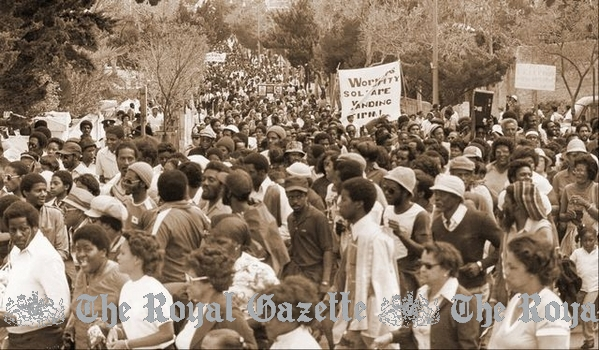
1981. DeFontes Broadcasting Company began as the St. George's Broadcasting Company Limited, another commercial radio station. It operated initially as an AM facility on 1450 kHz using the call sign VSB-1. Later, the same company introduced further AM facilities at 1160 and 1280 - and the FM Mix 106.1 facilities heard now.
1981. Last publication of the Bermuda Historical Quarterly, first published and printed in 1944. Volumes 1-38 each had 4 editions. Today, they can be found at the Bermuda Historical Society in Hamilton and at the Reference Department of the Bermuda National Library.
1981. Moira Stuart, the granddaughter of Bermuda politician and trade unionist E.F. Gordon, via her late mother, Dr Gordon’s daughter, Marjorie Davis, lived in Bermuda as a child. She became the first black woman newsreader on British television this year and later one of the best-known broadcasters at the BBC.
1981. The Bermuda Government established the Public Service Superannuation Fund.
1981. The Holiday Inn, St. George's, after only eight years of operation, was sold to the Loews Hotels group of New York.
1981. October. Bermuda Police drug squad officers discovered cannabis growing at the bottom of the garden of Government House. The police investigated but stated they were mystified how it got there. They stated they did not suspect the Governor, Sir Richard Posnett.
1981-83. Island-wide open space and arable land survey.
1982. Moratorium on sub-division of land.
1982. The present - and third - Watford Bridge was built, minus the Island. It claimed to be one of the most successful tributes to the use of galvanizing in civil engineering and was supposed to have a design life of 120 years.
1982. Establishment of West End Development Corporation as a government quango, formed to redevelop the former Royal Navy Dockyard). P. O. Box 415, Somerset, Mangrove Bay MA BX. Phone (441) 234-1709. Fax 234-3411. E-mail marketing@wedco.bm. Dockyard. The mandate was to manage and develop 214 acres of Government-owned land in the West End, including Watford Island, Boaz Island, Ireland Island South and North, the small islands forming the Crawl off Ireland South and the North and South basins and breakwaters, in all comprising 1.6 % of Bermuda's land mass. Revenue is generated from residential and commercial tenants plus berthing fees from the commercial and cruise ship docks. Mega cruise ships now dock near there. Recent work carried out by Wedco at Dockyard includes the installation of a reverse osmosis plant, the relocation of the marina and the development of ten residential units. Future planned developments include the Victualling Yard, Casemates, the South Basin and the Parsonage. It was initially the island's only self-sustaining quango.
1982. February 16, His Royal Highness the Prince of Wales, Prince Charles, eldest son of Her Majesty Queen Elizabeth II, and his bride, Diana, Princess of Wales, stopped off in Bermuda in their royal aircraft as part of their honeymoon trip to the Eleutheran Islands of the Bahamas. They were escorted around the original capital of St. George's by the Premier, the Hon. John W. Swan and the Acting Governor. The tour was arranged by the Special Branch of the Bermuda Police Force, after a special request from Prince Charles. Due to their high profile, the Royal visitors had several unobtrusive Special Branch members guarding them. To mark the Royal Wedding, the Bermuda Monetary Authority issued its seventh commemorative coin set, the "Royal Wedding, Prince of Wale and Lady Diana Spencer" issue, comprising a $250 piece in 690 pie fort, 790 proof and 217 uncirculated pieces; and a $1 coin in 16,296 proof and 65,004 copper-nickel pieces.
1982. Watford Bridge was destroyed as past economical repair and maintenance despite its young age of only 23 years in bridge age. It was re-built for the third time and exists today. It was constructed from galvanized structural steel and was designed to last for at least 120 years with normal maintenance and built-in corrosion protection.
1982. September 2. Cable & Wireless Bermuda finally obtained planning permission for its Devonshire ridge line Satellite A dish, 100 feet high, then the largest of its type in the world, at a cost of over $18 million, with construction to begin in June or July 1983 (but delayed until April 1984). Earlier attempts to approve it had been objected to strongly. Cable & Wireless, which then controlled all telecommunications to overseas, had complained its undersea cables could no longer handle the volume of traffic to go direct and had to be routed via other countries. The satellite dish would take care of the problem and last for an estimated 20 years.
1982. October. The Butterfield & Co warehouse on East Broadway went up in flames: that location is today occupied by the Bermuda Underwater Exploration Institute.
1982. Ben and Jerry - the famous American ice-cream makers - visited Bermuda to launch Bailey's Ice Cream.
1983. Bermuda's Historic Articles (Export Control) Act 1983 was enacted.
1983. January. The huge oil tanker Tifoso ran aground on Bermuda's reefs. She was nearly empty.
1983. January-June. Gerald Ford visited Bermuda in both January and June for events/meetings. Mrs. Ford traveled with him for the June 16-21st trip to attend the Shearson/American Express Chairman's Council Meeting.
1983. February. Bermuda General Election. The United Bermuda Party won 26 seats, the Progressive Labour Party 14.
1983. March. Governor The Hon. Sir Richard Neil Posnett, KBE, CMG, (born July 19, 1919, died May 11, 2009) who had arrived in Bermuda in 1980, was recalled to London at the request of the Bermuda Government. Sir Richard, who steadfastly maintained his innocence, was investigated by Bermuda's Attorney General and the Foreign Office in London after alleged irregularities were discovered in the Government House accounts paid for by the Bermuda Government. A British colonial administrator, he had earlier served as Governor of Belize (from 1972 to 1976). He was also briefly Commissioner of Anguilla (in 1969) and High Commissioner of the United Kingdom to Uganda (in 1979). Posnett was a founder of the Uganda Olympic Committee and a fluent speaker of Swahili. There were allegations that in his three year period in office he had fiddled £15,000 worth of travel and entertainment expenses. Sir Richard stated he was completely innocent of any wrongdoing but resigned in March 1983.
1983. May 14. 1981. Death in Manhattan, New York City, at the age of 79. of Elizabeth (Betty) Stettinius Trippe, two years and one month after the death in New York City at the age of 81, after a second stroke, of her late husband, the American commercial aviation pioneer Juan Terry Trippe, born June 27, 1899. Bermuda owes him a huge debt for introducing commercial aviation to Bermuda. He founded and operated Pan American World Airways, the most famous of all airlines. It operated in June 1937 the first USA commercial flights to and from Bermuda, initially with Sikorsky then Boeing aircraft in conjunction with then-Imperial Airways and daily flights until Pan Am's demise. He was also involved in the development of the Boeing 314 Clipper, the Boeing Stratoliner, Boeing 707 and Boeing 747. He and his wife Betty visited Bermuda often. They had four children, one of whom, Edward Stettinius Trippe, had a lovely home in Tucker's Town, Bermuda and was the part owner of a very prominent Bermuda hotel.
1883. Second-biggest lobster ever caught in Bermuda weighed 15 lbs and had an arm span of five feet eight and a half inches.
1983. September. The 595-foot grain carrier Sealuck ran aground on Bermuda's reefs.
1983. November. The fully-laden supertanker Aquila Azteca, nearly 1,000 feet in length, ran aground on Bermuda's reefs. A major disaster was narrowly averted.
1983. Third Bermuda Development Plan. 39% of Bermuda carries some form of open space or environmental protection zoning. Development areas are more site-specific and first residential standards apply.
1983. Bermuda’s first footsteps into the space industry were pioneered when Dr John Stubbs attended a conference held by the United Nations International Telecommunications Union (ITU). Due to his vision and advocacy, the ITU allocated four satellite orbital slots to Bermuda. The satellite slot located at 96.2° West Longitude was identified as the most commercially viable.
1983. Desalinization plant arrives. Regulation of water lens begins.
1983. Plans are developed for regulated development of Somerset Village, Pitts Bay and Rosemont Avenue, Flatt's Village and Blue Hole Hill.
1983. Housing Action program is issued in response to housing shortage.
1983. The Bermuda Post Office commemorated the 200th Anniversary of Manned Flight with the issue of these postage stamps shown below:
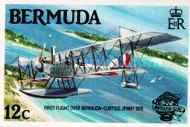
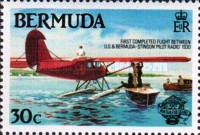
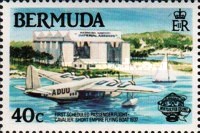
1983. 17th October. A British Airways Concorde flew from Bermuda to Orlando, Florida. in 1 hour and 36 minutes.
When British Airways and Air France commenced SST Concorde services in 1976 - see http://en.wikipedia.org/wiki/Concorde_SST - to their major routes, including in BA's case to the Caribbean, Bermuda was not then and never became one of the destinations included. Bermuda's runway was easily long enough but may have been deliberate policy on the part of BA not to fly the world's most expensive-to-operate supersonic aircraft which carried only a relatively small number of passengers when compared to much more expansive aircraft on the London-Bermuda direct route which was BA's single most profitable route by far. But it is known that BA charter or regular flights stopped off in Bermuda on several occasions during Concorde's commercial lifespan (that lasted until 2003), including when the Queen flew to and from the Caribbean on her Jubilee tour.
1983. November 2. A disabled Victor III-class nuclear-powered attack submarine surfaces in the Atlantic between Bermuda and South Carolina. Soviet ships towed it to Cuba for repairs.
1983. December. Bermuda's first Neighborhood Watch program was established in Granaway Heights, Southampton Parish.
1984. Local Plan for City of Hamilton.
1984. April. At its headquarter building in Devonshire Parish, Cable & Wireless built a huge satellite dish, a landmark, with satellite technology the forefront of communications at the time. It enabled C&W to communicate via 200 other facilities around the world. It was then the largest commercial satellite dish in the world measuring 30 meters wide and 300 metres in diameter.
1984. Demolition of historic Fort Langton, once a major fort for the British Army in Bermuda and its gate (the gate was later rebuilt at the National Museum). The fort was demolished and the site became the headquarters of the public transportation Bus Depot.
1984-85. The Marriott Corporation from the USA began to renovate and add on to the Castle Harbour Hotel in Bermuda.
1984. West End Development Plan.
1984. A series of 1984 reports Mr Tim Hodgson co-wrote with colleague Kevin Stephenson for The Royal Gazette on a leaked Cold War nuclear weapons deployment plan won a top US Inland Newspaper Association award for local government reporting and provided the basis for a Pulitzer Prize-winning analysis in The New York Times.
1984. One of the more popular wrecks in Bermuda, The Hermes, a 265-foot former US Navy freighter, built in 1943, was deliberately scuttled off Warwick Long Bay.
1984. October. The Desmond Hale Fountain statue of Admiral Sir George Somers in St. George's, Bermuda, was officially unveiled by Her Royal Highness Princess Margaret.
1984. At Dockyard, in the Old Cooperage building - building # 28 - (originally built by the Royal Navy in 1831 for navy storage), the Bermuda Arts Centre was formally opened by Her Royal Highness Princess Margaret. It is the creative workshop of local (Bermudian and resident foreign) artisans and artists, open 7 days a week. It was established in 1983 by the West End Development Corporation, a Bermuda Government quango, when Christopher Astwood, then WEDCO chairman, was keen to include the arts in the redevelopment of the Dockyard area. Workshops are also offered both artists and visitors, to upgrade skills and introduce new techniques. Crafts and handicrafts are also included.
1984. November. Eugene Sheel completed his report, begin in July that year, titled "A Comprehensive Management Plan for Admiralty House Park" in Spanish Point, Pembroke. It went into huge detail, complete with drawings and sketches on the state of what had once been the magnificent 16.36 acre estate that had been the property of the Royal Navy since 1814 and residence of the Admiral commanding the British fleet in an area of ocean covering the entire Caribbean, North and South Atlantic. It had been sold in the 1950s to the Bermuda Government for a mere British pound sterling £750,000 with its historic Clerk's Cottage dating back to the 18th or early 19th century donated separately to Bermuda in memory of the Royal Navy's many years of association with Bermuda.
1984. November 14. Death in Bermuda of Lt. Colonel John Anthony Marsh DSO, OBE who died suddenly at his home in Devonshire, aged 64. He was survived by his wife Priscilla and son Simon. In his early life in England he was an Under-Officer in the OTC and achieved the King’s Hundred at Bisley. On leaving school he joined the Artist’s Rifles as a private and at the outbreak of war was commissioned into the DCLI. In 1942 he was posted to 1DCLI but, arriving in Egypt just after the disastrous Battle of Bir-el-Harmat, found no battalion to join. He therefore applied for transfer to the SAS and was accepted. He served with 1SAS in North Africa and was probably the first British Officer to enter Tripoli when it was captured, leading a patrol in from the west as the main forces approached from the east. 1SAS went on to fight in Italy and was at Termoli on 5th October 1943 that, still as a junior officer, he won an outstanding DSO. Soon after the Normandy Landings he was parachuted in behind enemy lines to help organize the Maquis and he continued behind the lines in Belgium, Holland, Germany and finally Norway. He was twice Mentioned in Dispatches. He won medals galore. After the war he was a Staff Captain at Taunton, before joining 1DCLI in Cyprus, serving with them in Cyprus and Somaliland. After a further staff appointment in Tripoli he returned to England as Training Major of 21SAS, now affiliated to the Artist’s Rifles. In 1954 he rejoined 1DCLI in the West Indies. He took over ‘A’ Company DCLI in Bermuda and was responsible, not only for a number of very high powered guards of honour to world statesmen, but for the organisation of Tattoos which are still remembered on the island. He was so impressed by the kindness and hospitality of all he met there that after a tour as Adjutant and Training Major of 4/5 DCLI in 1957, he retired in 1958 and returned to Bermuda to work for the Trade Development Board. Six months later he was commissioned into the Bermuda Militia Artillery which he commanded until the amalgamation of the island forces when he commanded the Bermuda Regiment. On retirement he was awarded the OBE. Always a keen sailor, he coordinated the first Tall Ships Race in 1964 and ran the press office for the biennial Newport-Bermuda Ocean Yacht race.
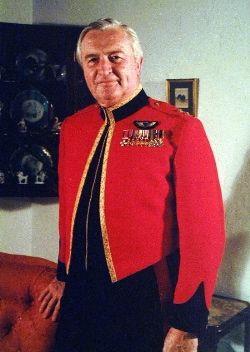
Lt. Colonel Marsh, British Army hero who commanded the British Army and Bermuda Regiment in Bermuda and was also a Bermuda tourism pioneer.
1985. Fisheries Amendment restricts pot fishing and limits size of pots.1985. May 15. Sinking at Bermuda of the Hermes. She was built in Pennsylvania in 1943 and operated by the U.S. Navy, the 165 feet long and 254 tons, she was bound for the Cape Verde Islands when she experienced engine trouble near Bermuda. Hermes was eventually abandoned by her crew because repairs were estimated to cost more than the ship was worth. After an anticipated sale did not materialize, the Bermuda government awarded the ship to the Bermuda Divers Association for creation of an artificial reef. The vessel was thoroughly cleaned and made dive safe prior to her final voyage. She lies one mile offshore at Horseshoe Bay, upright in 80 feet of water with her mast pointing toward the surface. Divers can examine her engines, galley, cargo hold, pilothouse, deck winch and propeller.
1985. The St. Brendan's Day Training School moved into a purpose-built facility called the Orange Valley School
1985. The Coral Island Club hotel, before that the Frascati Hotel in Flatt's from the late 1940s, closed down and was demolished and the St. James Court condos were built on the site.
1985. Summer. A small band of botanical enthusiasts under the leadership of Dr. Roberta Dow of the Ministry of Agriculture and Fisheries, fondly termed “Ag and Fish”, gathered in the building named Horticultural Hall in the Bermuda Botanical Gardens. The purpose of that meeting was to see if there was enough public interest in the botanical sciences to form an association. It was unanimously agreed upon that day to form the Bermuda Botanical Society (BBS). With 30 members, a constitution was written at a meeting on 23 September 1985, and the first general meeting was held on 25 November 1985. The Mission of the Bermuda Botanical Society remains today to encourage and support the botanical sciences within the community and promote the further development of the Botanical Gardens and Arboretum. On 4 December 1987 the young society was registered as a permanent charity under the 1978 Charities Act.
1985. Bermuda issued the following set of Parish postage stamps:
1985. ACE Bermuda Insurance Ltd. was formed in Bermuda by a group of 34 Fortune 500 US companies to provide excess liability and directors and officers insurance when capacity was scarce. They were unable to buy this type of coverage elsewhere because of the very large awards being handed out by the US legal system - people slipping on supermarket floors; suing fast-food restaurants for their coffee being too hot, etc. ACE Bermuda Insurance Ltd. (ACE Bermuda) was the original insurance company of the ACE Group and provides insurance protection for risks worldwide.
1985. The onetime Holiday Inn, then a Loews Hotel, was sold again to the Club Med group of France and it re-opened as a 630-room grand hotel called St George's Cove.
1985. The St. George's Club, Bermuda, was completed, on the grounds of the old St. George's Hotel, as a time share resort.
1985. The South Basin was dredged to allow nuclear submarines to come into the South Yard.
1985. October. Bermuda General Election. The United Bermuda Party won 31 seats, the Progressive Labour Party 7 seats, the NLP 2 seats.
1986. January. A British Airways Concorde flew from London to Bermuda for the first time, after having been in service since 1976. The flight took just 53 minutes to cover the same distance the Cavalier flying boat did in 1936 over 20 hours.
1986. January 10. Death in Bermuda of Sir Henry Tucker at the age of 82. Sir Henry, a wealthy and influential businessman, was leader of the British colony's internal self-government from its inception in 1968 until 1971. His ancestors were among the first British settlers of Bermuda in the 17th century and included Daniel Tucker, an early colonial governor of the island. Henry James Tucker was born in Bermuda on March 14, 1903. He worked for banks and stock brokerages in New York from 1924 to 1934 before joining the Bank of Bermuda, of which he became general manager in 1938. After more than 20 years in the Bermuda House of Assembly, he formed the United Bermuda Party, a moderate, multiracial group, in 1964. As its leader, he became head of the colony's executive council in 1968 after the island's first elections under universal adult suffrage. He resigned in 1971, citing his age, and was knighted a year later. Survivors include a son, Robert, who lives in Virginia, and a daughter, Judy Benney, of Texas.
1986. Development Applications Board was established.
1986. Bermuda National Parks Act set aside 74 protected areas for the use and enjoyment of present and future generations and established a commission to oversea its management. Total area was 710 acres or 5 percent of Bermuda.
1986. Professor Richard Gould of Brown University, Providence, Rhode Island, along with Earth watch and the Bermuda Maritime Museum, began a three year project that researched the HMS Vixen wreck in Bermuda waters. A gunboat, she displaced 1,230 tons and was built by Lungley Shipyard, Deptford, England, in 1864, and launched in 1867. According to Professor Gould of Brown, she was the first twin-screwed vessel of the Royal Navy. Vixen's iron hull was completely clad in teak wood. This design was made in an effort to overcome problems that iron hulled ships were having with marine organisms. The teak also produced extra drag on the ship, therefore, resulting in the Vixen being the slowest ironclad vessel in the Royal Navy. Another very interesting aspect of this ship is that she was built with a ram type bow. Her heavily supported bow protruded forward almost nine feet under the water line. Unfortunately, after sea trials, the Vixen and her sister ship, Viper, were considered too slow as well as un-seaworthy. They were withdrawn from service in 1887 and towed to Bermuda in 1888 as coast defense ships. By1895, Vixen had been allocated as a floating dormitory to house Dockyard laborers. In 1896,after removal of her engines and machinery, she was scuttled to block a narrow channel off Daniel's Head. This scuttling was done to prevent possible attacks by torpedo boats on Dockyard.
1986. The USA-Bermuda Tax Convention Act 1986 - see http://www.bermudalaws.bm/Laws/Consolidated%20Laws/U.S.A.%20-%20Bermuda%20Tax%20Convention%20Act%201986.pdf was signed by Sir John Swan for Bermuda.
1986. The Bermuda Overseas Investment Tax Amendment Act No. 9 of 1986 converted the Bermuda Government-mandated tax on overseas investments except for overseas travel and personal imports and a few other exceptions held by individual Bermudians and residents, to a tax on the purchase of any foreign currency for travel or investment purposes.
1986. October 6. Sinking of
Soviet submarine K-219 600 miles from Bermuda, reason for which may never be
known. The Yankee-class ballistic missile vessel, laden with 16 nuclear
warheads and 200 tons of radioactive plutonium, plunged 18,000 feet beneath
the waves after an explosion on board, in one of its missile tubes, three days
earlier. The Soviet Union claimed at the time that the explosion and a
subsequent fire – which killed four crew members – was due to a collision
with a US submarine. But the US Navy categorically denied that and the
submarine’s captain, Igor Britanov, later told an interviewer: “There was
no collision.” No one alive knows exactly what occurred onboard the 10,000
ton, 425ft long submarine, which had 113 men onboard. A book published in
1997, Hostile Waters, hinted at a collision between the American submarine USS
Augusta and K-219 over her missile compartment as the cause of the explosion.
Author Peter Huchthausen, a former US Navy officer and ex-naval attaché, also
detailed the bravery of the Russian crew, from Capt. Britanov, who he said
refused to comply with orders to keep his men onboard the ship before it sank,
to Sergei Preminin, the 21-year-old engineer seaman who lost his life after
manually shutting down the submarine’s reactors and averting a potentially
huge disaster. Three others died on board and many more of the crew suffered
permanent injury. Preminin received a posthumous award in his home country for
his bravery and was named a Hero of the Russian Federation in 1997.
1986. The
NASA Challenger shuttle disaster which claimed the lives of seven astronauts
when it blew up shortly after take-off, was watched with sadness in Bermuda by
the manager and staff at the NASA Tracking Station, Cooper's Island.. Mr. Way
and his colleagues had been at the NASA station waiting for the spacecraft to
'come over the hill' only to witness what they initially thought was the
rocket boosters coming off early. They later realised it was in fact an
explosion.
1986. XL Capital was formed, based on the same principles as ACE. This was the beginning of the next stage of Bermuda's development as an insurance centre.
1986. Marriott from USA took over the management of the Castle Harbour Hotel property and renamed it Marriott Castle Harbour Hotel.
1986. October. Birth of Bermuda Collectors Society. Founded by a small group of stamp collectors with a common interest in Bermuda. The society has since grown, with over some 160 members. The membership is truly international with members in Australia, Bermuda, Canada, Germany, Guernsey, New Zealand, Spain, Switzerland, United States of America and the United Kingdom. Many of the members have published specialist works on Bermuda related topics including Airmails, Censorship, Postcards together with definitive works on stamp issues. Founding members were Tom Bansak, Bob Dickgeisser, Art Hamm, George King, Harry Whitin, Phoebe MacGillivary, Tom McMahon, Bob Rand, Reid Shaw. Each of the above contributed $100 to get things going along with a “sizeable donation” from Charles Freeland. The founding members, acting as the Executive Board, decided to publish the Bermuda Post quarterly in October, January, April and July with Reid Shaw as the first President and Editor. Immediately following the establishment of the BCS, “Letters of Invitation” were sent to all known Bermuda collectors. In April 1987 Tom McMahon was named Secretary-Treasurer and reported the membership had reached 193. Six years later, in December, 1992, the Bermuda Collectors Society incorporated as a non-profit corporation and was required by its By-Laws to elect Officers and a Board of Directors. Thomas Olson, a member and a California attorney, handled the Incorporation.
1987. The Bermuda Government engaged Von Roll Ltd. of Switzerland to design, procure and install at Tynes Bay in Devonshire the incinerator's mechanical and electrical plant.
1987. The Bermuda Post Office introduced these stamps to commemorate the 50th anniversary of airmail service to Bermuda:
1987. April. The Bermuda Craft Market opened in the Cooperage building in Dockyard as a retail venue specifically designed to showcase locally-made crafts such as cedar work and jewellery. The ambience was that of a rustic marketplace, with wooden barrels and other bric-a-brac dotted among the merchandise displays. Artists and artisans were on hand to sell their goods, and some also demonstrated their craft. Ideally located to catch the tourist trade, the Centre was also popular with resident shoppers in search of locally made goods. It was run entirely as a co-operative, with each crafter renting their their stall, and thrived.
1987. The Bermuda Society & Secretariat in London, England, was incorporated at the request of then Premier, The Hon. Sir John Swan, KBE, JP; former Governor and Commander-in-Chief of Bermuda, The Viscount Dunrossil, CMG; and Sir Peter Gadsden, GBE, AC, former Lord Mayor of the City of London. The brief was to enhance and promote Bermuda’s image as an attractive, competitive and well-respected jurisdiction for international companies – across multiple financial sectors – to do business, and to foster the close links between Bermuda, the UK and elsewhere. The physical address and contact details are Five Trees, Wood Lane, Stanmore, Middlesex HA7 4JZ, England. Phone 011 44-(0)20-8954-0652. Website www.bermudasociety.com, email BermudaSoc@aol.com.
1987. Probably due to publicity from Professor Gould's activity in 1986, an official Vixen postage stamp was issued, and the site was classified as a protected wreck. This means that nothing can be removed from the wreck, and a permit is needed to explore the Vixen while on SCUBA although no permit is needed to snorkel the site. Today, the Vixen is a popular site for glass bottom boats. Her bow protrudes above the water line, and her hull is almost completely intact.
1987. June 12. The Bermuda Sun newspaper published a special section commemorating 50 years of commercial aviation in Bermuda. The section was ritten by Bermudian journalist Keith A. Forbes, who writes this website. His father was very much involved as the leader of a Cable & Wireless team of radio direction finding engineers.
1987. August. End of Prospect Secondary School for Girls, established in December 1957 at a former British Army barracks building.
1987. Hurricane Emily hit Bermuda and caused widespread damage. One of the many properties badly affected was the Club Med hotel in St. George's.
1988. The Club Med group decided to close down its storm-damaged hotel.( It remained in derelict condition for 20 years until 2008. Many attempts to resurrect the hotel failed despite mediation from the Bermuda Government).
1988. Departure from Bermuda of Viscount Dunrossil as Governor for six years. A professional diplomat whose seat in the House of Lords and contacts in Whitehall and London's financial world were not only useful to the Bermuda Government during his tenure as Governor but continued since his retirement. He was one of the longest-serving Governors. He became an informal lobbyist for Bermuda through his role as chairman of the Society for the Friendship of Bermuda and Great Britain, now the Bermuda Society in London. Some Bermudians referred to him at Viscount Dunfossil. His term is particularly remembered by the local press for the occasion when he was persuaded by a mischievous and irreverent British Fleet Street newspaper photographer to pose resplendent in full Governor's uniform complete with cocked hat on the springboard of the swimming pool at Government House. The photographer had said it was only there that the light was just right. The Governor was terribly upset afterwards but locals thought it was highly amusing.
1988-1992. Sir Desmond Langley became Governor of Bermuda. His family were wife Lady (Flick) Joan Langley, son Harry, daughter Charlotte and grandchildren, Oliver and Edward. Born in London in 1930, Sir Desmond was the son of the late Colonel Henry Langley, OBE and he was educated at Eton and the Royal Military Academy at Sandhurst. He was commissioned into the Life Guards in 1949. He had a distinguished army career that took him to Germany, Aden, Egypt, Cyprus, Malaya, as well as Northern Ireland. He served as an Assistant Secretary in the Chiefs of Staff Secretariat in the Ministry of Defence from 1971 to 1972 and in 1979 he became Brigadier General Staff in Headquarters United Kingdom Land Forces. He is a 1978 graduate of the Royal College of Defence Studies and commanded the Life Guards from 1969 to 1971, the Household Cavalry, from 1972 to 1975, Fourth Guards Armoured Brigade from 1976 to 1977 and the London District and the Household Division from 1979 to 1983. His last military appointment was Administrator of Sovereign Base Areas and Commander of the British Forces Cyprus. He retired in 1986 with the rank of Major General. He was made an MBE in 1967 and a KCVO in 1983.
1988. December 19. Mr L. N. (Dickie) Tucker, founder of the Bermuda Sailors’ Home and the Guild of Holy Compassion, died suddenly at his home, Valhalla, Paget, aged 86. He had recently complained of heart problems. Mr Tucker was remembered not only for his unselfish life but for his salty wit and unassuming manner.
1988. Late December. The Bermuda owned and registered container ship, Lloyd Bermuda, sank in bad weather conditions and was declared a total loss. It was an important regular shipper of goods and services to Bermuda, It was on one of its weekly runs to the United States from the island. Only three of the crew of 13 survived the icy waters of the North Atlantic.
1988. Caroldey Douglas became the first Bermudian beekeeper to bottle her honey to be sold as souvenirs to tourists. The initial response was excellent and this has continued with several of the large resort hotels serving local honey on their breakfast tables. In the same year, Randolph Furbert opened the first commercial-scale extracting facility in Bermuda at Chartwell Apiaries in Bailey's Bay.
1988. Bermuda 2000 Exhibition reveals public's deep concern for the environment.
1988. Cecil Dismont was elected as first black mayor of the City of Hamilton.
1988. Bermuda and USA sign the US-Bermuda tax treaty in Washington DC, shortly after Premier Sir John Swan met with President Ronald Reagan. It began the international business boom for Bermuda that continues to this day. It was signed because of the presence of the 1968 entrustment deal between Bermuda and the United Kingdom. It was an arrangement hugely favorable to Bermuda. Provisions included that in return for very small concessions, all US corporations that wanted to hold their conventions in Bermuda had their expenses born by American taxpayers and all US Corporations with a Bermuda presence were granted insurance premium exemptions from US franchise taxes.
1988. The much-liked Canima, party boat, built in Ireland and brought to Bermuda in the mid-1960s to serve as a tender, a fixture for partying US tourists in Bermuda, but was sold, eventually getting bought by North American investors.
1988. November 10. The Bermuda Government's Post Office issued this postage stamp that commemorates the uniforms used by some British Army units once posted to Bermuda.

1989. Sharp decline in reef fish noted.
1989. Bermudians (by birth or grant) age to vote in Parliamentary elections and bye-elections was lowered to from 21 to 18.
1989. February. Bermuda General Election. The United Bermuda Party won 23 seats, the Progressive Labour Party 15 seats, the NLP 1 seat, Independent 1 seat.
1989. March. Prince Philip, Duke of Edinburgh, arrived by himself for a brief visit.
1989. May 5. Death in the Bahamas of Lord Martonmere, 82, former Governor of Bermuda. Prior to that he had served 33 years in Britain's Parliament. Martonmere died in his sleep Wednesday at his home here, said his daughter, Loretta Rogers of Toronto. Martonmere, the former Sir Roland Robinson, had divided his time in retirement between homes in Bermuda and the exclusive Nassau suburb of Lyford Cay. He was born John Roland Robinson on Feb. 22, 1907, in Blackpool, England. Martonmere attended Trinity Hall at Cambridge University and served in Britain’s Parliament from 1931 until 1964, when he was appointed governor of Bermuda. He held that post until 1972. Martonmere is survived by his wife, the former Maysie Gasque, Mrs. Rogers and seven grandchildren.
1989. June 1. US Airways began US-Bermuda air service
1989. South African Thabo Mbeki, then in exile in Tanzania (later President) visited Bermuda for secret talks with South African political opponents.
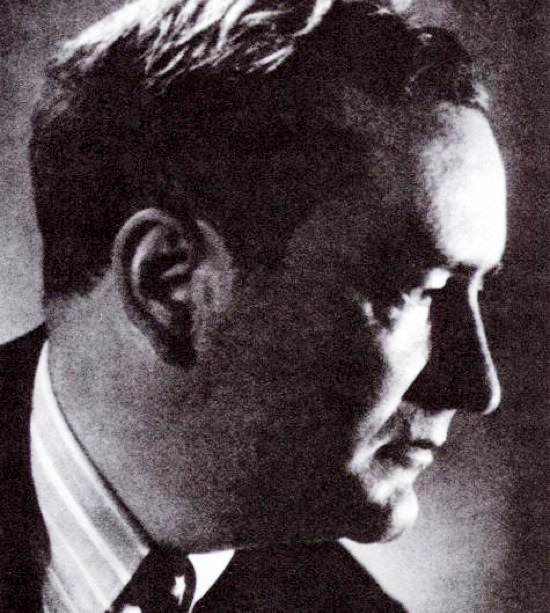 1989.
Death, at his home in Paget, Bermuda, at the age of 93, of war hero Sir William
Samuel Stephenson. See http://en.wikipedia.org/wiki/William_Stephenson
and photo, right. He won the Military Cross and Distinguished Flying
Cross for his exploits as an aviator in World War One. He
was buried at St. John’s Church, Pembroke. He was a highly successful
industrialist before he was recruited by Winston Churchill to head-up British
intelligence operations in the Western Hemisphere. In
1940, after the Hamilton
Princess Hotel was closed
for the duration of Word War 2 by order of the British Government and instead
became the HQ of British Atlantic and North American postal censorship
activity, he arrived in Bermuda to take command of intense intelligence
operations for the British Government in Bermuda, much to the annoyance of
some anti-British, pro-German Americans whose ships and aircraft were subject
to scrutiny. The censors used basement rooms in the hotel and depended greatly
on British Intelligence reports. It led to the post-war publication of The
Princess Spies by CIA Officer Thomas F. Troy who died in 2008. It was an
article, not book. The operation at the Princess Hotel, near Hamilton, Bermuda
was essentially the filter through which all correspondence in the Western
hemisphere was inspected. To the average
person during World War Two, censorship during times of war was a routine
activity. It didn't generate much interest. And that's exactly how British
Intelligence authorities wanted it to look because behind the walls of 13
rooms within the hotel, top secret sleuthing, a la James Bond, was taking
place. Even the majority of the "examiners" didn't know what went on
behind closed doors. Under the leadership of
British Intelligence officer William Stephenson, a Canadian some say
was one of the real-life inspirations for the literary and movie super-spy
James Bond, the co-ordination of the secret "offensive" censorship
took place in the 1940s.Troy says espionage experts used
technologically-advanced techniques to break into letters and packages in
order to produce and plant "forgeries useful in propaganda and blackmail
operations." The group of experts could
obtain the contents of any package leaving no trace of their tampering. Using
innovative techniques for the time they could even extract a letter from an
envelope without cutting, steaming or replacing it with a forged replica.
Their work proved to be so useful to the combined
efforts of the war that Sir William called the censorship initiative "a
political weapon of very special importance . . . credit to all
concerned." The hotel has many other
fascinating connections to the legacy of James Bond and to victory of the
Allied Forces in World War two. It housed twelve hundred
secret agents, experts, scientists and linguist in the former Adam Lounge,
dubbed Room 99, from 1940 to 1945. It was chosen because of because of its
strategic geographic location. Working out of a two-storey wooden building
plus what became the Gazebo Lounge and the Adam Lounge, (the Gold Lounge
today), the men intercepted all postal, telegraph and radio traffic between
the Western Hemisphere and Europe. Flying boats to Darrell's island would drop
off packages which were delivered by launch to the Princess dock. The mail was
sorted in the present-day Gazebo Lounge area before being sent over to the
Adam Lounge to check all the details. The parcels were then searched by the
Imperial Censorship staff for microdot messages that could have been sent by
German spies. The men would decode the secret correspondence, extract the
letters from the tightly sealed envelopes and put them back without anyone
knowing. As team leader, Senior Representative of British Intelligence, Sir
William Stephenson and his team under code name "Intrepid" helped to trap
a number of prominent German spies and agents in the US. The Canadian and his team thus helped
uniquely to frustrate the operations of Hitler. The hotel was re-opened after 1945 by the
British Government with the nickname, "Bletchley in the Tropics"
after Bletchley Park, the name of the English country house where Britain's
spymasters had their HQ and where the "Enigma" code was
broken. Stephenson reported directly to Bletchley Park. He almost worked
himself almost to death during the war, carrying out undercover operations and
often dangerous assignments. He was awarded the Presidential Medal for Merit,
and became the first non-American ever to receive this highest honour for a
civilian. When Sir Winston Churchill recommended him for a knighthood,
Churchill and King George VI noted this one was especially deserved. Sir William retired in 1964
and moved into a suite at The Princess with his wife. They eventually left
there to go to their own Paget home. Although he lived a private existence
here, Sir William had a small circle of close Bermudian friends and provided a
number of local charities with anonymous gifts. A scholarship for local
business students was established in his name at the Bermuda College. “High
up on my list of heroes is one of the great secret agents of the last war”
said James Bond author the late Ian Fleming, who met Sir William when he
served in British Naval Intelligence during World War Two.
1989.
Death, at his home in Paget, Bermuda, at the age of 93, of war hero Sir William
Samuel Stephenson. See http://en.wikipedia.org/wiki/William_Stephenson
and photo, right. He won the Military Cross and Distinguished Flying
Cross for his exploits as an aviator in World War One. He
was buried at St. John’s Church, Pembroke. He was a highly successful
industrialist before he was recruited by Winston Churchill to head-up British
intelligence operations in the Western Hemisphere. In
1940, after the Hamilton
Princess Hotel was closed
for the duration of Word War 2 by order of the British Government and instead
became the HQ of British Atlantic and North American postal censorship
activity, he arrived in Bermuda to take command of intense intelligence
operations for the British Government in Bermuda, much to the annoyance of
some anti-British, pro-German Americans whose ships and aircraft were subject
to scrutiny. The censors used basement rooms in the hotel and depended greatly
on British Intelligence reports. It led to the post-war publication of The
Princess Spies by CIA Officer Thomas F. Troy who died in 2008. It was an
article, not book. The operation at the Princess Hotel, near Hamilton, Bermuda
was essentially the filter through which all correspondence in the Western
hemisphere was inspected. To the average
person during World War Two, censorship during times of war was a routine
activity. It didn't generate much interest. And that's exactly how British
Intelligence authorities wanted it to look because behind the walls of 13
rooms within the hotel, top secret sleuthing, a la James Bond, was taking
place. Even the majority of the "examiners" didn't know what went on
behind closed doors. Under the leadership of
British Intelligence officer William Stephenson, a Canadian some say
was one of the real-life inspirations for the literary and movie super-spy
James Bond, the co-ordination of the secret "offensive" censorship
took place in the 1940s.Troy says espionage experts used
technologically-advanced techniques to break into letters and packages in
order to produce and plant "forgeries useful in propaganda and blackmail
operations." The group of experts could
obtain the contents of any package leaving no trace of their tampering. Using
innovative techniques for the time they could even extract a letter from an
envelope without cutting, steaming or replacing it with a forged replica.
Their work proved to be so useful to the combined
efforts of the war that Sir William called the censorship initiative "a
political weapon of very special importance . . . credit to all
concerned." The hotel has many other
fascinating connections to the legacy of James Bond and to victory of the
Allied Forces in World War two. It housed twelve hundred
secret agents, experts, scientists and linguist in the former Adam Lounge,
dubbed Room 99, from 1940 to 1945. It was chosen because of because of its
strategic geographic location. Working out of a two-storey wooden building
plus what became the Gazebo Lounge and the Adam Lounge, (the Gold Lounge
today), the men intercepted all postal, telegraph and radio traffic between
the Western Hemisphere and Europe. Flying boats to Darrell's island would drop
off packages which were delivered by launch to the Princess dock. The mail was
sorted in the present-day Gazebo Lounge area before being sent over to the
Adam Lounge to check all the details. The parcels were then searched by the
Imperial Censorship staff for microdot messages that could have been sent by
German spies. The men would decode the secret correspondence, extract the
letters from the tightly sealed envelopes and put them back without anyone
knowing. As team leader, Senior Representative of British Intelligence, Sir
William Stephenson and his team under code name "Intrepid" helped to trap
a number of prominent German spies and agents in the US. The Canadian and his team thus helped
uniquely to frustrate the operations of Hitler. The hotel was re-opened after 1945 by the
British Government with the nickname, "Bletchley in the Tropics"
after Bletchley Park, the name of the English country house where Britain's
spymasters had their HQ and where the "Enigma" code was
broken. Stephenson reported directly to Bletchley Park. He almost worked
himself almost to death during the war, carrying out undercover operations and
often dangerous assignments. He was awarded the Presidential Medal for Merit,
and became the first non-American ever to receive this highest honour for a
civilian. When Sir Winston Churchill recommended him for a knighthood,
Churchill and King George VI noted this one was especially deserved. Sir William retired in 1964
and moved into a suite at The Princess with his wife. They eventually left
there to go to their own Paget home. Although he lived a private existence
here, Sir William had a small circle of close Bermudian friends and provided a
number of local charities with anonymous gifts. A scholarship for local
business students was established in his name at the Bermuda College. “High
up on my list of heroes is one of the great secret agents of the last war”
said James Bond author the late Ian Fleming, who met Sir William when he
served in British Naval Intelligence during World War Two.
1989 Bermuda Hogge Money of 1615 commemoratives
1989. Hurricane Emily causes widespread damage to homes, utilities, boats and vegetation.1990. Fish pot ban.
1990. Princess Margaret opened the new Cruise Ship Terminal on the North Arm of Dockyard, Ireland Island.
1990. April 12. Thursday. Prime Minister Margaret Thatcher of the United Kingdom arrived in Bermuda at noon on a Royal Air Force VC-10 jet for a day of talks with government officials before meeting with President Bush of the USA for summit talks, which aides said would focus on developments in Europe. She stuck tersely by her decision to lift sanctions against South Africa. The beleaguered prime minister, facing a tax revolt and plummeting popularity at home as well as increasing isolation in the international community, was expected to hold nine hours of talks with Bush beginning early Friday -- their sixth meeting since Bush was elected in November 1988. Thatcher said she had explained to Bermuda Premier John Swan earlier in the day her reasons for lifting limited sanctions against South Africa last month even though the African National Congress had requested they remain in place until the racial system of apartheid was abolished. "I gave my views and the reasons for them, which you know well,' Thatcher said briefly in a statement to reporters outside Swan's office. Thatcher's stand on South African sanctions is a particular sore point in Bermuda, a dependent territory of Great Britain. In 1986 Thatcher refused to allow the Bermuda government to impose independent economic sanctions against the African government. Organizers held an anti-apartheid rally Thursday night in Hamilton to protest Thatcher's stand on South Africa. Cyril Ramaphosa, president of South Africa's powerful miners union, criticized Thatcher's policy on sanctions. "We find her stand objectionable. By taking that stand she is lending apartheid maximum support. By taking that stand it means she is in bed with apartheid. Our stand is sanctions should be maintained if not intensified. When you're boiling water you do not switch the kettle off as it is about to boil,' he added. 'It would be stupid. You cannot get a decent cup of tea without boiling water. Margaret Thatcher wants us to have a lukewarm cup of tea." Thatcher, whose South African policies have run counter to those of other Commonwealth nations, lifted the limited sanctions to show her approval of then-South African President Frederik de Klerk's decision in February to free ANC leader Nelson Mandela and lift a ban on the black nationalist organization. She said she believed negotiations to end the country's system of apartheid would come soon, pointing out that Mandela and de Klerk had held a conciliatory meeting last week. "I think we are all optimistic since the meeting between Mr. Mandela and Mr. de Klerk that things will perhaps begin to move more quickly toward negotiations," she said. Thatcher refused to take questions from the press before hurrying off for a tour of Bermuda's Naval Museum and dinner at Camden, the premier's official residence. Nonetheless, a crowd of 300 Bermudans who showed up to hear her statement applauded her warmly, something she may not be hearing frequently at home in England where her popularity is at an all-time low. Her new poll tax policy - which resulted later in the introduction of the much-hated and grossly unfair council tax methodology, sparked a riot two weeks ago that was considered one of England's worst in this century and her traditional supporters -- middle income homeowners -- are becoming increasingly unhappy with economic policies that have resulted in higher interest rates. "The talks will be very wide ranging with Europe at the center," said a spokesman at her 10 Downing Street office in London before her departure. The two leaders are expected to discuss specifically how a reunified Germany will be defended without alienating Soviet President Mikhail Gorbachev, whom Thatcher will see in Kiev in June, shortly after his summit with Bush. Gorbachev has said he has reservations about East Germany leaving the Warsaw Pact and becoming part of NATO through its unification with West Germany, one of NATO's key members. Bush is meeting with three NATO leaders in 10 days, starting with Canadian Prime Minister Brian Mulroney in Toronto last Tuesday and ending with French President Mitterrand next Thursday in Key Largo, Fla. Bush's frequent contacts with other world leaders and the past year's events in Eastern Europe have indicated that Britain is no longer the main focus of interest at the White House. London maintains, however, the relationship between Britain and the United States remains as strong as ever. Thatcher frequently consulted with former President Reagan. At the White House, press secretary Marlin Fitzwater said Bush hoped also to brief Thatcher on his recent meeting with Soviet Foreign Minister Eduard Shevardnadze, as well as the upcoming summit meeting with Gorbachev and the status of arms control negotiations.
1990. April 13. A left front view of Air Force One arriving at NAS Bermuda with President George Bush aboard. He was attending a summit meeting with Prime Minister Margaret Thatcher of Great Britain. He was met by an honor guard of USN officers and men and members of the Bermuda Government led by the Governor.
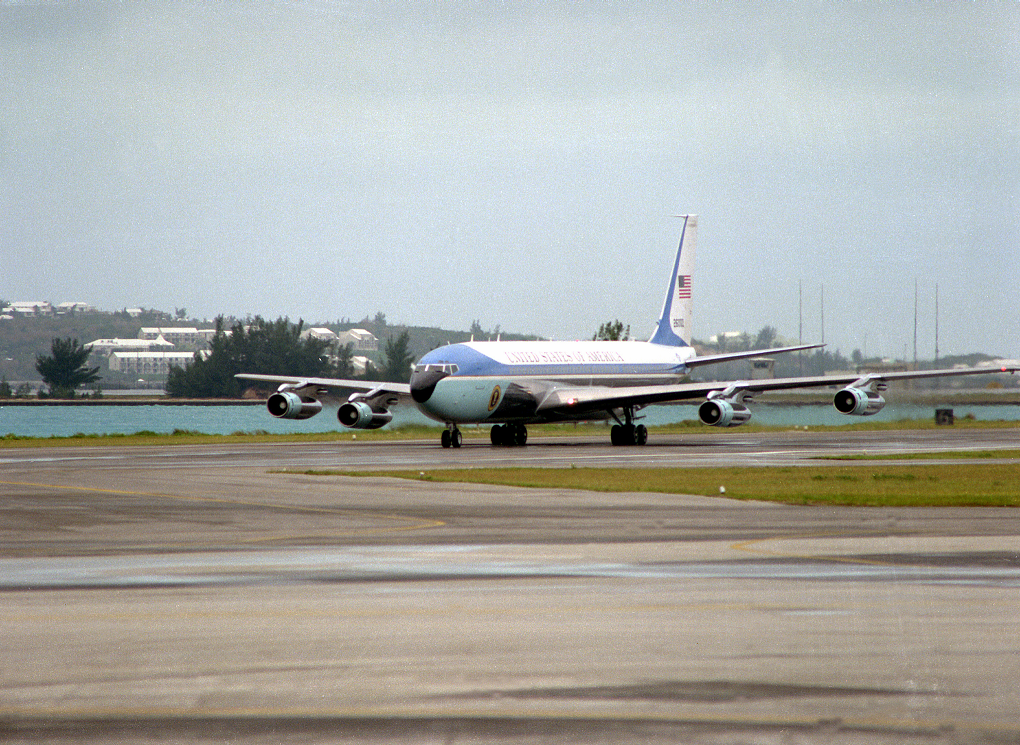
1990. Good Friday. US President George Bush and Prime Minister Margaret Thatcher conferred in Bermuda. They discussed the collapse of the Soviet Union. It was part of a continuing series of talks between Western Allies who were attempting to keep abreast of the radical developments in Eastern Europe and the Soviet Union. The two leaders also took part in traditional kite flying on Government House grounds. Residents will also remember that during that time the two leaders engaged in the quintessential Bermudian tradition of kite flying on the Government House grounds. Watching was Bermuda's Premier the Hon. John Swan. During that visit, Sir John and Lady Swan hosted a gala dinner for Mr Bush and Mrs Thatcher at Camden, the Premier’s official residence.
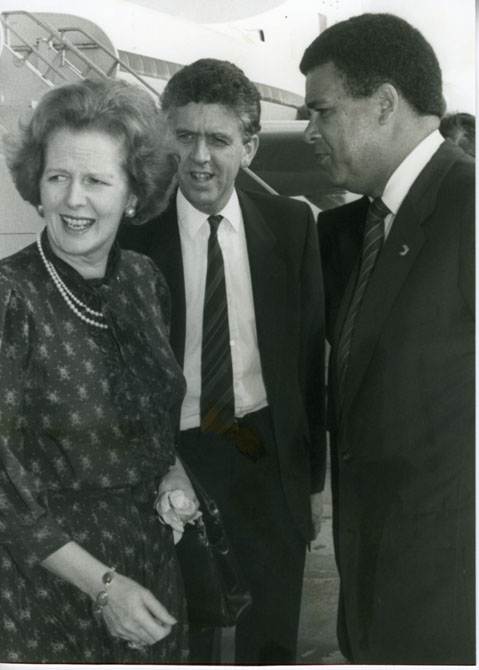
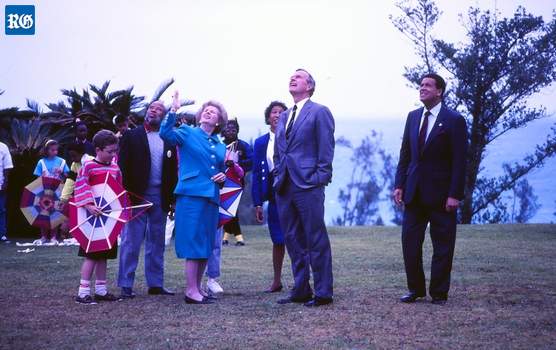
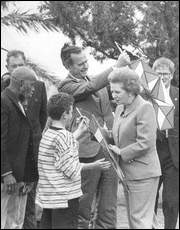
Bush-Thatcher visit 1990 and Mrs Thatcher with Premier Sir John Swan
1990. April 13. At the Lantana Colony Club in Somerset, Bermuda, the enemies of apartheid, as well as its diehard supporters, met in a historic gathering. One of them was William Payne, then a member of the New Jersey General Assembly. He had come from prominence in the National Association for the Advancement of Coloured People to find himself sitting next to a staunch, “rabidly prejudiced” believer in South Africa’s racist regime. Mr Payne arrived with United States delegates for secret talks in Bermuda organized by the Aspen Institute on the fate of the crumbling apartheid regime. It was the second round of covert discussions at the Lantana Colony Club, following on from a forum in March of 1989. Mr Payne attended with his brother, the late Congressman Donald Payne. The Aspen Institute brought members of Congress and Senators to discuss issues of national importance, away from their offices and across party lines. They met with leaders from South Africa, from both sides, under the radar.” A media blackout protected both meetings between members of South Africa’s National Party and the African National Congress. At that time in 1990, a ban on the ANC had only just been lifted with the freeing of Nelson Mandela, the jailed revolutionary and opponent of apartheid (who would become president of South Africa in 1994). The Aspen Institute identified those people in South Africa who were either fighting apartheid or were part of it, and they brought those adversaries together. They had discussions with the fighters for freedom and the Afrikaners who were defenders of apartheid. Bringing ideological enemies into the same room without courting disaster was a testament to the power of Dick Clark, the director and moderator from the Aspen Institute — a persuasively soft-spoken man. Having joined the NAACP at the age of 18 and becoming the chairman of its Youth Work Committee, Mr Payne was personally acquainted not only with Dr King, but Malcolm X and Medgar Evers, the Mississippi civil rights activist who was assassinated in 1963. Mr Payne recalled speaking with Mr Evers over the rumours that he was being targeted by white supremacists, only to be told that the activist was determined to go back and make Mississippi “safer for his children”. He was shot dead in the driveway of his home. “One thing that kept me going was that I personally know people that gave their lives,” Mr Payne said. Delegates spent four nights at Lantana, changing seats each night. “People got to know each other better, even that guy who was such a crude individual — I’m not sure his attitude changed, but I can’t imagine it was an easy task to convince them to come in the first place,” Mr Payne said. “There was less rancor. Obviously it was extremely valuable, especially for those who were in favour of apartheid to have a more intimate knowledge of those who were against it. It was also valuable to be removed to a place where the pressure was not on them.” Mr Payne served on the New Jersey General Assembly from 1998 to 2008. Among the legislation passed under his tenure was the state’s banning of racial profiling by police.1990. Clarence (Nicky) Saunders won Bermuda's first gold medal at the Commonwealth Games in New Zealand.
1990. Lieutenant Commander Ian Stranack, Royal Navy, wrote the book "The Andrew and the Onions." It described the history up to that time of the Royal Navy in Bermuda, once Bermuda's biggest employer.
1990.
Bermudiana Hotel, the second one (the first was destroyed by fire in 1955)
was demolished, to make way for a multinational insurance company.
1990.
One prominent visitor at a Ziggy Marley concert at BAA in Bermuda in 1990 was
US Senator Edward Kennedy of MA. He was one of many VIPs to have
sampled the house drink at the Swizzle Inn in Bailey's Bay as one of the
attractions of a Bermuda visit.
1990. The Motor Insurers’ Fund was set up at the initiative of local insurance companies who agreed with the Bermuda Government to establish a method of compensation for people injured by uninsured drivers or untraced drivers in “hit and run” cases. All drivers who buy motor insurance in Bermuda pay a surcharge of $5 per bike and $10 per car. However, the maximum payout the fund can make is $250,000.
1990. Under the terms of the Bermuda II Agreement signed in 1977 between the United Kingdom and USA, Manchester was added as a British gateway airport for transatlantic flights.
1990. The first referendum held in Bermuda was on capital punishment, when 78.4 percent favored retention of the death penalty.
1990. November 13. US Secretary of State James Baker and Canada's External Affairs Minister Joe Clark met in Bermuda to discuss deployment of Canadian troops to the Persian Gulf.
1990. In December, leading British born, American naturalized humorist Sir Bob Hope was in Bermuda with his wife and entourage. He came to film his NBC television 1990 Christmas Special on the NBC network. He made many perceptive jokes about Bermuda. He, his wife Dolores, actresses Loni Anderson and Dixie Carter, associates and production crew occupied forty rooms at the Belmont Manor Hotel (now closed) during their five day stay.
1991. January. At Fort Cunningham, Paget Island, St. George's Parish, an archeological expedition headed by Professor Richard Gould of Brown University discovered a quantity of British Army cannon, including 5 huge Rifled Muzzle Loaders (RMLs), weighing over 38 tons each.
1991. After a delay of three years due to environmental concerns, approval was given to restart the Tynes Bay incinerator project that was first approved in 1987. A Ministry project team faced the challenges of coordinating the design and the considerable task of bringing together the multi-national workforce to construct the $70 million facility on this small, isolated, mid-Atlantic island.
1991. March. Prince Philip, Duke of Edinburgh, arrived by himself for a brief visit.
1991. Second arable land survey was undertaken, by the Bermuda Government.
1991. Bermuda issued the commemorative postage stamp shown below to mark the 65th birthday of the Queen and 70th birthday of the Duke of Edinburgh.
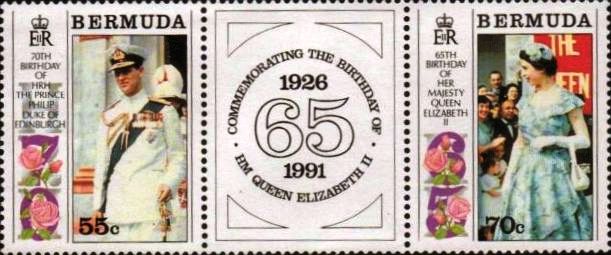
Oona and Charlie Chaplin with two of their children
1991. June. VSB TV-11 began broadcasting in Bermuda. Owned by Mr. Kenneth DeFontes, it broadcast from Barker's Hill, Devonshire and offered NBC Network Television programming with local product.1991. June. Michael Jackson, singer and entertainer, visited Bermuda by private jet. He paid a much publicized visit to the Island with child actor Macaulay Culkin and another friend, staying for several nights at the Hamilton Princess Hotel. Places they visited included Jack 'n' Jill's Toy Shop where they stocked up on a great quantity of squirt guns, water balloons and other toys. When word got out that both Michael Jackson and Macaulay Culkin were staying at the hotel, fans and guests began to gather under Michael's sixth floor penthouse window. That was when the three began playfully lobbing water balloons off the balcony at the people standing below. In a thoughtful gesture, when he checked out of The Fairmont Hamilton Princess, Jackson asked staff there to assist him in donating all the toys he had bought at Jack 'n' Jill's to one of our local children's charities. Long serving Princess Hotel employee Victoria Smith remembered accidentally bumping into singer Michael Jackson as he once used the back stairs in an attempt to flee the press.
June 1991 - Michael Jackson leaving Bermuda.
1991. US President George Bush and British Prime Minister John Major conferred in Bermuda, after the allied defeat of Saddam Hussein in the first Gulf war.1991. The
bankruptcy of Pan Am and TWA led to a major renegotiation of the Bermuda II
Air Agreement between the UK and USA, which allowed American Airlines
and United Airlines to take their places at Heathrow. Virgin Atlantic was also
given rights as a second British carrier to operate services.
1991. May. Death in Bermuda, at the age of 83, of Sir Edward Trenton Richards, Bermuda's first black Premier. He was was born in Berbice, British Guiana (now Guyana), the youngest of three siblings. After his mother died while he was an infant, he was raised by his father and grandmother. He trained as a teacher in the capital, Georgetown, and in 1930, at the age of 21, he joined his sister Pearl in Bermuda, where he taught mathematics, Latin and games at the mostly-black pupil Berkeley Institute school. He also worked as associate editor of the Bermuda Recorder, and on its pages made known his opposition to segregation. In 1940 Richards married Madree Williams of Bermuda, with whom he had three children. His son, E. T. "Bob" Richards, became a politician and Member of Parliament like his father, for the United Bermuda Party and later its successor. His elder daughter is circuit judge Patricia Dangor, who now lives in London, England, with her children and grandchildren. His younger daughter is the writer Angela Barry who remains in Bermuda with her children and grandchildren. He obtained his Bermuda status seven years after his arrival. In 1943 he went to Britain to study law at Middle Temple. While studying in London, he assisted Dr. E. F. Gordon to present a celebrated petition from the Bermuda Workers' Association to the British Colonial Secretary in 1946. Richards was called to the UK bar in 1946 and to the Bermuda Bar on 31 January 1947, becoming the fourth black lawyer to practice in Bermuda. In 1948 he was elected to Parliament representing Warwick Parish, serving in this position for the following two decades. In 1963, Richards welcomed Emperor Haile Selassie of Ethiopia when Selassie visited Bermuda with his granddaughter Princess Ruth Desta. In 1968, he was appointed Deputy Government Leader and Deputy Leader of the UBP. In December 1971, he became Bermuda’s first black Government Leader. In 1973, The Constitution Amendment (Consequential Amendments) Act 1973 changed the Government Leader’s title to Premier.] Richards held the position of Premier until December 1975. Sir Edward Richards retired from politics on 29 December 1975, and from law practice in 1986, at the age of 78. Richards was knighted by Queen Elizabeth II in 1970. Richards was a member of Alpha Phi Alpha fraternity. A portrait of Richards is one of 80 painted by Esther Dai for display in Bermuda. In June 2015, Richards was named a National Hero of Bermuda. His official biography Peaceful Warrior: Sir Edward Trenton Richards, 1988, was written by J. Randolf Williams.
1991. September 27. Death and later burial in Corsier-sur-Vevey, Switzerland, from pancreatic cancer, of Bermuda-born Oona O'Neill Chaplin, see http://en.wikipedia.org/wiki/Oona_O'Neill, born at Spithead, Harbour Road, Paget Parish on May 13, 1926. Her parents, then living at Spithead, were Americans the playwright Eugene O'Neill (born in USA October 16, 1888, died November 27, 1953) and Agnes Boulton. Her only sibling was brother was her brother Shane (born 1919 in USA). Later, she became close to Peter Arno (cartoonist), Orson Welles (actor and film director) and J. D. Salinger (novelist). On June 16, 1943 she married British-born actor Charlie Chaplin, which caused her to be disowned by her father. With Chaplin she had a good marriage despite the age difference and had a number of children, five daughters (Geraldine Chaplin, born July 31, 1944; Josephine Ronet, born March 28, 1949; Victoria Thieree, born May 19, 1951; Jane, born May 23, 1957; Annette, born December 3, 1959) and three sons (Michael, born March 7, 1946; Eugene, born August 23, 1953; and Christopher, born July 6, 1962).
1991. The Bermuda Government's Minister of the Environment, in an effort to actively protect the island's built heritage, decided to begin the compilation of a list of buildings of special architectural or historical interest that would also identify and protect the best examples. The purpose of the list was to put a marker on important buildings to ensure their special architectural and/or historical interest would be taken fully into account in decisions affecting their future. It was a bold move by the Ministry given that legislation giving it the power to do so had been granted in 1974 but to date had only rarely been invoked.
1991. November. Bermudian musician Lance Hayward died in New York, after a long fight with cancer. His obituary was published in The New York Times
1991. December. Austrian financier and billionaire Wolfgang Flottl, who had a number of exempted companies in Bermuda, bought Castle Point in Tucker's Town, one of Bermuda's most luxurious properties, 8 acres surrounded by water on three sides. He acquired it from American Dr. Henry Clay Frick1992. In Bermuda, the Sea Venture's contents from 1609 were recovered and fully documented.
1992. March 15. The Bermuda National Gallery (BNG) opened to much acclaim via an Act of Parliament and soon settled in at City Hall. Jay Bluck’s passion for art and the establishment of the BNG as a national art museum was key. Earlier, Bermudian sculptor Desmond Fountain had founded the Bermuda Fine Arts Trust in 1980 in the hope of establishing a national gallery. His dream finally became a reality. As a member of the steering committee, it was his drive which led to John Kaufmann’s similar concept for a gallery in the east wing of City Hall becoming such a facility. Another spur, the one that had the exhibits to make it possible immediately and finally set the wheels in motion for a National Gallery was the donation to the people of Bermuda of what is now known as The Watlington Collection. In his will, the late Hereward Watlington, art collector extraordinary, specified that his gift was predicated on the paintings being housed in a proper gallery with world-class storage facilities, including climate, light and temperature control, and which would also make possible the exhibition of valuable works of art from international galleries of similar quality. Built by Cooper & Gardner, the museum has five exhibition spaces, one of which, the Ondaatje Wing, opened on April 16, 1992 — one month and one day after the BNG, thanks to a successful appeal for an “angel” to finance the conversion, which came in the form of (now Sir) Christopher Ondaatje, who has subsequently opened other gallery spaces in his name in London and Toronto. Mrs. Gorham, who has been on the steering committee since 1986, became a full-time staffer in 1991. Chris Wineinger was hired as the first administrator, to oversee the Gallery’s capital campaign. From inception, volunteers have been an invaluable, and indeed the more than 100 of their ranks are an indispensable part of the Gallery’s function. From inception the BNG, has striven to fulfill its original mission, which is to promote, benefit and advance the visual arts in Bermuda through the creation of a collection of significant artworks, both from Bermuda and worldwide, as well as creating a facility in which such works can be cared for, researched and interpreted for the public.
1992. April. German visitor and teacher Antje Herkommer, 27, was raped and strangled by a prisoner on unsupervised work release.
1992. April. Appointment of Lord Waddington as Governor of Bermuda.
1992. April 23. Prince Edward (Anthony Richard Louis), 24 year old youngest son of Queen Elizabeth and Duke of Edinburgh, finished his first visit to Bermuda with an appearance at the Botanical Gardens where he opened the 55th Agricultural Exhibition. his busy day also included local participants in the Duke of Edinburgh's Scheme and met related projects at Verdmont, St. Brendan's, Girl Guides Association and King Edward VII Memorial Hospital. He lunched with Premier Sir John Swan and Mayor of St. George's. Henry Hayward.
1992. Decision taken to restructure public school system — including the building of a new senior secondary “mega school” at Prospect on the site of the old Devonshire Academy.
1992. Activist Sheelagh Cooper founded the Coalition for the Protection of Children to lobby for changes in legislation and to intervene in family crisis situations.
1992. Bermuda Plan promotes open space conservation in a high quality environment.
1992. Death in Bermuda at the age of 93 of K. C. Irving, a Canadian tycoon once listed among the richest people in the world. In 1971 he and his wife Winifred bought Skyline Cottage, near the Fairmont Southampton, after a row with the Canadian government over taxes and death duties. The Bermuda residence was a vital link in the controversial creation of a island-based trust designed to avoid high taxes in Canada. Mr Irving, was born in New Brunswick and built a business empire spanning oil and gas, timber and vehicle sales from a single Ford franchise opened in the 1920s. K. C. Irving Ltd owns around 300 private companies, mostly in New Brunswick and Quebec provinces, with interests in oil, timber, mining, shipbuilding, construction, real estate, the media and transportation. The company is a major employer in New Brunswick and a huge landowner. Mr Irving’s widow Winifred continued to live at Skyline Cottage, on South Road, Warwick, after Mr Irving’s death. She was one of the three trustees of the Bermudian-based trust established by Mr Irving’s will, which required the trustees to live outside Canada.
1992. August 27. The death, in Manhattan, New York, of the American billionaire and businessman Daniel Keith Ludwig, born June 24, 1897. one of the wealthiest men in his day whose vast array of business interests around the world included the building, construction and ownership of Bermuda's Southampton Princess Hotel from scratch, using materials imported from Canada for this hotel. He also bought the much older Hamilton Princess Hotel and other hotels. He wanted his own hotel in Bermuda and a place where he could stay in great comfort and privacy. Much later, both Princess Hotels in Bermuda were sold to other parties.
1992. Bermuda ordered a special type of material from France to upholster the interior of the historic 1771 Sedan Chair belonging to the Bermuda Historical Society, the only surviving one of its genre in the entire Western Hemisphere.
1992. The Bermuda Monetary Authority introduced its first commemorative note to in celebration of the 500th Anniversary of the Discovery of the New World by Christopher Columbus. This $50 note was issued as both a circulation and commemorative note with the commemorative version bearing a Spanish cross as the prefix of the special note’s serial number.
1992. September 30. The US Navy's Naval Facility (NAVFAC) Bermuda was decommissioned. It dated from June 1, 1955, making it the oldest continuously operating U.S. command at the time of its decommissioning. NAVFAC was located on the west end of Bermuda in Southampton Parish, adjacent to the island’s very scenic south shore. NAVFAC experienced numerous composition and equipment upgrades during its long operational tenure. In September, 1987, NAVFAC Bermuda weathered Hurricane Emily, with no loss of operational capability. NAVFAC Bermuda had fifteen officers, 155 enlisted personnel, 2 foreign national civilians and one resident contractor.
1992. December 27. Death in Bermuda of disability activist Margaret Carter. Miss Carter died from complications of a stroke just after Boxing Day. She was 53 years old. She was the founder and President of the Bermuda Physically Handicapped Association (BPHA) and advocated for people in Bermuda with disabilities to have access to buildings, services and education. She was also a human rights campaigner and a writer. She was not afraid to challenge authority. She led the campaign for people with disabilities to receive anti-discrimination protection in the Human Rights Acts, among other things. She was born with muscular dystrophy, a degenerative disease that causes muscle weakness. Her mother took her to New York as a toddler to seek medical treatment, but by age 11, she was permanently wheelchair-bound. She attended Mount St Agnes Academy, because it was the only school willing to accept her as a student. She was a lot more fortunate than other Bermudians with disabilities in her era, as they were usually kept at home or worse, housed in a psychiatric hospital such as St Brendans (now the Mid Atlantic Wellness Institute). It is probable Miss Carter’s legacy today includes the mainstreaming of children with disabilities into the regular school system, the establishment of Summerhaven as a residence for the handicapped, ramps on Hamilton city street and even the elevator in the Bermuda National Library. Miss Carter shared the same birthday as the late Dame Lois Browne-Evans, and they would always make a point to wish each other happy birthday. They shared an interest in ending oppression in the community. Miss Carter was a member of the Anti-Apartheid Coalition (ANC) in Bermuda founded in 1987 along with Ron Lightbourne, Glenn Fubler, and Canon Thomas Nisbett. When anti-apartheid activist Archbishop Trevor Huddleston visited Bermuda, having been a mentor to people like Bishop Desmond Tutu and Nelson Mandela, he saw the island in Miss Carter's adapted small bus-like vehicle. Lowdru Robinson was Director of the Ministry of Community Affairs in 1990 at the time when Margaret was Chairperson of the BPHA. Working together they brought about Access Awareness Week in Bermuda, which was celebrated in Bermuda for many years. They also persuaded Mayor Dismont in Hamilton to have City Hall made accessible for wheelchairs, as a result of which both a ramp and an elevator were installed in City Hall. Again working together they were disappointed when the Ministry was unable to include people with disabilities in the Human Rights Act 1981 but Miss Carter resolved to continue to lobby for an amendment until it was finally achieved. Miss Carter was also a passionate writer and loved making crafts and being creative. Her home Rothesay, on Mount Hill, Pembroke and the offices of the BPHA at Prospect were put at the disposal of creative and political activities. Writers met at Rothesay, included novelists Angela Barry and Brian Burland, journalist Meredith Ebbin, fiction writers Rawle Frederick, Nelda Simons, the late Joanne Pratt; and film maker Errol Williams. They all were friends who visited and took part in creative activities, particularly Writers’ Marathons. Miss Carter and Mr Lightbourne co-wrote the 1989 road show We Are You and contributed to the Bermuda Writers’ Collective book of short stories ‘Palmetto Wine,’ which was published in 1990. There is so much left to accomplish in the community with respect to access for people with all types of disabilities. For several years Access Awareness Week was organised by the BPHA in June to coincide with Ms Carter’s birthday.
1992. December 31. In the list of Bermudians recognized in the Queen's New Year's Honours List, the Hon. Quinton Edness, an MP since 1968 and a long-serving senior member of the Cabinet, becomes a CBE in the annual roll-call of honours. Retired Police Commissioner Mr. Clive Donald becomes an OBE and Bermuda Football Association president Mr. Charles Marshall is made an MBE. Among others honoured are World Cup soccer coach Mr. Gary Darrell and broadcaster Mr. David Lopes. Mr. Edness is the 61-year-old member for Warwick West. A South Shore, Warwick resident, he has held his present position since 1988 after a succession of Cabinet posts. A former radio announcer for Bermuda Broadcasting Company, he is now a director of the station. Mr. Edness and his wife Vicki, from Australia, have one daughter, Stacey. He is a keen golfer. Mr. Donald, 55, joined the Bermuda Police in 1959. He was posted to CID in 1965 and promoted to chief inspector in 1973. He became a superintendent in 1979 and Deputy Commissioner in 1981. He became Commissioner in 1990 and retired in May this year. Mr. Donald has represented the Island in cricket, soccer and squash. Mr. Marshall, FA president for just over a year, has been involved with soccer in Bermuda for more than 20 years. A qualified international FIFA referee, he has refereed matches in the US, Canada, Central America, Israel and Haiti. In 1986 he was appointed to the Senate. He resigned his seat in 1990. Police Supt. Andrew Bermingham, 51, head of the Special Branch, is awarded the Queen's Police Medal. He has been responsible for providing personal security to President George Bush, Prime Ministers Margaret Thatcher and John Major and many members of the Royal Family. Former chief inspector Mr. Roger Sherratt is awarded the Colonial Police Medal. He served in the Bermuda force for 28 years, the last 10 of them as head of the community-media relations department. In 1992 he retired from the Police and became secretary to the Corporation of Hamilton. The following receive the Queen's Certificate and Badge of Honour: Former national soccer coach Mr. Darrell, this year led Bermuda to its most successful World Cup run ever. A star player for Devonshire Colts between 1968 and 1972, he went on to serve as their coach before moving to Dandy Town. He became national coach in 1988. Mrs. Linda DeSilva was a teacher at Port Royal School from 1952 to her retirement in 1987. Mr. Erskine Doars, bandmaster of the North Village Band, has had a musical career spanning more than 50 years. Former soldier Mr. Gerald Fubler, whose "family'' of 33 boys help form Paget Youth Group, is honoured as an "unsung hero'' for his work with youngsters. Mr. David Lopes, one of BBC's earliest announcers, is the first voice many Bermudians hear when they wake. He was a major populariser of Country music on the Island. Mr. George Ogden, is honoured for being "almost entirely responsible for the beautification of the City of Hamilton for more than a quarter of a century''. Former teacher Mrs. Clara Phillips is honoured for her work as a secretary with the Police. Mr. Kenneth Simmons is honoured for his sporting, community and religious work.
1993. Mid-March. The special research submarine "Alvin" conducted certification and engineering dives off Bermuda. Two subsequent dives for the Royal Ontario Museum and the Bermuda Zoological Society sought to catalog biodiversity and biota zonation on the flanks of the island pedestal and nearby seamounts. Also completed was a seismic studies cruise to the Mid-Atlantic Ridge, but mechanical/electrical problems with Alvin’s new pressure-tolerant motor controllers resulted in a radically shortened dive program. Repairs were effected during a maintenance period in Bermuda in April, after which the sub successfully completed three dive series back at the ridge, including work at a newly-discovered vent field south of the Azores. One of those who visited Bermuda for the events and broadcast news events was CBS anchor Walter Cronkite.
1993. Death of journalist Marian Robb, before she was able to finish her manuscript commissioned by the Corporation of Hamilton.
1993. June. Premier Sir John Swan met US president Bill Clinton in the White House.
1993. The Register of Bermudians came into effect. To create the Register officials used that year’s Parliamentary Registry. So if you weren’t a registered voter in 1993, or were born after 1993, or your name changed after marriage post-1993, then your name will not be on the Register of Bermudians.
1993. RG Magazine began publishing.
1993. Archaeologists from the College of William and Mary in the USA and the Bermuda Maritime Museum agreed to jointly cooperate in the study of the early colonization of Bermuda through the excavation and documentation of the island's earliest 17th century fortifications.
1993. The Government of Bermuda, in response to community-wide concerns over the escalating cost of healthcare in Bermuda, and a growing public concern over the quality of healthcare services available on the Island at the time, appointed a committee chaired by Senator Oughton, to review the healthcare system.
1993. April, two women officers, Constables Yvonne Ricca and Cindy Eve-Spencer, made Bermuda Police history when they became the first female officers to be trained and authorized to ride Police motorcycles.
1993. October. Bermuda General Election. United Bermuda Party won 22 seats, the Progressive Labour Party 18 seats.
1993. Scottish composer Iain Hamilton wrote the work "The Bermudas." It premiered on 7th November at the Anglican Cathedral.
1993. November 26. Bermuda stands apart from the British Dependent Territories it met with in London this week, Premier the Hon. Sir John Swan said yesterday. Many Caribbean countries were tied to Britain for financial aid, but Bermuda's priorities were different, Sir John told The Royal Gazette. "Bermuda's in a unique position,'' he said. "It has this insurance business, and it has this tourist business. It has a strong infrastructure built up, and doesn't have problems of aid and support.'' With the exception of the Cayman Islands, other British Dependent Territories that attended "need financial support and therefore need to have a different focus. Once they become Independent, they can't expect to get aid from Britain anymore.'' Bermuda's focus was maintaining its present standards through stability and growth, said Sir John, who returned to the Island yesterday. While Bermuda was not reliant on Great Britain for financial support, the Premier said there was no telling whether the Island would move closer to Independence during this term of the Government. "I don't know,'' said Sir John, who has publicly supported Bermudian Independence in the past. "It really is a question of the will of the people.'' Independence was not a major topic at the Conference of British Dependent Territories, partly held to discuss interdependence and regional cooperation. But there was some talk about what Britain's position would be regarding the remaining Dependent Territories once Hong Kong returned to the Chinese in 1997. The remaining Dependent Territories would all have fewer than 200,000 people, Sir John said. At the Conference, there was a broad discussion about how the territories would be affected by world changes, and how partnerships could be formed to alleviate the impact, the Premier said. With the North American Free Trade Agreement area emerging as a major trading block, there were questions about relations with that trading zone versus the European Community. "You cannot expect to get full support out of NAFTA, and turn around and get the same benefits out of the European community,'' Sir John said. While the Conference was "remarkably'' successful, it also left more questions asked than answered, he said. Because the British Dependent Territories faced different problems than the Dutch or French, it emerged that the British territories needed to hold a meeting of their own. Among issues that could be discussed was "what are the best arrangements that can be made in terms of strengthening our relationship with the European community.'' The possibility of a meeting was being discussed when Sir John left early in order to return in time for today's House of Assembly session.
1993. December. The Canadian Forces Station Bermuda ended. (Later (December 1995) The Bermuda Government published a postage stamp to honor both this former base and those of Britain and the USA. The one relating to the former Canadian Forces Station has the following description for this BD$1 stamp on the liner details of the First Day Cover issued with this issue. "The Royal Canadian Navy leased some fourteen acres of former British Admiralty lands at Daniel's Head towards the western end of Bermuda in 1963. The installation was established as a signals intelligence unit to support the Canadian Forces and to aid in search and rescue operations. Due to changes in international relations and with increased fiscal constraints, the Canadian Government closed the site."
Closure of Canadian Military Base in Bermuda
1993. December. The one-time Bermudiana Hotel property, once the site of a gorgeous 1924-built hotel by Furness Withy, destroyed by fire on September 4, 1958 and rebuilt a year later, still in operation in 1990 but in a sad state by 1993 was sold for $14.5 million and became the site of the Ace and XL insurance buildings.1993. December. The United Bermuda Party's Jim Woolridge became the first in a string of Tourism Ministers from both major parties to claim that good news on Club Med was just around the corner. He announced that he had met with a group of businessmen from Massachusetts who had viewed the site and were interested in building a new hotel. But before anything could move forward, the Government had to deal with the fact that Club Med still held the lease to the land on which the hotel stood.
1994. Internet (Bermuda) Ltd offered the first public Internet service in Bermuda. It later became Logic Communications Ltd.
1994. January. Plan for $55 million, 200,000-square-foot school at Prospect (see 1992) unveiled by UBP Education Minister Clarence Terceira.
1994. January 27. The issue of new stamps this week commemorating the British Furness Withy shipping company was a reminder of the critical role it played in Bermuda's fledgling tourism industry between the two World Wars. Furness Withy not only brought the first significant numbers of tourists to the Island aboard its ships, it also built some of the most important hotels. The company's contribution to the Country can also be measured against the steady decline of the agricultural industry which began after World War One. Furness Withy moved aggressively into the Bermuda market in 1919 when it bought the Quebec Steamship Company which had been bringing both cargo and passengers to Bermuda since 1873. Soon after, Furness Withy launched an ambitious hotel building programme that began with the construction of the Bermudiana Hotel in 1920. That project was followed by the St. George's Hotel, the Mid Ocean Club and finally the Castle Harbour Hotel, built during the depths of recession. But it was Furness Withy's ships, which sailed as members of the Furness Bermuda Line, that identified the company so closely with the Island and its residents. With the 1919 purchase of the Quebec Steamship Company, Furness acquired the 11,000 ton passenger liner Bermudian which it promptly refitted and converted from coal to oil fuel. The vessel was re-named Fort Hamilton and sailed from New York to Bermuda for the first time on December 18, 1919. Also in 1919, Furness purchased two 14,000 ton ships and, after conversion to oil, renamed them Fort Victoria and Fort St. George. In 1923, Furness withdrew the Fort Hamilton , though it continued with its two other ships through to 1928 when they were joined by the 28,750-ton Bermuda. Bermuda's success prompted Furness to build the even bigger Monarch of Bermuda at 28,000 tons, which first sailed to Bermuda in 1931. Furness's Bermuda history included two shipping disasters. The first occurred on December 18, 1929 when Fort Victoria was rammed by the Algonquin while leaving New York in dense fog. She sank in three-and-a-half hours without loss of life. The second disaster struck the company on June 17, 1931 when fire broke out on the Bermuda while she was tied up alongside Front Street. While undergoing repairs in Belfast, a second fire destroyed the vessel. The loss left Furness with only two ships, the now inadequate Fort St. George and the chartered Veendam which was taken on following the loss of Fort Victoria. Before the Monarch of Bermuda began regular sailings, Furness chartered the Franconia from Cunard Line which first sailed in 1931. The ship was later replaced by her sister ship, the Carinthia. The Monarch sailed in November, 1931 and her success led the company to build the Queen of Bermuda . These two ships anchored the line's New York Bermuda business until the outbreak of the Second World War and becoming the company's best known vessels. The war took the two ships out of business. The Monarch served as a troop transporter for the entire war while the Queen first did duty as an armed cruiser and later as a transporter. In 1949, following a complete refit, the Queen of Bermuda returned to the New York-Bermuda service. In the same year and during a refit, the Monarch of Bermuda was severely damaged by fire and never returned to local service. To pick up the slack, Furness operated the Fort Amherst and Fort Townshend between Halifax, New York and Bermuda. Increasing competition from air travel led Furness Withy to not replace the Monarch of Bermuda with a similar-size vessel. Instead, the company built the smaller Ocean Monarch . She sailed for the first time in May, 1951, an event that coincided with the withdrawal of Fort Amherst and Fort Townshend. In the early 1960s, air travel competition intensified and finally forced Furness Withy to withdraw from the New York-Bermuda service. The Ocean Monarch's last sail from the Island took place in September, 1966. Two months later, the Queen of Bermuda left on her final voyage, ending the company's 47-year partnership with the Island. The information for the article was drawn from the Bermuda Post Office's history of the company.
1994. Artist Bermuda-based British artist Sam Morse-Brown's portrait of Mrs. Hilda Aitken was unveiled to mark the 50th Anniversary of the political emancipation of Bermudian women. It was located half way up the stair well of Sessions House leading to the Chambers that houses the Members of Parliament, flanked by ancient pieces of Westminster Palace statutory presented to the Bermuda Government in 1930.
1994. March 8-10. The Queen and Duke of Edinburgh again visited Bermuda, on a major 2 day tour. During this visit she took time out to chat with children and accepted freesias from some of them. This was consistent with her other visits. Her press officer explained that she wasn’t just in Bermuda to see the dignitaries but to meet as many people as possible. Her itinerary included a visit to Tucker House in St George to see their new archaeological exhibit. At a special dinner at what was then the Southampton Princess, she surprised everyone by touching on the subject of race during a speech about how Bermuda had changed since she first visited. She said, “Black people have taken the lead in many areas of national life politics the judiciary and the police to name a few.” She also remarked on the surge of international business since her visit in 1977. She was in Bermuda for 44 hours . Her wrist was bandaged after a fall from a horse.
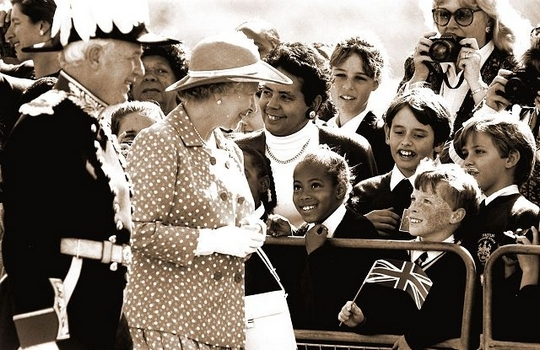
1994. English
Bermuda-based nurse raped by two men. The
evidence showed the woman was picked up by men on motorcycles and attacked on
a dark and secluded road. "She was saying take me home and I took it to
mean, she wanted sex," one defendant said. The other one said "she
wasn't fighting hard enough ...she didn't do enough to stop us." An
"acquittal option instruction" was presented by the judge to the
jury, which took an hour with its not-guilty verdict.
1994.
Brian Simmons, 29, was murdered, found at Pembroke Dump on October 9
with his throat slashed. The discovery was made near his Curving Avenue home.
1994. Incinerator at Tynes Bay opens. See http://rossgo.com/Tynes%20Bay/Incinerator.html. The Ministry of Public Works hoped it would only need one stream, with a second stream held in reserve; it was intended for each stream to be repaired while the other was in use. However, following a huge increase in the amount of municipal solid waste, both streams were required constantly.
1994. Casemates Prison in Bermuda, opened in 1963 from the former Casemates Barracks, was closed for good.
1994. October. Under the terms of the Bermuda II Agreement between the United Kingdom and USA, certain regional UK airports other than London Gatwick, London Heathrow and Manchester previously allowed could be added for trans-Atlantic passengers.
1994. Internet Bermuda Limited (as IBL) was the first company to bring Internet to the island. Prior to that time, only Bermudians wgo were able to go abroad had it, or who were members of the Bermuda Macintosh Users Group. Bermuda was believed to have been only the seventh country in the world to have its own access at the time, via Cable & Wireless Bermuda and it was very expensive.
1994. December 31. 12 Islanders are recognised in the Queen's New Year's Honours List. Dr. Marjorie Bean, an influential figure in local education circles for more than three decades, will become a Dame Commander of the Order of the British Empire. Dame Marjorie had earlier been made a Member of the Most Excellent Order of the British Empire. Also cited were Mr. Richard Masters Gorham, who was made a Knight Bachelor, and Mrs. Gloria McPhee, who became an Officer of the Most Excellent Order of the British Empire. Mrs. Joan Margaret Williams and Mr. Ward Young were both made Members of the Most Excellent Order of the British Empire. Rounding out the List with awards of the Queen's Certificate and Badge of Honour were businessman and top sports official Mr. John Richard Kane, civil servant Mrs. Janet Marlene Lambert, philanthropist Mrs. Valerie Harnett Masters, teacher and musician Mrs. Edna Louise Thomas, philanthropist Mrs. Elizabeth Anne Parker, engineer and linguist Mr. Stanley Walenciak and music director Mr. Alan Bernard Tucker. Dame Marjorie, who was also the first Bermudian woman to be appointed to the Island's former Legislative Council, began her career in education as English and geography mistress at the Berkeley Institute. In 1948, she became the first black person to be appointed to an administrative position in the Department of Education when she took on the job of Supervisor of Schools. An alumna of Wilberforce University in Ohio, the Columbia University Teachers College in New York and the Institute of Education at the University of London, Dame Marjorie was made an MBE "in recognition of the significant contribution she made to education in Bermuda.'' She was also awarded the Queen's Silver Jubilee Medal in 1977. Sir Richard Gorham is a leading Bermudian fundraiser who has worked on behalf of numerous individuals and groups. Among those that have benefitted from his financial and organisational talents are the Bermuda War Veterans Association, the New Testament Church of God, the English Speaking Union, the Adult Education School, the Royal Artillery Association and Bermuda College. In 1983, Sir Richard also created the Bermuda Charities and Community Services Fund, which provides immediate assistance to those who need financial, medical or educational aid. The Fund has an annual financial donation rate of approximately $26,000. Mrs. McPhee, a former Minister of Education and a former Minister of Health and Social Services, has been at the centre of community and political life in Bermuda since 1968, when she was first elected as an MP. Since then, she has served on the Board of Health, the Census Board and the Board of Education and has advanced a number of children's causes. Mrs. McPhee was also the first Bermudian woman to become a Cabinet Minister. English-born Mrs. Williams, who was a home economics teacher before being selected as Government's first protocol officer in 1981, has co-ordinated a number of visits to the Island by presidents, prime ministers and several members of the Royal Family. Mr. Young, meanwhile, has been a leading member of Bermuda's business community for more than two decades. He has also worked tirelessly on behalf of the United Bermuda Party and numerous sports bodies.
1995. February 10. Bermuda welcomed the crews of two French Navy warships. The submarine Psyche will come up for air in local waters this morning and head for Dockyard for refuelling. Commanded by Lt. Cmdr. LeSpace Mentec, she will remain in Bermuda until next Tuesday. But she will not be open to visitors. However, the light transport ship Francis Garnier , which will also arrive in Bermuda waters today, will be open for public tours from 3 p.m. to 5 p.m. on Saturday and from 2 p.m. to 5 p.m. on Sunday. She is due to leave on Monday. The ship last visited Bermuda in 1978. Although both visits are routine, it will be the last visit of a French warship to HMS Malabar before it closes at the end of next month. "It is sad to note the closing of HMS Malabar, because they have been an enormous help over the years in receiving ships of the French Navy,'' said Honorary France Consul Mr. William Frith. "Their services have been of great value and they will be sadly missed.'' Mr. Frith said close to 50 French ships had visited the UK base since he became Honorary Consul in 1961.
1995. March. After years of only part-time Royal Navy activity in Bermuda following the closure of the Royal Navy Dockyard in Bermuda generations earlier, the senior Royal Navy officer in Bermuda, officially known as Senior Naval Officer West Indies and (NATO) Island Commander, Bermuda, announced the imminent closure of HMS Malabar, Bermuda. The last portion of the once-great western Atlantic station of the Royal Navy, of which Bermuda had been the central base from 1795, with the great bulk of it already long closed, was to be closed forever, given the nature of modern warfare and the supremacy of the military forces of the United States of America in that ocean. All Royal Navy personnel in Bermuda had left. HMS Malabar was so-called from the successor, built in Bermuda, of a Royal Navy ship built from teak in India.
1995. March. The US Naval Air Base and US Naval Annex also closed soon after press attention from Sam Donaldson of ABC News. They could no longer be justified after the end of the Cold War. They were closed at the same time as many other US military bases in the USA and beyond. The Bermuda Government took possession of all former military bases. Also closed was the Roger B. Chaffee High School - see http://en.wikipedia.org/wiki/Roger_B._Chaffee - which had succeeded the older Kindley Air Force Base High School in 1970. The closure of the St. David's Island base meant a later death sentence for the easternmost house on what had once been Longbird Island but destroyed to create the base. It had been one of the few buildings saved and became the home of the commanding officer of Fort Bell, later the US Army Air Force then the US Kindley Air Force base then the US Naval Air Station, before closure.
1995. April 1. HMS Malabar, a Bermuda-based Royal Navy supply base, officially closed in Bermuda, following the announcement a month earlier. After the closure of the dockyard in 1958, and the disposal of most Admiralty land holdings in Bermuda, a small part of the base, which included the wharf of the South Yard, had been maintained as a supply base under this name following the end of the Cold War. The closure of HMS Malabar marked the end of 285 years of permanent Royal Naval presence in Bermuda. Commander Robin Bawtree, OBE, was the last Resident Naval Officer Bermuda. His duties included supervision of the Royal Navy's 28 acres of Bermuda holdings. They were left in a pristine condition, including the dockyard with the buildings and facilities all in working order. Prior to taking over the property, The Bermuda Government's quango the West End Development Corporation (Wedco) said it planned to turn The Cottage, the former home of the Commanding Officer, Royal Navy, Bermuda, into a guest villa, with a sports/spa facility and commercial offices suggested for the other buildings. Wedco said at that time that it would make no “rash decisions,” but hoped development could occur quickly because of the good shape of the buildings. (But Wedco allowed them to deteriorate).
1995. June1 & 2. The US Naval Air Station Bermuda, comprising its St. David's Island and Southampton facilities officially marked the end of more than a half century of American military presence on the island with a ceremony. Navy personnel turned over all air operations to the Government of Bermuda on June 1, including weather forecasting, air traffic control, electronic maintenance and fire fighting. American military personnel operated and maintained the island's only airfield since 1941. NAS Bermuda was to remain open until August 31 to allow for the orderly withdrawal by air of all records pertaining to the facilities. The official decommissioning ceremony was scheduled in early June because of the rapid draw-down of military personnel after the turnover of air operations.
1995. August 31. NAS Bermuda which had unofficially remained open until today to allow for the orderly withdrawal by air of all records pertaining to the facilities, ceased.
1995. The Bermuda II air agreement was revised yet again. Although Bermuda II was much less restrictive than the original Bermuda agreement it replaced, it was still widely regarded as a highly restrictive agreement that contrasts with the principle of "Open skies" against the background of continuing liberalisation of the legal framework governing the air transport industry in various parts of the world. Broadly speaking, only a combined four airlines from the US and UK are allowed to operate flights between London Heathrow and the US. The two British carriers are currently British Airways and Virgin Atlantic. The American carriers were American Airlines and United Airlines. The US also approved Continental to fly to London Heathrow but the British do not recognize this route authority and, consequently, this service is not in operation. However, the British have not obstructed Continental's codeshare agreement with Virgin Atlantic, which places Continental flight numbers in addition to its own on some Heathrow flights. Air India, El Al, Iran Air and Kuwait Airways were permitted to continue exercising their so-called "fifth freedom" traffic rights from Heathrow to JFK, which they had already enjoyed under the original Bermuda agreement. (Both El Al and Iran Air no longer exercise these rights. The former has decided that it makes better economic sense for it to fly non-stop between Tel Aviv and New York. The latter's US traffic rights were withdrawn in the aftermath of the 1979 Iranian hostage crisis.) Similarly, Air New Zealand was allowed to continue using its fifth freedom rights between London and Los Angeles.
1995. The establishment of the Bermuda Weather Service (BWS), in the wake of the US Navy Base’s departure from Bermuda. Since then the BWS has been responsible for all National Weather Service functions. Its director now has a seat at the annual World Meteorological Organisation Region Area IV Hurricane Committee, where discussions surrounding the effects from the last hurricane season, lessons learnt, changes to policy and NHC procedures as well as decisions such as which names will be retired, occur.
1995. August. the French resort company Club Med proposed reopening 100 of its Bermuda hotel's 340 rooms and simultaneously slashed its asking price for the building from $32 million to $13.5 million. Its argument was that it would be easier to sell the business as a going concern. But the Government rejected the proposal. Works & Engineering Minister Leonard Gibbons pressed ahead in taking Club Med to court to reclaim the property, arguing that the company was in violation of the terms of its lease. When the matter went to Supreme Court later this month in 1995, Puisne Judge Vincent Meerabux reversed his decision on whether to send the matter to arbitration and legal proceedings began that were to continue, on and off, for more than two years.
1995. Colin Coxall, 55, of the UK was appointed Police Commissioner. He was charged with the task of overhauling the Bermuda Police Service amid spiraling crime. The former Commissioner, whose appointment led to the then PLP Opposition launching a petition in a bid to block him getting the job, boasted an impressive CV on arrival in Bermuda. The law graduate had been Acting Commissioner of City of London Police. Before then senior roles included Deputy Chief Constable of Thames Valley Police, former head of Scotland Yard drugs squad and advising the Home Secretary on drugs policy. When he touched down in Bermuda, Mr. Coxall set about root and branch reform of what sources said was a service in an “appalling state, from top to bottom”. Manpower, training, forensics, intelligence gathering, promotions, complaint handling and press relations, the condition of buildings, and reservist training all came under the spotlight as crime and drug-related offences continued to rise. He was appointed after a recommendation by Her Majesty’s Inspector of Dependent Territories Police Forces Lionel Grundy in 1994. That report was never made public, but it is understood it contained damning criticism of the way the force was run. Mr. Coxall’s urgent review of the force saw 120 changes highlighted. And the former Commissioner gave himself three years to carry them out. One source compared the task of reforming and running the 500-man force at the same time as like operating a sea tanker “while trying to mend the engine at same time.” Never accepted in some circles because he was non-Bermudian and occupying one of the Island’s most important posts, he did not complete his three-year tenure. Despite almost slashing crime in half and serving time on dealers before training his sights on major suppliers, he quit in 1997 – five months before his contract was up – amid a blaze of controversy triggered by the major drugs clampdown, Operation Cleansweep. Already unpopular with the PLP, he ruffled feathers with the ruling UBP when a Cabinet Minister’s name emerged during Cleansweep investigations, although no action was taken through lack of evidence. Criticised by some for what they perceived as not getting on with senior officers and for failing to promote enough black officers, he has never returned to the Island.
Colin Coxall
1995. September 12th. "Crime Stoppers Bermuda" came into existence under the chairmanship of Mr. McNeil Warner. This non-Police organization sought to encourage members of the public to pass on information anonymously about crimes that they may have witnessed or know about. Once that information was supplied the caller is given a code number and asked to call back later to discover whether or not he or she was entitled to a monetary reward.
1995. A referendum on the issue of independence for Bermuda, only the second time in Bermuda a referendum was held, was defeated by a 75 percent margin. But it was flawed as the PLP instructed its members to boycott the referendum. Most did as they were told. After the result, long-term then-Premier Sir John Swan, who strongly supported the pro-Independence platform, resigned after having been outvoted. Interestingly, only he in British history has ever to date had the courage and integrity to resign, as he did, when he lost. In other referendum votes held in the UK to date, leading politicians who campaigned for a yes vote and lost did not resign.
1995. The Bermuda Police Force formally changed its name to the Bermuda Police Service.
1995. 4th December. The Bermuda Government issued six postage stamps on Military Bases formerly in Bermuda. They are shown below:
1996. February. Scientists from around the world visited Bermuda for a conference at the Fairmont Princess Hotel. Southampton, to create a landmark agreement. the “Bermuda Principles”. It led to the results of the Human Genome Project being made publicly available, accelerating genetic research internationally. The agreement was hugely significant in the world of genetics. 50 scientists met in Bermuda because it was mainly US and UK labs that were involved in the Human Genome Project and this was a neutral place. The core of the meeting was to decide what they were going to do with the gene sequences once each lab churned them out. When each gene gets sequenced, does the lab patent that gene and own the sequence or would they agree together that they would put that information in the public domain? They decided to do the right thing and put it in the public domain within 24 hours of sequencing being completed. By making the sequences freely available online, the resource became easily accessible, helping researchers around the world conduct their work. It helped to promote and accelerate scientific research to where it is today. If everyone had owned those gene sequences, patented them, researchers would have to fork out more money and it would take longer for research to happen. Interestingly the Bermuda Principles are no longer just used in genetics or even science. It has been a model for other disciplines.
1996. February. Club Med in Bermuda approached Government with a proposal to reopen its hotel by May of the following year. The Government set aside its legal action and compromise agreements were reached on re-licensing requirements relating to fire safety, sewage treatments and room standards.
1996. March. Premier David Saul met Mr. Clinton in the Oval Office. The visit was arranged to discuss issues related to the closure of the US military bases in Bermuda in 1995, among other things.
1996. May 24. Clearwater Beach and Park, Cooper's Island, off St. David's Island, now a 36 acre public park site, was re-opened to the public after 54 years as a US military reserve. It has pebbles in places, unlike most other Bermuda beaches. There are also nature trails, playground equipment and views of some outer islands reserved for wildlife.
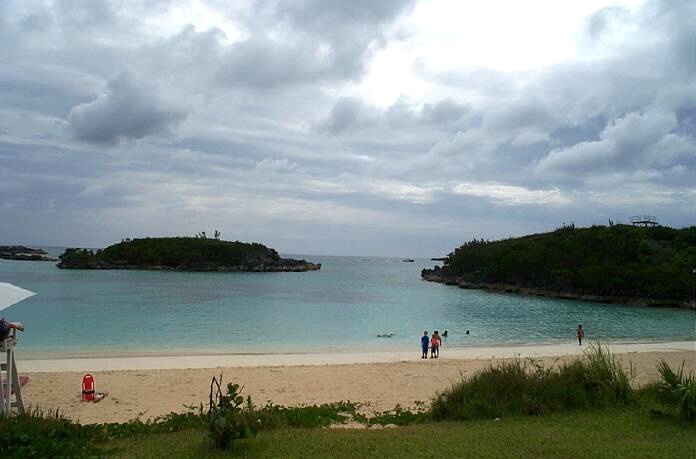
Clearwater
Beach
1996. The
Bermuda Land Development Corporation (BLDC) came into being as a limited
company tasked with developing and managing the former base lands at Southside,
Morgan's Point, Daniel's Head and Tudor Hill.
1996. The Rt. Rev. Ewen Ratteray became Bishop of Bermuda. He had begin his religious journey began with his baptism by Bishop Arthur Heber Browne. As a teenager he came under the influence of Canon William Manning, who encouraged him to become a server. He promptly joined a group of servers that included former Hamilton Mayor, Lawson Mapp, Martin Brewer, Walter Carlington and Henry Ming. It was in the Cathedral that he was confirmed at the age of 16. Due to the influence of the Canon, who later became a Bishop in South Africa, he went away to Codrington College in Barbados to study for the priesthood. After many years working in the North of England, he returned to Bermuda as Rector of Pembroke in 1980. In 1994 he became Archdeacon of Bermuda in the Cathedral, and two years later was consecrated as the Bishop of the Diocese by the Archbishop of Canterbury.
1996. The Bermuda Education Act 1996 enacted required that only three categories of schools can operate in the Bermuda Education system. The first is an aided school, which has all or a part of its property vested in a body of trustees or board of governors and is partially maintained by public funding or, since 1965 and the desegregation of schools, has received a grant-in-aid out of public funds. The second is a maintained school, has the whole of its property belonging to the Government and is fully maintained by public funds. The third is a private school, not maintained by public funds and has not, since 1965 and the desegregation of schools, received any capital grant-in-aid out of public funds. The private school sector consists of 6 traditional private schools, two of which are religious schools, and the remaining four are secular with one of these being a single gender school and another a Montessori school. Also, within the private sector there are a number of home schools which must be registered with the government and receive minimal government regulation. The only boys’ school opened its doors to girls in the 1990s and in 1996, one of the maintained public schools became a private school. Prior to 1965, the Bermuda school system was racially segregated and when the desegregation of schools was enacted in 1965, two of the formally maintained "white" schools and both single-sex schools opted to become private schools. The rest became part of the public school system and were either aided or maintained.
1996. July 3. Canadian tourist Rebecca
Middleton, 17 years old, was brutally stabbed and cut 35 times, beaten,
tortured, raped, sodomized and murdered at Ferry Reach in Bermuda. Dr. Keith Cunningham and Dr.
James Johnston completed an autopsy. Both discovered anal and vaginal trauma,
along with some 35 cuts, five of which were fatal. It was the worst, most
brutal and savage murder ever committed on a woman anywhere in the world. News
of it was flashed around the world. A notoriously botched murder case. Her
presumed killers were controversially absolved of murder. The original
police investigation was criticized as horribly inadequate and prosecution
decisions were condemned as inept when one man was allowed to plead guilty to
a lesser charge and the other was acquitted on a questionable ruling by the
trial judge. There have been far too many such rulings in Bermuda on
despicable offenses against women.
1996.
Summer. 35-year-old Billy Way, son of NASA Tracking Station on Cooper's Island
manager Mr. Way, Bermuda's number one tennis player who won a bronze medal
in the 1993 CAC Games in Mexico, was hit by a taxi as he crossed one of
Manhattan's busiest roads, Madison Avenue and died.
1996. August. After a period of illness that saw Progressive Labour Party (PLP) Deputy Leader Jennifer Smith assume the role of Acting Leader from 3rd April, Leader Mr. L. Frederick Wade died. The Party's constitution called for a new leader to be elected at a Special Delegates Conference one week following the untimely death and Ms. Jennifer Smith was the victor in a three-way race, against Mr. C. Eugene Cox and Mr. W. Alexander Scott. Mr. Scott was elected Deputy Leader. After eleven years under the leadership of the late Mr. L. Frederick Wade, the PLP had a new leader - the fifth.
1996. The 100th anniversary of the formation of the Bermuda Militia Artillery (now amalgamated into the Bermuda Regiment) was celebrated.
1997. February. A German patient who broke earlier his neck in a mental hospital in Bermuda commenced proceedings against the Bermuda Hospitals Board (BHB) for damages. Thomas Hofer, 47, was rendered quadriplegic by the accident at St Brendan’s now renamed the Mid-Atlantic Wellness Institute in February 1994. Mr Hofer, a former chef, allegedly fell off a bed and hit his chin on the floor while being treated at St Brendan’s for a paranoid psychiatric condition. According to court papers filed by his lawyer, he was not diagnosed with a broken neck until the day afterwards. Mr Hofer was flown home to his native Bavaria in April 1994 and is now in the care of the German state. He first issued proceedings against BHB for negligence and damages. The claim included costs for ongoing care and was expected to exceed $5 million.
1997. February 15. Uproar erupted yesterday after a bill allowing foreign ownership of the Bermudiana site passed in under 42 seconds -- without debate. Several Government MPs, surprised by the swift passage of the private bill in the House of Assembly, reacted furiously. At least two -- John Barritt and Tim Smith -- admitted they had been unaware of Parliamentary rules on debating private legislation. "I'm ashamed and embarrassed at what occurred in Parliament,'' said Minister of Technology and Information Mr. Barritt. The ex-Government Whip feared MPs wanting to speak on the Bermudiana Site Rehabilitation Act 1996 had been victims of a "clever Parliamentary maneuver. ''A bill of such magnitude should certainly have been debated. It seems incredible it should go through when only about half the MPs were present.'' He added: "We thought we would be invited by the House Speaker to talk on the bill, but that didn't happen. And I accept now the Speaker does not have to do so with private bills.'' United Bermuda Party Government backbencher and former Deputy Speaker Tim Smith directed an accusing finger at the Opposition Progressive Labour Party. He said PLP MP Reginald Burrows, who introduced the bill in the House of Assembly, should have launched a debate. "The silence was deafening if not duplicitous,'' he declared, while pointing out he would have supported the bill. His father, Anthony Smith, runs Villa Development Company which had been interested in building on the Bermudiana site. But the company's multi-million-dollar office and restaurant scheme was thrown out by planners. Opposition Leader Jennifer Smith yesterday defended the passage of the legislation. "I am amazed that a former Government Whip and former Deputy Speaker who have been elected since 1993 do not yet know how private bills get debated in the House.'' She said she was astonished the two MPs should consider themselves hard done by having missed out on the opportunity of speaking. Ms Smith, whose party backed the bill, said the Opposition position had been clear from the start. "If Government had spoken on it we would have spoken.'' The Bermudiana bill allows ACE Ltd and Exel Ltd to bypass the 60/40 ownership rule -- which requires that 60 percent of a company be Bermudian owned -- and take over the select Hamilton site off Pitt's Bay Road. ACE Ltd and Exel Ltd had agreed to buy the property from Argus Insurance and develop the site for their new offices, if the bill passed and planning permission was given. The hotel could now be demolished by March or April with offices for the two firms being phased in over five years. The ACE and Exel deal is opposed by the Bermuda Financial Centre Ltd which wanted to raise cash to develop the property for offices, shops and a hotel. It claims the land should be kept in Bermudian hands and still hopes to launch a rival bid despite struggling to raise the necessary cash. The United Bermuda Party had declared a whip for yesterday's vote. This compelled MPs to toe the party line and back the legislation. Premier David Saul, however, said the whip decision was a formality after the issue was thrashed out at a marathon caucus meeting. The House of Assembly was about half-full when Opposition House Leader Reginald Burrows introduced the bill for its second and third readings. Several MPs said they were absent because they believed the debate would last several hours. After the bill passed without objections, Mr. Smith tried to protest in the motion to adjourn -- a period when MPs can speak on virtually any subject. But House Speaker Ernest DeCouto ruled him out of order, saying the private bill had already been passed. He later pointed out to MPs that Parliamentary rules for private bills and public ones were different. With a private bill, any MP wishing to debate had to ask the Speaker to move the bill be "committed to the House. '' Mr. DeCouto pointed to the Rules of the House relating to private bills. "It just went through. I think Mr. Burrows thought the passage of the bill was a fait accompli given that both parties were meant to be supporting it.'' Last night Mr. Smith said he had listened to a tape-recording of proceedings. "I timed it. I'm stunned that the bill went through in less than 42 seconds.''
1997. March. Club Med decided reopening of its St. George's Hotel would not be possible until the spring of 1998 but proposed to reopen as a timeshare property. The Bermuda Government responded by re-launching its legal action to take back the lease.
1997. May. Pamela Felicity Gordon, JP, MP, United Bermuda Party, daughter of late Dr. E. F. Gordon who founded the Bermuda Industrial Union, became the first female Premier of Bermuda after the resignation as Premier and as a Member of Parliament of Dr. David Saul, then MP for Devonshire South.
1997. May 15. Sunk on purpose off Bermuda was the Xing Da, the one-time Chinese illegal immigrant smuggling ship. The 221 feet long Xing Da was carrying Chinese immigrants to be smuggled into the United States. There were 83 Chinese nationals some as young as 14, none older than mid-30s. Crewed by suspected members of the Chinese mafia known as the Triad, it had arranged to meet a smaller ship 145 miles off Bermuda for the immigrants to be transferred and taken into the United States. They had paid $20,000 to $40,000 each to the Triad's smuggling ring to escape their homeland. Instead, what they found was the U.S. Coast Guard and U.S. Marines. US Immigration and Naturalization (INS), as well as Coast Guard, knew about the Xing Da's activities even before she left port in China in June 1996. Smuggling was nothing new to the Xing Da. Going back as far as the Vietnam War, she smuggled everything from contraband to weapons for the North Vietnamese Army. The Xing Da was the 11th Chinese vessel to be intercepted with this form of cargo in course of five years. Towed into Bermuda while still under guard on October 8, 1996, the Xing Da's passengers were off-loaded and transferred to the US Marine base at Guantanamo Bay, Cuba, for extradition back to their homeland. Those involved in the smuggling operation were arrested. After being towed into Bermuda, broken down beyond repair and destined for a water grave, the Bermudan Government negotiated for possession of this ship. The Xing Da was towed past the seaward edge of Bermuda's northwest facing barrier reef and sent to the bottom where she was successfully placed on the ocean bed below 104 feet of water. Other than the removal of trash, fuel, waste and all her bulkhead doors, the Xing Da was left fully intact with all superstructure, deck machinery and booms as they were when she was captured. She went to her watery grave 105 feet down off Eastern Blue Cut, about six miles off Dockyard.
1997. An embargo on imported milk was introduced through the 1997 Importation of Milk (Prohibition) Act 1997.
1997. South African former President F. W de Klerk visited and laid a wreath at the Boer War cemetery.
1997. September. CedarBridge Academy at Prospect, planned since 1992, opens with, according to the Wachiira Report, “significant functional and construction problems.”
1997. September 6. Clearwater Middle School opened its doors in the former Roger B. Chaffee High School in St. David’s Bermuda. The students came from the former St. George's Secondary School, and the founding Principal was Mrs. Charlotte Ming. On that first day, Clearwater Middle School had 75 boys and 80 girls enrolled.
1997. September. Club Med in Bermuda formally ended its lease from the Bermuda Government of its St. George's hotel property.
1997. October. The Bermuda Equestrian Centre, or National Equestrian Centre as it is sometimes called, was established, about 1.5 miles into Vesey Street, off Middle Road. It was Bermuda's first-ever Special Development Order.
1997. The Code of Practice for the Elimination of Racial Discrimination and the Promotion of Equality of Opportunity in Employment was produced.
1997. The Bermuda Underwater Exploration Institute (BUEI) was opened, with exhibits including those of the history of underwater exploration, marine life at different depths and Bermuda's shipwrecks. Underwater crafts, including Charles William Beebe's bathysphere, were on display. One room housed a superb seashell collection. Its mission was “To advance the understanding, appreciation and knowledge of the ocean and to encourage the protection and preservation of the marine environment”. Reports on the condition of the marine environment highlight the threats this complex environment faces, many man-made. Rising sea levels, increasing water temperatures, pollutants, micro-plastics, coral bleaching and habitat damage to name a few, impact all of us both locally in Bermuda and worldwide. Education is a key component of the mission; by inspiring young Bermudians to learn more about science and in particular the ocean around us, the aim is to instill a sense of wonder, respect and stewardship. BUEI is also an important public resource and provides a forum for the community as a whole and also fosters collaboration between like-minded organizations.
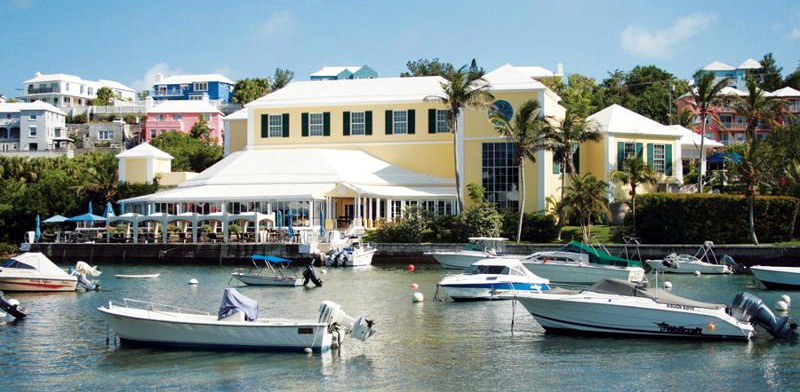
BUEI building
1997. The movie and US TV series "Wild on the Bermuda Triangle" - see http://www.imdb.com/title/tt0979230/fullcredits - filmed partly in Bermuda, was released.
1997. The Bermuda International Film Festival (BIFF) was launched to advance the love of independent film from around the world in Bermuda and to encourage and inspire young Bermudians to capture their very special narrative through a camera lens. It has welcomed numerous celebrities and stars of the film world over the years, including Michael Douglas, Earl Cameron, Willem Defoe and Richard Dreyfuss. While there are more than 1,000 film festivals worldwide, only 62 are Academy Award qualifying festivals and BIFF is one for the Short Film (Live Action) Oscar.
1998. June 30. Nearly six hundred Bermudians and residents converged on the campus of the Bermuda College to brainstorm and recommend solutions for uprooting racism in Bermuda. These persons were divided into three racial categories, “Blacks”, “Whites”, and “Others.” After an intensive brainstorming session, all participants convened in the college gymnasium to hear extensive reports from splinter groups. Under the general direction of a Steering Committee, these reports were reduced to strategies by a volunteer Implementation Committee. Seven sub-committees were formed from this Implementation Committee: Economics, Spirituality/Religious Beliefs, Education, Legislation, Political, Social and Personal Responsibility. In addition to these, ‘Media’ and ‘General’ categories for action were created to accommodate other strategies and comments. Members of the Implementation and Steering Committees met on a regular basis to review the “raw data”. They later produced the sentiments of those original participants as ‘strategies’ and ‘recommendations.’ Thus began what later became known as Citizens Uprooting Racism in Bermuda (CURB).
1998. Bermuda National Pension Scheme Act 1998 was enacted, for implementation in 2000.
1998. October. The Atlanta-based Camberley Hotel Company was being considered as the next potential developer, following the end of the Club Med lease. Talks between the company and Government progressed well over the subsequent months and by July the company had come to a labor agreement with the Bermuda Industrial Union and had set early 2000 as a target opening date. A month before the November 1998 General Election, said to be due to disturbing reports his company had received about Bermuda, Camberley president Ian Lloyd-Jones said his company's $32-million revamp plan for the hotel would be put on hold until after the poll.
1998. Internet Bermuda Limited (IBL) and Bermuda Systems Limited (BSL) merged and formed Logic Communications Limited (Logic) to bring together the best of Internet access and hardware support to the Bermuda market. Since its creation, Logic has brought a world of changes to the technology landscape of Bermuda.
1998. A landmark survey of the Bermuda's snails, by Drs. Rudiger Bieler and John Slapcinsky, revealed very sparse numbers of our endemic snail island-wide. Only 30 years earlier it was described as common everywhere.
1998. July 16. An increase in the number of cruise ship passengers has put extra strain on the transport system. Extra buses have been put on from the West End to cope with the demand when cruise ships are moored at Dockyard, making life difficult for locals who board the vehicles at stops past Boaz Island. The situation was worse when schoolchildren were also trying to get on the buses, but it is still a concern to transport officials. And this summer the Horizon has taken over from the Meridian at Dockyard, increasing the total possible number of passengers from 1,100 to 1,600. The ferry system also comes under pressure at certain times of day, but those passengers who do not want to go to Hamilton by boat and don't wish to hire a scooter, look to the buses to get to the beaches. Dan Simmons, assistant director of the Public Transportation Board, said there wasn't enough lift from Dockyard. Extra buses had been put on to satisfy demand and supervisors were stationed in the West End to order more vehicles if numbers warranted it. Most people want to go to the beaches and you can't get to the beaches via the ferry. If we have a very busy service from Dockyard, with people going to Hamilton or the beaches, then that means local people have a challenge getting on.'' Mr. Simmons said the problem only occurred with the buses travelling from the West End east. Passengers heading back to the Horizon tended to drift back in small numbers, not en masse. The Horizon visits each week from New York, staying at Dockyard between Tuesday and Thursday, when it switches to Hamilton.
1998. July 20. Archaeologists are digging up hundreds of years of history in a groundbreaking project to excavate one of Bermuda's oldest forts. The expert team from William and Mary College in Virginia have already unearthed the 17th Century ramparts of Smith's Fort on Governor's Island, St. George's. Now they are hoping to scratch the surface of some old ruined foundations, dating back to the American War of Independence. It is already thought to be the first time this century that so much of the fort has been exposed to the open. And the archaeologists are hoping to plough deep enough underground to find more relics and artifacts from the early 1600s. Smith's was one of Bermuda's first ten forts, built between 1612 and 1622. The team of six graduate students and a professor believe the fort could be a treasure trove like King's Castle on Castle Island, where the same team found 19 pieces of old Bermuda hogge money in a two-year dig. Project leaders working on Smith's Fort have been given the go-ahead to dig at Smith's Fort by the National Parks Commission and the Bermuda Maritime Museum. Museum curator and archaeologist Dr. Ed Harris said: "This team has been working on various sites in Bermuda since 1993. They are conducting an archaeological research project into the first 10 forts of Bermuda. Previous work at the King's Castle revealed completely unknown defensive features. And it was there that we also found the spectacular collection of 19 pieces of hogge money.'' The excavation team, who operate from the Sea Scout building at nearby Convict Bay, is being led by Norwegian expert Professor Norman Barka. His project on Governor's Island is expected to last up to six weeks. One of the researchers is a Bermudian student home for the summer -- and several volunteers are also expected to help with the dig. "Smith's Fort is a two-period fort,'' added Dr. Harris. "The original fort was started in late 1612 and the front, seaward part of the fort -- which is a gun battery -- survived. The rear portion, which was a small building with two towers, was demolished at the time of the American Revolutionary War. We are hoping to find the remains of that underneath parts of the later works, behind the ramparts. Those ramparts are already standing quite proud and it would have been quite some time since they were last seen.'' He said the excavation. which began on Monday, was being done by hand-digging. It's typical archaeological spadework. It's working with trowels. It's probably only about two feet down to the bedrock but if we unearth something remarkable like we did at Castle Island, we will obviously dig deeper.'' Any relics dug up would be put on public show in St. George's before a permanent home was found for them. The hogge money, eventually to be displayed at the Maritime Museum, is still being exhibited at the Bermuda Monetary Authority in Hamilton.
1998. August. Sudden death of Leon C. (Jimmy) Williams, PLP MP for St. George's North. This left the PLP looking for a replacement candidate for the constituency three months before the General Election had to be called. Selected to take his place was Delaey Robinson, the son of labour activist and guesthouse owner Trew Robinson and former House of Assembly candidate and Secretary to the Corporation of St. George's, Ernest Robinson.
1998. October 11. "64 people attended a brief but poignant ceremony at the war memorial in Church Stretton, Shropshire for the purpose of witnessing the addition of Lieutenant Colonel Cuthbert Brooke-Smith’s name to the list of those who gave their lives for their country during two world wars. This event was only possible because of the efforts of Cuthbert’s brother Louis, who also served with the Regiment, who had campaigned, with many others, tirelessly for this act of restitution to be achieved. After a short service of commemoration, his son Bruce, read an address and finished with these words. "In the Gospel of St John, chapter 15, verse 13, Jesus said". "Greater love has no man than this, that he lay down his life for his friends." Cuthbert Brooke-Smith, along with countless thousands of others – some of whom are already commemorated on this war memorial – literally laid down their lives for their friends. It is right and fitting that we add his name to theirs this day.’ List of those attending: Capt Louis & Mrs Jill Brooke-Smith (KSLI), Philippa Goodall, Bruce & Barbara Brooke-Smith & son Jonathan, Charles Brooke-Smith (GR), Guy & Margaret Brooke-Smith, Dianna Mason, Paul & Angela Spearing, David & Rosie Brooke-Smith, Col Tim Beath (KSLI), Maj Mike Benson (KSLI), Lt Col Christopher Booth (CO 5LI), Mr Michael Charlesworth OBE, Mr & Mrs Tom Coebill (KSLI), Lt Col & Mrs George Delme-Murray (KSLI),Mr & Mrs Eddie Edwards (KSLI), Capt Dennis Egan (KSLI), Lt Col & Mrs Dick Evans (KSLI), Brig & Mrs Neil Fletcher (KSLI), Mr & Mrs Harry Gandon (KSLI), Lt Col & Mrs Brian Goss (KSLI), Lt Col & Mrs David Grover (KSLI), Air Cdre & Mrs Basil Hamilton (Local RBL Chairman), Mr & Mrs Philip Harvey (Local PCC), Mr Anthony Hector (KSLI), Lt Col & Mrs Tom Hill (KSLI), Mr Bob Jones (KSLI), Mr Derek Jones (KSLI), Brig Percy Jones (KSLI), C Sgt Steve Jones (Bugle Major 5LI), Ex Bugle Major & Mrs Bernard Laidler (KSLI), Brig Brian Lowe (KSLI), Maj & Mrs Bob Maslen-Jones (KSLI), Revd Nick Monk (KSLI), Lt Col & Mrs Richard Osborne (KSLI), Mr George Reckless (KSLI), Mr & Mrs Tony Richardson (Local RBL Secretary), Lt Col & Mrs John Roberts (KSLI), Rev Preb & Mrs Michael Steadman (Vicar of Church Stretton), Mrs Percy Tarbuck (Local RBL President), Capt & Mrs James Whitehead (KSLI), Mr Ken Williams (KSLI), Maj Jeremy York (KSLI)." The above highlighted comments relate to the death in 1955 of Lieutenant Colonel Cuthbert Brooke-Smith, KSLI, who had served as ADC to the Governor of Bermuda in 1950, had married a Bermudian, Joyce Arnell, daughter of Mrs. Helen Arnell and her late husband. Joyce was the brother of Jack Arnell. See last part of British Army in Bermuda.
1998. November 9. Bermuda General Election. The Progressive Labour Party (PLP) won the General Election in Bermuda, with 26 seats out of 40, under the premiership of The Honorable Ms. Jennifer M Smith, JP, MP. She became the first black elected woman Premier of Bermuda. It was a historic first loss dor the United Bermuda Party that had been in power since 1968. PLP candidates were C Eugene Cox, Terry Lister - Sandys South; Walter Lister, Dennis Lister - Sandys North; Michael Scott -Southampton West; Reginald Burrows, Stanley Lowe - Southampton East; Dr. Ewart Brown, Elvin James - Warwick West; W. Alex Scott, Dale Butler - Warwick East; L. Milton Scott - Paget East; George Scott - Paget West; Lois Browne-Evans, Paula Cox - Devonshire North; Danny Farias - Devonshire South; Patrice Parris - Smith's North; David Burch - Smith's South; Renee Webbe, Derrick Burgess - Hamilton East; Randy Horton, Arthur Hodgson - Hamilton West; Carvel Van Putten - Pembroke West; Neletha Butterfield, Wayne Perinchief - Pembroke West Central; Ottiwell Simmons, Nelson Bascome - Pembroke East; Stanley Morton, David Allen - Pembroke East Central; Jennifer Smith, Delaey Robinson - St. George's North; Wilbur Lowe, Arthur Pitcher - St. George's South. After 35 years, the United Bermuda Party, then under Pamela Gordon, was defeated. Stanley Lowe, PLP, JP, MP became first black Speaker of the House of Assembly. This day ushered in an array of “firsts” in Bermuda’s 30 years history of party politics. With the victory, dramatic changes occurred. The PLP appointed the Island’s first political Attorney General in the person of Dame Lois Browne-Evans who was the first ever woman to hold this office, thus becoming the Island’s 41st Attorney General. She was also Bermuda’s first female lawyer having been called to the Bermuda Bar in December 1953. With the introduction of a political Attorney-General as provided for under the Constitution, criminal prosecutions were taken out of the responsibility of the now political Attorney-General. Bermuda had a new officer known as the Director of Public Prosecutions (DPP). He/She now conducts all criminal matters. This has resulted in two separate and distinct offices. The Attorney-General however remains the superintendent of the DPP and is also Bermuda’s Minister of Justice.
See above story
1998. November 15. The Atlanta-based Camberley Hotel Company was still being considered as the next potential developer, following the end of the Club Med lease. Talks between the company and Government resumed after the General Election, under new Tourism Minister David Allan.
1998. The movie Escape from Dino Island - see http://www.imdb.com/title/tt0154458/ was made in Bermuda, mostly on Alpha Island.
1999. Open Spaces forums.
1999. February. Destination Villages, Sandys, was created via the second-ever Special Development Order (SDO). Destination Villages of the USA opened the $13.5 million Daniel's Head Village cottage tent resort, with 135 units. It was owned by Americans Stanley Selengut and Lew Geyser. (But it since closed and reopened under a new name, Nine Beaches, also with new owners. There are many beaches, one public, 9 hotel owned, hence the name).
1999. February. Berkeley Institute, Pembroke, was another SDO.
1999. April. Elbow Beach Club Belmont Property, Warwick was yet another SDO
1999. April 2. Chelston, the official residence of the U.S. Consul General in Bermuda, was announced in the USA as for sale at an asking price of $15 million. The 14-acre property was given to the U.S. government in 1964 by the heirs of an American oil magnate, Carbon Petroleum Dubbs. Mr. Dubbs built Chelston in 1941 and lived there until his death in 1962. Chelston has a 10,000-square-foot main house with four bedrooms and several guest cottages. With prime beach frontage at Grape Bay, Paget Parish, the estate is 200 feet above sea level, with views of the ocean and the nearby city of Hamilton, Bermuda's capital. Acting Consul General Bruce Berton said the State Department decided to put Chelston on the market in the hopes that it could use money from the sale to reinvest in new embassies or upgrade existing ones. "We felt we didn't need 14 acres of property to represent our interests here," Mr. Berton says. Robert Farmer, who served five years as the consul general in Bermuda, left the post last month. Mr. Farmer's successor is Larry Owen, a Michigan businessman and Democratic fund-raiser.
1999. The Camberley deal to redevelop the former Club Med site, earlier much discussed, was close to collapse due to finances, or the lack thereof.
1999. June 14. Attorney General Lois Browne Evans received one of the highest commendations available to a woman in the Queen's Birthday Honours list. She became known as the Hon. Dame Lois Browne Evans DBE JP MP after the announcement was made this weekend, joining ten other Bermudians who have been honoured. Former Commissioner of Police Lennett Edwards will receive the Order of the British Empire (OBE) and broadcaster Ira Philip became a Member of the British Empire (MBE). Dame Lois decided to accept the honour -- which PLP members have traditionally rejected -- after consulting with her children and husband. Previously, after turning down a CBE, she commented that she would rather an independent Bermuda had its own "people awards'', but age and the first ever PLP Government had changed her mind. "I was so surprised because I didn't know my name had been submitted. I feel that the Premier had something to do with it,'' she said yesterday. "I am flattered and glad to have the opportunity. I discussed it with my children who all said `you must take it'. "I am extremely happy about it and my family are also.'' Bermuda's first female barrister and first black Bermudian woman to win a seat in the House of Assembly, she was also the first female Leader of the Opposition in the Commonwealth. Dame Lois became Minister of Legislative Affairs following the PLP's November 9 election victory, and subsequently became the first political Attorney General in modern politics. The Devonshire North MP said she would be attending the investiture. Mrs. Browne Evans said she expected she would be accompanied by her children in London, after they were unable to attend her swearing in as Legislative Affairs Minister following the November General Election. Lennett Edwards was awarded his OBE following 35 years service to the Police, including three years as Commissioner. After joining in 1961, he rose through the ranks to become Deputy Commissioner in 1990 and achieved the top post two years later, before ill health forced his retirement. Ira Philip MBE has been involved with the communications industry for over 50 years. A former chairman of the PLP, he sat in the Senate and on the Board of Education. He has been involved in both the print and broadcast media, has trained many young broadcasters and was editor of the now defunct Bermuda Recorder. Recipients of the Queen's Certificate and Badge of Honour were End to End charity walk organisers Eugene Carmichael and Valerie Dill, also a leading community worker. Mrs. Beatrice Ann Hayward, a volunteer at the St. George's Parish Rest Home, renowned musician Wendell (Shine) Hayward, architect John Hollis Kaufmann, retired lawyer William Robert Kempe, youth worker Cromwell Mujahid Ameen Shakir and Bermuda Aquarium principal curator Richard Winchell all received the Queen's Certificate and Badge of Honour.
1999. July 22. Bermuda won a legal battle Wednesday to keep McDonald’s out of the country, a relief to those who say the fast food giant’s arches are more gaudy than golden. The British Privy Council rejected an appeal by Grape Bay Ltd. to strike down Bermuda’s Prohibited Restaurants Act, enacted in 1996. The fast food opponents say such restaurants would harm the Old World image of the islands, where gambling is illegal and the top speed limit is 21 mph.The Privy Council, the highest court for British territories and some former colonies, did not immediately release details of its ruling. ``It was a very long and bitter fight _ but it was done in the best interests of Bermuda,″ said former legislator Anne Cartwright DeCouto, who led opposition to the chain. Some residents of Bermuda, 600 miles east of North Carolina in the Atlantic Ocean, had developed a taste for Big Mac hamburgers when a McDonald’s operated here on a U.S. military base that closed in 1995. Grape Bay, owned by former Premier John Swan, was seeking to open a McDonald’s restaurant in Bermuda. Grape Bay had argued that the anti-fast food law deprived it of property and a contract with McDonald’s, based in Oak Brook, Ill. Plans to open Pizza Hut and Taco Bell outlets also were thwarted by the 1996 law.
1999. Bermuda Biological Station Ground Water study and Bio Diversity study, Aquarium.
1999. Parliamentarian Terry Lister, then Minister of Development and Opportunity, after making a visit to the Pentagon outside Washington DC, described the US officials he had spoken to as "people who kill for a living." He added there was no moral leadership in the USA.
1999. The Commission for Unity and Racial Equality Act 1994 was amended to allow CURE to collect specific data for the monitoring process.
1999. September. Arizona-based consultants Comgate Telemanagement completed a report for the Ministry of Health on Bermuda's 38 towers that transmit cellular, microwave and satellite signals. It identified those not in compliance with FCC levels for workers and the general public.
1999. October 8. The Director of Bermuda College's Education Centre last night called for all sections of the community to go "out into the trenches'' to help tackle the Island's illiteracy problems. Gina Tucker said the whole Island had to pull together to ensure children can read properly. Speaking at the "Focus on Literacy Seminar'' at Bermuda College the day after Government statistics confirmed Bermudian children fall far behind their US counterparts when it comes to reading, she said it was time to "rally the whole village.'' Dr. Tucker referred to the 1984 US Commission on Reading which pointed the way to improving literacy rates. Nothing had changed in the past 15 years despite all the lessons that should have been learned, she said. "When Fidel Castro came to power in Cuba in 1959 he rounded up people who could read and sent them into the trenches to tackle the nation's chronic illiteracy problems. We are not Communists so we can't literally round people up, but if today's news articles (on literacy problems) don't cut deep and people don't say we must start rounding people up and sending them into the trenches to cut through this, I don't know what will. It is essential that parents talk to their pre-school children in an adult way to improve their language base." Dr. Tucker said people would say parents are struggling to put food on the table or keep a roof over their families' heads so they could not be expected to spend time reading to their children. But she argued: "That is the scenario we have. If in these first three years we don't attempt language development, what do we expect to happen by grade five? That foundation isn't there. We have to take a no-fault approach. We don't have time to waste blaming anyone anymore. Let's stop saying it's the teachers' or the parents' fault. It's our fault because we let it happen. We all have to take responsibility for it. We need an inclusive, comprehensive strategy that is systematic and spirited, one which has like Castro's people going out to the trenches for real because we have a community out there. We have to rally the whole village. We have to hit the problem from many angles. If we focus on education alone we will be in intervention mode, always trying to fix it. We need to begin to pull all our resources -- education, social services, other Ministries, community projects, community schools and reading clinics -- and bit by bit keep chipping away.''
1999. October. The Consumer Protection Act 1999 was enacted, with businesses having a 2-year period before it came into effect.
1999: November 17. Glen Wolffe, 43, was found dead in his Heathcote Hill, Sandy's, home. His body is thought to have been lying for several days before the crime was uncovered. Days later Police raided Studio 55 on Reid Street during an event known as Gay Night. Mr. Wolffe was openly homosexual. Revelers in the club believe Police were looking for a murderer when they came inside, but no arrests were made.
1999. December. The death penalty
was abolished in Bermuda.

History & daily newspaper
reports
Banner.jpg)
Authored,
researched, compiled and website-managed by Keith A. Forbes.
Multi-national © 2024. All Rights Reserved. Last updated 03 June 2024.