Click on graphic above to navigate the 165+ web files on this website, a regularly updated Gazetteer, an in-depth description of our island's internally self-governing British Overseas Territory 900 miles north of the Caribbean, 600 miles east of North Carolina, USA. With accommodation options, airlines, airport, actors, actresses, aviation, banks, beaches, Bermuda Dollar, Bermuda Government, Bermuda-incorporated businesses and companies including insurers and reinsurers, Bermudians, books and publications, bridges and causeway, charities, churches, citizenship by Status, City of Hamilton, commerce, communities, credit cards, cruise ships, cuisine, currency, disability accessibility, Devonshire Parish, districts, Dockyard, economy, education, employers, employment, environment, executorships, fauna, ferries, flora, former military bases, forts, gardens, geography, getting around, golf, guest houses, highways, history, historic properties, Hamilton, House of Assembly, housing, hotels, immigration, import duties, internet access, islands, laws, legal system and legislators, main roads, marriages, media, members of parliament, money, motor vehicles, municipalities, music and musicians, newcomers, newspaper, media, organizations, parks, parishes, Paget, Pembroke, performing artists, residents, pensions, political parties, postage stamps, public holidays, public transportation, railway trail, real estate, registries of aircraft and ships, religions, Royal Naval Dockyard, Sandys, senior citizens, Smith's, Somerset Village, Southampton, St. David's Island, St George's, Spanish Point, Spittal Pond, sports, taxes, telecommunications, time zone, traditions, tourism, Town of St. George, Tucker's Town, utilities, water sports, Warwick, weather, wildlife, work permits.

By Keith Archibald Forbes (see About Us)
|
See end of this file for all of our many History files |
 Bermuda was one
of the first jurisdictions in the world to introduce a uniform postal rate in
1842, only two years behind the United Kingdom and three years ahead of America.
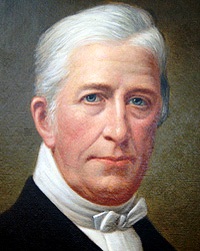
The earliest Bermuda stamps, Perot stamps, were named after William Bennett
Perot, who served as Bermuda’s first postmaster-general from 1818 to 1862.
Only 11 Perot stamps are known to still exist, and they can fetch more than
$100,000 at auction.
Bermuda was one
of the first jurisdictions in the world to introduce a uniform postal rate in
1842, only two years behind the United Kingdom and three years ahead of America.
The earliest Bermuda stamps, Perot stamps, were named after William Bennett
Perot, who served as Bermuda’s first postmaster-general from 1818 to 1862.
Only 11 Perot stamps are known to still exist, and they can fetch more than
$100,000 at auction.
As a group of very small and isolated islands only 21 square miles in collective total land area, surrounded by the western Atlantic Ocean, nearly 600 miles from the nearest mainland of Cape Hatteras, North Carolina, USA and 3,150 miles from London, England, Bermuda - developed after discovery in 1609 as a British colony - initially developed its own system for handling letters and parcels or valuable items, known as packets, for urgent delivery.
It began in Bermuda by depending first on packet ships that sailed mostly first from the southern English part of Falmouth, Devon. (See the book referred to above, The Bermuda Packet Mails and the Halifax-Bermuda Mail Service, 1806 to 1886. Dr. Jack (John) C. Arnell and Morris. H. Ludington).
These fast small sailing ships were the first in the world to offer a regular national and international parcel and postal service. Packet ships were vessels employed to carry British post office mail packets to and from British embassies, colonies and outposts. They were regular, scheduled service, carrying freight and passengers. Their crew were referred to by trade as packet men and their industry was the packet trade. Interestingly, the French word "paquebot" derives from the English term "packet boat," but means a large ocean liner.
Packet ships, among them Royal Mail ships and Cunard, connected Bermuda with St. Thomas in the US Virgin Islands, New York City and or Halifax in Nova Scotia, Canada. A packet agent was based in each of those ports. In those days, when the capital of Bermuda was the Town of St. George, not the later-built City of Hamilton, the packet agent managed all external mails from the town. (Packet agent hand stamps issued from 1820 were the precursors of the postage stamps of today). A domestic mail service was begun in Bermuda in 1784 by the Bermuda Gazette, but was later taken over by Bermuda's colonial government. In 1859, both internal and external mail service became the colony's responsibility, with the chief postmaster being based at the Town of St. George.
Beautiful stamps are a serious business for the Bermuda Post Office (BPO). The Island’s colorful stamps not only serve as payment for postage, they generate extra revenue thanks to legions of collectors around the world. It is a feather in the cap for the BPO that its stamps are so eagerly anticipated and collected. The BPO has a philatelic coordinator. Part of the magic is striking the right balance between issuing a number of pleasing, new designs each year and not ‘overkilling’ collectors with a constant barrage of releases.
Some 700 to 800 committed collectors of Bermuda stamps have standing orders with the post office that guarantee an automatic payment is made as soon as a new stamp issue is released. This ensures the latest designs are immediately forwarded to them to add to their collections. Most collectors are in the US, the majority on the East Coast. There some in Australia, Hong Kong, Eastern Europe, England and Canada. The BPO also has customers from the cruise ships or tourists staying at hotels who come in to buy stamps as they are collectors.
For a number of reasons the quantity of Bermuda stamps sold has fallen by between a third and a half in the past decade or so. One factor is the increasing use of e-mail and other forms of electronic messaging replacing traditional mail and letter writing. Less tourists in Bermuda has resulted in less postcards being sent, and therefore less stamps bought, and many businesses now use franking machines, doing away with the need for physical stamps.
Even so, many hundreds of thousands of Bermuda stamps are produced each year in four separate design issues. A lot of care is taken to ensure Bermuda stamps are interesting and lively. They tend to be bigger in size than other jurisdictions, allowing more detail to be included. Each stamp design is discussed and agreed on by committee then sent off for Royal approval before it can be issued. Many stamp collectors focus on a particular subject, era or country. Those who collect Bermuda’s stamps like the fact there are only four new issues each year. Sheets of stamps and first-day covers are highly collectable. Some Bermuda stamps from the earliest days, such as the Perot stamp of the 1840s, can trade for as much as $250,000. Sometimes an unexpected event can increase the demand for a particular stamp. The 2009 tall ships issue included one stamp featuring the Canadian ship SV Concordia, which visited Bermuda that year. When it sank a year later, near Brazil, many people sought out the Bermuda stamp as a collector’s item.
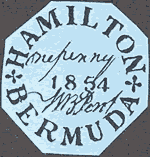
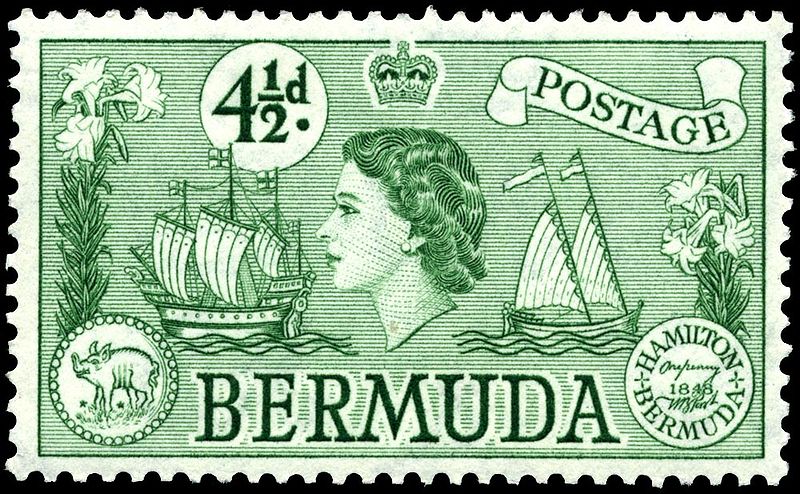
However, it was not from the town but in the new City 13 miles away that Hamilton William Bennett Perot, postmaster, whose ancestors had arrived in Bermuda from France as persecuted Huguenots and became Anglicized, created Bermuda's first postage stamps. He did so by hand, from his office at Par La Ville, Queen Street, Hamilton, using the words "HAMILTON BERMUDA" in a circle, with the year and Perot's signature in the middle. They became known as Perot Provisionals and are among the unique creations of philately. Bermuda's most cherished stamps are the original Perot stamps from 1848, in three values. Perot served as Bermuda’s first postmaster general from 1818 to 1862. Perot Post Office on Queen Street bears his name. He produced the stamps between 1848 (only eight years after they were introduced in Great Britain) and 1865 to foil mail cheats who were not leaving money in a dropbox for postage. His stamps were used only for the internal mail within Bermuda, which is why the collecting fraternity never found about them until 1897. Only 11 Perot stamps are thought to exist in the world and they have commanded as much as $100,000 at auction. The Queen has three and Dr Saul has two. Back in 1848, Mr Perot’s stamps were worth a penny. One of Dr Saul’s Pero'ts and one of the Queen’s were originally joined but were torn apart by an auctioneer in the 1930s. One was sold to the Queen and one was put on the market. The Queen is not an enthused stamp collector but she takes her duty to preserve one of the world’s best stamp collections very seriously. Much of the collection was inherited from her grandfather, George V. Her collection, known as the Royal Philatelic Collection, consists of 328 red albums of about 50 pages each of stamps from George V’s time, which means there are over 16,000 pages in the collection, which may have as many as 20 or 30 stamps on them. The focus of the collection is now on the postal stamps of Great Britain and all the colonies and now a lot of the Commonwealth countries) and the late Baron Stig Leuhesen's Estate (he once lived in Bermuda). A later (1860) crown-in-circle design used at St. George's is attributed to its then-postmaster James H. Thies.
1848. March 1. Bermuda's first postage stamps were produced locally in 1848 by Hamilton postmaster William B. Perot, consisting of the words "HAMILTON BERMUDA" in a circle, with the year and Perot's signature in the middle. Known as the Perot provisionals and only eleven are still known to exist. These first Bermuda stamps, issued 8 years after Britain's famous Penny Black by UK postmaster general William Hill, the word's first postage stamp, but which had not yet appeared in Bermuda, was a provisional issued because the postmaster was being cheated by letter-writers. Perot, set a fee of 1 penny per ounce for letters both local and abroad. Perot also delivered the mail. Perot's Post Office, established in 1842, was located in his home. Contemporary accounts depict Perot spending a lot of his time working in his garden, treating interruptions from postal customers as an annoyance. Due to the fact that stamps for prepayment of postage were not available, Perot placed a box at the door of his house for deposit of letters and the 1 penny fee. Perot regularly noticed that the postal box contained more letters than coins, but he was unable to determine which customers were not paying. The story goes that he mentioned his plight to a neighbor, an American who told him about the postmasters' provisionals that Virginia postmasters issued in the absence of government-authorized postage stamps. Perot decided to issue his own by striking his circular hand stamp on a sheet of bluish paper; the resulting black inscription read 'Hamilton' across the top and 'Bermuda' across the bottom. In the centre, he removed two plugs used to denote the day and month and substituted "One penny" and his name 'W.B. Perot'; he left the year plug intact. Perot then cut up the sheets and, commencing on March 1, 1848, sold the stamps as prepayment of postage until 1856. It's not known how many sheets were produced, but only 11 of the Perot 1 penny stamps in used condition are known to exist.
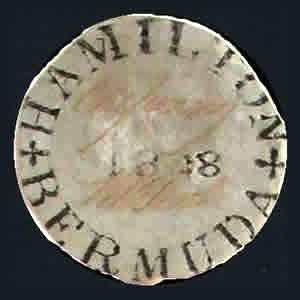
Bermuda Perot stamp of this year is shown below:
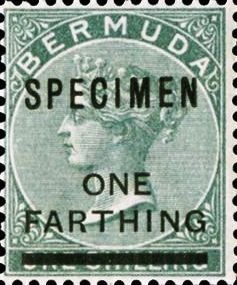
Issue of Queen Victoria 1 penny stamp, below
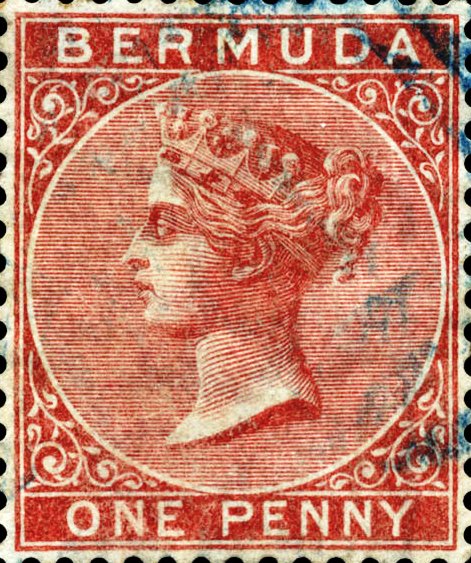
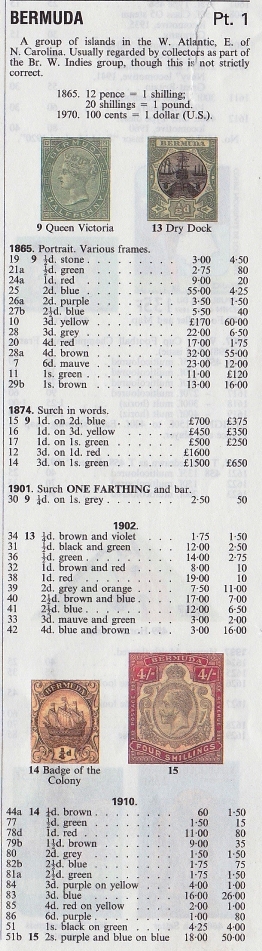
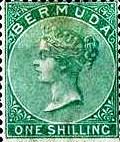
General stamp issues in Bermuda began with a set of three (1d, 6d, and 1 shilling), each with a different design based on the profile of Queen Victoria. Bermuda, as a British colony, followed the custom still common on most British UK and some (but not all) now-politically independent countries of the British Commonwealth but then pat of the British Empire to show an image of the current British monarch on all postage stamps. These were supplemented with 2d and 3d values in 1866 and 1873.
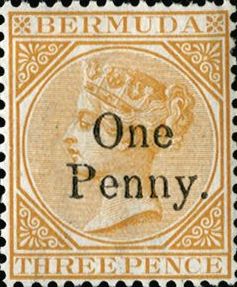
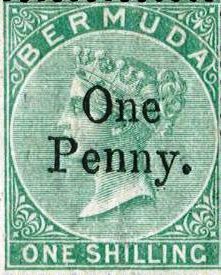
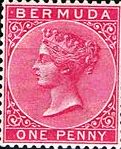
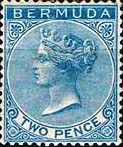
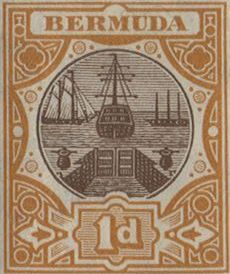
King Edward VII who succeeded his mother Queen Victoria after her reign of more than 60 years, was not honored with his image on new stamps like his late mother. Instead, the first postage stamp of his ilk depicted a Bermudian dry dock, as the stamp below shows.
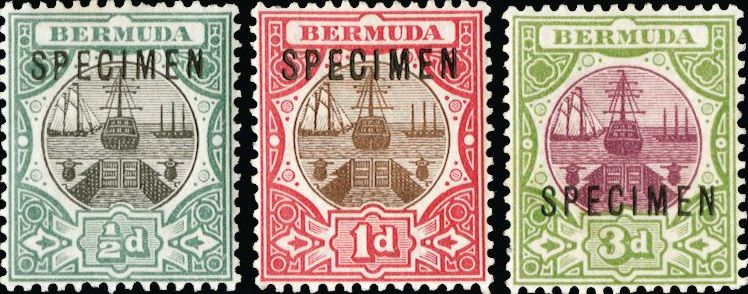
That design remained in use throughout his reign. However, the King was honored another and much longer way, with Bermuda's main civilian hospital, formerly the Cottage Hospital, renamed after him.
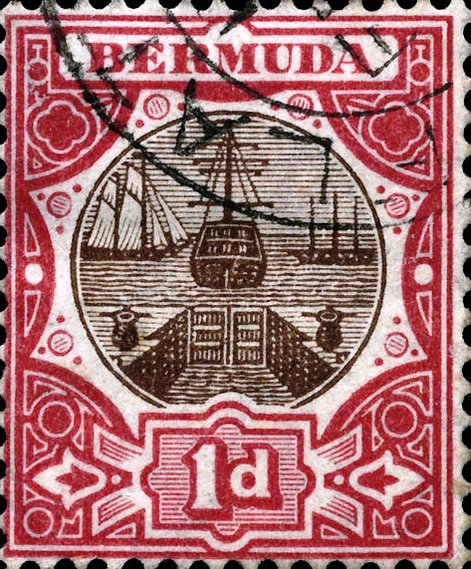
Bermuda one penny postage stamp, issued in the reign of King Edward VII.
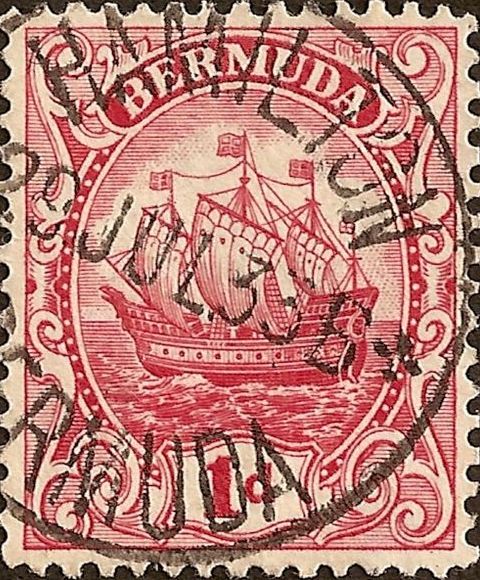
King George V had a number of Bermuda stamps bearing his likeness from 1910, including the seal of the colony (a caravel), and the higher values (2 shillings and more).
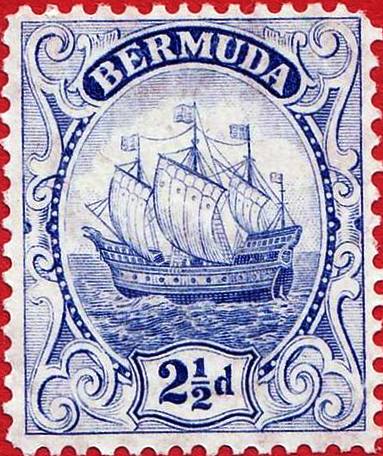
Bermuda stamp 1912.
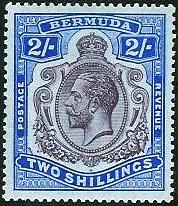
Bermuda stamp 1918
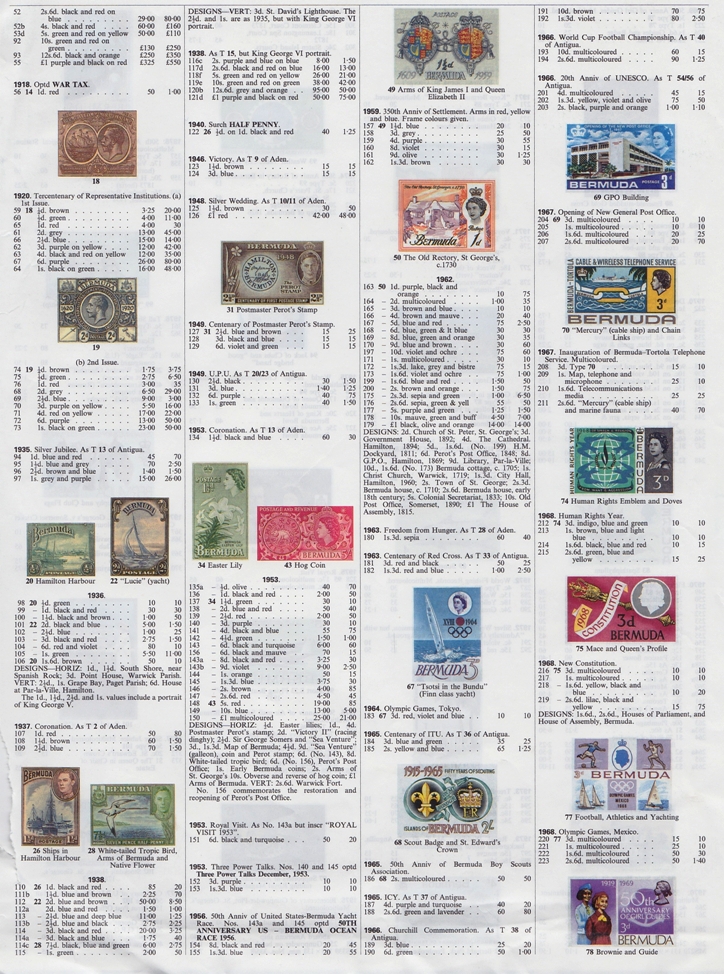
Bermuda's first commemorative stamps included this issue of 1920, marking the 300th anniversary of representative institutions. The design consisted of the caravel seal and a profile of George V, with the inscription "TERCENTENARY OF ESTABLISHMENT OF REPRESENTATIVE INSTITUTIONS" below.
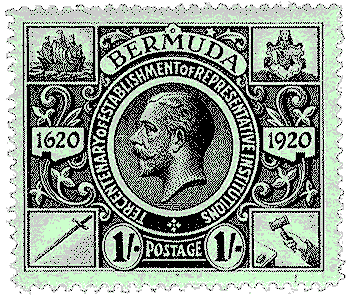
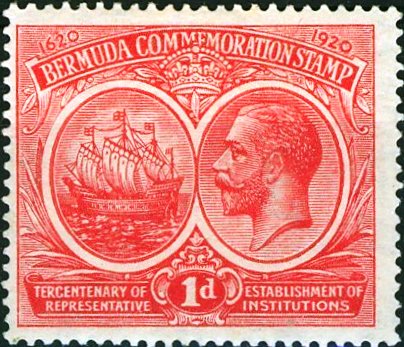
Bermuda Commemoratives 1920
A second issue of commemorative stamps a year later commemorated the same occasion with a completely different design, with George V in the centre and various symbols in the corners.

Bermuda stamps included the following:
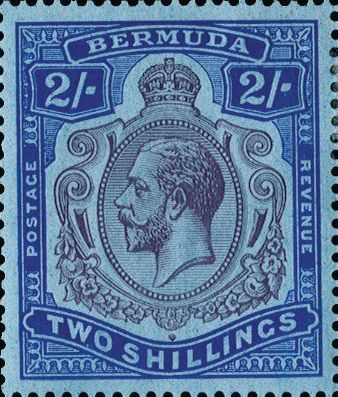
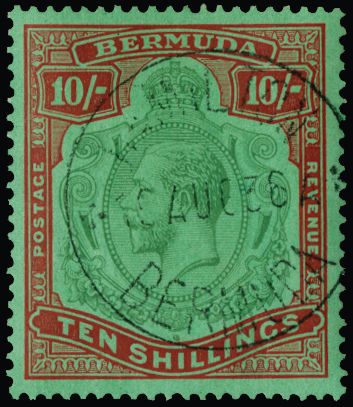
Included was this one:
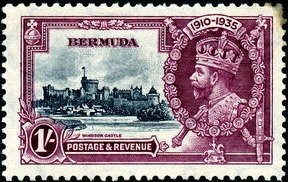
Bermuda issued a pictorial series of stamps, consisting of nine stamps with seven different designs depicting local scenery. Several of the designs were reused, and three more added, for a 1938 issue featuring King George VI.
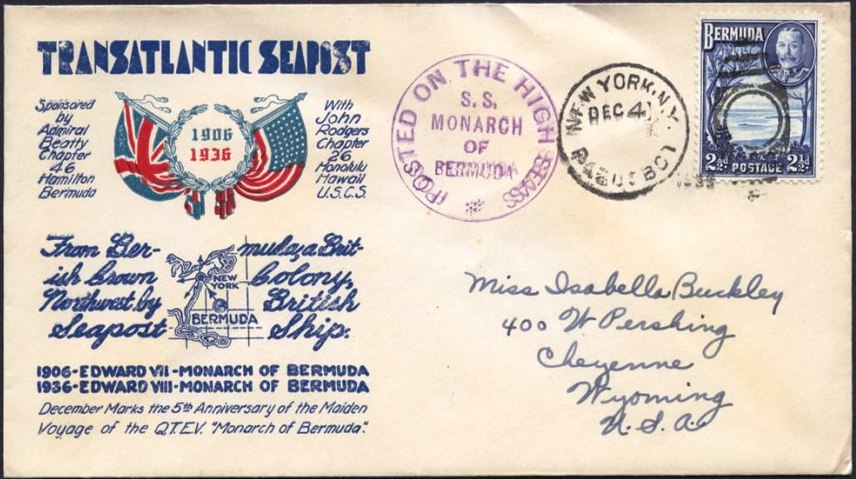
1936. December 4. The Bermuda Post Office issued a First Day Postage Stamp Commemorative Paquebot Cover. It marked the 5th anniversary in December of the sailing of the Furness Withy Q. T. E V cruise ship "Monarch of Bermuda" so-named in honor of King Edward VIII who reigned briefly and was posted in the high seas when the ship left New York for Bermuda. It also showed an American postage date. The Admiral Beatty Chapter 46 of Hamilton was an organization formed to honor the famous British Admiral who among other things had accepted the surrender of the German fleet in 1918 at the end of World War 1, or Great War. He died earlier in 1936.
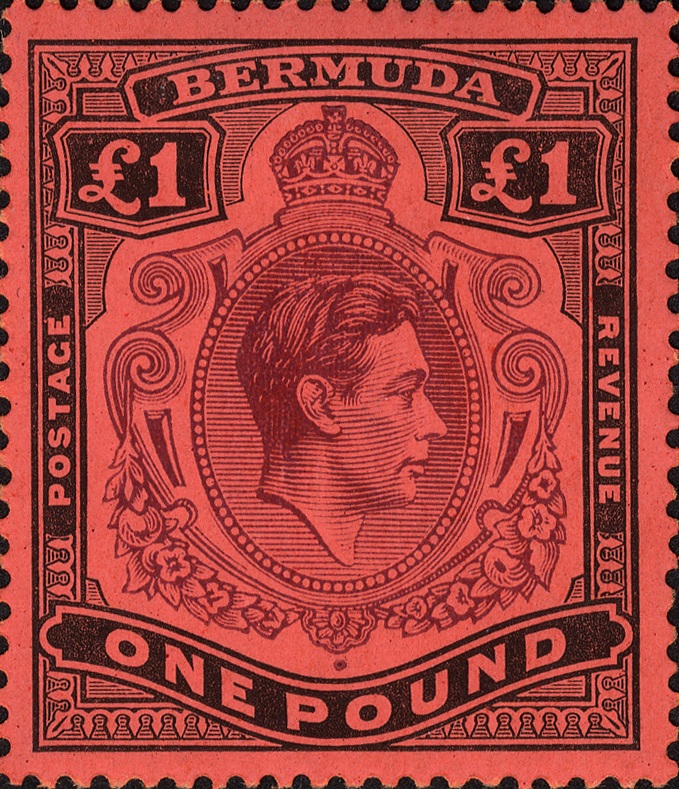
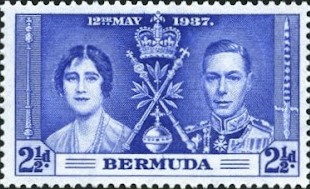
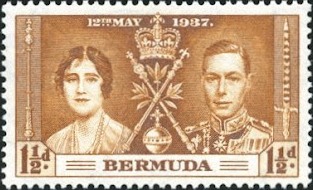
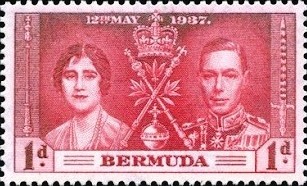
Stamps included several of the yacht Lucie:
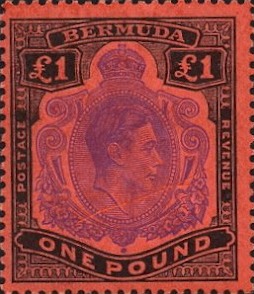
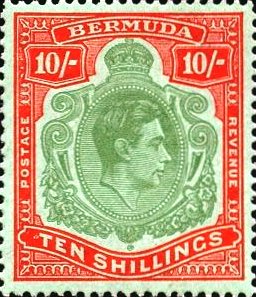
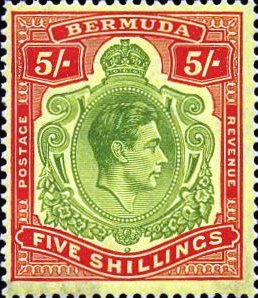
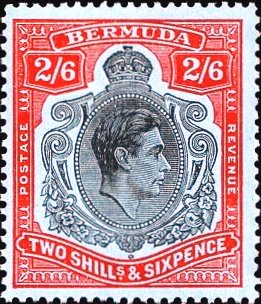
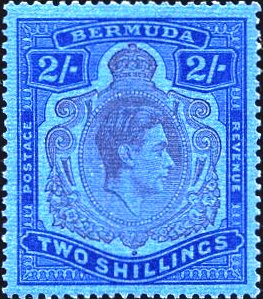
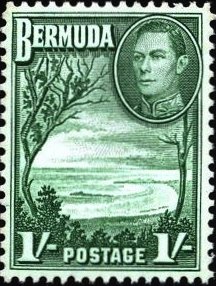
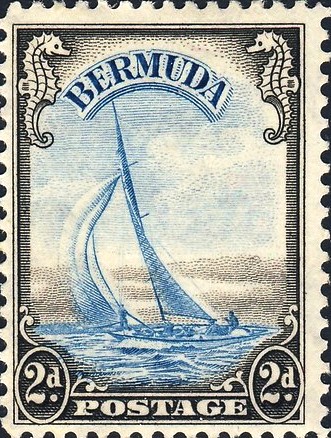
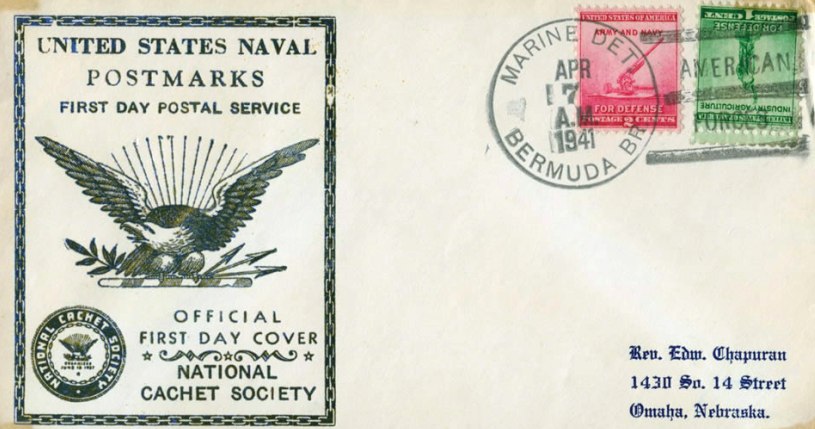
April 7. First Day Postal Service and Official First Day Cover of the US Military Bases post offices just established in Bermuda. Sent by the US Marine Detachment, first unit to be based in Bermuda. Stamps shown are United States of America Army and Navy for Defense Postage 2 Cents and United States of America, Industry Agriculture for Defense Postage 1 Cent.
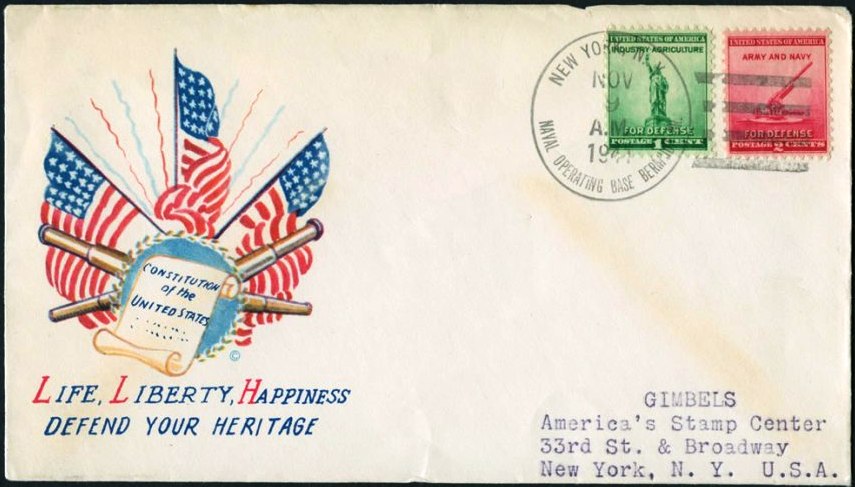
See above story
July 14. First Day Cover of First official mail from US Bases in Bermuda was sent, from members of the US Marine Barracks at NOB Bermuda, opened after the Marine Detachment Bermuda, referred to earlier, closed the day earlier. This base was part of the Land Lease program which exchanged British Bases for US Ships.
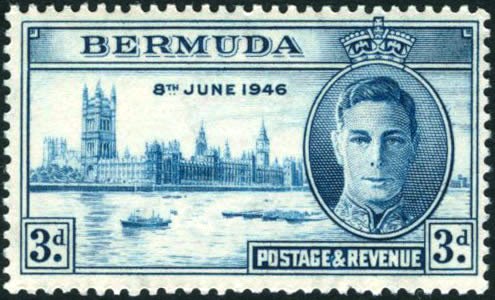
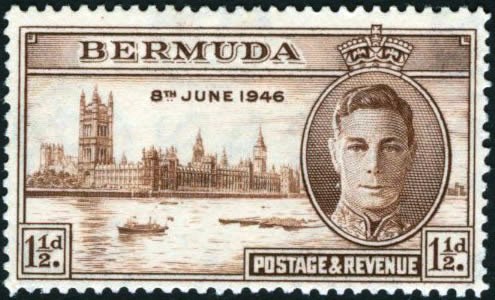
June 8. To commemorate the 1939-1945 World War 2 victory in its own way as a British Colony, the Bermuda Post Office issued these two postage stamps. They were referred to as Victory stamps.
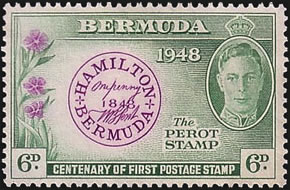
A century after it was issued, Postmaster Perot's provisional postage stamp (see below) was commemorated by the issue of three stamps, a 2 pence and a halfpenny blue and brown; a 3 pence black and blue; and a 6 pence violet and green.
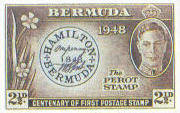
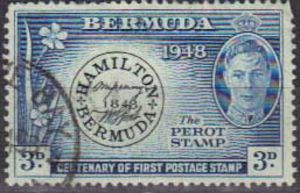
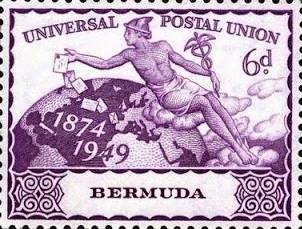
First two: 1949 Postmaster Perot postage stamps commemorating centenary of his first (1849) stamp.
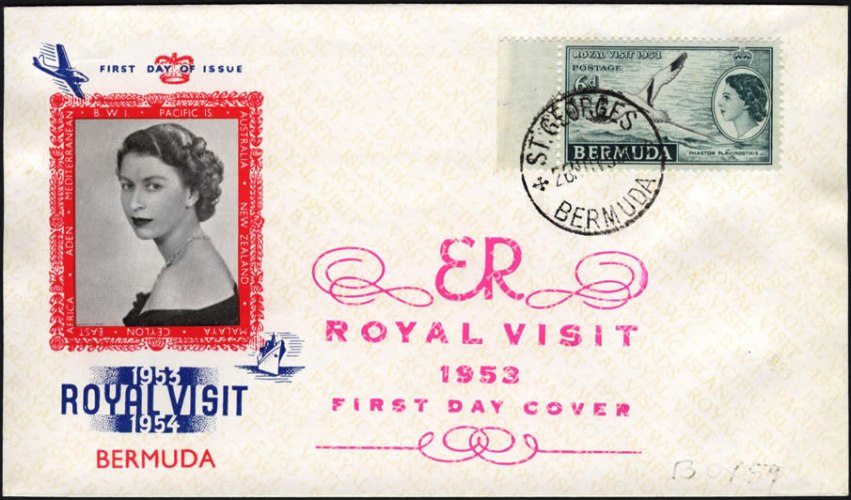
November 26. The Bermuda Post Office issued this First Day Cover to commemorate the just-concluded Royal Visit. The postage stamp used was a QEII 6d White-tailed Tropicbird Phaeton flavirostris.
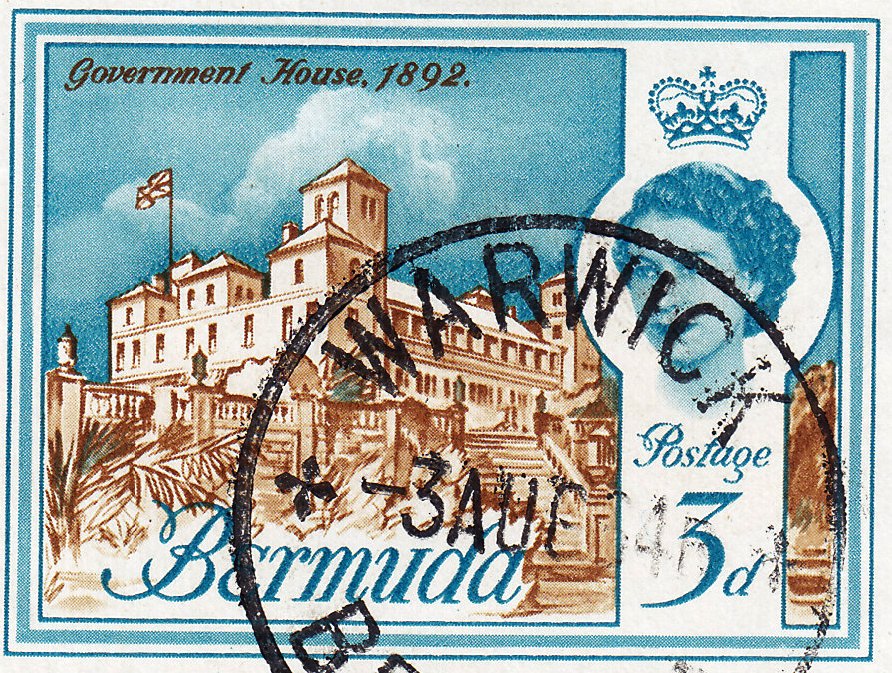
Note how Government House was spelt wrongly
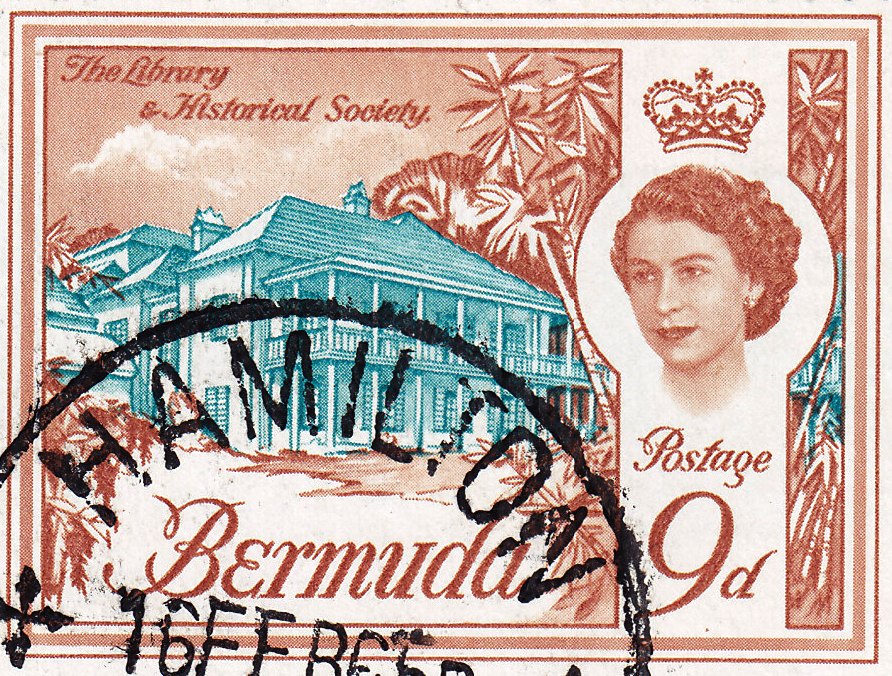
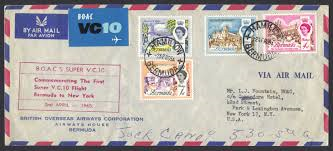
1965. April 2. British Overseas Airways Corporation (BOAC, later British Airways) first flew its new VC-10 aircraft from Bermuda to New York. At that time, BOAC was offering a Bermuda to New York and back service. It attracted a special postage stamp.
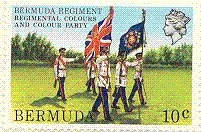
The Bermuda Regiment was formed, a stamp noting it.
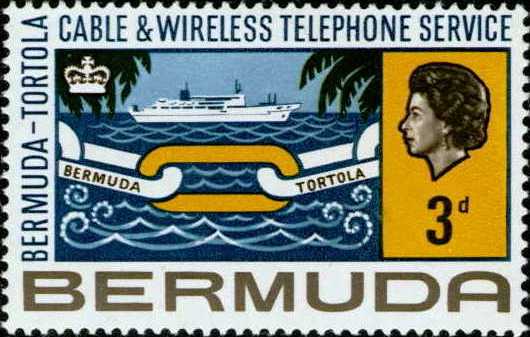
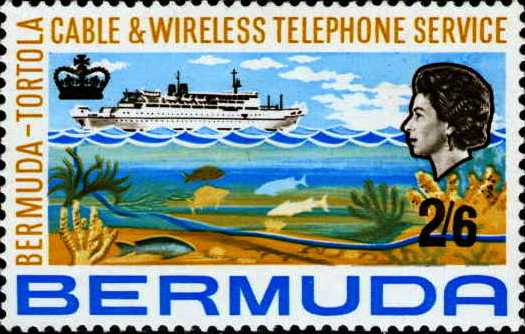
To celebrate Cable and Wireless telephone service between Bermuda and Tortola, BVI.
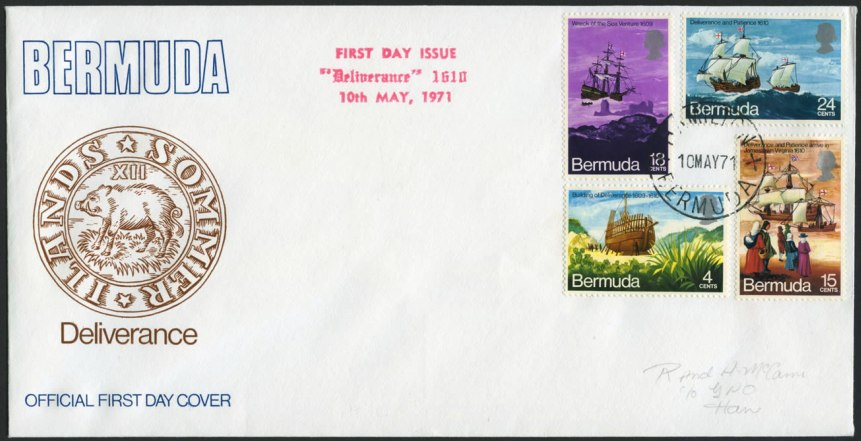
May 10. The Bermuda Post Office issued an Official First Day Cover and the following stamps commemorating the voyages of the Deliverance: :4c Building of Deliverance 1609-1610; 15c Deliverance and Patience arrive in Jamestown Virginia 1610; 18c Wreck of the Sea Venture 1609 and 24c Deliverance and Patience 1610.
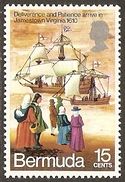
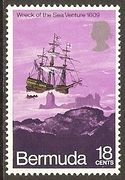
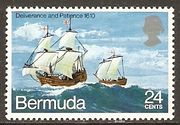
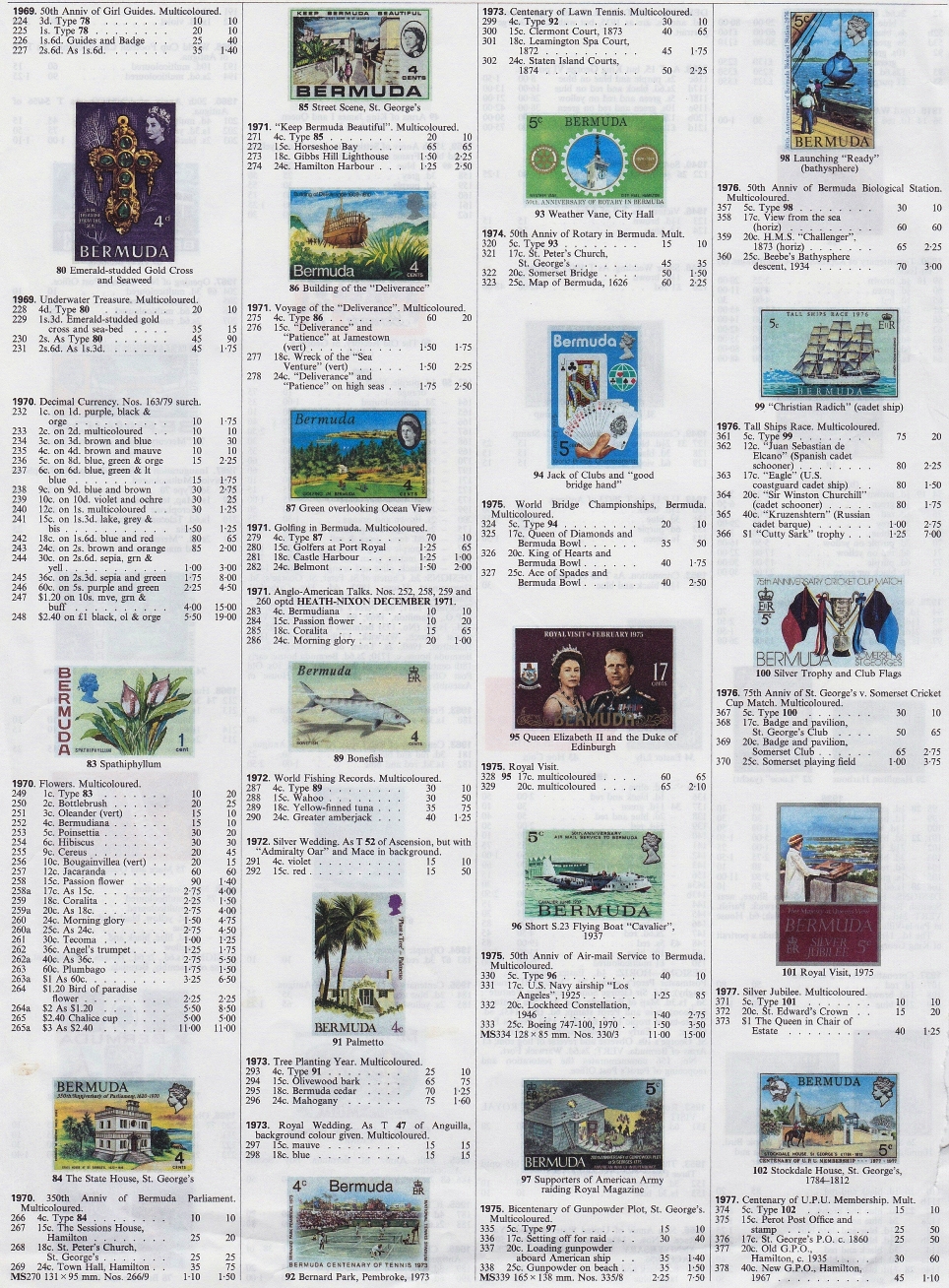
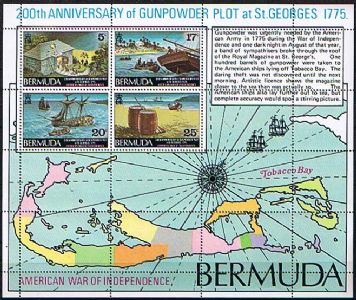
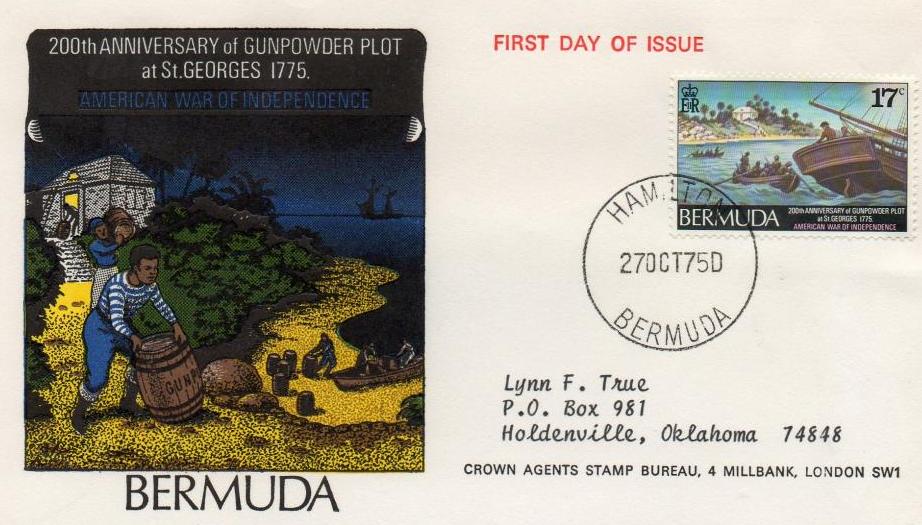
200th Anniversary of Bermuda's (pro-American) Gunpowder Plot. See Bermuda's History 1700-1799. Four stamps were issued, shown top left.
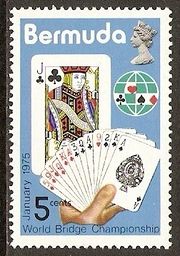
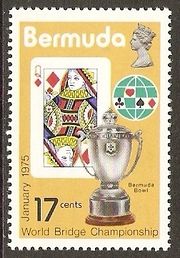
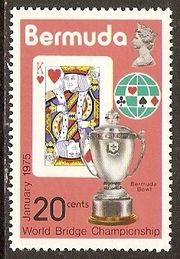
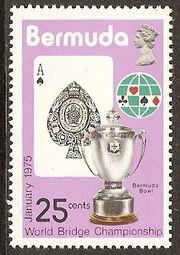
1975 Bermuda World Bridge Championship postage stamps
October 27. The following First Day Cover was issued for the 200th anniversary of the following:
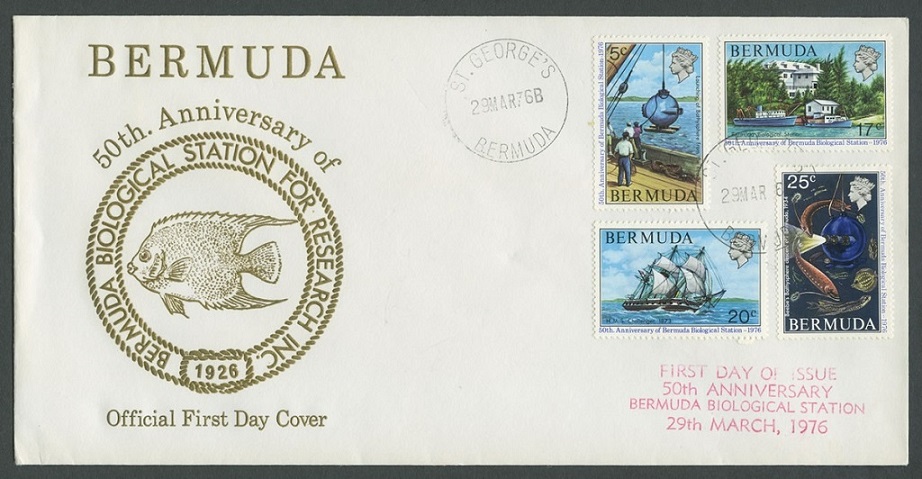
1976. March 29. The Bermuda Post Office issued this set of stamps and First Day Cover to mark the 50th anniversary of the Bermuda Biological Station.
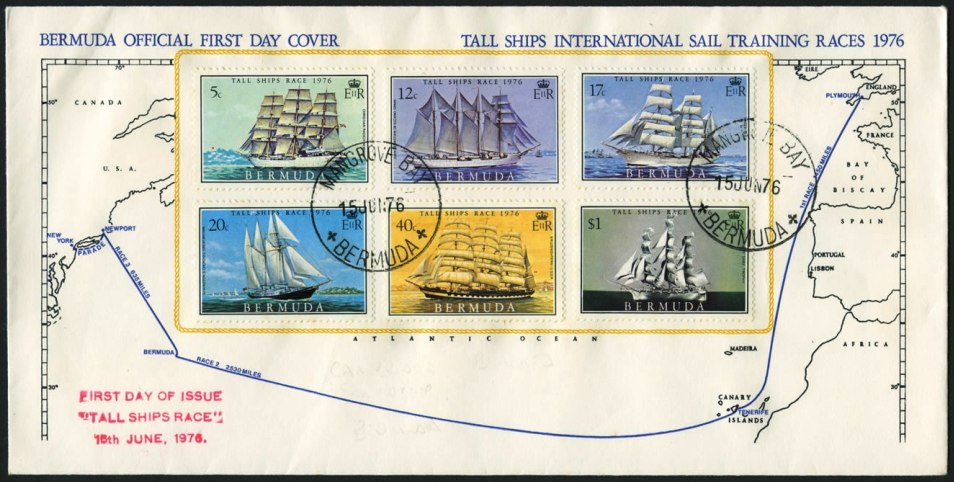
1976. June 15. The Bermuda Post Office issued a First Day Cover and special postage stamps to commemorate the arrival in Bermuda of a fleet of Tall Ships in their Tall Ships Race across the Atlantic to celebrate the 200th anniversary of the founding of the USA. Stamps: 5c Christian Radich Norway (cadet ship); 12c Juan Sebastian de Elcano Spain (cadet schooner); 17c Eagle USA (coastguard cadet ship); 20c Sir Winston S. Churchill Great Britain (cadet schooner); 40c Kruzenshtern USSR (cadet barque); $1 Cutty Sark trophy.
See above article
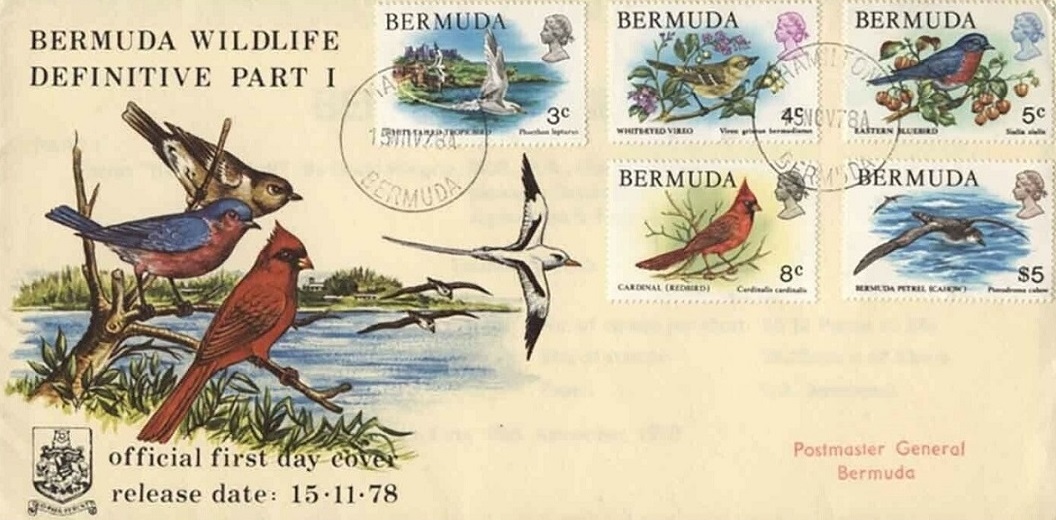
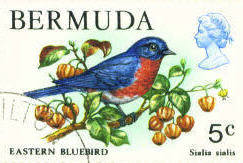
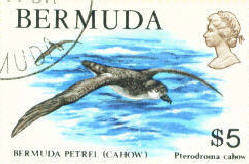
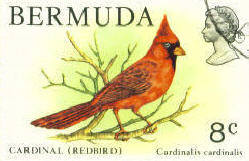
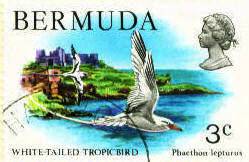
November 15. The Bermuda Post Office issued this First Day Cover and these stamps to honour Bermuda Wildlife Definitive Part 1 - Birds
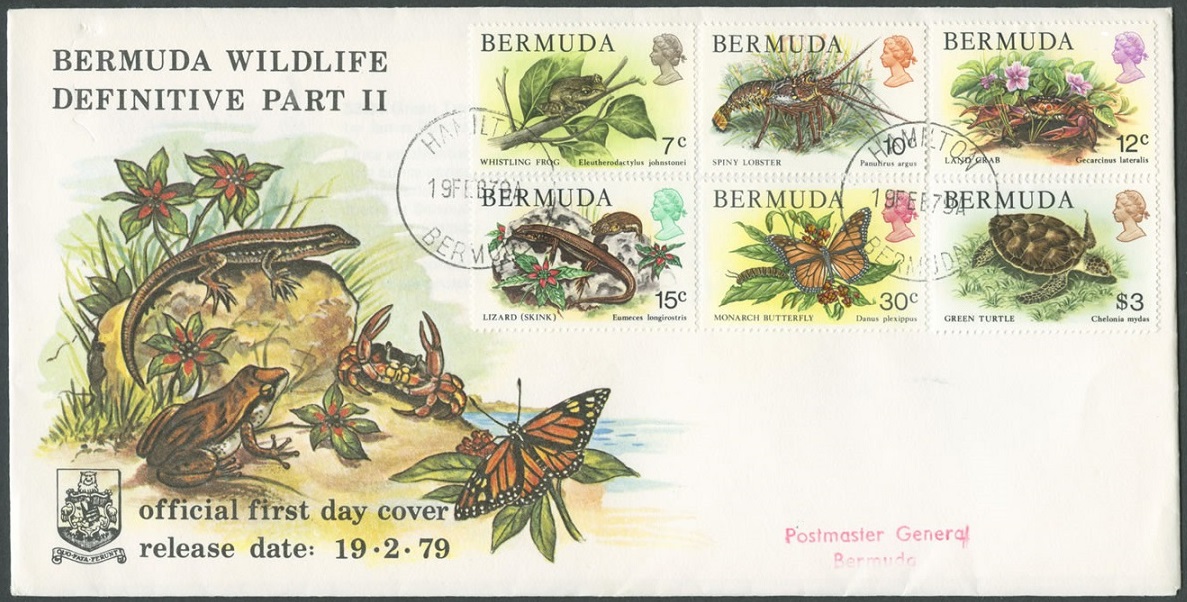
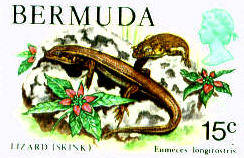
February 19. The Bermuda Post Office issued this First Day Cover and these stamps to honour Bermuda Wildlife Definitive Part 2 - Skinks and more
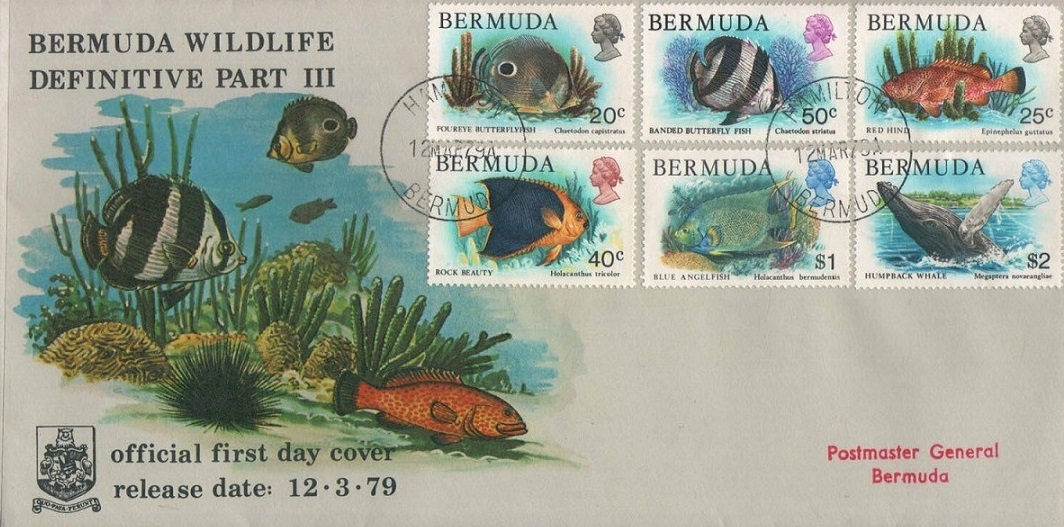
March 3. The Bermuda Post Office issued this First Day Cover and these stamps to honour Bermuda Wildlife Definitive Part 3 - Fish
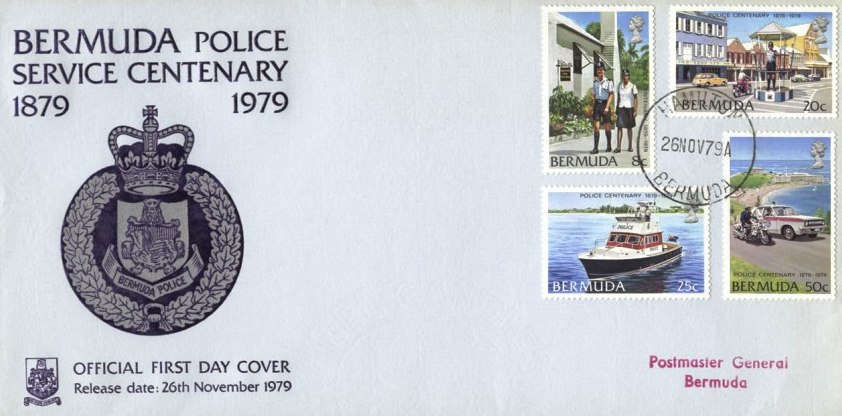
November 26. The Bermuda Post Office issued this First Day Cover and these stamps to honour the Centenary of the Bermuda Police Service. 8c male and female police officers; 20c police office in Birdcage; 25c Police launch "Blue Heron" and 50c Police car and motorcycle.
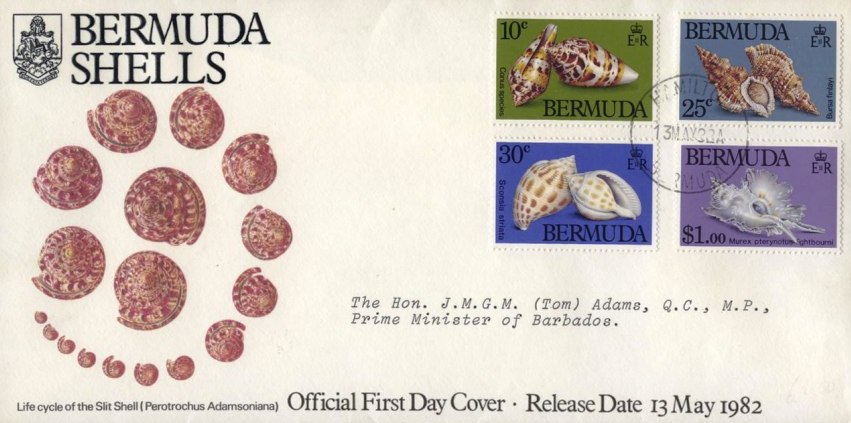
May 13. The Bermuda Post Office issued an Official First Day Cover to commemorate Bermuda Shells. This First Day Cover was sent to The Hon. J. M. G. M. (Tom) Adams, QC., MP, then Prime Minister of Barbados and a keen shell collector.
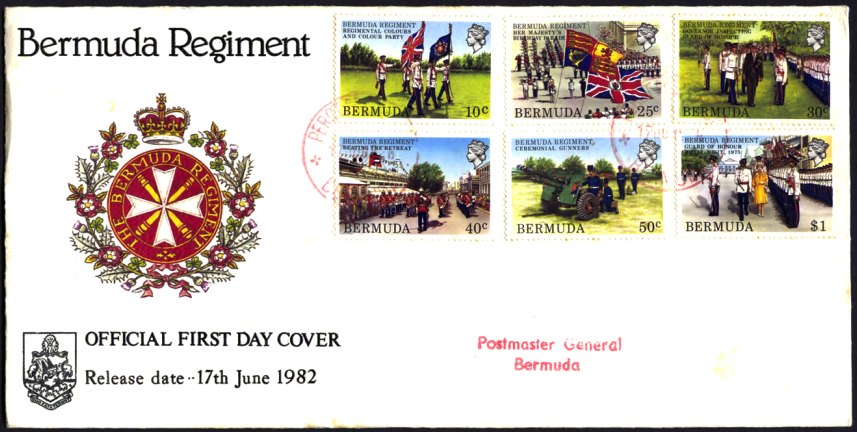
1982. June 17. The Bermuda Post Office issued this Official First Day Cover and postage stamps to commemorate the establishment of the Bermuda Regiment in 1965. Postage stamps are BERMUDA REGIMENT 10c REGIMENTAL COLOURS AND COLOUR PARTY; 25c HER MAJESTY'S BIRTHDAY PARADE; 30c GOVERNOR INSPECTING GUARD OF HONOUR; 40c BEATING THE RETREAT; 50c CEREMONIAL GUNNERS and $1 GUARD OF HONOUR ROYAL VISIT, 1975.
1962. 350th anniversary of Bermuda's Parliament, the House of Assembly, the oldest of all British colonial and overseas parliaments.
1982. November 18. The Bermuda Post Office issued this Official First Day Cover and postage stamps to commemorate Bermuda's Forts, with their original spelling. Stamps: 10c Charles forte; 25c Pembroks forte; 30c Southampton forte and $1 Smiths forte and Pagets forte.
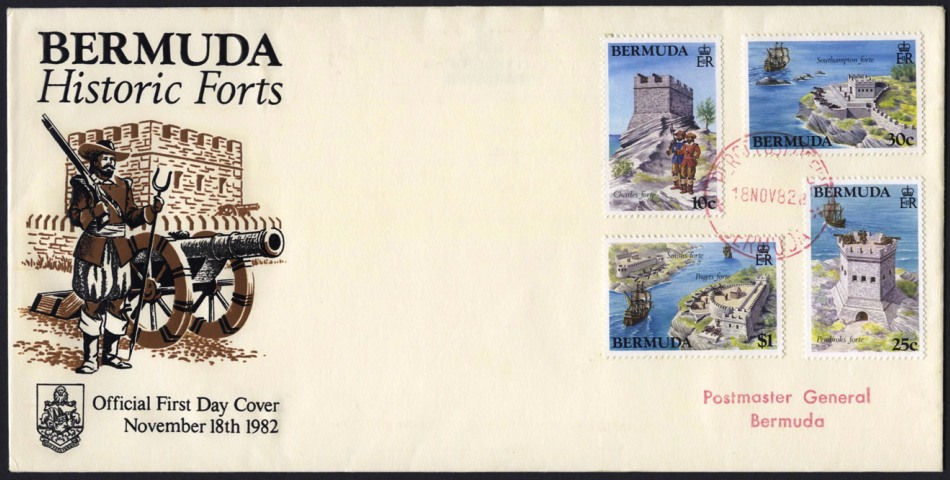
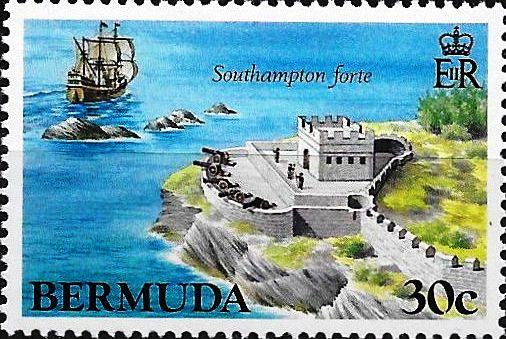
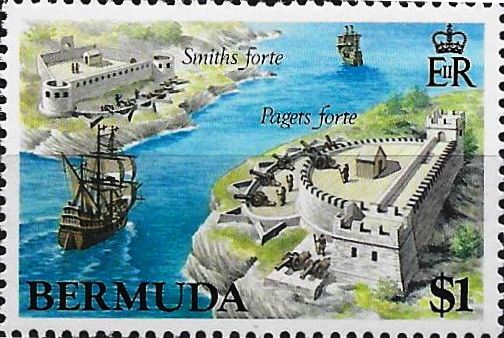
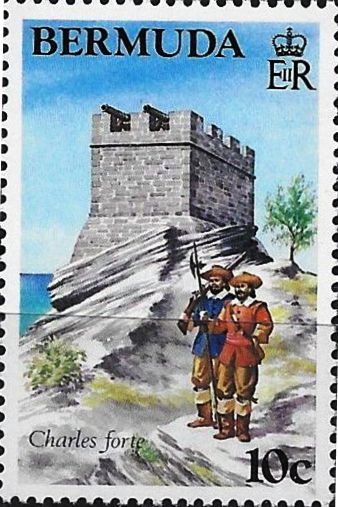
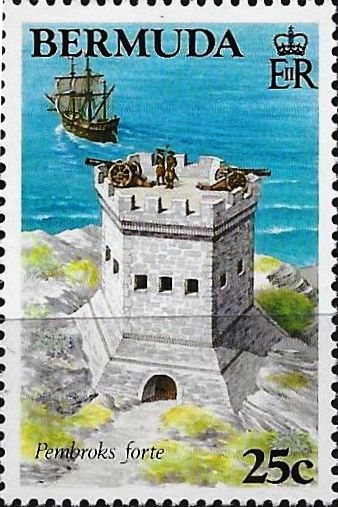
Bermuda Forts stamps, see above
October 13. The Bermuda Post Office commemorated the 200th Anniversary of Manned Flight with the issue of these postage stamps shown below:
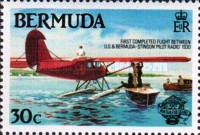
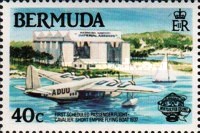
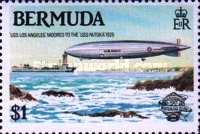
17th October. A British Airways Concorde flew from Bermuda to Orlando, Florida. in 1 hour and 36 minutes.
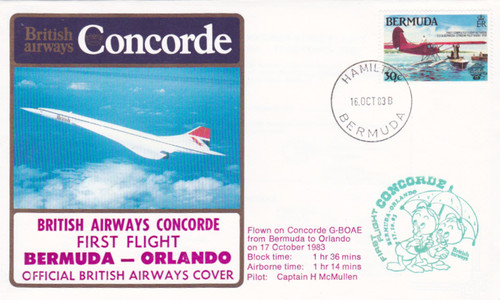
British Airways, not Bermuda Government, stamp issue
When British Airways and Air France commenced SST Concorde services in 1976 - see http://en.wikipedia.org/wiki/Concorde_SST - to their major routes, including in BA's case to the Caribbean, Bermuda was not then and never became one of the destinations included. Bermuda's runway was easily long enough but may have been deliberate policy on the part of BA not to fly the world's most expensive-to-operate supersonic aircraft which carried only a relatively small number of passengers when compared to much more expansive aircraft on the London-Bermuda direct route which was BA's single most profitable route by far. But it is known that BA charter or regular flights stopped off in Bermuda on several occasions during Concorde's commercial lifespan (that lasted until 2003), including when the Queen flew to and from the Caribbean on her Jubilee tour.
January 26. The Bermuda Post
Office issued a First Day Cover and Commemorative stamps to celebrate the 200th
anniversary of the Island's first newspaper and Postal Service.
Stamps: 12c Joseph Stockdale 1754-1803; 30c Bermuda's first newspaper; 40c
Stockdale's Postal Service; and $1 The 'Lady Hammond. '
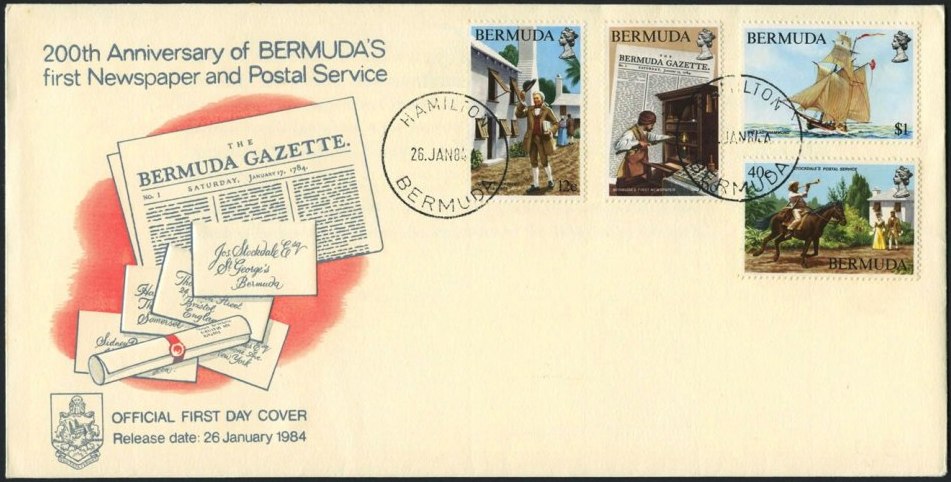
See above
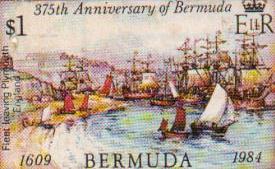
May 3. To commemorate the 375th anniversary of the colonization of Bermuda, the Bermuda Post Office published this First Day Cover and postage stamps:
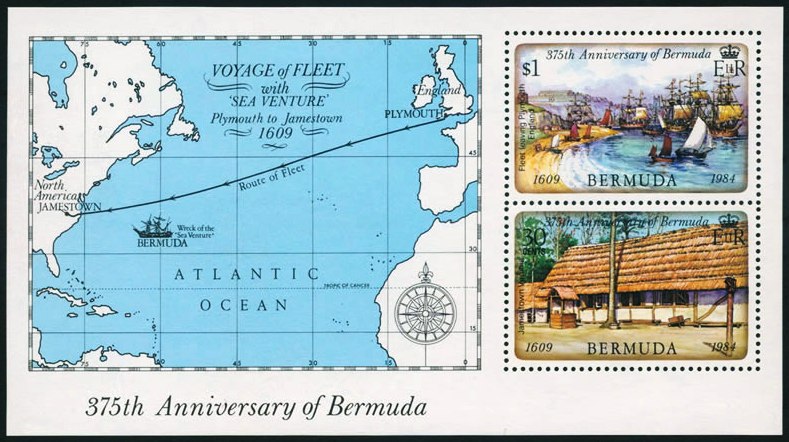
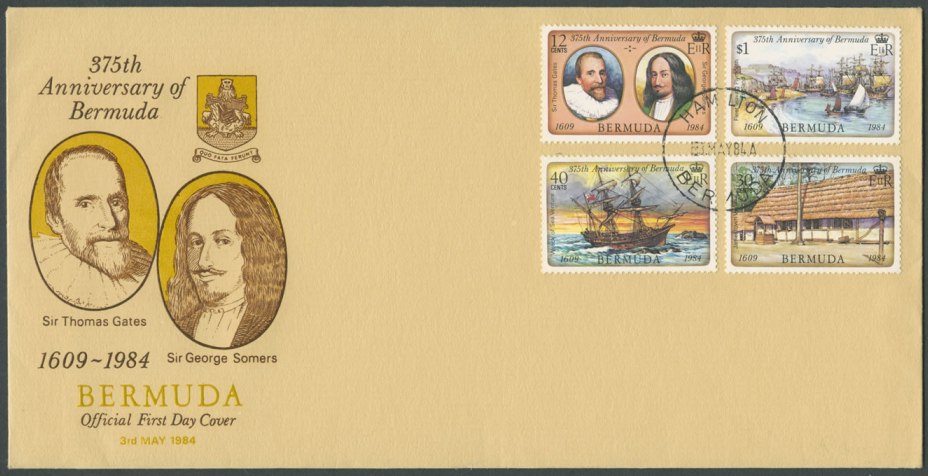
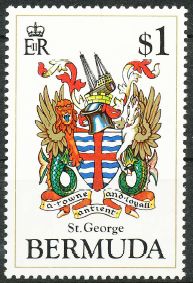
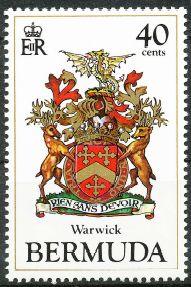
Bermuda issued these stamps on all the parishes:
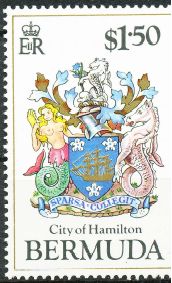
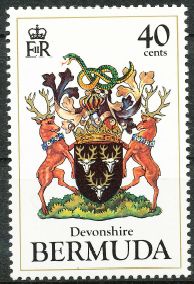
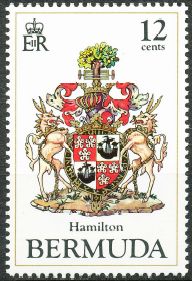
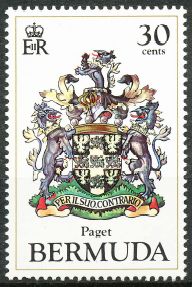
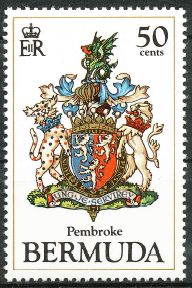
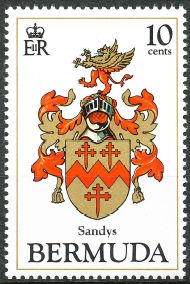
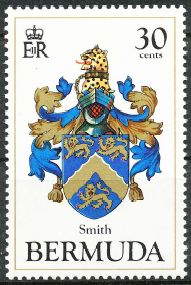
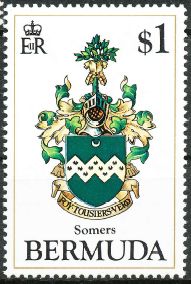
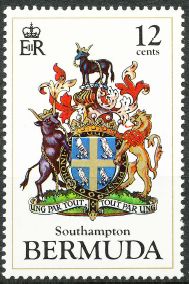
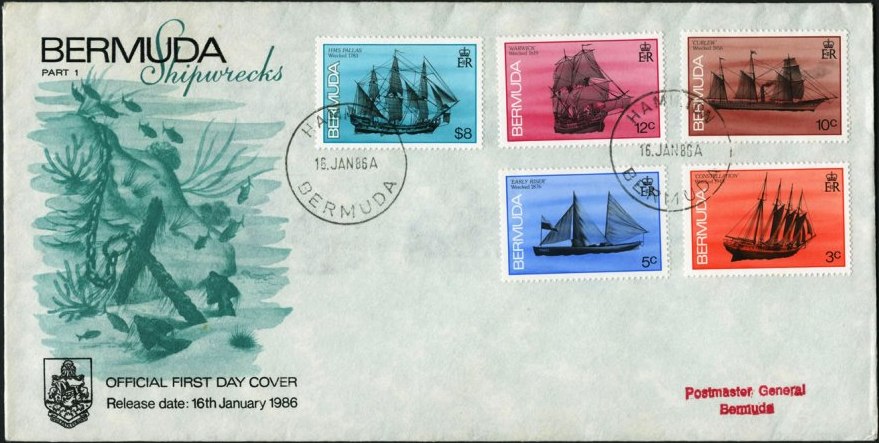
January 16. The Bermuda Post Office issued this Official First Day Cover of Bermuda Shipwreck postage stamps. Featured stamps were the 3c Constellation Wrecked 1943; 5c Early Riser Wrecked 1876; 10c Curlew Wrecked 1856; 12c Warwick Wrecked 1619; $8 HMS Pallas Wrecked 1783.
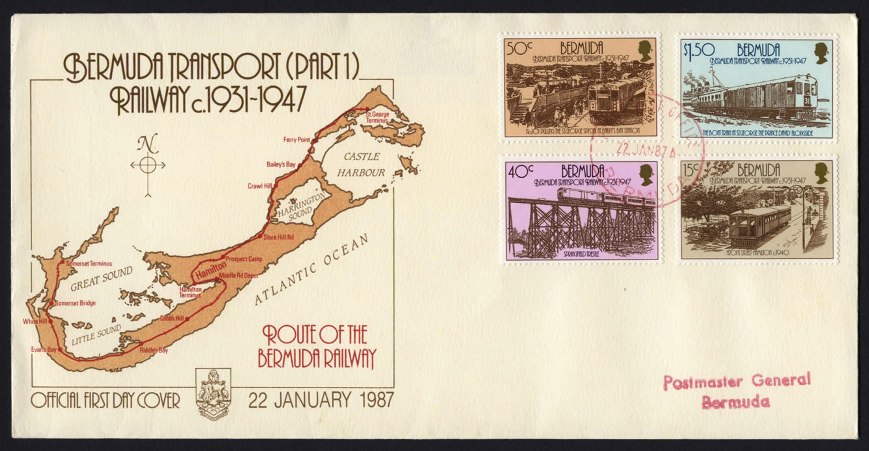
January 22. The Bermuda Post Office issued this new Official First Day Cover and postage stamps. They commemorated the Bermuda Railway of yesteryear. 15c Front Street Hamilton c.1940; 40c Springfield Trestle; 50c No. 101 Pulling the St. George Special at Bailey's Bay Station and $1.50 The Boat Train at St. George. The 'Prince David' alongside.
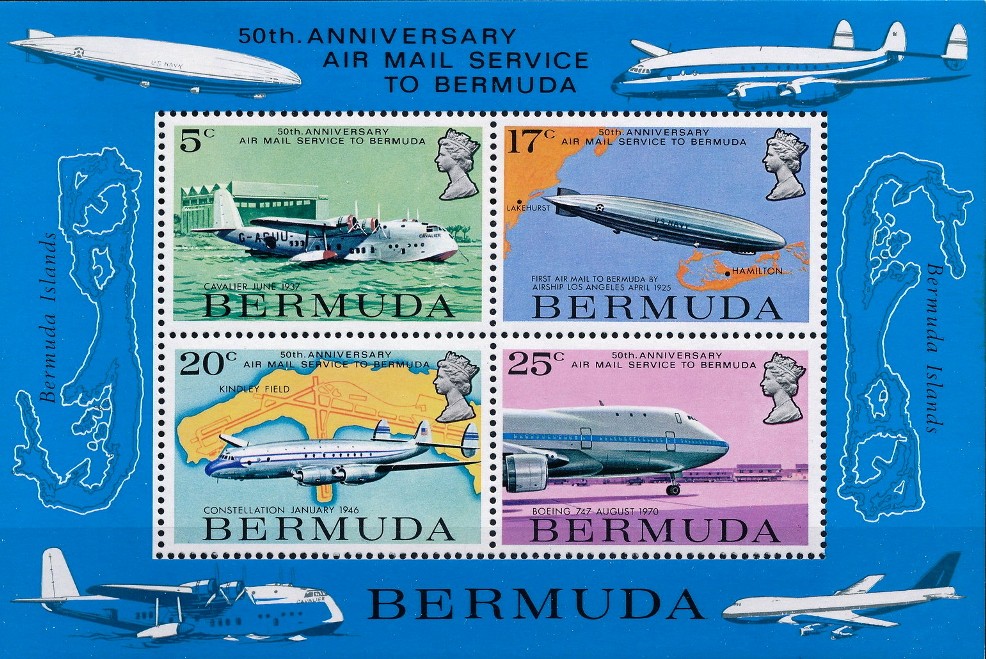
Bermuda issued the following commemorative postage stamps shown below to mark the 50th anniversary of aviation in Bermuda:
1987. April 30. To commemorate the artistry of Winslow Homer in Bermuda from 1901, the Bermuda Post Office issued these commemorative postage stamps:

April 19. The Bermuda Post Office issued a First Day Cover and postage stamps in honor of Masterwork's Bermuda Paintings. They featured 18c Fairylands, Bermuda, c 1890 Ross Sterling Turner; 50c Shinbone Alley, c. 1953 Ogden M. Pleissner; 60c Salt Kettle, 1916 Prosper Senate and $2 St. George's, 1934 Jack Bush.
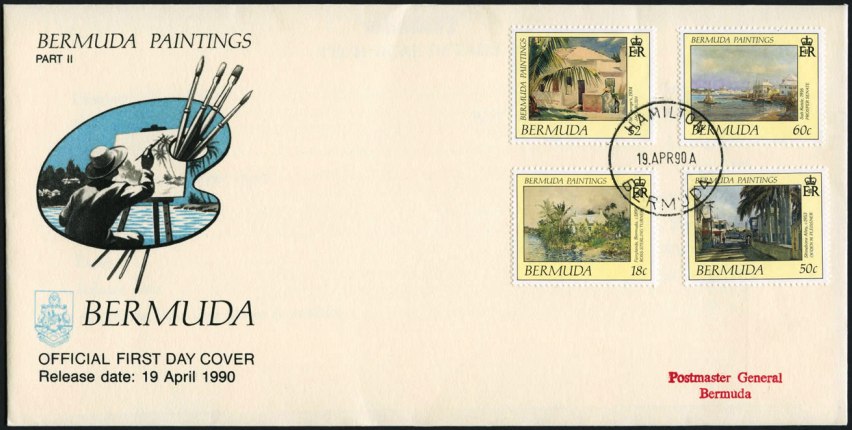
See above story.
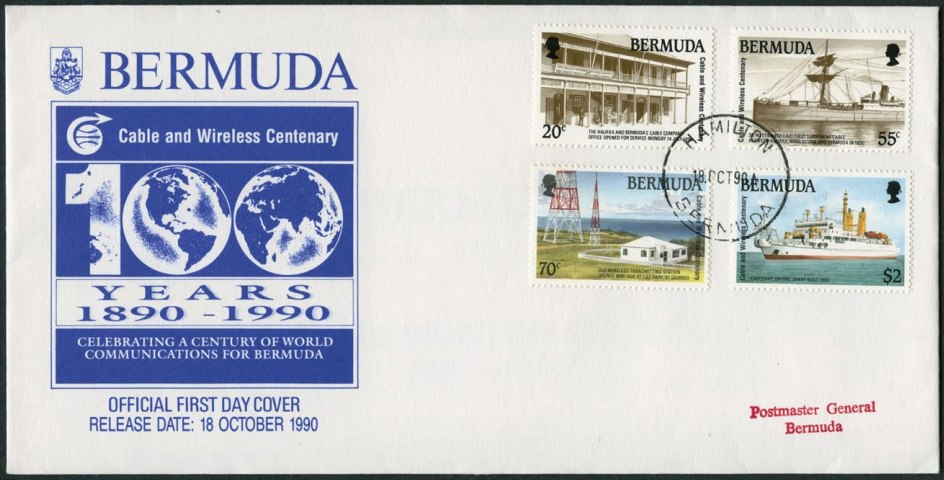
1990. October 18. The Bermuda Post Office issued a commemorative First Day Cover and postage stamps to celebrate a century of World Communications for Bermuda. Stamps: Cable and Wireless Centenary 20c The Halifax and Bermudas Cable Company Office opened for service Monday 14 July 1890; 55c SS Westmeath laid first submarine cable between Halifax, Nova Scotia and Bermuda in 1890; 70c Old wireless transmitting station opened May 1928 at Lily Park, St. George's; and $2 Cable ship Sir Eric Sharp built 1989.
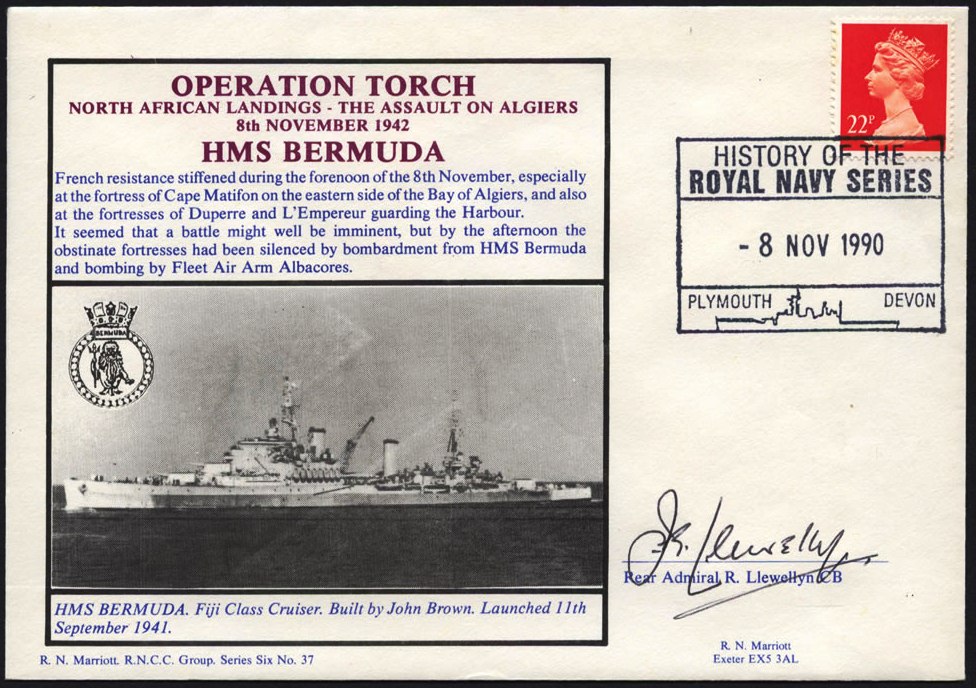
1990. November 8. The British Post Office in the United Kingdom issued this commemorative First Day cover on a Royal Navy ship named after Bermuda, which played an important role in World War 2 and which at one time was a periodic visitor to Bermuda.
May 16. The Bermuda Post Office issued this First Day Cover and Commemorative stamps Part 3. Stamps: 20c Pitts Bay Road, Prosper Senat 1916; 55c Frank Allison 1930; 70c Old Maid's Lane, Jack Bush 1934; $2 St. George's, Ogden M. Pleissner 1953.
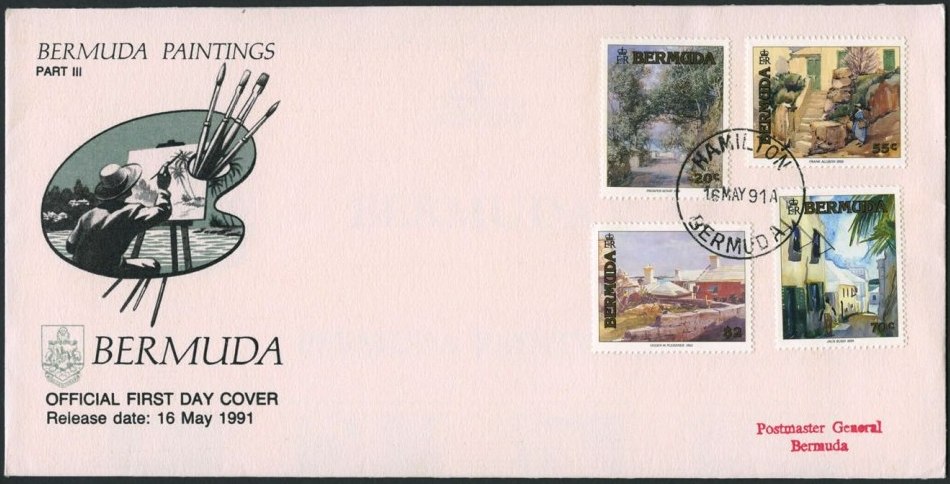
See item above
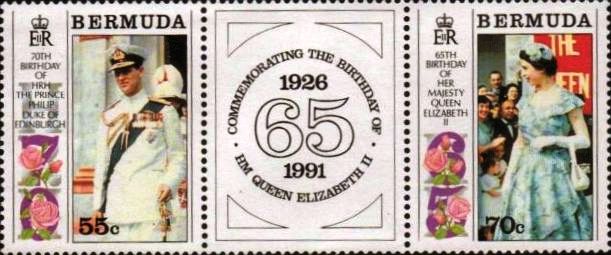
Bermuda issued this commemorative postage stamp to mark the 65th birthday of the Queen and 70th birthday of the Duke of Edinburgh.
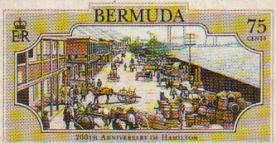
One of the many special stamps was for the City of Hamilton's bicentenary that year.
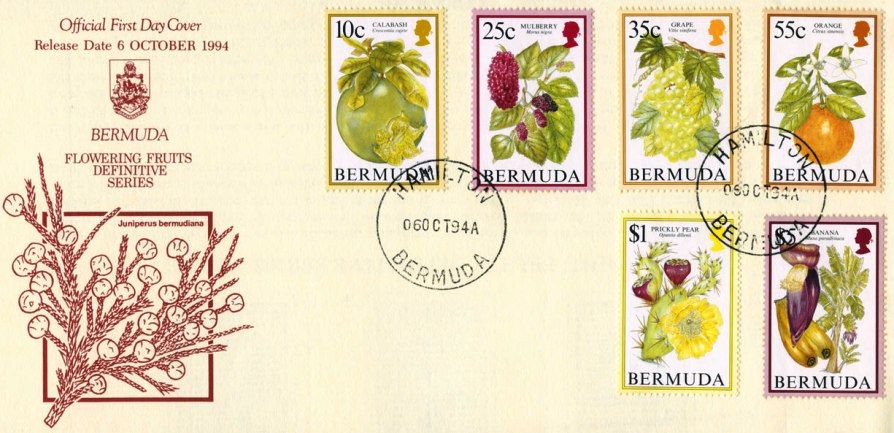
December 4. The Bermuda Post Office Government issued an Official First Day Cover and six postage stamps on Military Bases formerly in Bermuda. They are shown below:
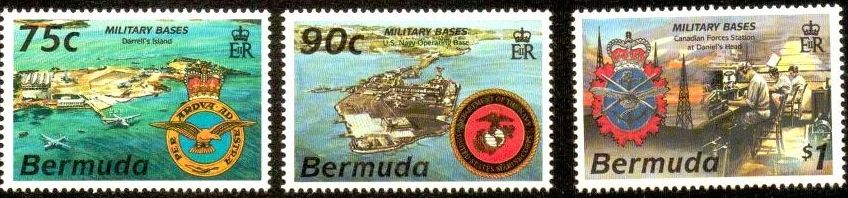
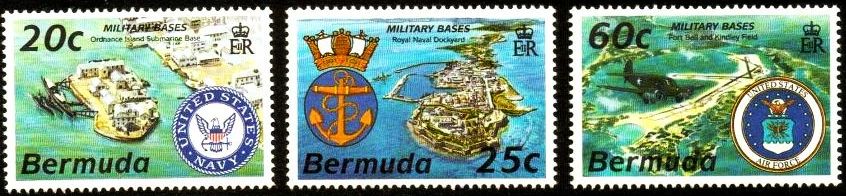
The one relating to the former Canadian Forces Station has the following description for this BD$1 stamp on the liner details of the First Day Cover issued with this issue. "The Royal Canadian Navy leased some fourteen acres of former British Admiralty lands at Daniel's Head towards the western end of Bermuda in 1963. The installation was established as a signals intelligence unit to support the Canadian Forces and to aid in search and rescue operations. Due to changes in international relations and with increased fiscal constraints, the Canadian Government closed the site in December 1993."
Since then, cultural, illustrated events and personalities in Bermuda history have largely dominated Bermuda postage stamps.
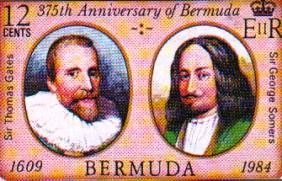
Of special interest are these stamps that commemorated Bermuda's colonial history as a British island nation and overseas territory. Sir Thomas Gates, as Governor designate, and Admiral Sir George Somers commanded the British fleet to Jamestown, Virginia, in 1609, from Plymouth, Devon. Off the Azores, after a tempest, seven of nine ships got to Jamestown. The flagship Sea Venture, with Somers, Gates and 150 others, was wrecked on a Bermuda reef. All survived and found wild hogs, birds and marine life as food, no humans. Bermuda was uninhabited, with a warm and mild climate. Nine months later, in May 1610, leaving four men to keep Bermuda inhabited as a new British possession, they sailed on two pinnaces they built in Bermuda from native red cedar, the Deliverance and Patience, for Jamestown.
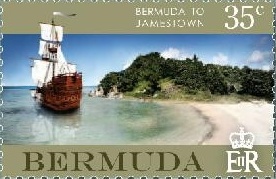
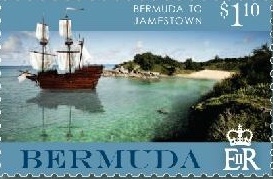
They arrived there with enough provisions from Bermuda for the starving Virginia colony.
Conditions were horrible there, with chronic food shortages, rampant starvation, miserable conditions, sickness and difficulties with Indians, compared to idyllic if isolated circumstances in Bermuda nearly 600 miles away. In Virginia, they had been presumed dead. Only when they arrived did the Virginians - later, officials in England - know they had landed and survived.
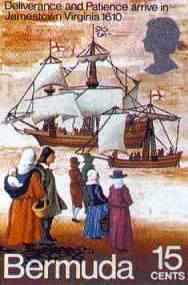
Accounts of their tempest ordeal before their shipwreck and their pleasure with Bermuda caused a sensation in London. They inspired William Shakespeare to pen his The Tempest drama; and resulted in the permanent settlement of Bermuda in 1612.
In 1620, the first legislative meeting was held at St. Peter's Church, St. George's, later rebuilt in limestone. English architecture was used by the first colonists but with local limestone not wood after 1620. Bermuda limestone was the building material, for protection against hurricanes. But quarrying and cutting was arduous. It is still used today mostly for roofs. (Concrete blocks are now the walls in modern Bermuda homes). Early settlers built first wooden then limestone forts on Paget and Smith's islands. But only one ever fired a shot in anger, against a Spanish ship.
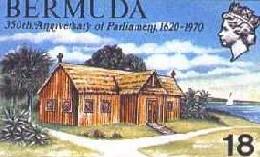
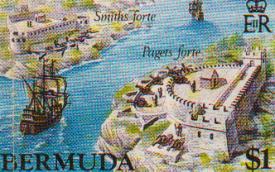
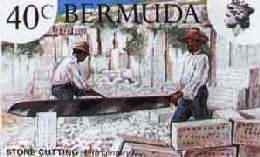
In 1775, some Bermudians, sympathetic when America rebelled against British rule, stole gunpowder from the British Army in St. George's. They delivered it to an American ship, for General George Washington's armies. The Continental Congress exempted Bermuda from the food and grain embargo against other British territories during the Revolutionary War.
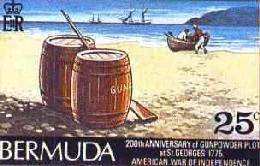
In 1793, over the objections of the town of St. George, Hamilton was incorporated in 1793 as Bermuda's capital.
May. A new postage stamp set was issued, showing four Bermuda caves - Fantasy Cave, Crystal Cave, Prospero's Cave and Cathedral Cave.
November 18. 50th Anniversary of Bermuda Orchid Society was celebrated with the issue of four orchid stamps.
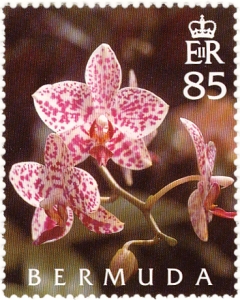
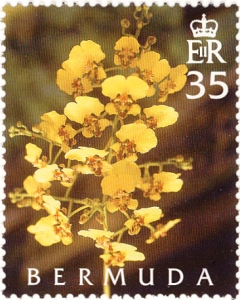
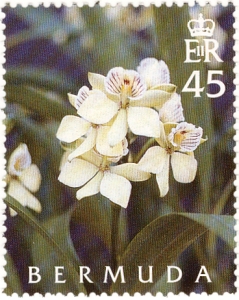
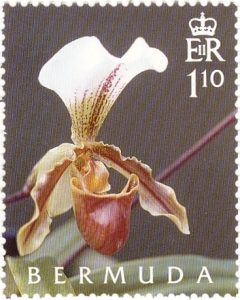
2005
December 23. Stanley Gibbons Group Ltd, noted rare stamp dealers, launched the Bermuda domiciled and incorporated Rare Stamp Investment Fund, with legal advisor Cox Hallett and Wilkinson.
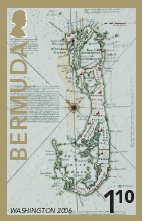
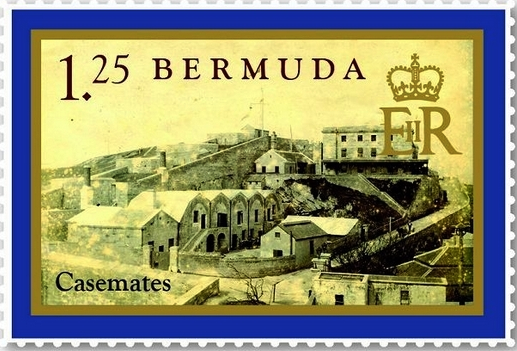
Bermuda's 400th year of settlement.
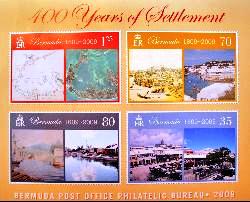
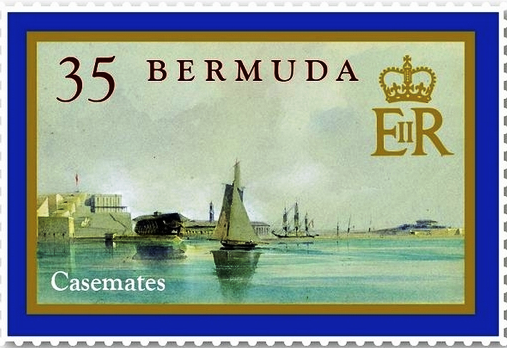
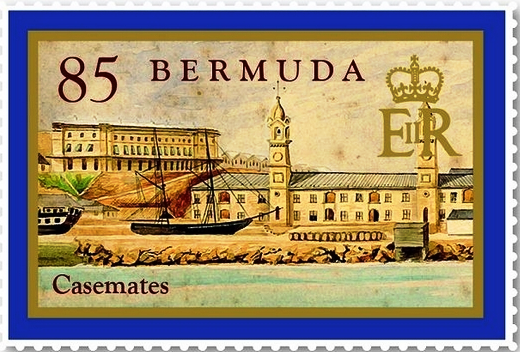
Bermuda Casemates Dockyard stamps
.png)
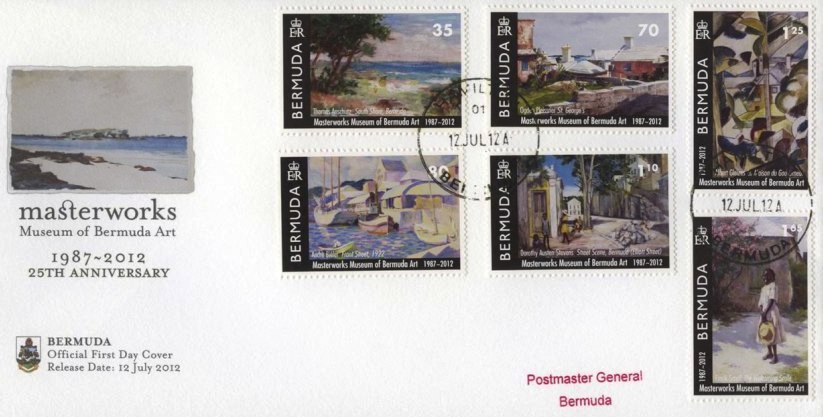
July 12. The Bermuda Post office, to commemorate Masterworks Museum of Bermuda, released this First Day Cover of new Bermuda postage stamps. They featured the artworks done in Bermuda by Thomas Anshutz, South Shore, Bermuda; Ogden Pleissner St. George's; André Biéler, Front Street; Dorothy Austen Stevens Street Scene, Bermuda (Elliott Street); Albert Gleizes La Maison du Gouveneur; and Frank Small,Welcoming Smile.
Other stamps include St. Peter's Church
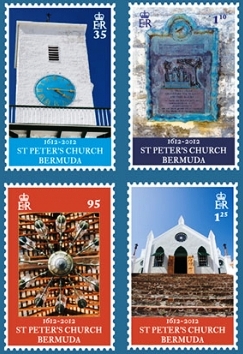
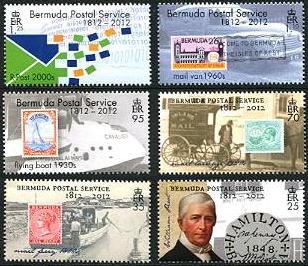
Bermuda stamps 2012
May 16. The Bermuda Post Office issued this First Day Cover showing new postage stamps circulated about Bermuda's beaches, part 2.
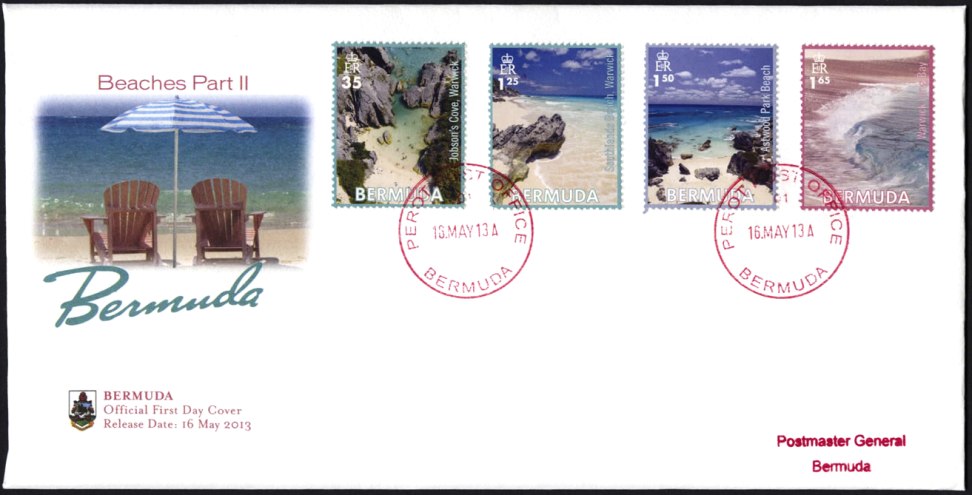
Bermuda Beach stamps Part 2, above.
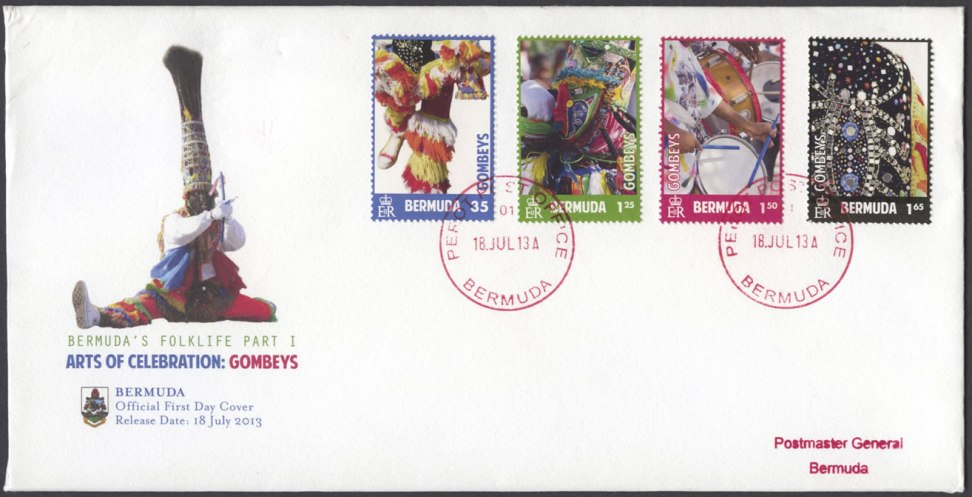
July 18. One of Bermuda’s most cherished traditions was chosen to adorn a new set of Island stamps. Gombeys are the subject of the third set of stamps issued by the Bermuda Post Office for 2013 and they are the first in a planned series focusing on folk life and arts of celebration on the Island. The brightly colored images will be seen around the world, on regular mail and by collectors who order first-day covers or sheets of stamps. Gombey dancers are really Bermudian. They’re significant to Bermuda's heritage and they have not been showcased greatly in past years. Those who purchase the first-day covers also received liner notes about the Gombeys and their place in Bermuda history. The Gombey stamps feature close-up details of the dancers’ costumes and dancing movements.
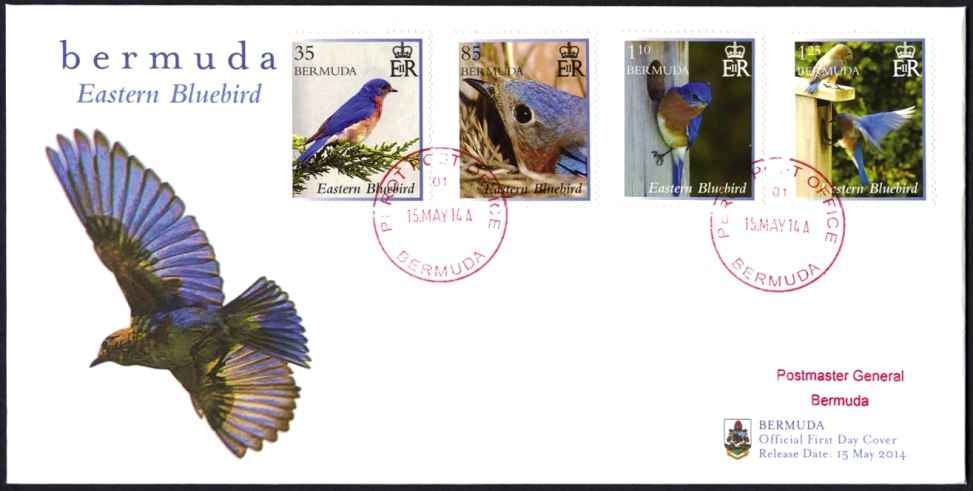
May 15. The Bermuda Post Office released this new First Day Cover and stamps featuring Bermuda's Bluebirds.
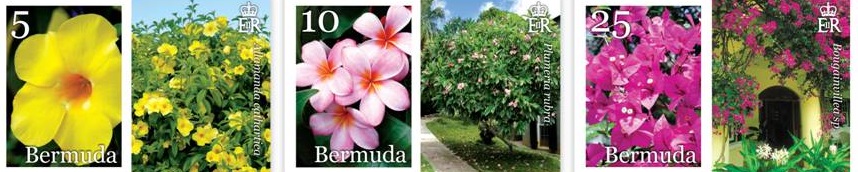
Bermuda Flowers featured on Bermuda Postage stamps
To come.
2016. May 17. A new series of stamps highlighting Bermuda’s involvement in the First World War is set to be released this week by the Bermuda Post Office. The series, designed by Keno Simmons, celebrates the service of the 500 young Bermudians who left the island to fight, and the 80 who lost their lives. Contingencies from both of the segregated militias of the day — the white Bermuda Volunteer Rifle Corps and the black Bermuda Militia Artillery — took part in combat in Europe, working alongside the Lincolnshire Regiment and the Royal Garrison Artillery respectively. The first of the stamp series, valued at 50¢, shows the first contingent of the BVRC on the Hamilton Docks, awaiting their deployment in May 1915, while the $1 stamp depicts the Bermuda contingency of the Royal Garrison Artillery, along with a map showing the locations where they were engaged. The $1.15 stamp shows a letter sent from the island to W.F. Anderson, who was attached with the Lincolnshire Regiment, and returned with the notation “Killed in Action 1/4/16”, along with the dog tags of Harold Trimingham. The series continues with a $1.20 stamp, which focuses on a postcard sent back to Bermuda by BVRC’s Cyril Young and a photograph of Cyril Chesterfield Easton of the BMA, and a $1.35 stamp which highlights a pre-war recruitment poster for the BMA and a Royal Garrison Artillery cap badge. The final stamp, valued at $1.55 in the series portrays 19-year-old Cecil Montgomery-Moore, who earned the Distinguished Flying Cross after shooting down three German planes. The stamp series is set to be released on Thursday.
2017. June 9. A set of stamps highlighting the Queen’s connection to the island are set to be released this month to celebrate her position as the longest reigning monarch. The three-stamp collection features photographs of Her Majesty taken during recent visits to the island. The First Day Cover also features a portrait of the Queen painted by former Bermuda resident Henry Ward, which was personally unveiled by the Queen last year. Philatelist Horst Augustinovic said that the addition of the portrait came late in the process, after the stamps had been approved. “We had already finalized this with the royal cipher and we opened The Royal Gazette that morning and there was the story about the painting,” he said. “I thought gee, I know Henry from way back, and I called his mother. He called back within an hour or two, but we had to get permission from all sorts of people.” He said that in order for the stamps to become a reality, they have to be approved by several parties, including Buckingham Palace itself. Mr Ward said he was flattered to have his painting included in the collection, saying: “It was very kind of Horst to suggest it, but also we’re delighted that Her Majesty has approved it. “That she has given us her permission to use this is very flattering, I think.” He said he was “deeply honored” to not only have the Queen herself unveil the portrait — something that is rarely done — but then to have the painting garner international attention. “The media took it and it went all over the world,” he said. “It was the front page of The Times, it was on media outlets around the world. It just spooled everywhere. It was lovely to be able to do the whole project. It was a great undertaking. It took a year to paint it, and I think a lot of people forget that the Queen is 92 years old. When I painted her, she was 90. It’s a difficult balance to get, between the eternal quality of the Queen, the gravitas of the position, but at the same time not overly paint wash it so she looks unrealistic or too young. It’s a very difficult balance. I was very honored to do it. The experience of meeting her was wonderful, and I was honored that she unveiled it herself.” Discussing the details of the portrait, he said the arrangement of her Garter Robes beneath her was intended to convey her sovereignty of the island nation, while the door behind her is decorated with iconography including the sphinx, a phoenix and a lamb. “These doors were rebuilt for Her Majesty after Windsor Castle burnt down, so these are all very specific images pertinent to the Queen,” he said. “It could have been a black backdrop or a Red Cross arrangement. I had to find something to highlight her divine status, and I was able to work that into the work.”
March. The Bermuda Post Office released a commemorative stamp marking 50th Anniversary of the Bermuda Turtle Project.
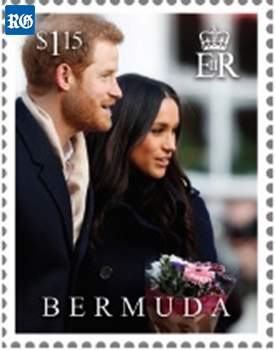
May 22. The Bermuda Post Office has issued commemorative stamps to commemorate the wedding of the Duke and Duchess of Sussex. Three stamps have been produced, priced at 50 cents, $1.15 and $1.35. The stamps feature Prince Harry and his new wife, American actress Meghan Markle, in official photographs taken in the grounds of Kensington Palace, London. The couple exchanged vows at Windsor Castle on Saturday at a wedding attended by celebrities and royals from around the world.
1976. March 29. The Bermuda Post Office issued this set of stamps and First Day Cover to mark the 50th anniversary of the Bermuda Biological Station.
2018. December 20. Bermuda’s wartime air heroes were honored with a special stamp series issued to mark the 100th birthday of the Royal Air Force. The four stamps from the Bermuda Post Office highlight Rowe Spurling, who fought in the First World War, and Geoffrey Osborn, Hugh Watlington and Alan “Smokey” Wingood, who served in the Second World War. Major Ben Beasley, Second in Command of the Royal Bermuda Regiment and a former RAF officer, said Bermuda made significant contributions to the war efforts in the air. He said: “It’s great to see the Bermuda Post Office honour our airman veterans, especially as this year marks not only the 100th birthday of the RAF, but also the end of the First World War, when airpower became a significant force for the first time.
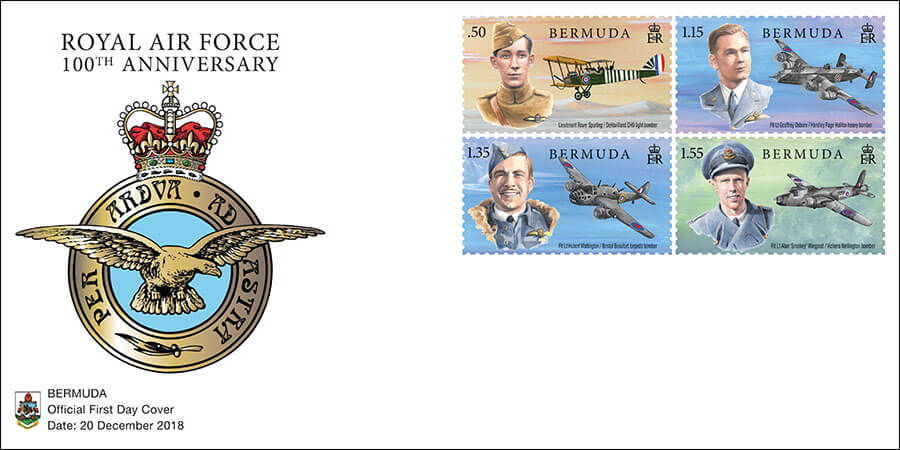
It is a fitting tribute to their service and sacrifice.” Horst Augustinovic, who sits on the stamp design advisory committee, said authorities in Britain had sent some designs to commemorate the anniversary, but none had a Bermuda theme. He added that the committee decided to come up with designs that reflected the island’s contribution to the RAF. Mr Augustinovic said: “They submitted some proposals, but they were all British planes. There was really no specific Bermuda connection. I thought with Bermuda having produced a number of pilots who flew in both world wars, we could Bermudianise it.”
He said he had met three of the pilots highlighted on the stamps while the fourth, First World War pilot Mr Spurling, had created a fascinating career. Mr Augustinovic added: “It was not just by the story of how he became an ace by absolute chance — he was lost, he tried to land in a German airfield and they didn’t see him because of the sun and he managed to shoot down five planes and become an instant ace. He was also an intriguing fellow in the Second World War. He was ferrying flying boats from Catalina to England, but he got involved as a contraband officer and he often made hilarious comments in his reports.” Mr Augustinovic said he knew Mr Osborn, who was a top pilot and fellow stamp collector honored for risking his life to pull injured crew members from a crashed bomber. He added that Mr Watlington and Mr Wingood both made a name for themselves outside of combat. Mr Augustinovic said he had spoken to relatives of the late pilots, who were excited to see their wartime heroics immortalized. He said: “I think stamps are a good way to recognize their contributions because they are permanent. They will for ever be in catalogues and collections worldwide.” Major Beasley also highlighted the contributions of RAF Flying Officer Grant Ede, the first Bermudian to die in the Second World War, and Airman Philip Lamb, who continued to serve even after he was injured in an air raid. He said: “The harrowing experiences that those who served in the RAF will never been known to most, yet we live in a free world because of what they gave, along with their sailor and soldier counterparts. Little remains in Bermuda of our contrition to the war in the skies save for some graves in the West End, a dilapidated building on Darrell’s Island, and the RAF ensign that flies at the Cenotaph.” Major Beasley added: “I am extremely proud to be a Royal Bermuda Regiment officer and a former RAF officer, and I hope that in some small way my duties can honour the important role my country and my countrymen played in the darkest of times.” The RAF was formed in 1918 by a merger of the British Army’s Royal Flying Corps and the Royal Naval Air Service. About 20 Bermudians flew in the First World War, and another 80 were trained at the Bermuda Flying School during the Second World War. Many of the island-trained pilots joined the RAF, while others flew spotter aircraft for the Royal Artillery or signed up with the Royal Canadian Air Force. Four Bermudian veterans will be featured on the Royal Air Force anniversary stamps.
2019. January 23. The historic Perot Post Office on Hamilton’s Queen Street reopened yesterday after a major refurbishment. Walton Brown, the Minister for the Cabinet Office, said the renovated post office will now be the home of the Bermuda Philatelic Bureau, which used to be housed in the General Post Office on Church Street. Mr Brown said: “We view the philatelic bureau’s relocation as a natural transition, as Perot Post Office is considered one of Bermuda’s most iconic historical visitor attractions. We anticipate that this move will result in added revenue from the purchase of special edition stamps offered by the philatelic bureau.” The minister added that stamp collection remained popular and several commemorative stamp series released last year in Bermuda were a hit. Mr Brown said: “Last year, the bureau released three popular commemorative stamp series. In March, it released the 50th Anniversary of the Bermuda Turtle Project. “In May, it released stamps commemorating the Royal Wedding of the Duke and Duchess of Sussex, and in June, the bureau issued a stamp series recognizing Bermuda’s cedar-handle bags. We’ve found that individuals who engage in the popular hobby of collecting stamps do so because it represents a piece of history, and teaches and educates about art, culture, geography, the environment, science and technology, transportation, entertainment and more. So, we expect that the philatelic bureau will prove to be a popular addition to the Perot Post Office.” Mr Brown added: “During the renovation period, we were extremely careful to ensure that the upgrades did not affect the historical building status of Perot Post Office. We are pleased with the outcome, and are also pleased to officially reopen the Perot Post Office with the new addition of the Philatelic Bureau.”
2019. February 21. Four Bermuda National Trust properties are featured in commemorative stamps issued by the Bermuda Post Office.

Waterville in Paget, Devondale in Devonshire, Springfield in Sandys and Bridge House in St George’s are pictured on the stamps which can be purchased at Perot Post Office. The Bermuda National Trust was established in 1970 to preserve Bermuda’s natural, architectural and historic treasures and to encourage public appreciation of them. It is the steward for 82 properties including three museums, more than 277 acres of open space and 15 cemeteries.
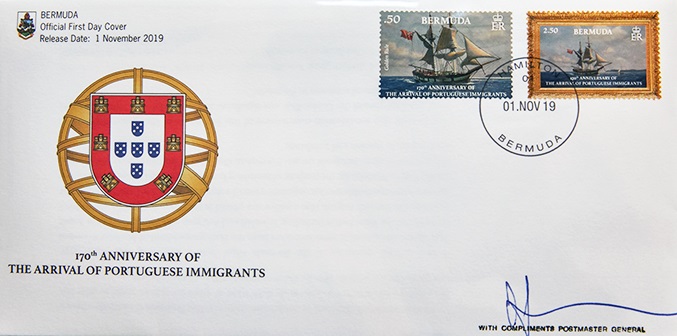 2019. November 1. A set of
stamps were released today to celebrate the 170th anniversary of the first
Portuguese immigrants to Bermuda. Wayne Furbert, the Cabinet Office
minister, said: “The stamp series is modeled after the portrait of the ship,
the Golden Rule, which delivered the first Portuguese immigrants to Bermuda in
1849.” Mr Furbert explained “History shares that the first group of
immigrants arrived in Bermuda on November 4, 1849, with 58 individuals,
consisting of 35 men, 16 women and seven children. The historic and considerable
contribution of this first group of Portuguese immigrants from Madeira aboard
the Golden Rule was significant — the creation of sustainable and successful
agricultural economy in Bermuda." Mr Furbert was speaking as he unveiled
the stamps at the historic Perot Post Office in Hamilton’s Queen Street
yesterday. He said: “Today, our island derives great benefit economically,
socially and politically from the contribution of Bermudians of Portuguese
descent whose ancestors arrived on the island, not only from Madeira but also
from mainland Portugal and the Portuguese islands of the Azores and Cape Verde.
This government and the Bermuda Post Office is pleased and honoured to celebrate
this historical milestone.” Andrea Moniz-DeSouza, the Honorary Consul of
Portugal, who was presented with a set of the stamps, said the announcement of a
national holiday on Monday to mark the anniversary was “an immense honour”
for the Portuguese community. She added: “This is an extra-special honour for
us. Thank you to the community, thank you to all the Bermudians for recognizing
us, that we’re part of you also. I think that’s one of the major themes for
us — is making Bermudians of all cultures, nationalities, backgrounds realise
we’re all one, and we should be able to celebrate each other and where we come
from.” Susan Moore-Williams, the acting Postmaster General, said: “This
presentation in respect of the 170th anniversary of the arrival of the first
Portuguese immigrants in Bermuda could not be held in a more fitting place. This
is the Perot Post Office, which itself is very historic and it is, of course,
the home of the Philatelic Bureau. When we think about stamps in the post
office, this is our glamorous side, because stamps are not only wonderful in
terms of their intrinsic value for stamp collectors, but they’re also
beautiful and colourful and they tell a lot about the history of Bermuda.” She
added: “There’s something for everyone because, in respect of the images of
our stamps, we also have a lot of what we call philatelic retail items. Those
items are things such as tea towels, coasters, we have notebooks, we have
greeting cards.”
2019. November 1. A set of
stamps were released today to celebrate the 170th anniversary of the first
Portuguese immigrants to Bermuda. Wayne Furbert, the Cabinet Office
minister, said: “The stamp series is modeled after the portrait of the ship,
the Golden Rule, which delivered the first Portuguese immigrants to Bermuda in
1849.” Mr Furbert explained “History shares that the first group of
immigrants arrived in Bermuda on November 4, 1849, with 58 individuals,
consisting of 35 men, 16 women and seven children. The historic and considerable
contribution of this first group of Portuguese immigrants from Madeira aboard
the Golden Rule was significant — the creation of sustainable and successful
agricultural economy in Bermuda." Mr Furbert was speaking as he unveiled
the stamps at the historic Perot Post Office in Hamilton’s Queen Street
yesterday. He said: “Today, our island derives great benefit economically,
socially and politically from the contribution of Bermudians of Portuguese
descent whose ancestors arrived on the island, not only from Madeira but also
from mainland Portugal and the Portuguese islands of the Azores and Cape Verde.
This government and the Bermuda Post Office is pleased and honoured to celebrate
this historical milestone.” Andrea Moniz-DeSouza, the Honorary Consul of
Portugal, who was presented with a set of the stamps, said the announcement of a
national holiday on Monday to mark the anniversary was “an immense honour”
for the Portuguese community. She added: “This is an extra-special honour for
us. Thank you to the community, thank you to all the Bermudians for recognizing
us, that we’re part of you also. I think that’s one of the major themes for
us — is making Bermudians of all cultures, nationalities, backgrounds realise
we’re all one, and we should be able to celebrate each other and where we come
from.” Susan Moore-Williams, the acting Postmaster General, said: “This
presentation in respect of the 170th anniversary of the arrival of the first
Portuguese immigrants in Bermuda could not be held in a more fitting place. This
is the Perot Post Office, which itself is very historic and it is, of course,
the home of the Philatelic Bureau. When we think about stamps in the post
office, this is our glamorous side, because stamps are not only wonderful in
terms of their intrinsic value for stamp collectors, but they’re also
beautiful and colourful and they tell a lot about the history of Bermuda.” She
added: “There’s something for everyone because, in respect of the images of
our stamps, we also have a lot of what we call philatelic retail items. Those
items are things such as tea towels, coasters, we have notebooks, we have
greeting cards.”
A Beginning Collection of Bar and Duplex Cancels on the Victorian Stamps of Bermuda. David R. Pitts. Mimeo; May 1998. [58 pp.]
A Study of the Printings of the King George VI Key-Type High Values of Bermuda, Leeward Islands & Nyasaland. Eric P. Yendell. Study paper no. 13. King George VI Collectors Society, 1983; 21 pp.
Air Mails of Bermuda. Norman C. Baldwin. Sutton Coldfield, U.K, F.J. Field, 1967. [16 pp.].
Bermuda. Henry R. Holmes. London, H.F. Johnson, 1932; 93 pp.
Bermuda, 1938-53, 1/- to £1: Inferences from the Crown Agents' Records. Study paper no. 2. King George VI Collectors Society, 1973; 16 pp. Originally published as whole number 74 of Geosix.
Bermuda: A Study of the King George VI High Value Definitives - 12/6 Perf. 14. Wilson C. K. Wong. Study paper no. 14. King George VI Collectors Society, 1989; 46 pp.
Bermuda by Air: A Handbook and Catalog of Bermuda Philately. Charles E. Cwiakala. Edited by R.W. Dickgiesser. Killen, Ala., Bermuda Catalog Project, 1996, xiv+141 pp.; bibliography.
Bermuda King George VI High Values: A Guide to the Flaws and Printings. Robert W. Dickgiesser. Weston, Mass., Triad Publications, 1980, 59 pp.; bibliography.
Bermuda Mails to 1865; An Inventory of the Postal Markings. Michel Forand and Charles Freeland. Monograph no. 13. British Caribbean Philatelic Study Group, 1995; 128 pp.; bibliography, index.
Bermuda: The 1910-36 "Ship" Type Stamps. M. H. Ludington. London, Junior Philatelic Society, 1955; 35 pp.
Bermuda: The Half-Penny on One Penny Provisional of 1940. {Study paper no. 9] King George VI Collectors Society, 1976; 11 pp. Published as whole number 93 of Geosix.
Bermuda: The Handstruck Stamps and Cancellations. Robson Lowe, 1956. London, 45 pp.
Bermuda: The Post Office, Postal Markings and Adhesive Stamps. Robson Lowe, 1962. London, 297 pp. + 51 plates. A 4-page list of "Addenda and Corrigenda" was published in 1966. Supplement. London, Robson Lowe, 1968; 38 pp. + 14 plates.
First flights of Bermuda and British Caribbean FAM Routes. Charles E. Cwiakala. [Monograph no. 3]. British Caribbean Philatelic Study Group, ca. 1982; [35 pp.]. Reprinted from the British Caribbean Philatelic Journal.
Head-plate flaws of the King George VI high values of Bermuda, Leeward Islands, and Nyasaland. Interim report no. 2. King George VI Collectors Society, May 1970; 25 pp.
King George VI Large Key Type Stamps of Bermuda, Leeward Islands, Nyasaland. Robert W. Dickgiesser and Eric P. Yendall. Weston, Mass., Triad Publications, 1985, 183 pp.; bibliography.
Regular Sea Communications with Bermuda to 1914. Reprinted from Bermuda Historical Quarterly, 1979; iv+8 pp.
Stamps from the Bermuda Prize Court Sale. Kasimir Bileski. Canada ca. 1949, 11 pp.
Study of the head-plate flaws of the George VI high values of Bermuda, Leeward Islands and Nyasaland. Edwin H. Folk. Interim report. Philadelphia, August 1968, 7 pp.
The Airmails of Bermuda, 1925-1989: A Specialized Catalogue and Illustrated Price List. William J. Clark. Greenwich, Conn., Havemayer Press, 1990; [68 pp.]. Second edition revised and augmented, 1991 [76 pp.]. Third edition, revised and augmented, 1992.
The Bermuda Packet Mails and the Halifax-Bermuda Mail Service, 1806 to 1886. Dr. Jack (John) C. Arnell and Morris. H. Ludington. Postal History Society, 1989, 103 pp. Includes annual tables showing dates of departure and arrival of each packet and mail boat at its various ports of call.
The Development of the Transatlantic Mail Service to Bermuda. Dr. Jack (John) C. Arnell. Offprint from Bermuda Journal of Archaeology and Maritime History. 1989. 18 pp. [pages 25 to 42.
The Encyclopedia of British Empire Postage Stamps. Volume 5, part 5; Bermuda and British Honduras. Robson Lowe. London, Robson Lowe, 1973; 128 pp.
The Furness Line to Bermuda. M. H. Ludington and Michael R. Rego. Monograph no. 11, British Caribbean Philatelic Study Group, 1991; 60 pp.
The King George V High-Value Stamps of Bermuda. Myles Clazer. Marblehead, Mass., Calaby Publishers, 1994; xv+208 pp.; bibliography; index
The King George VI issue for Bermuda - the 1/2d to 1/6 values: an attempt to examine and evaluate new evidence. Frank R..Saunders. King George VI Collectors Society, 1970; 16 pp.
The Postal History of Blockade Running through Bermuda, 1861-1865. Monograph no. 14. British Caribbean Philatelic Study Group, 1966; iii+47 pp.; 2 indexes
The Postal History of Bermuda. Edward B. Proud. E.B. Proud Ltd., 2003; 432 pp..
The Postal History and Postage Stamps of Bermuda. Lawrence, Mass., Quarterman, 1978; 446 pp.; index.
The Postage Stamps of Bermuda. Bertram W. H. Poole. W.E.P. philatelic handbook no. 7. London, D. Field, 1911; 39 pp.
The Royal Mail Steam Packets to Bermuda and the Bahamas, 1942-1859. M. H. Ludington and Geoffrey A. Osborn. London, Robson Lowe, 1971; 26 pp. + 7 loose maps.
West Indian Censorship Devices. Handbook no. 2. Geoffrey G. Richie. Harrogate, U.K., Roses Caribbean Philatelic Society, 1977; 105 pp. In addition to Bermuda, contains articles on Bahamas, Barbados (revised), British Guiana (revised), British Honduras, Cayman Islands (revised), French West Indies, Grenada (revised), Jamaica (revised), Leeward Islands, St. Lucia (revised), and St. Vincent.
To which all enquiries re postal stamps should be made
The Philatelic Bureau, Bermuda General Post Office, 56 Church Street, Hamilton HM 12. Bermuda. E-mail Email philatelic@gov.bm. Telephone: (441) 297-7893.
Advises the Bermuda Government's General Post Office on what stamps should be issued and when. See under alphabetical order in Bermuda Government Boards.


Banner.jpg)
Authored,
researched, compiled and website-managed by Keith A. Forbes.
Multi-national © 2020. All Rights Reserved